


Your team just committed to delivering 3 major initiatives by year-end, but 6 weeks in, you’re already seeing the warning signs: scope creep, missed milestones, and that familiar feeling that things are slipping through the cracks. The difference between projects that deliver and those that struggle often comes down to structure — a project lifecycle framework that guides work from initial concept through successful completion.
This guide breaks down the 5 core phases every successful project needs, helps you choose the right lifecycle model for your specific challenges, and shares practical ways to scale these approaches across your entire organization. You’ll discover techniques for managing phase transitions, coordinating cross-functional teams, and leveraging platforms that make lifecycle management seamless rather than bureaucratic.
Try monday.comKey takeaways
- Move through initiation, planning, execution, monitoring, and closure with defined deliverables and gates at each phase to keep projects on schedule and within scope.
- Set specific, measurable criteria for each phase transition so stakeholders can objectively evaluate progress and authorize advancement before problems compound.
- Match predictive approaches to stable requirements, iterative methods to evolving needs, and adaptive frameworks to uncertain environments for optimal results.
- Create consistent lifecycle approaches across your organization to capture proven practices, reduce startup time, and enable knowledge sharing between project teams.
- Dashboard capabilities aggregate data from across projects, enabling leaders to spot bottlenecks and make informed decisions without digging through reports.
What is the project lifecycle?
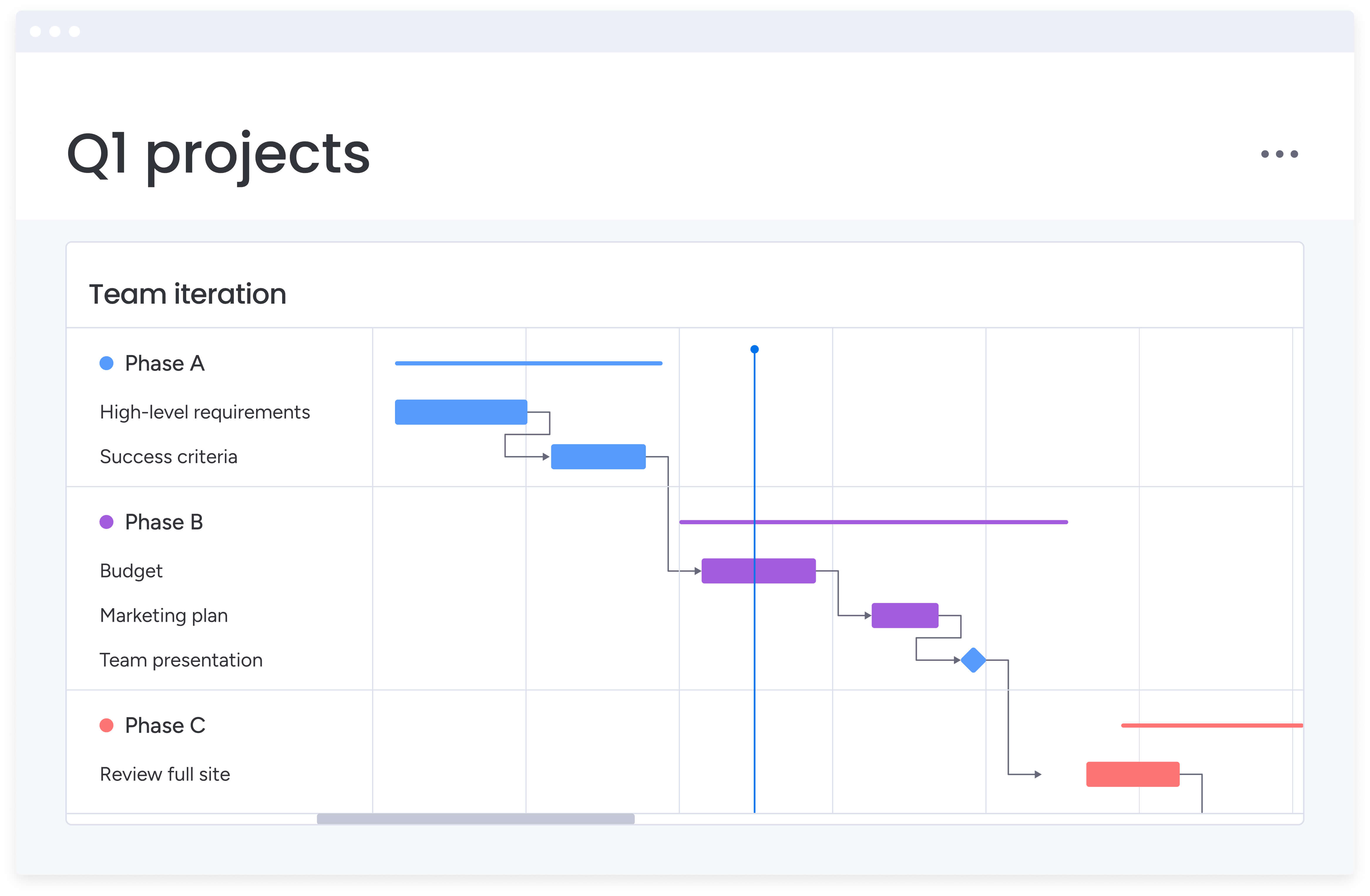
Think of the project lifecycle as your roadmap from concept to completion. It’s the structured framework that helps teams organize work, make critical decisions, and track progress as they transform ideas into tangible results.
Every project moves through distinct phases that require different activities, stakeholders, and success criteria. The lifecycle framework creates predictable transition points where teams assess progress, validate direction, and decide whether to proceed to the next phase.
Organizations that implement structured lifecycle management gain transparency that enables stronger decision-making at all levels. In fact, according to McKinsey research, 79% of operating‑model redesigns were completed and implemented when using structured governance approaches, with 63% meeting most objectives and improving performance. When projects follow consistent phases with defined deliverables and gates, leaders can quickly assess status, identify problems, and allocate attention where it’s needed most.
Understanding the project lifecycle framework
A project lifecycle framework consists of structured phases that organize work into manageable segments with defined boundaries and objectives. Each phase represents a distinct period of focus with specific deliverables that must be completed before the project advances. The framework creates natural checkpoints, called phase gates, where stakeholders review progress and authorize continuation.
When these elements work in harmony, they create predictability your entire organization can count on. Teams understand their exact deliverables, approval timelines, and what success looks like before moving forward.
| Component | Definition | Purpose |
|---|---|---|
| Phases | Distinct periods of work with specific objectives and deliverables | Group related activities and create logical progression through the project |
| Gates | Decision points between phases where stakeholders evaluate deliverables and authorize advancement | Prevent premature progression and ensure quality standards are met |
| Deliverables | Tangible outputs that demonstrate phase completion | Create accountability and enable objective progress measurement |
Key elements of lifecycle management
The following elements form the foundation of successful lifecycle management:
- Phase transition criteria: Specific, measurable standards that define when a phase is complete and the project is ready to advance
- Stakeholder engagement patterns: Defined roles and involvement levels for different stakeholder groups across phases
- Documentation requirements: Standardized artifacts that capture decisions, rationale, and outcomes at each phase
- Success metrics: Phase-specific measures that indicate whether objectives are being met
- Change management processes: Structured approaches for evaluating and incorporating changes without disrupting lifecycle progression
Project lifecycle vs. SDLC
Project lifecycle and Software Development Life Cycle (SDLC) are frequently confused because both describe phases of work progression. However, they serve different purposes and apply to different contexts.
| Project lifecycle | SDLC | |
|---|---|---|
| Scope | Applies to any project across all industries and domains | Specific to software development projects |
| Primary focus | Managing work progression from initiation through closure | Designing, building, testing, and deploying software |
| Phase emphasis | Governance, stakeholder management, and business value delivery | Technical activities like requirements analysis, coding, and testing |
| Typical duration | Varies widely based on project type and complexity | Often iterative with shorter cycles |
| Deliverables | Business outcomes, strategic objectives, and varied outputs | Software products, code, and technical documentation |
The 5 phases of the project lifecycle
Whether you’re launching a product, planning an event, or building software, the 5-phase lifecycle model gives you a proven structure that works. Each phase naturally builds on what came before, creating a clear path from initial idea to successful delivery. Understanding each phase enables teams to allocate resources appropriately and maintain momentum throughout the project journey.
Phase 1: Project initiation
Initiation is where you build your foundation by answering 2 critical questions: What are we trying to accomplish, and is it worth doing? During this phase, you’ll turn a rough concept into a formally approved project with clear boundaries, goals, and stakeholder buy-in. Key initiation activities include developing the business case, identifying stakeholders, assessing feasibility, creating the project charter, and recognizing major risks.
Typical deliverables from this phase include:
- Project charter: The formal document that authorizes the project, names the project manager, and grants authority to allocate resources
- Stakeholder register: A comprehensive map of all individuals and groups who will be affected by or can influence the project
- Preliminary scope statement: An initial definition of what the project will and won’t include
Phase 2: Project planning
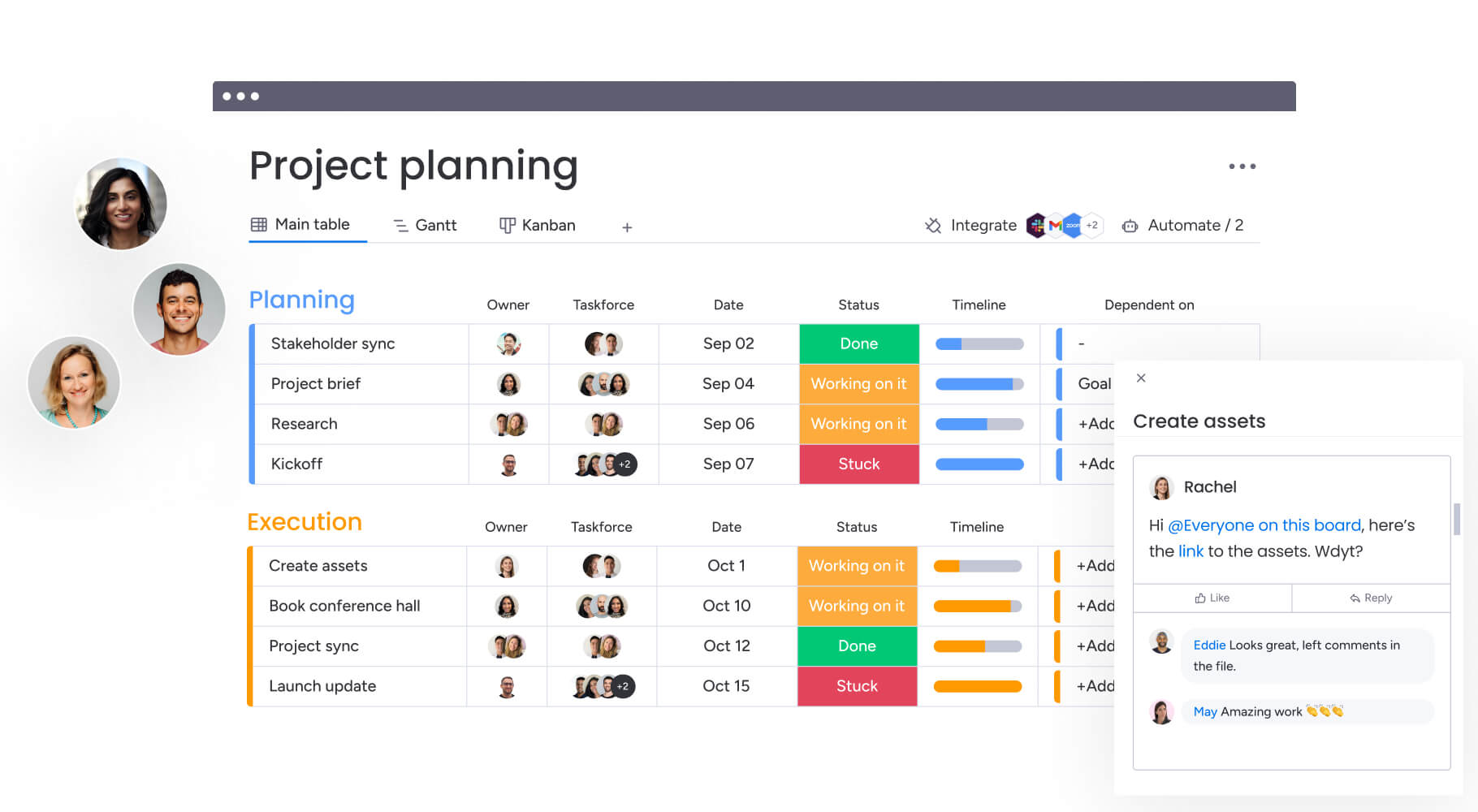
In the planning phase, you’ll transform your approved concept into a detailed roadmap everyone can follow. This is where you nail down the how, who, when, and what of your project, creating the blueprint that will guide your team through execution. What separates successful projects from struggling ones often comes down to planning quality.
Essential planning activities include:
- Scope definition: Breaking down deliverables into detailed work packages and establishing boundaries for what’s included and excluded
- Schedule development: Sequencing activities, estimating durations, and creating timelines that show when work will occur
- Resource allocation: Identifying and assigning people, equipment, materials, and budget to project activities
- Risk planning: Analyzing identified risks, assessing their probability and impact, and developing response strategies
- Communication planning: Defining what information stakeholders need, how often they’ll receive it, and through what channels
Core planning deliverables include the project management plan, schedule baseline, budget baseline, and risk register.
Phase 3: Project execution
Execution is where the rubber meets the road — your team rolls up their sleeves and brings plans to life. This phase typically consumes most of your budget and resources, but it’s also where you create the deliverables your stakeholders are counting on.
Key execution activities include:
- Work coordination: Directing and managing team members as they complete assigned activities
- Deliverable creation: Producing the outputs defined in the scope, whether they’re products, services, documents, or other results
- Quality assurance: Implementing planned quality processes to ensure work meets standards
- Team development: Building skills, improving collaboration, and enhancing team performance throughout execution
- Stakeholder engagement: Keeping stakeholders informed, addressing concerns, and managing expectations as work progresses
Teams using monday.com gain execution visibility through shared workspaces where team members coordinate activities, update progress, and communicate status. Integrations with tools like Microsoft Teams, Gmail, Slack, and Jira enable teams to run projects without switching tabs.
Phase 4: Monitoring and control
While execution is happening, monitoring and control runs alongside it — like a co-pilot watching the instruments while you fly the plane. You’re constantly comparing actual performance against your plan, spotting issues early, and making smart adjustments before small problems become major obstacles.
These activities help teams detect issues early and correct course before problems escalate:
| Monitoring activity | What it measures | Why it matters |
|---|---|---|
| Performance measurement | Actual progress vs. planned baselines | Enables objective assessment of project health |
| Variance analysis | Differences between planned and actual performance | Reveals root causes and informs corrective actions |
| Change control | Impact of requested changes | Maintains project integrity while allowing necessary adaptations |
| Issue resolution | Problems arising during execution | Prevents delays and maintains momentum |
Phase 5: Project closure
Closure is your project’s finish line — where you wrap up final details, hand off deliverables, and document what you’ve learned. Many teams rush through this phase (or skip it entirely), but that’s a mistake. Proper closure ensures your organization captures valuable insights and frees up resources for the next big initiative.
Audits repeatedly show that incomplete project closeout exposes organizations to financial, compliance, and operational risk — reinforcing the importance of formal closure.
Essential closure activities include:
- Deliverable handoff: Transferring completed outputs to customers or operational teams who will use or maintain them
- Contract closure: Completing all contractual obligations and formally closing vendor relationships
- Resource release: Formally releasing team members, equipment, and other resources so they can be allocated to other work
- Documentation archiving: Organizing and storing project records for future reference or compliance purposes
- Lessons learned capture: Documenting what went well, what didn’t, and what should be done differently in future projects
Proper closure creates a clean transition from project work to operational support or the next initiative. It ensures that investments made during the project continue to deliver value after the project team disbands.
Get it now: Project closure template
Try monday.comProject lifecycle management roles and responsibilities
![What is Project Management? The Complete Guide [2025]](https://res.cloudinary.com/monday-blogs/fl_lossy,f_auto,q_auto/wp-blog/2020/12/WM_Boards_3-1-scaled.jpg) Effective lifecycle management depends on clear ownership — not micromanagement. Each role contributes at different points in the lifecycle, with defined responsibilities that prevent confusion, duplication, and stalled decisions.
Effective lifecycle management depends on clear ownership — not micromanagement. Each role contributes at different points in the lifecycle, with defined responsibilities that prevent confusion, duplication, and stalled decisions.
Rather than spreading accountability thin, successful teams align roles to lifecycle phases so decisions are made by the right people at the right time.
Project manager
The project manager owns lifecycle execution end to end. They are responsible for guiding the project through each phase, ensuring deliverables meet defined criteria, and maintaining momentum as the project evolves.
Across the lifecycle, the project manager:
- Defines scope, success criteria, and constraints during initiation
- Builds and maintains plans during planning
- Coordinates work and resolves blockers during execution
- Tracks performance and manages changes during monitoring and control
- Ensures proper project handoff and documentation during closure
Their role is not to do all the work, but to orchestrate it — balancing timelines, resources, risks, and stakeholder expectations throughout the project.
Executive sponsor
Executive sponsors provide strategic oversight and authority at critical moments. Their involvement is highest at lifecycle gates, where decisions about funding, priority, and continuation are made.
Sponsors are responsible for:
- Approving the business case and success metrics
- Resolving escalated issues that exceed the project manager’s authority
- Confirming continued alignment with organizational priorities
Clear sponsor engagement prevents projects from drifting or continuing after they no longer deliver strategic value.
Project team members
Project team members execute the work defined in the plan. Their responsibilities evolve as the project progresses, but always center on delivering quality outputs and surfacing risks early.
Team members:
- Contribute expertise during planning
- Own assigned deliverables during execution
- Provide status updates and input during monitoring
- Support knowledge transfer during closure
Visibility into dependencies and expectations is critical to keeping cross-functional teams aligned.
Stakeholders
Stakeholders influence or are affected by the project’s outcomes. While they are not involved in day-to-day execution, their input and approval are essential at key lifecycle points.
Effective stakeholder management means:
- Involving stakeholders early during initiation
- Aligning expectations during planning
- Providing targeted updates during execution
- Confirming outcomes and acceptance during closure
Lifecycle structure ensures stakeholder engagement is intentional — not reactive.
Supporting roles
Depending on project complexity, additional roles may support lifecycle execution, including business analysts translating requirements into actionable work, technical leads guiding solution design and feasibility, and quality assurance ensuring deliverables meet defined standards.
These roles integrate into the lifecycle as needed, without diluting ownership.
Why this matters: When roles are clearly mapped to lifecycle phases, teams move faster, decisions happen earlier, and accountability stays intact — even as projects scale.
How to choose the right project lifecycle model
Different lifecycle models give you various ways to organize and sequence your work. They all cover similar ground, but what sets them apart is phase flexibility, how much upfront planning they require, and how easily they adapt when things change.
4 types of project lifecycle models
The model you choose shapes how your team works, adapts to change, and delivers results. Here’s how the 4 main approaches compare:
| Lifecycle model | Core approach | Best suited for | Common use cases |
|---|---|---|---|
| Predictive (Waterfall) | Sequential, phase-by-phase execution | Stable, well-defined requirements | Construction, manufacturing, compliance |
| Iterative | Repeating cycles with incremental refinement | Partially known requirements | Product development, process improvement |
| Adaptive (Agile) | Short iterations with frequent change | Uncertain, fast-changing environments | Software, digital initiatives |
| Hybrid | Mix of predictive and adaptive methods | Projects with both stable and evolving elements | Digital transformation, enterprise programs |
Benefits of structured project lifecycle management
Teams that embrace structured lifecycle management consistently outperform those winging it with ad hoc approaches. The payoff goes well beyond just delivering projects successfully – it creates strategic advantages that benefit your entire portfolio and organization.
- Enhanced project visibility and control: Real-time dashboards in monday.com aggregate data across all projects, presenting it in visual formats that make status immediately visible. Leaders can drill down from portfolio views to individual project details without requesting special reports.
- Proactive risk management: monday.com’s Portfolio Risk Insights scans all project boards, quickly flagging potential risks by severity. Teams can spot critical issues at a glance without manually combing through data.
- Optimized resource utilization: Workload views in monday.com show who’s assigned to what and when. Overallocation is immediately visible, enabling proactive rebalancing before conflicts cause delays.
- Strategic business alignment: Organizations using monday.com track progress towards strategic objectives through goals and OKRs integrated into project boards. Dashboards show how each project contributes to strategic outcomes.
Understanding these benefits helps leaders justify investment in lifecycle management capabilities and measure their impact on organizational performance.
Try monday.com7 best practices for project lifecycle excellence
To get the most from lifecycle management, you need to consistently apply a few key practices that have proven their worth. Master these approaches and you’ll sidestep the common traps that derail projects while delivering more predictable results. The following best practices represent the most impactful approaches for lifecycle excellence:
- Define phase gate criteria: Phase gates only provide value when they’re based on objective, measurable criteria. Each criterion should have a definition of what “complete” means and who verifies completion.
- Implement automated progress tracking: Manual status collection is time-consuming and often outdated by the time it’s compiled. Automated tracking captures actual completion dates and deliverable status as work happens, eliminating the delay that occurs when team members manually report progress.
- Establish continuous stakeholder communication: Lifecycle management fails when stakeholders are surprised by project status or decisions. Different phases require different communication patterns.
- Create reusable lifecycle templates: Templates capture organizational knowledge and enable consistency across projects, enabling teams to launch new projects quickly while maintaining organizational standards and incorporating proven practices.
- Monitor benefits throughout all phases: Projects exist to deliver business value, not just produce deliverables. During initiation, teams define the specific benefits the project should deliver. During execution, teams monitor leading indicators that suggest whether benefits will materialize.
- Build comprehensive documentation: Documentation serves multiple purposes. It captures decisions and rationale, enables knowledge transfer, supports future projects, and provides audit trails.
- Integrate portfolio-level insights: Individual project lifecycles contribute to broader portfolio management. Cross-project dependencies, resource capacity planning, and strategic alignment assessment all require portfolio-level visibility.
Scale project lifecycle management across portfolios with monday.com
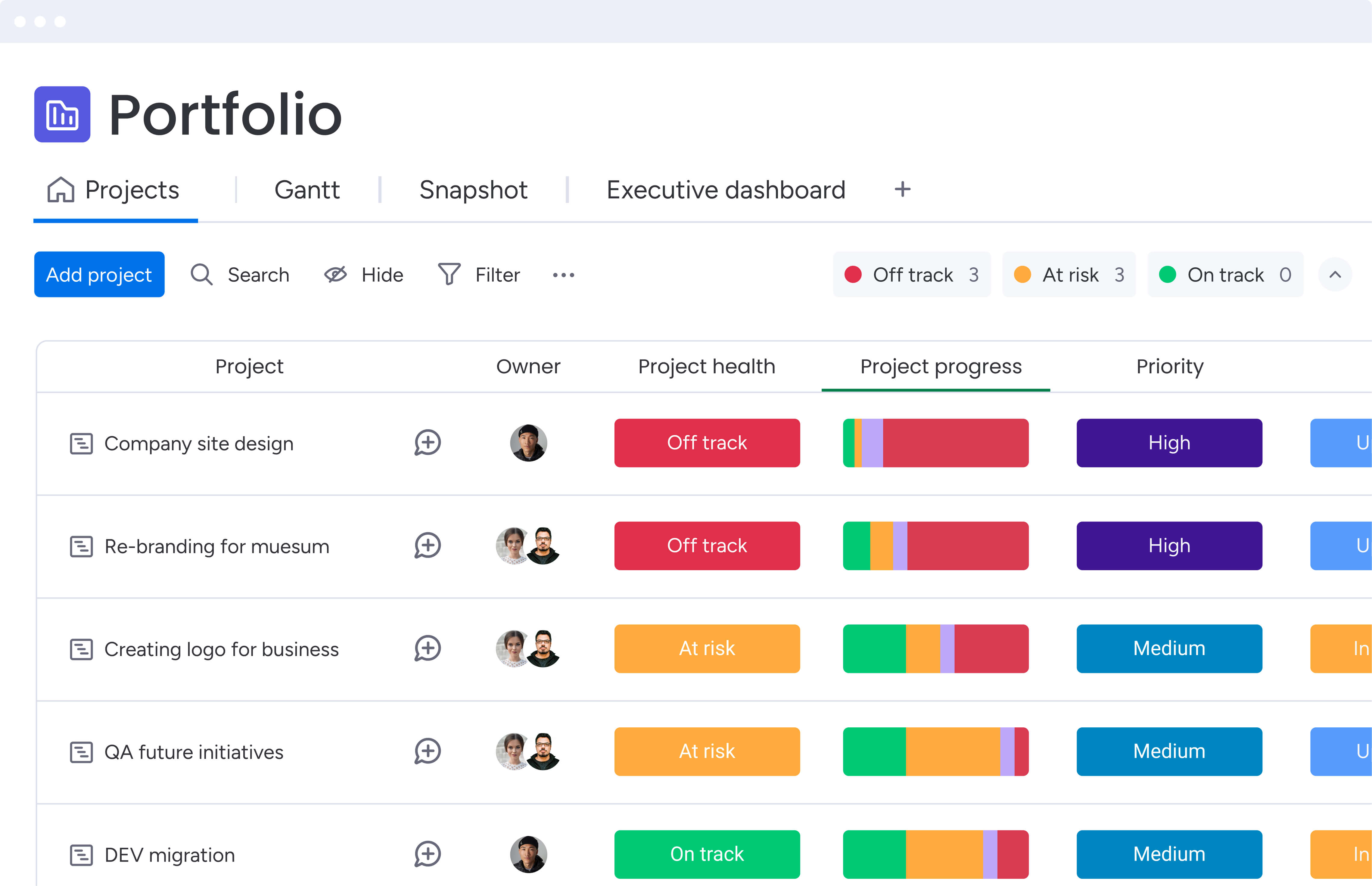
When you’re juggling dozens or even hundreds of projects at once, managing each one individually isn’t enough. You need portfolio-level lifecycle management – a way to coordinate teams, standardize approaches, and keep everything aligned with your strategic priorities. Organizations that master portfolio-level lifecycle management gain significant competitive advantages through improved resource utilization and strategic alignment.
Managing multiple concurrent lifecycles
Coordinating multiple projects simultaneously requires visibility into how projects interact and compete for resources. Dependency mapping reveals connections between projects and enables coordinated scheduling.
Portfolio-level views in monday.com show which projects are in which phases, where bottlenecks exist, and which initiatives are at risk.
Cross-project resource coordination
Resource sharing across multiple projects requires careful coordination. Real-time visibility into resource commitments across all projects prevents double-booking and unrealistic assignments.
The platform’s resource management capabilities enable organizations to plan, schedule, and allocate resources to adapt to changing priorities.
Enterprise-wide lifecycle standards
Standardized lifecycle approaches across the organization enable consistency, comparison, and knowledge sharing. Governance frameworks define which lifecycle models are appropriate for different project types. With monday.com, you get support for any function and process across the organization, with multi-level permissions that control users’ access to viewing and changing data.
AI-driven project lifecycle innovation
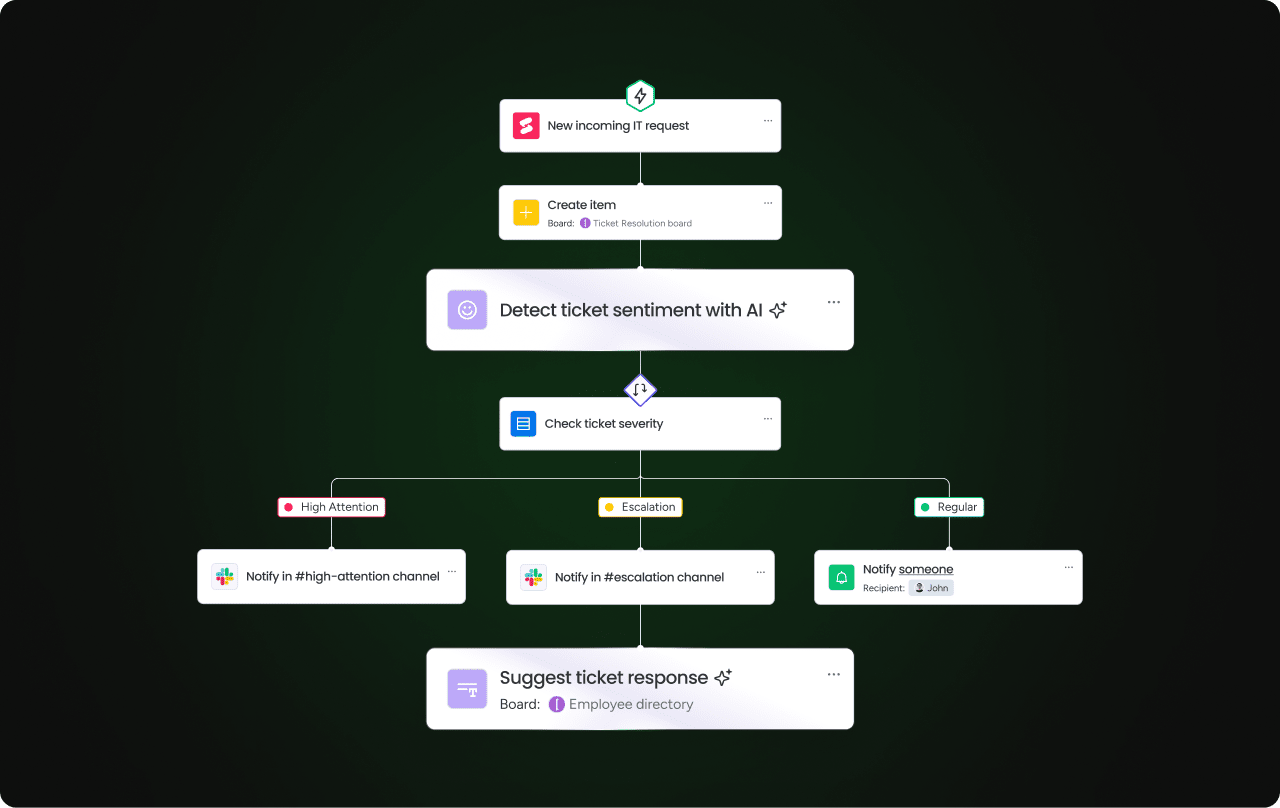 Organizations that integrate AI into their lifecycle management gain competitive advantages through faster decision-making and more accurate predictions.
- Predictive analytics for risk prevention: AI analyzes historical data and real-time indicators to predict issues before they occur, enabling project managers to focus on the highest-probability threats.
- Automated resource recommendations: AI optimizes allocation by analyzing skills, availability, and performance data. With monday.com, you can assign the right people to the right projects based on effort, level, availability, and skills.
- Real-time performance optimization: AI monitors performance and recommends adjustments as deviations occur. The Project Analyzer in monday.com flags bottlenecks and provides proactive insights to keep everything on track.
Transform your project outcomes with structured lifecycle management
A structured lifecycle approach completely changes how teams deliver results. It gives you a clear path from idea to implementation, with checkpoints that keep everyone aligned. The payoff? Lower risk, better resource use, and projects that actually deliver on your strategic goals.
The organizations that thrive in today’s complex environment are those that combine proven lifecycle principles with intelligent technology. They move beyond reactive project management to proactive orchestration that anticipates challenges and optimizes performance across entire portfolios.
This transformation is within reach with monday.com, which provides the visibility, automation, and coordination capabilities to make structured lifecycle management practical at scale. With AI-powered insights and real-time collaboration, teams execute projects with confidence while leaders maintain strategic oversight across all initiatives.
Try monday.comFAQs
What are the 5 stages of a project life cycle?
The most commonly used model includes 5 stages: initiation, planning, execution, monitoring and control, and closure. Some organizations combine execution and monitoring into a 4-phase model. Both approaches are valid as long as governance and accountability remain clear.
What is the difference between a project life cycle and a software development life cycle?
The project life cycle applies to any project across all industries and focuses on managing work from initiation through closure. Software Development Life Cycle (SDLC) is specific to software development and focuses on technical activities like coding and testing.
How long does each project lifecycle phase typically take?
Phase duration varies by project size and complexity, but typical proportions are: initiation (5-10%), planning (15-20%), execution (50-60%), and closure (5-10%). Monitoring runs parallel to execution.
Can project lifecycle phases overlap?
Project lifecycle phases can overlap, especially in iterative and agile approaches. The key is maintaining phase integrity while allowing practical overlap that improves efficiency.
What is the most important phase in project lifecycle?
All phases are important, but planning often determines overall project success because it establishes the foundation for everything that follows. Inadequate planning leads to unrealistic schedules and unidentified risks.
How do you transition between project lifecycle phases?
Phase transitions occur through formal gate reviews where stakeholders evaluate whether the project has met defined criteria and is ready to advance. Effective transitions include verifying deliverables, confirming gate criteria, and obtaining formal approval.

 Get started