


Choosing between Wrike and Basecamp means deciding between enterprise-grade project control and communication-first simplicity. Both platforms help teams manage work, but they serve fundamentally different needs. Wrike delivers structured workflows, Gantt charts, resource allocation, and AI-powered risk analysis for teams that need visibility across complex projects. Basecamp offers message boards, to-do lists, and flat-rate pricing for teams that prioritize alignment over configuration.
The difference matters because the wrong choice costs time. Teams outgrow platforms that lack the depth they need, or they abandon tools that feel too complex for their actual workflow. This comparison walks through features, pricing, integrations, and real-world fit so you can make an informed decision before committing.
Below, you will find side-by-side feature breakdowns, current pricing models, and guidance on which platform matches your team size, project complexity, and collaboration style. Whether you manage a small creative team or coordinate multi-department launches, the right platform depends on how your team works today and how you expect that work to evolve.
Key takeaways
- Wrike is generally better suited for teams that need more structured project management, reporting, resource planning, and customization
- Basecamp is generally better suited for teams that want a simple, centralized place for communication, tasks, schedules, and files
- Pricing, plan limits, integrations, storage, support, and available features can change, so teams should review each vendor’s current plan pages before deciding
- The best choice depends on your team size, project complexity, collaboration style, reporting needs, and how many workflows you want to manage in one place
- monday.com’s AI Work Platform helps teams manage projects, dashboards, automations, integrations, approvals, AI-powered workflows, and cross-functional work in one connected workspace
What is Wrike?
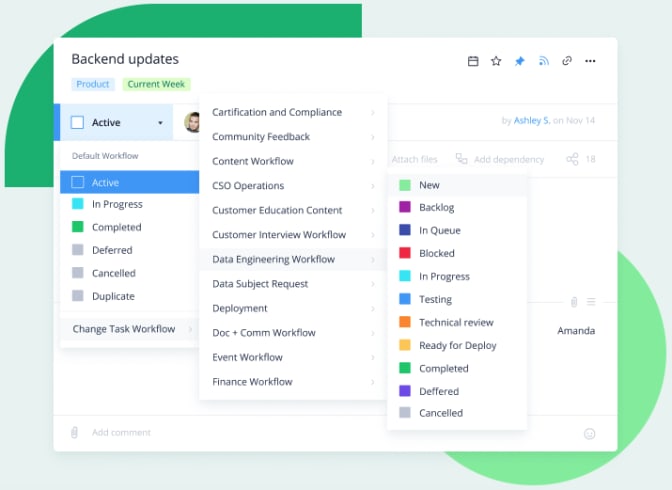
Wrike is a project management platform built for mid-to-large teams that need granular control over complex workflows. Founded in 2006 and now owned by Citrix, it positions itself as an enterprise-grade solution where visibility, accountability, and cross-departmental coordination come first.
The platform centers on structured project planning. Teams get Gantt charts with task dependencies, Kanban boards, custom workflow statuses, and a calendar view that consolidates deadlines across projects. Wrike also includes built-in proofing and approval workflows, making it popular with marketing and creative teams that manage review-heavy deliverables such as ad creatives, videos, and campaign assets.
On the AI front, Wrike offers content generation, automated task creation from project briefs, and predictive risk analysis that flags potential delays before they hit. Resource management dashboards let managers monitor team workload and reallocate capacity in real time. The platform connects to 400+ third-party applications, including Salesforce, Jira, Slack, and Adobe Creative Cloud.
Wrike’s depth comes with a tradeoff: the interface takes time to learn, and smaller teams may find the configuration options overwhelming. For a full breakdown of costs across tiers, see this Wrike pricing guide. Teams evaluating alternatives to Wrike can also explore options on this Wrike alternatives page.
What is Basecamp?
Basecamp, built by 37signals, takes a deliberately opinionated approach to project management. Instead of adding more features, the team behind Basecamp strips away complexity. The result is a communication-first platform designed for small- to mid-sized teams that value simplicity over configurability.
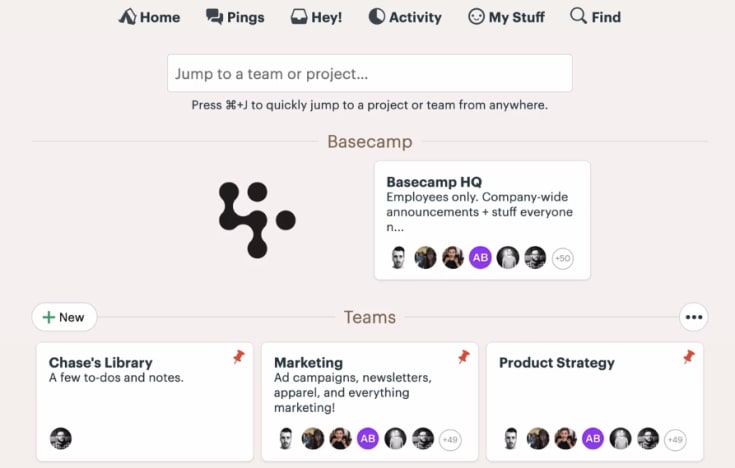
Every Basecamp project includes the same set of built-in components: message boards for long-form updates, Campfires for real-time group chat, to-do lists, a schedule, automatic check-ins that replace daily standups, and a file storage area. Recent additions include Card Table (a Kanban-style board), Lineup (a timeline view for high-level project scheduling), and Hill Charts for visualizing progress as work moves from uncertainty to completion.
Basecamp also introduced Doors, a feature that lets teams embed links to third-party applications directly within a project. This approach acknowledges that Basecamp is not trying to replace every specialized tool. It acts as a coordination layer instead. There are no Gantt charts, no resource allocation dashboards, and no built-in automations. The philosophy is that less software leads to less confusion.
That simplicity resonates with teams who feel overwhelmed by heavily configured platforms. Setup takes about 15 minutes, and there is almost no learning curve. For teams exploring alternatives, this Basecamp alternatives page offers additional options worth reviewing.
How Wrike and Basecamp features compare
What are the key differences between Wrike and Basecamp? It comes down to depth versus simplicity. Wrike gives project managers fine-grained controls: task dependencies, time tracking, resource allocation, and custom reporting dashboards. Basecamp gives teams a shared space to communicate, organize to-do lists, and stay aligned without configuration overhead. They solve different problems for different kinds of teams.
The comparison table below maps out where each platform leads, lags, or sits at parity across the most-searched project management software criteria.
| Feature | Wrike | Basecamp | |
|---|---|---|---|
| Task management | Custom statuses, subtasks, dependencies, request forms | Simple to-do lists with assignments and due dates | |
| Gantt charts | Built-in with dependencies and critical path | Not available | |
| Kanban boards | Yes | Card Table (basic Kanban) | |
| Timeline view | Gantt-based timeline | Lineup (high-level scheduling) | |
| Time tracking | Built-in (Business plan and above) | Third-party only (Harvest | Toggl) |
| Resource management | Workload charts with capacity planning | Not available | |
| Reporting and dashboards | Custom dashboards with real-time analytics | Hill Charts only | |
| Automations | Rule-based automations (Business plan+) | Automatic check-ins only | |
| Proofing and approvals | Built-in visual proofing with markup | Not available | |
| AI features | Wrike AI: content generation, task creation, risk prediction | Not available |
Wrike wins on structured project execution. Teams running multi-phase campaigns, software releases, or design team workflows benefit from Gantt dependencies, workload balancing, and approval routing that keep deliverables moving without email chains. Proofing is particularly valuable for creative teams who need stakeholder sign-off on visual assets before launch.
Basecamp wins on team communication and simplicity. Automatic check-ins remove the need for status meetings, Campfires keep informal conversations searchable, and Hill Charts offer a unique way to visualize whether work is still in the “figuring it out” phase or moving toward completion. For teams that prioritize alignment over granular tracking, this approach reduces friction and keeps everyone focused on output rather than process.
The gap is most visible in reporting and resource management. Wrike gives project managers dashboards they can customize by team, project, or date range. Basecamp offers no equivalent. Managers who need capacity data or cross-project analytics will need to supplement with external tools, adding cost and complexity to a platform that promises simplicity.
How Wrike and Basecamp pricing compare
How do Wrike and Basecamp pricing models compare? They work on fundamentally different principles. Wrike scales with your team size through per-user tiers, each unlocking additional features. Basecamp keeps pricing flat with a structure that favors larger teams willing to pay a single monthly fee regardless of headcount.
Here is how each model breaks down in practice.
| Plan | Wrike | Basecamp |
|---|---|---|
| Free | Up to five users, limited features | One project, 1GB storage |
| Entry paid tier | Team: $10/user/month | Plus: $15/user/month |
| Mid tier | Business: $25/user/month (5-user minimum) | N/A |
| Top tier | Pinnacle: custom pricing (Enterprise retired for new customers) | Pro Unlimited: $299/month flat (unlimited users) |
The math shifts depending on your team size. A 10-person team on Wrike Business pays $250/month. That same team on Basecamp Plus pays $150/month, or they can lock in Pro Unlimited at $299/month and never worry about cost increases as they hire. At 20 users, Basecamp Pro Unlimited costs $14.95 per person, which undercuts both Wrike Team and Basecamp’s own per-user plan. At 50 users, the effective per-person cost drops to $5.98/month.
Wrike offers more granular feature gating. Time tracking and advanced automations unlock at the Business tier. Resource management and proofing require Business or above. Basecamp takes the opposite approach: every feature is available on every paid plan. The difference is storage (500 GB on Plus versus 5 TB on Pro Unlimited) and support priority.
How does your team size affect total cost? For growing companies expecting to double headcount within a year, Basecamp Pro Unlimited provides cost predictability that per-seat models cannot match. For lean teams under 10, Wrike’s Team plan at $10/user/month may deliver more features at a comparable total cost.
For teams comparing project management options alongside other platforms, the monday.com pricing page provides a clear breakdown of plans for monday.com’s AI Work Platform, with paid plans starting at $9 per seat/month.
Get started with monday.comWhich tool is easier to set up and use?
Basecamp’s onboarding is almost frictionless. A new team can sign up, create a project, and start posting messages within 15 minutes. There is no configuration layer: no custom fields to define, no workflow statuses to build, no permissions matrix to set up. Every project comes with the same structure, including a message board, to-dos, schedule, chat, files, and check-ins. That uniformity eliminates decision fatigue during setup.
Wrike’s learning curve is steeper by design. The platform offers custom workflows, folder hierarchies, request forms, dashboards, and granular permission controls. New teams often need a week or more to configure spaces, define statuses, and train members on navigation. Wrike offers deployment services and onboarding guides to offset this, but the initial setup investment is real. How much configuration does your team actually need? That question determines whether Wrike’s setup time pays off or simply delays productive work.
The interface philosophy reflects each platform’s priorities. Basecamp keeps navigation flat: everything lives within a project page, and there are few menus to drill through. Wrike’s interface rewards power users who build views, save filters, and customize dashboards, but it can feel dense for occasional users. Tools like monday.com balance this trade-off with an intuitive drag-and-drop interface that still supports advanced workflows such as automations and custom dashboards.
For teams adopting built-in features like time tracking tools, an intuitive interface reduces time-to-value significantly. When team members can start tracking hours on day one without training, adoption rates stay high, and data quality improves.
How integrations and collaboration differ
Wrike natively connects to 400+ third-party applications. The integration library covers CRM platforms (Salesforce), developer tools (Jira, GitHub), communication apps (Slack, Microsoft Teams), and creative suites (Adobe Creative Cloud). Wrike also offers an open API, allowing engineering teams to build custom integrations with internal systems.
Basecamp takes a leaner approach. Native integrations are limited, and most connections run through Zapier or the Doors feature, which embeds links to third-party tools within Basecamp projects. Doors work well for lightweight references, such as linking to a Figma file or a Google Doc, but they do not sync data across platforms. Teams relying on real-time data flow between their project management platform and CRM, accounting, or developer tools will find this limiting.
For collaboration, Basecamp’s built-in messaging and Campfires reduce the need for Slack or Teams. Wrike relies on integrations for communication rather than building its own messaging layer. Both approaches work, but they require different habits. Does your team already live inside Slack? Wrike will feel natural. Does your team want fewer tools? Basecamp consolidates communication into the project itself.
monday.com’s AI Work Platform offers native integrations and an open API, giving teams a flexible way to connect their work across tools. Teams comparing developer-focused integrations can also review this Wrike vs. Jira breakdown for additional context.
What about security and compliance?
Wrike holds SOC 2 Type II and ISO 27001 certifications, and the platform complies with GDPR requirements. Security features include role-based access controls, two-factor authentication (2FA), single sign-on (SSO), and data encryption at rest and in transit. Enterprise-tier accounts add locked spaces, audit reports, and custom access roles, features that procurement and IT teams expect during vendor evaluations.
Basecamp provides 2FA and SOC 2 compliance, with data encrypted in transit and at rest. The security model works for most small- to mid-sized teams, but Basecamp lacks the enterprise-grade controls that regulated industries require. There is no SSO, no granular permission hierarchies, and no audit logging at the platform level. Teams in healthcare, finance, or government will likely find Wrike’s compliance stack more aligned with their requirements.
How important is compliance in your vendor evaluation? For organizations evaluating either platform, security is rarely a feature you can add later. The compliance certifications and access controls available at signup often determine whether IT and procurement will approve the vendor at all. Make sure your shortlist matches your security requirements from the start.
All about customer support
Wrike provides email, chat, and phone support, with response times and access levels tied to your plan tier. Enterprise and Pinnacle accounts receive dedicated success managers, deployment services, and priority routing. Teams on lower tiers rely on email and the help center, which can mean longer wait times during peak periods.
Basecamp takes a different approach. The company staffs a human support team that aims for response times under 30 minutes. There are no chatbots, no tiered access, and no upsell-gated support. Every customer gets the same level of attention. This model works well for straightforward issues but may not scale for complex deployment questions or multi-department rollouts.
For teams where downtime can directly affect revenue, responsive support matters. monday.com’s AI Work Platform gives paid customers access to support resources designed to help teams stay unblocked across time zones, so work can keep moving when issues come up.
How monday.com compares to Wrike and Basecamp
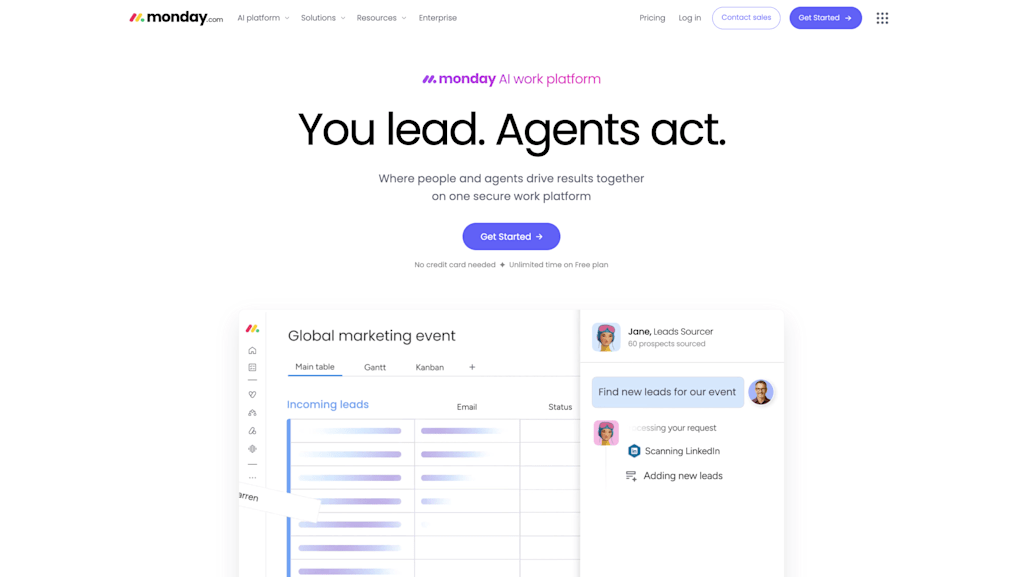
monday.com’s AI Work Platform gives teams a flexible way to manage projects, workflows, automations, dashboards, and cross-functional work in one connected workspace. While Wrike is often a strong fit for structured project management and Basecamp is built around communication simplicity, monday.com gives teams the flexibility to manage both everyday tasks and more complex workflows without forcing work into a single fixed structure.
The table below compares all three platforms across key areas that teams often evaluate when choosing project management software.
| Feature | Wrike | Basecamp | monday.com’s AI Work Platform |
|---|---|---|---|
| Task views | Gantt, Kanban, table, calendar | To-dos, cards, lineup, schedule | Multiple views, including Gantt, Kanban, timeline, calendar, chart, workload, map, and form |
| Automations | Rule-based automations, depending on plan | Limited native automation | No-code automations for reminders, status changes, assignments, approvals, and workflow updates |
| AI features | Wrike AI features for content, tasks, and risk-related support | Limited native AI capabilities | AI-powered capabilities including monday vibe, monday sidekick, monday agents, AI columns, and AI workflow builder |
| Dashboards | Custom dashboards | Hill Charts and project visibility tools | Customizable dashboards with widgets and cross-project visibility |
| Time tracking | Built-in time tracking on select plans | Typically handled through external tools | Built-in time tracking column and reporting widgets |
| Resource management | Workload and resource management capabilities | Limited native resource management | Workload view and capacity planning to help teams manage availability |
| Integrations | Broad integration library and API | More limited native integrations, with external connection options | Native integrations and an open API to connect work across tools |
| Pricing | Plan-based pricing that varies by features and users | Simple pricing structure | Plans for monday.com’s AI Work Platform start at $9 per seat/month |
| Best fit | Teams that need structured project management and reporting | Teams that want simple communication and project coordination | Teams that need flexible project management, workflow automation, dashboards, AI-powered capabilities, and cross-functional visibility |
Three differentiators stand out. First, monday.com’s AI Work Platform gives non-technical users a no-code way to automate repetitive work, from status updates and notifications to task assignments, approvals, and deadline reminders. Second, monday vibe helps teams create apps and workflows from natural language prompts, making it easier to move from an idea to a working process. Third, monday.com offers multiple project views, so teams can manage the same work as a timeline, Gantt chart, Kanban board, calendar, workload view, dashboard, or form, depending on what they need to see.
These capabilities map to common team needs:
- Marketing teams can use monday.com to manage campaigns across channels, connecting creative briefs, deliverables, owners, deadlines, and approvals in one place. Automations can notify stakeholders when assets move into review, keeping campaign work moving without manual follow-up
- Product teams can build roadmaps with timeline or Gantt views and track feature development from ideation through release using connected boards. Workload views can help managers spot capacity issues before sprint planning becomes overloaded
- Agencies can manage client work in shared workspaces, using dashboards to report on progress without rebuilding status updates manually. Each client can have a dedicated board while leadership tracks consolidated metrics across accounts
You can explore project timeline templates to see how these views translate into real workflows.
For teams already evaluating Wrike, this detailed monday.com vs. Wrike comparison digs into specific feature matchups. Additional comparisons like Wrike vs. Asana and Smartsheet vs. Wrike offer a broader context. Teams exploring a wider range of options can also browse project management alternatives.
Get started with monday.comChoosing the right project management tool for your team
The Wrike vs BNasecamp decision comes down to what your team needs most: depth or simplicity. Basecamp is the right fit for small- to mid-sized teams that want a fast setup, built-in communication, and a flat monthly cost that stays predictable as headcount grows. Wrike fits teams that need enterprise-grade project tracking with Gantt dependencies, resource allocation, proofing workflows, and compliance-ready security.
For teams that want both, monday.com delivers the visual simplicity and fast onboarding of Basecamp alongside the structured project management depth of Wrike. With no-code automations, eight+ project views, built-in AI, and pricing starting at $9/seat/month, it gives growing teams room to scale without switching platforms.
The most productive teams pick the platform that matches how they work today and adapts as that work evolves.
The content in this article is provided for informational purposes only and, to the best of monday.com’s knowledge, the information provided in this article is accurate and up-to-date at the time of publication. That said, monday.com encourages readers to verify all information directly.
Frequently asked questions
Does Basecamp have Gantt charts?
Basecamp does not offer native Gantt charts. Teams that need timeline visualization, dependencies, and more detailed project scheduling may prefer platforms with built-in Gantt views, such as Wrike or monday.com’s AI Work Platform.
Can Wrike and Basecamp be used together?
Wrike and Basecamp can be connected via third-party automation tools such as Zapier to sync specific tasks or updates. However, they do not offer a deep native integration with each other, so teams should consider whether managing both platforms would add unnecessary complexity.
Which platform is more cost-effective for small teams?
The most cost-effective option depends on team size, required features, and pricing structure. Basecamp may appeal to teams that prefer simpler pricing, while Wrike may work for teams that need structured project management features at specific plan tiers. monday.com’s AI Work Platform offers paid plans starting at $9 per seat/month, making it a flexible option for teams that want project views, automations, dashboards, and workflow management in one platform.
Does Basecamp have built-in time tracking?
Basecamp does not include native time tracking. Teams that need to track hours usually connect Basecamp to third-party tools such as Harvest or Toggl. Platforms with built-in time tracking, such as Wrike or monday.com, can reduce the need for additional setup.
How does monday.com’s AI Work Platform handle project management differently than Wrike or Basecamp?
monday.com’s AI Work Platform gives teams a flexible workspace for managing projects, workflows, dashboards, automations, integrations, and AI-powered capabilities in one place. Wrike is often stronger for structured project management, while Basecamp focuses on simplicity and team communication. monday.com gives teams a visual, customizable way to manage both everyday tasks and more complex cross-functional work.
 Get started