


Teams searching for Notion alternatives often share the same frustration: what started as a flexible workspace became an unstructured maze of nested pages, disconnected databases, and fragmented workflows. The flexibility that made Notion appealing in the first place becomes a liability when cross-functional teams need structured project tracking, real-time resource visibility, and reliable cross-departmental reporting.
The landscape of work management platforms has shifted significantly toward AI-first experiences. Where Notion introduced AI as an add-on layer, newer platforms embed autonomous AI agents, natural-language app builders, and context-aware assistants directly into operational workflows. The gap between “AI-assisted notes” and “AI-powered execution” has never been wider.
Whether your team needs deeper project management capabilities, a simpler knowledge base, or a platform that connects strategy to execution across every department, the right alternative depends on how your team actually works. Here are 12 platforms worth evaluating.
Get started with monday.comKey takeaways
- Notion is useful for flexible documentation and lightweight databases, but growing teams often need more structure for project tracking, reporting, ownership, and cross-functional execution
- The best Notion alternative depends on what your team most needs: stronger project management, a cleaner knowledge base, better database structure, or AI-powered workflows
- Lightweight tools like Nuclino, Slite, Obsidian, and Evernote work well for notes and knowledge management, while platforms like ClickUp, Asana, Airtable, and Coda support more structured team workflows
- monday.com’s AI Work Platform is a strong option for teams that need to connect projects, dashboards, automations, resource planning, documentation, and AI-powered capabilities in one workspace
- Before choosing a replacement, compare how each platform handles structure, scalability, integrations, reporting, AI capabilities, and day-to-day adoption across your team
How Notion alternatives compare at a glance
The best free alternative to Notion depends on your primary need: ClickUp offers the broadest free feature set for project management, while Obsidian provides unlimited local-first note-taking at no cost. For teams evaluating paid plans, the comparison table below breaks down the most important differentiators across all 12 alternatives.
| Platform | Best For | AI Features | Starting Price | Free Plan |
|---|---|---|---|---|
| monday.com’s AI Work Platform | Cross-functional work, dashboards, automations, and AI-powered workflows | monday sidekick, monday agents, monday vibe, AI columns, and AI workflow builder | Paid plans start at $9/seat/month | Yes |
| ClickUp | All-in-one collaboration | ClickUp Brain | $7/member/mo | Yes |
| Microsoft Loop | Microsoft 365 ecosystem teams | Copilot integration | Included with M365 | No (requires M365) |
| Coda | Custom doc-based workflows | Coda Brain, AI Assistants | $10/mo/Doc Maker | Yes |
| Nuclino | Lightweight knowledge base | Built-in AI writing | $5/user/mo | Yes |
| Asana | User-friendly project management | Asana Intelligence | $10.99/user/mo | Yes |
| Evernote | Personal note-taking and organization | Basic AI search | $10.83/user/mo | Yes |
| Obsidian | Private, local-first knowledge base | Community plugins | Free (personal) | Yes |
| Tana | AI-native knowledge workspace | AI command bar, Supertags | Free tier available | Yes |
| Airtable | Spreadsheet-database hybrid apps | Airtable AI | $20/seat/mo | Yes |
| Slite | Team knowledge sharing with AI | AI-powered search and writing | $8/member/mo | Yes (50 docs) |
How to pick the right Notion alternative
| Platform | Best For | AI Features | Starting Price | Free Plan |
|---|---|---|---|---|
| monday.com’s AI Work Platform | Cross-functional work, dashboards, automations, and AI-powered workflows | monday sidekick, monday agents, monday vibe, AI columns, and AI workflow builder | Paid plans start at $9/seat/month | Yes |
| ClickUp | All-in-one collaboration | ClickUp Brain | $7/member/mo | Yes |
| Microsoft Loop | Microsoft 365 ecosystem teams | Copilot integration | Included with M365 | No (requires M365) |
| Coda | Custom doc-based workflows | Coda Brain, AI Assistants | $10/mo/Doc Maker | Yes |
| Nuclino | Lightweight knowledge base | Built-in AI writing | $5/user/mo | Yes |
| Asana | User-friendly project management | Asana Intelligence | $10.99/user/mo | Yes |
| Evernote | Personal note-taking and organization | Basic AI search | $10.83/user/mo | Yes |
| Obsidian | Private, local-first knowledge base | Community plugins | Free (personal) | Yes |
| Tana | AI-native knowledge workspace | AI command bar, Supertags | Free tier available | Yes |
| Airtable | Spreadsheet-database hybrid apps | Airtable AI | $20/seat/mo | Yes |
| Slite | Team knowledge sharing with AI | AI-powered search and writing | $8/member/mo | Yes (50 docs) |
How to pick the right Notion alternative
Not every team leaves Notion for the same reason. Before committing to a new platform, evaluate each option against these five criteria to find the right fit for how your team operates.
- Structured vs. unstructured data: Notion stores everything as freeform pages and databases. If your team needs predefined fields, statuses, and board structures to enforce consistency, look for platforms with built-in structured data models
- AI capabilities – assist vs. execute: Some platforms offer AI writing assistance (summarize, draft, rewrite). Others deploy autonomous AI agents that analyze risks, manage campaigns, and run workflows without manual intervention, a shift reflected in the latest AI project management tools landscape. The difference shapes how much time your team actually saves
- Cross-functional reach: Does your team span marketing, sales, product, and operations? A platform that connects CRM, service, and development workflows into a single data layer eliminates the silos that Notion’s horizontal design can create
- Scalability and pricing at 50+ users: Many platforms offer attractive per-seat pricing at a small scale, but costs compound quickly. Pay attention to how AI features are priced; credit-based add-ons can double your bill as adoption grows
- Integration depth: Check whether integrations are native and bidirectional or limited to one-way data pushes. Deep integrations with your existing stack (Slack, Jira, Salesforce, GitHub) reduce the manual coordination required by fragmented setups
What is Notion and where does it fall short?
Notion is a connected workspace that combines notes, documents, databases, wikis, and project boards into a single platform. Since its launch, it has evolved into a legitimate productivity ecosystem, particularly for startups, content teams, and knowledge-heavy organizations that value flexibility over rigid structure.
In 2026, Notion significantly expanded its AI capabilities. Notion AI Agents, with over 21,000 already built by users, can automate research, triage requests, and surface information from connected pages. The platform also supports MCP integrations, enabling third-party AI services to interact directly with Notion workspaces.
What are the limitations of Notion? Despite these advances, several structural constraints remain. The core data model is freeform: pages and databases offer maximum flexibility but minimal guardrails, which means teams at scale often struggle with inconsistent data entry, sprawling page hierarchies, and a lack of standardized reporting.
Here are the most common pain points teams encounter as they grow on Notion (for a detailed breakdown, compare Notion and monday.com side by side):
- Unstructured data at scale: Without enforced fields, statuses, and workflows, information becomes difficult to track, audit, and report on across large teams
- No vertical depth for project management: Notion lacks native Gantt charts, workload views, time tracking, resource management, and critical path analysis, features that dedicated project management platforms provide out of the box
- Credit-based AI pricing: Notion AI is an $8/user/month add-on with credit-based usage, which can become expensive at scale and unpredictable in cost
- Limited cross-functional orchestration: While Notion connects documents and databases well, it does not natively extend into CRM, service management, or software delivery, leaving operational gaps for multi-department organizations
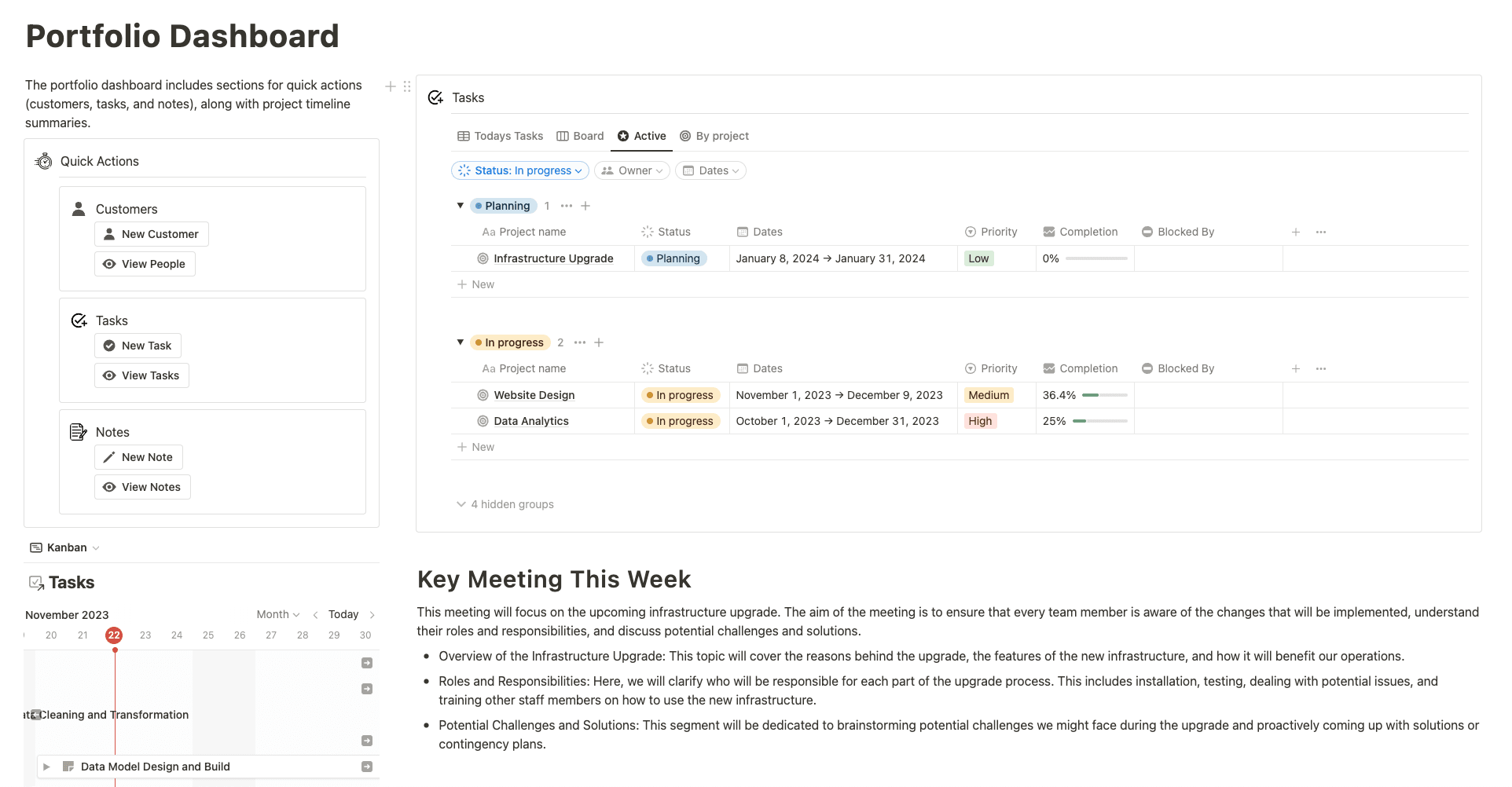
monday.com’s AI Work Platform
Best for: Teams that need structured, cross-functional work management with built-in AI-powered capabilities.
While Notion provides a flexible canvas, monday.com’s AI Work Platform delivers a structured operating layer in which projects, workflows, dashboards, and updates connect to a shared data foundation.
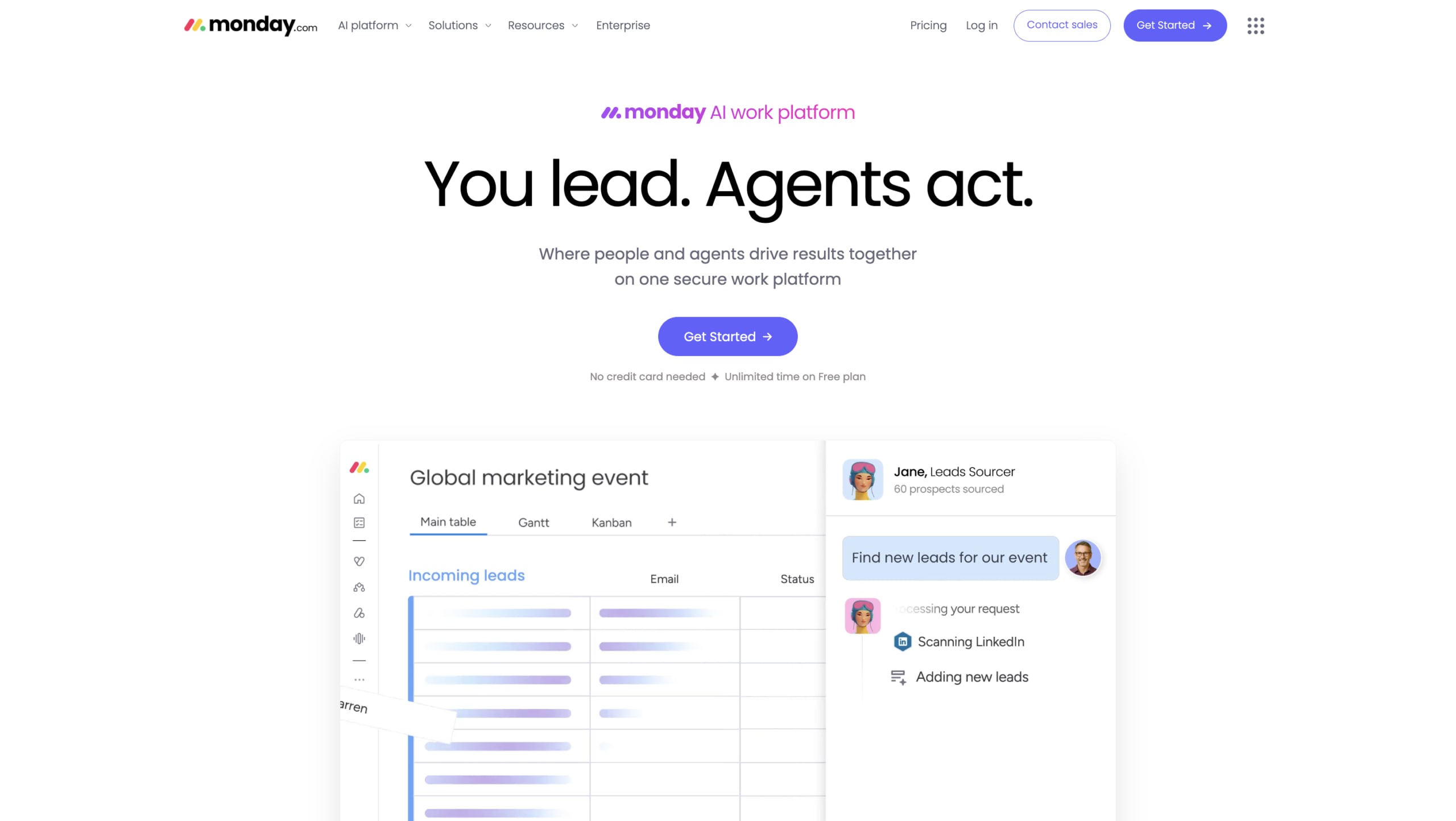
The platform’s AI capabilities span four distinct experiences that address different work needs:
- monday sidekick: A built-in AI assistant that can respond to natural-language queries, generate content, summarize information, and help teams act on workspace context within the flow of work
- monday agents: AI agents that can help teams analyze work, surface risks, summarize updates, and support specific processes across projects and workflows
- monday vibe: A natural-language app builder that helps teams turn a workflow idea into an app with boards, automations, and dashboards faster
- AI-powered workflow capabilities: AI columns and the AI workflow builder can help teams add intelligent steps to workflows without code
Beyond AI, the platform includes native integrations with tools such as Slack, Microsoft Teams, Jira, GitHub, and Salesforce, as well as Gantt charts, Kanban boards, workload management, time tracking, portfolio management, and Goals and OKRs.
Get started with monday.comClickUp
Best for: Teams with diverse collaboration needs who want an all-in-one platform.
ClickUp positions itself as “the everything app for work,” combining documents, whiteboards, chat, project management, and time tracking into a single interface. For teams that want a single platform covering multiple use cases without switching between apps, ClickUp offers a broad feature set that competes directly with both Notion and dedicated project management solutions.
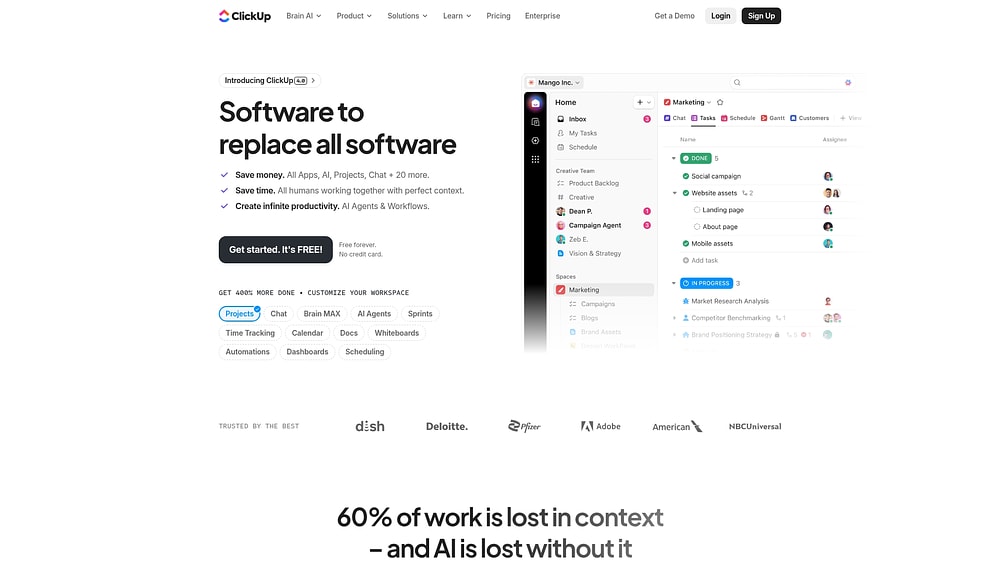
ClickUp Brain, the platform’s AI layer, works across documents, projects, and communication. It can summarize threads, draft content, generate subtask lists, and surface project updates through natural-language prompts. The AI is context-aware across the workspace, meaning it can pull information from different areas to answer questions about project status, team capacity, or document content.
The trade-off is complexity. With so many features packed into one platform, teams often face a steep learning curve during onboarding, and performance can slow in larger workspaces with heavy customization.
Pricing: Free Forever plan, Unlimited at $7/member/mo, Business at $12/member/mo, Enterprise at custom pricing. ClickUp Brain is available as a $5/member/mo add-on. See how the platforms stack up in this ClickUp vs monday.com comparison, or explore ClickUp alternatives.
Microsoft Loop
Best for: Teams already embedded in the Microsoft 365 ecosystem.
Microsoft Loop is a collaborative workspace designed to work seamlessly within the Microsoft 365 environment. Its defining feature is the Loop component, a portable content block that stays synchronized across Teams, Outlook, OneNote, and Word. When someone updates a Loop component in a Teams chat, the same content updates everywhere it appears.

With Copilot integration, Loop gains AI-powered drafting, brainstorming, and summarization capabilities that leverage the same AI engine available across Microsoft 365 apps. Real-time co-authoring, flexible page layouts, and native connections to Microsoft’s productivity suite make it a natural choice for organizations already paying for Microsoft 365 Business or Enterprise plans.
The limitations are notable, though. Loop is still maturing compared to Notion’s depth of templates and database features. It requires buy-in to the Microsoft ecosystem; teams using Google Workspace or other non-Microsoft stacks will find limited value. And for structured project management, Loop lacks the boards, Gantt views, and automation capabilities that dedicated platforms provide.
Pricing: Included with Microsoft 365 Business and Enterprise plans. No standalone free tier.
Coda
Best for: Teams who want to build custom workflows in a doc-like interface.
Coda blends the flexibility of documents with the power of spreadsheets and application logic. Every Coda doc can contain tables, buttons, automations, and formulas that turn static pages into interactive workflows. Think of it as a programmable document where teams can build custom approval processes, project trackers, or OKR dashboards without leaving the doc.

Coda Brain serves as the platform’s AI layer, connecting to company data sources and answering questions in context. AI Assistants can be configured to automate specific actions within docs, from categorizing form responses to generating meeting agendas based on calendar data. The doc-first approach appeals to teams that think in documents rather than boards or databases.
The main challenge is scalability. As Coda docs grow in complexity, they can become slow and difficult to navigate. The learning curve for building advanced automations is steeper than that of platforms with visual workflow builders.
Pricing: Free plan; Pro at $10/mo per Doc Maker; Team at $30/mo per Doc Maker; Enterprise at custom pricing.
Nuclino
Best for: Teams that want a lightweight, fast knowledge base without complexity.
Nuclino strips away the feature density that makes Notion overwhelming and focuses on doing one thing exceptionally well: fast, organized team knowledge.

Every page in Nuclino loads instantly, and the interface stays clean regardless of how much content your team creates. A graph view visualizes connections between pages, making it easy to discover relationships across your knowledge base. Real-time collaboration, inline comments, and instant search round out the core experience, all without requiring setup or configuration.
Where Nuclino intentionally stays lean, it also stays limited. There are no project management features, no automations, and no database functionality. For teams that need a dedicated knowledge base and nothing more, that focus is the point. For teams that need execution and documentation in one place, it will need to be paired with another platform.
Pricing: Free tier available, Standard at $5/user/mo, Premium at $10/user/mo.
Asana
Best for: Teams seeking a user-friendly project management platform.
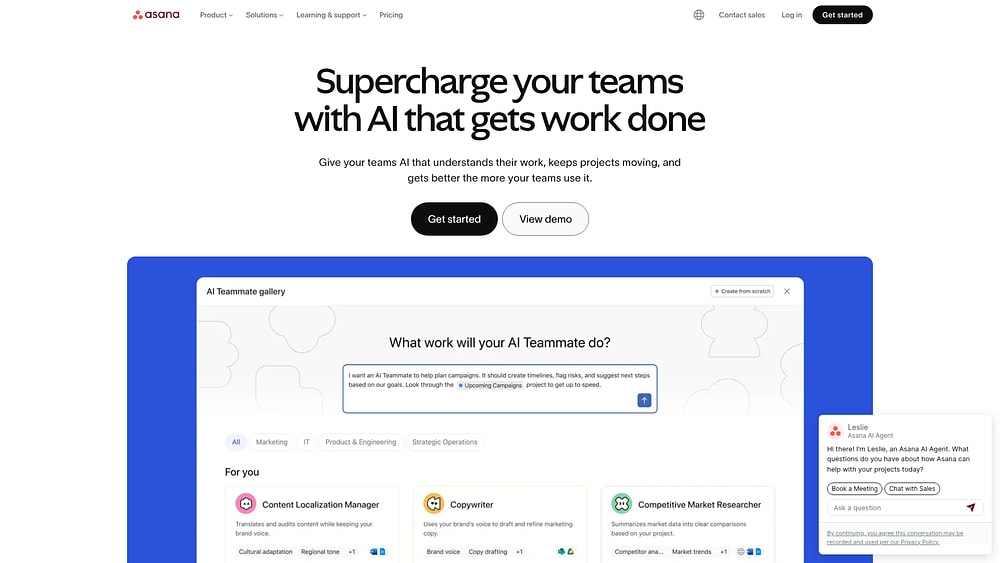
Asana has built its reputation on clean design and intuitive project tracking. The platform offers multiple views (list, board, timeline, calendar), custom fields, project templates, and workflow automations that help teams manage work without a steep learning curve. For organizations that prioritize ease of adoption across non-technical teams, Asana delivers a polished experience.
For personal use, Evernote’s web clipper, document scanning, and tag-based organization remain effective. However, team collaboration features are minimal compared to modern alternatives, and the platform’s development pace has slowed considerably. Teams looking for shared workspaces, real-time co-editing, or project management capabilities will need to look elsewhere.
Pricing: Free plan, Personal at $10.83/user/mo, Professional at $14.17/user/mo, Teams at $20.83/user/mo.
Obsidian
Best for: Power users who want a private, local-first knowledge base.
Obsidian takes a fundamentally different approach to knowledge management: all data is stored locally on your device in plain Markdown files. There is no cloud dependency, no vendor lock-in, and no risk of a company shutting down and taking your notes with it. For privacy-conscious users and teams in regulated industries, this architecture is a significant advantage.

The platform’s plugin ecosystem includes over 1,000 community-built extensions, ranging from Kanban boards and daily planners to advanced graph visualization and spaced repetition. The graph view maps connections between notes, helping users discover patterns and relationships across large knowledge bases. And because everything is Markdown, your notes remain portable and readable in any text editor.
Is Obsidian right for teams? That depends. Collaboration requires the paid Obsidian Sync service, and there are no native project management features. Obsidian excels as a personal knowledge system and struggles as a shared workspace; it’s purpose-built for individual depth, not cross-functional coordination.
Pricing: Free for personal use, $50/user/year for commercial use. Sync and Publish are optional paid add-ons.
Tana
Best for: Power users who want an AI-native knowledge workspace.
Tana is a newer entrant that treats structured data as a first-class citizen within a note-taking environment. Its Supertags system lets users define typed nodes with specific fields and behaviors, turning every piece of information into queryable, structured data without sacrificing the fluidity of freeform notes.

The AI command bar is deeply integrated into the editing experience, allowing users to transform, classify, extract, and generate content in line. Unlike bolt-on AI features, Tana’s AI feels native to the workflow; it operates on structured data, which means prompts can reference specific fields and relationships rather than raw text alone.
As a newer platform, Tana’s ecosystem is still growing. Integrations are limited, the learning curve is steep for users unfamiliar with graph-based or structured note-taking, and enterprise features are not yet mature. For power users who want to push the boundaries of personal knowledge management, however, Tana offers one of the most forward-thinking approaches available.
Pricing: Free tier available, with paid plans for expanded features.
Airtable
Best for: Teams looking to build custom apps and centralize data with a spreadsheet-database hybrid.
Airtable bridges the gap between spreadsheets and databases, giving teams a visual interface to organize, link, and automate structured data. Each base can contain multiple tables with relationships, attachments, formulas, and custom views (grid, calendar, Kanban, gallery, Gantt). For teams that think in rows and columns but need relational data, Airtable feels immediately familiar.

Airtable AI adds a layer of automation and intelligence: it can categorize records, generate summaries, and extract insights from text fields. The platform’s Interface Designer lets teams build lightweight apps on top of their data without code; useful for creating client portals, project dashboards, or intake forms.
Where Airtable falls short is in traditional project management. Gantt charts and timeline views exist but lack the depth of dedicated platforms, and there is no native resource management, workload view, or cross-functional orchestration. Pricing also escalates quickly. The Team plan starts at $20/seat/mo, and the Business tier at $45/seat/mo is required for advanced features. Review Airtable pricing details for a full breakdown.
Pricing: Free plan, Team at $20/seat/mo, Business at $45/seat/mo, Enterprise Scale at custom pricing.
Slite
Best for: Teams wanting to centralize and share company knowledge with AI assistance.
Slite focuses on a specific problem: making team knowledge easy to find, share, and keep up to date. Its AI-powered search understands natural-language questions and surfaces answers from across your documentation, reducing the time spent digging through pages and folders. For teams drowning in outdated wikis and scattered documents, Slite offers a focused solution.

The platform includes AI writing assistance for drafting and editing, collaborative editing with inline comments, and organizational features such as collections and verified content flags to help maintain documentation quality over time. Slite integrates with Slack, making it easy to surface knowledge directly within team conversations; useful for onboarding, OKRs, and process documentation.
Slite’s scope is intentionally narrow. It handles knowledge management well but does not extend into project tracking, workflow automation, or cross-functional operations. Teams that need both documentation and execution will need a complementary platform alongside Slite.
Pricing: Free plan (up to 50 docs), Standard at $8/member/mo, Premium at $12.50/member/mo, Enterprise at custom pricing.
How monday.com’s AI Work Platform solves common Notion pain points
The three most common reasons teams outgrow Notion are unstructured data that resists reporting, limited project management depth, and a lack of integration across departments such as marketing, sales, product, and operations. A platform built around structured boards, cross-functional orchestration, and AI that executes, not just assists, addresses each of these gaps directly.
Here is a closer look at the AI and operational capabilities that differentiate the platform:
- monday sidekick serves as a context-aware AI assistant embedded directly in your workspace. Teams can use it to ask questions, summarize information, draft content, and work with context from connected boards
- monday agents can support defined processes by helping teams analyze work, surface risks, summarize updates, and keep workflows moving. Teams can also create agents tailored to specific processes, with the right context and guardrails in place
- monday vibe helps teams turn natural-language descriptions into apps and workflows. Teams can describe what they need, such as a resource planning dashboard, event portal, or sales forecasting view, and move from idea to a structured workflow faster
- AI columns and the AI workflow builder can help teams add AI-powered steps to workflows, such as categorizing incoming requests, summarizing updates, generating responses, or extracting data without writing code
Beyond AI, the platform supports portfolio management, Goals and OKRs, capacity planning, and resource visibility; the operational depth that Notion’s page-based structure may not provide for teams managing complex cross-functional work. For teams evaluating structured work platforms, it’s worth reviewing current monday.com customer stories, analyst reports, and product pages for the latest approved proof points.
Organizations on the platform report saving 3,564+ hours per year and over $60,000 in operational costs. That translates to a 46% improvement in operational efficiency across nearly 250,000 customers, including over 60% of the Fortune 500. monday.com was also named a Leader in the Gartner Magic Quadrant for Collaborative Work Management, positioned furthest in Completeness of Vision. For more context on how structured platforms drive measurable outcomes, see the latest project management statistics.
Get started with monday.comChoosing the right platform for your team
The right Notion alternative depends on your core operational need. For personal knowledge management and privacy, Obsidian and Evernote keep things simple and local. For lightweight team documentation, Nuclino and Slite deliver fast, focused knowledge bases without the overhead. When teams need structured project execution with more depth, Gantt views, automations, resource management, and dashboards, platforms like monday.com’s AI Work Platform, ClickUp, and Asana provide a stronger operational backbone than Notion’s freeform setup.
Ecosystem fit matters, too. If your organization runs on Microsoft 365, Loop integrates seamlessly. If your team thinks in spreadsheets and relational data, Airtable bridges the gap. And for power users pushing the boundaries of structured note-taking, Tana and Coda offer forward-thinking approaches.
For teams that need AI-powered workflows across departments, not just AI-assisted documentation, a structured platform can reduce manual handoffs, improve cross-functional coordination, and support more reliable reporting as the organization scales. According to the PMI Pulse of the Profession 2025 report, organizations with mature project management practices consistently outperform peers in both delivery speed and budget adherence.
Among the Notion alternatives covered here, the combination of structured data, AI-powered capabilities, and multi-department reach is what separates platforms built for individual flexibility from those built for team-wide execution.
The content in this article is provided for informational purposes only and, to the best of monday.com’s knowledge, the information provided in this article is accurate and up-to-date at the time of publication. That said, monday.com encourages readers to verify all information directly.
FAQs
What is the best free alternative to Notion?
The best free alternative to Notion depends on your use case. ClickUp offers the broadest free project management features, Obsidian provides unlimited local-first note-taking at no cost, and monday.com includes a free plan with structured boards and collaboration for up to two users.
Can monday.com’s AI Work Platform replace Notion?
Yes, monday.com’s AI Work Platform can replace Notion for teams that need structured project management, cross-functional workflows, dashboards, automations, and AI-powered capabilities. Notion is strong for flexible documentation, while monday.com is better suited for teams that need connected execution across departments.
Which Notion alternative has the best AI features?
Among the platforms reviewed, monday.com’s AI Work Platform offers a broad set of AI-powered capabilities, including monday sidekick, monday agents, monday vibe, AI columns, and the AI workflow builder. These capabilities help teams move beyond AI-assisted documentation and bring AI into everyday workflows.
Is ClickUp better than Notion?
ClickUp is a stronger option than Notion for project management, offering Gantt charts, time tracking, and workflow automations that Notion lacks natively. Notion is better for freeform documentation and wiki-style knowledge bases.
What can I use instead of Notion for project management?
For dedicated project management, monday.com’s AI Work Platform, Asana, and ClickUp are strong Notion alternatives. Each offers more structured project tracking than Notion, with features such as timeline views, automations, resource management, dashboards, and reporting.
Is Notion good for large teams?
Notion can work for large teams that primarily need a documentation and knowledge management layer, but its unstructured data model, limited project management depth, and credit-based AI pricing create challenges at scale, particularly for cross-functional organizations that need standardized reporting and workflow governance.

 Get started