

Your finance team just spent three weeks processing invoices that could have been handled in three days. Your customer service queue is backing up because you can’t hire fast enough to match demand. Meanwhile, your IT department is drowning in routine maintenance when they should be building the systems that drive growth.
That’s where business process outsourcing stops being about cutting costs and starts being about gaining an edge. BPO involves contracting entire business functions to specialized external providers who handle everything from payroll and customer support to data processing and compliance management.
Done right, BPO turns fixed costs into flexible ones and gives you instant access to expertise and tech that’d take years to build in-house.
In this practical post we will cover the essential BPO service types, how AI’s reshaping the industry, and explore the steps required to find partners who actually feel like part of your team. You’ll also see how a unified work platform keeps you in control across multiple providers — so outsourced work becomes a real advantage, not a liability.
Key takeaways
- Use BPO to free internal teams for high-value work: outsourcing standardized operational processes reduces execution drag and allows internal teams to focus on growth and strategic initiatives.
- Treat BPO as a long-term operating model, not a quick fix: successful outsourcing depends on clear process ownership, performance baselines, and continuous optimization rather than short-term cost cuts.
- Select BPO partners based on outcomes and integration capability: the strongest providers combine domain expertise, automation, and the ability to work seamlessly inside your existing systems.
- Centralize outsourced operations with monday work management: unified dashboards, automated workflows, and AI insights give visibility and control across multiple BPO providers in one operating system.
- Plan transitions deliberately to avoid disruption: structured assessments, phased rollouts, and disciplined knowledge transfer reduce risk and set the foundation for scalable outsourcing success.

Business process outsourcing (BPO) is the strategic practice of contracting specific business functions to third-party service providers. This means companies transfer entire operational processes — from payroll and customer support to data entry and logistics — to specialized external partners who handle them completely.
Unlike simple task delegation or freelancing, BPO turns fixed costs into variable ones and gives you specialized expertise and tech that’d cost a fortune to build in-house. A tech company might outsource its entire customer success department to a specialized firm, while a retail chain contracts a third party to manage logistics and inventory data.
The post-2020 business world changed how companies think about BPO. Physical location matters less than the ability to integrate with digital workflows and deliver measurable outcomes, with 14.7% of U.S. civilian workers now having telework routinely allowed in 2025. Cloud platforms and strong API integrations let external teams work like they’re internal — the old barriers between inside and outside teams just disappear.
Understanding BPO in today’s business environment
Organizations now use BPO to access niche skills that are scarce in the domestic labor market, with 7.1 million job openings reported by U.S. employers in November 2025 highlighting persistent talent gaps. AI, advanced analytics, and compliance expertise are suddenly within reach — no need to build entire departments from scratch.
Modern BPO has evolved from a cost-cutting mechanism into a strategic lever for agility and digital transformation, with 25% of UK businesses now using AI as of late 2025 to enhance their operations. Companies use these partnerships to focus internal teams on what matters most while keeping non-core functions running smoothly.
BPO vs outsourcing and managed services
While these approaches are often used interchangeably, they operate at very different levels. The table below clarifies where each model fits and what it is designed to deliver.
| Aspect | BPO | General outsourcing | Managed services |
|---|---|---|---|
| Scope | Complete business processes (HR, finance) | Specific tasks or finite projects | Ongoing IT or infrastructure functions |
| Duration | Long-term partnerships (3–5+ years) | Project-based or short-term | Continuous service agreements |
| Responsibility | Provider owns process outcomes and KPIs | Shared responsibility | Provider manages infrastructure health |
| Focus | Process optimization and efficiency | Cost reduction or temporary access | Technical maintenance and uptime |
| Strategic value | High; drives operational transformation | Low to medium; solves capacity issues | High; ensures foundational stability |
BPO works for companies that want to offload entire departments and focus on what they do best.
General outsourcing works for companies that need temporary help on specific projects like website redesigns. Meanwhile, managed services work for businesses that need constant technical uptime without hiring full IT teams.

The BPO lifecycle moves from initial assessment to continuous optimization in defined stages. A standard timeline: two to four weeks for assessment, three to six months for implementation, then ongoing management and optimization.
Success depends on careful planning, solid documentation, and strong communication channels before you process the first transaction. Here’s how companies move from spotting outsourcing opportunities to running smooth operations:
- Needs assessment: organizations identify resource-intensive but non-core processes, defining scope and expected ROI.
- Provider selection: rigorous RFP processes evaluate partners based on expertise, technology stack, cultural fit, and cost structure.
- Contract negotiation: Service Level Agreements establish penalties for underperformance and bonuses for exceeding targets.
- Knowledge transfer: internal teams document processes and train the provider’s core staff.
- Go-live and stabilization: operations shift to the provider in phases with intense monitoring.
The BPO implementation journey
Implementing a BPO partnership takes a disciplined approach to keep disruption low. Each phase builds on the last, setting you up for long-term success.
- Process mapping and documentation come first. Before outsourcing, map every workflow step to spot inefficiencies and nail down standard operating procedures.
- Knowledge transfer protocols follow, involving structured shadowing sessions, video documentation, and creating a central knowledge base to ensure providers understand business nuances.
- Integration planning establishes secure connections between client ERP or CRM systems and provider platforms, ensuring real-time data flow.
- Pilot testing creates a sandbox phase where providers handle small volumes to test accuracy and turnaround times without risking broader business operations.
- Performance baseline establishment requires both parties to agree on ground zero metrics against which future improvements will be measured.
- Full deployment scales volume incrementally once pilots meet success criteria until providers manage the full contract scope.
Key players in BPO partnerships
Successful BPO relationships need well-defined roles to prevent communication gaps. Clear ownership structures spell out who owns what, who escalates issues, and who tracks success.
Client-side roles include:
- BPO program manager: owns the relationship and high-level performance.
- Process owners: define how work should be done and audit quality.
- IT liaisons: manage technical integrations and security protocols.
Provider-side roles encompass:
- Account managers: focus on contract health and future growth.
- Delivery managers: oversee daily operations and team performance.
- Quality assurance teams: monitor output to ensure SLA compliance.
A Joint Steering Committee with execs from both sides meets quarterly to review strategic alignment. Operational teams meet weekly to tackle immediate issues.
4 essential types of BPO services
BPO services break down by work type, provider location, and strategic goals. Knowing these differences helps you pick the right model for your operational gaps.
Knowledge vs operational process outsourcing
- Knowledge Process Outsourcing (KPO): involves high-value, judgment-intensive work requiring specialized domain expertise. Think financial investment research, legal document review, engineering design, and medical diagnostics. Providers hire highly skilled pros with advanced degrees — they focus on quality and insight, not volume.
- Operational Process Outsourcing: covers routine, rules-based, transaction-heavy processes. Payroll processing, data entry, inventory management, and basic claims processing fall into this category. The main goals: efficiency, speed, and cost tracking. Management tracks throughput and error rates.
Customer-facing vs internal operations
- Customer-facing BPO: handles direct interaction with the client’s customer base through omnichannel support, telemarketing, technical helpdesk, and order taking. Management needs strict adherence to brand voice and customer satisfaction metrics — providers are your company’s face.
- Internal operations BPO :supports business behind the scenes without direct customer contact. Think HR administration, accounts payable/receivable, procurement, and IT infrastructure management — all focused on accuracy, compliance, and turnaround time.
Location-based BPO models
Where your provider’s located affects cost, communication, and control. Each model has its own perks:
| Model | Definition | Cost profile | Key considerations |
|---|---|---|---|
| Onshore | Provider in same country as client | High | Best for cultural alignment and data residency requirements |
| Nearshore | Provider in neighboring country or similar time zone | Medium | Balances cost savings with real-time collaboration |
| Offshore | Provider in distant country with time difference | Low | Maximizes cost savings and enables 24/7 operations |
Digital-first BPO solutions
BPO providers compete on tech as much as service. The best partnerships use automation and AI to deliver outcomes that beat what humans can do alone.
- Automation-enabled BPOL: utilizes Robotic Process Automation to handle repetitive work like form filling and data migration, reducing human headcount required for standard contracts.
- AI-powered BPO: deploys artificial intelligence for complex decision-making such as fraud detection or sentiment analysis, offering capabilities exceeding human speed.
- Cloud-native BPO: delivers services entirely through cloud platforms, allowing instant scalability and integration. Teams using monday work management connect internal workflows directly with provider systems, creating shared digital workspaces where automated workflows keep client and provider teams in sync.
Which business processes should you outsource?
Strategic BPO targets functions that are standardizable, rule-based, and non-core but still critical. The key: spot processes that drain team time without giving you a competitive edge.
Core administrative functions
These standardized processes follow predictable patterns and are more efficient when handled by teams with specialized expertise:
- Payroll and benefits administration: ensures compliance with constantly changing tax laws and labor regulations.
- Accounts payable and receivable: high-volume transactional processes with defined rules and deadlines.
- Data entry and document processing: repetitive activities that free internal staff for analytical work.
- Travel and expense management: specialized providers enforce policies and audit expenses more strictly.
Customer experience operations
External providers bring flexibility and specialized skills that scale easily:
- Customer service and support: provides 24/7 coverage across multiple languages without managing round-the-clock shifts.
- Technical helpdesk services: tier 1 support handles volume while complex issues remain in-house.
- Order processing and fulfillment: providers scale staffing instantly to match seasonal demand spikes.
- Customer onboarding: standardized welcome calls and data verification ensure consistent experience.
Specialized technical services
These services give you enterprise-grade capabilities without maintaining specialized teams:
- IT infrastructure management: network monitoring and server maintenance require 24/7 vigilance and specialized certifications.
- Software development and maintenance: companies outsource legacy system maintenance to free developers for new products.
- Quality assurance and testing: external QA teams provide unbiased performance views across device configurations.
- Cybersecurity monitoring: Security Operations Centers offer enterprise-grade threat intelligence and constant surveillance.
5 strategic benefits of business process outsourcing
When implemented strategically, BPO delivers value well beyond cost reduction. These benefits show why organizations use outsourcing as a core operating advantage.
Operational cost optimization
BPO’s financial impact goes way beyond wage differences. Shifting from capital to operational expenditure helps you avoid heavy upfront investments in facilities,
Providers spread infrastructure costs across multiple clients, passing on economies of scale. Hidden costs of recruitment, training, benefits, and attrition transfer to providers.
Access to global talent and expertise
Outsourcing unlocks immediate pipelines to specialized talent that may be scarce or prohibitively expensive locally. Mid-sized companies access the same cybersecurity expertise, data science capabilities, or legal compliance knowledge as Fortune 500 enterprises.
Providers invest heavily in training and certifications, ensuring clients benefit from latest industry practices without funding professional development.
Accelerated digital transformation
BPO providers compete on technology, often possessing tech stacks more advanced than their clients. Partnering with tech-forward providers allows organizations to leapfrog legacy systems and access pre-built digital solutions, automation capabilities, and analytics platforms immediately.
Teams using monday work management connect provider capabilities directly into existing workflows, creating unified views of both internal and outsourced operations.
Enhanced business agility
Volatile markets make agility a competitive advantage. BPO enables organizations to scale operations rapidly in response to market shifts, seasonal demands, or economic downturns without hiring or layoff friction.
This flexibility allows companies to enter new geographic markets quickly by leveraging provider infrastructure and regulatory knowledge.
Risk distribution and compliance management
Outsourcing distributes operational risk through contracts with strict liability clauses and compliance guarantees, effectively transferring specific regulatory and operational risks to partners. In highly regulated industries, BPO providers maintain dedicated compliance teams ensuring adherence to regulations.
Multiple providers across different geographies ensure business continuity when disruptions occur.
How AI and automation are revolutionizing BPO
Artificial intelligence shifts the BPO value proposition from cheaper labor to smarter operations. The industry moves toward outcomes-based models where AI drives speed and accuracy that human-only teams cannot match.
The rise of hybrid human-AI operations
The most effective BPO models employ human-in-the-loop approaches. AI handles initial data processing, analysis, and routine interactions while human agents focus on complex problem-solving, empathy-driven customer service, and exception handling.
This hybrid structure improves job satisfaction by removing robotic activities and enhances service quality by ensuring human judgment applies where it matters most. AI systems continuously learn from human corrections, creating improvement cycles.
Intelligent process automation in BPO
Intelligent Process Automation combines RPA with cognitive technologies to automate end-to-end workflows. These capabilities transform BPO delivery:
- Document processing: AI uses Optical Character Recognition and Natural Language Processing to extract data from unstructured invoices and contracts.
- Customer interaction analysis: sentiment analysis monitors live calls to prompt agents with responses or flag supervisors.
- Predictive maintenance: AI analyzes system logs to predict server failures or software bugs before downtime.
- Resource optimization: algorithms analyze historical patterns to predict staffing needs, ensuring SLAs are met without overstaffing.
Predictive analytics for BPO performance
AI enables shifts from reactive reporting to proactive management. Instead of reviewing last month’s failures, predictive analytics forecast next month’s performance risks.
These systems identify patterns indicating potential compliance breaches, predict customer churn based on support history, and suggest process optimizations.
Organizations leveraging monday work management use AI capabilities like Portfolio Risk Insights to scan project boards and flag potential issues by severity, transforming BPO providers from task-doers into strategic advisors capable of guiding business improvements.
7 steps to select your ideal BPO partner
Selecting the right BPO partner requires systematic evaluation across multiple dimensions. Each step below builds on the previous one to ensure comprehensive due diligence and strategic alignment.
Step 1: map your outsourcing strategy
Internal teams must document current state and define future state before contacting vendors. This involves mapping processes for outsourcing, identifying pain points, and setting objectives.
Teams build visual process maps on intelligent platforms like monday work management to track readiness of each function for migration.
Step 2: evaluate technical capabilities
Provider tech stacks matter as much as their people. Evaluation must assess:
- Ability to integrate with existing systems via API.
- Maturity in deploying automation for efficiency.
- Disaster recovery protocols.
Real-time dashboards beat static weekly PDFs.
Step 3: assess financial stability and track record
Due diligence requires deep dives into provider financial health ensuring stable long-term partnership. Review audited financial statements, debt levels, and cash flow.
Validate track records by requesting references from clients with similar complexity and tenure.
Step 4: verify security and compliance standards
For processes involving data, security is non-negotiable. Verify certifications such as SOC 2 Type II, ISO 27001, and industry standards like PCI-DSS.
Assessment must cover data encryption standards, access control policies, and physical security measures at facilities.
Step 5: test cultural and operational alignment
Cultural fit determines daily partnership friction. Evaluate provider communication style, responsiveness, and management philosophy.
Site visits and interviewing potential account managers gauge whether working styles complement organizational culture.
Step 6: structure performance-based agreements
Contracts govern relationships and must include detailed Service Level Agreements with measurable KPIs. Pricing models should align incentives through gain-share models rewarding providers for identifying efficiency improvements.
Governance structures must define meeting cadences, escalation paths, and exit provisions.
Step 7: design your transition roadmap
Successful transitions require detailed project plans outlining timelines for knowledge transfer, system setup, training, and phased go-live schedules.
Centralized project management platforms ensure client and provider teams align on milestones and deliverables throughout critical phases.

Managing BPO relationships across multiple providers, processes, and teams requires more than spreadsheets and email threads. monday work management serves as the central nervous system for BPO oversight, eliminating fragmentation and providing a unified view of vendor operations.
Centralize all vendor operations
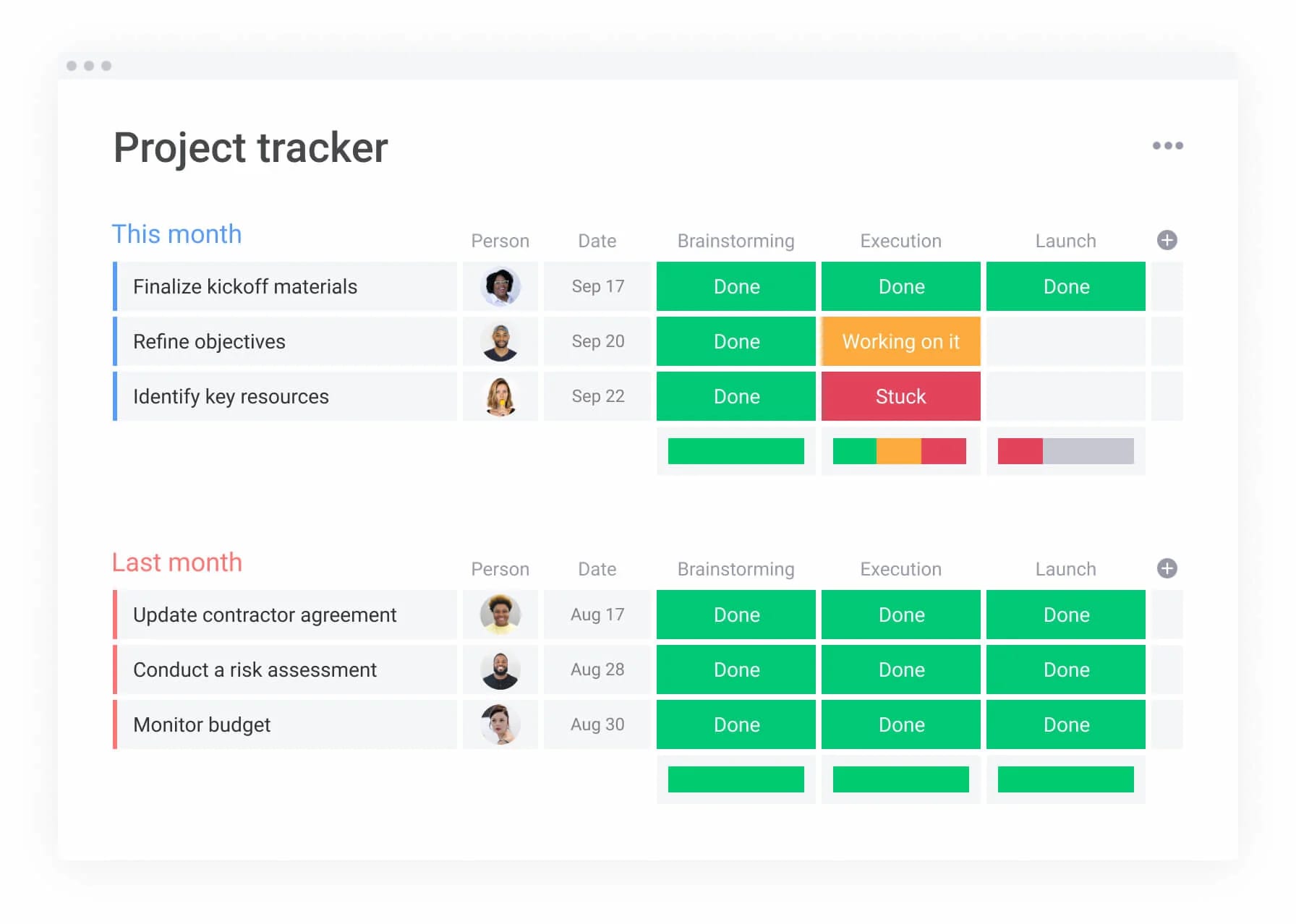
Multi-provider dashboards create consolidated control towers aggregating live performance data from every BPO partner. Executives spot risks and performance trends instantly without manual data compilation.
Standardized reporting templates enforce consistent metrics across vendors, ensuring accurate performance comparisons regardless of provider systems.
Contextual communication happens directly on project boards, creating permanent audit trails of decisions and instructions that replace scattered email threads. Internal teams and external providers collaborate on shared boards with granular permission settings, ensuring transparency without compromising data security.
Automate complex BPO workflows
Automation within the platform reduces administrative burden of managing external teams. AI Blocks automatically categorize incoming vendor requests, routing them to appropriate internal owners.
These capabilities summarize lengthy vendor status updates into concise executive bullets and extract critical data points from invoices or contracts directly into board columns.
Automated escalations trigger instant notifications when critical KPIs fall below agreed thresholds or deliverables risk missing deadlines. Workflow orchestration manages dependencies automatically, notifying BPO providers when prerequisites complete, eliminating downtime between handoffs.
Monitor performance with AI insights
AI shifts BPO oversight from after-the-fact reporting to continuous, forward-looking control.
Key capabilities include:
- Proactive risk detection: Portfolio Risk Insights scans project boards to flag bottlenecks and resource conflicts before SLAs are impacted.
- Predictive performance forecasting: historical trends are analyzed to anticipate service level risks and guide capacity adjustments.
- Anomaly detection: the system highlights metrics that deviate from normal patterns, prompting immediate review.
- Workflow improvement suggestions: recurring delays trigger recommendations to address process inefficiencies.
This allows teams to manage outsourced operations with foresight rather than reaction.
Scale outsourcing with confidence
Organizations create BPO onboarding board templates deployable for new vendors in minutes, ensuring every partnership starts with rigorous structure. High-level portfolio boards allow directors to manage dozens of vendor relationships simultaneously without losing track of individual performance.
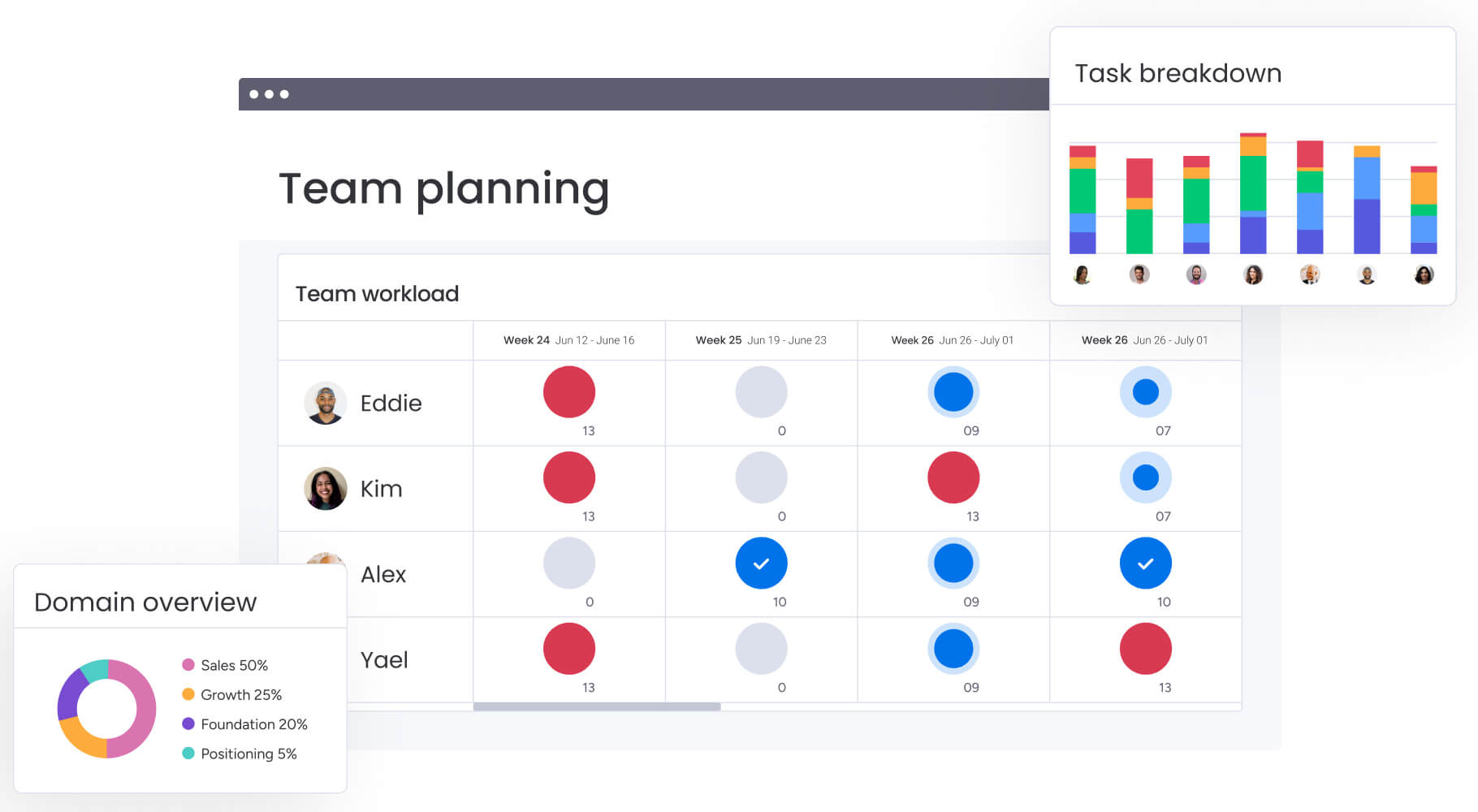
Workload views visualize capacity across internal and external teams, ensuring effective work distribution. With 200+ pre-built integrations including Jira, Salesforce, and Slack, the platform connects seamlessly with whatever systems BPO providers use.
Build your BPO success framework today
BPO partnerships deliver transformational value when approached strategically rather than tactically. Organizations that treat outsourcing as a core business capability — not just a cost-cutting exercise — achieve sustainable competitive advantages through enhanced agility, specialized expertise, and operational excellence.
The most successful BPO implementations combine rigorous partner selection with robust management frameworks. Teams that establish performance baselines, implement continuous monitoring, and maintain strategic oversight create partnerships that evolve and improve over time.
Sophisticated solutions like monday work management enables this strategic approach by providing the visibility, automation, and integration capabilities needed to manage complex multi-provider relationships effectively. Organizations gain the control and insight necessary to transform BPO from a necessary operational function into a strategic differentiator.
Frequently asked questions
What is the difference between BPO and BPM?
The difference between BPO and BPM is that Business Process Outsourcing (BPO) involves contracting specific operations to external providers, while Business Process Management (BPM) is the internal discipline of analyzing and optimizing business processes for improved efficiency.
How quickly can BPO deliver cost savings?
Organizations typically realize initial cost reductions within three to six months as transitions stabilize, with maximum ROI achieved between 12 and 18 months once processes are fully optimized.
What size companies benefit most from BPO?
Mid-to-large organizations with over 100 employees derive the most significant value from BPO, as their operational volume and process complexity justify management overhead and maximize economies of scale.
Which industries use BPO services the most?
Banking, financial services, and insurance (BFSI), healthcare, telecommunications, and retail are the heaviest BPO users, leveraging it for customer support, claims processing, and back-office data management.
How do you ensure quality with offshore BPO providers?
Quality is secured through rigorous Service Level Agreements, real-time monitoring dashboards, regular calibration sessions, and dedicated internal vendor management teams overseeing performance.
What role does AI play in modern BPO services?
AI transforms BPO by automating routine high-volume activities, providing predictive analytics for decision-making, and augmenting human agents with real-time insights, shifting focus from labor arbitrage to intelligent process execution.

 Get started