


Not all AI-powered email platforms are created equal. Some use AI to generate a subject line, while others use it to decide who gets which message, when, and why based on live CRM data — and that distinction is reshaping how marketing teams approach platform selection.
This article covers 10 AI features that are redefining what email marketing platforms can do, what each one actually means in practice, and how to evaluate whether a platform delivers genuine AI capability or just rebranded automation. You’ll also get a practical framework for getting value from these features without overcomplicating your rollout — and see how platforms like monday campaigns put these capabilities into action.
Key takeaways
- Modern AI email platforms adapt to real customer behavior over time, making your campaigns sharper with every send.
- AI is only as good as the data behind it — audit your contacts and close any gaps before you flip the switch.
- Pick 1 or 2 high-impact features to pilot first, measure the revenue outcomes, and build from there.
- Tie every campaign to CRM deal stages so you can prove pipeline impact — not just open rates — to leadership.
- With native CRM integration and real-time optimization, platforms like monday campaigns help you build, target, and launch smarter campaigns without stitching together separate tools.
What AI in email marketing actually means
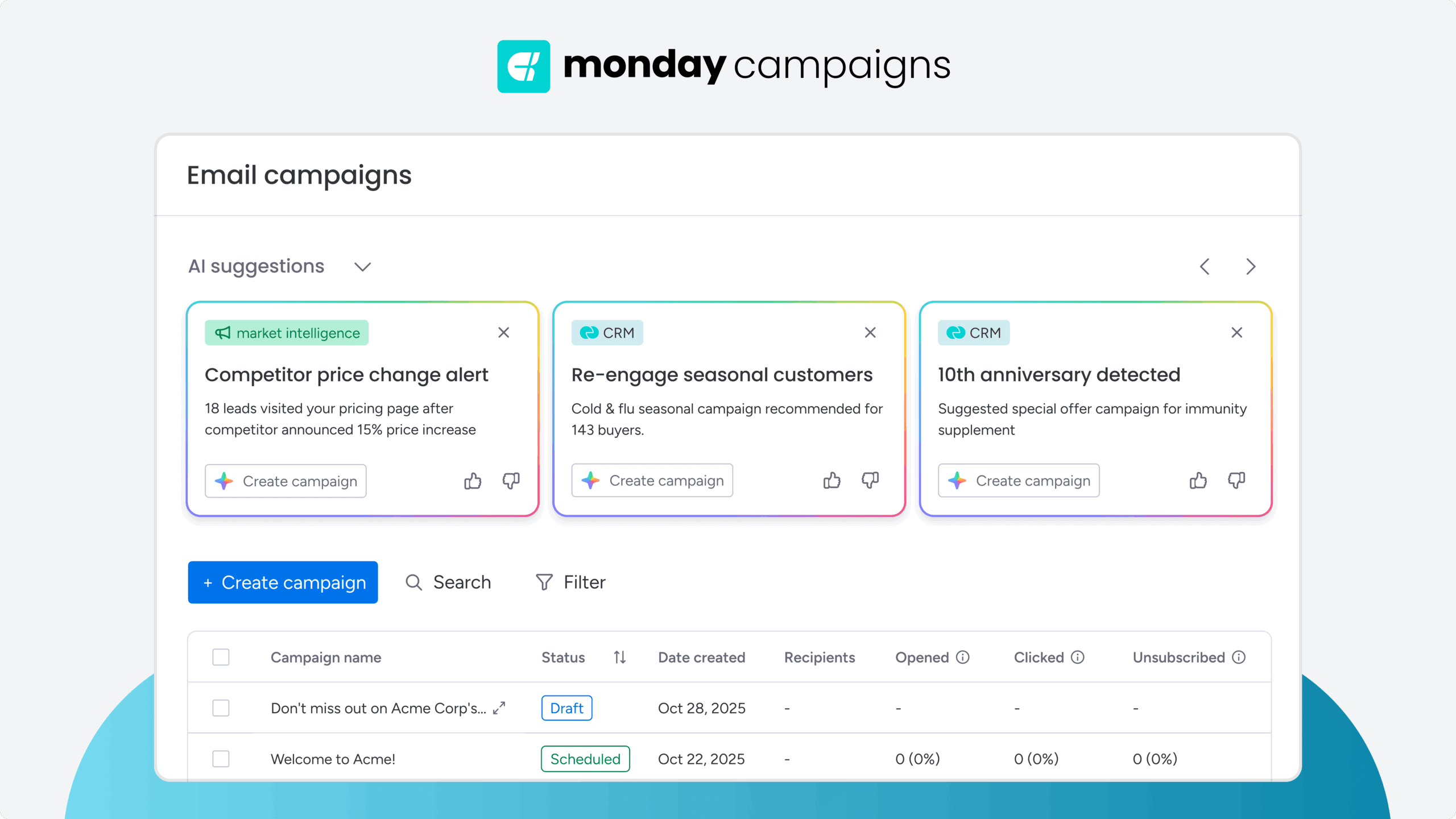
AI in email marketing means systems that predict customer behavior, generate personalized content, and optimize campaigns without constant manual tweaking. These platforms learn from every interaction, adapt messaging based on real-time signals, and make decisions that previously required hours of analysis.
The shift from basic automation to true AI has changed how campaigns actually perform. AI-powered platforms stand apart because of 4 core capabilities:
- Machine learning models: These systems improve over time by analyzing engagement patterns, conversion data, and customer behavior across millions of interactions.
- Natural language processing: AI generates subject lines, body copy, and calls-to-action that match brand voice while adapting to individual recipient preferences.
- Predictive analytics: Algorithms forecast optimal send times, identify high-intent segments, and anticipate customer needs before they’re expressed.
- Real-time optimization: Campaigns adjust automatically based on live customer signals, sales activity, and performance metrics.
Why AI has become essential for email marketing success
The bar for email marketing has never been higher, and the gap between what customers expect and what manual processes can deliver keeps widening. These are the forces driving AI from a “nice to have” to a genuine business requirement:
- Customer expectations have shifted fundamentally. Buyers now expect every email to feel personally relevant — not just addressed to their first name, but tailored to their interests, timing preferences, and current relationship with the brand. Delivering this level of personalization to thousands of contacts is impossible without AI.
- There’s more data than any team can process manually. Marketing teams manage behavioral signals, CRM records, purchase history, website activity, and sales data across dozens of touchpoints. How can marketers deliver one-to-one personalization to thousands of contacts at scale? AI makes it possible to do this effectively across every touchpoint.
- Teams need to do more with less. Marketing teams are expected to do more with the same headcount. AI-driven automation handles repetitive work (segmentation, send-time optimization, content variations) so marketers can focus on strategy and creative direction.
10 AI features reshaping email marketing platforms
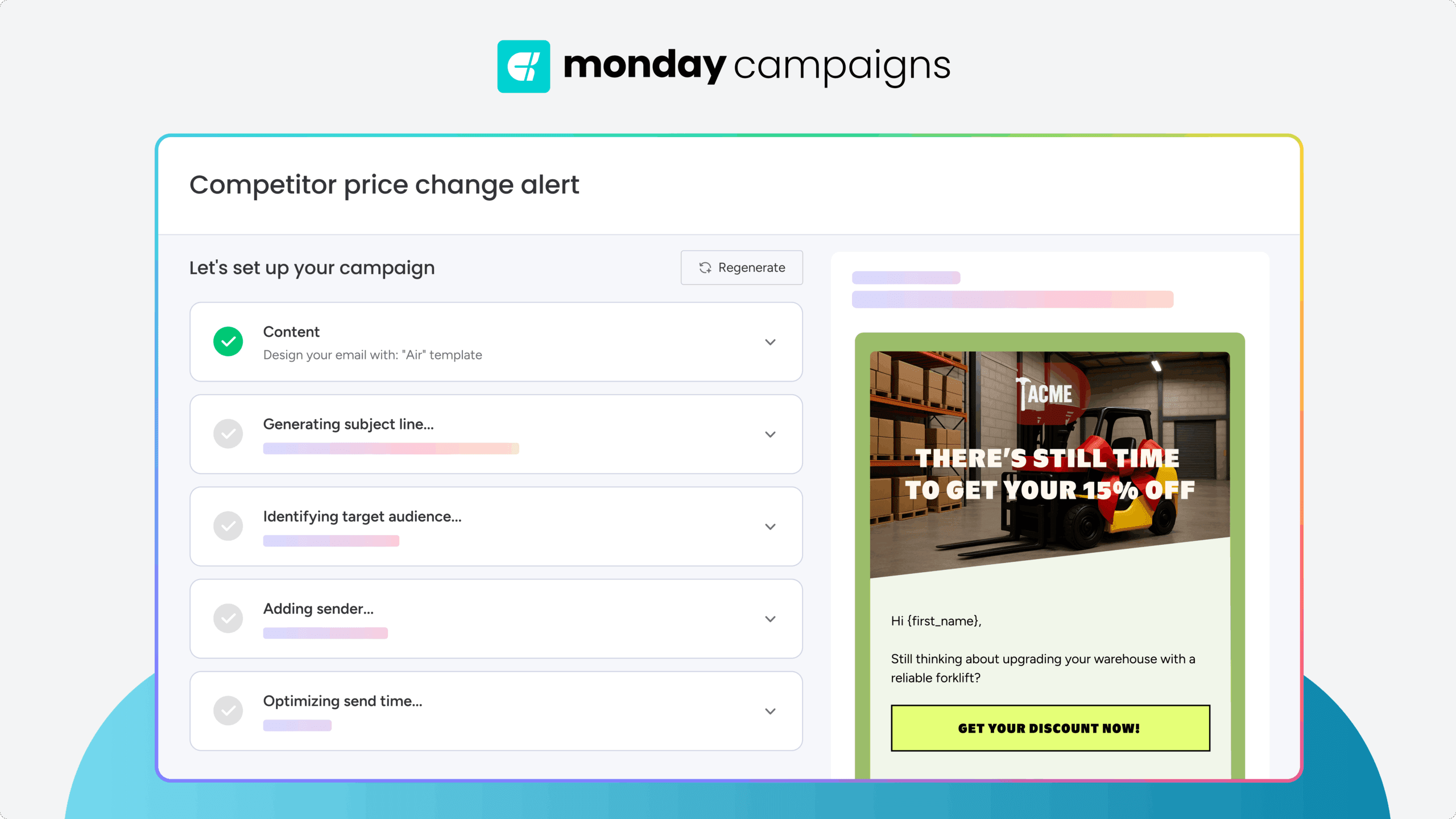
Each of the AI capabilities that matter most in email marketing right now solves a real problem and drives measurable results. Understanding what each feature actually does (and why it matters) is the first step to evaluating whether a platform is genuinely AI-powered or just rebranding automation.
1. AI-powered content and copy generation
AI-powered content generation creates email subject lines, body copy, and calls-to-action based on brand voice guidelines, audience data, and campaign objectives. Unlike static templates, these systems learn from performance data and adapt messaging dynamically based on what resonates with specific segments.
The impact is real: marketing teams can produce dozens of content variations in minutes instead of hours, test more approaches at once, and scale personalization with their existing team. Among AI users, 66% report AI lets them spend more time on high-value work and 58% say they’re now producing work that was out of reach a year ago, according to the 2026 Microsoft Work Trend Index.
Key capabilities within AI content generation include:
- Brand voice training: The system learns your tone, terminology, and style from approved content examples.
- Performance-based learning: Messaging adapts over time based on what drives engagement and conversions.
- Guardrail enforcement: Content boundaries ensure AI outputs stay on-brand and compliant.
- Human-in-the-loop refinement: Marketers can edit, approve, or reject AI suggestions before anything goes live.
2. Smart audience segmentation from CRM data
AI-driven segmentation analyzes CRM data — behavioral signals, purchase history, engagement patterns, and demographic information — to create dynamic segments that update automatically as customer data changes. This approach catches patterns that rule-based segmentation misses.
Traditional segmentation requires marketers to manually define rules like “customers who purchased in the last 90 days.” AI segmentation goes further by identifying non-obvious patterns: customers who engage heavily with product documentation before upgrading, or contacts whose email engagement velocity predicts near-term purchase intent.
| Segmentation type | Data freshness | Maintenance | Insights generated |
|---|---|---|---|
| Static lists | Outdated at creation | Manual rebuilds | Limited to predefined rules |
| Rule-based automation | Periodic updates | Ongoing rule management | Only explicit criteria |
| AI-driven dynamic segmentation | Real time | Self-updating | Identifies non-obvious correlations |
3. Predictive send-time and send-order optimization
Predictive send-time optimization finds the best moment to deliver emails to each recipient based on their engagement history, time zone, and behavior. Send-order optimization takes this further by prioritizing which contacts receive emails first based on likelihood to engage.
Here’s how it works in practice:
| Optimization type | How it works | Example |
|---|---|---|
| Individual pattern learning | AI analyzes each contact's engagement history to identify the best send time. | A contact who consistently opens emails at 7:30 a.m. receives messages just before that window. |
| Global campaign scheduling | AI coordinates delivery across time zones automatically. | Recipients in Tokyo, London, and New York all receive emails during their local morning hours. |
4. One-to-one personalization at the point of send
One-to-one personalization at the point of send means the email builds itself dynamically when it’s delivered, using real-time customer data. This goes far beyond inserting a first name. It tailors entire messages based on recent interactions, predicted intent, and current relationship status. Adoption is moving fast: 67% of retail executives expect to have AI-driven personalization capabilities within the next year, according to Deloitte’s 2026 Retail Industry Global Outlook.
AI pulls data from CRM records, behavioral signals, and sales activity to personalize content, so a recipient who browsed enterprise pricing yesterday sees messaging emphasizing enterprise features. A contact whose deal just moved to negotiation stage receives content addressing common late-stage objections.
The difference between static personalization tokens and dynamic AI-driven personalization is significant. Static tokens insert fixed values that were accurate when you created the list. Dynamic personalization reflects the customer’s current state at the exact moment the email is sent.
5. Conversational AI interfaces and campaign agents
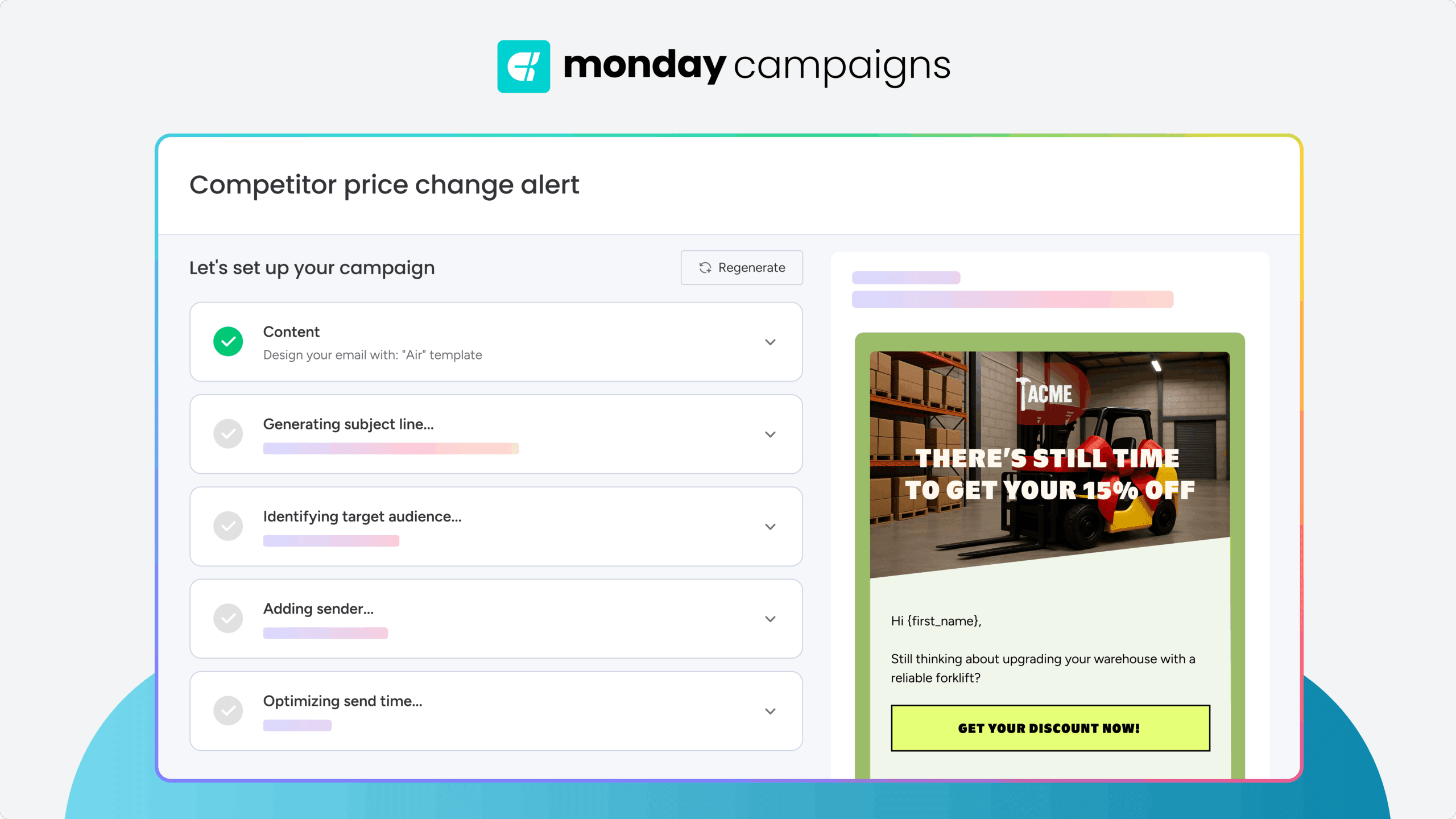
Conversational AI interfaces let marketers build, launch, and optimize campaigns through natural language prompts instead of navigating complex menus. With monday campaigns, marketers can describe a goal and let AI handle the setup end-to-end.
A marketer can describe a goal — “Send a re-engagement campaign to customers who haven’t logged in for 30 days” — and the AI handles:
- Audience selection: Identifying and building the right segment from CRM data
- Content drafting: Generating subject lines and body copy aligned to the campaign goal
- Send scheduling: Timing delivery based on individual engagement patterns
This shift from manual setup to AI-assisted workflows turns what used to take multiple screens and steps into a simple conversation where the AI asks questions and executes based on your answers.
6. Real-time optimization from sales and customer signals
Real-time optimization connects marketing campaigns to sales activity and customer behavior, adjusting campaigns mid-flight based on live data. AI monitors performance, detects issues, and makes corrections: pausing underperforming sends, reallocating resources, or triggering follow-ups based on customer signals.
What this looks like in practice:
- Signal learning: When a contact opens an email and then schedules a demo, the AI learns that this email content drives pipeline activity.
- Mid-campaign correction: When engagement drops mid-campaign, AI can pause sends to underperforming segments and reallocate to higher-performing audiences.
- Continuous monitoring: Rather than waiting until a campaign ends to analyze results, AI monitors performance throughout execution and makes adjustments in real time.
7. Inbox intelligence for Gmail and Apple Mail
Inbox intelligence optimizes emails for deliverability and engagement in specific email environments. It accounts for spam filters, inbox categorization, and rendering differences across Gmail, Apple Mail, Outlook, and other clients.
With spam filter prediction, AI analyzes content patterns that trigger filtering algorithms, flagging issues before send. Gmail’s tabbed inbox presents a specific challenge because emails that land in the Promotions tab typically see significantly lower engagement.
AI analyzes factors that influence tab placement and recommends changes to improve Primary inbox delivery.
8. Dynamic content and real-time product recommendations
Dynamic content inserts personalized content blocks (product recommendations, contextual offers, or tailored messaging) into emails based on real-time customer data and predictive models. These elements update when the email sends, based on where the recipient is right now.
AI recommends products or content by analyzing:
- Browsing history: A customer who viewed running shoes yesterday sees running shoe recommendations.
- Purchase behavior: A customer whose purchase history suggests they buy quarterly sees messaging timed to their typical purchase cycle.
- Predicted intent: Recommendations reflect where the customer is in their journey, not just what they’ve done in the past.
Learn more: AI email automation
9. Closed-loop revenue attribution and incrementality testing
Closed-loop revenue attribution tracks email campaigns from first touch to closed deal, connecting engagement to actual revenue in your CRM. Incrementality testing measures whether campaigns actually drove new revenue or just captured demand that would’ve converted anyway.
- Multi-touch attribution: AI connects email engagement to CRM deal stages by tracking the customer journey across touchpoints and giving credit to all the interactions that influenced the outcome.
- Incrementality testing: AI isolates the true impact of campaigns by comparing outcomes for recipients who received emails against a control group who didn’t, separating genuine lift from coincidental conversion.
10. Transparent AI governance and brand safety controls
AI governance provides controls (brand voice guardrails, approval workflows, content moderation, and audit trails) that ensure AI-generated content stays on-brand and compliant. These controls are essential for enterprise adoption where consistency and compliance are non-negotiable. The urgency is real: Only 1 in 5 companies has a mature governance model for autonomous AI agents, according to Deloitte’s State of AI in the Enterprise 2026 report.
Key governance capabilities include:
- Brand voice enforcement: AI learns from approved content examples and extracts patterns in tone, terminology, and style to apply consistently.
- Human-in-the-loop approval: AI outputs receive appropriate review before reaching customers, keeping marketers in control.
- Decision transparency: Visibility into why AI made specific recommendations builds trust and supports continuous improvement.
Learn more: AI for email marketing
How to evaluate AI features when choosing a platform
Selecting an AI-powered email marketing platform means looking beyond feature checklists. These criteria separate platforms that deliver real AI value from those that treat AI as a marketing checkbox. Knowing what to look for (and what questions to ask) saves time and avoids costly platform switches later.
Native CRM and workflow integrations
Native CRM integration beats third-party connectors because real-time data flow determines AI accuracy. When AI relies on data that syncs hourly or daily, your personalization and segmentation are already outdated. Native integrations ensure AI works with current customer state.
| Integration type | Data freshness | Setup complexity | Maintenance |
|---|---|---|---|
| Native integration | Real time | Low | Minimal |
| Third-party connector | Hourly to daily | Medium | Ongoing |
| Manual sync | Weekly or ad hoc | High | Heavy |
Predictive AI versus rules-based automation
Predictive AI learns and adapts. Rules-based automation follows static if/then logic that requires manual updates, while predictive AI adapts on its own as customer behavior evolves. Understanding this distinction helps evaluate whether a platform’s “AI” delivers genuine intelligence or rebranded automation.
Rules-based automation has real limitations:
- Manual updates: Every new customer behavior or campaign scenario requires someone to adjust the rules.
- Static logic: Workflows can only respond to conditions you’ve explicitly defined in advance.
- Limited insight: Rules can’t uncover hidden patterns or relationships that marketers didn’t think to look for.
Predictive AI overcomes these limitations by learning continuously from customer behavior. Instead of relying on fixed rules, it adapts automatically as new data comes in, identifies emerging patterns, and improves recommendations over time without constant manual intervention.
Try monday campaigns5 steps to getting value from AI email marketing
Implementing AI email marketing features successfully takes more than flipping switches. You need preparation, prioritization, and process changes. The fastest teams don’t try to activate everything at once. They start with a solid data foundation, set clear guardrails, and build from there.
Step 1: Audit your first-party data and CRM connections
AI is only as good as the data behind it. Clean, structured customer data means accurate predictions and relevant personalization.
- Review CRM contact records for missing or outdated information.
- Map CRM fields to email platform data requirements.
- Identify data gaps that will limit AI effectiveness before launch.
Step 2: Set brand guardrails for generative AI
Set brand voice guidelines, content guardrails, and approval workflows before you turn on AI-generated content. Do this upfront and you’ll prevent off-brand content from reaching customers.
- Document brand voice guidelines including tone, terminology, and messaging principles.
- Set content boundaries specifying topics to avoid and required disclosures.
- Define the approval workflow so every AI-generated campaign has a human checkpoint.
Step 3: Start with high-impact, lower-complexity features
Pick 1 or 2 AI features to pilot based on expected impact and how hard they are to implement. Starting small makes it easier to measure what’s working and prove value internally.
- Run controlled tests comparing AI-optimized campaigns against baseline performance.
- Measure specific outcomes — open rates, pipeline influence, closed deals — rather than general impressions.
- Use early wins to build the case for broader AI adoption.
Step 4: Tie AI outputs to revenue metrics
Connect AI-driven campaigns to revenue by tracking attribution, pipeline impact, and closed deals. Engagement metrics tell part of the story. Revenue metrics tell the one that matters to leadership.
- Track pipeline influence by measuring which campaigns correlate with deal progression.
- Connect campaign performance to CRM deal stages for closed-loop reporting.
- Report in revenue terms rather than engagement metrics when communicating with leadership.
Step 5: Build a human-in-the-loop review process
Keep human oversight in place even as AI automates more work. The goal is to focus human attention where it creates the most value, with AI handling the repetitive work in the background.
- Set up approval workflows for AI-generated campaigns, especially for high-stakes audiences or content.
- Review AI outputs regularly and provide explicit feedback on what worked and what didn’t.
- Treat AI as a collaborator, not a replacement. The best results come from human judgment guiding AI execution.
How monday campaigns brings AI-powered email marketing to your CRM
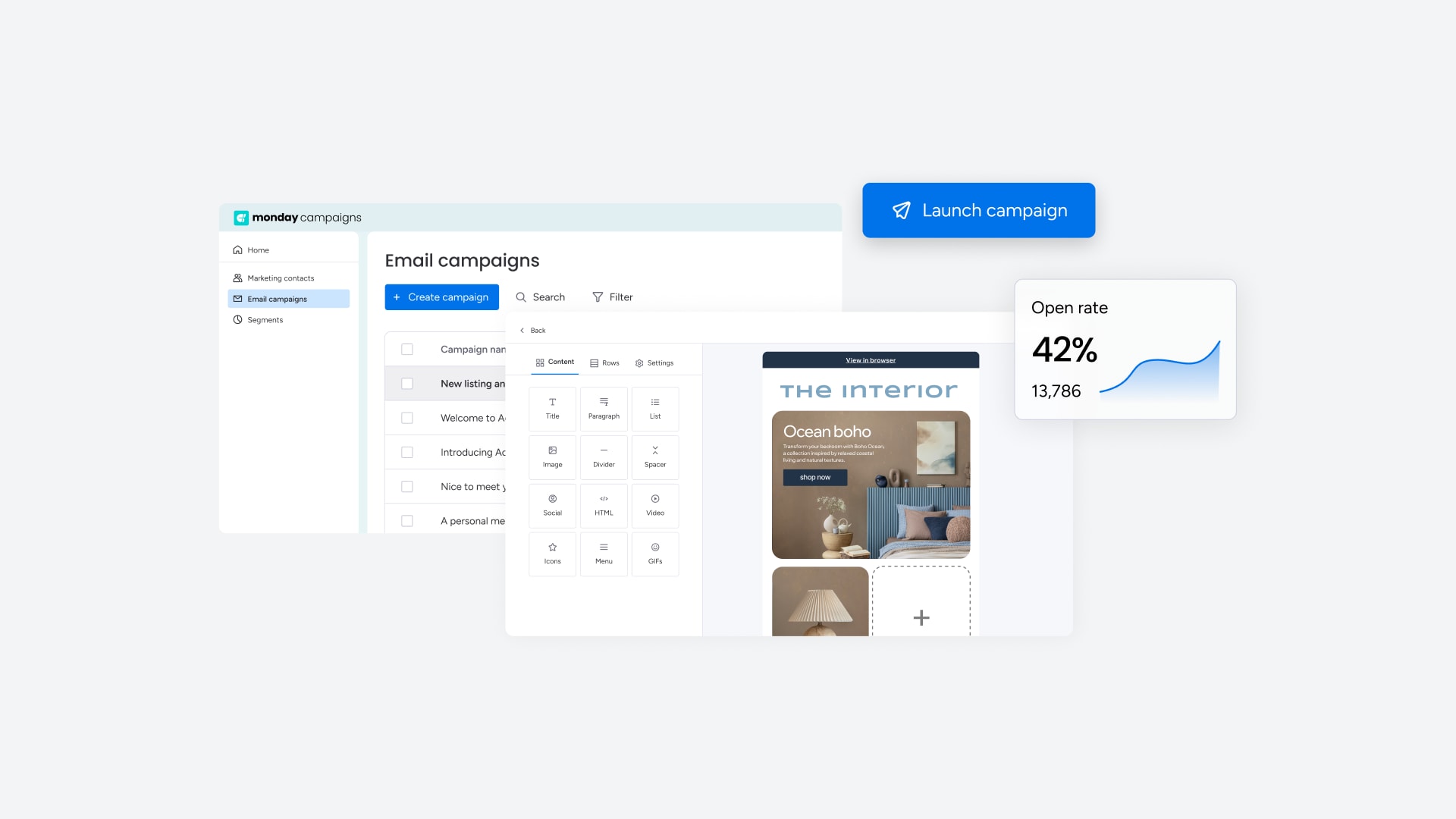
Built into monday CRM, monday campaigns is an AI-powered email marketing platform that combines intelligent campaign creation with native CRM integration and real-time optimization based on sales and customer signals. For marketing teams that want AI to do more than generate subject lines, this native CRM connection makes all the difference.
The platform covers the full campaign lifecycle:
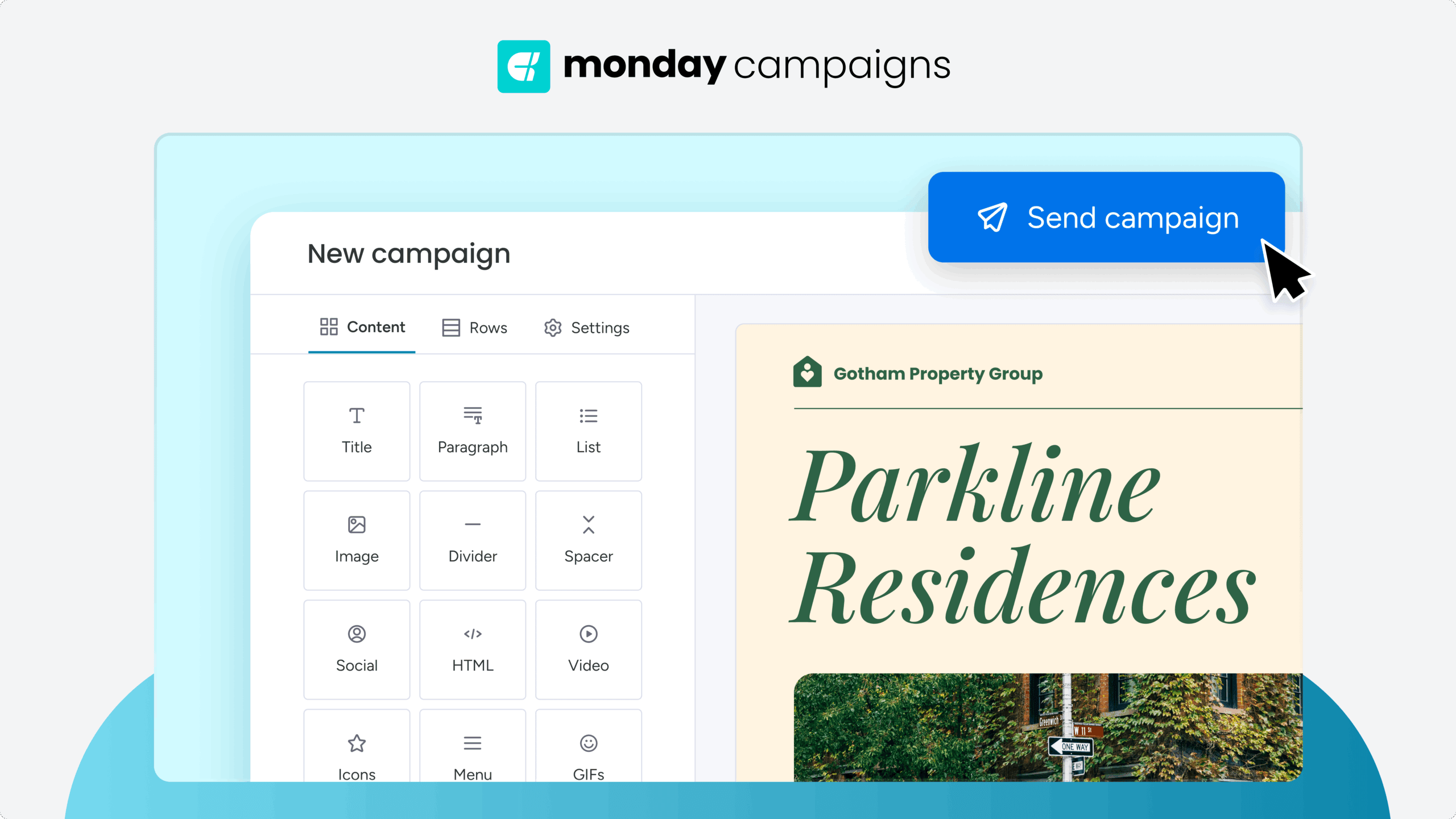
- Build: AI generates email copy, subject lines, and calls-to-action based on campaign goals and brand guidelines, reducing creation time from hours to minutes.
- Target: Dynamic segmentation updates automatically based on CRM data changes, ensuring targeting always reflects the current customer state in real time.
- Launch: Smart scheduling delivers emails at the right moment for each recipient, without manual time-zone management.
- Optimize: Campaign performance connects directly to CRM deal stages and revenue outcomes, enabling marketers to see which emails drive pipeline and closed-won deals.
What the right AI email marketing approach looks like in practice
AI in email marketing is past the hype stage — the platforms and features in this article are available now, measurable, and delivering real results. The teams seeing the strongest outcomes start with clean data, set clear guardrails, connect campaigns directly to revenue, and automate one high-impact feature at a time.
If you’re evaluating platforms or rethinking your email setup, use the criteria in this article to separate genuine AI from rebranded automation. Get started with monday campaigns to see what native CRM integration and real-time optimization look like in practice.
Try monday campaignsFAQs
What is AI in email marketing?
AI in email marketing means intelligent systems that use machine learning, natural language processing, and predictive analytics to automate and optimize email campaigns. These systems generate personalized content, identify optimal send times, create dynamic audience segments, and connect campaign performance to revenue outcomes.
How does AI improve email personalization?
AI improves email personalization by analyzing customer data in real time and assembling content dynamically at the moment of send. Instead of inserting static tokens like first names, AI tailors entire messages based on recent behavior, CRM deal stage, engagement history, and predicted intent.
What's the difference between AI and automation in email marketing?
Automation follows predefined rules that you have to update manually when conditions change. AI learns from data and adapts over time. It finds patterns humans miss and optimizes continuously based on performance.
How do AI email marketing platforms connect to CRM systems?
AI email marketing platforms connect to CRM systems through native integrations or third-party connectors. Native integrations provide real-time data flow, so AI works with current customer information instead of delayed snapshots.
What should I look for when evaluating AI email marketing platforms?
Key evaluation criteria include native CRM integration, brand safety controls and AI transparency, data quality requirements and first-party data access, predictive AI versus rules-based automation, and vendor commitment to ongoing AI development.
How does AI help with email deliverability?
AI improves email deliverability by predicting spam filter behavior, optimizing content for inbox placement, and testing how emails render across clients and devices. These capabilities catch potential deliverability issues before you send, so you can fix them and improve inbox placement rates.

 Get started