


While other channels compete for shrinking attention spans and rising ad costs, email keeps delivering because it’s built on something more durable: direct access to an audience you own, with data you control. That’s why lifecycle and CRM marketers keep choosing email over almost every other channel.
From AI-powered personalization to privacy resilience, email has evolved into one of the most measurable, scalable ways to drive revenue and build lasting customer relationships. We’re breaking down 10 benefits that show why email still wins — and what happens when your campaigns run on live CRM data.
Key takeaways
- Email gives you an audience you actually own — it can’t be taken away by an algorithm change or platform update.
- Email costs stay flat as your list grows, meaning more subscribers translates directly to more revenue without proportional budget increases.
- Set up behavior-triggered sequences once, and they run continuously — delivering the right message to the right person without manual effort.
- Email is built for a privacy-first world, and permission-based, first-party data means email stays effective as third-party tracking disappears and privacy regulations tighten.
- monday campaigns connects your campaigns to real customer data, so every email you send is informed by live customer context.
What is email marketing?

Email marketing is the practice of sending targeted messages straight to people’s inboxes. Unlike social posts lost in endless feeds, these are messages subscribers have asked for, designed to build relationships and bring in revenue.
Email lands in a personal space that people check multiple times daily. In fact, research finds 40% of people check their email before 6 a.m., with nearly a third returning to their inbox around 10 p.m.
The core mechanism works through permission-based communication. Businesses collect email addresses with explicit consent, organize subscribers into segments based on behavior and preferences, and deliver personalized content matching each group’s interests. That trade (useful content for inbox access) is what separates real email marketing from spam.
Marketing teams send various email types throughout the customer journey. Here’s what a typical email marketing program looks like in practice:
| Email type | Purpose | Typical timing |
|---|---|---|
| Welcome emails | Introduce your brand when someone signs up | Immediately after subscription |
| Promotional newsletters | Feature product updates or special offers | Weekly or monthly cadence |
| Abandoned cart reminders | Recover potential lost sales | 1–24 hours after abandonment |
| Post-purchase follow-ups | Build loyalty after a transaction | Days to weeks after purchase |
| Event invitations | Drive registrations and attendance | 2–4 weeks before event |
| Nurture flows | Guide prospects through the buying process | Multi-touch over weeks or months |
| Win-back campaigns | Re-engage inactive subscribers | 60–90 days of inactivity |
| Customer updates | Share important account or product information | As needed or triggered by changes |
Email still wins because it gives you something no other channel can: direct access to an audience you actually own. Social algorithms change and ad costs fluctuate, but an email list stays with you, delivering measurable results that tie directly to revenue.
Why email marketing is still one of the most effective channels.
Social media, messaging apps, new channels — they all compete for attention. But email still outperforms most of them when it comes to results you can actually measure. The reasons? Structural advantages newer channels just can’t copy.
- Direct ownership: Social platforms? One algorithm change and your reach disappears. Email lists? You own them. You control delivery. You have full control over your message delivery.
- Universal accessibility: Every internet user has an email address with no special app required and no platform preference to navigate. That reach crosses demographics, devices, and geographies in ways no single social platform can touch.
- Measurable performance: Opens, clicks, conversions, and revenue attribution create a visible chain from campaign to result. Justifying budget is easy when you can point to exactly which emails drove which sales.
- Cross-generational reach: Gen Z checks email for professional and transactional communication. Baby Boomers rely on it as a primary digital channel — 47% prefer email for customer service, second only to voice calls. That universality makes email essential, not niche.
Where does your email program stand? AI personalization, behavioral triggers, and smart automation have turned batch-and-blast into something far more precise.
Email’s reach remains unmatched. With roughly 4.59 billion email users worldwide, it’s one of the few digital channels that spans virtually every demographic, geography, and device type.
10 benefits of email marketing that drive real ROI.
Email marketing’s staying power isn’t accidental. It’s structural. From owned audiences to AI automation, email delivers advantages that stack up and drive real revenue. Here are 10 reasons marketing and lifecycle teams keep betting on email.
1. High ROI compared to other marketing channels
Email beats most digital channels on ROI. Consistently. The math is simple. Low cost per send. Direct revenue tracking. And you can reach thousands without spending more.
Once you’re set up, sending to 1,000 or 10,000 subscribers costs about the same. Paid ads? Every new impression costs more. That ROI advantage plays out across every campaign type:
- Promotional campaigns: Generate revenue with minimal production costs when sent to segmented audiences.
- Automated sequences: Welcome series, abandoned cart recovery, and re-engagement campaigns run continuously, generating revenue around the clock.
- Customer retention: Regular communication costs far less than acquiring new customers, directly increasing customer lifetime value.
2. Direct access to an owned audience
Email gives you direct access to an audience you own. No third-party platforms. No algorithm changes that tank your reach overnight. When someone subscribes, you control that relationship. You retain their contact information, permission to communicate, and inbox access that no platform can take away.
| Channel | Ownership | Reach control | Data portability | Cost structure |
|---|---|---|---|---|
| Email list | You own it | You control delivery | Fully exportable | Fixed infrastructure |
| Social followers | Platform owns | Algorithm decides | Cannot export | Pay for reach |
| Paid advertising | Rented access | Budget determines | No relationship data | Continuous spend |
Owning your audience creates real value in 2 ways:
- Business continuity: If a social platform changes policies or loses popularity, your email list remains intact.
- Data portability: Export your email list and move to any email platform without losing your audience.
3. Personalization at scale through smart segmentation
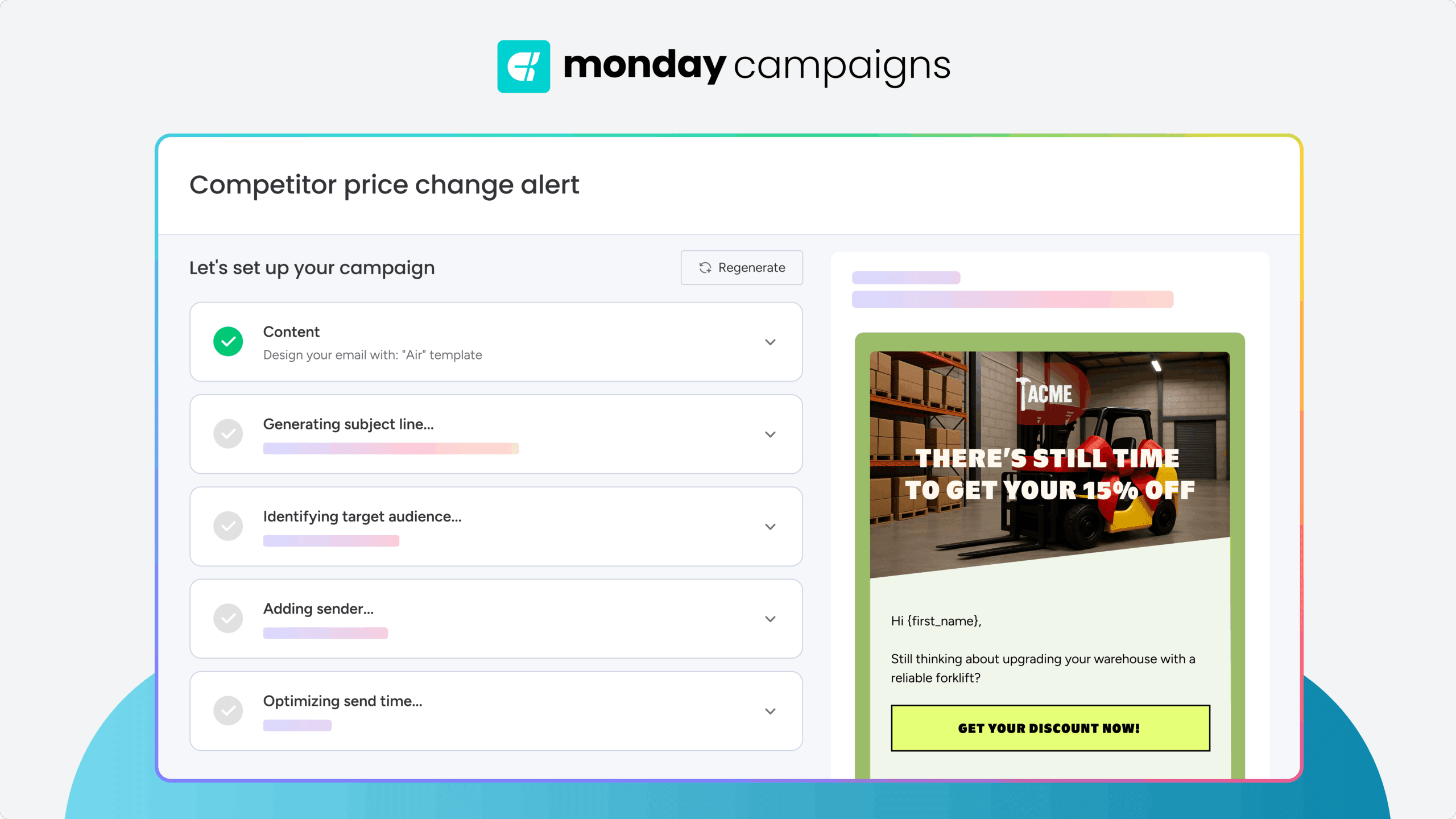
Email lets you send personalized messages to thousands at once. The trick? Segment by behavior, preferences, and customer data. Instead of blasting everyone with the same message, you split your list into groups and tailor content to what each group actually needs.
Segmentation looks different depending on your goals and data:
- Behavioral segmentation: Different messages go to customers who opened your last email versus those who didn’t.
- Purchase history: Recent buyers receive recommendations for complementary products.
- Engagement level: Highly engaged subscribers receive advanced content while new subscribers get introductory material.
- Lifecycle stage: Welcome sequences onboard new subscribers while special incentives win back inactive ones.
Dynamic segments update automatically as your data changes. You set criteria once, and the system continuously identifies the right audience for each message. With monday campaigns, segmentation pulls straight from live CRM data. Your segments update automatically. No manual list rebuilding.
4. Lifecycle automation that runs in the background
Email automation means setting up sequences that trigger based on what customers do or when time passes. Right message, right moment, all fully automated. You build the series once. Then it runs automatically when conditions are met.
The best automation sequences hit the moments that matter most:
- Welcome sequences: New subscribers automatically receive emails introducing your brand and guiding them toward their first purchase.
- Abandoned cart recovery: When someone adds items but doesn’t complete checkout, an automated sequence reminds them.
- Post-purchase follow-up: Automated emails confirm the order, provide shipping updates, and recommend complementary products.
- Re-engagement campaigns: Subscribers who haven’t opened emails in 60–90 days automatically receive a “we miss you” sequence.
Once they’re live, these sequences run 24/7, bringing in revenue while you sleep.
5. Revenue attribution and measurable performance
Email gives you precise data on every interaction, from send to conversion. Every email tracks opens, clicks, conversions, and revenue. You see exactly what drove results.
What metrics should you track, and what do they tell you about performance?
- Campaign revenue: Track exactly how much revenue each email campaign generates, down to individual product sales.
- Conversion tracking: See which email messages drive specific actions like purchases, demo requests, or content downloads.
- Customer journey attribution: Understand email’s role across the entire customer lifecycle.
- Segment performance: Compare how different audience segments respond to campaigns.
When you know what works, double down. When something flops, fix it fast.
6. Cost-effective reach for any business size
Email needs minimal upfront investment and scales without breaking the bank. Small businesses can compete with enterprises on results, not just budget. Paid ads? Reach costs scale with every impression. Email? Costs barely budge as you grow.
- Startups and small businesses: Launch email marketing with minimal investment, building audience and revenue without the prohibitive costs of paid advertising.
- Growing businesses: Your list grows from hundreds to thousands. Costs creep up a little. Revenue potential? It explodes.
7. Stronger customer relationships and retention
Email builds long-term relationships. It’s direct, personal, and keeps your brand in front of customers with value that goes beyond transactions. Building relationships through email looks like this:
- Value-driven content: Regular newsletters that educate, inform, or entertain position your brand as a trusted resource.
- Exclusive access: Email subscribers receive early product launches, special offers, or insider information.
- Personalized communication: Birthday messages, anniversary acknowledgments, and milestone celebrations show customers you recognize them as individuals.
Retention compounds. The value adds up fast. Engaged customers buy more often, spend more per order, and bring in referrals.
Try monday campaigns8. Faster campaign launches with AI
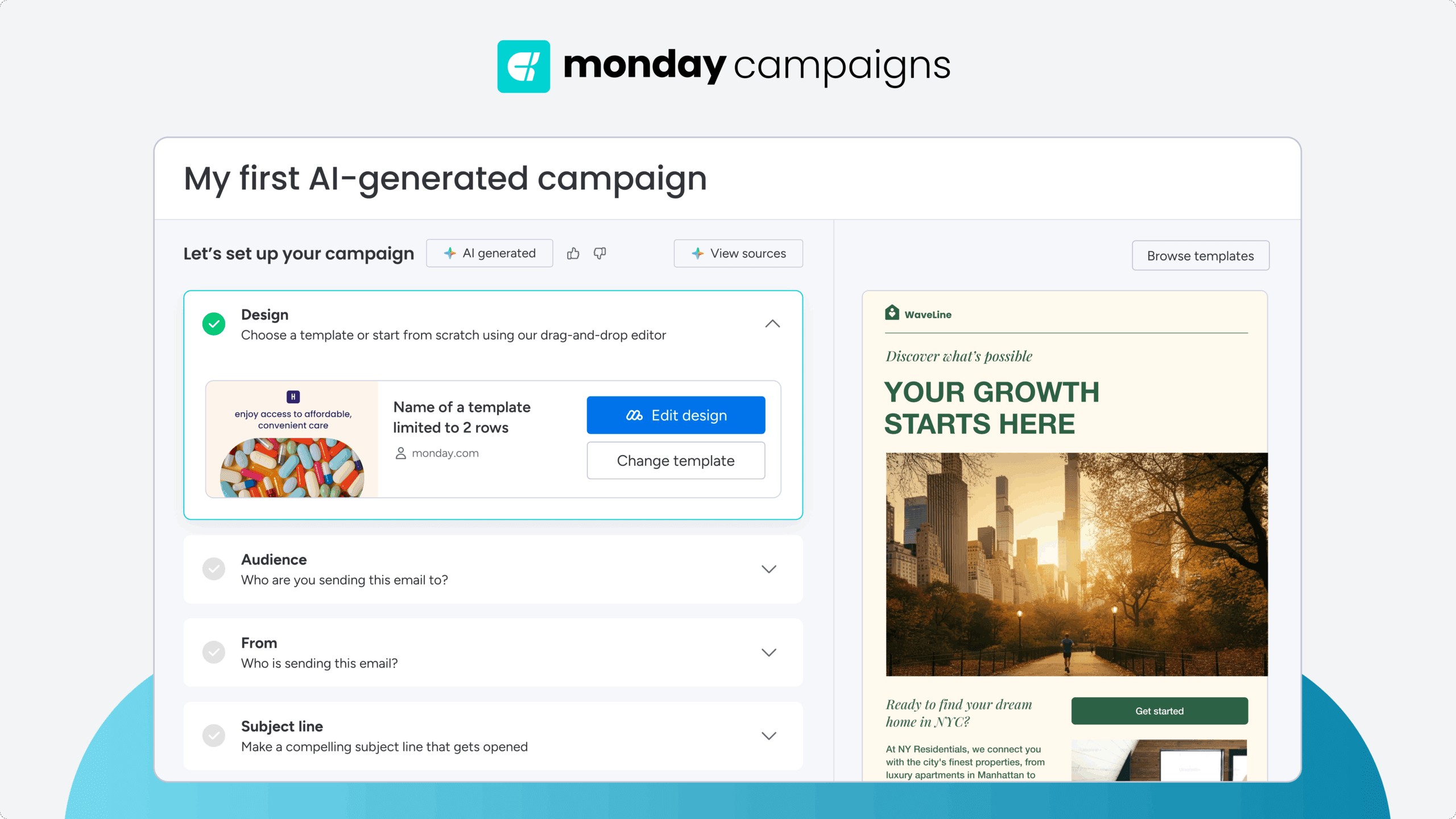
AI handles the time-sucks: copywriting, subject lines, audience targeting, and figuring out when to hit send. Indeed, 66% of workers say AI lets them spend more time on high-value work — capacity that translates directly into faster campaign launches and more precise targeting. Instead of writing subject line after subject line or analyzing which segments to target, AI does it automatically based on past performance.
Speed up email marketing with AI, which:
- Drafts email copy, suggests subject lines, and creates variations for A/B testing
- Analyzes customer data to automatically identify high-value segments
- Determines the optimal send time for each individual subscriber
- Forecasts campaign performance before sending
monday campaigns uses AI for content creation, audience targeting, and optimization. AI writes copy, suggests segments from CRM data, and checks brand consistency. Advanced capabilities, accessible to any team size.
59% of global marketers say AI-powered personalization and optimization will be the marketing trend with the biggest impact on their work (Nielsen)
9. Marketing and sales alignment in one funnel
Email connects marketing and sales. Both teams see prospect engagement, coordinate outreach, and create a smooth experience from first touch to closed deal. Siloed vs. aligned? The difference is huge:
| Traditional approach | Aligned approach |
|---|---|
| Marketing sends leads and hopes for the best | Marketing sees which leads convert and why |
| Sales lacks context on prospect interests | Sales knows exactly what prospects engaged with |
| Duplicate outreach frustrates prospects | Coordinated communication respects the relationship |
| Attribution disputes between teams | Shared visibility creates shared accountability |
monday campaigns connects natively with monday CRM, so marketing and sales stay aligned automatically. Campaign performance and lead tracking live in one place. Teams see the full journey, from lead to loyal customer.
10. Resilience in a privacy-first inbox
Privacy regulations are tightening. Third-party tracking is fading. Email’s foundation on permission-based, first-party data makes it one of the most resilient channels out there. GDPR, CCPA, browser changes killing third-party cookies, platform privacy features — they’re all reshaping digital marketing.
Email stays resilient because of its permission-based foundation, where every subscriber has actively chosen to receive your messages. Additionally, first-party data ownership ensures information you collect directly from subscribers remains fully accessible and usable.
4 ways AI amplifies the advantages of email marketing

AI doesn’t just speed up email marketing. It makes the whole channel smarter. AI handles audience targeting and performance analysis. Your team focuses on strategy and creative. Here’s where it matters most:
- Smart audience segmentation: Analyze customer data to find patterns and high-value segments you’d miss manually. It scores subscribers by engagement likelihood and detects behavioral patterns for precise targeting.
- On-brand copy and subject lines: Generate campaign content, subject lines, and variations that match your brand voice. Marketers start with solid drafts instead of blank pages, then refine for maximum impact.
- Predictive send-time optimization: Determine the best send time for each subscriber based on their past engagement. No more one-size-fits-all blasts—each email arrives when that person is most likely to open it.
- Automated performance insights: Review results and surface what matters without manual digging. It flags performance anomalies and identifies patterns between campaign elements and outcomes.
Why monday campaigns is built for modern email marketing
Email marketing delivers results when campaigns connect to real customer data. monday campaigns is built directly on monday CRM, which means every email you send pulls from live customer context — no syncing delays, no disconnected platforms, just marketing that knows exactly where each contact stands.
Here’s what makes monday campaigns different:
- Native CRM integration: Campaigns run on the same platform as your sales pipeline, so marketing and sales stay aligned automatically without manual handoffs or data exports.
- Live customer data: Segment audiences based on deal stage, recent activity, or any CRM field — segments update in real time as customer data changes.
- AI-powered content creation: Generate on-brand copy, subject lines, and campaign variations that match your voice, turning blank pages into solid drafts in seconds.
- Behavioral automation: Trigger sequences based on CRM updates, customer actions, or lifecycle milestones — the right message reaches the right person at exactly the right moment.
- End-to-end attribution: Track campaign performance from first touch to closed deal, connecting marketing efforts directly to revenue outcomes.
- Unified workspace: Marketing, sales, and customer success teams work from the same platform, eliminating silos and creating visibility across the entire customer journey.
monday campaigns makes sophisticated email marketing accessible to teams of any size. Advanced capabilities without the complexity, built on a platform your team already knows.

"With monday campaigns, we can launch professional emails in minutes and instantly see who engaged. Our sales team follows up directly with those showing interest - making outreach faster and more effective."
Michael Fitzpatrick | National Workplace Training ManagerEmail marketing works and here's how to make it work for you
Email’s advantages stack up. Owned audiences, measurable ROI, AI personalization, and privacy resilience don’t just coexist. They reinforce each other. The teams winning treat email as the thread connecting marketing, sales, and the entire customer lifecycle.
The shift from batch-and-blast to smarter, behavior-driven communication is already happening. First automated sequence or mature program? The fundamentals stay the same. Know your audience. Send the right message at the right time. Measure everything.
Platforms like monday campaigns make this work at any scale. Campaign performance connects straight to CRM data, so every email pulls from real customer context.
Try monday campaignsFAQs
What does an email marketer do?
Email marketers handle strategy, segmentation, campaign creation, testing, and analysis. They write messaging that resonates with different segments, build automation, track performance, and optimize based on what works.
What are the most effective email marketing strategies?
The best email strategies? Segment by behavior and preferences. Automate lifecycle communication. Personalize with customer data. A/B test constantly. Align marketing and sales around shared goals.
How do I create an email marketing strategy?
Building an email strategy? Five steps. Define goals and metrics. Understand your audience through data. Map the customer journey. Pick a platform that connects campaigns to customer data. Set up measurement and optimization.
Is email marketing still effective in 2026?
Email still works because it gives you direct access to an owned audience, delivers measurable ROI, and runs on first-party data that fits privacy regulations. AI has made personalization and optimization easier to pull off.
Why is email marketing important for small businesses?
Email marketing is important for small businesses because it requires minimal upfront investment, scales efficiently, and allows smaller teams to compete with larger competitors on effectiveness rather than budget. The cost structure means reaching more subscribers doesn't proportionally increase costs.
How does email marketing help with customer retention?
Email marketing helps with customer retention by maintaining consistent communication between purchases, delivering ongoing value through educational content, recognizing customers through personalized messages, and proactively addressing needs before customers disengage.

 Get started