


Your sales team closes a deal, and marketing has no idea which emails helped get it there. Meanwhile, marketing sends a campaign, and sales never sees who engaged. Most sales email automation platforms fall short because they can’t connect email activity to revenue outcomes. They track opens and clicks, but they can’t tell you which campaigns actually drive pipeline.
Sales email automation tools bridge this gap by connecting every send directly to your CRM and measuring what moves deals forward. The right platform does more than schedule follow-ups. You get real-time visibility into buying signals. Responses automate based on lead behavior. And you see exactly which touchpoints influence closed-won deals. We’re breaking down 15 sales email automation platforms built for revenue teams in 2026, covering the features that separate revenue drivers from basic email blasters, pricing models, and a 5-step process for building automation that actually impacts your pipeline with platforms like monday campaigns.
Try monday campaignsWhat sales email automation software does for revenue teams
Sales email automation isn’t about blasting emails and hoping for the best. It connects every send to your pipeline and measures what drives revenue. The focus shifts from vanity metrics like open rates to real business outcomes.
Marketing platforms prioritize long-term engagement, while sales automation is built for speed: real-time CRM syncing means your team catches buying signals as they happen, not hours later. Every interaction stays timely, relevant, and pushes deals forward.
Responding to a lead within 5 minutes can increase conversion rates by up to 400%. Most teams can’t keep up, but a smart automation platform can.
A smart system automates follow-ups based on real-time lead behavior, turning missed opportunities into closed deals.
7 features that separate revenue-driving platforms from email blasters
Guessing which campaigns make money is exhausting. Your email platform should do more than send emails; it should drive revenue. Basic email blasters track opens and clicks. A true revenue platform? It connects every campaign to sales outcomes and gives your team the intelligence to close deals faster.
Deep CRM integration that goes beyond basic syncing
Most integrations are just slow, scheduled data syncs. Your team ends up working with stale data. Your sales team ends up a step behind, discovering lead engagement hours too late. A lot can change in a few hours.
True integration isn’t a sync. It’s your CRM and campaign platform operating as one system.
- Instant reflection: Every action reflects instantly, connecting campaign touches to closed deals without manual work.
- Single source of truth: No delays. No data gaps. Your team always has the latest context.
AI that works today, not tomorrow

Vague promises about future AI capabilities won’t help you hit this quarter’s numbers. Real AI delivers value now. It automates optimization without replacing your strategy. You get results now, not years from now.
- Smart scheduling: Automatically find the perfect send time for each person on your list.
- Automated testing: A/B test subject lines and scale the winner for you instantly.
- Focus on strategy: Let AI handle the repetitive work so you can focus on the big picture.
Multi-channel orchestration
Your customers live on more than one channel. Your campaigns should too. A revenue platform coordinates every touchpoint (email, SMS, social) into one unified campaign. Mixed messages disappear. You reach people on their preferred channels.
Running separate activities across channels creates chaos. Messages conflict. Timing’s off. The platform manages one cohesive sequence and adjusts in real time. Lead ignores an email but engages on LinkedIn? The campaign shifts channels automatically.
Deliverability infrastructure
Brilliant campaigns are worthless in the spam folder. Strong deliverability is non-negotiable for revenue. It requires serious infrastructure. This technical foundation gets your message seen.
- Managed reputations: Keep your sender reputation pristine to avoid spam filters.
- Proper authentication: Ensure your domain is verified and trusted by major inbox providers.
- Smart bounce management: Automatically clean your lists to maintain high deliverability rates.
Real-time lead intelligence
Guessing what leads are thinking wastes time. A smart platform gives your sales team instant alerts on buying signals the moment a prospect visits the pricing page or re-engages with an old email. Generic follow-ups become timely, relevant conversations.
Revenue attribution
Vanity metrics don’t pay the bills. One question matters: which campaigns drive revenue? True attribution connects every marketing touchpoint to closed-won deals. You see what’s working so you can stop funding campaigns that generate clicks but no cash.
Enterprise-grade compliance
Compliance isn’t just a legal checkbox. It builds trust and protects your business as you grow. Enterprise-grade platforms automate consent management and unsubscribe handling. These automated safeguards prevent costly mistakes so that you can scale email programs without compliance risk.
15 best sales email automation tools for revenue teams
Choosing a sales email automation tool means wading through endless promises. The real test? What your team needs to hit its numbers and drive revenue. Options range from simple email builders to full revenue operations platforms. Some focus on intricate automation, while others prioritize connecting marketing to sales outcomes.
| Platform | Starting price | Primary strength | CRM integration | AI features |
|---|---|---|---|---|
| monday campaigns | Consumption-based | Native CRM integration with AI-powered campaign intelligence | Native monday CRM connectivity with real-time sync | Campaign generation, audience segmentation, send-time optimization, content personalization |
| ActiveCampaign | $29/month | Advanced automation workflows and behavioral triggers | Third-party integrations with major CRMs | Predictive sending, content recommendations |
| HubSpot | Free tier available; Sales Hub starts at $45/month | Comprehensive sales and marketing suite | Native HubSpot CRM | Lead scoring, email optimization |
| Brevo | Free tier available; Starter at $25/month | SMS integration and transactional email | API integrations with major CRMs | Send-time optimization, subject line generation |
| Mailchimp | Free tier available; Essentials at $13/month | User-friendly interface and audience segmentation | Basic CRM integrations | Content recommendations, subject line helper |
| Omnisend | Free tier available; Standard at $16/month | E-commerce automation and multi-channel workflows | E-commerce platform integrations | Product recommendations, send-time optimization |
| MailerLite | Free tier available; Growing Business at $10/month | Simplicity and affordability | Basic CRM integrations | Limited AI features |
| Klaviyo | Free tier available; Email starts at $20/month | Data-driven segmentation and e-commerce focus | E-commerce platform integrations | Predictive analytics, product recommendations |
| Mixmax | $34/user/month | Gmail integration and sales engagement features | Salesforce integration | Email tracking, scheduling optimization |
| Kit | Free tier available; Creator at $25/month | Creator economy focus and simple automation | Limited CRM integrations | Basic automation recommendations |
| GetResponse | $19/month | Webinar integration and landing pages | Third-party CRM integrations | Email subject line suggestions |
| Apollo.io | Free tier available; Basic at $49/user/month | B2B prospecting database and sales intelligence | Native CRM with third-party integrations | Lead scoring, email optimization |
| Outreach | Custom pricing | Enterprise sales engagement platform | Deep Salesforce integration | Conversation intelligence, sequence optimization |
| Salesloft | Custom pricing | Sales development and conversation intelligence | Salesforce and Microsoft Dynamics integration | AI-powered coaching, email recommendations |
| Lemlist | $59/user/month | Personalization at scale for cold outreach | Third-party CRM integrations | Image personalization, icebreaker generation |
Features alone don’t separate these tools. Their core approach does. Many platforms treat email as a separate function. Others unify marketing and sales, connecting campaign performance to revenue through native CRM integration.
1. monday campaigns
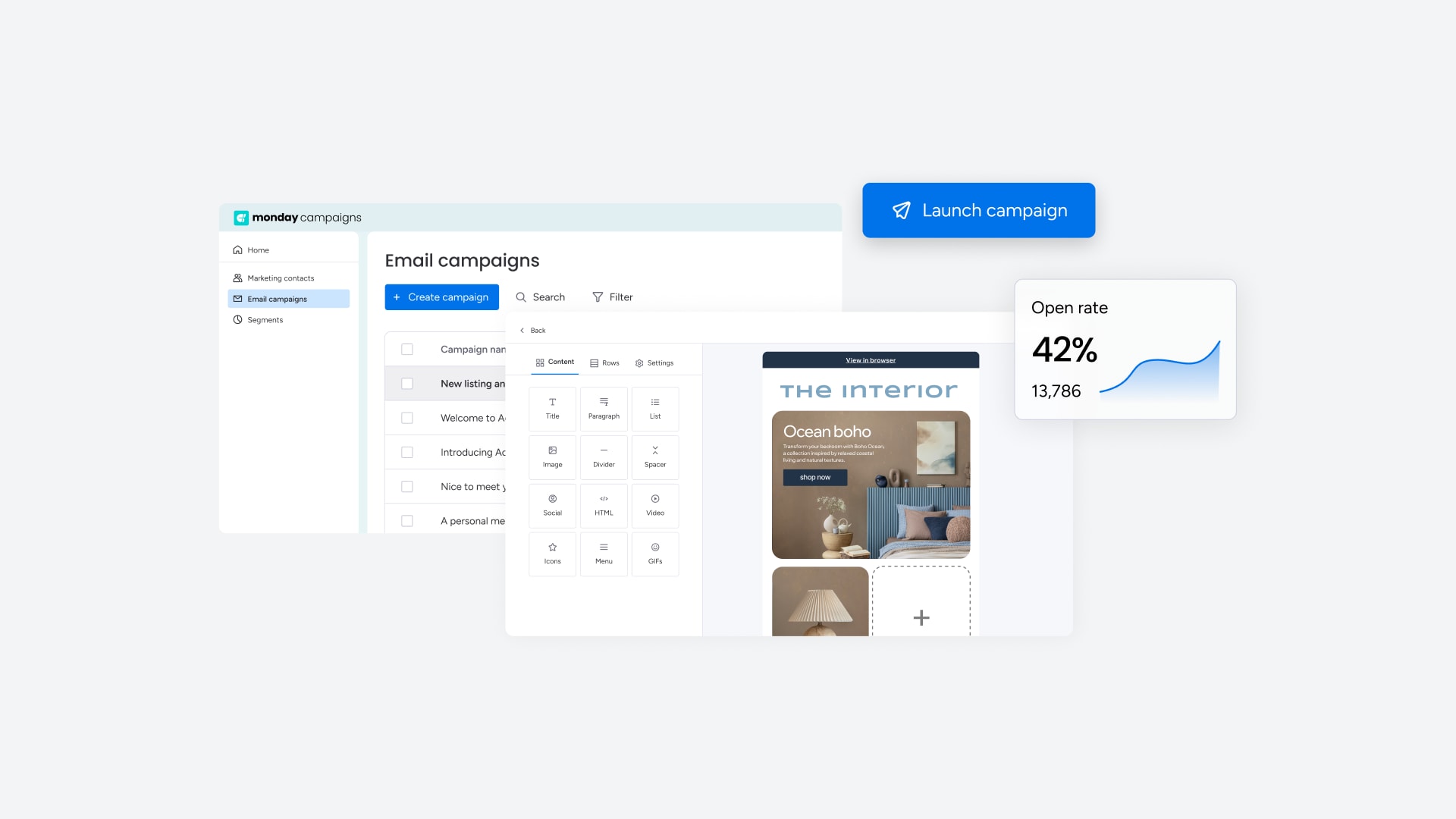
monday campaigns connects marketing and sales in one unified platform, transforming sales email automation. The platform specializes in CRM-native automation that eliminates data silos. Perfect for revenue teams seeking seamless marketing-sales coordination. Built specifically for revenue teams, not adapted from marketing platforms. monday campaigns delivers AI-powered campaign creation, insightful analytics, and native CRM integration.
Use case:
Revenue teams seeking unified marketing-sales operations. You get AI-enhanced campaign creation, clear analytics, and native CRM connectivity that eliminates data silos and accelerates pipeline growth.
Key features:
- AI-powered campaign creation: Generate complete email sequences, subject lines, and content variations based on campaign objectives and audience characteristics. Campaign creation time drops from hours to minutes.
- Native monday CRM integration: Real-time, two-way data sync eliminates manual data entry. Marketing and sales teams work from the same information.
- Intelligent automation: Trigger campaigns based on CRM updates, lead behavior, deal stage changes, and custom conditions without complex workflow builders.
Pricing:
- Pricing model: Features a flexible, consumption-based model that scales with your campaign volume and success, so you only pay for what you use.
- Free trial: A 14-day free trial is available with no credit card required.
Why it stands out:
- CRM-triggered automation: Campaigns automatically adjust based on deal stage changes and lead scoring thresholds, creating tight marketing-sales coordination that accelerates pipeline velocity.
- Revenue attribution built-in: Track campaign performance alongside pipeline metrics and sales outcomes in unified dashboards, connecting email engagement directly to closed deals.
- Real-time engagement visibility: Campaign interactions automatically log to contact timelines in monday CRM, giving sales teams immediate insight for timely follow-up without leaving their workflow.
2. ActiveCampaign
ActiveCampaign delivers sophisticated email automation that responds to complex behavioral triggers and customer actions. The platform specializes in creating multi-step nurture sequences that adapt based on prospect engagement, making it particularly effective for B2B companies with longer sales cycles. Their visual automation builder enables highly personalized sequences that feel one-to-one despite running at scale.

Use case:
Small to mid-size B2B companies managing complex nurture sequences with multiple decision points and behavioral triggers.
Key features:
- Visual automation builder with decision trees based on email engagement, website behavior, and CRM data
- Automated 1:1 emails sent from individual rep inboxes (Gmail/Outlook) with personalization and tracking
- AI-powered features including predictive sending, win probability scoring, and content optimization
Pricing:
- Starter: From $15/month (for under 1,000 contacts)
- Plus: Mid-tier pricing with enhanced automation features
- Pro: Advanced features with increased email send limits
- Enterprise: Custom pricing for large organizations
- Enhanced CRM features (Sales Engagement, Pipelines) available as add-ons
- Annual billing discounts available
- 14-day free trial and 30-day money-back guarantee
Considerations:
- Automated 1:1 emails are text-only with no visual design options and capped at 500 emails per day per connected mailbox
- Many advanced sales automation features require the Enhanced CRM add-on, increasing overall costs beyond base plan pricing
3. HubSpot
HubSpot delivers comprehensive sales and marketing automation through its integrated customer platform, combining CRM, email sequences, and analytics in one system. The platform targets businesses of all sizes with a core focus on mid-market companies looking to consolidate their sales stack. Over 288,000 customers worldwide use HubSpot as an all-in-one alternative to managing multiple separate tools.

Use case:
Companies wanting comprehensive sales and marketing automation in one platform, particularly those starting without existing CRM or marketing infrastructure.
Key features:
- Send automated email follow-ups that unenroll contacts upon reply. Available on Professional and Enterprise plans; workflow-driven enrollment is an Enterprise-only feature.
- Optimize your outreach with built-in A/B testing and step-level reporting. Deal rate tracking and revenue attribution are available on the Enterprise plan.
- Email automation is tied directly to CRM contact records, deal stages, and sales pipeline management with real-time notifications.
Pricing:
Note: The Sequences feature is only available on the Sales Hub Professional and Enterprise plans.
- Sales Hub Starter: $20/month per seat
- Sales Hub Professional: $100/month per seat
- Sales Hub Enterprise: $150/month per seat (annual billing required)
- Free tier: Basic email capabilities with limited automation features
- Sales Hub Enterprise onboarding: $3,500 one-time fee required
- Nonprofit discount: 40% off Professional or Enterprise tiers for eligible organizations
- Startup discount: 30-90% off first year through HubSpot for Startups program
Considerations:
- Daily send limits cap sequences at 500 emails per day (Professional) or 1,000 per day (Enterprise) with no option to increase.
- Manual sequence steps cannot be bulk-completed, creating additional workload for high-volume outreach campaigns.
4. Brevo
Brevo unifies promotional campaigns, transactional messaging, and sales outreach in one comprehensive platform. Multi-channel automation that seamlessly switches between email and SMS based on engagement patterns makes it perfect for businesses needing coordinated messaging across touchpoints.

Use case:
Small to medium businesses running multi-channel campaigns that combine promotional email with SMS outreach and transactional messaging.
Key features:
- Multi-channel automation that coordinates email and SMS campaigns with intelligent channel switching based on engagement
- Transactional email capabilities that merge marketing campaigns with operational communications like order confirmations and shipping notifications
- AI-powered sales assistance that generates follow-up emails from call transcripts and provides one-click data enrichment
Pricing:
- Free: Forever plan for individuals with 300 emails per day
- Starter: Designed for single users starting with email marketing, this plan includes 5,000 emails monthly
- Standard: From $18/month including marketing automation, A/B testing, and advanced reporting
- Professional: From $499/month for 150,000+ emails with multi-user access, WhatsApp integration, and AI features
- Enterprise: Custom pricing with SSO, dedicated IP, and enterprise support
- Annual billing offers a discount on standard paid plans
Considerations:
- Advanced outreach sequences require the Sales Advanced add-on, which increases costs for teams needing full sales automation capabilities
- Individual mailbox connections are limited to three per user, which may restrict teams managing multiple email accounts
5. Mailchimp
Mailchimp helps growing businesses turn email marketing into a revenue driver with user-friendly automation. E-commerce-focused campaigns shine here, with AI-powered tools personalizing customer messages effectively. Over 300 integrations and reliable deliverability make setting up automated workflows like welcome emails and abandoned cart reminders straightforward — no technical background required.

Use case:
Small businesses and ecommerce companies needing straightforward email campaigns with basic automation and audience segmentation.
Key features:
- Pre-built automation flows for welcome sequences, abandoned cart recovery, and customer win-back campaigns
- AI-assisted content generation and predictive segmentation to personalize messaging at scale
- Cross-channel capabilities combining email and SMS marketing with ecommerce triggers
Pricing:
- Free: Up to 500 contacts with single-step automations; multi-step journeys require a paid plan
- Essentials: Starting at $13/month with basic automations and A/B testing
- Standard: Starting at $20/month with enhanced automations, dynamic content, and predictive segmentation
- Premium: Starting at $350/month with multivariate testing and priority phone support
- 15% nonprofit discount available with verification
- Transactional Email available as an add-on for Standard and Premium plans
- SMS marketing available as an add-on to paid plans in select countries
Considerations:
- Advanced automation features are plan-gated, with Send Time Optimization unavailable on automated emails
- Pricing scales with contact count and sends, potentially creating unexpected overages for growing lists
6. Omnisend
Omnisend delivers comprehensive e-commerce automation with pre-built workflows that turn shopping behaviors into revenue-driving campaigns. Unified email, SMS, and push notification automation makes it ideal for online retailers coordinating multi-channel customer journeys. Deep e-commerce integrations and behavior-triggered flows transform browsing patterns and purchase data into personalized customer experiences.

Use case:
Online retailers and e-commerce businesses automating customer lifecycle campaigns from acquisition through retention with coordinated email and SMS workflows.
Key features:
- Pre-built e-commerce automation templates for abandoned cart recovery, post-purchase sequences, and customer win-back campaigns
- Multi-channel workflow builder that coordinates email, SMS, and push notifications in a single automation
- Dynamic product recommendations and personalized content blocks that adapt to customer browsing and purchase history
Pricing:
- Free: Up to 250 contacts and 500 emails/month with basic automations included
- Standard: Starts at $16/month for up to 500 contacts with 24/7 support
- Pro: Starts at $59/month for up to 2,500 contacts with unlimited emails and monthly SMS credits equal to plan price
- Enterprise: Custom pricing with unlimited emails, personalized content, and dedicated account management
- 30% discount available for first three months when paying quarterly upfront
Considerations:
- Abandoned cart automations require identified contacts, limiting targeting of anonymous visitors until they’re recognized
- Pricing tiers auto-adjust monthly based on “billable contacts,” which can increase costs as store activity grows beyond subscriber counts
7. MailerLite
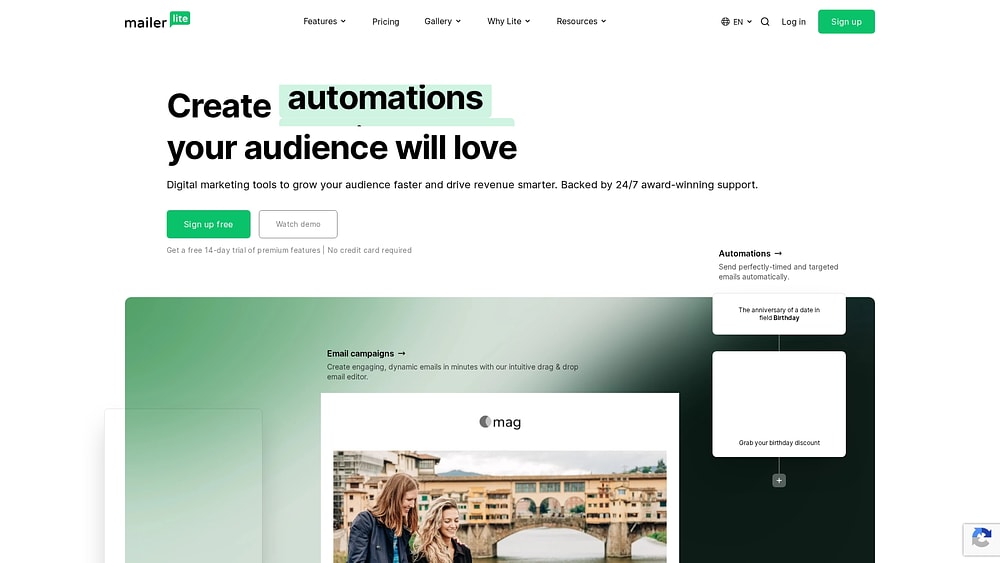
MailerLite delivers straightforward email automation designed for small businesses and creators who value simplicity over complexity. Drag-and-drop builders and pre-built automation templates make email marketing accessible, serving over 1 million users worldwide. Unlimited sends on paid plans and 24/7 support remove common barriers that prevent small teams from implementing effective email automation.
Use case:
Small sales teams and creators who need reliable email automation without the learning curve or high costs of enterprise platforms.
Key features:
- Multi-trigger automations that allow up to three entry conditions per workflow, including e-commerce triggers for abandoned cart recovery
- AI-powered Smart Sending that optimizes email delivery times based on subscriber behavior patterns
- Real-time automation reporting with 30-day attribution tracking for email-driven purchases and conversions
Pricing:
- Free: $0/month for up to 500 subscribers (12,000 monthly emails, automation builder included)
- Growing Business: Starting at $10/month (unlimited emails, 3 seats, 24/7 email support)
- Advanced: Starting at $20/month (unlimited emails, unlimited seats, Smart Sending, enhanced automations)
- Enterprise: Custom pricing for 100K+ subscribers (dedicated success manager, optional dedicated IP)
- 10% discount when billed annually
- 30% nonprofit discount available
Considerations:
- Not suitable for cold outbound campaigns due to strict anti-spam policies requiring provable subscriber permission
- Limited CRM capabilities compared to dedicated sales platforms, relying on third-party integrations for advanced pipeline management
8. Klaviyo
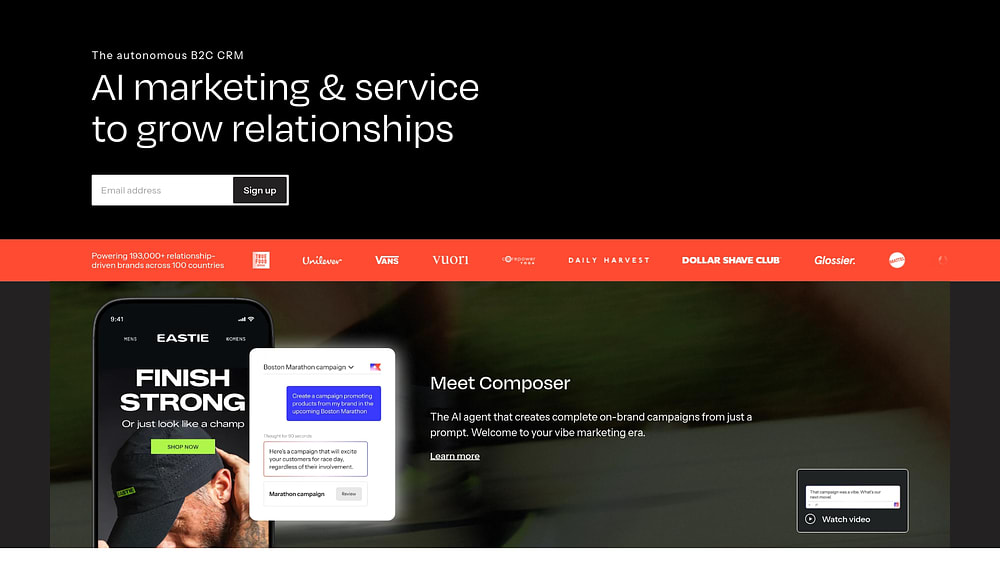
Klaviyo transforms customer data into revenue-driving email campaigns through advanced segmentation and behavioral targeting. E-commerce automation is the specialty here, perfect for consumer brands needing sophisticated personalization at scale. Deep integrations across 350+ platforms and AI-powered insights help brands turn every customer interaction into actionable marketing intelligence.
Use case:
E-commerce companies with large product catalogs that need sophisticated behavioral targeting and lifecycle marketing to drive revenue through personalized customer experiences.
Key features:
- Advanced behavioral segmentation based on purchase history, browsing patterns, and predictive analytics for highly targeted campaigns
- Pre-built e-commerce flows including abandoned cart recovery, browse abandonment, back-in-stock alerts, and price drop notifications
- AI-powered product recommendations and personalized content that adapts to individual customer preferences and shopping behavior
Pricing:
- Free plan: Up to 250 profiles, 500 emails/month, 150 mobile message credits
- Paid plans: Scale by active profile count with email send allowances (pricing varies by profile volume)
- Enterprise: Custom packaging with advanced products, services, and support (quote-based)
- Add-ons: SMS/WhatsApp credits, Customer Hub ($20/month), Helpdesk ($10/month), Marketing Analytics ($100/month)
Considerations:
- Primarily designed for B2C e-commerce brands, limiting value for B2B sales teams without e-commerce components
- Pricing based on “active profiles” can increase costs as contact lists grow, even for non-subscribers captured at checkout
9. Mixmax
Mixmax transforms Gmail and Outlook into powerful sales engagement platforms with native automation, tracking, and AI-powered insights. Inbox-centric workflows make it ideal for sales teams who prefer executing outreach directly from their email interface. Context switching disappears while sophisticated sequencing and analytics capabilities appear.

Use case:
Sales teams using Gmail or Outlook who want to add automation, tracking, and AI-assisted outreach without leaving their familiar email environment.
Key features:
- Multi-channel sequences with email, phone, SMS, and LinkedIn steps that automate follow-ups based on recipient behavior
- Interactive email enhancements including polls, surveys, and CTA buttons that drive higher engagement rates
- Deep Salesforce integration with inbox-based CRM updates, automated lead creation, and comprehensive Insights reporting
Pricing:
- Free: Email tracking, meeting scheduling, and basic sequences (after 14-day trial)
- Inbox Copilot: $29/month (annual) or $34/month (monthly)
- Meeting Copilot: $29/month (annual) or $34/month (monthly)
- Engagement Copilot: $49/month (annual) or $65/month (monthly)
- Mixmax Suite: $89/month (annual) or $105/month (monthly) — includes all three Copilots
- Mixmax for Teams: Custom pricing for teams of 5+ with enterprise features
- Annual billing provides 15-25% discounts across all plans
- Add-ons available for extra sequence capacity beyond 1,500 recipients/month and dialer functionality
Considerations:
- Daily sending limits and rate restrictions may require spreading large campaigns across multiple days
- Outlook feature parity still developing — some views like Outbox currently have limited functionality compared to Gmail
10. Kit
Kit transforms subscriber journeys into hands-off revenue with visual automation workflows designed specifically for creators. Purchase-aware automations and integrated commerce make it ideal for content creators monetizing their audience without technical complexity.

Use case:
Content creators, course sellers, and creator economy businesses can automate subscriber communications and product delivery while maintaining personalized engagement throughout the customer journey.
Key features:
- Visual automation builder with drag-and-drop workflows, conditional logic, and purchase-based triggers
- Commerce-aware automations that automatically remove purchasers from sales sequences and trigger post-purchase flows
- Native selling capabilities with embedded “buy now” buttons in emails and integrated payment processing
Pricing:
- Newsletter (Free): $0/month for up to 10,000 subscribers with 1 basic automation
- Creator: Starts at $33/month for up to 1,000 subscribers with unlimited automations and sequences
- Pro: Starts at $66/month for up to 1,000 subscribers with advanced analytics and priority support
- Annual billing includes two months free
- Commerce fees of 0.6% plus standard payment processing fees
Considerations:
- Limited to creator-focused workflows, lacking deep CRM integration and enterprise-grade analytics needed for traditional B2B sales teams
- Visual automations are not retroactive and subscribers must enter workflows after activation
11. GetResponse
GetResponse delivers comprehensive email automation with integrated webinar hosting and landing page creation. E-commerce automation workflows shine here, especially for businesses combining email marketing with webinar programs. Predictive delivery features and a reported 99% deliverability rate help support revenue-critical sequences.

Use case:
Companies combining email marketing with webinar programs who want integrated platforms for the complete webinar lifecycle — from promotional emails to post-event follow-up.
Key features:
- Visual drag-and-drop automation builder with 40+ prebuilt templates for abandoned cart, post-purchase, and win-back campaigns
- Predictive send-time optimization with “Perfect Timing” and localized “Time Travel” scheduling
- Native ecommerce integrations with product recommendations, promo-code sync, and cart content recovery
Pricing:
- Free: 14-day premium trial, then limited free version with 500 contacts and basic features
- Starter: $19/month for 1,000 contacts with core email, forms, and one automation workflow
- Marketer: $59/month for 1,000 contacts with unlimited automation workflows and advanced ecommerce features
- Creator: $69/month for 1,000 contacts adding webinars and monetization capabilities
- Enterprise (MAX): Custom pricing with SMS marketing and dedicated support
- Annual prepay offers ~18% discount; 50% discount available for charities and NGOs
Considerations:
- Starter plan restricts users to only one automation workflow, requiring an upgrade for multiple campaigns
- Transactional emails are a paid add-on available only for MAX² accounts
12. Apollo.io
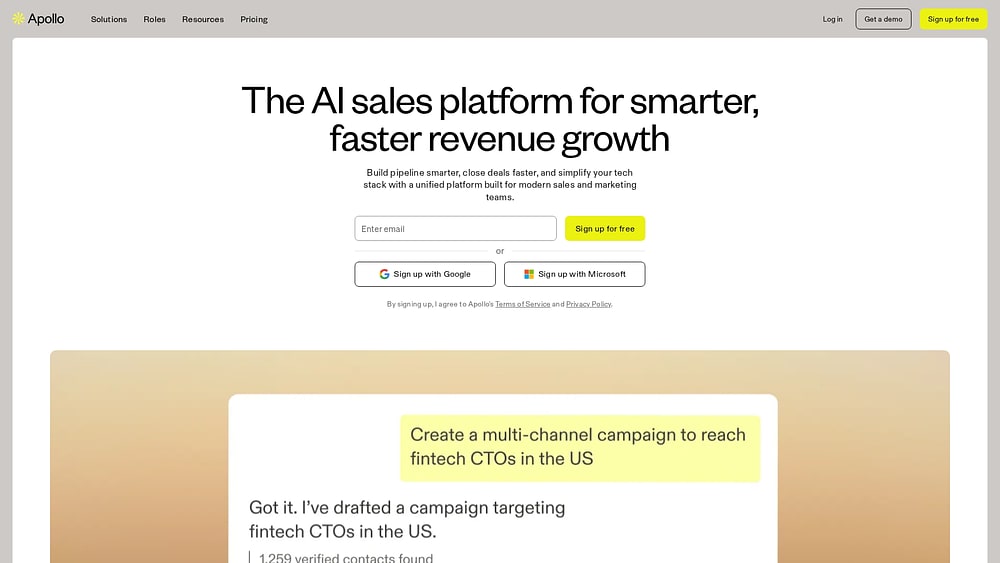
Apollo.io combines a massive B2B contact database with email automation and sales engagement features in one unified platform. Sales prospecting automation excels here — sales teams find verified contacts and launch personalized sequences without switching between multiple platforms. List building and campaign execution happen in the same place.
Use case:
B2B sales teams focused on prospecting and lead generation who need integrated contact discovery and outreach automation.
Key features:
- Built-in database of 210M+ verified contacts with advanced search and filtering
- Multi-step email sequences with AI-powered content generation and A/B testing
- Native deliverability suite with mailbox warm-up, rotation, and sending limit controls
Pricing:
- Free: $0 with basic access and limited credits
- Basic: Starts at $49/user/month (billed annually)
- Professional: Starts at $79/user/month (billed annually)
- Custom/Organization: Quote-based pricing for enterprise needs
- Additional costs apply for credits (data reveals, exports), dialer add-ons, and extra mailbox warm-up
Considerations:
- Credit-based model can increase costs significantly with high-volume usage
- AI writing assistant currently supports English only with daily generation limits
13. Outreach
Outreach delivers enterprise-grade sales engagement combining email automation with phone, social, and task management in unified workflows. Large sales organizations with complex processes benefit from AI-powered sequencing and conversation intelligence that coordinates multi-channel outreach at scale. Governance and analytics depth stand alongside automation capabilities for enterprises with dedicated sales operations resources.

Use case:
Large sales organizations with complex processes requiring coordinated multi-channel engagement and comprehensive team performance analytics.
Key features:
- Multi-step sequences that coordinate automatic emails, manual emails, calls, and social tasks with AI-assisted drafting and buyer sentiment analysis
- Conversation intelligence features that analyze sales calls and emails to surface coaching opportunities and track engagement quality
- Enterprise governance controls including granular opt-outs, send limits, and compliance frameworks (SOC 2, ISO 27001/27701, HIPAA)
Pricing:
- Amplify Core: Quote-only pricing with AI agents and core sales engagement features
- Amplify Plus: Quote-only pricing adding real-time conversation intelligence, coaching, and deal management features
- Amplify Pro: Quote-only pricing including forecasting, scenario planning, and enterprise features
- Per-user pricing with no platform fees and Plus support included with Core tier
- G2 data suggests average discounts around 12% with typical ROI achieved in 11 months
Considerations:
- Complex learning curve and configuration requirements that can create friction for new users in large enterprise environments
- Custom pricing model without published rates requires multi-stakeholder buying cycles and extended procurement processes
14. Salesloft
Salesloft delivers enterprise-grade sales engagement automation designed to scale personalized outreach across your entire revenue team. AI-powered email generation combines with robust deliverability controls, making it a strong choice for large sales organizations using Salesforce or Microsoft Dynamics. Conversation intelligence and unified cadence management help enterprise teams coordinate high-volume outreach while maintaining message quality.

Use case:
Enterprise sales teams focused on sales development productivity and coaching, particularly those using Salesforce or Microsoft Dynamics who need sophisticated automation with governance controls.
Key features:
- AI-generated email steps within cadences that create unique, personalized messages for each recipient while maintaining template-based automation options
- Advanced deliverability management, including custom tracking domains, DKIM lookup, SPF/DMARC checks, and domain send limits to protect sender reputation
- Comprehensive CRM integration with bi-directional sync across Salesforce, Microsoft Dynamics 365, HubSpot, and Zoho for seamless data flow
Pricing:
- Package-based pricing: Quote-only with no published list prices
- Add-ons available: AI Account Agents, Forecast, Dialer/Talk & Text, and professional services
- Professional services: Multiple onboarding tiers (Essentials/Premier/Premier Plus) with additional costs
- Enterprise features: Advanced Plus license required for LinkedIn Sales Navigator integration
Considerations:
- AI-generated email steps require manual review and approval, preventing full automation of personalized messages
- Quote-only pricing model lacks transparency, and add-ons can significantly increase total cost of ownership
15. Lemlist
Lemlist delivers AI-powered personalization for cold outreach campaigns, transforming generic emails into highly targeted messages that drive responses. Prospecting data, advanced personalization features, and built-in deliverability protection combine to help sales teams scale outreach without losing the human touch. Dynamic image personalization and multichannel sequencing create memorable campaigns that stand out in crowded inboxes.

Use case:
Sales teams focused on personalized cold outreach and prospecting who need to maintain human connection while scaling their email automation efforts.
Key features:
- AI-powered personalization with dynamic variables, custom images, and personalized landing pages that reference specific prospect attributes
- Built-in deliverability toolkit including lemwarm email warming, inbox rotation, and smart sending algorithms to protect domain reputation
- Multichannel sequences combining email, LinkedIn automation, calls, and WhatsApp outreach with unified inbox management
Pricing:
- Email Pro: $63/month per user (yearly billing) or $79/month (monthly billing)
- Multichannel Expert: $87/month per user (yearly billing) or $109/month (monthly billing)
- Enterprise: Custom pricing for teams of 5+ users
- 14-day free trial available with no credit card required
- Additional costs include $0.01 per enrichment credit and various add-ons like WhatsApp automation ($20/user/month)
Considerations:
- Per-user pricing plus usage-based credits for data enrichment can increase total costs as teams scale their outreach volume
- Conservative daily sending limits (typically under 100 emails per inbox) may constrain high-volume email campaigns compared to dedicated email service providers
Best sales automation software by revenue goal
Company size shouldn’t dictate your sales automation choice. Revenue goals should call the shots. The right platform matches the results you need to hit, not your headcount.
Rather than a one-size-fits-all list, here are platforms organized by their primary strengths. Whether you’re aligning a massive enterprise team or ending the marketing vs. sales cold war, the platform must match your mission.
For enterprise revenue alignment
Enterprise teams working together need shared visibility into the same numbers. A platform connecting marketing campaigns directly to sales deals shows exactly what’s driving revenue.
- monday campaigns: Natively connects to monday CRM, giving marketing and sales a single, real-time view of the entire customer journey. Its AI optimizes campaigns based on pipeline impact, not just vanity metrics.
- HubSpot: Offers a comprehensive, all-in-one platform for alignment. However, getting the full benefit requires a commitment to its entire ecosystem, which can get complex and costly at the enterprise level.
For scaling sales teams
Fast-growing teams can’t afford broken processes. A platform that scales with you keeps everyone consistent without drowning new hires in training.
- monday campaigns: Features consumption-based pricing that grows with you, so you aren’t penalized for adding team members. Its AI generates entire campaigns in minutes, cutting onboarding time for new marketers.
- ActiveCampaign: Scales well for small to mid-size teams by automating processes to keep everyone on the same page as you grow.
- Apollo.io: Helps new reps get started fast with a built-in prospecting database, letting them build pipeline without a steep learning curve.
For marketing-sales bridge building
The marketing vs. sales blame game gets old fast. Building a bridge between these teams requires a platform where data flows freely, attribution is clear, and everyone works from the same playbook.
- monday campaigns: Ends the data disputes with a native CRM foundation where marketing and sales updates happen in real time. This unified view means no more finger-pointing — just clear attribution.
- HubSpot: Provides strong integration, but it works best when your teams are fully committed to the entire HubSpot ecosystem.
- Brevo: Offers basic multi-channel coordination, but its CRM integration isn’t as seamless as native platforms, leaving room for data gaps.
The real cost of sales email automation
Monthly subscription fees rarely tell the whole story. The real cost of email automation hides in pricing models that punish growth, hidden fees, and the opportunity cost of a platform that doesn’t deliver. Getting this right from the start separates investments that drive revenue from those that drain your budget.
Pricing models that scale with success
Per-contact pricing is a classic trap penalizing audience growth. As your database expands from 10,000 to 50,000 contacts, your bill can quadruple, even with flat email volume. This model forces hesitation before adding valuable prospects to your list.
Per-user pricing seems simple but gets expensive fast as you scale, forcing access restrictions to control costs. Consumption-based pricing offers a more strategic approach, aligning cost directly with value. You pay based on campaign performance and results, not arbitrary metrics like contact counts, creating a sustainable model where budget grows alongside revenue.
Calculating your cost per meeting
Cost per meeting is the ultimate efficiency measure. It’s not just the subscription fee, but total platform cost, staff time, and integration expenses divided by qualified meetings booked. This number reveals exactly how hard your automation works for you.
If each meeting costs $60 and converts to a $600 closed deal, you have a tangible benchmark for comparing channels. Effective automation typically delivers cost per meeting significantly lower than paid ads. Are your campaigns pulling their weight?
Hidden costs that kill ROI
Some of the biggest expenses never appear on invoices. Watch for costs that quietly erode returns and waste team time.
- Integration costs: Connecting your email platform to CRM and other systems often requires technical resources and ongoing maintenance, adding thousands to first-year expenses.
- The training tax: Teams can take months to master new platforms, and during that time, performance suffers and opportunities vanish.
- Deliverability issues: Emails landing in spam generate zero return. Poor deliverability can waste a huge portion of your investment before you notice the problem.
Lessons from common sales email automation mistakes
Even the best automation strategy can derail. Common traps create the exact frustrating experiences that make everyone skeptical of automation. Recognizing these mistakes early saves time, budget, and team trust.
Aligning your process before automating
Ever receive a “Welcome!” email for a product you’ve used for a year? That’s automation layered on a disconnected process. If sales and marketing teams aren’t aligned, automation just accelerates chaos, sending mixed signals to prospects and frustrating reps. Both teams must agree on lead definitions, handoffs, and communication ownership at every stage before automating anything.
Protecting your sender reputation
Sender reputation determines inbox placement or spam folder exile. Neglecting it is like building a race car with flat tires. Sending to bad lists, accumulating spam complaints, or ignoring bounce rates tanks deliverability before you notice. A good reputation opens doors; a bad one gets you blacklisted.
Focusing on cash over clicks
Are campaigns busy or actually driving revenue? Celebrating high open rates on emails generating zero meetings is a classic vanity metric trap. Track what matters: cost per meeting, lead-to-opportunity conversion rates, and impact on closed deals. A campaign with 15% open rate driving 20 qualified meetings wins. One with 45% open rate and no pipeline impact is just noise.
Choosing a platform that breaks down walls
An email platform that doesn’t communicate with your CRM is just another silo. Separate systems mean perpetually out-of-sync data. Sales reps fly blind without knowing which campaigns prospects engaged with, and marketing keeps emailing deals that already closed. Native connectivity is non-negotiable for keeping both teams working from a single source of truth.
From email metrics to revenue attribution
Open and click rates show people are looking. But do they reveal who’s buying? Connecting campaign performance to closed deals is the only way to know which emails create customers and which create noise. Revenue attribution transforms email marketing from a line item into a revenue engine.
Find the metrics that actually predict pipeline growth
Waiting months to know if a campaign works isn’t necessary. Leading indicators provide early signals for real-time optimization instead of hoping for the best. These metrics reveal whether you’re on track long before deals close. Before diving into the list, remember these metrics help understand engagement quality, not just quantity.
- Reply rate to first email: A strong predictor of pipeline quality. Prospects who reply are far more likely to convert to meetings than those who don’t.
- Content engagement depth: Are prospects glancing or genuinely interested? Someone engaging with multiple assets is a much warmer lead.
- Meeting show rates: High bookings with low show rates can signal wrong audience attraction. This metric qualifies lead quality beyond initial interest.
Build a clear view from marketing to revenue
Full visibility means connecting dots between email platform, CRM, and revenue data. This integration shows how campaigns influence deals across the entire sales cycle, not just at one point. You see which campaigns start relationships, which nurture prospects, and which help seal deals.
A unified platform makes all the difference here. Instead of stitching data together, monday campaigns provides native CRM connection. Marketing campaign data and sales pipeline live in the same place, showing exactly which campaigns touched a deal and when — no complex data mapping required.
Prove your campaign ROI with confidence
Calculating ROI means comparing campaign costs to revenue generated. This proves email campaign value across the entire customer journey, not just as a lead source. A comprehensive approach reveals true financial impact.
- Direct revenue attribution: The clearest line to draw. If a $2,000 campaign generates $50,000 in closed deals, you’ve got 25x ROI.
- Influenced revenue attribution: Captures every campaign touching an opportunity during the sales cycle, showing how emails accelerate deals or prevent churn.
- Cost per acquisition (CPA): Divide total campaign cost by customers acquired. This measures profitability against customer lifetime value.
How monday campaigns unifies marketing and sales intelligence
Most email integrations are glorified data syncs creating more problems than they solve. monday campaigns is built differently, sharing the same DNA as monday CRM from the ground up. This isn’t an add-on, it’s a single, unified engine for turning campaigns into revenue.
AI-powered campaign creation, native CRM connectivity, and unified analytics combine here. The result is marketing-sales alignment that drives measurable growth and proves your impact.
AI built for revenue teams
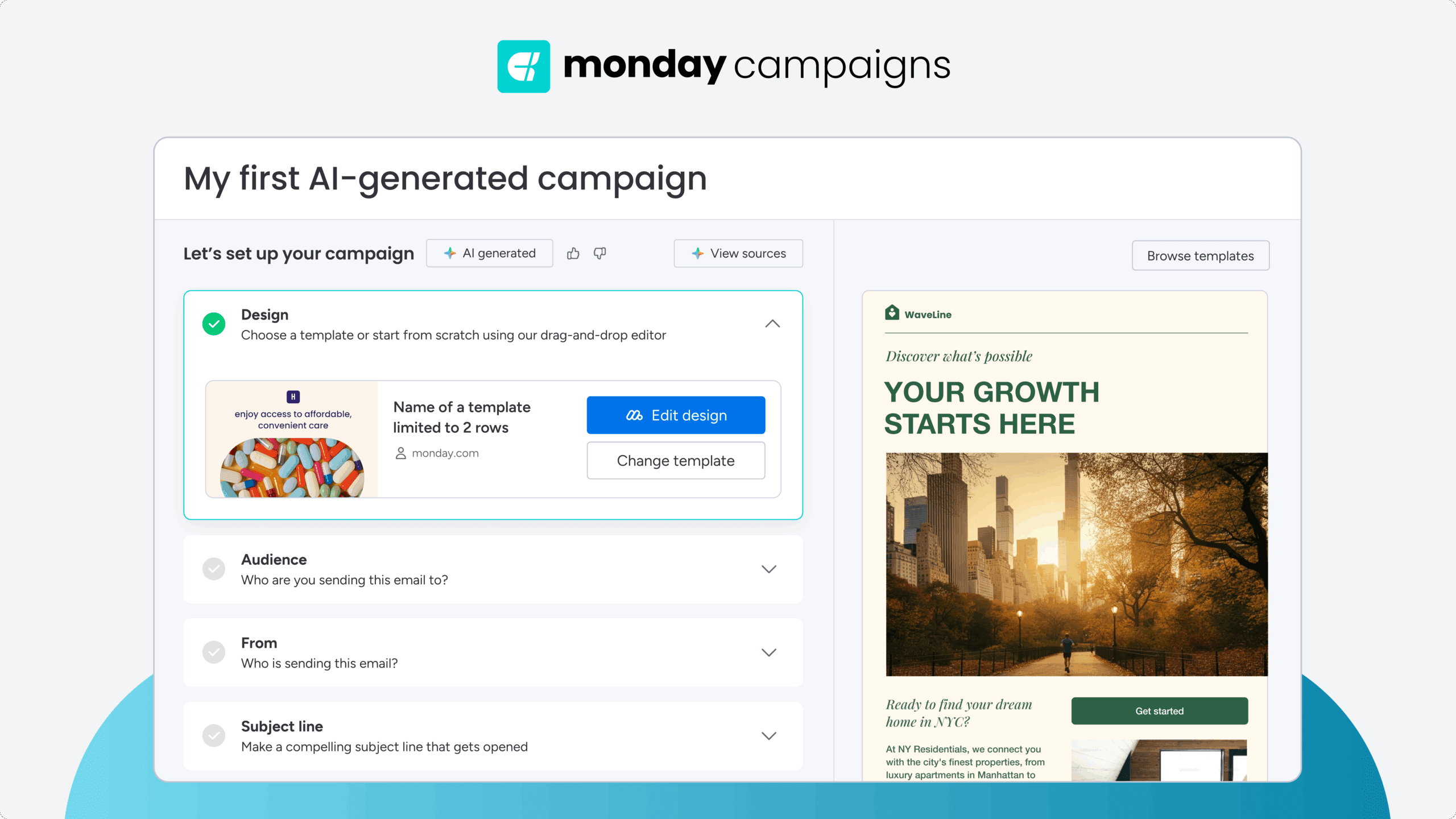
The AI in monday campaigns learns from your sales data to identify what actually drives meetings and closes deals. You start with a business goal, and the AI analyzes your audience and past wins to generate entire email sequences already optimized to perform. It segments your audience automatically, creating personalized messaging for each group without guesswork.
The power of native CRM integration
Native integration means marketing and sales teams see the exact same data, always. When a lead engages with an email, their monday CRM profile updates instantly with no sync delays or data gaps. A demo request triggers instant confirmation email and sales rep notification, armed with full context on that lead’s journey, and campaigns can trigger based on any CRM change to send the perfect message at the perfect time.
From campaign idea to closed revenue
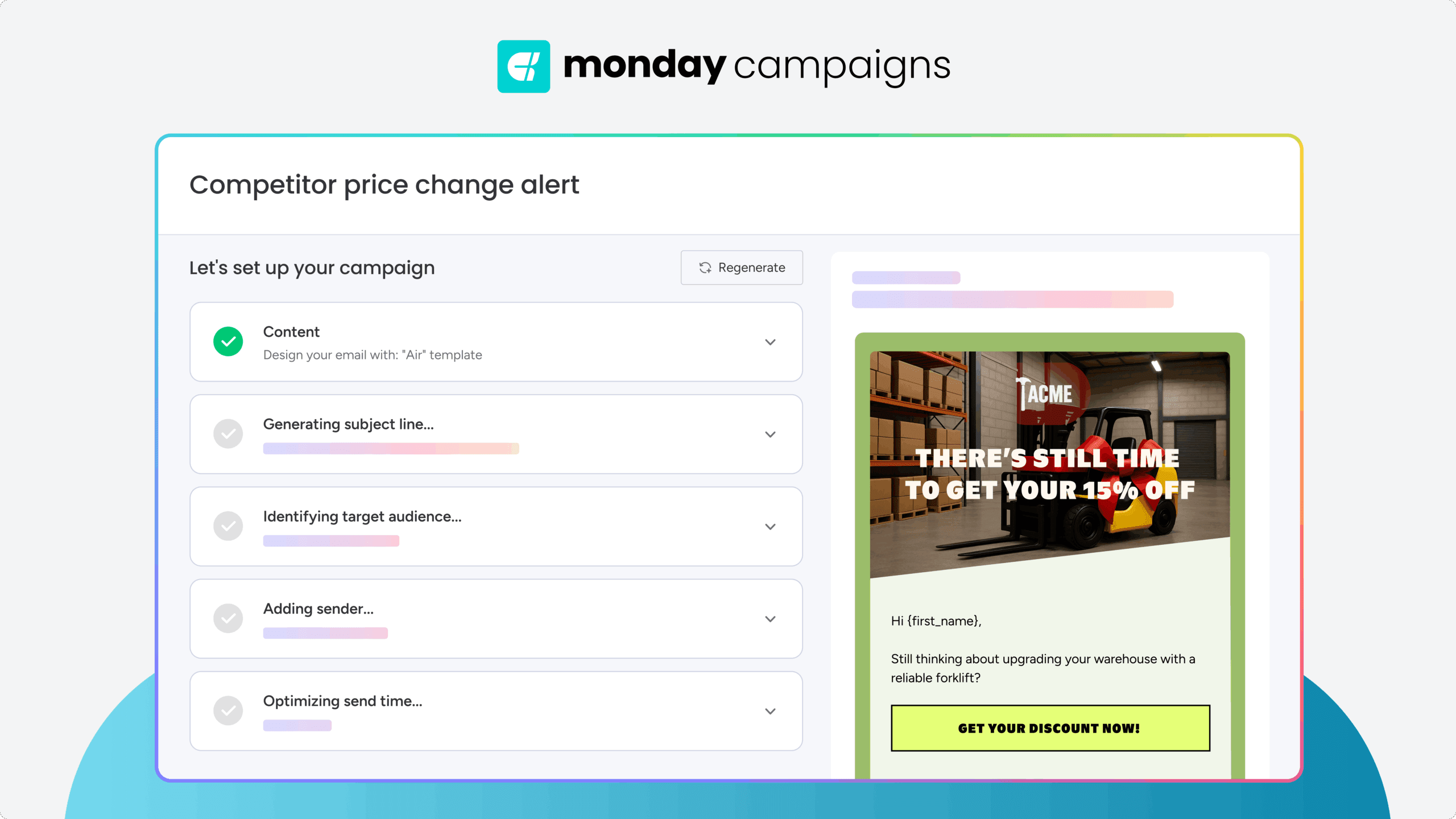
monday campaigns takes you from campaign goal to full, AI-generated email sequence in minutes, not days. As campaigns run, the platform automatically tracks which touchpoints influence opportunities with true, multi-touch revenue attribution that proves ROI and shows exactly what’s working. You can optimize efforts based on pipeline results, not just email metrics.
Turn your email campaigns into a predictable revenue engine
Chasing open rates is a distraction. Real AI email automation connects every campaign directly to sales outcomes. The right platform breaks down silos between marketing and sales, giving your team real-time visibility into the entire customer journey. You stop guessing what works and start scaling what actually closes deals.
Take a hard look at your current workflow and identify where leads get stuck. Map your ideal customer journey, choose a platform that natively supports your CRM, and launch your first targeted sequence. Focus on pipeline impact rather than vanity metrics, and transform email marketing from a simple communication channel into a powerful driver of business growth.
Try monday campaignsFAQs
What exactly is a sales email automation platform?
A sales email automation platform sends personalized emails at scale, focusing on generating revenue and integrating directly with your CRM. It connects email activity to pipeline impact, moving beyond simple open and click metrics.
How can teams maintain email deliverability?
Maintain email deliverability by keeping contact lists clean through bounce removal, authenticating your domain with SPF and DKIM, and consistently monitoring sender reputation. Platforms with managed deliverability infrastructure remove this technical burden from your team.
What is the typical implementation time for sales automation?
Implementation time ranges from a few hours to several weeks. Platforms with intuitive, AI-assisted setup like monday campaigns allow quick starts, while more complex systems may require longer configuration.
Which sales automation platforms integrate with CRMs?
Many platforms offer CRM integrations, but native connections like monday campaigns with monday CRM provide the most seamless data sync. This eliminates delays and creates a single, unified view of the customer journey for marketing and sales.
How do you personalize automated sales emails?
Personalize automated sales emails using dynamic content from your CRM and segmenting audiences based on behavior or attributes. This ensures every message feels relevant and timely, driving higher engagement and conversions.
What ROI metrics should sales teams track?
Track ROI metrics measuring revenue impact: lead-to-opportunity conversion rates, campaign influence on closed deals, and changes in deal velocity. These metrics provide clear visibility into how automation contributes to the bottom line.
How does monday campaigns differ from traditional email platforms?
monday campaigns focuses on revenue outcomes instead of just engagement. Native CRM integration and AI-powered optimization connect every campaign directly to pipeline growth and closed deals.
 Get started