


Your marketing team sends hundreds of emails every month, but you’re still guessing whether they actually drive revenue. Meanwhile, your sales team operates from different data and you can’t definitively say which campaigns influenced that big deal that just closed. AI email automation flips this on its head. Instead of static rules and manual work, it uses machine learning to figure out the right message for each person and when to send it, analyzing individual behavior patterns, predicting optimal engagement times, and automatically adjusting campaigns based on real-time performance data.
Here’s what AI email automation actually is, how it works under the hood, and why revenue teams are ditching traditional email marketing. You’ll see what makes these campaigns tick, the real benefits teams get, and how platforms like monday campaigns tie email activity directly to pipeline and revenue, so you finally know what’s actually working.
Key takeaways
- Smart decisions, zero manual work: AI learns from subscriber behavior and adjusts campaigns in real-time.
- Reclaim 10+ hours weekly: AI handles segmentation, A/B testing, and optimization automatically so your team can focus on strategy.
- Connect campaigns to revenue: Track how emails influence pipeline and closed deals, not just opens and clicks.
- Scale without growing your team: AI creates individual-level personalization across thousands of subscribers.
- Unified email automation and CRM: monday campaigns eliminates data silos and gives sales teams complete visibility into prospect engagement.
What is AI email automation?
AI email automation runs campaigns without you babysitting every step.
Unlike traditional automation that follows preset “if-then” rules, AI email automation makes dynamic decisions based on real-time customer data, behavioral patterns, and predictive analytics.
The system gets smarter over time. When a subscriber consistently opens emails at 7 a.m. on mobile devices, AI detects this pattern and adjusts future delivery accordingly. When prospects engage more with case study content than feature-focused emails, AI shifts messaging to match their preferences.
Four things make AI email automation work:
- Machine learning algorithms: Analyze subscriber behavior, engagement patterns, and campaign performance to make intelligent decisions about targeting and timing
- Natural language processing: Understands and generates email content that resonates with recipients, adapting tone and messaging for different audience segments
- Predictive analytics: Forecasts optimal send times, subject line performance, and content variations before campaigns launch
- Automated decision-making: Makes real-time adjustments without human input — shifting traffic toward higher-performing subject lines or triggering follow-up sequences based on engagement signals
AI email automation vs. traditional email marketing
The difference between AI and traditional email marketing goes deeper than tech. It changes how you plan, run, and improve campaigns.
| Dimension | Traditional email marketing | AI email automation |
|---|---|---|
| Decision-making | Manual rules and fixed schedules based on assumptions | Adaptive, data-driven decisions based on real-time signals |
| Personalization | Basic merge tags and segment-based content | Individual-level customization based on behavior and preferences |
| Optimization | Periodic A/B tests with manual analysis | Continuous multivariate testing with automatic adjustments |
| Scalability | Requires proportionally more resources as volume grows | Handles complexity automatically with the same team |
| Learning capability | Static rules that don't improve over time | Improves continuously from every send, click, and conversion |
Traditional email marketing means manually segmenting audiences, guessing the best send times, setting up A/B tests, waiting for results, and then using what you learned next time. Every step eats up time.
AI automation kills that cycle. The system figures out who belongs where based on real behavior, when each person’s likely to engage, and tests multiple versions at once, then uses what it learns right away.
Learn more: AI for email marketing
How machine learning transforms email workflows
Machine learning is what makes AI email automation smart enough to do things you couldn’t pull off manually at scale. Once you see how ML works in practice and the processes behind it, you’ll understand why teams are moving on from traditional email marketing.
Behavioral pattern recognition
ML algorithms identify patterns in subscriber behavior that humans would miss. The system might catch that subscribers who open emails on mobile between 7 and 9 a.m. are 3x more likely to click product links than desktop users. It finds these patterns by crunching thousands of data points across your whole subscriber base.
Predictive send-time optimization
Analyzes individual engagement history to predict when each subscriber is most likely to open and engage. Rather than sending to everyone at 10 a.m. because that’s when “most people” check email, ML schedules delivery to each person’s optimal time.
Content performance learning
Evaluates which content elements drive results for different audience segments. ML tracks how subject line styles, CTA placements, and copy length perform across segments, then uses what it learns in future campaigns.
Automated segmentation
Creates dynamic audience groups based on behavior, engagement levels, and predicted interests without manual rule-setting. Instead of marketers defining “engaged subscribers” as “opened 3+ emails in 30 days,” ML identifies natural engagement clusters and creates segments that update automatically.
AI email automation uses a few key capabilities working together to create campaigns that feel personal and timely. Understanding how these work helps you pick the right platform and plan your rollout.
How AI email automation works
AI email automation uses a few key capabilities working together to create campaigns that feel personal and timely. Understanding how these work helps you pick the right platform and plan your rollout.
Step 1: Natural language processing for email intelligence
Natural language processing (NLP) is how AI understands and writes like a human. In email automation, NLP does two big things that change how campaigns connect with people.
Understanding subscriber intent and sentiment happens when NLP analyzes email responses, survey feedback, and engagement signals to understand how subscribers feel about content. If a subscriber keeps opening product update emails but ignores promos, NLP catches that and adjusts future sends.
Generating relevant, personalized content becomes possible when NLP helps create subject lines, email copy, and CTAs that resonate with specific audience segments. It adapts tone, messaging, and language based on who’s reading while keeping your brand voice consistent.
Step 2: Dynamic segmentation using CRM data
Dynamic segmentation means AI groups subscribers automatically based on real-time behavior, CRM data, and predictions. It fixes the problems with old-school static segmentation that gets stale fast and misses the subtle patterns that actually predict engagement.
AI-powered dynamic segmentation keeps evaluating each subscriber’s engagement, purchase history, lifecycle stage, and predicted interests, then puts them in the right segments automatically. Four types of dynamic segments work best:
- Engagement-based segments: Groups based on recent interaction patterns and predicted likelihood to engage
- Behavioral segments: Clusters based on browsing behavior, content preferences, and past actions
- Lifecycle stage segments: Automatic categorization based on customer journey position
- Predictive segments: Groups based on likelihood to convert, churn risk, or upsell potential
When email automation integrates natively with your CRM, segmentation pulls from all your customer data across sales, marketing, and service. monday campaigns connects directly to monday CRM, so segments refresh automatically as contact data changes. A subscriber who downloads a pricing guide might automatically move from a “general interest” segment to a “high-intent prospect” segment, triggering a tailored nurture sequence without manual intervention.
Step 3: AI-powered content generation
AI content generation helps you create email copy, subject lines, and creative faster while keeping your brand consistent and personalized at scale.
- Subject line optimization analyzes historical performance data to suggest subject lines likely to drive opens for specific segments. AI tests multiple versions automatically and figures out which styles work for different audiences.
- Email copy creation drafts body content based on campaign goals, audience characteristics, and brand guidelines. AI-generated copy gives you a solid starting point to refine.
- Personalization at scale inserts contextually relevant content blocks, product recommendations, or messaging based on individual subscriber data. This goes way beyond name merge tags. AI can customize entire email sections based on a subscriber’s industry, role, past purchases, or engagement history.
Step 4: Real-time campaign optimization

Real-time optimization means AI watches campaign performance and tweaks things automatically while campaigns are live. No more launching, waiting, analyzing, and adjusting. Key optimization capabilities include:
- Send-time optimization: Analyzes when individual subscribers typically engage and automatically schedules email delivery to each person’s optimal time
- Content variation testing: Runs multiple subject lines, CTAs, or content blocks simultaneously and automatically shifts traffic toward higher-performing variations
- Frequency capping: Monitors engagement signals to prevent over-emailing subscribers who show signs of fatigue
- Performance-based routing: Can pause underperforming campaigns, reallocate sends to higher-performing segments, or trigger follow-up sequences based on engagement thresholds
monday campaigns brings all these AI capabilities together in one platform, so you can launch smarter campaigns without juggling multiple tools or complex integrations.
Try monday campaigns7 benefits of AI email automation
Here’s what teams actually get when they implement AI email automation. Knowing these benefits helps you figure out which capabilities matter most for your team.
1. Reclaim 10+ hours weekly from manual work
AI email automation cuts out the repetitive work that eats up your schedule.AI eliminates the time teams spend on manual segmentation, A/B test setup, performance monitoring, and reporting. Instead of spending Monday mornings manually segmenting webinar attendees, AI handles this entire workflow automatically based on engagement signals. McKinsey finds that the most gen AI-mature marketers have already achieved 22% efficiency gains and expect 28% within two years.
2. Create hyper-personalized campaigns at scale
AI enables individual-level personalization across thousands or millions of subscribers. Two subscribers might receive the same campaign, but one sees product recommendations based on browsing history with a subject line optimized for mobile opens at 8 a.m., while the other receives different products with a desktop-optimized subject line at 2 p.m., all determined and executed automatically. This level of email personalization drives significantly higher engagement and conversion rates.
3. Connect every campaign to revenue impact
AI email automation platforms track campaigns beyond opens and clicks to show direct connections to pipeline, deals, and revenue. Instead of reporting “our nurture campaign had a 25% open rate,” you can show “our nurture campaign influenced $150K in closed revenue this quarter.” monday campaigns’ native CRM integration enables this revenue attribution without requiring separate systems or complex integration setup.
4. Align marketing and sales with shared intelligence
AI email automation breaks down silos between marketing and sales by ensuring both teams work from the same customer data. When a sales rep opens a contact record, they immediately see which marketing emails the prospect engaged with, what content they downloaded, and their engagement score.When email automation integrates natively with your CRM, sales reps see which emails prospects opened, what content they checked out, and where they are in the buying journey. This sales and marketing alignment accelerates deal velocity and improves close rates.
Learn more: Sales email automation tools
5. Launch campaigns in minutes instead of days
AI dramatically reduces campaign creation time by automating setup, content generation, and technical configuration. Instead of spending days building segments, writing multiple subject line variations, and configuring follow-up workflows, AI handles these based on your campaign objective. monday campaigns’ drag-and-drop email builder combined with AI capabilities enables rapid campaign creation while maintaining brand consistency.
6. Optimize messaging using field insights
AI email automation platforms can incorporate insights from sales conversations, customer service interactions, and field feedback to improve email messaging. If sales reps consistently hear prospects asking about a specific integration during calls, AI can automatically prioritize that topic in nurture emails to similar prospects.Instead of waiting weeks to gather enough data for insights, AI identifies patterns and optimizes campaigns in real-time.
7. Scale without growing your team
AI email automation allows marketing teams to dramatically increase campaign volume, sophistication, and personalization without proportionally increasing headcount. The same team can handle way more campaigns because AI takes care of segmentation, optimization, and execution automatically. 67% of retail executives expect to have AI-driven personalization capabilities within the next year, per Deloitte’s 2026 Global Retail Industry Outlook.
3 types of AI email automation platforms
Different platform architectures deliver AI email automation capabilities, each with distinct advantages and limitations. Understanding these options helps teams select the approach that best fits their current systems and strategic goals.
Standalone AI email assistants
Standalone AI email assistants are specialized platforms that add AI capabilities to existing email marketing systems through integrations or plugins. They typically connect to email platforms via API to add AI features and usually specialize in specific capabilities like subject line optimization or content generation.
Ideal for: Teams satisfied with their current email platform who want to add specific AI capabilities without changing their core system.
Key limitations:
- May lack full context since they don’t natively access all customer data
- Require integration setup and maintenance
- Can create data silos if insights don’t flow back to CRM
Integrated CRM email automation
Integrated CRM email automation platforms have AI-powered email capabilities built directly into a customer relationship management system, creating a unified environment for customer data and campaign execution.
Ideal for: Organizations prioritizing alignment between marketing and sales, teams wanting to eliminate data silos, and companies seeking to connect email performance directly to revenue outcomes.
Key advantages:
- No integration setup or maintenance required
- Complete customer context informs AI decisions
- Seamless handoffs between marketing and sales
- Direct attribution from campaigns to deals and revenue
monday campaigns exemplifies this category, offering AI email automation built directly into the monday CRM suite. Campaign performance and lead conversion tracking live in one place, giving teams a complete view of the customer journey from lead to loyal customer.
Autonomous AI email agents
Autonomous AI account outreach agents are advanced systems that independently manage entire email programs with minimal human intervention, making strategic decisions about targeting, content, timing, and optimization.
Potential use cases: Large-scale operations managing thousands of campaigns, organizations with mature data infrastructure, and teams comfortable delegating strategic decisions to AI.
Key considerations:
- Require significant trust in AI decision-making
- Need robust governance and oversight frameworks
- Best suited for organizations with defined success metrics and mature processes
Successful AI email automation adoption requires thoughtful planning and execution. Following these steps helps teams avoid common pitfalls and accelerate time to value.
6 steps to implement AI email automation
Successful AI email automation adoption requires thoughtful planning and execution. Following these steps helps teams avoid common pitfalls and accelerate time to value.
Step 1: Map your current email processes
Document current email marketing processes, workflows, and pain points. This creates a baseline for measuring improvement and identifies which capabilities will deliver the most value.
Start by auditing your existing email workflows:
- How long does it take to create and launch campaigns?
- Which manual tasks consume the most time?
- Where do bottlenecks occur in your current process?
- What data sources inform your segmentation decisions?
Step 2: Define success metrics and goals
Set specific, measurable goals tied to business outcomes. “Improve email marketing” is too vague. “Increase email-attributed revenue by 25% within 6 months” provides direction.
Focus on metrics that matter to leadership:
- Revenue influenced by email campaigns
- Pipeline acceleration from nurture sequences
- Time saved on campaign creation and management
- Improvement in lead quality and conversion rates
Step 3: Select the right platform
Evaluate AI capabilities, CRM integration depth, ease of use, and scalability. For teams prioritizing marketing-sales alignment and revenue attribution, platforms with native CRM integration eliminate integration complexity and provide unified customer visibility from the start.
Key evaluation criteria include:
- AI sophistication: How advanced are the machine learning capabilities?
- Integration requirements: Does it work with your existing tech stack?
- Implementation timeline: How quickly can you get up and running?
- Scalability: Can it grow with your team and campaign volume?
Step 4: Connect and clean your data
AI email automation is only as good as the data it learns from. Audit existing data, clean duplicates, standardize fields, and establish data governance before implementation.
Essential data preparation tasks:
- Remove duplicate contacts and outdated information
- Standardize field formats across all data sources
- Establish data quality standards and ongoing maintenance processes
- Map data fields between systems for seamless integration
Step 5: Configure and test initial campaigns
Start with focused pilot campaigns that allow you to learn the platform, validate configurations, and demonstrate early wins. Select high-impact, low-risk campaigns where AI can add value without significant downside.
Recommended pilot campaign types:
- Welcome sequences for new subscribers
- Re-engagement campaigns for inactive contacts
- Event follow-up sequences with clear success metrics
- Product education series with measurable outcomes
Step 6: Scale and optimize continuously
After successful pilots, expand AI email automation across more campaigns while establishing ongoing optimization practices. AI email automation improves over time as the system learns from more data.
Build sustainable optimization habits:
- Regular performance reviews and strategy adjustments
- Continuous testing of new AI capabilities and features
- Team training on advanced platform features
- Documentation of best practices and lessons learned
How monday campaigns delivers AI-powered email automation
monday campaigns brings AI email automation directly into your CRM, so you’re not juggling multiple tools or dealing with messy integrations. Your team gets intelligent campaign management that learns from every interaction while keeping all your customer data in one place. Sales and marketing work from the same information, and you can finally trace email activity straight through to closed deals.
The platform handles the heavy lifting automatically. Segmentation updates in real-time as contact data changes, send times optimize for each subscriber, and campaigns adjust based on what’s actually working. You spend less time on manual tasks and more time on strategy that drives revenue.
AI-powered content creation and optimization
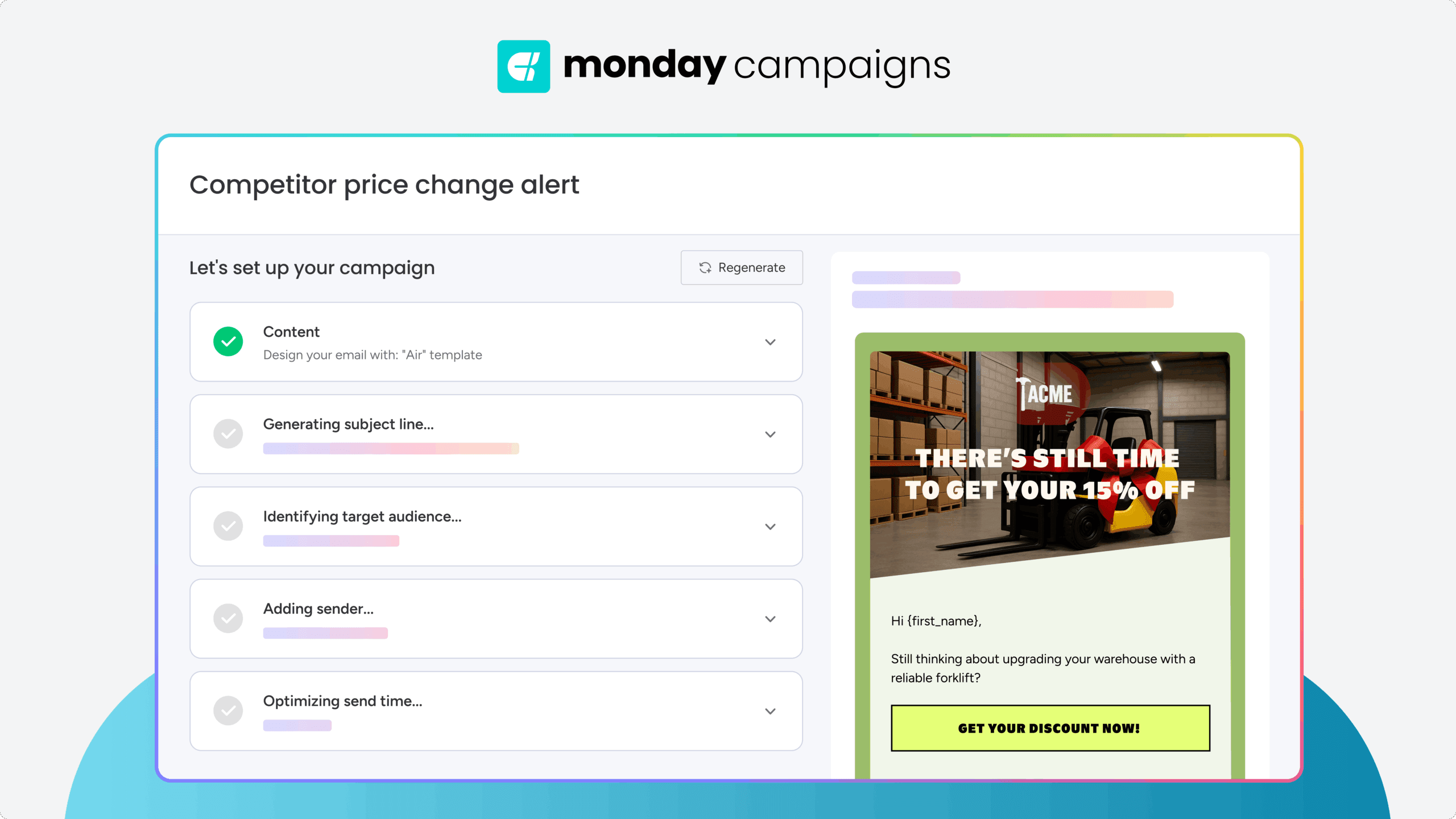
Generate email copy, subject lines, and variations instantly using AI that understands your brand voice and audience preferences. The system analyzes historical performance to suggest content likely to resonate with specific segments, then automatically tests multiple versions and shifts traffic toward winners. You get personalized campaigns at scale without writing every variation manually.
Native CRM integration for unified customer intelligence
Campaign data lives directly in your CRM, so sales reps see exactly which emails prospects opened, what content they engaged with, and where they are in the buying journey. No switching between platforms or wondering if your data synced. Marketing and sales work from the same customer view, and you can track how campaigns influence pipeline and revenue without complex attribution models.
Dynamic segmentation that updates automatically
Segments refresh in real-time based on CRM data, engagement signals, and behavioral patterns. AI identifies natural audience clusters and moves contacts between segments as their behavior changes, triggering relevant nurture sequences without manual intervention. A prospect who downloads a pricing guide automatically enters a high-intent sequence, while someone who goes quiet gets re-engagement messaging.
Real-time campaign intelligence and adjustments
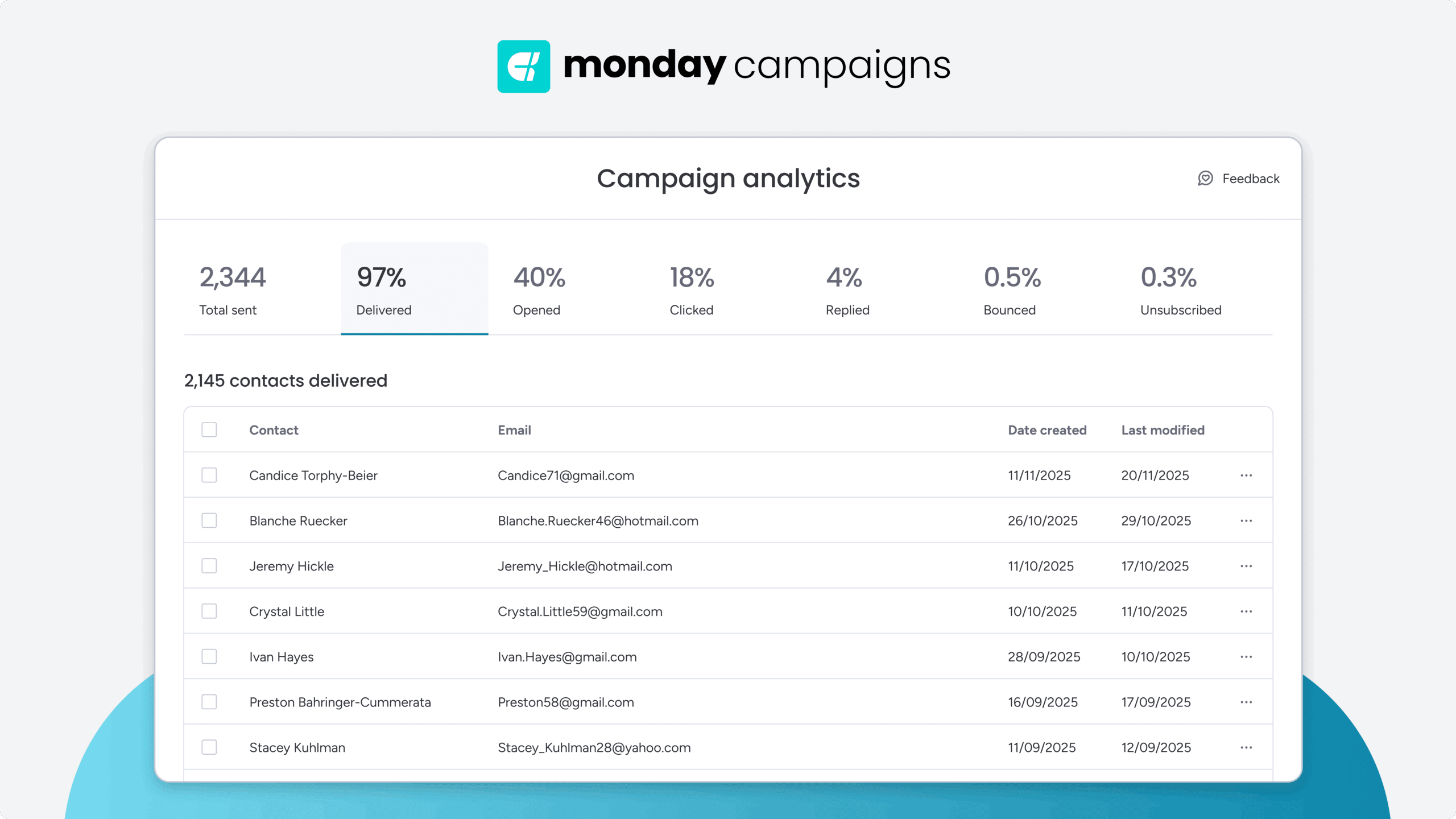
AI monitors campaign performance as emails go out and makes adjustments on the fly. Send times optimize for individual subscribers, underperforming content variations get paused automatically, and the system learns from every interaction to improve future campaigns. You launch smarter campaigns that get better over time without constant manual tweaking.
Transform your email marketing with AI automation
AI email automation represents a fundamental shift from reactive, manual email marketing to proactive, intelligent campaign management. Teams that embrace this technology gain significant advantages in personalization, efficiency, and revenue attribution.
The key to success lies in choosing the right platform architecture for your organization’s needs. Integrated CRM solutions eliminate the complexity of managing multiple systems while providing the unified customer view that makes AI truly powerful, which is exactly what monday campaigns delivers.
Try monday campaigns
 Get started