


Most marketing teams have plenty of data. What they lack is the time to turn it into action. Campaigns go out, results come in, and by the time someone has analyzed what worked and adjusted the next send, the window has already passed. A campaign performance AI agent closes that gap. It monitors your campaigns continuously, spots what’s working and what isn’t, and makes adjustments without waiting for a weekly review meeting.
These AI marketing agents handle audience segmentation, send time optimization, budget reallocation, and anomaly detection. When you connect them to your CRM data, they stop optimizing for vanity metrics and start driving real revenue. We’ll break down what campaign performance AI agents actually are, how they’re different from traditional marketing automation, and what adoption looks like in practice with platforms like monday campaigns.
Key takeaways
- AI agents do the work, not just the reporting: Campaign performance AI agents don’t wait for you to spot problems. They detect, act, and optimize in real time, around the clock.
- Adopt in phases, not all at once: Start with reporting and insights, then expand agent autonomy as your confidence and data grow. Each phase delivers value on its own.
- Your CRM data is what makes AI agents powerful: Connecting campaign activity to sales data lets agents optimize for real revenue outcomes, not just open rates and clicks.
- monday campaigns bridges marketing and sales in one place: With native monday CRM integration, every campaign feeds the pipeline, and every closed deal makes the next campaign smarter.
- Keep humans in the loop where it counts: Set clear guardrails around budget, messaging, and major decisions so agents handle the tactical work while your team stays focused on strategy.
What is a campaign performance AI agent?
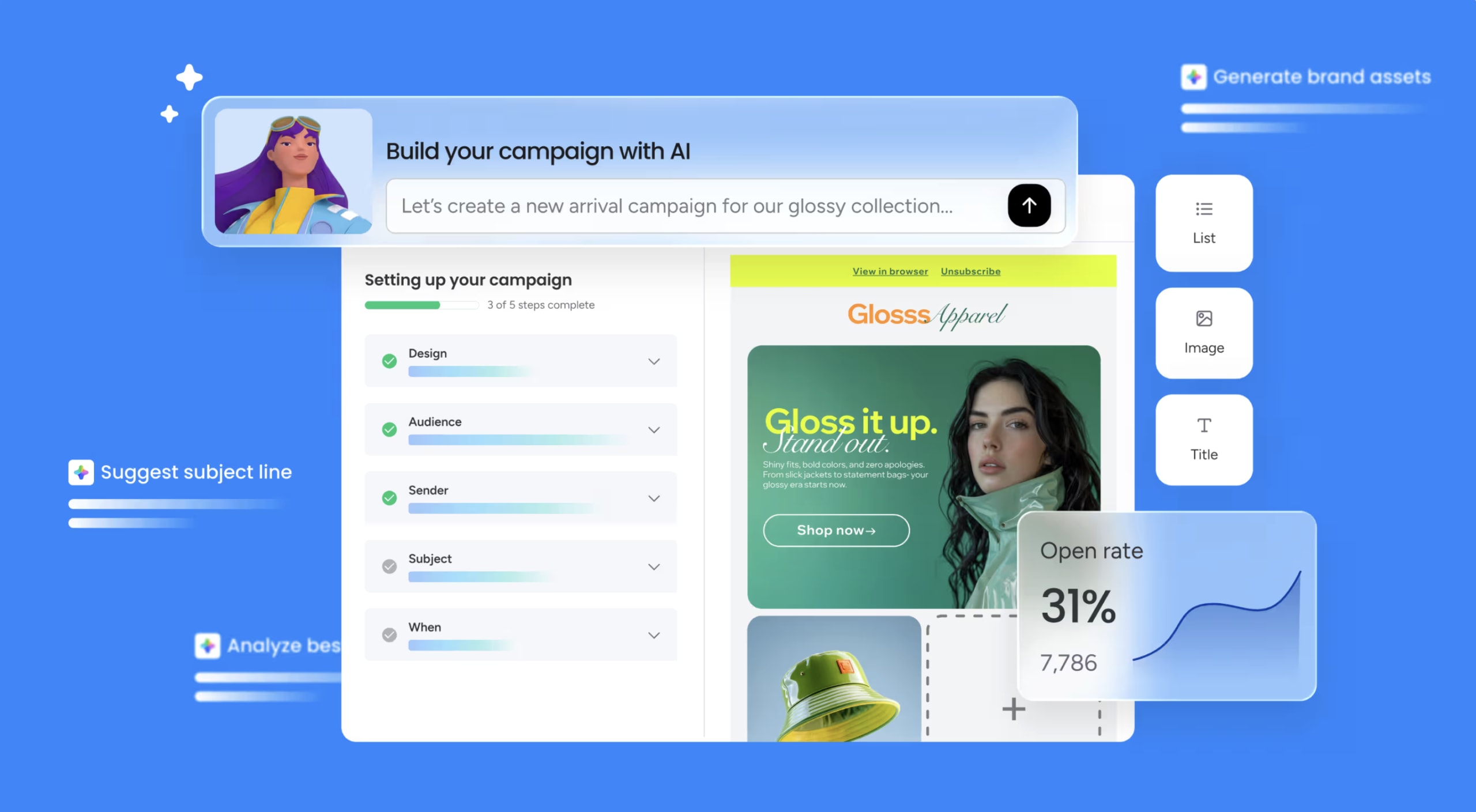
A campaign performance AI agent monitors, analyzes, and optimizes your marketing campaigns in real time, without you. Traditional automation follows preset rules.
AI agents reason through your data, spot opportunities or problems, and make changes, freeing your team to focus on strategy.
Here’s what they actually do, the work that used to eat up hours of your week:
- Analyze email open rates and automatically adjust send times
- Identify which audience segments respond best to specific messaging
- Reallocate budget from underperforming campaigns to high-performers
- Operate continuously, not just when someone remembers to check the dashboard
So why now? Marketing teams need to prove ROI faster than ever. Personalization expectations have escalated to the point where batch-and-blast approaches actively damage brand perception, and 67% of retail executives expect to have AI-driven personalization capabilities within the next year. The volume of campaigns, channels, and data has blown past what any human team can manage alone.
Core traits that define an AI agent in marketing
The term “AI agent” gets applied loosely to anything with machine learning under the hood. Real campaign performance AI agents are different. Here’s what sets them apart from basic automation:
- Autonomous decision-making: Agents make choices on their own, no waiting for approval on every move. Agents make choices on their own, acting immediately when they spot an opportunity. When an agent spots rising cost-per-lead, it cuts spend, tests new targeting, and shifts budget to what’s working.
- Goal-oriented behavior: Agents focus on outcomes, not just checking boxes. A traditional automation might “send email to segment A at 10 AM.” An agent optimizing for lead quality adjusts targeting, timing, and messaging based on which combinations actually produce qualified opportunities.
- Learning and adaptation: Agents get better with every campaign they run. When an agent discovers that personalized subject lines mentioning the recipient’s industry outperform generic ones, it uses that insight in every campaign going forward.
- Contextual awareness: Agents see the full picture, not just isolated data points. They know that low open rates on Monday mornings need a different approach than Friday afternoons.
How campaign performance AI agents differ from marketing automation
If you’ve used marketing automation platforms, you’re probably wondering how AI agents are different. The difference changes everything about how you run campaigns. Here’s how they stack up:
| Capability | Traditional marketing automation | Campaign performance AI agents |
|---|---|---|
| Decision-making approach | Rules-based: "If X, then Y" | Autonomous reasoning: evaluates multiple factors and determines optimal action |
| Adaptation | Static workflows requiring manual updates | Continuous learning from results without reprogramming |
| Scope of action | Predefined tasks within configured workflows | Dynamic problem-solving across campaign elements |
| Human involvement | Requires constant configuration and monitoring | Operates with strategic oversight while handling tactical execution |
| Optimization | Manual A/B testing with human analysis | Real-time multivariate optimization across dozens of variables |
Take send time optimization. Traditional automation lets you schedule emails for 10:00 a.m. on Tuesday based on industry benchmarks. A campaign performance AI agent analyzes each recipient’s engagement history, time zone, and real-time behavior to determine the optimal moment for that specific person, sending to the early-morning reader at 6:30 a.m. and the lunch-break scanner at 12:15 p.m.
Learn more: AI AB testing
How AI agents for marketing actually work
Understanding how campaign performance AI agents work helps you set them up right, interpret what they’re telling you, and know when to step in. Let’s break down the core operating loop and the data infrastructure that makes it work.
Step 1: Run the reason, act, and learn loop
Traditional campaigns have a clear start and end: plan, build, launch, wait, analyze, repeat. Campaign performance AI agents work differently. They run in continuous cycles, constantly evaluating and adjusting instead of waiting for post-campaign analysis.
The cycle has 3 phases, and they repeat nonstop:
- Reason: The agent analyzes campaign data, audience behavior, and performance signals, looking for opportunities or problems. It spots patterns across your data that you’d miss staring at dashboards.
- Act: Based on what it finds, the agent takes action: adjusts targeting, modifies content, reallocates budget, or triggers workflows. The agent acts the moment the problem surfaces.
- Learn: The agent takes what it learned, records the insights, and uses them in future campaigns. The learning sticks around for every campaign.
This loop runs nonstop and often multiple times a day. Hundreds of small optimizations add up to performance gains you can’t match manually.
Step 2: Connect the right data, tools, and memory
Agents are only as good as the data, tools, and memory they can access. To make smart decisions, agents need access to multiple data types:
- Campaign metrics: Opens, clicks, and conversions
- Audience data: Demographics and behavioral patterns
- CRM data: Deal stages and customer lifecycle position
- External signals: Market trends and seasonal patterns
Data quality and completeness make or break how well agents perform. An agent optimizing email campaigns needs both email engagement data and downstream conversion data. With visibility into which opens led to purchases, the agent can optimize for revenue instead of vanity metrics.
6 ways AI agents improve campaign performance

Campaign performance AI agents improve results in 6 key ways. Each one shifts you from manual, reactive optimization to automated, proactive improvement. Together, they change how you run campaigns.
1. AI-driven audience segmentation
Traditional segmentation uses static demographic or firmographic criteria. You create segments once, and they stay fixed until someone manually updates them. Campaign performance AI agents work differently. They create and refine segments on the fly based on behavioral patterns and engagement signals.
Agents spot patterns that humans miss when working across large volumes of data. They might discover that users who engage with pricing content but don’t convert within 7 days respond 3x better to case study content than discount offers. That’s a micro-segment defined by behavior and timing, not demographics.
2. Personalized content and creative variants at scale
Personalization has moved far beyond “Hi {First_Name}.” Recipients expect content that reflects their industry, challenges, and where they are in the buying process. But creating personalized content at scale used to mean either hiring a massive creative team or settling for generic messaging.
Agents generate and test content variations across segments, channels, and campaign stages. monday campaigns uses AI to help teams create these variations without expanding headcount. Here’s how it works:
- Create industry-specific email variations
- Test these variations across segments
- Identify winners within hours
- Automatically apply learnings to future campaigns
3. Smart send time and channel selection
The “best time to send email” varies for every recipient. The optimal moment shifts based on individual behavior. What matters is the best time to reach each specific recipient, and that varies based on their role, industry, time zone, and personal habits.
Agents analyze each recipient’s engagement patterns across 4 areas:
- When they typically open emails
- How quickly they respond
- Which days show the highest engagement
- How timing correlates with conversion
4. Always-on optimization and budget reallocation
The traditional campaign optimization cycle runs weekly or monthly. You review performance, identify issues, make adjustments, and wait for results. Campaign performance AI agents compress this cycle to hours or minutes. They detect performance changes in real time and respond immediately.
When an agent spots rising cost-per-lead, it doesn’t wait for the weekly review. Within 24 hours, it’s already:
- Reducing spend on the underperforming campaign
- Tests alternative targeting approaches
- Reallocates budget to higher-performing campaigns
5. Anomaly detection and performance alerts
Campaign performance AI agents set performance baselines and catch problems before they get expensive. They monitor thousands of signals across channels, watching for shifts that would take humans hours or days to notice. They catch issues you’d miss, like:
- Deliverability problems: Open rates that drop overnight
- Engagement anomalies: Click rates that spike but conversions don’t follow
- Budget pacing issues: Spend that accelerates ahead of schedule
- Audience fatigue signals: Declining engagement across repeated sends
When an agent detects an anomaly, it doesn’t just send an alert. It takes immediate action within its guardrails. monday campaigns provides real-time monitoring and automated responses that keep campaigns performing even when your team is offline.
6. Insight-to-action reporting
Traditional marketing reports answer “what happened.” Campaign performance AI agents transform reporting into “what to do next,” connecting insights directly to action.
Instead of “Campaign A had a 2.3% click rate,” an agent reports: “Campaigns targeting mid-market accounts generate 2x the pipeline of enterprise campaigns despite lower email engagement. Recommend shifting 20% of enterprise budget to mid-market targeting.” The agent doesn’t stop at the recommendation. It can implement the change once you approve it.
Try monday campaignsHow AI agents connect campaigns to revenue through CRM data
Campaign performance AI agents are only as good as the data they can access. The most impactful agents don’t just analyze campaign metrics, they connect marketing activity to the full customer lifecycle, a core theme in AI and the future of CRM. That’s where the real revenue impact comes from.
Why first-party data is the foundation
First-party data includes customer records, engagement history, purchase behavior, lifecycle stage, support interactions, and sales conversations. That’s different from campaign-only data like opens, clicks, and unsubscribes.
Meaningful optimization requires more than campaign data alone. Here’s why:
- Campaign-only data risks increasing engagement while decreasing lead quality or pipeline contribution
- First-party data enables optimization for business outcomes: lead quality, pipeline contribution, and customer lifetime value
Closing the loop between marketing and sales
The traditional marketing-sales divide creates constant friction. It’s one of the most common reasons campaigns fail to drive revenue. Campaign performance AI agents with access to both marketing and CRM data track the complete journey and optimize for outcomes both teams care about.
The native integration between monday campaigns and monday CRM keeps data flowing constantly, from campaign reporting to lead conversion tracking. Marketing and sales share the same funnel, goals, and source of truth. Every campaign drives the pipeline. Every sale makes the next one smarter.
4 phases to adopt a campaign performance AI agent
Most organizations adopt campaign performance AI agents gradually, over time. The most successful implementations take a phased approach: start with low-risk analysis and build toward semi-autonomous execution as confidence grows.
Phase 1: Start with a reporting and insights agent
Start with agents focused on analysis and recommendations, not autonomous execution. Reporting and insights agents analyze campaign performance, surface patterns, and identify opportunities. They generate recommendations, leaving action in your team’s hands.
Focus on these capabilities in Phase 1:
- Performance anomaly detection
- Cross-campaign pattern analysis
- Automated reporting with recommendations
- Predictive performance modeling
Phase 2: Add creative and segmentation agents
Deploy agents that take action in controlled, reversible areas. Content generation and audience segmentation work well here since mistakes are easy to fix, and the impact is measurable.
monday campaigns supports Phase 2 with AI-generated copy and audience segment suggestions. Teams can test agent-driven execution in controlled domains before expanding scope.
Phase 3: Layer in optimization with guardrails
Deploy agents that make autonomous optimization decisions within defined boundaries. Optimization agents adjust send times, reallocate budgets, modify targeting, and trigger workflows, all within guardrails that limit their scope of action.
Essential guardrails to put in place:
- Spending limits
- Approval thresholds
- Performance boundaries
- Human-in-the-loop checkpoints
Phase 4: Scale toward semi-autonomous campaign operators
Deploy agents that can plan, execute, and optimize campaigns end-to-end with strategic human oversight. Agents handle most tactical execution while humans focus on strategy and creative direction.
Even in Phase 4, humans remain essential for strategy, brand direction, creative vision, and high-stakes decisions. According to Microsoft’s 2026 Work Trend Index, 66% of AI users say AI lets them spend more time on high-value work. The goal is augmentation, not replacement.
Guardrails and human oversight for AI agents in marketing
Campaign performance AI agents deliver the most value when they operate autonomously within well-defined boundaries. Knowing where to draw that line, and how to enforce it, is what makes AI adoption both effective and safe.
Where to keep humans in the loop
Some decisions call for human judgment. The following areas should always involve human oversight:
- Strategic positioning and messaging
- Budget allocation above defined thresholds
- New audience targeting
- Campaign pausing or major structural changes
- Sensitive or regulated content
- Cross-functional impact decisions
The table below outlines the 4 core guardrail types and how to implement them:
| Guardrail type | Implementation | Example |
|---|---|---|
| Approval thresholds | Agents can act up to defined limits; larger changes require approval | Budget changes under $1,000 are automatic; above requires sign-off |
| Notification triggers | Agents alert humans when detecting anomalies or edge cases | Alert when engagement drops 30% below baseline |
| Review cycles | Regular human review of agent decisions and outcomes | Weekly review of all agent-initiated changes |
| Override capabilities | Humans can always intervene and reverse agent decisions | One-click pause on any agent optimization |
monday campaigns: AI-powered campaign management built for performance
monday campaigns gives marketing teams the tools to run smarter campaigns without adding headcount. Built on the monday.com Work OS, it combines campaign execution with native CRM integration, so every email, audience segment, and conversion feeds directly into your sales pipeline. Marketing and sales work from the same data, eliminating the usual friction between teams.
AI capabilities are embedded throughout the platform, handling the repetitive work that used to consume hours each week. From content generation to send time optimization, monday campaigns uses AI to help teams move faster and optimize for revenue, not just engagement metrics.
AI-generated email content and subject lines
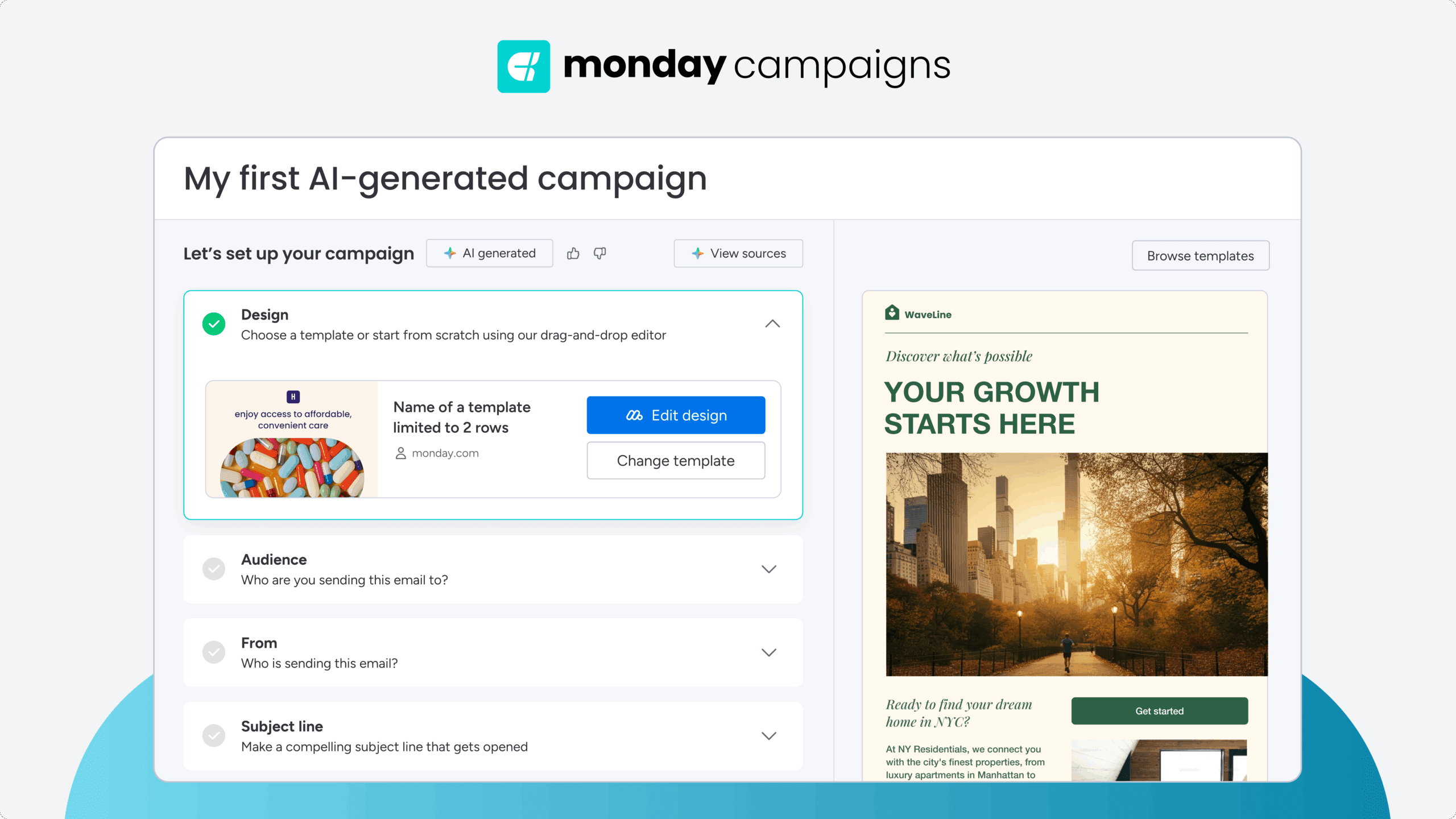
monday campaigns uses AI to generate email copy and subject line variations tailored to different audience segments. Instead of writing dozens of versions manually, teams can create industry-specific or persona-based content in minutes. The AI learns from performance data over time, so the suggestions get better with every campaign you run.
Intelligent audience segmentation
The platform analyzes engagement patterns, CRM data, and behavioral signals to suggest high-performing audience segments. AI-driven segmentation goes beyond static demographics, identifying micro-segments based on how contacts actually interact with your campaigns. These segments update dynamically as new data comes in, keeping targeting sharp without manual updates.
Real-time performance monitoring and alerts
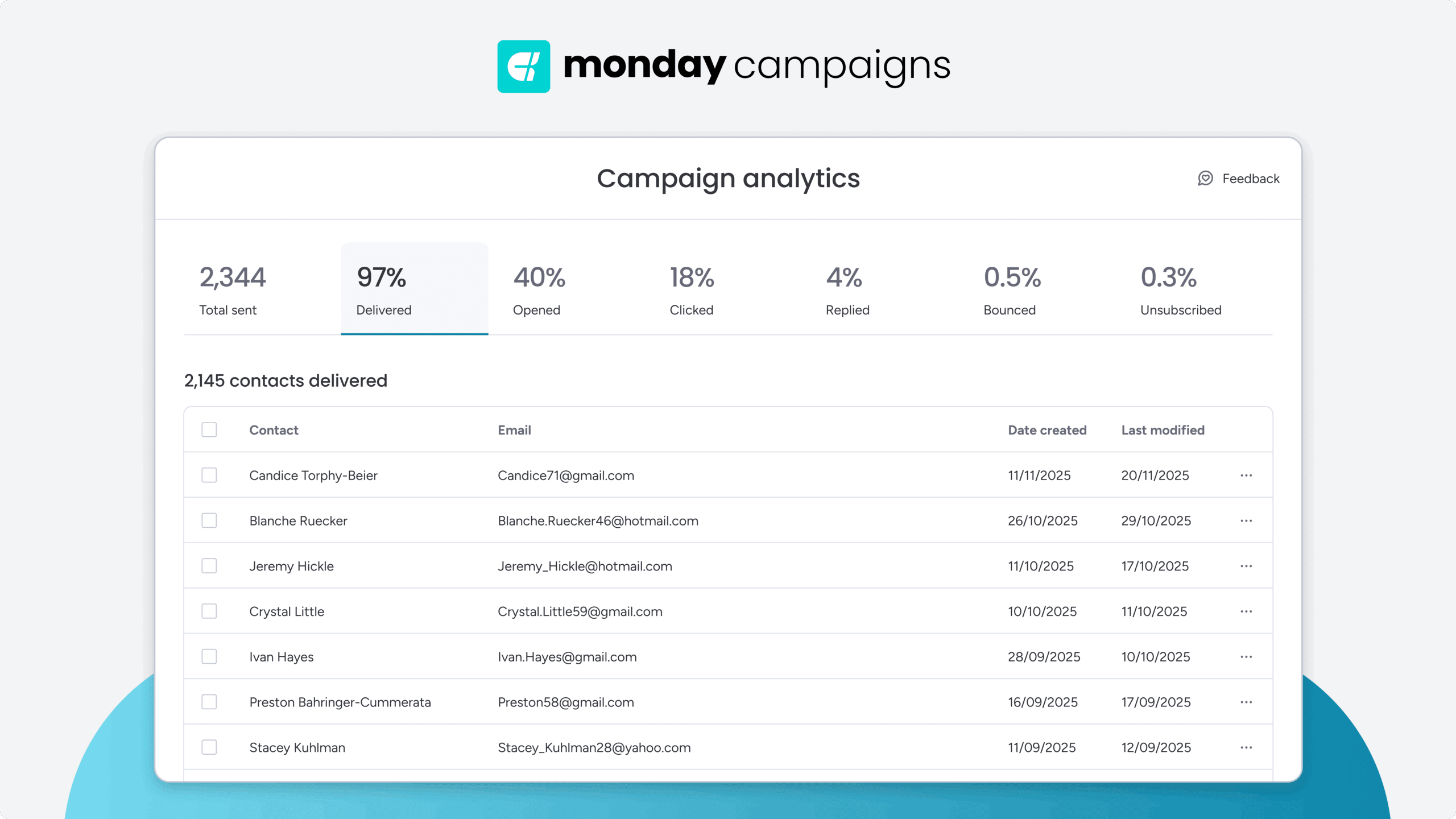
monday campaigns tracks campaign performance continuously and alerts you the moment something shifts. The AI detects anomalies like sudden drops in deliverability, engagement spikes that don’t convert, or budget pacing issues before they become expensive problems. Alerts come with recommended actions, so you can respond immediately instead of waiting for the next review cycle.
Native CRM integration for full-funnel optimization
With monday CRM built into the same platform, campaign data flows directly into deal records and sales pipelines. AI agents can optimize for pipeline contribution and revenue outcomes, not just opens and clicks. Marketing sees which campaigns drive closed deals, and sales sees the full engagement history behind every lead, all in one place.
Let agents do the heavy lifting
Campaign performance AI agents are already reshaping how marketing teams operate today. Forrester research finds that half of US agencies already use agentic AI for marketing execution. The teams that move first are compounding performance gains that widen the gap between them and slower-moving competitors while also saving time. The phased adoption approach outlined here lets you roll things out gradually. Start with reporting and insights, build confidence, then expand agent autonomy as your team and data mature.
monday campaigns connects campaign execution directly to CRM data, giving AI agents the full-funnel visibility they need to optimize for revenue, not just engagement metrics. When marketing and sales share one source of truth, every campaign gets smarter with every send.
Try monday campaignsFAQs
What is the difference between AI agents and AI assistants in marketing?
The difference between AI agents and AI assistants in marketing is proactivity. AI assistants respond to human requests: you ask a question, and the assistant provides an answer. AI agents operate proactively and autonomously toward defined goals without being asked. AI agents operate proactively and autonomously toward defined goals without being asked.
How much data do campaign performance AI agents need to be effective?
Campaign performance AI agents need a baseline of data to be effective, typically 3–6 months of historical campaign data and at least 1,000 contacts. Effectiveness improves significantly with more data and complete records connecting engagement to conversion outcomes. Effectiveness improves significantly with more data and complete records connecting engagement to conversion outcomes.
Can small marketing teams benefit from campaign performance AI agents?
Yes, small marketing teams often benefit most from campaign performance AI agents because they face the greatest capacity constraints. A team of 2–3 marketers using agents can execute the volume and sophistication of campaigns that would traditionally require 8–10 people. A team of 2–3 marketers using agents can execute the volume and sophistication of campaigns that would traditionally require 8–10 people.
How do campaign performance AI agents handle multi-channel campaigns?
Campaign performance AI agents handle multi-channel campaigns by optimizing across channels holistically rather than channel-by-channel. With access to cross-channel data, they identify which channels drive the strongest results for different audience segments and determine optimal sequencing.
What happens when an AI agent makes a mistake?
When an AI agent makes a mistake, well-designed guardrails limit the impact. Budget caps prevent overspending, performance floors pause optimization if metrics drop too far, and approval thresholds require human sign-off on major changes. Budget caps prevent overspending, performance floors pause optimization if metrics drop too far, and approval thresholds require human sign-off on major changes.
How do campaign performance AI agents protect customer data and privacy?
Campaign performance AI agents protect customer data and privacy by operating within the same data governance frameworks as other marketing systems. They process data only for defined purposes, respect consent settings, and maintain audit trails of data access and use.

 Get started