


Imagine launching an email campaign knowing it’s already optimizing itself for maximum revenue. No more waiting weeks for A/B test results on a single subject line, only to start the process all over again for the call-to-action. The manual, one-variable-at-a-time approach is too slow for a market that shifts in days. AI A/B testing changes this entire equation. Instead of testing one element at a time over weeks, machine learning algorithms test multiple variables simultaneously and adapt in real-time based on subscriber behavior. These systems automatically generate variants, dynamically shift traffic to winners, and optimize campaigns while they’re running, not after they’ve concluded.
Here’s how AI A/B testing works for email campaigns, why you need it now, and what makes AI-powered optimization actually effective. You’ll move from manual testing that takes weeks to systems that optimize campaigns in hours. The result is faster optimization cycles that connect email performance directly to revenue outcomes, the kind of speed and precision you get with platforms like monday campaigns.
Key takeaways
- Speed beats perfection: AI identifies winning variants in hours, not weeks.
- Test everything at once: AI tests subject lines, send times, and content simultaneously.
- Connect to revenue, not clicks: Focus on pipeline impact and deal progression.
- AI handles the grunt work: Automated testing frees up time for strategy.
- Transform with monday campaigns: AI-powered testing optimizes for revenue while connecting to CRM data.
What is AI A/B testing for email campaigns?

AI A/B testing for email campaigns uses machine learning algorithms to automatically design, execute, and optimize email experiments. With 88% of organizations now reporting regular AI use in at least one business function, these systems spot your best-performing campaign elements without weeks of manual analysis. Unlike traditional email A/B testing, AI analyzes multiple variables simultaneously and adapts in real-time based on recipient behavior.
Understanding the core terminology helps you evaluate different AI testing platforms and align your team on a shared strategy. These key terms distinguish between basic automation and true, revenue-driving optimization:
- Machine learning algorithms: Software that improves automatically through experience, identifying patterns in data that humans can’t process at scale
- Statistical significance: The confidence level that results aren’t due to random chance (typically 95% confidence is the threshold for declaring a winner)
- Multivariate testing: Testing multiple variables simultaneously (subject line AND send time AND content) rather than one at a time
Traditional email testing vs. AI-powered testing
Traditional A/B testing follows a rigid, manual process. Marketers create two versions of an email, split their audience evenly, wait for enough data to accumulate (typically 7–14 days), analyze results, and declare a winner. This process tests one variable at a time because testing multiple variables simultaneously requires exponentially larger audiences and complex statistical analysis.
AI-powered testing works completely differently. Algorithms generate multiple variants based on past performance, then shift traffic to winners as engagement data comes in.
The system tests multiple variables at once while staying statistically valid, no need for perfect sample sizes on every variant.
| Dimension | Traditional A/B testing | AI-powered testing |
|---|---|---|
| Test design | Manual variant creation requiring copywriting time | Automated generation with brand consistency guardrails |
| Variables tested | One at a time (subject line OR send time) | Multiple simultaneously (subject + content + timing) |
| Audience allocation | Fixed 50/50 split throughout test | Dynamic allocation shifting to winning variants |
| Time to results | 3–7 days minimum for significance | Hours to real-time optimization |
| Human effort required | High (design, monitor, implement) | Low (set parameters, review insights) |
The speed difference is massive. Traditional tests need days or weeks to reach statistical significance and they require large sample sizes and fixed time periods. AI systems spot patterns and shift traffic within hours by analyzing early engagement and applying models trained on past campaigns.
How machine learning is changing email experimentation
Machine learning algorithms analyze thousands of data points like open rates, click patterns, conversion behaviors, time-to-engagement, device types, and geographic patterns to identify which campaign elements drive results. Research demonstrates that AI-powered next-best-experience capabilities can increase revenue by 5–8% while achieving click rates two to three times higher than traditional campaigns. AI spots subtle patterns across segments that would be nearly impossible to identify manually, like how question-based subject lines resonate with IT buyers but fall flat with finance executives.
Predictive modeling uses past performance to forecast which variants will work best for specific segments before you send to the full list. The system predicts results based on past campaigns and sends more traffic to likely winners from the start.
Continuous learning sets AI testing apart from static experiments. AI systems treat every send as a chance to learn, pulling new data into their models and adapting to subscriber preferences, seasonal shifts, and market changes. A subject line style that worked in Q1 might underperform in Q4. AI systems detect and adapt to these shifts automatically.
Personalization at scale becomes possible when AI in digital marketing determines the optimal variant for each individual subscriber based on their unique behavior patterns. Every subscriber gets the exact message that works best for them.
Why AI A/B testing matters for revenue marketers

Revenue marketers face serious pressure to prove ROI while managing more complex campaigns across bigger subscriber lists. The days of reporting on open rates and click-through rates are over. Executives want to see pipeline contribution, revenue attribution, and how marketing spend connects to closed deals. Traditional testing methods can’t keep up with how fast business moves or how sophisticated buyers have become.
Speed and scale advantages
Market windows keep getting shorter across every industry. Product launches, competitive responses, and seasonal opportunities need campaigns deployed in days, not weeks. Traditional testing timelines mean you can’t optimize before the opportunity disappears.
Revenue marketers typically manage 10+ active campaigns across multiple segments, products, and customer lifecycle stages. Running manual A/B tests across this portfolio requires dedicated analysts, weeks of calendar time, and high manual overhead. AI testing removes these resource constraints, making it possible for any organization to run sophisticated optimization campaigns.
AI testing cuts timelines by spotting winning variants within hours of launch. Systems analyze early engagement patterns and apply models trained on past data to forecast which variants will perform best. This lets you optimize campaigns while they’re still running, not after they’re done.
Direct revenue impact
Traditional email metrics like open rates and click rates don’t directly answer the question executives care about: “Did this campaign generate revenue?” Marketing teams that only report engagement metrics struggle to justify budgets, secure resources, and prove their strategic value.
AI testing optimizes for qualified leads, sales conversations, and deal progression, not just clicks. Systems that connect email engagement to CRM opportunity data show which campaign elements move prospects deeper into the funnel. Revenue optimization changes how you think about testing entirely. AI systems prioritize variants that bring in valuable customers over those that just get clicks.
Platforms like monday campaigns connect email performance directly to pipeline data, giving you the revenue attribution executives demand while reducing the manual work that slows down campaign optimization.
Try monday campaignsHow to use AI A/B testing for email campaigns

AI testing follows a continuous cycle rather than the linear “design → test → implement” approach of traditional methods. The system constantly identifies opportunities, generates hypotheses, creates variants, allocates traffic, analyzes results, and applies insights across multiple campaigns at once. You define what success looks like, set brand and compliance guardrails, and review insights to shape your broader strategy. The AI handles the tactical work of creating variants, monitoring performance, and implementing winners that would otherwise eat up hours of your time.
Automate test design and hypothesis generation
AI systems analyze campaign performance, subscriber behavior, and conversions to spot underperforming elements or untested variables. The system flags specific opportunities like “subject lines underperforming for enterprise segment by 23% compared to benchmark” or “send times not optimized for West Coast subscribers.”
Hypothesis generation happens automatically based on:
- Historical data patterns: Performance trends across previous campaigns
- Industry benchmarks: Comparative analysis against sector standards
- Predictive models: Forecasting based on subscriber behavior patterns
If data shows question-based subject lines outperform statement-based lines by 15% for a segment, the system suggests testing this pattern across similar campaigns.
The AI generates test variations that match the hypothesis while keeping your brand voice, message coherence, and technical best practices intact. You get a complete test plan with variants, target segments, success metrics, and projected timeline. You review and approve instead of building from scratch, cutting setup time from hours to minutes.
Implement dynamic segmentation and personalization
Traditional testing uses fixed segments (50% see version A, 50% see version B) maintained throughout the test regardless of performance. AI testing constantly adjusts which subscribers see which variants based on performance data and how individuals behave.
The personalization layer picks the best variant for each subscriber based on their characteristics, behavior history, and predicted preferences. Different subscribers in the same campaign might see different subject lines, content, or send times based on what’s most likely to get them to engage. This approach to email personalization delivers the right message to the right person at the right time.
| Segmentation approach | Audience treatment | Optimization speed | Personalization level |
|---|---|---|---|
| Traditional A/B | Fixed 50/50 split across entire test | After test concludes (7–14 days) | None, everyone in segment sees same variant |
| Basic AI | Dynamic allocation shifts to winners | During test (hours to days) | Segment-level, different variants per segment |
| Advanced AI | Individual-level variant selection | Real-time continuous | Individual-level, unique experience per subscriber |
Enable real-time analysis and adaptation
AI systems analyze engagement data as it arrives (opens, clicks, conversions) instead of waiting for predetermined sample sizes or time periods. This lets you spot winning variants and underperforming elements within hours of launch.
Bayesian statistics and multi-armed bandit algorithms figure out when there’s enough confidence to shift traffic toward better-performing variants. These approaches balance statistical validity with maximizing campaign performance. They don’t need the large sample sizes and fixed time periods that traditional frequentist statistics require.
5 essential elements of AI-powered email testing
AI testing systems vary widely in their sophistication and ability to drive revenue outcomes. These essential elements help you evaluate solutions and set the right expectations. Each element affects how effective AI-driven optimization is and how much value your team gets from automated testing.
1. Intelligent variation creation
AI systems create variants by analyzing high-performing historical content, applying natural language processing to understand what resonates, and generating alternatives that test specific hypotheses. This goes beyond simple word swapping, the AI understands that “Last chance to register” and “Your spot expires tomorrow” test the same urgency concept with different approaches.
Brand consistency remains paramount even with automated generation. Advanced systems incorporate:
- Brand guidelines: Tone, voice, and messaging framework adherence
- Technical best practices: Deliverability and compliance requirements
- Message coherence: Ensuring variants align with campaign objectives
2. Multi-variant testing at scale
Manual A/B testing is typically limited to one variable at a time because testing multiple variables simultaneously requires significantly larger audiences and becomes statistically complex. Testing 3 subject lines and 3 send times means 9 variants and a big audience to reach statistical significance for each combination.
AI systems use advanced statistical methods (Bayesian optimization, multi-armed bandits) to test multiple variables at once with smaller audiences. The algorithms allocate traffic efficiently to find winning combinations without needing perfect statistical power for every variant.
3. Predictive performance analytics
AI systems use past performance and early engagement to forecast which variants will perform best, often within hours of launch. This lets you optimize faster without waiting for full statistical significance.
Early signal detection identifies patterns in initial engagement that correlate with eventual performance. If a variant gets strong engagement from high-value segments early, the system predicts it’ll perform well overall and shifts traffic. These insights also inform your broader email marketing strategy by revealing what resonates with different audience segments.
4. Automated winner implementation
Traditional testing requires you to manually review results, declare winners, update templates, and redeploy. This manual process takes days, whereas AI systems automate implementation to ensure speed and accuracy. AI systems automatically implement winning variants once confidence thresholds are met.
Continuous application extends beyond the current campaign. AI systems don’t just implement winners for the active test; they automatically apply learnings to future campaigns with similar characteristics.
5. Continuous learning and improvement
AI systems treat every campaign as a learning opportunity, capturing insights about what works for specific segments, industries, campaign types, and business contexts. This creates an ever-growing knowledge base that informs future optimization decisions.
Pattern recognition identifies insights across campaigns that humans might miss. The system might discover that question-based subject lines outperform statement-based lines for early-stage prospects but underperform for late-stage opportunities, then automatically apply this insight to future campaigns.
Try monday campaignsTransform your emails with monday campaigns AI-powered optimization
AI A/B testing represents a fundamental shift from reactive campaign management to proactive revenue optimization. Teams that embrace AI testing gain the ability to run more experiments, optimize faster, and connect email performance directly to business outcomes, while reducing the manual effort traditionally required for campaign optimization.
As a platform, monday campaigns is built for revenue marketers who need to prove ROI while managing complex campaigns at scale. Instead of spending hours manually creating test variants and analyzing results, you get AI-powered optimization that runs continuously in the background. The system learns from every send, adapts to subscriber behavior in real-time, and connects email performance directly to the pipeline data that matters to your business.
AI-powered variant generation
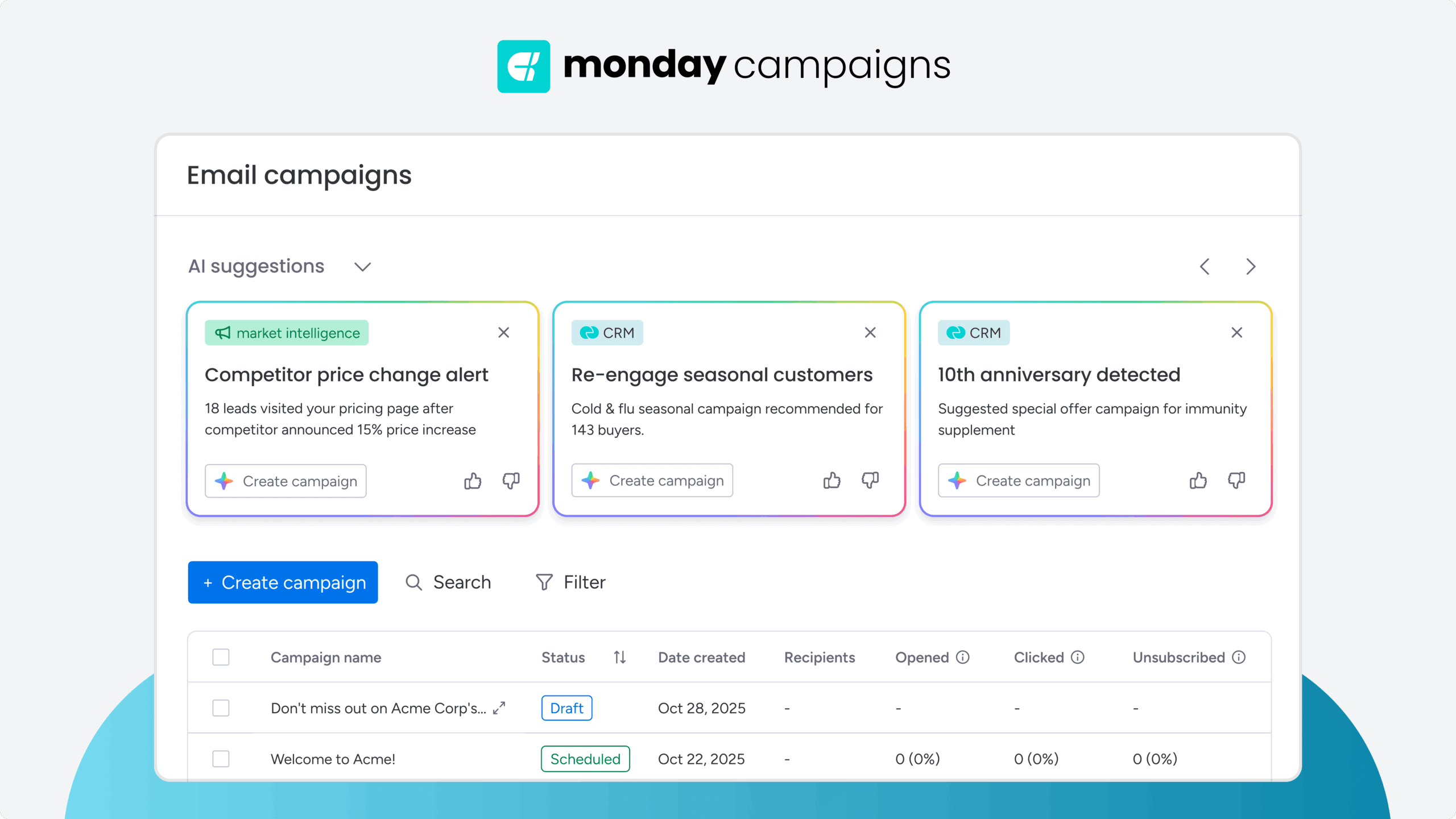
The AI analyzes your best-performing historical content and automatically generates test variants that maintain your brand voice while exploring new approaches. You set the guardrails for tone, messaging, and compliance, then the system creates subject lines, preview text, and content variations that test specific hypotheses. This cuts variant creation time from hours to minutes while ensuring every test aligns with your brand standards.
Real-time optimization and traffic allocation
Advanced algorithms monitor engagement as it happens and dynamically shift traffic toward winning variants within hours of launch. The system uses Bayesian statistics to balance statistical validity with performance maximization, so you don’t sacrifice campaign results while waiting for perfect sample sizes. Winning elements get implemented automatically across your active campaigns, turning insights into action without manual intervention.
Revenue-focused analytics and attribution
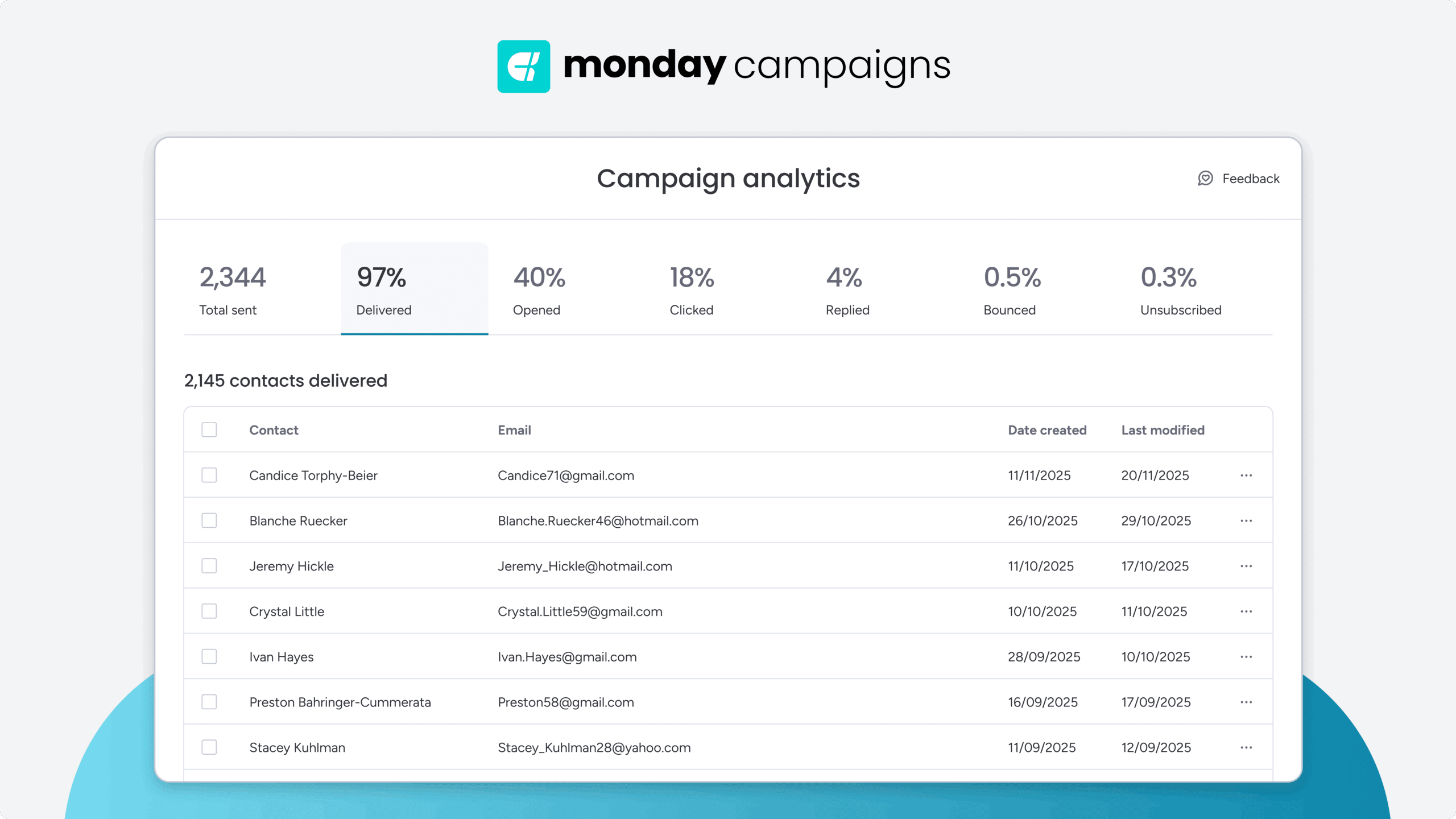
The platform connects email engagement directly to CRM opportunity data, showing which campaign elements drive qualified leads, sales conversations, and closed deals. You get clear attribution from email performance to pipeline contribution, the kind of revenue metrics executives actually care about. AI-powered dashboards surface patterns across campaigns, segments, and customer lifecycle stages to inform your broader strategy.
Continuous learning across campaigns
Every send becomes a learning opportunity that improves future performance. The AI captures insights about what works for specific segments, industries, and campaign types, then automatically applies these learnings to new campaigns with similar characteristics. Pattern recognition identifies subtle trends that would be nearly impossible to spot manually, like how certain subject line styles perform differently across buyer roles or deal stages.

"With monday campaigns, we can launch professional emails in minutes and instantly see who engaged. Our sales team follows up directly with those showing interest - making outreach faster and more effective."
Michael Fitzpatrick | National Workplace Training ManagerStart optimizing for revenue, not just opens
The shift from manual A/B testing to AI-powered optimization isn’t just about speed. It’s about fundamentally changing how you approach email campaigns, moving from reactive adjustments to proactive revenue generation. AI testing gives you the ability to run sophisticated experiments at scale, personalize experiences for individual subscribers, and prove the direct connection between your email campaigns and pipeline growth.
The question is whether you’ll adopt these capabilities now or spend another year running manual tests while competitors optimize in real-time. Platforms like monday campaigns make AI-powered testing accessible to any revenue marketing team, removing the technical barriers and resource constraints that previously limited sophisticated optimization to enterprise organizations with dedicated data science teams.
FAQs
What is AI A/B testing and how does it work in email marketing?
AI A/B testing uses machine learning algorithms to automatically design, execute, and optimize experiments that identify the highest-performing campaign elements. Unlike manual testing that requires weeks of analysis, AI systems analyze multiple variables simultaneously and adapt in real-time based on recipient behavior.
How does AI-powered A/B testing differ from traditional A/B testing?
Traditional A/B testing requires manual variant creation, fixed audience splits, and sequential testing of one variable at a time over 7–14 days. AI testing automates variant generation, dynamically shifts traffic to winners, and tests multiple variables simultaneously within hours.
Can AI A/B testing work with small email lists?
AI A/B testing can work with smaller lists than traditional methods because algorithms like Bayesian optimization and multi-armed bandits don't require the large sample sizes that frequentist statistics demand. However, very small lists (under 1,000 contacts) may still limit testing capabilities.
How long does AI A/B testing take to show results?
AI A/B testing typically identifies winning variants within hours of campaign launch by analyzing early engagement signals and applying predictive models. Traditional testing requires 7–14 days minimum to reach statistical significance.
Does AI A/B testing replace human marketers?
AI A/B testing doesn't replace human marketers — it elevates their role from tactical execution to strategic direction. Marketers set optimization goals, define brand guardrails, and apply insights to broader strategy while AI handles variant creation, monitoring, and implementation.
What are the main benefits of using AI for A/B testing?
AI testing accelerates optimization cycles, enables personalization at scale, and connects campaign performance directly to revenue outcomes. Teams can run significantly more experiments in the same timeframe while reducing manual effort on variant creation, statistical analysis, and winner implementation.

 Get started