


AI-powered CRM transforms guesswork into precision, turning your sales pipeline into a predictable revenue engine. Revenue teams are already using AI to shorten sales cycles, improve forecast accuracy, and automate the busy work that keeps reps from building customer relationships.
This guide explores 7 ways AI reshapes CRM in 2026 — from predictive lead intelligence to autonomous customer journey orchestration. You’ll discover practical implementation strategies, see how different teams leverage AI capabilities, and build a roadmap that delivers measurable results within a single Work OS.
Key takeaways
- Use machine learning to forecast which deals will close and when, giving you objective pipeline insights instead of relying on rep estimates.
- Let AI handle data entry, follow-ups, and routine activities so your reps spend time building relationships and closing deals.
- Real-time analytics and sentiment analysis catch at-risk deals and unhappy customers early, when you can still fix things.
- Multi-agent systems coordinate sales, legal, finance, and customer success automatically, eliminating coordination delays that kill deal momentum.
- Generate contextual emails, proposals, and follow-ups that adapt to each prospect’s behavior and preferences with monday CRM’s AI-powered Work OS.
The evolution from traditional CRM to AI-powered systems
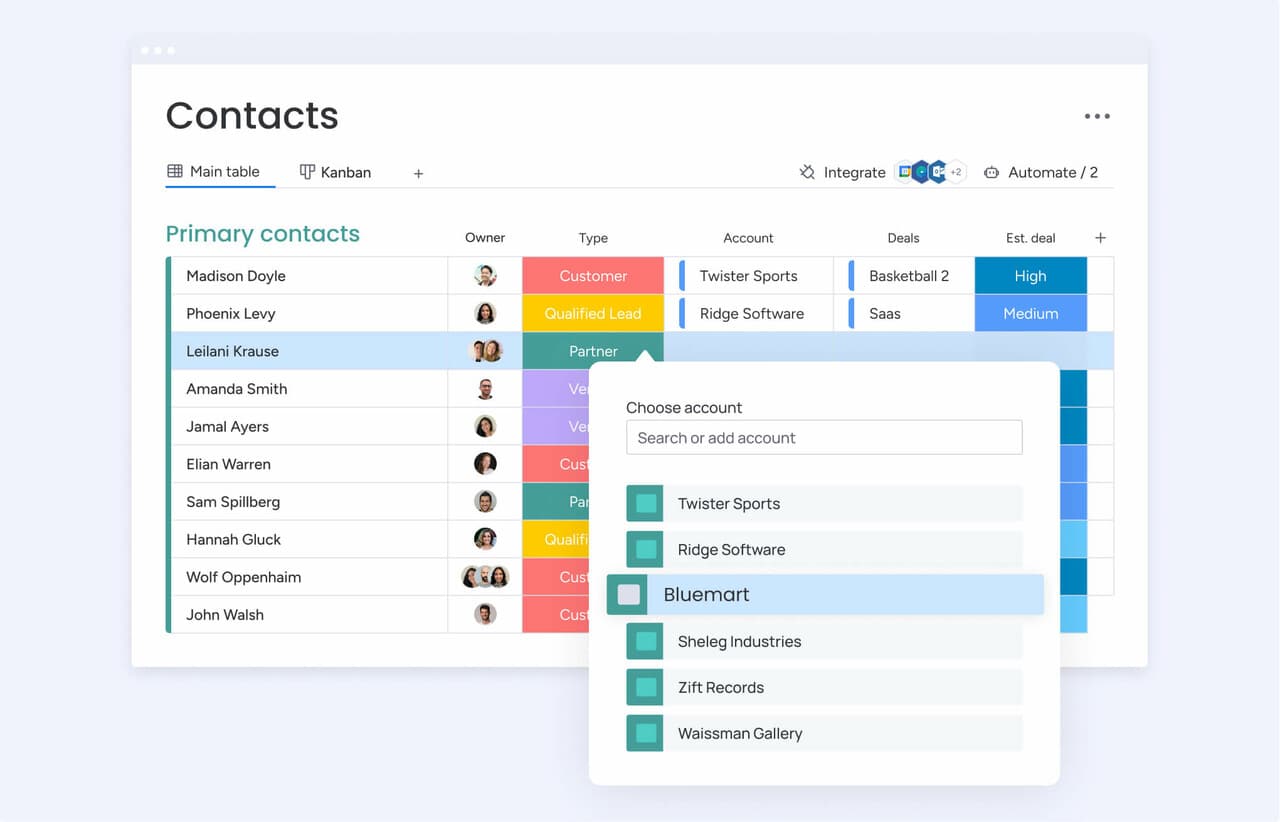
CRM technology transformed completely over the past 2 decades. Simple contact databases became comprehensive and now AI-powered CRM platforms are shifting things further. This isn’t a small upgrade. It’s a complete rethink of what CRM can do.
Three big shifts define this evolution:
- From manual to automated: Data entry, follow-up sequences, and routine activities happen automatically, freeing teams to focus on relationship-building and strategic selling.
- From reactive to predictive: Instead of reviewing what happened last quarter, teams see what’s likely to happen next and can adjust course before problems materialize.
- From siloed to orchestrated: Information flows seamlessly between sales, marketing, customer success, legal, and finance without manual handoffs or coordination overhead.
Understanding AI-enhanced CRM capabilities
AI-enhanced CRM bakes machine learning, natural language processing, and predictive analytics right into your workflows. These capabilities run in the background — analyzing patterns, generating insights, and handling tasks that used to need a human.
The practical applications cover every stage of the customer lifecycle. AI capabilities improve daily workflows in a few key ways:
- Predictive scoring: Machine learning algorithms analyze historical win/loss data, engagement patterns, and behavioral signals to calculate which leads are most likely to convert.
- Automated data capture: Natural language processing extracts key information from emails, call transcripts, and documents, then populates the appropriate CRM fields.
- Intelligent recommendations: Pattern recognition identifies what actions have worked in similar situations and suggests next steps.
Traditional CRM makes humans input data, analyze it, and decide what to do. AI-enhanced CRM automates the first 2 steps and guides the third.
Transitioning from system of record to system of action
The distinction between “system of record” and “system of action” captures the fundamental shift in CRM philosophy. A system of record stores information. A system of action uses it to drive revenue — no waiting for humans to step in.
| Capability | System of record | System of action |
|---|---|---|
| Data entry | Manual input required | Automatic capture from emails, calls, documents |
| Deal updates | Rep changes fields manually | AI adjusts based on activity signals |
| Next steps | Rep decides and creates activities | AI recommends and can execute actions |
| Forecasting | Based on rep estimates | Based on objective behavioral patterns |
| Cross-team coordination | Manual handoffs and notifications | Automated workflows trigger appropriate actions |
Consider a common scenario. A sales rep finishes a customer call where the prospect expressed urgency about solving a problem before quarter-end.
- In a system of record: The rep manually logs the call, types notes about the urgency, updates the deal stage, creates a follow-up activity, and perhaps alerts a colleague who needs to prepare a proposal.
- In a system of action: AI transcribes the call, identifies the urgency signal, updates the deal stage and close date, creates prioritized activities for the rep and proposal team, and adjusts the revenue forecast. All within minutes of the call ending.
This shift solves the predictability and efficiency problems mid-market revenue leaders face. When systems drive outcomes instead of just storing data, the gap between information and action shrinks fast.
AI copilots vs. agents vs. multi-agent systems
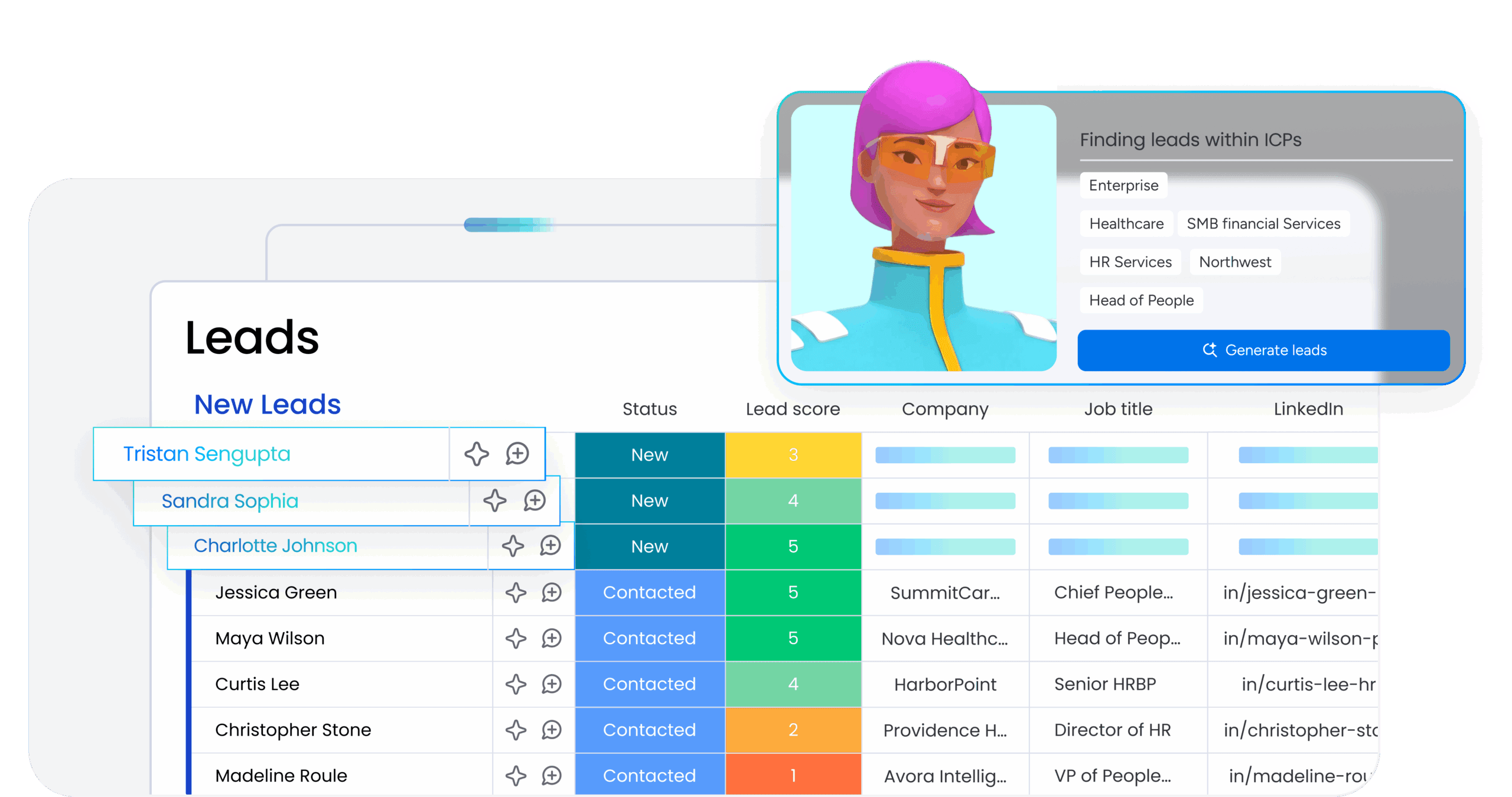
AI in CRM exists on a spectrum — from assistive tools to fully autonomous CRM systems. The right approach depends on the task, risk level, and how much control your team wants to maintain.
| Capability | AI copilots | AI agents | Multi-agent systems |
|---|---|---|---|
| Role | Assist humans with tasks and recommendations | Execute tasks autonomously within rules | Coordinate complex workflows across teams |
| Human involvement | High (human reviews and approves) | Medium (humans define rules and guardrails) | Low (system orchestrates end-to-end) |
| Best for | Drafting, prep work, recommendations | Repetitive, rule-based tasks | Cross-functional processes |
| Example use cases | Email drafting, meeting briefs, next-step suggestions, data enrichment | Lead qualification, follow-up sequences, data cleanup, scheduling | Deal-to-cash workflows, onboarding, renewals, escalations |
| Decision-making | Suggests actions | Acts within defined boundaries | Coordinates multiple systems and teams |
| Risk level | Low | Medium | Higher (requires strong governance) |
When to use each:
- Copilots: Speed up work without giving up control.
- Agents: Scale execution for repetitive workflows.
- Multi-agent systems: Eliminate handoffs across teams.
Copilots help your team move faster. Agents help you scale. Multi-agent systems remove coordination entirely.
7 AI transformations reshaping CRM
These 7 transformations are the biggest shifts revenue teams will see in 2026. They fix specific pain points mid-market revenue leaders deal with every day: unpredictable forecasts, manual admin work, poor cross-department coordination, and trouble scaling personalized customer engagement.
Each transformation builds on proven AI capabilities already delivering results for smart revenue teams.
1. Predictive lead intelligence and opportunity scoring
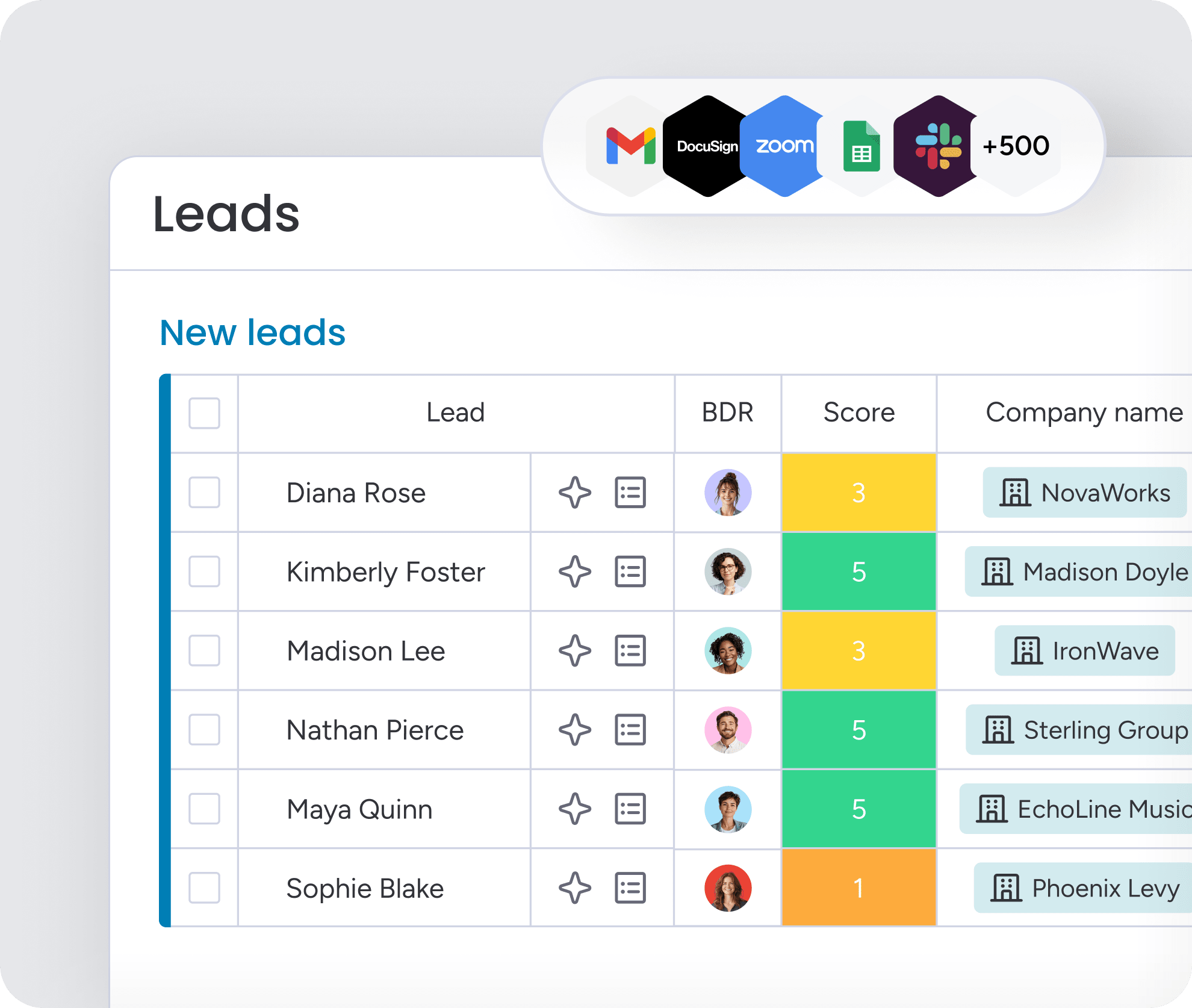
Predictive lead intelligence uses machine learning to analyze historical win/loss patterns, customer behavior, and external data — then forecasts which opportunities will convert and when. This beats traditional lead scoring, which relies on static rules like job title or company size.
Traditional scoring assigns points based on set criteria. AI scoring learns continuously from actual outcomes. The algorithm analyzes thousands of variables across won and lost deals, catching patterns humans miss.
Maybe deals close faster when 3 or more stakeholders engage in the first two weeks. Maybe prospects asking about integration capabilities convert at twice the rate of those who don’t. AI finds these patterns and bakes them into scoring automatically.
AI analyzes several types of signals for predictive scoring:
- Engagement patterns: Frequency of email opens, content downloads, and website visits.
- Behavioral changes: Sudden increases in activity or involvement of multiple stakeholders.
- Contextual factors: Budget discussions, timeline mentions, and competitive evaluations.
For CROs struggling with forecast accuracy, predictive scoring changes pipeline reviews completely. Instead of asking reps for their best guess, leaders see objective scores based on behavioral evidence.
2. Natural language interactions replace manual entry
Natural language processing enables sales reps to update CRM records, search for information, and execute activities using conversational language instead of navigating forms and fields. The interface becomes a conversation rather than a data entry exercise.
Reps can provide simple prompts that guide AI to write the perfect text, choose the tone and length, and preview the generated content before saving. This capability reduces administrative burden across common workflows.
Practical applications of natural language interactions include:
- Voice-to-CRM updates: A rep finishes a call and describes the conversation, and AI creates the activity record.
- Conversational search: A manager asks for specific deals and the system returns filtered results.
- Email-to-CRM capture: AI extracts budget confirmations from emails and updates deal records.
3. Autonomous customer journey orchestration
Customer journey orchestration means AI-driven coordination of touchpoints across the entire customer lifecycle, from first contact through renewal and expansion. Autonomous orchestration goes further: AI actively manages the journey by triggering appropriate actions at each stage based on customer behavior and predefined playbooks.
A prospect downloads a pricing guide from the website. AI identifies this as a buying signal and immediately increases the lead score, activates a personalized follow-up email sequence, and alerts the assigned sales rep with context about the prospect’s recent activity.
| Journey stage | Orchestration actions | Business impact |
|---|---|---|
| Lead nurturing | Delivers relevant content, adjusts messaging, identifies sales-ready leads | Higher conversion rates |
| Sales acceleration | Coordinates multi-touch sequences, triggers content, alerts reps | Shorter sales cycles |
| Onboarding | Triggers educational content, schedules check-ins, identifies gaps | Faster time-to-value |
| Renewal management | Identifies at-risk customers, initiates workflows, surfaces opportunities | Higher retention rates |
Orchestration addresses cross-department coordination challenges by automatically triggering handoffs to customer success, legal, finance, and implementation teams.
4. Real-time sentiment analysis drives proactive engagement
Sentiment analysis uses natural language processing to evaluate the emotional tone and intent behind customer communications in real-time. This capability transforms how teams identify and respond to customer needs.
AI detects sentiment signals across multiple dimensions:
- Positive indicators: Enthusiastic language, questions about implementation, and involvement of additional stakeholders.
- Negative indicators: Frustration expressions, comparison shopping language, and decreased responsiveness.
Teams can automatically categorize text input as Positive, Negative, or Neutral. This capability can be applied to columns on any board, enabling teams to monitor customer communications systematically.
Proactive engagement scenarios triggered by sentiment analysis include:
- Escalation prevention: AI detects frustration and alerts the account manager before churning occurs.
- Opportunity acceleration: AI identifies buying intent and prompts immediate action.
- Risk mitigation: AI notices communication pattern changes and flags for relationship review.
For revenue leaders focused on predictability, sentiment analysis provides early warning signals that enable intervention before problems become visible in traditional metrics.
5. AI-powered pipeline forecasting and revenue intelligence
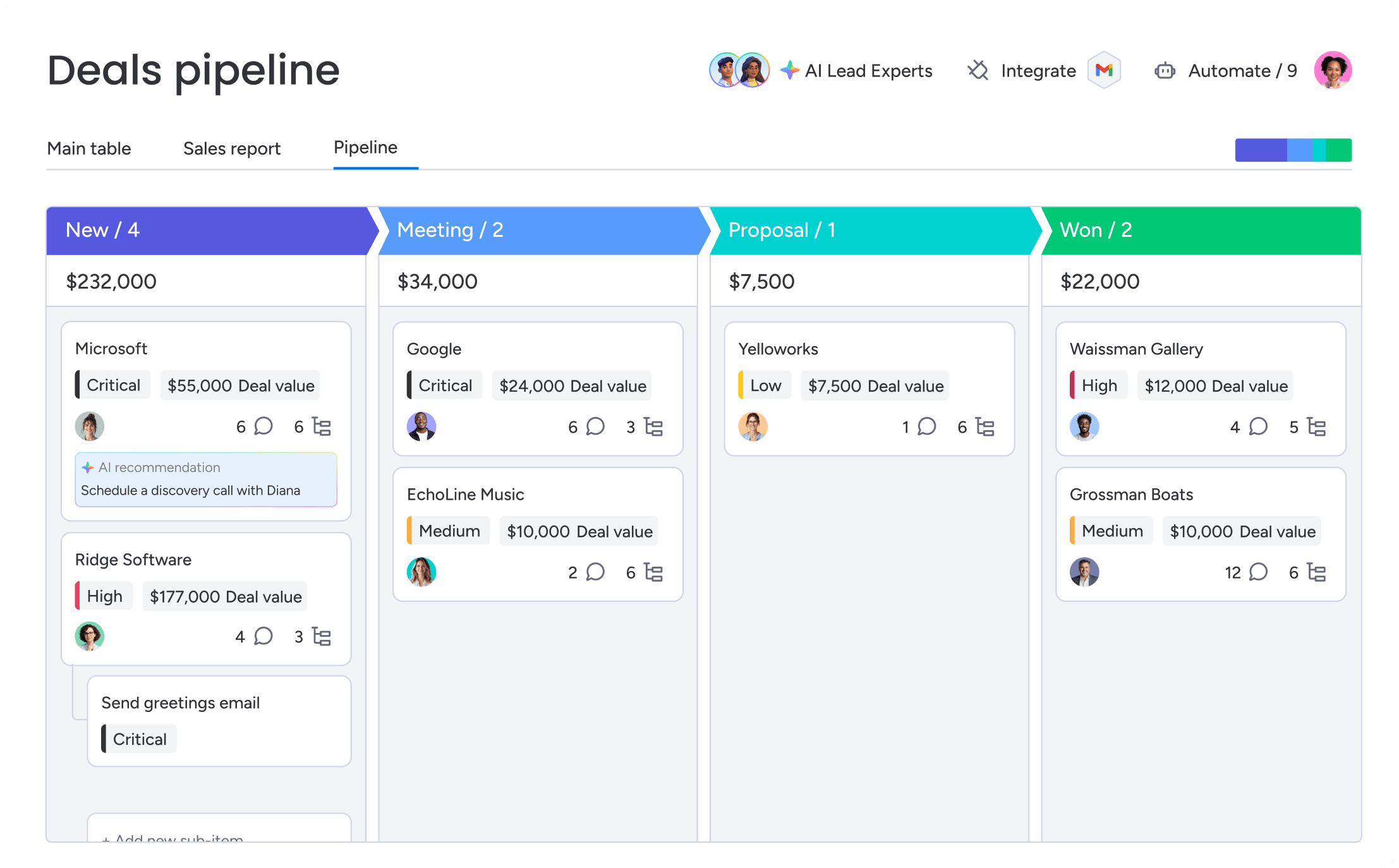
AI-powered forecasting analyzes deal velocity, historical close rates, rep performance patterns, and external factors to generate more accurate revenue predictions than traditional pipeline reviews based on rep estimates.
The key components of AI forecasting address predictability challenges:
- Deal health scoring: Evaluates each opportunity’s likelihood to close.
- Risk identification: Flags stalled deals or warning signs.
- Trend analysis: Identifies patterns across the pipeline.
Traditional forecasting relies on subjective assessments. AI analyzes objective signals: activity gaps, missing executive sponsors, unusual deal sizes, and historical patterns. The AI-adjusted forecast reflects reality rather than optimism.
Teams gain immediate insights into sales pipeline status, sales forecasting, team performance, and activity status through code-free, customizable dashboards. Sales-specific widgets like leaderboards and funnels help identify strong and weak points in the pipeline.
6. Cross-department workflow automation without coding
No-code workflow automation enables revenue teams to create sophisticated, cross-functional processes without IT involvement or technical expertise. Visual workflow builders allow users to drag and drop triggers, conditions, and actions to create automation rules.
This democratization means sales ops, RevOps, or even individual managers can build and modify workflows as needs evolve. The barrier between needing automation and having it shrinks from weeks to hours.
Cross-department workflow examples show how automation eliminates manual coordination:
- Deal approval routing: Workflows automatically route to appropriate approval chains based on deal parameters.
- Contract generation: Workflows generate contracts, send for review, notify finance, and create onboarding projects.
- Renewal coordination: Workflows alert teams, pull analytics, identify opportunities, and schedule meetings.
- Escalation management: Workflows escalate based on sentiment or SLA violations with full context.
Teams can work with legal and security teams in one secure place to review and update contracts and statuses. These automated workflows eliminate the manual coordination burden that consumes RevOps time.
7. Proactive customer success through behavioral signals
AI analyzes customer behavior patterns to identify at-risk accounts and expansion opportunities before they become obvious through traditional metrics. The shift from reactive to proactive customer success represents a fundamental change in approach.
AI identifies issues and opportunities by detecting subtle pattern changes that precede explicit signals.
| Signal category | Specific indicators | What it suggests |
|---|---|---|
| Usage patterns | Decreasing login frequency, feature drops, reduced users | Potential disengagement |
| Engagement changes | Slower response times, champion turnover, reduced participation | Relationship risk |
| Support patterns | Increasing tickets, recurring issues, escalation frequency | Product friction |
| Expansion indicators | New user additions, advanced feature exploration, capability questions | Growth opportunity |
Teams can track onboarding progress and manage renewals while monitoring collection status to spot where attention is needed. Behavioral signal analysis transforms customer success from reactive support into a proactive revenue driver.
Personalizing every customer interaction with AI
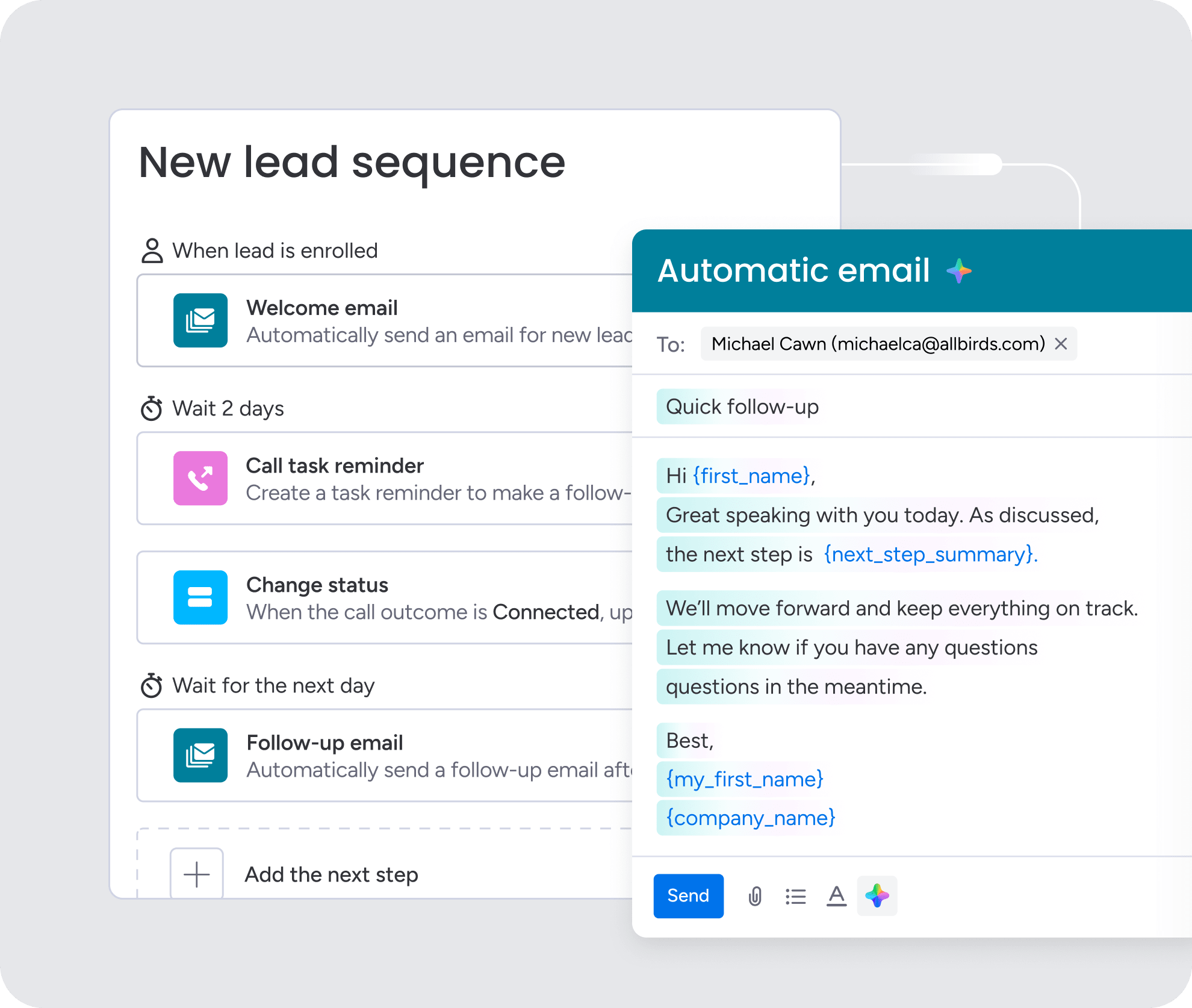
Personalization at scale was previously impossible for mid-market teams with limited resources. AI changes this equation by automating the analysis and content creation that personalization requires.
Customers expect relevant interactions. Generic outreach gets ignored. Organizations that deliver personalized customer experiences at scale build stronger relationships and close more deals.
Implementing dynamic content generation at scale
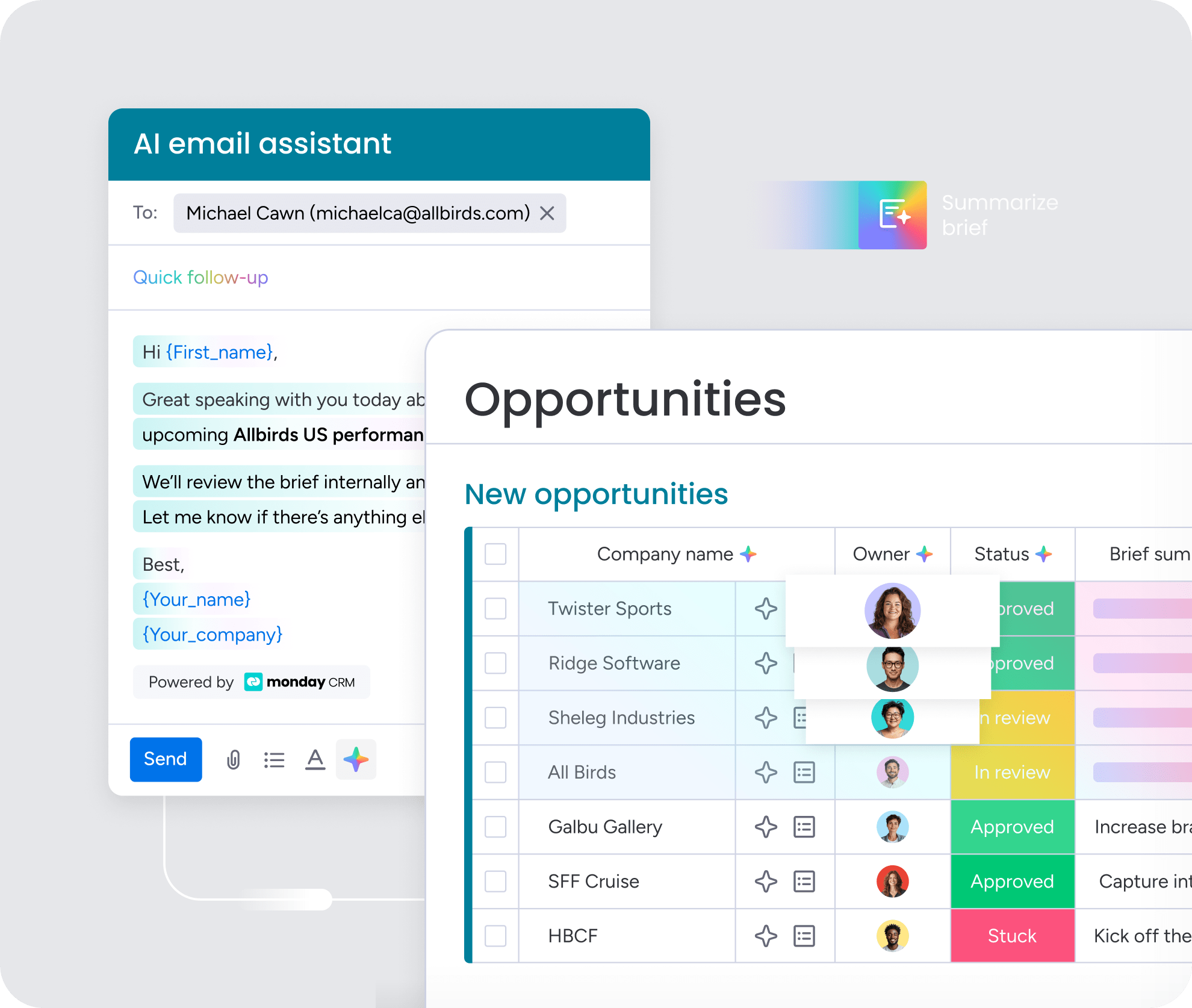
AI-powered content generation creates personalized emails, proposals, presentations, and other customer-facing materials by analyzing customer data, interaction history, and context. The system pulls relevant information from CRM records and generates tailored content.
Teams provide simple prompts that guide AI to write perfect text for their needs. They choose the tone and length, and preview the generated text before saving.
Dynamic content generation transforms customer-facing communications:
- Personalized outreach emails: AI generates emails referencing industry challenges and relevant case studies.
- Custom proposals: AI creates documents highlighting features matching stated needs.
- Follow-up sequences: AI adapts email sequences based on recipient engagement.
- Meeting preparation briefs: AI generates pre-call summaries with customer background.
AI-generated content maintains brand voice and messaging consistency while dramatically reducing time investment.
Deploying contextual next-best actions for revenue teams
AI analyzes the current state of each customer relationship and recommends the optimal next action for sales reps, account managers, or customer success teams. These recommendations consider deal stage, customer behavior, interaction history, and successful patterns from similar situations.
What should a rep do when a deal stalls? When a prospect suddenly engages? When a customer shows signs of risk? AI provides specific, contextual guidance based on what has worked before.
Common scenarios where AI provides next-best action guidance:
- Stalled deal: AI analyzes similar successful re-engagements and recommends specific actions.
- Engaged prospect: AI recognizes buying signals and suggests immediate next steps.
- At-risk customer: AI recommends business review meetings based on usage decline patterns.
Teams can give instructions to AI, reference any column on their board for input, and AI generates output per their specifications. Next-best actions help less experienced reps perform like top performers by codifying winning behaviors.
Creating hyper-personalized customer experiences
Hyper-personalization goes beyond using a customer’s name in an email. It means tailoring every interaction based on comprehensive understanding of their business context, preferences, challenges, and goals.
Components of hyper-personalized experiences show how AI enables deeper customer understanding:
- Contextual awareness: AI maintains complete interaction history and understands journey position.
- Preference learning: AI identifies communication preferences through behavior analysis.
- Adaptive messaging: AI adjusts tone and content based on customer role and engagement.
Every interaction including emails, meetings, and notes gets logged and tracked in one timeline. AI creates short summaries of all communication events, helping teams save valuable time while maintaining complete context.
Automating manual work with intelligent workflows

Manual administrative work is the top productivity drain for sales teams. Every hour spent logging calls, updating records, and coordinating handoffs is an hour not spent engaging customers. Intelligent workflow automation eliminates repetitive activities and lets revenue teams focus on high-value activities.
This section explores 3 key areas where AI-powered automation delivers immediate impact for revenue teams.
Step 1: Eliminate data entry through AI recognition
AI recognition technologies automatically extract information from various sources and populate CRM records without manual input. This addresses the data entry burden that causes reps to avoid their CRM and undermines data quality.
AI automatically extracts and organizes key information from files like invoices, resumes, or contracts. Information can also be extracted from text columns, documents, and images. Specific details appear directly in board columns, eliminating manual input.
Key data entry elimination capabilities include:
- Email intelligence: AI reads conversations and automatically logs activities.
- Call transcription: AI transcribes calls and identifies action items.
- Document parsing: AI extracts information from contracts and proposals.
- Calendar integration: AI automatically logs meetings based on calendar events.
Step 2: Implement smart follow-up sequences and prioritization

AI-powered follow-up sequences adapt based on recipient behavior, and intelligent prioritization helps reps focus on the highest-impact activities.
Smart sequences differ from traditional drip campaigns in their adaptability. Traditional sequences send predetermined emails on fixed schedules. Smart sequences adjust content, timing, and next steps based on engagement signals.
Adaptive sequence behaviors demonstrate real-time AI response:
- Engagement-based progression: AI recognizes high-intent signals and accelerates sequences.
- Disengagement handling: AI shifts channels or pauses to avoid spam perception.
- Content adaptation: AI changes follow-ups based on what prospects engage with.
Teams can send individual and mass emails using dynamic fields and templates, and track emails including open rate and link clicks. Automated follow-ups ensure consistent engagement without manual effort.
Step 3: Deploy intelligent document processing for faster deals
Intelligent document processing uses AI to automatically generate, review, and manage contracts, proposals, and other deal-related documents, accelerating the sales cycle.
Key document processing capabilities reduce friction in the contract-to-close process:
- Template-based generation: AI creates contracts by pulling information from CRM records.
- Clause extraction: AI reads contracts and flags non-standard terms.
- Approval routing: AI sends documents to stakeholders based on deal parameters.
- Version control: AI tracks changes and maintains audit trails.
Teams can create a library of all the documents they need to close deals, including legal, security, financial, and more. Faster document processing shortens sales cycles and reduces friction in handoffs between sales, legal, and finance.
How AI impacts sales, marketing, and service teams
AI transforms workflows differently for each revenue team function. While the underlying capabilities are similar, the specific applications and outcomes vary based on each team’s objectives and workflows.
Understanding these differences helps organizations prioritize AI deployment and set appropriate expectations for each team.
Sales teams gain AI-guided selling and deal intelligence
AI enhances sales team effectiveness by providing real-time guidance, deal insights, and administrative automation that help reps focus on selling rather than administrative activities.
Core AI capabilities for sales teams include:
- Deal coaching: AI analyzes deal progression and provides advancement recommendations.
- Competitive intelligence: AI monitors deal signals and alerts when competitors are involved.
- Win/loss analysis: AI identifies patterns in won and lost deals.
- Activity optimization: AI recommends optimal outreach timing and messaging.
| Outcome | How AI contributes |
|---|---|
| Shorter sales cycles | Timely actions based on buying signals accelerate progression |
| Higher win rates | Stronger qualification and engagement strategies improve conversion |
| Larger deal sizes | Identifying expansion opportunities increases average deal value |
| Improved forecast accuracy | Objective signals replace subjective estimates |
| Reduced ramp time | New reps perform faster through AI guidance |
Teams see where deals stand with a visual pipeline, customize their pipeline with drag and drop deal stages, and automate actions based on custom conditions.
Marketing teams leverage predictive segmentation and campaign AI
AI transforms marketing effectiveness through stronger targeting, personalized campaigns, and performance optimization that maximize return on marketing investment.
Core AI capabilities for marketing teams include:
- Predictive segmentation: AI identifies high-value audience segments based on conversion likelihood.
- Content optimization: AI tests and optimizes email subject lines and content variations.
- Channel attribution: AI determines which touchpoints influence conversions.
- Lead scoring and routing: AI qualifies inbound leads and routes them appropriately.
Teams can collect leads via website forms, social ad campaigns, or other sources, auto-enrich lead data, and centralize, qualify, and assign all leads.
Service teams deliver proactive support with AI insights
AI enables customer service and success teams to shift from reactive problem-solving to proactive relationship management that prevents issues and identifies opportunities.
Core AI capabilities for service teams include:
- Issue prediction: AI identifies customers likely to experience problems.
- Automated triage: AI categorizes and routes support requests.
- Knowledge recommendations: AI suggests relevant help articles.
- Sentiment monitoring: AI tracks satisfaction signals across interactions.
Teams see all relevant account and contact information with an expanded item view, see all connected deals, accounts, contacts, and projects in one place, and log every interaction in one timeline.
Your roadmap to implementing AI-powered CRM
Understanding AI’s potential differs from successfully implementing it. This roadmap provides a practical, phased approach designed for mid-market organizations that need to demonstrate ROI quickly without massive upfront investment.
Each phase builds on the previous one, allowing teams to gain confidence and expertise before advancing to more sophisticated AI capabilities.
Phase 1: Foundation assessment and quick wins
The first phase focuses on understanding current state and capturing immediate value from AI capabilities that require minimal change management.
Assessment activities establish the foundation for successful AI deployment:
- Data quality audit: Assess current CRM data for completeness and accuracy.
- Process mapping: Document current workflows and identify automation opportunities.
- Technology inventory: Catalog existing integrations and data flows.
Quick win implementations deliver immediate time savings:
- Email capture and logging: Enable AI to automatically log email interactions.
- Meeting transcription: Implement call transcription with automatic activity logging.
- Basic lead scoring: Deploy initial AI-powered lead scoring using existing data.
AI creates short summaries of all communication events, helping sales and support teams save valuable time. Phase 1 typically takes 4-6 weeks.
Phase 2: Workflow automation and predictive analytics
The second phase expands AI deployment to automate workflows and introduce predictive capabilities that improve decision-making.
Workflow automation priorities address the highest-friction manual processes:
- Follow-up sequences: Implement adaptive email sequences.
- Deal stage automation: Configure AI to update stages based on activity signals.
- Cross-department notifications: Automate handoff notifications between teams.
Predictive analytics deployment introduces forward-looking intelligence:
- Pipeline forecasting: Enable AI-powered forecasting analyzing deal signals.
- Churn risk scoring: Implement customer health scoring.
- Expansion opportunity identification: Deploy AI to identify growth signals.
Teams can apply AI capabilities to columns including Text, Date, Number, Dropdown, People, and Status columns. Phase 2 typically takes 8-12 weeks.
Phase 3: Advanced AI and continuous optimization
The third phase deploys more sophisticated AI capabilities and establishes processes for continuous improvement.
Advanced AI deployment expands the scope of AI-driven operations:
- Multi-agent orchestration: Implement coordinated AI workflows spanning departments.
- Natural language interfaces: Enable conversational CRM interactions.
- Hyper-personalization: Deploy AI-powered content generation at scale.
Continuous optimization practices ensure AI value compounds over time:
- Performance monitoring: Establish dashboards tracking AI effectiveness.
- Feedback loops: Create processes for users to flag AI errors.
- Regular review cycles: Schedule quarterly reviews of AI performance.
Teams can review the details of AI actions taken and the logic behind the results. Phase 3 is ongoing, with new capabilities deployed as AI maturity increases.
Governance, ethics, and human oversight in AI-driven CRM
AI capabilities require thoughtful governance to ensure responsible use, maintain customer trust, and comply with evolving regulations. This section outlines the key components of effective AI governance for CRM implementations.
Step 1: Establishing AI governance frameworks
Effective AI governance defines who can deploy AI capabilities, what decisions AI can make autonomously, and how AI actions are monitored and reviewed.
Governance framework components establish boundaries and accountability:
- Decision authority matrix: Define which decisions AI can make autonomously versus requiring human approval.
- Audit and transparency requirements: Establish logging requirements for AI actions.
- Review and override processes: Create processes for humans to review AI decisions.
- Bias monitoring: Implement processes to detect and address potential bias.
Step 2: Balancing automation with human judgment
The goal of AI in CRM is augmenting human capabilities, not replacing human judgment. AI handles data capture, prioritization, routine notifications, and pattern detection. Humans drive relationship strategy, exception handling, ethical considerations, and strategic direction.
Teams can preview AI results before saving and deactivate AI capabilities on any column if needed.
Step 3: Addressing data privacy and compliance considerations
AI-powered CRM processes significant customer data, creating privacy and compliance obligations. Key considerations include data minimization, consent and transparency, data retention policies, and cross-border transfer compliance. Involve legal and compliance teams early in AI deployment planning to address these considerations proactively.
Maximizing revenue potential with monday CRM
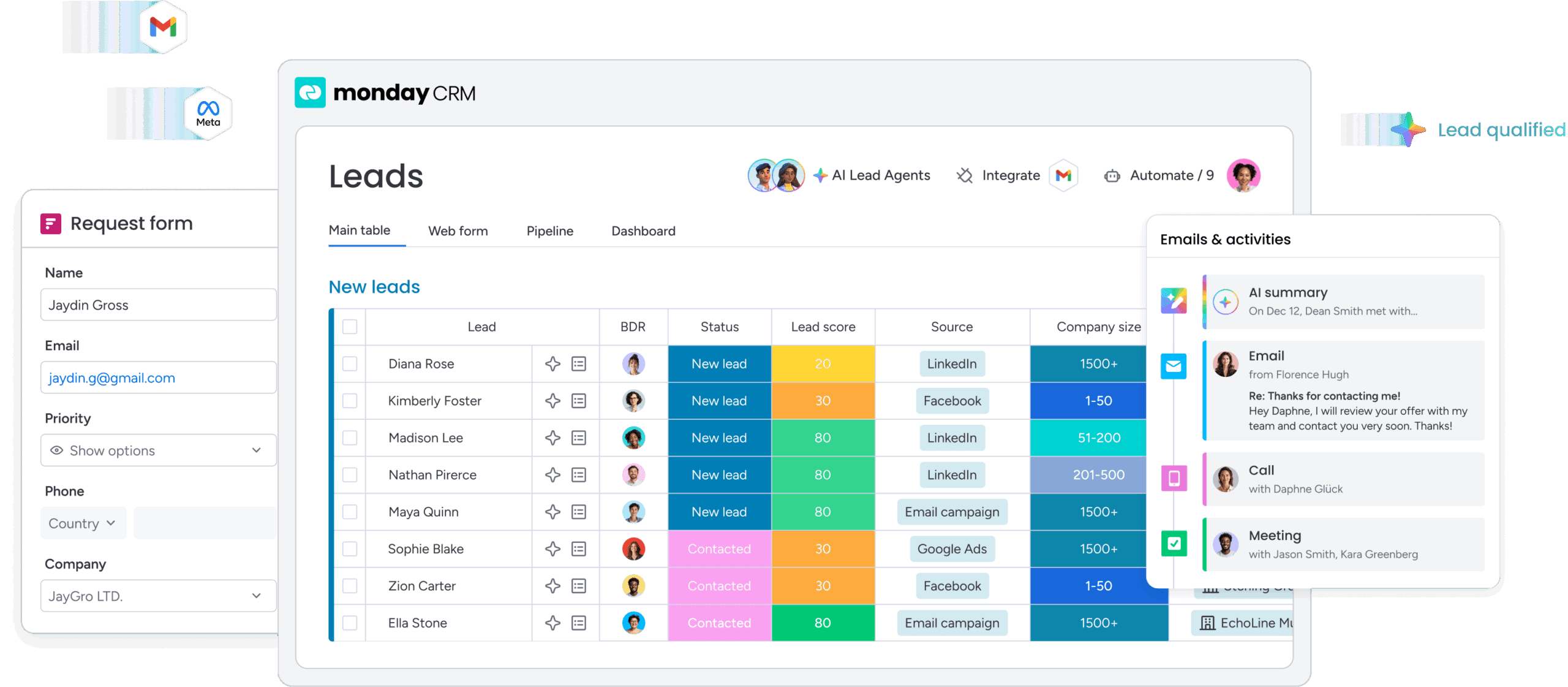
monday CRM delivers AI-powered capabilities that transform how revenue teams work. This isn’t just another CRM with AI features bolted on — it’s a complete Work OS built to help mid-market teams predict revenue, automate workflows, and close deals faster. monday CRM’s predictive intelligence replaces forecast guesswork with objective data. Automation eliminates the manual work that keeps reps from selling. Real-time analytics catch pipeline problems while you can still fix them.
monday CRM integrates AI capabilities directly into your daily workflows without forcing you to learn a new system or change how your team works:
- Automated data capture: AI extracts information from emails, calls, and documents, then populates CRM fields automatically — no manual entry required.
- Intelligent forecasting: Machine learning analyzes deal velocity and behavioral signals to generate accurate revenue predictions based on what’s actually happening, not rep optimism.
- Smart content generation: AI drafts personalized emails, proposals, and follow-ups that match your brand voice and adapt to each prospect’s context.
- Proactive pipeline management: Real-time sentiment analysis and deal health scoring flag at-risk opportunities early enough to intervene.
- Cross-department orchestration: Multi-agent workflows coordinate sales, legal, finance, and customer success automatically — no manual handoffs.

“With monday CRM, we’re finally able to adapt the platform to our needs — not the other way around. It gives us the flexibility to work smarter, cut costs, save time, and scale with confidence.”
Samuel Lobao | Contract Administrator & Special Projects, Strategix
“Now we have a lot less data, but it’s quality data. That change allows us to use AI confidently, without second-guessing the outputs.”
Elizabeth Gerbel | CEO
“Without monday CRM, we’d be chasing updates and fixing errors. Now we’re focused on growing the program — not just keeping up with it."
Quentin Williams | Head of Dropship, Freedom Furniture
“There’s probably about a 70% increase in efficiency in regards to the admin tasks that were removed and automated, which is a huge win for us.“
Kyle Dorman | Department Manager - Operations, Ray White
"monday CRM helps us make sure the right people have immediate visibility into the information they need so we're not wasting time."
Luca Pope | Global Client Solutions Manager at Black Mountain
“In a couple of weeks, all of the team members were using monday CRM fully. The automations and the many integrations, make monday CRM the best CRM in the market right now.”
Nuno Godinho | CIO at Velv
“monday.com provides developmental flexibility, operational efficiency, and data transparency — all in one place. We became a company that moved from chasing data to leading with it.”
Hyunghan Lee | Team Lead, Sandbox Network
"monday.com brought every part of our business into one connected space. The harmony between work management and CRM has become our operating system — giving us the clarity and confidence to scale.”
Jennifer Chinburg | Executive Vice President of Corporate Development & Brand, Chinburg Properties
“We just weren’t getting value from our old CRM. With monday.com, it's a thousand times better. Our sales teams are more informed, more consistent, and far more connected."
James Arnold | Chief Operating Officer, CenversaStart transforming your CRM with AI today
The implementation roadmap provides a phased approach designed for mid-market teams. Start with quick wins like automated email logging and meeting transcription to demonstrate immediate value. Expand to workflow automation and predictive analytics as your team gains confidence. Deploy advanced AI capabilities for maximum impact as your organizational AI maturity increases.
monday CRM makes this progression straightforward. The platform’s no-code interface means your RevOps team can build and modify AI-powered workflows without IT involvement. You control which AI capabilities to enable, preview results before they go live, and maintain complete visibility into what AI does on your behalf.
Try monday CRM AI CapabilitiesFAQs
What is AI-enhanced CRM and how does it differ from traditional CRM?
An AI-enhanced CRM differs from a traditional CRM by integrating machine learning, natural language processing, and predictive analytics directly into workflows. Unlike traditional CRM that requires manual data entry and analysis, AI-enhanced CRM automatically captures information, analyzes patterns, and provides intelligent recommendations. The system actively drives revenue outcomes rather than passively storing data.
How do AI copilots, agents, and multi-agent systems work in CRM?
AI copilots function as intelligent assistants that provide suggestions while keeping humans in control of decisions. AI agents execute complete activities autonomously within predefined parameters. Multi-agent systems coordinate networks of specialized AI agents across departments to complete complex workflows. Each level represents progressively more autonomous AI capabilities.
What are the main benefits of predictive lead scoring over traditional scoring?
Predictive lead scoring uses machine learning to continuously learn from actual win/loss outcomes, analyzing thousands of variables to identify conversion patterns. Traditional scoring relies on static rules and predetermined criteria. AI scoring adapts automatically as it discovers new patterns, providing more accurate predictions of which leads are most likely to convert and when.
How does real-time sentiment analysis improve customer engagement?
Real-time sentiment analysis uses natural language processing to evaluate emotional tone and intent in customer communications as they happen. This enables proactive engagement by detecting frustration before churn occurs, identifying buying intent for immediate action, and flagging relationship risks early. Teams can intervene before problems become visible in traditional metrics.
What should organizations consider when implementing AI governance for CRM?
Organizations should establish decision authority matrices defining what AI can do autonomously versus requiring human approval. Implement audit trails and transparency requirements for AI actions. Create processes for humans to review and override AI decisions. Monitor for potential bias and ensure compliance with data privacy regulations. Involve legal and compliance teams early in planning.
