


Your sales team just closed a $500,000 deal. Leadership celebrates, the rep hits quota, and everyone’s excited. But here’s the reality: if that’s a five-year contract, you’re looking at $100,000 in annual value, not half a million. Annual Contract Value normalizes every deal to show what it’s actually worth each year, regardless of contract length or payment terms. It lets you compare a three-year enterprise deal and a one-year pilot fairly, giving revenue teams one consistent way to evaluate deals, set quotas, and allocate resources.
Here’s what ACV actually means for sales teams, how to calculate it across different contract types, and why it matters more than total contract value for running revenue operations. We’ll cover the calculation mistakes that mess up forecasting, when to use ACV instead of other metrics, and how to track it without living in spreadsheets using tools like monday CRM.
Key takeaways
- Calculate ACV by dividing total recurring contract value by contract years: A $300K three-year contract and $100K one-year deal both equal $100K ACV.
- Only include recurring revenue that repeats annually: Exclude one-time implementation fees, professional services, and variable usage charges.
- Use ACV to set realistic quotas and allocate resources: SMB averages $15K ACV while enterprise averages $150K+ ACV.
- Automate ACV tracking with monday CRM’s no-code formulas: Extract contract data automatically and give all teams real-time access to consistent metrics.
- Avoid the five common mistakes that distort forecasting: Don’t include one-time fees, normalize multi-year contracts, treat variable usage consistently, and update values when contracts change.
What is ACV in sales?
Annual Contract Value (ACV) is the average annual revenue you’ll generate from a single customer contract, normalized to a 12-month period. Whether a customer signs for six months, two years, or five years, you calculate what their contract contributes annually to your revenue. ACV is basically your revenue equalizer. A $300,000 three-year deal and a $100,000 one-year deal might look dramatically different on paper, but their ACV tells the real story: both contribute $100,000 annually to your business.
Sales teams need ACV because raw contract amounts create confusion. Your pipeline might show millions in total contract value, but if those are all five-year deals, your actual annual revenue looks completely different.
ACV cuts through different contract terms and billing structures to give you one reliable number for evaluating deals, setting quotas, and deciding where to put resources.
Understanding the ACV acronym and definition
ACV stands for Annual Contract Value, but you might also hear “annualized contract value” or “annual value.” Whatever you call it, the concept’s the same: normalize any contract to 12 months for fair comparison.
SaaS companies created this metric to compare deals consistently. Without it, comparing a one-year pilot to a five-year enterprise deal is pointless. Normalization matters because business planning runs on annual cycles: budgets, quotas, headcount, and revenue targets all work on yearly timelines.
ACV is your internal tracking metric, not what the customer signs. They commit to specific payment schedules and terms while you translate that into a standardized number for analysis.
Core components of annual contract value
To calculate ACV accurately, you need to know which revenue pieces actually count. The goal is capturing predictable revenue that repeats every year, and the key distinction is predictability. ACV captures revenue that recurs each year, not one-time charges or amounts that fluctuate based on what customers do.
Focusing on recurring components is what makes ACV useful for forecasting. Here’s what belongs in your ACV calculation:
| Component type | Include in ACV | Rationale |
|---|---|---|
| Recurring subscription fees | Yes | Core predictable annual revenue |
| Committed usage charges | Yes | Contractually guaranteed amounts |
| Mandatory add-ons | Yes | Required features in base contract |
| Annual support fees | Yes | Ongoing fees billed annually |
| One-time implementation | No | Won't repeat in subsequent years |
| Variable usage charges | No | Not contractually guaranteed |
| Professional services | No | Project-based, not recurring |
What to include and exclude in ACV
If you’re not consistent about what counts toward ACV, your metrics become meaningless. Without clear definitions, you’ll end up with ACV numbers you can’t compare across deals, reps, or quarters. Exclude one-time fees because they don’t represent value that continues year after year.
When customers renew, they’re not paying implementation fees again. Including those fees in ACV creates an inflated baseline that makes renewal look like contraction.
| Include in ACV | Exclude from ACV |
|---|---|
| Annual subscription fees | One-time implementation fees |
| Recurring platform licenses | Professional services |
| Committed annual usage | Variable usage charges |
| Mandatory feature packages | Optional add-ons not yet purchased |
| Annual support contracts | Setup or onboarding fees |
| Multi-year contracts (normalized) | Hardware costs |
Edge cases need clear, documented rules. Ramp periods where pricing increases, mid-contract adjustments, and promotional discounts all need consistent treatment. Some organizations use average annual value across the contract term while others use year-one value.
Neither approach is wrong, but don’t mix them or you’ll create chaos. Document your approach and use it consistently. When everyone calculates ACV the same way, you can actually trust it for comparisons and decisions.
How to calculate ACV for any deal structure
The ACV formula looks simple, but real contracts rarely match the textbook examples. Different contract structures need different calculation methods to keep your revenue tracking accurate.
Step 1: Apply the standard ACV calculation formula
The basic calculation normalizes total recurring contract value to an annual number:
ACV = Total Recurring Contract Value ÷ Number of Contract Years
Total Recurring Contract Value includes only revenue that repeats annually:
- Subscription fees: Core platform or service charges
- Committed usage: Contractually guaranteed amounts
- Mandatory add-ons: Required features in base contract
- Support contracts: Ongoing fees billed annually
Leave one-time charges out completely. For example, a customer signs a 2-year contract for $80,000 in subscription fees plus $10,000 in implementation. The ACV calculation: $80,000 ÷ 2 = $40,000. The implementation fee doesn’t factor in because it won’t recur at renewal.
Step 2: Handle different contract types correctly
Contract structures vary a lot, and each one needs the right approach to stay accurate. Here’s how to handle common scenarios:
- Simple annual contract: 1-year term at $48,000 annual subscription equals $48,000 ACV
- Multi-year with consistent pricing: 3-year term at $150,000 total equals $50,000 ACV
- Multi-year with price increases: 3-year term with Year 1 at $40,000, Year 2 at $45,000, Year 3 at $50,000 equals $45,000 average ACV
- Monthly billing: 12-month commitment at $5,000/month equals $60,000 ACV
- Contract with variable components: 2-year term at $30,000/year base subscription equals $30,000 ACV (committed only)
Step 3: Normalize billing frequency to annual value
Billing frequency and contract length can confuse things, but ACV always normalizes to annual value regardless of how customers pay. Get these distinctions right and you’ll avoid calculation errors.
- Monthly contracts require annualization: A $5,000/month subscription translates to $60,000 ACV. Annual contracts paid monthly differ from true month-to-month agreements.
- Annual contracts are the simplest: The annual subscription fee equals ACV directly. Contracts under 12 months should be normalized: a $50,000 contract over 10 months represents $60,000 ACV.
- Multi-year contracts require division by years: A 3-year, $180,000 contract yields $60,000 ACV. When pricing increases over time, pick either average annual value or year-one value and stay consistent.
ACV vs ARR vs TCV: When each metric matters
ACV exists within a family of B2B sales metrics serving different purposes. Knowing when to use each one helps you create aligned forecasts and make sound strategic decisions, as each metric tells you something different about revenue performance.
Key differences between ACV and ARR
People mix up ACV and ARR all the time, but they measure completely different things. ACV operates at the individual deal level while ARR (Annual Recurring Revenue) aggregates across your entire customer base to show total predictable revenue, for example, from subscriptions.
| Aspect | ACV | ARR |
|---|---|---|
| What it measures | Average annual value per contract | Total annual recurring revenue |
| Scope | Individual deal level | Company-wide aggregate |
| Primary use | Sales forecasting, quota setting | Financial reporting, valuation |
| Changes when | New deal closes or renews | Any customer change occurs |
| Who uses it most | Sales reps, managers, RevOps | Finance, executives, investors |
ACV answers “how valuable is this specific deal?” while ARR answers “how much recurring revenue does the business generate?” The metrics connect directly: close 10 deals averaging $50,000 ACV and you add $500,000 to ARR.
Understanding Total Contract Value
Total Contract Value (TCV) captures all revenue across a contract’s full term, including one-time fees that don’t count toward ACV. TCV shows the customer’s total financial commitment.
For a 3-year contract with $30,000/year subscription plus $15,000 implementation:
- TCV: ($30,000 × 3) + $15,000 = $105,000
- ACV: $30,000 (annual recurring only)
TCV matters most for cash flow planning and understanding total deal economics. Large enterprise deals with significant implementation might have TCV far exceeding ACV.
Choosing the right revenue metric
Which metric you use depends on what question you’re trying to answer. Pick the wrong metric, and you’ll reach the wrong conclusions.
| Scenario | Recommended metric | Rationale |
|---|---|---|
| Evaluating deal quality | ACV | Normalizes for fair comparison |
| Setting sales quotas | ACV | Creates consistent annual targets |
| Reporting revenue health | ARR | Shows total recurring revenue |
| Forecasting cash flow | TCV | Captures total incoming revenue |
| Comparing rep performance | ACV | Eliminates contract length distortion |
| Prioritizing customer success | ACV | Identifies highest-value accounts |
Why revenue teams track ACV
Knowing how to calculate ACV only matters if you actually use it to make decisions. Revenue teams track ACV because it makes forecasting more accurate, helps allocate resources smarter, and gets everyone aligned. The metric stops being just a number and becomes something you actually use to run operations.
Improving sales forecasting accuracy
Normalizing to ACV cuts out the distortions that mess up forecasting. Without it, one big multi-year deal can make you way too confident. Consider closing a 5-year, $500,000 contract. Without ACV normalization, that deal might appear as $500K in your forecast, but only $100K will actually be recognized each year. Accurate sales forecasting depends on understanding the true annual impact of every deal in your pipeline.
Smarter pipeline and territory management
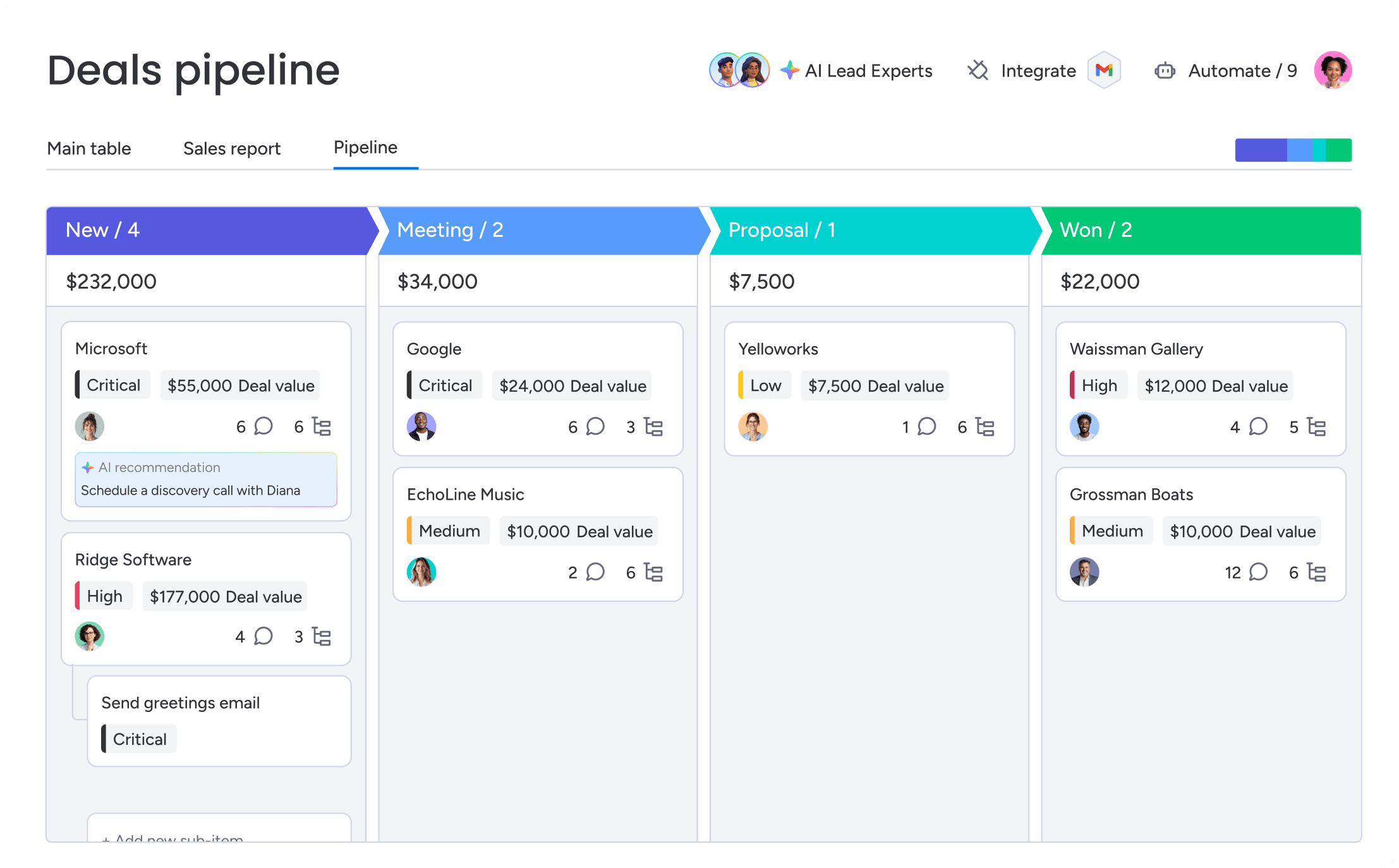
ACV helps you allocate resources smarter by showing where deals fall on the value scale. Revenue leaders use ACV data to make operational calls with clear thresholds: enterprise reps focus on opportunities above $100K ACV, deals exceeding $200K trigger VP engagement, and territories get balanced by ACV potential rather than just account count. Effective sales territory management relies on distributing accounts based on their actual annual value, not just the number of logos.
Setting data-driven quotas and targets
Setting quotas without ACV data is basically guesswork. With ACV benchmarks from past performance, you can set quotas that are actually achievable. Each market segment has its own typical ACV range, so an SMB segment averaging $15K ACV works totally differently than enterprise at $150K ACV. Understanding sales quota structures that align with your ACV distribution ensures reps have realistic targets based on their territory’s potential.
Creating visibility across teams
ACV gives sales, finance, customer success, and executives a common language. When everyone uses the same metric with the same definition, teams naturally get aligned. Finance uses ACV for revenue recognition modeling, customer success prioritizes account management based on ACV, and marketing uses it for attribution analysis. Strong sales and marketing alignment happens when both teams evaluate campaign success using consistent ACV metrics rather than conflicting definitions of deal value.
5 mistakes that distort ACV forecasting
Even teams who get ACV in theory make calculation mistakes that snowball into big forecasting problems. These mistakes mess up quotas, territory planning, and how you allocate resources.
Mistake 1: Including one-time fees in ACV calculations
It’s tempting to include implementation or setup fees, but that inflates ACV and sets up false expectations for renewal.
A $50K subscription plus $20K implementation should be $50K ACV, not $70K. When renewal comes, the customer won’t pay implementation again. If you included that $20K in the original ACV, renewal looks like 29% contraction when it’s really just flat.
Mistake 2: Failing to normalize multi-year contracts
Treating a 3-year, $300K contract the same as a 1-year, $300K contract messes up every metric downstream. The multi-year deal contributes $100K annually while the single-year contributes $300K.
Just divide total recurring value by contract years and set up your systems to calculate ACV automatically from contract terms.
Mistake 3: Inconsistent treatment of variable usage
Usage-based pricing gets messy. Some teams include estimated usage while others exclude all variable components. When reps use different rules, you can’t compare anything.
Set a clear policy: either include only committed amounts for conservative forecasting, or include estimated usage but document your assumptions.
Mistake 4: Confusing ACV with revenue recognition
ACV measures contract value while revenue recognition follows accounting rules. A $100K ACV deal might recognize revenue differently based on payment terms or accounting standards.
Make it clear: ACV is a sales metric for evaluating deals while revenue recognition is an accounting thing with its own rules.
Mistake 5: Not updating ACV for mid-contract changes
Treating ACV like it never changes ignores reality. When customers expand, contract, upgrade, or downgrade, ACV changes. Using up-to-date ACV data is essential for creating accurate renewal forecasts.
Build a process for updating ACV whenever terms change. Automated workflows that recalculate based on current status cut out manual tracking.
Track and grow ACV with monday CRM
Manual calculation errors, lack of real-time visibility, and inconsistent tracking all stem from ACV data trapped in systems that weren’t built for collaboration. Revenue teams need platforms that handle complex ACV tracking while maintaining accuracy across deals, workflows, and team touchpoints.
With monday CRM, teams close the gap between understanding ACV in theory and tracking it consistently across revenue operations. The platform calculates ACV automatically from contract terms, eliminating manual spreadsheet work. Custom formula columns adapt to your specific methodology, whether you use average annual value or year-one value.
Step 1: Automate ACV calculations with AI
Automate ACV tracking in monday CRM using no-code formulas that calculate annual value directly from contract fields. The AI-powered Autofill feature extracts information from contracts and invoices directly into board columns, eliminating manual data entry. When contract terms change, ACV updates automatically across all views and reports. These CRM automation capabilities ensure your team always works with current data without manual recalculation.
Step 2: Get AI-powered insights on ACV opportunities
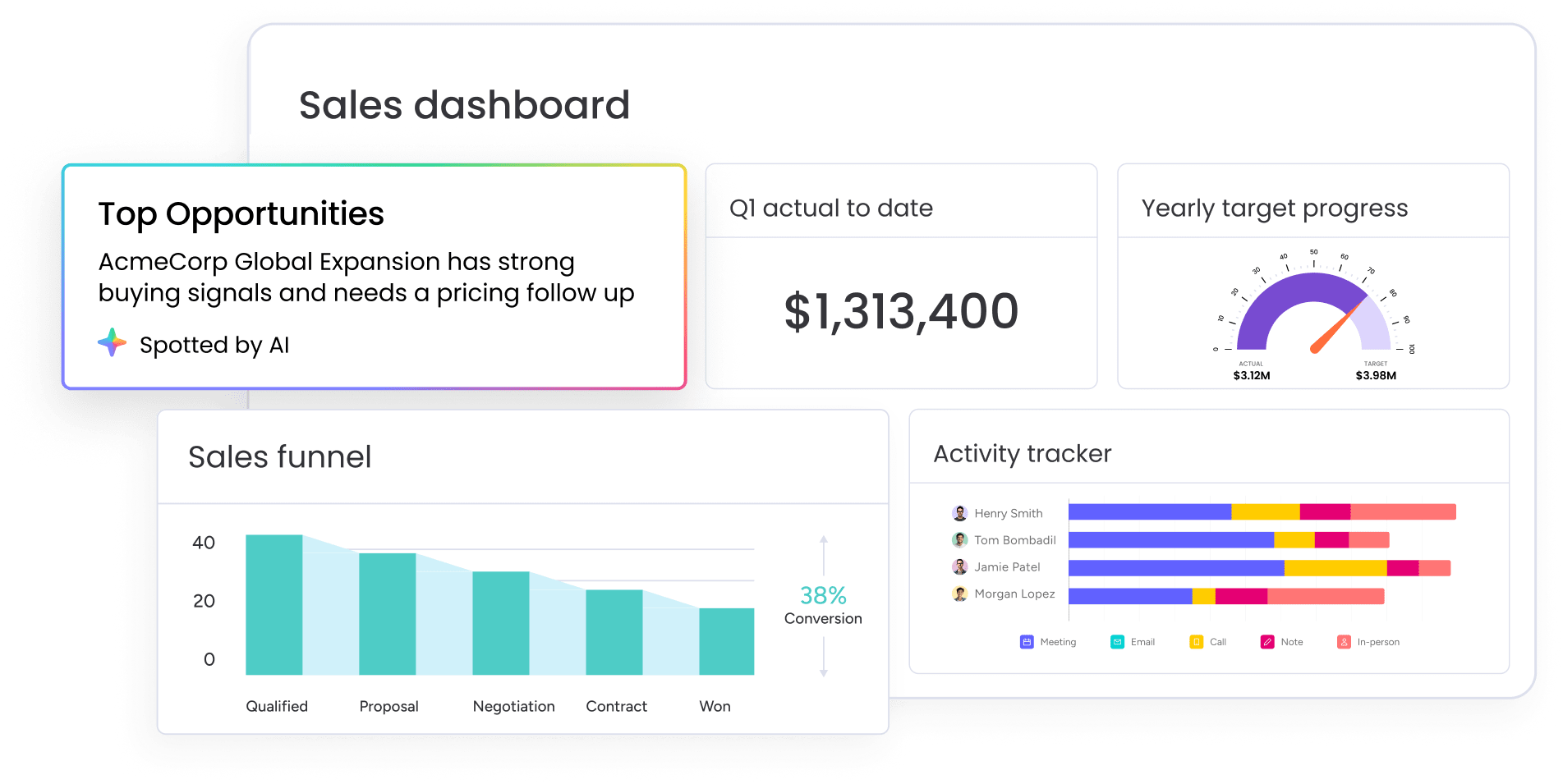
AI capabilities in monday CRM identify patterns and opportunities that manual review would miss. The platform’s AI CRM use cases include intelligent automation that categorizes deals based on ACV thresholds and routes high-value opportunities to appropriate team members. The Assign Label action automatically categorizes deals, while the Assign person action routes high-ACV opportunities based on skills and capacity. AI Timeline Summary condenses months of contract negotiations into quick summaries, helping teams make informed decisions about resource allocation.
Step 3: Unite sales and revenue teams around ACV goals

Using monday CRM as your single source of truth means sales, RevOps, finance, and customer success all reference the same numbers, calculated consistently and updated in real-time. Shared CRM reporting dashboards align teams around ACV targets and eliminate version control nightmares. Finance sees the same pipeline ACV that sales reports, while customer success sees account ACV matching exactly what sales closed. Implementing CRM best practices around data governance ensures everyone calculates and interprets ACV the same way across your organization.
Turn ACV tracking into revenue growth
ACV normalizes contract value to enable fair comparisons and reliable forecasting. Teams that track it systematically make confident decisions about pipeline, quotas, and resources. The metric becomes powerful when connected to forecasting, planning, and cross-functional workflows, turning ACV from a reporting number into a decision-making framework that improves collaboration between sales, finance, customer success, and RevOps.
Manual ACV tracking breaks down as deal volume and contract complexity grow. Revenue teams need centralized data, automated calculations, and real-time dashboards. Tools like monday CRM use AI and no-code automations to make consistent ACV tracking practical at scale, evolving from spreadsheets to integrated systems your team can trust.
Try monday CRMFAQs
How does ACV work for usage-based pricing models?
For usage-based pricing models, ACV typically includes only the committed minimum usage amount or base platform fee while excluding variable charges that aren't contractually guaranteed.
Should implementation fees count toward ACV?
Implementation fees, onboarding costs, and other one-time charges should not be included in ACV calculations because they don't represent recurring annual value.
What's the difference between ACV and average deal size?
ACV normalizes contracts to annual value regardless of contract length, while average deal size typically reflects total contract value without normalization.
Can ACV be negative?
ACV itself cannot be negative, but ACV change can be negative when customers downgrade or reduce their subscription.
How often should ACV be updated?
ACV should update whenever contract terms change, including expansions, contractions, renewals, or mid-contract adjustments.
What's a good ACV for SaaS companies?
Good ACV varies dramatically by market segment. SMB-focused companies might average $5K-$25K ACV, mid-market companies typically range $25K-$100K, and enterprise-focused companies often exceed $100K average ACV.

 Get started