


A single group booking can involve 20 payment schedules, a dozen dietary restrictions, and at least one passport emergency. Generic CRMs treat this like a standard sales deal. It’s not. A travel agent CRM built for group bookings coordinates multiple travelers, suppliers, and currencies in one place. It tracks who owes what, who needs what documents, and which supplier pays when, giving you a single source of truth instead of guesswork.
This article compares 5 platforms that approach group bookings differently. We’ll cover the features that matter for group management, how AI can take over coordination, and how to match a platform to your booking volume, especially when you need a flexible system you can shape to your exact workflow like monday CRM.
Try monday CRMWhat makes group bookings in travel agencies so complex
Group bookings aren’t just multiple reservations stacked together. They’re networks of interdependent details that all have to work in sync. Trying to manage them with a standard sales CRM? It doesn’t work. You need something built for this kind of complexity.
A single group booking is a web of interconnected details that can quickly become overwhelming. For example, one trip can easily involve:
- Twenty different payment schedules.
- A dozen dietary needs.
- A handful of last-minute passport panics.
You’re left chasing down deposits in three different currencies while trying to confirm wheelchair access for one traveler and a gluten-free meal for another. Manual tracking guarantees missed details and lost revenue.
Then there’s the supplier side. You’re coordinating with airlines, hotels, and tour operators, each with its own commission structure and payment timeline.
The core problem: How do you track profitability when one hotel pays in euros 30 days after checkout and a tour company pays in dollars 60 days later? Without a single source of truth, you’re just guessing what your real bottom line is.
5 best travel agent CRM platforms for group bookings
Managing group bookings demands precision across dozens of passengers, partial payments, and supplier details, all while calculating commissions in multiple currencies. Generic sales CRMs only amplify the confusion. You need a platform built for this exact problem.
We evaluated five platforms that approach group bookings from different angles. Some cater exclusively to travel professionals, while others provide adaptable frameworks you can mold to your exact requirements. Here’s how they compare on payments, passengers, and supplier management.
| Platform | Multi-passenger management | Commission calculation | Supplier integration | Automation capabilities | Starting price |
|---|---|---|---|---|---|
| monday CRM | Custom fields for traveler details | Custom number fields for commissions | Integrations to connect your stack | AI features + no-code automations | $12/user/month |
| Zoho CRM | Standard contact management | Built-in commission tracking | 800+ app integrations | Workflow automation rules | $14/user/month |
| Pipedrive | Activity-focused contact records | Manual commission calculations | 400+ integrations via marketplace | Activity-based automations | $14/user/month |
| Ezus | Built-in passenger manifest tools | Travel industry commission templates | Limited to travel-specific tools | Pre-built travel workflows | $79/user/month |
| Freshsales | Contact management with custom fields | Basic commission tracking | Native Freshworks ecosystem + integrations | AI-based automations | $15/user/month |
What’s the verdict? Specialized travel platforms often lock you into rigid workflows. Revenue teams often achieve better results with monday CRM, building precisely the group booking system they need while centralizing all customer communication and deal updates.
1. monday CRM
Travel agencies using monday CRM can manage group bookings with structured, repeatable operations. Teams build dedicated pipelines for corporate retreats, destination weddings, or school excursions, then modify them as your offerings, suppliers, and policies evolve.
Here’s what that looks like in practice: monday CRM consolidates deals, accounts, contacts, and communication history. Handoffs work smoothly when a coordinator takes time off or a client changes plans mid-booking. Need each group to follow the same playbook while still handling exceptions? This is where monday CRM delivers.
Example:
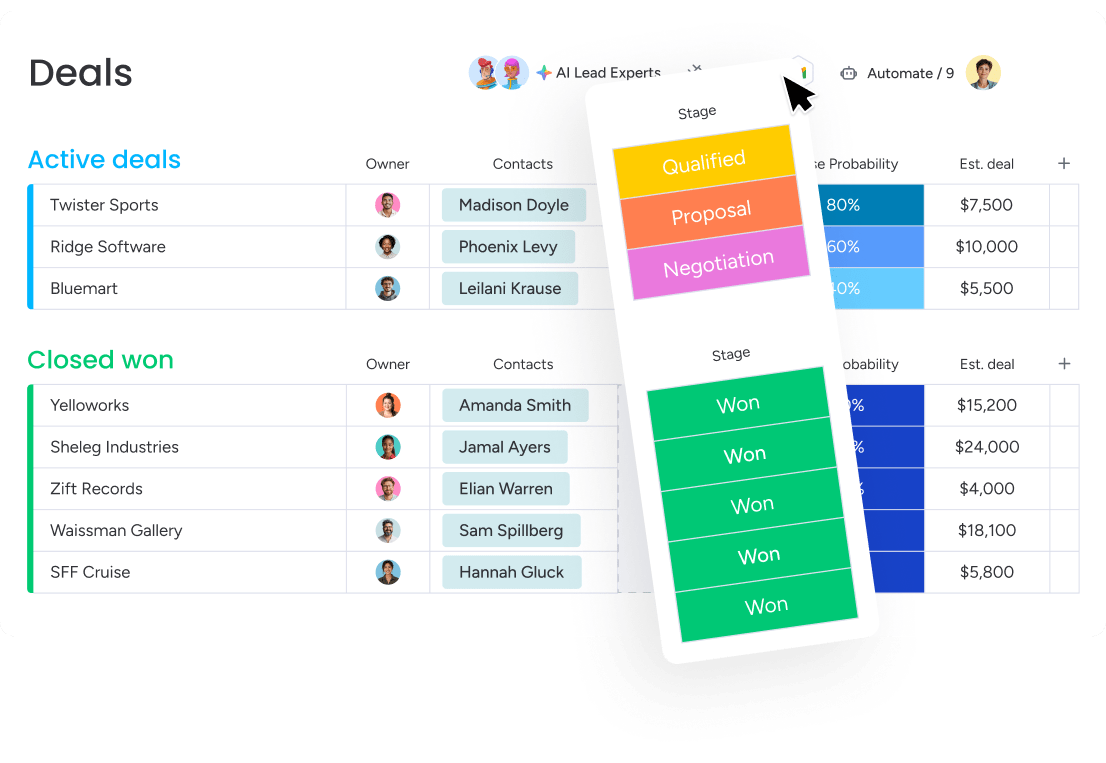
Travel agencies leverage monday CRM to orchestrate group bookings as interconnected workflows: one deal per group, linked contacts for each traveler, and a unified timeline capturing every email, call, meeting, and note. Who’s pursuing deposits? Who’s awaiting passport details? Who made specific promises to the group leader? Everything lives in one place.
Key features:
These monday CRM capabilities prove most valuable when your “deal” encompasses 20 individuals rather than a single buyer. They keep you organized, your communication consistent, and cut down on manual data entry.
- Visual pipeline management: Track each group’s status in a visual pipeline, customize stages with drag-and-drop, and keep things moving when plans change.
- Emails & Activities timeline: Record and track every interaction (emails, meetings, and notes) in a single timeline, giving anyone stepping in immediate access to the complete history.
- Mass email and tracking: Dispatch individual and bulk emails using dynamic fields and templates, then monitor metrics like open rates and link clicks.
Pricing:
- Basic: $12/month per user (billed annually)
- Standard: $17/month per user (billed annually)
- Pro: $28/month per user (billed annually, most popular)
- Enterprise: Custom pricing (contact sales)
- Annual discount: 18% savings when billed yearly
- Minimum users: Plans start from 3 users
Why it stands out:
Teams that sell trips and then execute mini-projects for each group need a CRM that extends beyond “close won.” monday CRM handles the full customer journey with workflows for coordination, approvals, and collections.
- One place for the full journey: Teams maintain customer information, deals, and post-sales activities together, including onboarding-style processes and collection tracking.
- Visibility and control for leaders: Custom dashboards enable leaders to monitor pipeline status, forecasting, team performance, and activity without waiting for manual updates.
- Built for collaboration: Teams coordinate effortlessly with stakeholders like finance and legal when contracts, payments, or approvals reach critical milestones.
Advanced AI features:
AI in monday CRM does useful work without adding complexity. It speeds up writing, creates instant history recaps, and turns unstructured documents into organized data fields.
- AI Timeline Summary: Generate concise summaries of a client’s Emails & Activities timeline, encompassing emails, calls, meetings, and notes.
- Compose emails in Emails & Activities: Draft messages using AI directly within your team’s existing communication tracking interface.
- Autofill with AI (board columns): Apply AI actions to Text, Date, Number, Dropdown, People, and Status columns, including Extract information, Summarize, Translate, Detect sentiment, Assign label, and Assign person.
Automations:
Fast-moving group bookings make manual follow-ups a problem. monday CRM gives you automations that keep work moving based on your rules.
- Automate actions based on custom conditions: Trigger updates when deals change stages or key fields are modified.
- Automate email follow-ups: Maintain consistent follow-ups when leads go quiet or groups haven’t confirmed details.
- Conditional label change: Keep statuses accurate as conditions evolve, ensuring the team always knows the next step.
Integrations:
Most travel agencies already use multiple systems. monday CRM connects them so customer and booking information stays in one place.
- Connect key systems: Link your CRM to the platforms your team relies on for communication and operations.
- Centralized reporting: Consolidate updates into unified workflows so revenue teams can report progress confidently.
- Less manual updating: Stop entering the same data twice by connecting your key systems.
Travel agent CRM features:
These monday CRM features work for travel agencies that want control without building custom systems.
- Lead management: Capture leads from website forms or campaigns, qualify them, assign ownership, and automate follow-ups.
- Account and contact management: View account and contact details in an expanded item view, plus connected deals, contacts, and projects in one location.
- Deal management that maps to real delivery: Track deals through visual pipeline management, then extend the process into coordination workflows after booking confirmation.
2. Zoho CRM
Zoho CRM provides extensive automation and multi-currency capabilities tailored for travel agencies navigating complex international bookings. The platform manages group travel with customizable workflows that track payments, commissions, and traveler status across multiple currencies and suppliers.

Use case:
Zoho CRM simplifies payment tracking and commission calculations for travel agencies managing group bookings with multiple travelers, currencies, and suppliers.
Key features:
- Multi-currency payment tracking with real-time exchange rates and automated commission calculations in your base currency
- Group booking workflows that monitor each traveler’s journey from inquiry to post-trip follow-up through customizable stages
- Automated communication sequences for pre-trip information packets, document collection, and supplier updates when passenger counts change
Pricing:
- Free: Up to 3 users with core CRM essentials
- Standard: $14/month per user (annual billing)
- Professional: $23/month per user (annual billing)
- Enterprise: $40/month per user (annual billing)
- Ultimate: $52/month per user (annual billing)
- Annual subscriptions save up to 34% compared to monthly billing
- Additional costs may apply for portal users, extra storage, and premium support
Considerations:
- Complex group scenarios involving multiple suppliers may require manual workarounds or custom development beyond standard automation capabilities
- Advanced automation features like Blueprint and CommandCenter are restricted to higher-tier plans, potentially increasing costs for agencies requiring full functionality
3. Pipedrive
Pipedrive converts complex group bookings into visual pipeline stages that travel agents can actually navigate. Its activity-based approach tracks every touchpoint in group deals, from initial inquiries to final confirmations. Built by salespeople for salespeople, it adds structure to managing multiple group bookings at once.

Use case:
Pipedrive excels at showing group booking progress through customizable deal stages, making it easier for travel agents to track where each group stands.
Key features:
- Visual pipeline management with customizable stages like Initial Inquiry, Proposal Sent, Deposit Received, and Travel Completed
- Activity-based tracking that connects every call, email, and document request to specific group deals
- Automated follow-up reminders that prevent critical touchpoints from slipping through the cracks
Pricing:
- Lite: $14/month (billed annually)
- Growth: $24/month (billed annually) — includes automations and sequences
- Premium: $49/month (billed annually) — adds lead generation, scoring, and contracts
- Ultimate: $69/month (billed annually) — includes advanced security and extended support
- Annual billing saves up to 26% compared to monthly plans
- 14-day free trial available
Considerations:
- Managing individual passenger details within group bookings demands workarounds since the platform emphasizes deal-level rather than contact-level tracking
- Travel-specific integrations remain limited compared to general business integrations in their marketplace
4. Ezus
Ezus is a travel operations platform built specifically for tour operators, DMCs, and travel agencies. The platform combines native travel workflows with CRM features, making it a good fit for agencies managing custom itineraries and complex supplier relationships. With 600+ agencies using it, Ezus focuses on automating travel-specific processes that generic CRMs can’t handle.

Use case:
Established tour operators running standardized group packages with consistent supplier relationships get the most from Ezus’s travel-focused automation and production workflows.
Key features:
- Native passenger manifest management and rooming list automation for group bookings
- Built-in supplier catalog with commission tracking templates for travel industry arrangements
- Integrated traveler portals with automated document generation and payment processing
Pricing:
- Professional: €75/user/month billed annually (includes built-in travel CRM, itinerary builder, and invoicing)
- Premium: €100/user/month billed annually (adds API access, automated translation, and multi-brand support)
- Enterprise: Custom pricing for 30+ users (includes private API, SSO, and custom workflows)
- One-time onboarding fee: €1,990-€2,490 depending on package selected
Considerations:
- Agencies with non-standard workflows or those handling diverse group types beyond traditional travel scenarios may find flexibility limited
- Higher price point compared to general CRM solutions, with required annual billing and mandatory onboarding fees that increase total cost of ownership
5. Freshsales
Freshsales pairs AI-powered automation with built-in communication channels for travel agencies managing complex group bookings. The platform includes predictive lead scoring, automated follow-up sequences, and centralized traveler communication in one system. With 24×5 support and clear pricing, it works for growing agencies that need strong automation without too much complexity.

Use case:
Growing travel agencies that prioritize smooth customer communication and team collaboration over specialized travel features.
Key features:
- AI-driven lead scoring and automated follow-up sequences that predict optimal timing for group booking communications
- Built-in email, phone, and chat tools that centralize all traveler interactions within group booking records
- No-code workflow automation for document collection and booking reminders, though more advanced triggers (like time-based automation) are reserved for higher-tier plans
Pricing:
- Free: $0 for up to 3 users
- Growth: $9/user/month (billed annually) or $15/user/month (billed monthly)
- Pro: $39/user/month (billed annually)
- Enterprise: $59/user/month (billed annually)
- 21-day free trial available across all paid plans
- Add-on costs for AI Agent sessions at $49 per 100 sessions
Considerations:
- Commission tracking requires manual setup through custom modules and formulas rather than native travel industry functionality
- Limited travel-specific integrations compared to specialized travel CRMs, requiring marketplace solutions or third-party connectors
Must-have CRM features for travel agency group management
Generic CRMs weren’t built for the complexity of group travel. They treat every booking like a simple sales transaction, not a complex network of 50 travelers, multiple currencies, and looming visa deadlines. Stop juggling spreadsheets and get real control over your operations. Here are the features that actually matter:
- Bulk operations that update intelligently: Update every affected record at once when a flight time changes, then send personalized mass emails that track opens and clicks.
- Multi-currency tracking with automated conversion: Automated conversion with real-time rates keeps your financials accurate so you see exactly how exchange rates affect your bottom line.
- Document and visa tracking automation: Automated systems send reminders as deadlines approach and flag at-risk documents in a single dashboard.
- AI-powered data extraction: AI extracts information from uploaded documents and populates your CRM fields automatically, then flags inconsistencies before they become problems.
- Customizable group workflows: Build custom pipelines for each group type with stages that match your actual operations, then modify them as your offerings evolve.
- Centralized communication history: Every email, call, meeting note, and document request lives in one timeline tied to the group booking.
- AI-generated summaries and insights: Turn months of client interactions into concise summaries with one click. AI analyzes your booking history to predict patterns and suggest optimal pricing windows.
- Custom dashboards for instant visibility: See pipeline status, payment collection rates, and team performance without waiting for manual reports.
monday CRM delivers these capabilities in a platform that adapts to how your agency actually works. Build the exact workflows you need, automate the repetitive coordination tasks, and give your team a single source of truth that scales from boutique operations to high-volume tour operators.
Try monday CRMHow AI transforms group booking management
Coordinating group travel involves countless moving pieces. Passenger lists, supplier rates, and last-minute changes can transform a dream trip into a logistical nightmare. AI handles the tedious monitoring and coordination that slows down agents, flagging only the complex issues that need human judgment. Here’s how AI tackles the biggest group booking headaches.
Track price drops automatically
Manually scanning dozens of supplier websites for the best group rates guarantees missed opportunities. Small rate changes can hurt your margins, but constant monitoring isn’t realistic.
AI monitors trip pricing around the clock across all your suppliers. It alerts you to price changes and suggests the best booking windows based on past data and market trends. You get the best rates without the tedious legwork.
Automate passenger follow-ups
Chasing travelers for passport details, payments, and dietary restrictions is one of the least enjoyable parts of the process. It’s repetitive, time-consuming, and pulls you away from building relationships and solving real client problems.
Revenue teams leverage monday CRM to automate routine communications and gather required information. The platform can:
- Send info packets: Automatically distribute pre-trip details and itineraries.
- Collect documents: Gather passport information and other required forms on your behalf.
- Flag issues: Escalate questions or incomplete tasks to the appropriate team member, complete with full context.
Predict booking patterns with confidence
Are your decisions based on last year’s data or mere intuition? AI analyzes years of booking information to identify trends, forecast seasonal demand, and inform proactive sales strategies.
Historical data becomes a real competitive edge. You can see which months bring the most inquiries for specific destinations or which corporate clients are due for their annual retreat. This lets you price confidently and focus marketing where it’ll have the biggest impact.
Pick the right travel CRM based on your group volume
A CRM that works for a 20-group agency won’t scale for a 200-group operator. Your group volume changes everything. Let’s match your real-world scale to the features that matter.
| Agency size | Annual group volume | Biggest challenges | Must-have features | What to avoid |
|---|---|---|---|---|
| Boutique agencies | Under 50 groups | Spreadsheet chaos, lost emails, manual tracking | Payment visibility, contact management, email automation, simple integrations, scalable pricing | Platforms requiring extensive training or technical expertise |
| Growing agencies | 50-200 groups | Manual workarounds breaking down, handoff errors, tracking hundreds of travelers | Automated reminders, document collection, supplier communications, clear workflows, room to scale | Systems you'll outgrow within a year or require migration |
| High-volume operators | 200+ groups | Mass updates, profitability tracking, complex approvals, enterprise-scale data | Real-time dashboards, bulk operations, advanced reporting, approval workflows, enterprise security | Platforms that can't handle massive data volumes or break under load |
Why your CRM should work like your travel agency does
Your travel agency isn’t one-size-fits-all. You handle everything from corporate accounts to destination weddings, and each one works differently. A rigid CRM that forces you into set workflows just creates more work. The right platform adapts to how you actually operate, not the other way around.
Travel agencies using monday CRM build systems that match their exact processes. Whether you’re coordinating multi-city tours or managing intimate group retreats, the platform shapes itself around your workflow. You get the structure you need without the constraints that slow you down.
No-code automations that handle complex booking logic

Group bookings involve dozens of moving parts and last-minute changes. Revenue teams build automations using simple “when this, then that” logic without writing code. When a destination wedding group advances to “Deposit Received,” the platform automatically creates tasks for welcome packets, notifies accounting to record payment, and alerts supplier managers to confirm reservations. These automations eliminate manual tracking and prevent details from slipping through the cracks.
AI-powered data extraction from travel documents
Manual passport data entry wastes hours and introduces errors. AI handles the grunt work by extracting names, passport numbers, and expiration dates from uploaded scans, then populating fields automatically. The system flags inconsistencies like names that don’t match booking records or passports nearing expiration, catching issues immediately instead of days before departure.
AI timeline summaries for instant context
Jumping into a group booking mid-process usually means scrolling through months of emails and notes. AI generates concise summaries of the entire client timeline with one click, encompassing emails, calls, meetings, and notes. Your team gets instant context on what’s been promised, what’s pending, and what needs attention next.
Centralized integrations that connect your entire stack
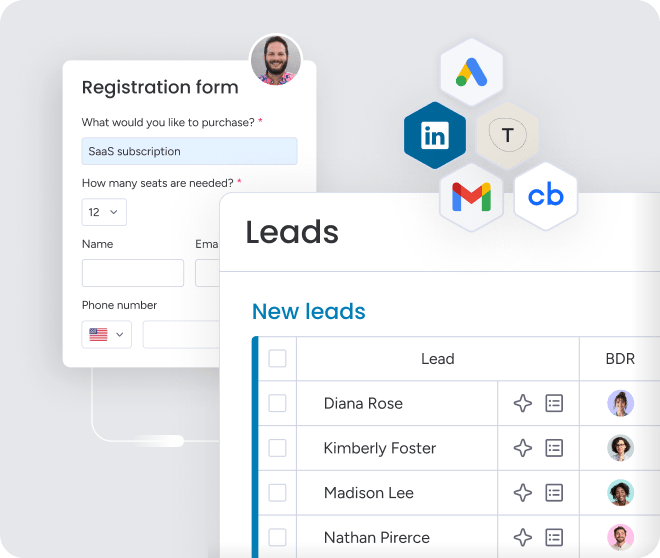
Your agency runs on multiple platforms like booking engines, accounting software, and payment processors. The platform serves as the central hub, connecting your entire tech stack so information flows automatically between systems. When a payment is processed in Stripe, the deal record updates in the CRM, and an entry appears in QuickBooks, creating a single source of truth without manual data reconciliation.
| Feature | monday CRM approach | Traditional travel CRM approach |
|---|---|---|
| Customization flexibility | No-code visual builder for any workflow | Pre-configured templates with limited modification |
| AI capabilities | Extract data, automate coordination, predict patterns | Basic automation rules, if you're lucky |
| Integration options | Open API and 200+ pre-built integrations | A small list of travel-specific integrations only |
| Learning curve | Intuitive interface designed for quick adoption | Requires extensive training and documentation |
| Scalability | Grows with you, from boutique to enterprise | Forces a painful migration to a new platform to scale |
| Total cost of ownership | Clear, per-user pricing with no hidden fees | Base price plus expensive add-ons for essential features |
Take control of your group bookings
Group travel doesn’t have to mean chaos. Moving away from spreadsheets and rigid legacy systems transforms the complexity of group bookings into a streamlined, predictable process. The right tools provide visibility to spot issues before they escalate and automation to handle the busywork that slows you down.
When your team isn’t buried in manual data entry, they can focus on what actually drives revenue: building relationships and crafting unforgettable experiences. Stop reacting to every change and start running your agency with confidence.
Try monday CRMFAQs
Can a CRM handle split payments for group bookings?
To answer if a CRM can handle split payments for group bookings, yes, it can. A capable CRM tracks each traveler's payment status and automates reminders. This provides a real-time overview of the entire group and eliminates manual tracking.
How do travel CRMs manage passenger manifests and rooming lists?
Travel CRMs manage passenger manifests and rooming lists by centralizing all passenger details, like passport numbers and room preferences. It then automatically generates supplier-ready documents that update in real time, removing manual data entry.
What integrations do travel CRMs offer for booking platforms?
Travel CRMs can integrate with major booking platforms to sync reservation data, pricing, and availability in real time. This consolidates all booking confirmations and itinerary changes into a single, unified view.
How does a CRM track group travel communications?
A CRM tracks group communications by linking every email, call, and message to a specific booking and traveler. This creates a complete, time-stamped history and enables automated follow-ups so no one gets left behind.
Can travel CRMs generate custom reports for group bookings?
Yes, a travel CRM can generate custom reports on group booking revenue, profit margins, and payment status. You can build dashboards to track your pipeline and performance, then easily share them with stakeholders.
How do CRMs handle group travel cancellations and refunds?
A CRM handles cancellations by tracking supplier policies, calculating refund amounts, and managing the process for each traveler. Automated workflows can trigger refund tasks and send status updates to keep everyone informed.