


A well-crafted price quote template transforms how prospects engage with your pricing, turning silence into responses and interest into closed deals. The right template does more than organize numbers; it guides prospects through your offer, addresses objections proactively, and makes acceptance the natural next step.
This guide explains 5 types of price quote templates you should have on hand for different business models, from consulting to product sales. You’ll discover what makes each template effective, the essential elements every quote needs, and how to connect your quotes to a central sales pipeline using monday CRM for complete visibility and faster conversions.
Key takeaways
- Service quotes need flexible scope sections, product quotes require SKU details, and project quotes must include milestone-based pricing to prevent scope creep.
- Every quote needs business details, itemized services, pricing breakdown, expiration date, payment terms, legal conditions, and signature line — missing any creates delays or lost deals.
- Standardized formats eliminate decision fatigue, reduce errors, and let new team members create professional quotes from day one, saving busy sales teams 15+ hours monthly.
- Monitor which quotes get accepted, how long decisions take, and what pricing works best to refine your approach over time.
- Track quote status automatically, automate follow-up sequences, and gain pipeline visibility with monday CRM that turns quote activity into revenue forecasting data.
What is a price quote template?
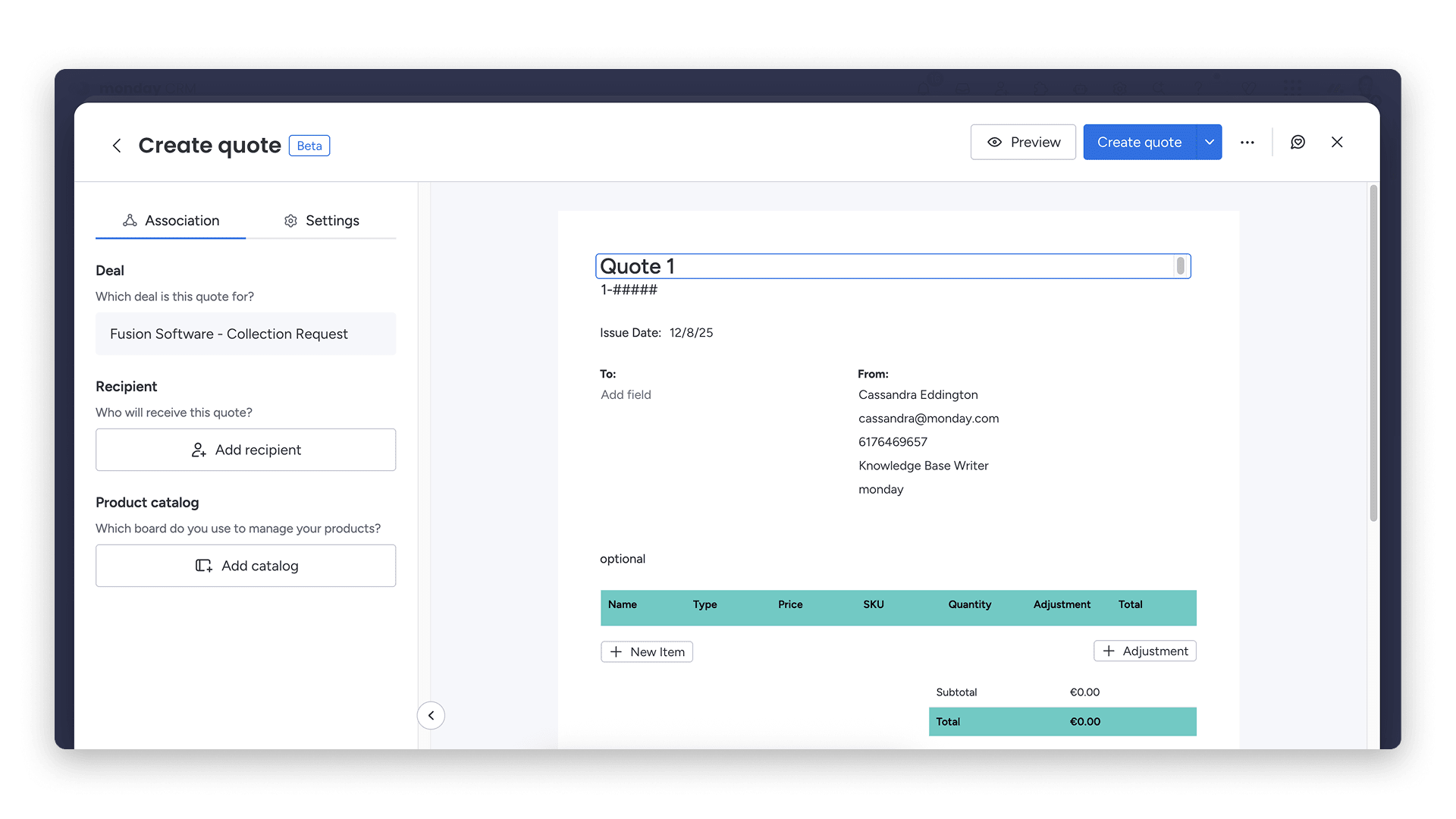
A price quote template is a pre-built document that standardizes how you present pricing to prospects. Every quote includes the right information, calculates accurately, and looks professional.
Templates show their value when you compare them to starting from scratch. Without a template, you make dozens of tiny decisions every time: what to include, how to structure pricing, which terms to add. Templates decide once, then apply it every time. A sales team creating 20 quotes weekly saves 15+ hours a month just by cutting out the guesswork.
Core benefits of using quote templates
Quote templates turn your quoting process from reactive to systematic. They do more than save time (though that’s reason enough to use them).
As your business grows, these benefits stack:
- Time efficiency: Quote creation drops from 45 minutes to 5 minutes
- Error reduction: Pre-built formulas eliminate calculation mistakes
- Brand consistency: Every quote reinforces your professional image
- Scalability: New team members create perfect quotes on day one
- Legal protection: Standardized terms reviewed once by counsel appear on every quote
Price quote vs. estimate vs. invoice
A price quote is a formal document that presents your pricing to prospects before work begins — it’s your official offer with fixed costs and specific terms. Understanding how quotes differ from estimates and invoices isn’t just semantics; it determines your legal obligations, sets client expectations, and protects your business from disputes.
| Category | Price quote | Price estimate | Price invoice |
|---|---|---|---|
| Purpose | Formal offer with fixed pricing | Rough approximation of costs | Payment request |
| When used | Before work begins | Before work begins | After work completion |
| Binding nature | Binding once accepted | Non-binding | Legally binding |
| Price certainty | Fixed unless scope changes | Subject to change | Final amount due |
| Validity period | Has expiration date | May not expire | Has payment due date |
Typical flow: Estimate (if needed) → quote → acceptance → work completion → invoice. Your invoice amount should match your accepted quote unless you’ve documented scope changes.

5 types of price quote templates
Looking for a quote template that actually closes deals? These 5 types of templates can fix real quoting problems, from service retainers to product bundles.
1. Service quote template for consultants and agencies
Service businesses deal with quoting problems product companies don’t face. Your scope shifts mid-project. Deliverables evolve during discovery. And clients struggle to understand what they’re paying for when the work isn’t tangible.
This type of template tackles those problems with a flexible structure that handles multiple pricing models. It shows clients the value of your expertise, not just billable hours.
What makes this template work:
- Hourly rate breakdowns: Show different rates for senior consultants versus associates, with estimated hours per phase
- Service scope descriptions: Write deliverables in plain language that non-experts understand
- Timeline estimates: Map out phase-by-phase delivery with dependencies clearly noted
- Revision policies: State exactly how many revision rounds are included and what additional rounds cost
Use this template if you price by time, phases, or retainers. It works for a quick 10-hour strategy session or a 6-month engagement. Revenue teams using monday CRM can link these quotes directly to deal records, keeping pricing discussions connected to the full customer relationship.
2. Project quote template for one-time deliverables
Fixed-scope projects need different structure than ongoing services. Clients expect specific outcomes by specific dates. Delivering a website redesign, market research study, or custom software build? Uncertainty kills deals.
This template type protects you and your client from 2 big risks: scope creep and payment disputes. It sets firm boundaries on what’s included while maintaining readability.
What makes project quotes work:
- Milestone-based pricing: Break costs into phases like discovery, development, testing, and delivery.
- Deliverable specifications: List exactly what the client receives at each stage, including formats and quantities.
- Completion timelines: Include start dates, milestone dates, and final delivery with buffer time built in.
- Acceptance criteria: Define what constitutes project completion to prevent endless revision cycles.
The template should have a section for exclusions. When clients ask for something outside scope, point here instead of trying to remember what you agreed to. That clarity saves your relationships and your margins.

3. Product quote template for sales teams
B2B product sales get complicated in ways service quotes don’t. You’re juggling SKUs, volume discounts, shipping logistics, and multiple decision-makers who care about different parts of the quote.
This type of template cuts through that complexity with consistent formatting that works for any deal size. It works for single-item purchases or multi-product deals with tiered pricing.
Get your sales team on the same page with these elements:
- Itemized product lists: Include SKU numbers, descriptions, and specifications in scannable tables
- Unit pricing clarity: Show list price versus quoted price so discounts are visible
- Volume discount tiers: Display pricing breaks at different quantities
- Shipping and handling: Separate freight, insurance, and delivery options with clear costs
Teams using monday CRM can standardize these fields on boards, so every rep follows the same pricing logic and terms. Consistency builds buyer confidence and gets you faster approvals.
4. Website design quote template
Web projects mix creative work and technical complexity in ways that confuse clients. Clients don’t get why a website costs $15,000 instead of $1,500. This template explains it.
The structure breaks web projects into clear phases that justify your pricing. Instead of one big number, clients see where their money goes and what they get at each stage.
What web design quote templates need:
- Design phase pricing: Include wireframes, mockups, and revision rounds as separate line items
- Development costs: Break out front-end, back-end, CMS integration, and testing hours
- Content migration: Show the work involved in moving and optimizing existing content
- Ongoing maintenance: Offer monthly packages for updates, security, and hosting
This template type explains technical elements in plain language. When you quote “responsive design implementation,” the template helps you explain why that matters to the client’s business goals.
Try monday CRM5. Professional services quote template
Legal, accounting, consulting, and marketing services face the same problem: you can’t always scope the work upfront. This type of template gives clients structure while keeping things flexible.
The format works across different fee structures and engagement types without getting messy. Bill hourly, use flat fees, or mix both — the template adapts.
What professional services templates need:
- Service descriptions: Explain each service without industry jargon
- Fee structure options: Support hourly, flat, or hybrid pricing models
- Expense handling: Clarify how travel, materials, and third-party costs get billed
- Engagement terms: Include duration, renewal conditions, and termination provisions
7 essential elements every price quote must include
Professional quotes follow a proven structure that cuts confusion and speeds up decisions. Miss one and you’ll face delays or lose deals.
1. Business and customer details
Complete contact info makes your quote legally valid and keeps communication smooth. Include your legal business name (not just your DBA), full address, and tax identification.
For customers, grab these details:
- Decision-maker’s name and title
- Company name and billing address
- Direct contact information
- Unique quote number and issue date for tracking

2. Itemized products or services
Detailed line items prevent the dreaded “what exactly are we getting?” question. List each product or service with descriptive names, not internal codes.
Include quantities and unit prices, line totals for each item, and optional add-ons in a separate, clearly marked section.
3. Pricing breakdown and totals
Clear pricing builds trust faster than any pitch. Show subtotals before additional charges. Itemize discounts with clear descriptions. Calculate taxes with rates specified. List shipping or delivery fees separately.
Make the grand total obvious so there’s zero confusion about the final amount.
4. Quote validity and expiration
Quotes need expiration dates. Your costs and availability change. Standard validity:
- 30 days for products
- 30-60 days for services
- 60-90 days for construction projects
Pro tip: State the expiration explicitly: “This quote is valid until [date].”
5. Payment terms and methods
Define when payment is due and how customers can pay. Specify whether payment is due upon acceptance, net 30, or tied to milestones.
Payment details to include accepted payment methods, late payment policies, and deposit requirements (percentage and due date).
6. Terms and conditions
Terms protect your business and set expectations. Include scope limitations, warranty info, cancellation policies, liability caps, and IP ownership. Have these reviewed by legal counsel, especially for high-value quotes.
7. Acceptance signature line
A signature line turns your quote into a binding agreement. Include fields for signature, printed name, title, and date. Add a statement that signing means accepting all terms.
Try monday CRMHow to create a winning price quote in 5 steps
Good quotes take more than filling in blanks. These steps make your quotes accurate, competitive, and strong enough to close deals.
Step 1: Gather complete requirements
Accurate quotes start with real discovery that digs past surface-level needs. Ask about specific outcomes they want, their decision timeline, budget constraints, and who else weighs in.
Questions to ask:
- What does success look like for this project?
- Who needs to approve this purchase?
- What’s your timeline for making a decision?
- Are there budget parameters I should know about?
Rush this and your quotes will miss on price or scope.
Step 2: Calculate true costs and margins
Know your numbers before quoting to protect your profitability. Factor in direct costs (materials, labor), indirect costs (overhead), your target profit margin, and a risk buffer for surprises.
Include:
- Direct costs: Materials, labor, subcontractors
- Indirect costs: Overhead, administrative time, tools
- Profit margin: Your target percentage
- Risk buffer: 5-15% for unexpected issues
This discipline stops margin erosion that kills profits.
Step 3: Design for clarity
How you present quotes affects perceived value more than you think. Use visual hierarchy to guide readers. Keep your brand consistent with logo and colors. Add white space for easy scanning. Emphasize critical info.
Design elements that work:
- Clean, professional layout
- Consistent fonts and spacing
- Strategic use of bold text for key information
- Logical flow from overview to details to next steps
Step 4: Include comprehensive terms
Protect your business with complete terms that set clear expectations. Have legal counsel review these, especially for high-value quotes.
Essential terms to include:
- Scope limitations and change order processes
- Payment schedules and late fees
- Cancellation and refund policies
- Liability limitations and dispute resolution
Clear terms prevent disputes and set professional boundaries.
Step 5: Track quote outcomes
Monitor what happens after sending quotes to improve your win rate over time. Track status (sent, viewed, accepted, rejected), key dates, quote values, and win/loss reasons.
Organizations using monday CRM can automate this tracking, connecting quote activity directly to pipeline reporting. This visibility helps you identify patterns in what works and what doesn’t.
Excel vs. Word vs. Google Docs: Choosing your quote platform
Each platform offers different strengths for quote creation, but all have limitations that become painful as you scale.
| Feature | Excel | Word | Google Docs |
|---|---|---|---|
| Calculations | Excellent with formulas | Manual only | Manual only |
| Design flexibility | Limited | Excellent | Good |
| Collaboration | File sharing only | File sharing only | Real-time editing |
| Mobile access | Limited | Limited | Full access |
| Version control | Manual | Manual | Automatic |
All 3 share critical limitations: no quote tracking, manual follow-up processes, and no connection to customer data. As quote volume grows, these limitations become increasingly painful and cost you deals.
Scale your quote process with monday CRM
Templates give you consistency, but scaling requires systems that connect quotes to your broader sales process. The gap between creating quotes and managing them strategically is where most teams struggle.

With monday CRM, you can bridge this gap by making quotes part of your sales workflow, not separate documents. Instead of quotes living in folders and inboxes, they connect directly to deals, contacts, and pipeline stages.
Centralized quote and deal management
When quotes live on your CRM, everything connects seamlessly. Quote details link to deal records, team members see all quotes in one workspace, and status updates happen automatically.
This eliminates common frustrations, including:
- The constant question of “where’s that quote?”
- Version control nightmares
- Disconnected follow-up processes
- Lost quote history when team members leave
Automated quote workflows

The platform’s automation transforms manual quote processes into systematic workflows that run themselves. AI features extract information from existing quotes, compose follow-up emails with full context, and route quotes for approval based on deal parameters.
Your team focuses on selling while automation handles quote status updates, follow-up email sequences, approval routing based on deal size, and pipeline stage advancement.
Pipeline visibility and forecasting

Quotes tell you what’s really happening in your pipeline beyond just “interested” or “not interested.” Track quote-to-close conversion rates, see average time from quote to decision, and forecast revenue based on quote status.
Revenue leaders gain the predictability they need to plan confidently and allocate resources effectively.
Turn quote templates into your competitive advantage
Templates solve the immediate problem of creating professional quotes quickly, but the real opportunity lies in building a complete quoting workflow. The businesses that win consistently don’t just send better quotes — they build better processes around those quotes.
Start with templates to standardize what you send and ensure nothing gets missed. Add basic tracking to see what happens after sending and identify improvement opportunities. Then connect quote activity to your pipeline for true visibility into what drives revenue.
This progression takes you from reactive quote management to strategic revenue management, turning quotes into data that informs decisions.
Try monday CRMFAQs
What should a price quote template include?
A price quote template should include complete seller and buyer contact information, unique quote number, issue date, itemized products or services with descriptions and pricing, subtotals, taxes, discounts, grand total, payment terms, validity period, terms and conditions, and an acceptance signature line.
How do you customize a price quote template?
Customize a price quote template by adding your company logo and brand colors, editing line item descriptions to match your specific offerings, adjusting payment terms to fit your business model, and modifying terms and conditions based on your legal requirements.
What is the difference between a price quote and an invoice?
A price quote is a formal offer sent before work begins that includes a fixed price and expiration date. An invoice is a payment request sent after work is completed that represents money owed by the customer.
How long should a price quote be valid?
Price quotes typically remain valid for 30-90 days depending on your industry. Product quotes usually expire after 30 days, service quotes after 30-60 days, and construction or complex project quotes after 60-90 days to account for material cost fluctuations.
Can quote templates be reused for multiple clients?
Yes, quote templates are designed for reuse across multiple clients. Keep the structure, pricing logic, and terms consistent while customizing client details, specific line items, and amounts for each individual deal.
How do quote templates improve accuracy?
Quote templates improve accuracy through pre-built formulas that calculate totals automatically, standardized fields that ensure no critical information gets missed, and consistent terms that reduce the chance of errors or omissions in your quotes.
