


A lead comes in from AutoTrader, another from your website, and a third walks into the showroom before the first rep finishes their coffee. The gap between inquiry, follow-up, and real pipeline visibility is what slows dealerships down—and a CRM for the automotive industry closes that gap by keeping every conversation, appointment, and deal stage in one connected place.
This article covers what an automotive CRM does, why dealerships rely on it, which features matter most, and 13 platforms worth a serious look. You’ll also learn how to choose the right fit for your store, where AI is changing dealership workflows, and how to roll out a system your team will actually use.
What is a CRM for the automotive industry?
Car sales follow a very different rhythm than software sales. Buyers bounce between listing sites, phone calls, showroom visits, and follow-up appointments, often over the course of several weeks. An automotive CRM gives your team a way to manage that complexity instead of reacting to it lead by lead.
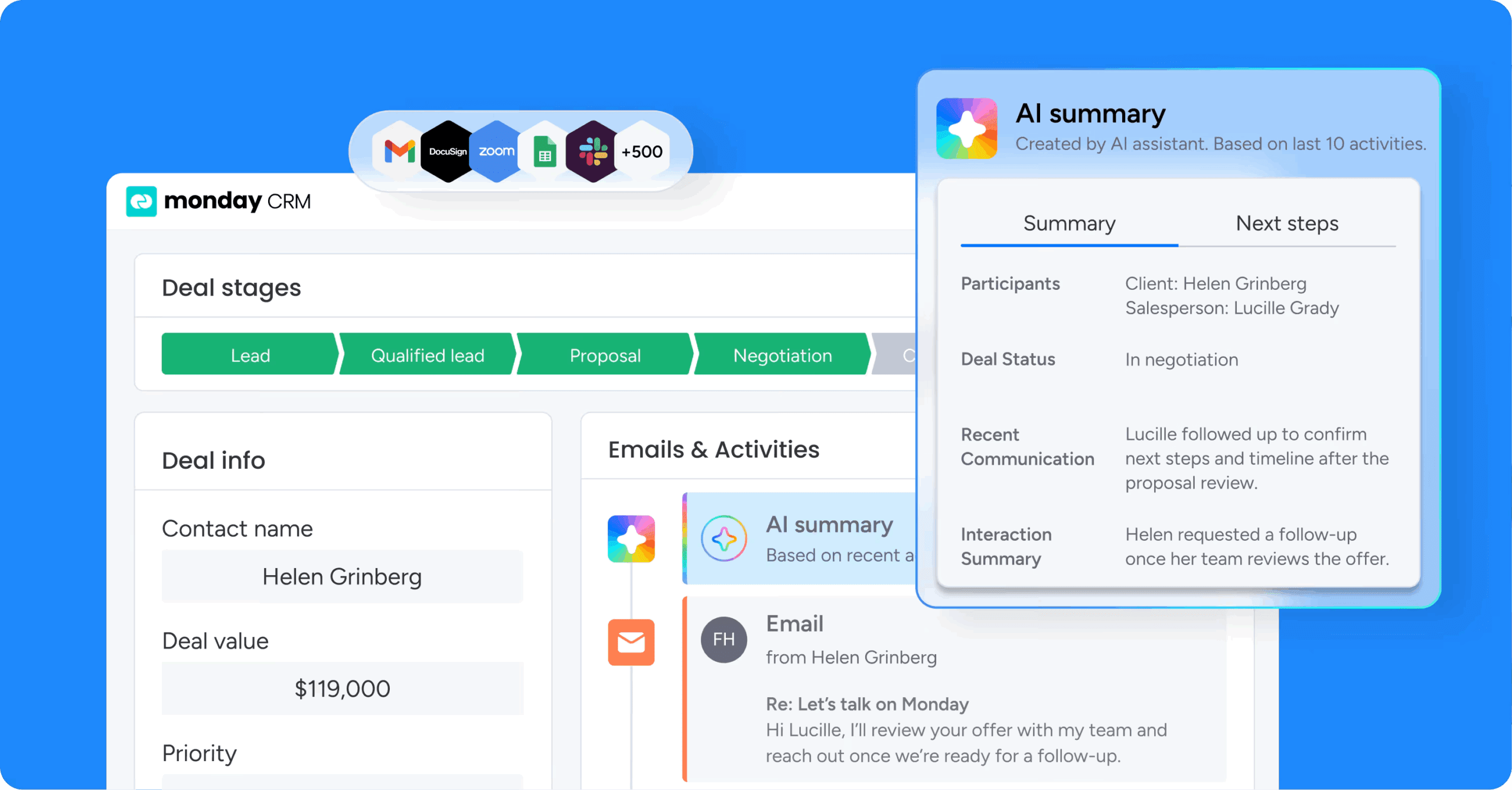
It brings every customer interaction into a single system, from an initial click on AutoTrader to a service visit years down the line. With that full history in one place, your team gets a clearer view of the relationship.
It’s also important not to lump it together with a Dealer Management System (DMS), which is built for inventory, accounting, and other back-office work. The DMS keeps dealership operations running behind the scenes; the CRM manages the customer-facing side of the business. It records every deal, automates follow-ups before leads cool off, and helps turn a single purchase into long-term loyalty.
Try monday CRMWhy dealerships need an automotive CRM
Most dealerships aren’t short on leads. What they lack is a reliable view of what happens after those leads come in. Inquiries arrive from OEM portals, marketplace listings, website forms, and walk-ins, yet tracking each one through the pipeline is where things start to break down.
Lose that visibility, and you lose control. A shopper who fills out an online form has probably contacted several competing dealerships, and the store that responds first often gets the opportunity. At the same time, managers are left without a live read on pipeline health, which makes forecasting feel speculative and coaching more reactive than strategic.
The best dealerships win by building a process they can repeat, measure, and improve. Revenue teams use monday CRM to create that kind of system, with one workspace for lead tracking and follow-up activity. The result is a solid foundation for growth, with a fast implementation that delivers value quickly.
13 best automotive CRM platforms for dealerships
Every dealership operates differently, so a one-size-fits-all CRM rarely works. Some platforms are designed specifically for automotive retail and offer deep DMS integrations. Others focus on flexibility, giving teams room to shape workflows around how they actually sell.
The best choice depends on your dealership’s size, your current tools, and which operational problems you need to solve first. Here are 13 of the top options to consider, first in a quick-look table and then more in-depth after:
| Platform | Use case | Free trial* | Notable feature | Starting price* |
|---|---|---|---|---|
| monday CRM | Full customer lifecycle management from lead to post-sale | 14 days | Visual sales pipeline with drag-and-drop stages | $12/seat/month |
| DealerSocket | Multi-rooftop franchise and independent dealerships | Contact vendor | Equity mining with RevenueRadar across 11 targeting categories | Custom quote |
| CDK Global | Large franchise dealerships needing integrated DMS and CRM | Contact vendor | AI-powered AIVA virtual assistant for lead follow-up | Custom quote |
| Tekion | Dealerships wanting unified DMS and CRM on one data model | Contact vendor | Cloud-native platform with unified customer record | Custom quote |
| VinSolutions | High-volume franchise dealerships with predictive lead prioritization | Contact vendor | Buying Signals with first-party Cox Automotive data | Custom quote |
| ProMax | Credit-driven retailing with embedded compliance | Contact vendor | Only value-added reseller of all 3 credit bureaus | Custom quote |
| Salesforce | OEMs and large dealer groups managing vehicle lifecycles | Contact vendor | Automotive Cloud with AI-powered Sales Concierge | $25/user/month |
| HubSpot | Dealerships prioritizing digital lead generation and marketing | Free plan available | Native lead ad integration from Facebook, Google, LinkedIn | $15/seat/month |
| Zoho CRM | Independent dealerships with technical resources for configuration | Free plan available | AI assistant Zia with cross-sell and upsell predictions | $14/user/month |
| AutoAlert | Dealer groups converting customer data into sales opportunities | Contact vendor | Patented equity mining with AlertMiner | Custom quote |
| Reynolds and Reynolds | Dealerships running ERA-IGNITE DMS | Contact vendor | Integrated deal continuity across sales, F&I, and service | Custom quote |
| DriveCentric | Franchised dealerships focused on engagement-first selling | Contact vendor | Omnichannel communication with unified conversation threads | Custom quote |
| AutoRaptor | Independent dealerships needing purpose-built CRM | Contact vendor | AI Voice Agent answering calls 24/7 | Custom quote |
*Note: Prices may vary based on plan, billing cycle, or region. Free trial availability may change. Verify current pricing and trial terms before purchasing.
1. monday CRM
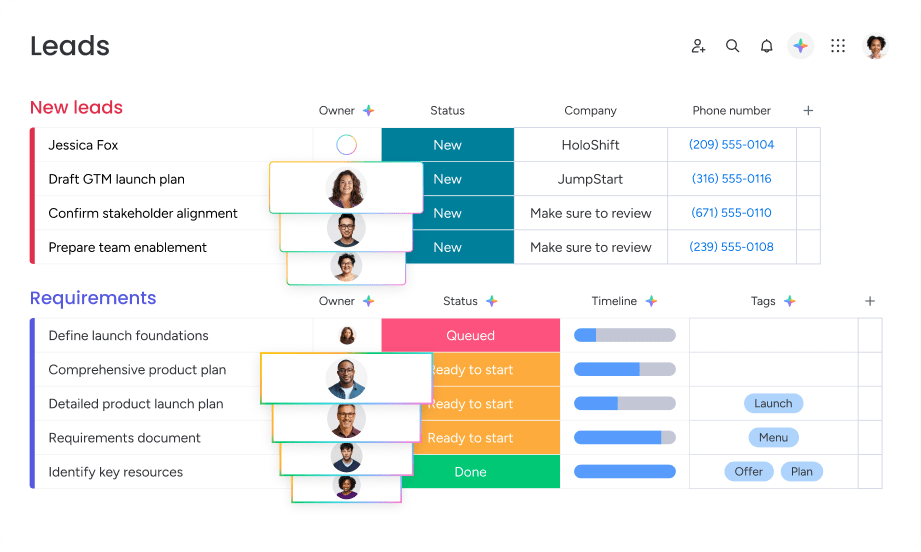
monday CRM gives automotive sales teams a configurable pipeline that can be shaped around the way they actually sell. Because it runs on the monday.com Work OS — with boards, items, dashboards, views, and more — teams can adjust stages, fields, and handoffs as processes evolve.
Its value goes well beyond the initial transaction. Teams use monday CRM to centralize customer information, manage post-sale work such as onboarding and renewals, and give leadership stronger oversight through dashboards and permissions.

Use case: Dealerships wanting to manage the full customer lifecycle — from first lead to deal management, to post-sale follow-up — in one place
Example: The platform can route new internet leads to the appropriate rep, capture every call and email in one timeline, and then carry that account into post-sale workflows such as onboarding, renewals, or collection tracking.
Key features
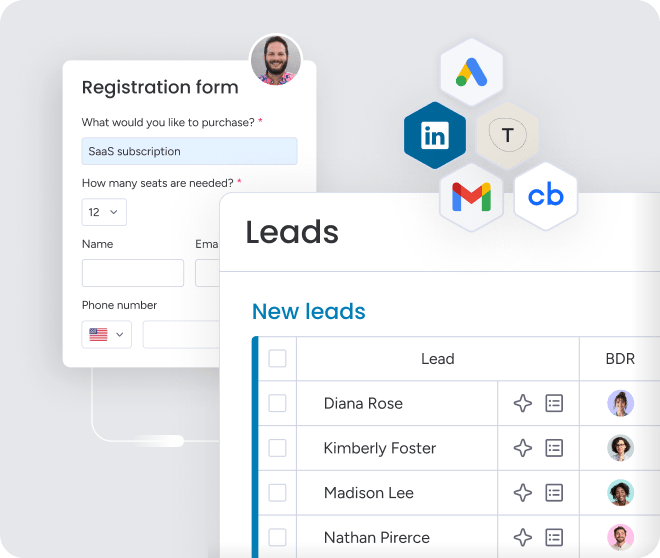
- Visual sales pipeline: Drag-and-drop stages make it easy for reps and managers to monitor deal movement. Add the Sales pipeline widget, and you can check pipeline status without exporting data.
- Automated email follow-ups: Send one-to-one or bulk emails with dynamic fields and templates, then monitor engagement through open rates and link clicks. Teams that need branded communication can use the HTML email editor to create custom layouts.
- Sales forecasting: Build forecasts and projections, compare forecast vs. actual, and analyze by month, sales rep, or any criteria that matters to your business. That helps leaders answer the real question: “Are we on pace, and who needs support this week?”
Pricing
- Basic: $12/seat/month (billed annually)
- Standard: $17/seat/month (billed annually)
- Pro: $28/seat/month (billed annually)
- Ultimate: Custom pricing (contact for a quote)
- Annual billing saves 18% compared to monthly plans
- Plans start from 3 seats; teams with more than 40 seats can request a custom quote
- A 14-day free trial is available; no permanent free plan
Why it stands out
- Teams choose monday CRM when they want flexibility without waiting on IT for every adjustment. Deal stages can be changed, handoffs can be automated, and customer information stays centralized, giving leadership more visibility and control.
- It also matches how revenue work actually happens. Sales doesn’t work in isolation. Teams use monday CRM as a collaborative CRM with finance, legal, and operations inside the same workflows, while keeping deal context attached throughout.

“With monday CRM, we’re finally able to adapt the platform to our needs — not the other way around. It gives us the flexibility to work smarter, cut costs, save time, and scale with confidence.”
Samuel Lobao | Contract Administrator & Special Projects, Strategix
“Now we have a lot less data, but it’s quality data. That change allows us to use AI confidently, without second-guessing the outputs.”
Elizabeth Gerbel | CEO
“Without monday CRM, we’d be chasing updates and fixing errors. Now we’re focused on growing the program — not just keeping up with it."
Quentin Williams | Head of Dropship, Freedom Furniture
“There’s probably about a 70% increase in efficiency in regards to the admin tasks that were removed and automated, which is a huge win for us.“
Kyle Dorman | Department Manager - Operations, Ray White
"monday CRM helps us make sure the right people have immediate visibility into the information they need so we're not wasting time."
Luca Pope | Global Client Solutions Manager at Black Mountain
“In a couple of weeks, all of the team members were using monday CRM fully. The automations and the many integrations, make monday CRM the best CRM in the market right now.”
Nuno Godinho | CIO at Velv
“monday.com provides developmental flexibility, operational efficiency, and data transparency — all in one place. We became a company that moved from chasing data to leading with it.”
Hyunghan Lee | Team Lead, Sandbox Network
"monday.com brought every part of our business into one connected space. The harmony between work management and CRM has become our operating system — giving us the clarity and confidence to scale.”
Jennifer Chinburg | Executive Vice President of Corporate Development & Brand, Chinburg Properties
“We just weren’t getting value from our old CRM. With monday.com, it's a thousand times better. Our sales teams are more informed, more consistent, and far more connected."
James Arnold | Chief Operating Officer, Cenversa2. DealerSocket
DealerSocket acts as a central operating system for franchise and independent dealerships across the U.S., connecting sales, marketing, and service workflows in one platform. Built specifically for automotive retail, it covers lead management, desking, equity mining, and DMS integration — making it especially appealing for multi-rooftop dealer groups that need broader visibility.

Use case: Franchise and independent dealerships wanting 1 platform for managing leads, desking deals, mining the customer database, and tracking performance across multiple rooftops
Key features
- OEM lead integration and compliance: Imports inquiries directly from manufacturer portals into the CRM and supports nearly 80 OEM program certifications, helping franchise dealers stay audit-ready.
- Equity mining with RevenueRadar: Scans the customer database across 11 targeting categories to identify high-probability buyers, then supports omni-channel outreach with built-in direct mail and 24/7 live-agent appointment booking.
- In-CRM desking and digital retail: Connects deal structuring directly to the DMS with configurable finance and lease options, cutting rekeying and shortening time-to-deal — with PrecisePrice averaging an additional $300 gross per deal.
Pricing
- Quote-based: No public pricing tiers; proposals are customized by store count, product mix, and add-ons.
- Contact DealerSocket directly via the CRM pricing request page to get a quote.
- Additional usage-based costs may apply for messaging volumes (SocketTalk), direct mail and appointment services (RevenueRadar), and credit pulls (SocketCredit).
Considerations
- Pricing opacity makes vendor comparisons harder during the evaluation process, since there are no published tiers to benchmark against.
- The strongest value case depends on adopting multiple Solera products; dealerships running mixed vendor stacks may find the end-to-end cohesion less pronounced than advertised.
3. CDK Global
CDK Global offers an integrated DMS and CRM platform built specifically for franchise dealerships and large dealer groups. It ties front-office functions — sales, service, and marketing — to desking, F&I, and compliance tools within a single environment, making it a logical option for dealerships already using CDK’s back-office infrastructure. Its built-in Customer Data Platform (CDP) adds real-time customer intelligence directly inside CRM workflows.

Use case: Large franchise dealerships and dealer groups that want to consolidate DMS and CRM into a single integrated platform
Key features
- AI-powered lead follow-up: AIVA, CDK’s AI virtual assistant, handles real-time conversational lead follow-up, while AI Summary condenses complex customer data into actionable points for sales teams.
- Integrated desking: Side-by-side deal comparisons, incentive compatibility logic, and live rates and residuals sit directly inside the CRM, reducing negotiation time and supporting gross improvement.
- Equity mining and targeted marketing: AI-assisted propensity-to-buy scoring and 60+ data points help teams identify and activate the right customers for both sales and service revenue opportunities.
Pricing
- Quote-only: CDK does not publish list pricing; all CRM packages are sold through direct sales engagement.
- Packaging is organized into integrated Suites within the CDK Dealership Xperience Platform (DXP): Foundations, Fundamentals, Modern Retail, Vehicle Inventory, Fixed Operations, and Intelligence.
- Additional modules — including AI features, desking, marketing tools, and texting — are separately licensed.
Considerations
- CDK is best suited for dealerships already within its ecosystem; teams outside it may find integration with non-CDK platforms more complex and costly to implement.
- A 2024 cyberattack caused multi-day outages across thousands of North American dealerships, highlighting the operational risk of single-vendor dependency at the platform level.
4. Tekion
Tekion combines DMS and CRM on a single cloud-native platform built expressly for automotive retail. Founded in 2016, it targets franchised dealerships, enterprise dealer groups, and OEMs that want one unified system rather than a chain of integrations. With AI embedded throughout its workflows and a reported 3,000+ dealership rooftops already on the platform, Tekion stands out as a serious option for groups ready to leave legacy systems behind.

Use case: Dealerships and dealer groups that want DMS and CRM built on one data model, allowing sales, service, and accounting teams to work from the same customer record in real time
Key features
- AI-powered lead management: Tekion’s CRM Pro layer delivers AI lead snapshots, intelligent prioritization, and call transcription and summarization — helping sales teams spend less time on admin and more time closing.
- Unified customer record: A single profile spans sales, service, marketing, and accounting, giving every department complete context without manual data transfers.
- Enterprise controls: Centralized permissions, cross-rooftop reporting, standardized messaging, and audit trails give multi-location groups consistent visibility and governance across every store.
Pricing
- Quote-only: Pricing is defined in each customer’s order form. Contact Tekion directly for a demo and proposal.
- Add-on modules (Advanced Analytics, Tekion Pay, Digital Service Experience, Payroll) are available within the ARC platform; fees are not publicly disclosed.
Considerations
- As a newer entrant, Tekion’s third-party integration ecosystem may be narrower than longer-established platforms — dealerships should confirm compatibility with existing lead sources and vendor tools before committing.
- Migrating to Tekion requires a structured implementation process, and large dealer groups have publicly noted transition costs during the switchover period, so budget for change management alongside licensing.
5. VinSolutions
VinSolutions pulls dealership sales and service data into one customer record, giving franchised dealers a unified view of shopper activity. As part of the Cox Automotive ecosystem, it brings first-party data from Autotrader, Kelley Blue Book, and Dealer.com directly into CRM workflows, which makes it especially attractive to high-volume dealerships already invested in Cox products.

Use case: Franchised dealerships that need predictive lead prioritization and deep OEM-certified workflows across a high-volume sales operation
Key features
- Buying signals and predictive insights: Aggregate first-party Cox data from Autotrader, KBB, and Dealer.com to score and prioritize leads based on real purchase intent.
- VinLens web behavior tracking: Link a shopper’s anonymous website browsing history to their CRM record the moment they identify, giving sales teams full context before the first conversation.
- Vinessa virtual contact assistant: Get an AI assistant that sets appointments, updates customer records, monitors sentiment, and responds in both English and Spanish — without pulling a rep away from the floor.
Pricing
- Quote-only: VinSolutions does not publish public pricing; contact their sales team via the Connect CRM product page for a custom quote.
- Pricing is modular by product and rooftop, with add-ons such as CRM-native texting, call tracking, video marketing, and Predictive Insights available at incremental cost.
- Qualified dealers may offset costs through OEM co-op programs such as GM iMR Turnkey eligibility.
Considerations
- The mobile app ratings are notably low, which points to ongoing stability and UX friction for on-lot teams.
- Dealerships outside the Cox Automotive ecosystem may find integrations with non-Cox platforms more complex and legacy reporting lacks drill-down capability during peak periods.
6. ProMax
ProMax brings CRM, desking, credit, and compliance together in one platform built specifically for automotive dealerships. Founded in 1994, it is aimed at franchised and independent dealerships that want a cleaner sales-to-finance handoff without switching between multiple systems. Its biggest differentiator is that it is the only value-added reseller of all 3 credit bureaus, with credit and compliance embedded directly inside the CRM workflow.

Use case: Dealerships that need credit-driven retailing, where lender fit, compliance checks, and deal profitability surface at every stage of the sale
Key features
- Integrated credit and desking: Pull soft-credit data and run deal structures from a single customer profile screen, with Lender Select calculating reserve optimization across lenders.
- Compliance automation: FTC/GLBA/FCRA-aligned workflows handle OFAC screening, Red Flags identity verification, synthetic fraud alerts, and required disclosures automatically throughout the deal process.
- Lead and internet lead management (ILM): OEM-certified lead ingestion, Daily Workplan workflows, integrated SMS/MMS texting, call tracking, and a mobile app with VIN and driver’s license scanning keep the sales floor moving.
Pricing
- Quote-only: ProMax does not publish pricing. Contact ProMax directly or schedule a demo to receive a quote tailored to your dealership’s size and selected modules.
- Add-on costs apply to certain services, including additional SMS virtual numbers, inbound call forwarding minutes, NCOA/Reverse Phone Lookup, and the website Incentive Optimizer.
Considerations
- Dealerships that need robust marketing automation or service department integration may find ProMax’s core focus on sales and F&I workflows requires supplemental platforms to cover those gaps.
- DMS sync speed varies by provider — some connections run near real-time, while others operate on batch schedules, which can affect data freshness expectations.
7. Salesforce
Salesforce brings enterprise CRM capabilities to automotive organizations that need more than a standard pipeline tracker. Built for OEMs, large dealer groups, and captive finance organizations, Automotive Cloud unifies vehicle data, dealer performance, and customer relationships on one platform. AI-powered tools and prebuilt industry workflows give revenue teams a substantial head start on complex sales and service cycles.

Use case: Large automotive organizations that need to manage vehicle lifecycles, dealer networks, warranty claims, and finance operations from one connected platform
Key features
- Automotive data model: Tracks vehicles, warranties, finance agreements, and stakeholder relationships with built-in calculated insights via Data Cloud to reduce manual data stitching.
- AI-powered sales workflows: AI-powered Sales Concierge, guided test-drive scheduling, and trade-in appraisal workflows with integrations to valuation sources like KBB and J.D. Power accelerate lead-to-sale cycles.
- Dealer and partner collaboration: Experience Cloud templates give dealer groups and partners secure portals for lead sharing, service scheduling, and performance tracking.
Pricing
- Starter Suite: $25/user/month
- Pro Suite: $100/user/month (annual contract)
- Sales Cloud Enterprise: $175/user/month
- Sales Cloud Unlimited: $350/user/month
- Einstein 1 Sales: $550/user/month
- Connected Vehicle Unlimited add-on: $15,000/org/month (list price)
- Premier Success Plan: typically 30% of net license fees (included with Unlimited)
- Einstein AI consumption is billed separately (e.g., per conversation or via Flex Credits). While Salesforce publishes pricing for its core Automotive Cloud editions, expect a sales conversation for add-ons and enterprise configurations.
Considerations
- Salesforce requires significant implementation investment — expect to involve consultants or a dedicated admin to configure and maintain the platform, which raises the total cost of ownership well beyond base license fees.
- Many advanced capabilities, including Data Cloud setup, OmniStudio flows, and Experience Cloud portals, require technical expertise to deploy, making it a less accessible option for single-point dealerships or smaller groups.
8. HubSpot
HubSpot combines marketing automation and CRM in one platform, making it a strong fit for dealerships that prioritize digital lead generation over heavy back-office integration. With native syncing from Facebook, Google, and LinkedIn lead ads, plus automated follow-up sequences, it supports the full buyer journey from first inquiry to post-sale service.

Use case: Dealerships and dealer groups that run active digital marketing operations and need one platform to manage leads, sales pipelines, and post-sale communications
Key features
- Lead ad integration: Automatically imports leads from Facebook, Google, and LinkedIn ad campaigns into contact records and triggers follow-up workflows — removing manual data entry.
- Pipeline and deal tracking: Manage every stage of the deal with meeting scheduling, email templates, sequences, and reporting built in, so sales teams can stay on top of active opportunities.
- Post-sale service communications: Service Hub ticketing and a unified inbox keep customer relationships active after the sale, supporting service reminders and repeat business campaigns.
Pricing
- Free: $0/month
- Starter: from $15/seat/month
- Professional: from $1,450/month (6 seats included)
- Enterprise: from $4,700/month (8 seats included)
- Note: Professional and Enterprise tiers typically require paid onboarding fees (starting at $3,000). Marketing contact volume and seat count drive total cost as teams scale. Verify current pricing at hubspot.com.
Considerations
- HubSpot does not offer native DMS integration or OEM lead source connections out of the box — dealerships with high floor traffic volume or complex inventory workflows will likely need third-party connectors or custom development to close those gaps.
- Costs can rise quickly as contact databases grow and marketing contact tiers upgrade automatically, so high-volume dealerships should model total cost carefully before committing.
9. Zoho CRM
Zoho CRM gives budget-conscious automotive operations a configurable base for managing leads, service workflows, and dealer networks — without the price tag of a purpose-built vertical platform. Its AI assistant, Zia, adds cross-sell and repeat-purchase predictions that help service teams act on revenue opportunities they might otherwise miss.

Use case: Independent dealerships and used car operations that have the technical resources to configure a general-purpose platform for automotive workflows
Key features
- Workflow automation and journey orchestration: Blueprint and CommandCenter enforce consistent processes across test drives, service hand-offs, and follow-ups — reducing manual coordination across departments.
- AI-assisted selling with Zia: Zia surfaces cross-sell and upsell signals, including repeat-purchase predictions for consumables like engine oil and coolant, helping service advisors act on revenue opportunities at the right moment.
- Omnichannel customer communication: Email, telephony, live chat, and WhatsApp messaging integrate directly into the CRM, keeping service reminders, status updates, and follow-ups in one place.
Pricing
- Free: Up to 3 users
- Standard: $14/user/month (billed annually) or $20/user/month (billed monthly)
- Professional: $23/user/month (billed annually) or $35/user/month (billed monthly)
- Enterprise: $40/user/month (billed annually) or $50/user/month (billed monthly)
- Ultimate: $52/user/month (billed annually) or $65/user/month (billed monthly)
- Annual billing saves up to 34% compared to monthly plans.
- Premium support is available at 20% of subscription cost; Enterprise support at 25% (minimum license thresholds apply).
- WhatsApp messaging, telephony minutes, and RouteIQ field routing are billed separately as add-ons.
Considerations
- Zoho CRM is not a purpose-built automotive platform — dealerships will need technical resources and configuration time to align it with automotive-specific workflows, which can extend implementation timelines.
- Advanced desking, native OEM program integrations, and deep DMS connectivity typically require custom development or third-party integrations, adding complexity for larger franchise operations.
10. AutoAlert
AutoAlert merges data mining and customer engagement in one automotive-specific platform, helping dealerships identify upgrade-ready customers before they ever step back into the showroom. Built for franchised dealerships and multi-store dealer groups, it pairs patented equity mining with CRM workflows that trigger timely, targeted outreach. The payoff is fewer missed opportunities and a service lane that contributes directly to sales.

Use case: Dealer groups that want to convert existing customer data into sales opportunities, particularly through service-lane acquisition and equity-based outreach
Key features
- Equity and data mining (AlertMiner): Analyzes DMS data to identify customers in a strong position to upgrade based on equity, lease end, mileage, warranty expiration, and more — then triggers ranked alerts and follow-up workflows automatically.
- Enterprise multi-rooftop CRM: Unifies customer records, service history, and inventory recommendations across multiple store locations, giving centralized BDC teams and group executives a single source of truth.
- Behavior-driven follow-ups: Replaces time-based cadences with engagement-based outreach, so sales teams reach customers based on actual browsing, service, and communication signals rather than arbitrary schedules.
Pricing
- Quote-based: Pricing is not publicly listed; all plans are customized based on dealership size, data volume, and modules selected (CXM, AlertMiner Pro, Engagement Studio, AI Assistants, Service Lead Management, Enterprise).
- Training add-on: Optional on-site training is available at $1,500 for the first day and $1,000 for the second day, per trainer.
- Third-party services: Credit pulls via 700Credit and direct-mail campaigns carry separate usage-based costs through partner providers.
Considerations
- AutoAlert functions best as a complement to a primary CRM rather than a standalone solution — dealerships should confirm whether they need a full CRM or a data mining add-on before committing.
- Pricing opacity makes direct cost comparisons difficult; prospective buyers need to engage the sales team for a custom quote before modeling ROI.
11. Reynolds and Reynolds
Reynolds and Reynolds has served automotive dealerships since 1927, and its FOCUS CRM reflects nearly a century of dealership operating knowledge. As part of a fully integrated Retail Management System, FOCUS links sales, F&I, service, and accounting under one data layer, making it a compelling option for dealerships that want every department working from the same information.

Use case: Dealerships that run Reynolds’ ERA-IGNITE DMS and want a CRM that shares a single data layer across sales, F&I, and service
Key features
- Integrated deal continuity: Deals started in FOCUS carry through to desking and F&I in ERA-IGNITE without data breaks, so nothing gets lost between departments.
- AI-powered call intelligence: Conversation AI transcribes and summarizes calls, tags outcomes, and writes directly to each customer’s FOCUS profile — reducing manual follow-up work for sales teams.
- Predictive lead mining: XtreamService surfaces buy-ready leads by combining DMS transaction data, behavioral signals, and demographic information, including non-equity opportunities that standard pipelines miss.
Pricing
- Quote-based: Reynolds does not publish list pricing for FOCUS; all pricing is configured per dealership through direct sales engagement.
- Contact Reynolds and Reynolds for a custom quote via their contact page.
- Add-ons such as XtreamService, RITS telephony, Conversation AI, Unlimited Text Messaging, and LaneView are available at additional cost.
Considerations
- FOCUS delivers its strongest value when paired with ERA-IGNITE and other Reynolds modules — dealerships running mixed or third-party stacks may find the integration benefits harder to access.
- Some users reporting crashes and UI inconsistencies on the go with the Android FOCUS mobile app.
12. DriveCentric
DriveCentric offers an engagement-first CRM for franchised automotive dealerships across the U.S. and Canada. It combines texting, email, calling, and video messaging into one conversation thread, making it well suited for sales teams that value relationship-based selling over pure outreach volume. Its agentic AI operates inside the CRM to manage after-hours follow-up and keep leads warm without pulling closers away from active deals.

Use case: Franchised dealerships wanting to respond faster, follow up more consistently, and manage the full lead lifecycle from one mobile-friendly platform
Key features
- Omnichannel communication: Send texts, emails, calls, and personalized video messages — including live video calls — without leaving the CRM, keeping every conversation in one unified thread.
- AI Agents: Role-based AI (Sales, Nurture, Prospect) handles after-hours responses and consistent follow-up automatically, measured by outcomes like appointments and revenue influence rather than message volume.
- Real-time dashboards: Health and Live dashboards give managers instant visibility into pipeline activity and team performance, supporting in-the-moment coaching decisions.
Pricing
- Quote-based: Pricing is customized per rooftop and units sold — contact DriveCentric for a quote.
- Add-ons such as Desking, Rates/Rebates/Residuals, Reputation Management, Managed Chat, and Service Pipeline are available at additional cost.
- Contracts are annual or multi-year with monthly invoicing.
Considerations
- Desking and F&I-related features are add-ons rather than core inclusions, so dealer groups with deep finance and insurance workflow needs should confirm module scope during the quoting process.
- Public third-party review volume is limited on some directories, which can make independent benchmarking harder before committing to a sales conversation.
13. AutoRaptor
AutoRaptor is an automotive CRM built from the ground up for independent and used car dealerships rather than adapted from a general sales platform. Founded in 2006 by dealership sales professionals, it addresses the realities of independent retail: missed calls, delayed lead response, and manual deal structuring. Its AI-first approach means the platform actively works leads around the clock, not only when your team is on the lot.

Use case: Independent dealerships that want a purpose-built CRM that handles lead capture, follow-up, and deal structuring in one place
Key features
- AI Voice Agent: Answers every inbound call 24/7, qualifies buyers, and books appointments automatically — so no lead slips through because the line was busy.
- Integrated desking: Structures deals with real-time payment calculations and side-by-side scenario comparisons directly inside the CRM, then pushes finalized data to the DMS.
- AI Sales Assistant (“Rick”): Captures and qualifies leads across text, email, chat, and phone around the clock, logging all context directly in the CRM for sales reps to pick up seamlessly.
Pricing
- Starter: 3–5 users (quote-based; contact AutoRaptor for pricing)
- Pro: 6–10 users (quote-based)
- Power: 11–15 users (quote-based)
- Power+: Unlimited users (quote-based)
- Annual contracts are available and typically discounted versus month-to-month; multi-location groups may qualify for volume discounts.
- Additional costs may apply for premium integrations, extra SMS volume, additional phone numbers, and custom websites.
Considerations
- Pricing is not publicly listed — you’ll need to go through a sales conversation to get actual numbers, which adds friction for buyers who want to compare costs quickly.
- Integrated desking is currently optimized for desktop, so teams that rely heavily on mobile for deal structuring will need to move to a desk for that step.
8 key features of automotive CRM software
Most CRMs can’t keep up with how fast dealerships actually move. Multiple lead sources, rapidly changing inventory, and customer relationships that stretch far beyond the initial sale expose every weakness in a generic system. The right automotive CRM closes those gaps with features built for the way dealerships actually operate.
Here are the 8 features that separate platforms worth implementing from the ones that only look good in demos:
- Lead capture and routing across every source: Cars.com, OEM portals, your website, walk-ins — leads come from all directions. A capable CRM gathers every incoming lead in one place and routes each one to the right rep automatically, so nothing gets buried in inboxes or missed entirely.
- Speed-to-lead automation and AI follow-up: Slow replies lose deals. The dealership that answers first usually sets the pace. CRM automation sends personalized responses the moment a lead comes in, and AI can draft follow-up emails to keep opportunities moving even outside business hours.
- Visual sales pipeline and deal forecasting: Momentum is hard to spot in a spreadsheet. A visual pipeline makes it obvious. Managers can see stalled deals, identify where support is needed, and forecast from what’s actually happening on the floor instead of guessing.
- Service and account management in one timeline: Closing the sale isn’t the end of the relationship. When service visits, recalls, and ownership history live in one timeline, sales and service teams get the same context, supporting a more consistent customer experience.
- Real-time dashboards and sales analytics: Monthly reports tell you what already happened. Live dashboards show lead volume, rep activity, and conversion performance in real time, so teams can act faster and adjust before the month’s over.
- DMS, inventory, and OEM lead source integrations: If the CRM can’t connect to your DMS, your team ends up re-entering data manually and introducing errors at nearly every step. The right CRM connects systems instead of adding another one to manage.
- AI-powered lead scoring and sentiment analysis: AI pushes your hottest prospects to the top of the list, flags frustrated customers before a deal goes cold, and summarizes entire conversation histories in seconds — freeing up sales teams to focus on building relationships instead of chasing context.
- Mobile access for the showroom and service lane: Most sales activity doesn’t happen at the desk — it happens on the lot, in the showroom, and in the service lane. Mobile access keeps records accurate because reps can update deals, log test drives, and capture activity in the moment.
These aren’t nice-to-haves. They’re the core requirements. Once leads, deals, and customer history live in one connected platform, the revenue leaks from gaps and delays start to close.
6 steps to choose the right automotive CRM for your dealership
Choosing a CRM is bigger than a software decision. It shapes how your team sells, collaborates, and operates every day. Choose poorly, and the platform turns into shelfware while reps retreat to spreadsheets and sticky notes. These 6 steps help narrow the field so you can pick a system your team will genuinely use.
Step 1: Map your lead sources and response gaps
Start by listing every channel that generates leads: website forms, third-party sites, OEM portals, walk-ins, and phone calls. Put them all in front of you. Then identify the weak points. Where do leads tend to sit untouched the longest?
That exercise reveals the specific problems your CRM must solve. A dealership that depends heavily on digital lead flow has very different requirements from one that relies on showroom traffic. Buying for the wrong mix gets expensive fast.
Step 2: List your required DMS and inventory integrations
Before you sit through a single demo, document the systems your dealership already depends on. Your DMS — whether that’s CDK, Reynolds and Reynolds, or Tekion — is a hard requirement. Reps need access to live inventory data, not information delayed by manual syncing.
If the CRM cannot communicate with your DMS, you create a 2-system problem that slows everyone down and introduces avoidable mistakes. Confirm the CRM integration first. Then book the demo.
Step 3: Define your sales and service workflows
Every dealership has its own process. Map yours from first contact through delivery, and include service follow-up as well. That gives you a practical blueprint of how work actually moves through the business.
Once you do that, the bottlenecks become easier to see. You’ll know which manual tasks are ready for automation, and you’ll give vendors a concrete picture of what needs to be configured instead of settling for a generic setup.
Step 4: Evaluate customization and no-code flexibility
Automotive retail does not stand still. OEM incentives change, market conditions shift, and your internal workflows need to change with them. If every adjustment requires an IT ticket, the CRM will slow you down instead of helping.
The better path is a customizable CRM platform your team can adapt on their own. Revenue teams find success using monday CRM to update workflows independently because it is built for flexibility; no code, no consultants, no waiting.
Step 5: Compare pricing against your growth plans
CRM pricing can be all over the place. Some vendors charge per seat, some price by dealership, and others bundle everything into enterprise contracts. Don’t evaluate pricing only for the team you have today.
Think about what happens when you add another rooftop or expand headcount. A platform that looks inexpensive at 5 users may become costly at 20. Ask vendors directly how pricing changes as you grow.
Step 6: Run a live pilot with real dealership data
Scripted demos won’t tell you much. They won’t show how the system handles your actual lead volume, your DMS, or your reps. Push for a live pilot with your own team and your own data.
Track response times, adoption, and data accuracy during that test. If the platform struggles in a controlled environment, it will struggle even more at scale. Better to learn that before signing a contract.
5 steps to roll out automotive CRM software your team will use
CRM rollouts rarely fail because the technology is incapable. More often, they fail because adoption never happens. The platform turns into an expensive digital paperweight while the team quietly returns to old habits and old spreadsheets.
Getting adoption right takes a deliberate rollout. People first. Technology second.
- Give your CRM a captain: Choose a champion — ideally a sales or BDC manager the team respects — and give that person protected time to drive usage and accountability. Without a clear owner, momentum disappears quickly.
- Roll it out in phases: Begin with core functions such as lead capture and pipeline tracking. Once people are comfortable, add automations and reporting in stages.
- Clean your data before you go live: Before migration starts, apply CRM data management practices to clean the data, remove duplicates, and standardize formatting.
- Weave it into your daily workflow: A CRM sticks when it becomes part of the day, not an extra administrative task. Use dashboards in morning huddles. Pull one-on-one reports directly from the platform. If leadership ignores the CRM, the rest of the team will too.
- Measure what matters and fix it fast: For the first 90 days, treat adoption metrics like business-critical numbers, because they are. Watch login frequency, deal updates, and how quickly reps act on new leads. If friction shows up, address it immediately.
A careful rollout is what turns software into a habit your team depends on to hit targets.
Drive more revenue with a connected dealership
Automotive sales is moving faster than ever, and disconnected systems or manual spreadsheets are no longer enough. A modern CRM gives your dealership the visibility and control required to turn scattered leads into predictable revenue. It closes the gap between the sales floor and the service lane, so every interaction contributes to a stronger customer relationship.
Once data is centralized and routine follow-ups are automated, your team spends less time chasing information and more time closing deals. The right platform fits your actual sales motion, helping reps work more intelligently and giving managers the confidence to forecast based on real activity.
Take the time to review your current workflows, identify the bottlenecks, and choose a solution your team will truly adopt. Prioritize flexibility and ease of use, and you create a foundation for sustainable growth that keeps your dealership ahead of the competition.
FAQs
What is the difference between a CRM and a DMS in automotive dealerships?
The difference between a CRM and a DMS in automotive dealerships is their function. A CRM manages customer relationships and the sales process, while a DMS handles back-office operations like inventory, accounting, and financing.
How much does automotive CRM software cost?
The cost of an automotive CRM varies; purpose-built platforms often require custom quotes and long contracts. Flexible CRMs typically offer transparent, per-user pricing that scales with your dealership's size.
Can a general CRM work for automotive dealerships, or do I need an automotive-specific platform?
Yes, a general CRM works for automotive dealerships if it's flexible enough to match your sales process. These platforms allow you to build custom workflows, whereas automotive-specific CRMs can be rigid.
What integrations should I look for in an automotive CRM?
The most important integrations for an automotive CRM are your DMS, OEM lead portals, and communication tools like email and phone. Your CRM should connect with the tools you already use.
How long does it take to implement an automotive CRM?
Implementation time depends on the platform; purpose-built CRMs often take months to set up. A flexible, no-code CRM can be configured by your team and running in just a few weeks.
What is speed-to-lead and why does it matter for automotive dealerships?
Speed-to-lead is the time it takes to respond to an inquiry. It matters because the first dealership to contact a buyer is far more likely to win the deal.
