


The best CRM systems become your team’s primary workspace — the place where sales reps start their day, find everything they need instantly, and actually want to spend time. When your CRM experience is right, adoption soars, data quality improves, and your platform transforms into a genuine revenue accelerator that helps teams hit their numbers consistently.
This guide reveals what CRM experience actually means and how to build systems your sales teams will embrace. You’ll discover the essential components that drive adoption, how AI eliminates friction from daily workflows, and practical strategies for creating a CRM experience so intuitive and visual that it delivers measurable business results.
Key takeaways
- Great CRM experience drives revenue through consistent team usage rather than technical capabilities, so measure login frequency and data completeness before adding new features.
- Transform daily workflows by automating data entry, email drafting, and deal categorization without requiring technical expertise or complex setup.
- Unify customer information from emails, calls, and documents in one accessible workspace so teams collaborate on identical data instead of hunting across multiple systems.
- Align CRM processes with existing sales approaches rather than forcing teams to change proven methods, as intuitive design reduces training time and increases voluntary usage.
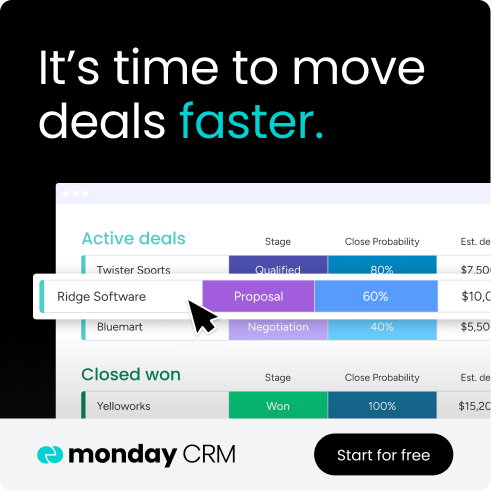
- Visual interfaces like monday CRM let teams see their entire pipeline at a glance and update deals with drag-and-drop simplicity, eliminating the friction that causes CRM avoidance.
What is CRM experience?
CRM experience means 2 different things, and the confusion matters.
- It’s the operational reality of how revenue teams interact with their CRM system daily: from lead capture through closed deals and beyond.
- It’s the professional skills someone demonstrates when managing customer relationships through CRM platforms.
For revenue teams, CRM experience is the day-to-day workflow that determines whether a CRM becomes your primary workspace or expensive shelfware. It’s the friction between capturing a lead and closing a deal, measured through adoption rates, data completeness, forecast accuracy, and how fast handoffs happen across teams.
Think about the difference between a sales rep who opens their CRM eagerly each morning, finding everything they need in seconds, versus one who dreads logging in, fighting clunky interfaces and hunting for information across multiple screens. Same software category, completely different experience. This distinction matters: CRM experience directly impacts whether teams hit their numbers, forecast accurately, and scale efficiently.
CRM experience vs. CRM systems
CRM systems are the platforms and their technical capabilities. CRM experience is what determines whether those capabilities actually drive revenue. This distinction explains why feature comparisons fail to predict CRM success: a system packed with capabilities delivers nothing if teams avoid using it.
| Category | CRM systems | CRM experience |
|---|---|---|
| Definition | Technical platforms and capabilities | How teams actually interact with the CRM daily |
| Focus | Features, integrations, infrastructure | Usability, workflows, and adoption |
| Success metric | Number of features | Adoption, data quality, and revenue impact |
| Risk | Overbuilt but unused systems | Friction that reduces productivity |
CRM systems include the foundational technical elements:
- Database architecture: Storing customer information securely and accessibly
- Feature sets: Pipeline management, reporting, and communication tools
- Integration options: Connections with other business applications
CRM experience encompasses the human side:
- Interface intuitiveness: Whether navigation feels natural or requires constant mental effort
- Information accessibility: How quickly teams find what they need
- Manual work requirements: Balance between automated processes and human data entry
- Process alignment: Whether the system adapts to how sales teams work or forces them to change proven approaches
The human element in customer relationship management
CRM technology supports human relationships. It doesn’t replace them. When this human element gets lost in technical complexity, CRM systems become obstacles instead of platforms that help. Strong CRM experience reduces friction points that directly impact selling time.
Here’s how it impacts daily work:
- Eliminating repetitive data entry: Every minute spent typing information that could be captured automatically is a minute not spent on customer conversations.
- Providing customer context: Sales conversations improve dramatically when reps enter them prepared with relevant history and preferences readily available.
- Enabling seamless collaboration: Complex deals involve sales reps, account managers, legal, and finance teams who need shared visibility.
The impact extends to customers, too. When sales teams have positive CRM experiences, they respond faster because information is accessible. They provide more relevant information because context is available. They create smoother handoffs because collaboration is built into their workflow.

How CRM experience drives revenue
CRM experience directly impacts pipeline velocity, forecast accuracy, and closed revenue in 3 ways that compound over time.
- Adoption drives data quality. When teams actually use their CRM because the experience is positive, data becomes reliable. Reliable data enables accurate forecasting and informed strategic decisions. Poor-experience CRMs generate incomplete data that leads to missed opportunities and inaccurate projections.
- Efficiency accelerates pipeline. Strong CRM experience reduces administrative time, allowing sales teams to focus on high-value work. When reps save 5 hours weekly on CRM administration, that translates to more customer conversations and shorter deal cycles. Across ten reps, that’s 50 hours weekly redirected from data entry to revenue generation.
- Visibility enables proactive management. Real-time insights and intuitive dashboards help sales leaders identify risks and opportunities early. Deals stalling in particular stages get attention before they die. Reps struggling with specific deal types receive coaching before quarters end.
Why CRM experience matters for revenue teams
Revenue teams face mounting pressure to hit aggressive targets with existing resources while providing accurate forecasts to leadership. CRM experience becomes a strategic lever that directly influences sales performance, team productivity, and revenue predictability. These impacts help revenue leaders prioritize experience improvements that deliver measurable business results.
Direct impact on sales performance
Sales performance depends on rep skills and the systems that either help or slow them down. Even talented reps underperform when fighting their systems rather than focusing on customers.
Strong CRM experience improves performance in these ways:
- Reduced administrative burden: Sales reps who spend hours weekly on data entry and status updates lose valuable selling time.
- Improved deal context: Easy access to customer history and previous interactions enables more relevant discussions.
- Faster response times: Intuitive mobile access and real-time notifications ensure immediate responses to prospects and customers.
Poor CRM experience often looks like a skills problem. When CRMs are difficult to use, skilled reps underperform because they’re fighting systems rather than focusing on strategy and relationships.
Team adoption and productivity gains
Low adoption rates and inconsistent usage hurt many CRM investments. This doesn’t happen because sales teams don’t understand CRM value. It happens because poor experience makes the system feel burdensome.
The connection between adoption and experience follows predictable patterns:
- Intuitive design drives voluntary usage: Teams use systems that make work easier, not because they’re required to.
- Reduced training requirements: Strong CRM experience means new team members become productive quickly without extensive training.
- Productivity multipliers: Consistent CRM usage enables reliable automation, accurate reporting, and improved collaboration.
Experience-focused CRMs create cycles that build on themselves. Teams see immediate value, which encourages continued use, which generates more reliable data, which provides more value. In contrast, experience-focused CRMs create positive cycles where intuitive workflows encourage adoption and generate compounding value.

Revenue predictability through improved experience
Accurate revenue forecasting needs complete, reliable data as its foundation. When CRM experience is positive, sales teams consistently update deal information and maintain accurate pipeline data. Poor-experience CRMs produce incomplete or outdated data, making forecasts unreliable guesses.
Strong CRM experience includes dashboards providing instant visibility into pipeline health and team performance. Sales leaders identify risks early and take corrective action before quarterly results suffer. Reliable, comprehensive CRM data reveals which deal characteristics predict success, typical deal durations, and activities correlating with closed revenue. Poor data quality makes this analysis impossible.
Try monday CRM5 essential components of a great CRM experience
Great CRM experience comes from design choices and capabilities that prioritize user needs. These 5 components consistently separate the CRMs teams embrace from the ones they avoid. Each component addresses friction points that determine whether teams adopt or abandon their CRM system.
1. Intuitive design that teams actually use
Intuitive design means interfaces that make sense immediately. Workflows match how teams actually work. Navigation requires minimal training. This reduces mental effort so teams focus on selling instead of figuring out systems.
Intuitive design includes:
- Visual organization: Information is organized logically with important data prominent and minimal unnecessary complexity.
- Workflow alignment: The CRM adapts to existing sales processes rather than forcing teams to change their approach.
- Minimal clicks: Common activities like updating deal stages require few steps.
- Contextual help: Guidance is available in context when users need it.
2. AI and automation without complexity
AI and automation dramatically improve CRM experience by eliminating repetitive work, but only when they’re easy to use instead of adding confusion.
Here’s the difference between AI that adds burden and AI that removes it:
| Area | Poor experience | Strong experience |
|---|---|---|
| Data entry | Manual typing for every field | Automatic capture from emails and documents |
| Configuration | Requires coding or IT involvement | Visual builders accessible to all users |
| Learning curve | Weeks of training to use AI features | Immediate value with ready-made actions |
| Maintenance | Constant adjustment and troubleshooting | Set-and-forget automation that works |
3. Single source of truth for customer data
All customer information needs to live in one accessible place. This eliminates information hunting, makes collaboration easier, and improves decision quality.
A real single source of truth means:
- No information hunting: Sales reps access everything immediately without searching multiple systems.
- Seamless collaboration: Account managers, sales reps, and support teams work from identical data.
- Confident decisions: Leaders trust their data without second-guessing or manual verification.
4. Flexible integration architecture
Revenue teams use email platforms, marketing automation, and document management systems alongside their CRM. Great experience requires smooth integration across email platforms, marketing automation, and document management systems.
Integration quality determines daily friction levels:
- Bidirectional data flow: Information syncs automatically between systems.
- Pre-built connectors: Ready-made integrations with common applications.
- API accessibility: Robust APIs enable custom integrations for unique requirements.
Poor integrations create compounding friction. Manual data copying between systems leads to avoidance and errors.
5. Real-time visibility and insights

Sales reps, managers, and leaders each need different visibility. Sales reps need pipeline views and next actions. Managers need team performance metrics. Leaders need forecast accuracy and strategic trends.
Actionable visibility includes:
- Role-appropriate dashboards: Information is relevant to specific responsibilities.
- Mobile accessibility: Critical information is available anywhere.
- Predictive insights: Forecasting likely outcomes beyond historical reporting is possible.
Signs your CRM experience needs improvement
Many organizations struggle with CRM experience without recognizing the symptoms. They blame team performance or market conditions instead. Identifying these warning signs early lets you make targeted improvements before adoption problems become entrenched habits that hurt revenue performance.
Poor adoption warning signs
Adoption problems signal CRM experience issues. When teams avoid, work around, or barely use their CRM, experience is almost always why.
Common warning signs include:
| Warning sign | What it looks like | What it indicates |
|---|---|---|
| Low login frequency | Reps access CRM only for required meetings | System feels burdensome |
| Incomplete data | Missing fields, outdated records | Data entry too cumbersome |
| Shadow systems | Spreadsheets used alongside CRM | Teams working around poor experience |
| Resistance to updates | Complaints about changes | System already overwhelming |
| High support volume | Frequent questions and confusion | Interface not intuitive |
Hidden costs of bad CRM experience
Poor CRM experience creates hidden costs that significantly impact revenue performance:
- Opportunity costs: Hours spent on CRM administration instead of customer conversations
- Data quality costs: Incomplete data undermining forecasting and decision-making
- Turnover costs: Daily CRM frustration contributing to sales team attrition
- Lost deals: Slow response times and information gaps losing deals to faster competitors
What excellence looks like

Excellent CRM experience looks different by role but shares one thing: the system helps with work instead of creating it.
- For sales reps, the CRM becomes their primary workspace. They start days viewing priorities, log activities effortlessly, access customer context instantly, and collaborate seamlessly.
- For managers, real-time visibility reveals team performance, deal health, and pipeline quality. They identify coaching opportunities and spot risks early.
- For revenue leaders, strategic visibility provides business trends, predictive insights, and scenario modeling capabilities.
Here are some key metrics to watch:
| Metric | What to measure | Business impact |
|---|---|---|
| Adoption rate | Login frequency, feature usage | Higher usage = better data |
| Data completeness | Filled fields, updated records | Enables accurate forecasting |
| Time savings | Hours spent on admin tasks | More selling time |
| Response time | Speed of follow-ups | Improves win rates |
| Pipeline velocity | Time from lead to close | Faster revenue generation |
| Forecast accuracy | Predicted vs. actual revenue | Better planning and strategy |
How AI transforms CRM experience for sales teams
AI fundamentally transforms CRM experience by changing how teams interact with customer data and execute sales processes. Value depends on implementation: accessible AI that eliminates work creates transformation, while complex AI adds burden. These transformations help revenue teams evaluate AI capabilities that genuinely improve daily workflows.
From manual activities to intelligent workflows
Manual CRM work eats up time: data entry, status updates, and information extraction. AI’s immediate impact eliminates this friction with smart automation.
Practical AI reduces daily friction:
- Automatic data capture: AI extracts information from emails and documents, populating fields without manual entry.
- Intelligent categorization: AI analyzes content and assigns appropriate categories and priorities.
- Content generation: AI drafts emails and summarizes meetings based on conversation context.
- Information extraction: AI extracts key information from contracts and proposals into relevant fields.
Predictive insights driving action
AI provides predictive insights that go beyond historical reporting. It forecasts outcomes and recommends actions to influence results.
Key predictive capabilities include:
- Deal scoring: AI predicts closure likelihood based on historical patterns.
- Risk identification: AI identifies warning signs before deals stall.
- Opportunity surfacing: AI reveals cross-sell potential and optimal outreach timing.
The value of predictive insights depends on data quality and AI sophistication. Strong CRM experience combines reliable data with smart AI that generates insights you can act on.
Learn more: CRM virtual assistant
7 ways to improve your CRM experience
Improving CRM experience requires a systematic approach, whether you’re struggling with adoption, evaluating systems, or optimizing implementations. These 7 strategies address the most common friction points that keep teams from getting value from their CRM investment. Each approach builds on the others, creating improvements in user satisfaction and business results that compound over time.
- Measure adoption before features: Establish baseline metrics that show how teams currently use the CRM. Track login frequency, data completeness, feature utilization, system time, and support requests before making changes.
- Simplify before automating: Automation amplifies existing processes, even the inefficient ones. Simplify workflows first by reducing required fields, streamlining stages, and using familiar language matching team vocabulary.
- Prioritize mobile experience: Sales teams don’t work from desks all day. Mobile access determines whether updates happen in real-time or get delayed. Evaluate mobile experience by attempting common activities on phones.
- Integrate communication channels: Customer interactions happen across email, calendar, and communication platforms. Smooth integration ensures information flows automatically and context stays unified.
- Implement AI incrementally: Introduce AI capabilities gradually. Start with high-impact, low-complexity applications. Start by eliminating manual data entry, then move to categorization, content assistance, and eventually predictive insights.
- Create feedback loops: Ongoing improvement needs input from daily users. Set up regular surveys, usage analytics, direct channels, and review cadences to keep improving.
- Invest in ongoing optimization: CRM experience needs continuous work as teams evolve and processes change. monday CRM’s flexible design supports ongoing optimization with adjustable workflows and configurations that don’t require technical expertise.
Building CRM experience that drives results with monday CRM
CRM experience determines whether your investment speeds up revenue or becomes an expensive obstacle. The difference lies in prioritizing user needs over feature counts, focusing on adoption over implementation, and treating CRM as a strategic advantage instead of an administrative requirement.

Revenue teams using monday CRM discover that great experience creates benefits that build on themselves. Initial time savings from intuitive design multiply through improved data quality. Better data enables better forecasting. Better forecasts drive more informed decisions. This positive cycle transforms CRM from something you have to use into a competitive advantage.
monday CRM stands apart by combining powerful capabilities with the intuitive experience that drives consistent adoption. Built on the same visual, flexible platform that millions trust for work management, monday CRM eliminates the traditional friction between sophisticated functionality and ease of use.

Here’s what makes monday CRM different:
- Visual pipeline management: See your entire sales pipeline at a glance with customizable board views that match how your team actually works — no complex navigation or hidden menus required
- Drag-and-drop simplicity: Update deal stages, reassign accounts, and modify priorities with intuitive interactions that feel natural from day one
- No-code customization: Adapt workflows, fields, and automations without technical expertise or IT involvement — revenue teams control their own CRM experience
- Accessible AI capabilities: Leverage powerful automation through ready-made actions like Extract information, Summarize, and Assign label that deliver immediate value without complex setup
- Unified workspace: Connect emails, documents, and customer data in one accessible location that eliminates information hunting and enables seamless collaboration
- Mobile-first design: Access critical information and update deals from anywhere with a mobile experience that matches desktop functionality
Teams transition to monday CRM and see adoption rates climb immediately because the platform removes barriers instead of creating them. Sales reps log in eagerly because finding information takes seconds, not minutes. Managers get real-time visibility without chasing updates. Leaders trust forecasts built on complete, reliable data.
Transform your CRM experience
Great CRM experience means creating an intuitive workspace that teams actually want to use every day. When your CRM combines visual simplicity with powerful automation, adoption soars, data quality improves, and your platform becomes a genuine revenue accelerator that helps teams consistently hit their numbers.
Ready to see the difference that exceptional CRM experience makes? Try monday CRM free and discover how visual pipeline management, drag-and-drop simplicity, and accessible AI can transform your sales team’s productivity from day one.
Try monday CRMFAQs
What is CRM experience and how does it differ from CRM software?
CRM experience is the day-to-day reality of how revenue teams interact with their CRM: usability, workflow fit, and business outcomes. CRM software refers to the technical platform and features.
What skills demonstrate real CRM experience on a resume?
Real CRM experience shows through pipeline management, keeping data clean, configuring automation, reporting and analytics capabilities, and cross-functional collaboration within CRM systems.
How does AI change CRM experience for sales teams?
AI transforms CRM experience by eliminating manual data entry through automatic extraction, drafting emails from conversation context, summarizing interaction history, and providing predictive deal insights.
What are signs of poor CRM experience in an organization?
Poor CRM experience shows through low login frequency, incomplete data fields, shadow spreadsheet systems, high support request volume, and resistance to system updates.
How do you measure CRM experience ROI?
CRM experience ROI measures through adoption rates, data completeness, forecast accuracy, administrative time savings, response time improvements, and ultimately pipeline velocity and closed revenue.
What makes CRM experience different from customer experience?
CRM experience refers to how internal teams interact with their CRM system, while customer experience describes how customers perceive their interactions with your company throughout their journey.
