


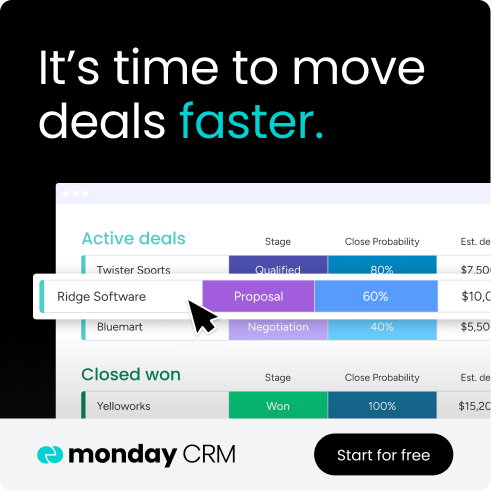
Your sales team needs a CRM that keeps up with their pace, not one that slows them down. The right platform turns momentum into closed deals by making updates effortless — whether your reps are at their desks or in the field.
This guide walks you through eight CRM platforms built for speed. You’ll discover how they compare on setup time, mobile capabilities, AI features, and flexibility, so you can choose the one that matches how your team actually works.
Try monday CRMWhat high-performing teams actually need from a CRM app
Most CRM apps are built for a different era. They’re slow, rigid, and need an IT team just to tweak one workflow, and that kind of clunky software kills momentum when your team makes decisions in hours, not weeks.
You need a platform that matches your pace, not one that slows you down. Here’s what separates a useful CRM from a simple spreadsheet.
- Setup in days, not quarters: You shouldn’t need 6 months and a project plan just to start tracking deals. A great CRM gets your team working from day one.
- An interface people actually use: If reps need a user manual to log a call, the platform’s already failed. It should feel intuitive from the first click — not like another chore.
- Customization without the code: Your sales process will change. That’s not a bug; it’s how you grow. Your CRM should adapt with you, tweaking pipelines and workflows on the fly, no developer required.
- Integrations that just work: Your team lives in email and calendars. A CRM that walls itself off creates manual work and kills momentum. Everything should connect and keep your data in one place.
Revenue teams move faster when their platform is built for speed and flexibility. A no-code platform that bends to your process, not the reverse, allows your team to focus on what they do best: closing deals.

Here’s what sets top performing CRM apps apart:
- Real-time data sync: Everyone sees the same info, instantly. No more “I didn’t know.”
- Simple automations: Handle follow-ups and admin tasks without thinking about it.
- A great mobile app: Let your team sell from anywhere, not just their desks.
- Easy integrations: Connect the tools you already use in minutes, not months.
- Visual pipelines: Spot bottlenecks and keep every deal moving forward.
- Actually useful AI: Get insights that help you close, not just reports that create more work.
8 best CRM apps for teams that move quickly
Clunky software doesn’t just frustrate your team. It costs you revenue. Every minute wrestling with a complicated interface? That’s a minute you’re not closing deals. The platforms worth your time don’t just store contacts. They push deals forward.
Skip the platforms with endless menus and confusing workflows that promise everything and deliver nothing. You need software that stays invisible, handles repetitive tasks automatically, and surfaces critical details when your reps need them.
| Platform | Use case | Free plan? | Notable feature | Starting price |
|---|---|---|---|---|
| monday CRM | Revenue teams needing flexibility beyond basic pipeline tracking | No | No-code customization with full customer lifecycle support | $12/seat/month |
| Pipedrive | SMB sales teams wanting visual, action-focused CRM | No | Activity-based selling with “rotting” deal alerts | $14/user/month |
| HubSpot CRM | Mid-market teams connecting sales, marketing, and service | Yes | Unified customer platform with native tool integration | $20/user/month |
| Zoho CRM | Teams automating tasks with predictive insights | No | Zia AI assistant for deal predictions and automation | $14/user/month |
| Freshsales | Growing teams needing visual pipelines with AI insights | Yes | Freddy AI groups deals by close probability | $9/user/month |
| Streak | Gmail-centric teams managing pipelines in their inbox | Yes | Gmail-native interface with zero context switching | $15/user/month |
| Zendesk Sell | Existing Zendesk customers connecting sales and support | No | Native Zendesk Support integration | $19/user/month |
| NetHunt CRM | Google Workspace teams managing sales inside Gmail | No | Multi-channel communication timeline in Gmail | $24/user/month |
1. monday CRM
A visual, no-code platform, monday CRM lets revenue teams run their sales motion without turning CRM setup into a side job. It’s built for sales and customer-facing teams who need flexibility across the full customer lifecycle — account management, payment tracking, not just a pipeline board.
Instead of forcing your team into a rigid process, monday CRM lets you shape the workspace around how you actually sell. Want to tweak a pipeline stage today because your sales cycle changed this morning?

Use case: Revenue teams — account managers juggling renewals, finance teams tracking payments, or customer success teams coordinating onboarding — that need flexibility beyond basic pipeline tracking
Key features
- Lead management that doesn’t drop the ball: Collect leads from website forms or campaigns, qualify and assign them, and follow up with individual or mass emails using dynamic fields and templates.
- Mass email and tracking: Send mass emails and track engagement, including open rates and link clicks, so you can follow up based on signals instead of guesswork.
- Expanded item view for customer context: See relevant account or contact details, plus connected deals and related work, in one place.
Pricing
- Basic CRM: $12/seat/month — includes core pipeline management, mobile access, and 200+ integrations.
- Standard CRM: $17/seat/month — adds timeline views, automation capabilities, and advanced integrations.
- Pro CRM: $28/seat/month — unlocks AI features, advanced reporting, and priority support.
- Ultimate CRM: Custom pricing with dedicated success management, advanced security controls, and custom integrations.
- Pricing details: All plans start at 3 users. Prices shown reflect annual billing, which saves 18% over monthly plans.
Why it stands out
- Adapts to any sales cycle: Revenue leaders adjust processes quickly, using no-code building blocks that don’t require specialized help.
- Centralizes customer information: Teams track deals, accounts, contacts, and communication history together, making forecasting conversations tighter.
- Supports the full customer journey: Go from lead management to post-sales workflows like onboarding progress, renewals, collection tracking, and client projects, all in one connected system.
2. Pipedrive
Pipedrive turns your sales pipeline into a visual command center where deals move forward through simple drag-and-drop actions. The platform focuses on activity-based selling for small and mid-size teams, making it dead simple to track what matters most: the actions that actually close deals. Built by salespeople who got tired of clunky systems, it keeps your team focused on selling instead of wrestling with software.

Use case: SMB sales teams that want a visual, action-focused CRM that gets them up and running fast without the complexity of enterprise platforms
Key features
- Visual pipeline management: Drag-and-drop deal progression and customizable stages show exactly where every opportunity stands.
- Activity-based selling methodology: Track calls, emails, and meetings as primary success metrics rather than just data entry.
- “Rotting” deal alerts and probability weighting: Flag stalled opportunities and provide weighted forecasts to keep momentum alive.
Pricing
- Lite: $14/month per user (annual billing)
- Growth: $39/month per user (annual billing)
- Premium: $59/month per user (annual billing)
- Ultimate: $79/month per user (annual billing)
- Annual billing saves up to 42% compared to monthly plans
- Add-ons like LeadBooster, Campaigns, and Web Visitors start from $13-$42/month per company
- 14-day free trial available
Considerations
- Customization requires navigating multiple settings menus, which can slow down teams that need to adapt processes frequently.
- Add-on costs for marketing automation, web visitor tracking, and advanced features can increase total cost compared to all-in-one platforms.
3. HubSpot CRM
HubSpot CRM delivers a unified customer platform that connects sales, marketing, and service teams around a shared database. The platform targets scaling businesses with its freemium model and integrated approach, making it particularly valuable for teams already using HubSpot’s marketing or service tools. With over 258,000 customers globally, HubSpot emphasizes ease of use and quick time-to-value for growing organizations.

Use case: Mid-market teams that want their sales pipeline tightly connected to marketing campaigns and customer service workflows
Key features
- Pipeline governance and automation: Stage-based rules, required fields, and automated actions keep deals moving forward while maintaining data quality.
- AI-powered insights: Predictive deal scoring and Breeze AI assistants provide guided next steps and automated summaries to accelerate decision-making.
- Unified customer platform: Native integration with marketing, service, and content tools eliminates data silos and creates seamless handoffs between teams.
Pricing
- Free tier: Unlimited users and contacts with basic pipeline management
- Sales Hub Starter: $20/user/month with automation and custom fields
- Sales Hub Professional: $100/user/month with advanced forecasting and reporting
- Sales Hub Enterprise: $150/user/month plus $3,500 onboarding fee with approvals and advanced governance
- Annual billing discounts available across all tiers
Considerations
- Teams often experience sticker shock when moving from the generous free tier to paid plans that unlock essential automation and reporting features.
- The interface can become cluttered and complex as organizations add more HubSpot products, creating navigation challenges for daily users.
4. Zoho CRM
Zoho CRM delivers AI-powered sales automation through its Zia assistant, targeting teams who want intelligence without complexity. The platform combines traditional CRM functionality with predictive insights and workflow automation, making it ideal for organizations seeking data-driven sales processes.

Use case: Teams looking to automate routine tasks while gaining predictive insights into deal outcomes and customer behavior patterns
Key features
- Zia AI assistant: Predicts deal outcomes, suggests optimal contact times, and automates data entry to reduce manual work.
- Blueprint process mapping: Visual, step-by-step sales process designer with enforced transitions and automated actions.
- Multi-channel communication: Integrates email, phone, social media, and live chat in one unified workspace.
Pricing
- Standard plan: $14/user/month with basic CRM features
- Professional plan: $23/user/month with workflow automation and advanced customization
- Enterprise and Ultimate plans: Higher tiers unlock AI capabilities and advanced analytics
- Annual billing: Save up to 34% with yearly subscriptions
Considerations
- Steeper learning curve requires significant time investment to configure workflows and integrations properly.
- The interface feels dated compared to other visual CRM platforms, and advanced features need technical knowledge to implement effectively.
5. Freshsales
Freshsales brings AI-powered pipeline management to sales teams who want predictive insights without the complexity. The platform targets SMBs and mid-market organizations with transparent pricing and built-in communication tools that eliminate app-switching. Teams get multiple visual pipeline views — from Kanban boards to forecast timelines — all enhanced by Freddy AI predictions.

Use case: Growing sales teams that need visual pipeline management with AI-driven deal insights and integrated communication tools at affordable pricing tiers
Key features
- Multiple pipeline views: Kanban boards, forecast timelines, and table formats with drag-and-drop deal management.
- Freddy AI groups deals by predictions: Likely to close, at-risk, trending — and provides forecasting insights for revenue planning.
- Built-in phone and email capabilities: Automatic tracking of opens, clicks, and replies to reduce tool switching.
Pricing
- Free: Up to 3 users with basic contact management and pipeline views
- Growth: $9/user/month (billed annually) includes Kanban views and core CRM features
- Pro: $39/user/month adds multiple sales pipelines, Deal Insights by Freddy AI, and advanced automation
- Enterprise: $59/user/month includes Forecasting Insights, custom modules, and audit logs
Considerations
- Multiple sales pipelines are only available on Pro tier and above, limiting Growth plan users to single pipeline management.
- Kanban deal cards display maximum 6 fields, which may constrain at-a-glance context for complex sales processes.
6. Streak
Streak transforms Gmail into a lightweight CRM, letting teams track deals without ever leaving their inbox. The platform specializes in spreadsheet-style pipeline management embedded directly in Gmail, making it perfect for teams that live and breathe email.

Use case: Gmail-centric teams that want to manage sales pipelines, project workflows, and customer relationships without adopting a separate CRM platform
Key features
- Gmail-native interface: Run your entire pipeline inside Gmail with zero context switching — emails, deals, and tasks all in one place.
- Saved views and inbox prioritization: Create real-time segments like “leads not contacted in 14 days” and pin priority deals directly at the top of your inbox.
- Magic columns and automation: Auto-populate metrics like “Days in Stage” and “Last Email Date” while triggering follow-ups and stage changes automatically.
Pricing
- Free: Basic email tracking, snippets, and mail merge up to 50 per day
- Solo: $15/month (annual) or $19/month (monthly) — adds CRM pipelines and advanced email features
- Pro: $49/month (annual) or $59/month (monthly) — includes team collaboration and advanced automation
- Pro+: $69/month (annual) or $89/month (monthly) — adds AI features and advanced reporting
- Enterprise: $129/month (annual) or $159/month (monthly) — custom roles, data validation, and priority support
Considerations
- The platform only works with Gmail and Chrome/Safari browsers, creating barriers for teams using Outlook or other email systems.
- Teams expecting drag-and-drop Kanban boards or advanced reporting capabilities might find Streak’s grid-based approach too basic for complex sales processes.
7. Zendesk Sell
Zendesk Sell delivers sales automation and pipeline management with deep integration into the broader Zendesk customer experience ecosystem. The platform excels for teams already using Zendesk Support, creating unified visibility across sales and service interactions.
Note: Zendesk announced that Sell will be retired on August 31, 2027, which significantly impacts long-term planning for new implementations.

Use case: Existing Zendesk customers who need sales functionality that connects seamlessly with their support operations
Key features
- Visual pipeline management: Both Stage view (tabbed lists) and Board view (drag-and-drop kanban) give you flexible deal tracking.
- Sales automation and mobile access: Handle follow-ups and repetitive tasks automatically while mobile access keeps field teams connected.
- Native Zendesk Support integration: Share customer context seamlessly between sales and service teams.
Pricing
- Team plan: $19/month per user (billed annually) with basic CRM features
- Growth plan: $55/month per user (billed annually) adds advanced automation and reporting
- Professional plan: $115/month per user (billed annually) includes AI-powered features and custom integrations
- Enterprise plan: $169/month per user (billed annually) with unlimited pipelines and advanced analytics
- Monthly billing available at higher rates than annual pricing
Considerations
- Platform retirement scheduled for 2027, with Zendesk recommending migration to Pipedrive.
- Limited value for teams not already using Zendesk Support, as the main differentiator becomes irrelevant.
8. NetHunt CRM
NetHunt CRM transforms Gmail into a complete sales platform, embedding pipeline management directly into your inbox. The platform specializes in Google Workspace integration, making it perfect for teams who live in Gmail and want CRM functionality without switching between apps. With multi-channel communication tracking and workflow automation built right into your email interface, NetHunt eliminates the context switching that kills sales momentum.

Use case: Small to midsized teams that are deeply integrated with Google Workspace and want to manage their entire sales process without leaving Gmail
Key features
- Gmail-native pipeline management: Track deals, update stages, and manage your entire sales process directly within your Gmail interface.
- Multi-channel communication timeline: Unify emails, WhatsApp, LinkedIn messages, and calls in one chronological view for complete customer context.
- Event-driven automation: Automatically update deal stages, assign tasks, send notifications, and route leads based on pipeline activity.
Pricing
- Basic: $24/month per user (monthly billing)
- Basic Plus: Higher tier with additional features (contact for annual pricing)
- Business: Quote-based for annual billing
- Business Plus: Quote-based for annual billing
- Custom: Quote-only for 10+ users
- 14-day free trial available
- Annual billing offers ~20% discount
- Startup discount: 75% off Business plan for first 12 months
- Nonprofit discount: 25% off all plans
- Additional automation actions available in paid blocks
Considerations
- Gmail-centric approach limits functionality for teams using multiple communication channels outside Google’s ecosystem.
- Advanced features and reporting capabilities lag behind full-featured CRM platforms, potentially requiring upgrades as teams scale.
Mobile CRM features that teams actually use
Your sales team lives on their phones, not at their desks, which is why a CRM for phone integration is essential. A CRM app that chains them to a computer might as well not exist. Outdated records from the field mean wrong forecasts, blind managers, and deals slipping through the cracks.
What separates a mobile CRM people actually open from a shrunken desktop disaster? Purpose-built tools designed for how reps really work. These features make the difference between adoption and abandonment.
- Offline access: No signal? No problem. A great mobile CRM works anywhere, syncing updates automatically once you’re back online so no data gets lost.
- Quick deal updates: Your team needs to update a deal in the 30 seconds between the car and the client’s front door. Simple swipes and visual drag-and-drop boards, like those on monday CRM, make it fast and painless.
- Instant contact context: Walking into a meeting and need a quick refresher on the last conversation? A quick search should pull up every email, note, and deal detail instantly. Zero guesswork, just confidence.
- Automatic logging: Manual data entry is where CRM adoption goes to die. A mobile CRM should log calls and emails automatically, letting reps add notes with voice-to-text.
- A pipeline view that fits in your pocket: Reps need to see what’s hot and what’s not at a glance. A clean, visual dashboard helps them prioritize their day and keeps momentum going.
- Snap and attach: From business cards to whiteboard notes, real-world info needs a digital home. The best apps let you snap a photo and attach it directly to a deal or contact.
- AI that works in the field: The best mobile CRMs use AI to surface deal insights, suggest next steps, and flag at-risk opportunities right on your phone. Your reps get smart recommendations without digging through data.
Equipping your team with these tools ensures data flows freely from the field to the forecast. When the mobile experience removes friction, your reps can focus on the client in front of them, not the admin waiting for them back at the office.
How to pick a CRM your team will open every day
Feature lists don’t predict adoption. A CRM can have every capability imaginable and still collect dust if your team finds it frustrating. The real test isn’t what a CRM can do, but what your team will do with it.
- Get real about what’s broken: Your team doesn’t need another platform; they need fixes for what’s actually slowing them down. Is your forecast a total guessing game? Are deals getting lost in messy inboxes? Nail down the top 3 problems you must solve, then find a platform that tackles them head-on. This approach cuts through marketing noise and separates real solutions from shiny objects.
- Look at it through your reps’ eyes: You aren’t the primary user — your reps are. If they need a manual to log a call or update a deal, they just won’t do it. A clunky, text-heavy interface creates friction that kills momentum.
- Test the mobile app on the move: Don’t just open the app at your desk. Use it like your reps will: updating a deal while grabbing coffee or logging a call with one hand. If it requires endless pinching and zooming, it’s not built for the field. A great mobile experience is a non-negotiable for teams that sell in the real world, not just from behind a screen.
- Map your tools and check for connections: Your CRM can’t live on an island. It needs to talk to your email, calendar, and marketing tools without causing a headache. Make a list of your team’s essential platforms, then find a CRM that connects to them easily.
- Be honest about training time: A complex CRM that takes weeks to learn is a CRM that won’t get used. If you need an IT degree to make a simple change, your team can’t adapt and grow. Look for a platform your team can learn in hours, not days. The right platform should bend to your process, not the other way around.
- Run a real-world trial, not a perfect demo: Demos are designed to look perfect; a trial shows you the truth. Get your team to use it with real data and their actual workflows. Listen to their unfiltered feedback. If they’re avoiding it or complaining, that’s your biggest red flag. A trial is the best predictor of whether you’re buying a game-changer or a paperweight.
Why monday CRM is the best CRM app for fast-moving teams
Your team needs a CRM app that moves at their speed, not one that slows them down. The best CRM apps combine visual dashboards, powerful mobile capabilities, and flexible workflows that adapt as you grow. With monday CRM you get all 3 without the complexity that bogs down traditional platforms.
Here’s what makes monday CRM stand out as a CRM app:
- Visual dashboards that tell the story: See your entire pipeline at a glance with customizable widgets like sales funnels, leaderboards, and deal forecasts. No digging through reports; just instant clarity on what’s working and what needs attention.
- Mobile app built for the field: Update deals, log calls, and access customer context from anywhere. The monday CRM mobile app works offline and syncs automatically, so your reps stay productive whether they’re in a coffee shop or a client’s office.
- No-code customization: Adapt your CRM app to match your process, not the other way around. Add fields, create automations, and adjust pipelines in minutes — no IT support required.
- Connected workflows beyond sales: Link deals to onboarding tasks, renewal tracking, and payment collection. monday CRM connects your entire revenue operation in one platform, eliminating the handoff chaos that kills momentum.
- Real-time collaboration: Tag teammates, share updates, and coordinate across departments without leaving the app. Everyone sees the same data, instantly.
The best CRM apps accelerate your entire sales motion, and monday CRM gives your team the speed, visibility, and flexibility they need to close more deals without the friction that traditional platforms create.
Choose a CRM that keeps up with your team
The right CRM app doesn’t just organize your pipeline — it removes friction, speeds up your sales cycle, and gives your team the tools they need to close more deals. Look for platforms that combine visual workflows, powerful mobile capabilities, and no-code flexibility so your CRM adapts to your process instead of forcing you into rigid templates.
monday CRM delivers the speed and simplicity fast-moving teams need, with customizable pipelines, AI-powered insights, and seamless integrations that connect your entire revenue operation. Start your free trial today and see how the right platform transforms your sales motion from day one.
Try monday CRMFAQs
How quickly can we migrate from spreadsheets to a CRM?
Migrating from spreadsheets to a CRM typically takes 1-4 weeks, depending on data cleanup and team size. With intuitive import tools, many revenue teams find success using monday CRM to get up and running in just a few days.
Which CRM apps work offline for field teams?
To find CRM apps that work offline, look for mobile apps with full data caching and automatic sync. The monday CRM mobile app lets you access contacts, log activities, and update your pipeline offline, syncing everything once you're back online.
Can non-technical teams customize these CRMs?
Yes, non-technical teams can customize CRMs using no-code tools to change pipelines, add fields, or build automations. Organizations achieve better results when they leverage monday CRM for this, as its drag-and-drop interface lets anyone adapt their workflows without calling IT.
Do we need IT support for CRM implementation?
You typically do not need IT support for CRM implementation, as cloud-based platforms are designed for business teams to set up themselves. If you do need IT support, it's probably not the right CRM app for you.
What makes a CRM app different from desktop CRM?
CRM apps are cloud-based platforms accessible from any device, while desktop CRMs require installation on specific computers. Smart CRM apps like monday CRM offer real-time sync across devices, automatic updates, and mobile-first experiences that keep field teams connected wherever they work.
How long does CRM onboarding really take?
CRM onboarding typically takes 1-4 weeks for most teams, depending on data complexity and customization needs. With the right platform, you can have your team logging deals and tracking contacts within days.
What should fast-moving teams prioritize in a CRM?
Fast-moving teams should prioritize quick setup, mobile access, no-code customization, and automation that eliminates manual work. Look for platforms that adapt to your process instantly and keep your team focused on selling, not wrestling with software.

 Get started