


What if your sales pipeline could grow around the clock, without hiring a single new person? For most sales leaders, that sounds like a fantasy. But as lead volumes explode and response-time expectations shrink to mere minutes, the teams hitting their numbers are the ones who have stopped relying solely on human power. They’ve found a way to engage every prospect instantly, qualify opportunities with perfect consistency, and free up their reps to do what they do best: close deals.
Enter the AI SDR agent — your digital sales rep that calls, qualifies, and books meetings with leads 24/7. While old-school automation just follows scripts, these smart systems actually adapt to what prospects say, keep your CRM updated automatically, and hand off real opportunities to your team when they’re ready to buy. They’re not replacing your sales reps — they’re handling the high-volume prospecting work so your team can focus on closing deals.
This article covers everything you need to know about AI SDR agents, from how they work within your existing CRM to measuring their impact on pipeline generation. We’ll explore the 7 key benefits that are transforming sales teams, address common implementation concerns, and show you how to deploy this technology successfully while integrating smoothly with your current processes.
Key takeaways
- Scale your pipeline 24/7 without hiring: AI SDR agents handle hundreds of leads simultaneously, responding instantly and qualifying prospects while your team focuses on closing deals.
- Cut SDR costs by 70% while boosting results: Replace expensive human SDRs with AI agents that never sleep, take breaks, or need training — delivering enterprise coverage at small business prices.
- Get perfect data and consistent qualification: Every interaction gets logged automatically with detailed summaries, ensuring your CRM stays accurate and only qualified leads reach your sales team.
- Start in minutes with monday CRM’s native AI SDR: Skip weeks of integration headaches — activate AI prospecting instantly since it already has your data and workflows built in.
- Free your reps to sell, not prospect: AI handles the repetitive outreach and initial qualification, so your human team spends time building relationships and closing deals instead of chasing cold leads.
What is an AI SDR agent?
An AI SDR agent is a digital sales representative that uses artificial intelligence to automatically call, qualify, and book meetings with leads. This means your CRM agent handles the repetitive tasks of reaching out to prospects, determining if they’re ready to buy, and scheduling time with your sales team — all without human intervention.
Think of it as having an AI sales agent who never sleeps, never takes a break, and can handle hundreds of conversations simultaneously. AI SDR agents work inside your CRM, using your existing data to personalize outreach and make intelligent decisions about which leads deserve your team’s attention. They’re not just automation scripts or chatbots — they’re sophisticated systems that learn from every interaction and get smarter over time.
The technology has evolved rapidly. While earlier sales automation required manual trigger setup and rigid workflows, modern AI SDR agents operate autonomously, adapting to new information without constant oversight. They watch how leads behave, switch tactics based on what they hear, and handle tricky qualification conversations that used to need a human’s gut instinct.
How AI SDR agents work
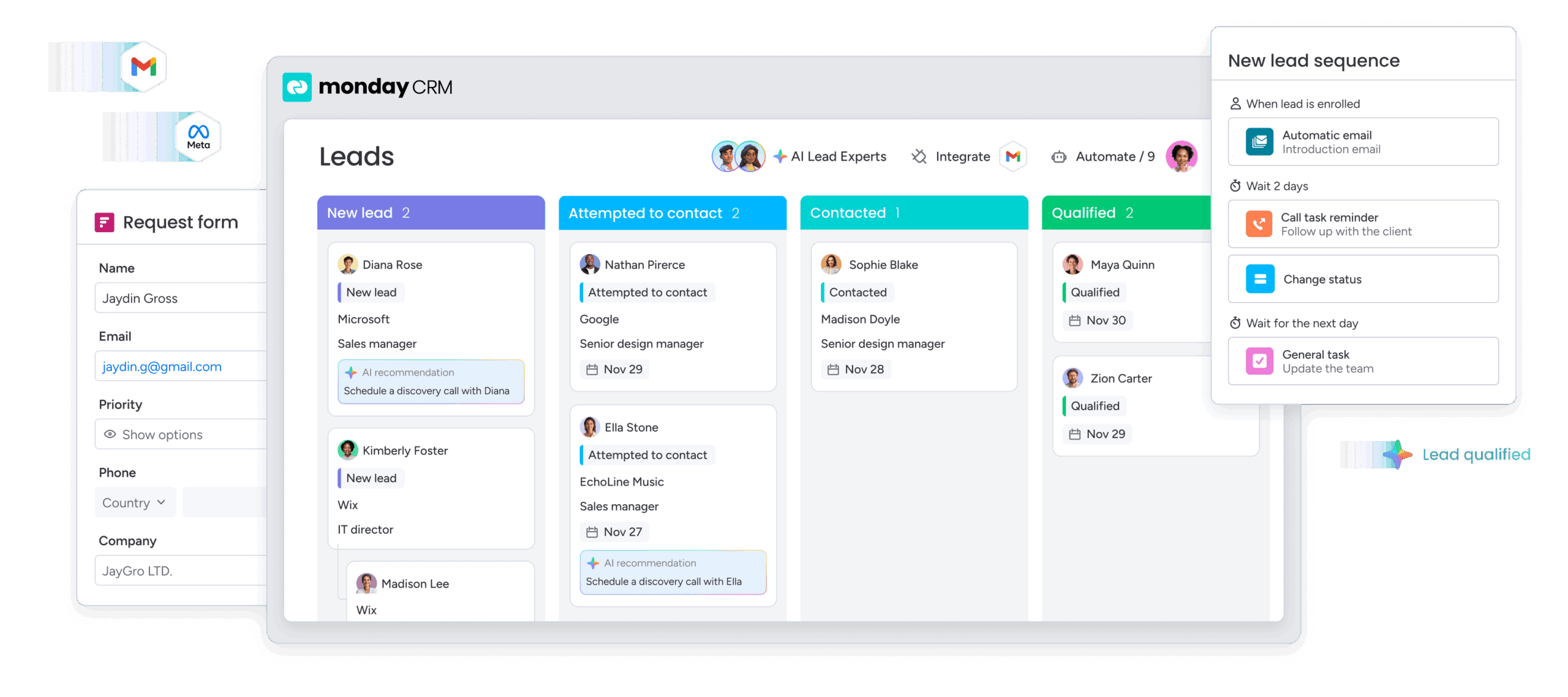
AI SDR agents follow a systematic process that mirrors what human SDRs do, but at massive scale. When a new lead enters your CRM — whether from a website form, marketing campaign, or inbound call — the AI agent immediately springs into action.
The agent first checks if a lead matches your ideal customer profile. Looking at things like company size, industry, and how they’ve engaged with you before, it quickly spots your best opportunities. Your most promising leads get contacted first, so they never have time to lose interest or engage with competitors.
Next comes the actual outreach. The AI SDR agent initiates contact through phone calls or emails, using adaptive scripts that change based on the lead’s responses. During these conversations, the agent asks qualifying questions, gathers essential information, and assesses buying intent. Every interaction is logged directly in your CRM with detailed summaries, call recordings, and next steps.
When the AI identifies a qualified opportunity, it seamlessly coordinates with your sales team’s calendars to book meetings. The handoff includes complete context — what was discussed, pain points identified, and relevant background information. Your reps walk into meetings fully prepared, without spending hours on research or discovery calls.
All this happens in real-time. While your team focuses on closing deals, the AI SDR agent’s AI lead management continuously works through your lead list, ensuring consistent follow-up and zero missed opportunities.
Try monday CRM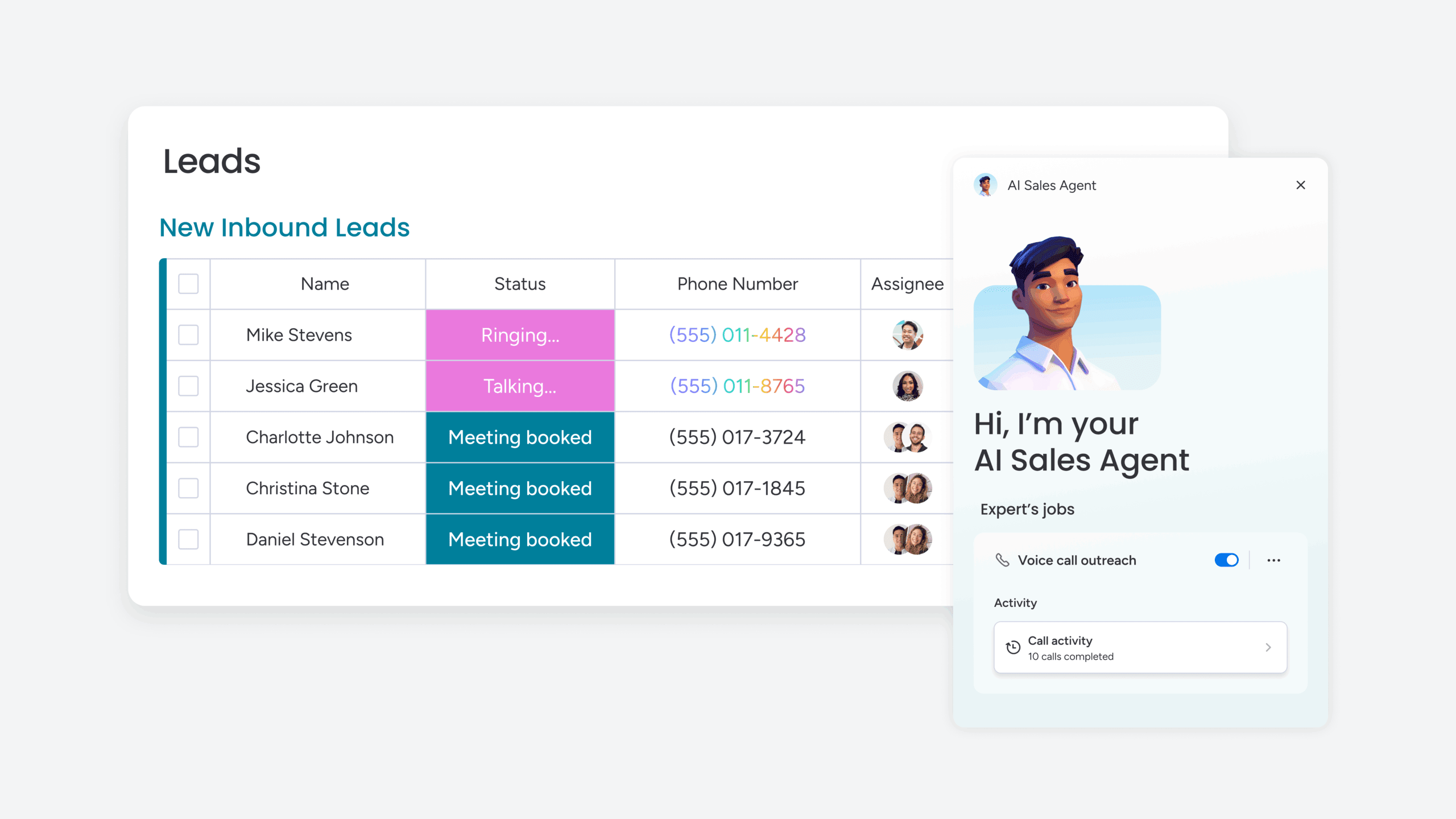
7 game-changing benefits of AI SDR agents
AI SDR agents transform how sales teams operate by addressing fundamental challenges that have plagued the industry for decades. These digital teammates deliver measurable improvements across every aspect of the sales development process.
1. Round-the-clock pipeline generation
Your pipeline never stops growing when AI SDR agents work 24/7. Leads that come in at midnight get the same immediate response as those arriving at noon. This always-on approach means international prospects in different time zones receive instant attention, and weekend inquiries don’t sit idle until Monday morning.
The impact on conversion rates is dramatic. When you respond to leads within minutes instead of hours or days, you’re often the first vendor to engage. That first-mover advantage translates directly into more qualified meetings and closed deals.
2. Instant lead response at scale
Speed wins deals, period. With AI SDR agents, every new lead gets a personalized message seconds after they hit your system. We’re not talking about those robotic “thanks for your interest” emails — these are tailored conversations that mention their company, situation, and what they’re likely struggling with.
The benefits of instant response extend beyond just being fast:
- Higher engagement rates: Leads are most interested right after they’ve shown intent
- Reduced competition: You reach prospects before competitors even know they exist
- Improved lead quality: Fast qualification means your team only talks to serious buyers
3. Dramatic cost reduction
Scaling an SDR team traditionally means significant investment in salaries, benefits, training, and management overhead. AI SDR agents eliminate these costs while delivering superior results. One AI agent can handle the workload of multiple human SDRs without fatigue, sick days, or turnover.
Consider the math: an average SDR costs $66,260 annually according to the Bureau of Labor Statistics’ 2024 median wage data and handles 50-100 leads per day. An AI agent has a significantly lower cost and can process thousands of leads daily. The ROI? Enterprise-level prospecting muscle on a small business budget.
4. Perfect data accuracy
Manual data entry is a common source of frustration for sales teams. It consumes valuable time and often leads to errors that compromise pipeline integrity. It kills productivity and breeds errors that mess up your entire pipeline. AI SDRs log everything automatically and keep your CRM squeaky clean. Beyond just saving time, you’ll finally have data you can actually trust when making forecasts and strategic calls.
Sales leaders gain complete visibility into pipeline health, conversion rates, and team performance. No more guessing about activity levels or wondering why deals stalled. Everything is documented, searchable, and actionable.
5. Consistent qualification standards
Human SDRs have good days and bad days. They interpret qualification criteria differently and sometimes let personal bias influence decisions. AI SDR agents apply your exact qualification framework to every single lead, ensuring only genuine opportunities reach your sales team.
This consistency creates predictable pipeline quality. Your closing rates improve because reps spend time with properly qualified prospects. Revenue becomes more forecastable because you know exactly what percentage of qualified leads will convert.
6. Continuous learning and improvement
Old automation tools are like dinosaurs — they never change. AI SDR agents get smarter every day. They pick up patterns from your successful deals, notice when market conditions shift, and double down on what’s actually working. When your star rep finds that perfect objection-handling technique? Your AI starts using it right away.
The learning happens automatically through:
- Outcome analysis: The AI tracks which approaches lead to booked meetings
- Team feedback: Sales managers can correct and guide the AI’s behavior
- Pattern recognition: The system identifies what works for different customer segments
7. Enhanced rep productivity
AI SDR agents take over the grunt work of prospecting and qualifying, so your human team can do what they do best. Instead of chasing cold leads or wrestling with CRM updates, your reps get to build relationships, run killer demos, and close more deals.
This division of labor maximizes everyone’s strengths. AI excels at repetitive tasks and data processing. Humans excel at complex problem-solving and relationship building. Together, they create a sales machine that outperforms either working alone.
Common concerns about AI SDR agents
Sales leaders naturally have questions about trusting AI with prospect interactions. These concerns are valid and worth addressing directly.
Will prospects know they’re talking to AI?
Today’s AI SDR agents sound pretty natural on calls, but let’s talk transparency. Many teams just tell prospects upfront they’re talking to AI, and guess what? Most people don’t mind — they care more about getting fast, helpful responses than whether there’s a human on the other end. What matters is asking the right questions and providing real value.
What matters most is the quality of the interaction. When AI SDR agents use your CRM data to personalize conversations and ask intelligent questions, prospects engage because they’re getting value — it’s a prime example of how to use AI in sales, not because they think they’re talking to a human.
How do you prevent AI from damaging your brand?
Brand protection starts with choosing the right AI SDR solution. With a CRM-native agent, such as the one available with monday CRM, you get complete transparency through call recordings, transcripts, and summaries. You can review exactly what the AI says, provide feedback, and refine its approach.
Quality control measures include:
- Customizable scripts: Define exactly how the AI should represent your company
- Escalation protocols: Complex situations automatically route to human reps
- Regular audits: Review AI interactions to ensure brand consistency
- Guardrails and limits: Set boundaries on what the AI can and cannot discuss
What about complex objections?
AI SDR agents handle routine objections effectively, but they’re smart enough to recognize when human expertise is needed. When prospects raise complex technical questions or unique situations arise, the AI seamlessly escalates to your team while providing full context about the conversation so far.
This hybrid approach actually improves objection handling overall. The AI documents every objection and response, creating a knowledge base that helps both the AI and your human team improve over time.
Try monday CRMImplementing AI SDR agents successfully
Simply deploying AI SDR technology without a clear strategy often leads to disappointing results. The most successful teams follow a structured implementation plan.
Start with clear objectives
Before you turn on your AI SDR, get crystal clear about what winning looks like. Pick specific numbers to track — like “respond to every lead within 2 minutes” or “qualify 30% more leads than last quarter.” These concrete targets make it easy to see if your AI is actually delivering.
Your objectives should align with broader sales goals:
- Pipeline targets: How many qualified opportunities do you need monthly?
- Quality standards: What constitutes a qualified lead for your business?
- Efficiency goals: How much time should reps save on prospecting?
Choose the right platform
The platform you choose determines implementation complexity and long-term success. CRM-native solutions offer significant advantages over standalone tools. With the AI SDR agent in monday CRM, setup takes minutes because the system already has your data, workflows, and team structure.
Standalone platforms require extensive integration work, data mapping, and ongoing maintenance. They create data silos and synchronization delays that undermine the speed advantage AI should provide. Native solutions eliminate these friction points entirely.
Phase your rollout
Rather than transforming your entire sales process overnight, implement AI SDR agents gradually. Start with a specific segment — perhaps inbound leads or a particular product line. Learn what works, refine your approach, then expand.
A typical phased approach looks like:
- Week 1-2: Activate for one lead source or territory
- Week 3-4: Refine scripts and qualification criteria based on results
- Month 2: Expand to additional segments
- Month 3: Full deployment with optimized workflows
Train your team
Your sales team needs to understand how to work alongside AI SDR agents effectively, which is an example of AI sales enablement in action. This isn’t about technical training — it’s about adapting processes and mindsets. Reps should know what information the AI provides, how to interpret it, and how to pick up conversations seamlessly.
Key training topics include:
- Handoff protocols: How to engage leads after AI qualification
- Data interpretation: Understanding AI-generated insights and summaries
- Feedback loops: How to help the AI improve through coaching
- Performance tracking: Using new metrics to measure success
Measuring AI SDR agent performance
Tracking the right metrics ensures your AI SDR agent delivers expected results and continuously improves.
Response time metrics
Measure how quickly your AI SDR agent engages new leads. Track average time from lead creation to first contact, comparing AI performance to previous human benchmarks. Most teams see response times drop from hours to seconds.
Beyond raw speed, analyze response time by lead source and time of day. This reveals patterns about when leads are most responsive and helps optimize outreach timing.
Qualification accuracy
Monitor how well your AI SDR agent identifies genuine opportunities. Track the percentage of AI-qualified leads that progress to closed deals versus those qualified by human SDRs. This comparison validates the AI’s judgment and identifies areas for refinement.
Regular quality audits help maintain high standards. Review a sample of AI conversations weekly, checking for appropriate qualification decisions and professional communication.
Pipeline contribution
Measure the AI SDR agent’s impact on overall pipeline generation. Track metrics like number of meetings booked, pipeline value created, and contribution to monthly quotas. Compare these against the cost of the AI solution to calculate ROI.
Most organizations see positive ROI within the first month as the AI SDR agent scales to handle lead volumes impossible for human teams — McKinsey’s 2024 Global Survey found 66% of organizations using generative AI in sales reported revenue increases.
Team productivity gains
Quantify how much time your sales team saves by not doing manual prospecting and qualification. Track metrics like calls per rep, demos conducted, and deals closed. When reps focus on selling instead of searching, productivity typically increases by 30-50% — Harvard’s 2025 research shows gen AI adoption saves 1.7% of total worked hours across employed respondents.
Try monday CRM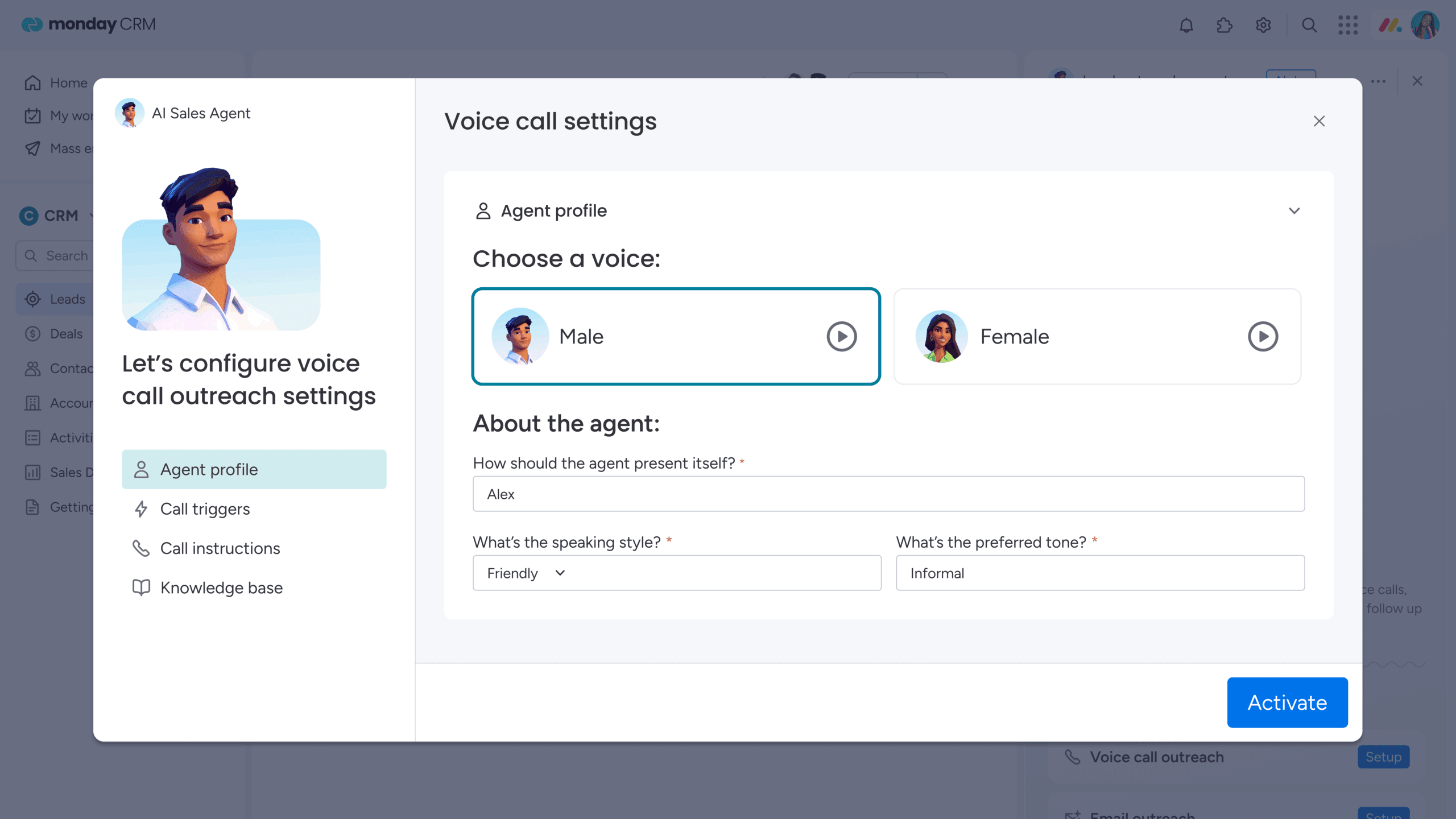
monday CRM's AI SDR Agent
monday CRM’s native AI SDR agent transforms how sales teams handle prospecting by embedding intelligent automation directly into your existing workflow. Unlike standalone tools that require weeks of integration, this solution activates in under 2 minutes because it already has access to your data, contacts, and sales processes.
Instant activation and seamless integration
The AI SDR agent works natively within monday CRM, eliminating the integration headaches that plague standalone platforms. There’s no data mapping, no API configuration, and no synchronization delays. Your AI agent immediately understands your pipeline, knows your ideal customer profile, and starts engaging leads the moment you activate it.
Key capabilities that drive results
- 24/7 lead engagement: Responds to every new lead within seconds, regardless of time zone or when inquiries arrive
- Intelligent qualification: Applies your exact qualification criteria consistently to every prospect, ensuring only genuine opportunities reach your sales team
- Automated meeting booking: Coordinates with your team’s calendars to schedule qualified prospects without manual intervention
- Perfect CRM hygiene: Automatically logs every interaction with detailed summaries, call recordings, and next steps — no manual data entry required
- Personalized outreach at scale: Uses your CRM data to customize conversations, mentioning specific company details and relevant pain points
- Complete transparency: Provides full visibility into every AI conversation through recordings and transcripts, so you maintain brand control
- Smart escalation: Recognizes complex situations and seamlessly routes them to human reps with complete context
- Continuous improvement: Learns from successful interactions and team feedback to optimize performance over time
Enterprise power, small business simplicity
monday CRM’s AI SDR agent delivers enterprise-level prospecting capabilities without the enterprise-level complexity or cost. You get the same always-on coverage, consistent qualification, and data accuracy that large organizations enjoy — but with a setup process measured in minutes, not months. Your team can start generating qualified pipeline today while maintaining complete control over how your brand engages prospects.
Benefits
| Value | Benefit |
|---|---|
| Speed (speed-to-lead) | ● Reach every lead in seconds - no missed opportunities ● The deal cycle gets shorter |
| Quality | ● Reps don't waste time on cold leads - Only real buyers reach your reps → stronger pipeline, better win rates. ● Learns from every call to improve lead qualification |
| Efficiency & cost saving | Grow your pipeline without growing your team. |
| Simple & Easy | 2-minute activation; easy to set, guide, customize, and iterate; effortless adoption |
| Visibility & trust | See/hear every call; your CRM auto-updates with summaries, next steps, recordings.. |
Core capabilities
| Capability | Description | Benefit |
|---|---|---|
| Call & qualify | ● Reaches every new lead instantly via call or email (WIP) ● Runs smart discovery calls using ICP + CRM context | No more cold leads or delays. One agent, infinite reach, higher connect and conversion. |
| Book meetings | ● Schedules meetings for sales reps with qualified leads only ● hands off with context | Reps don’t waste time - calendar fills with quality meetings |
| Learn & improve | Improves through rep feedback | Smarter, faster, more relevant conversations |
| Auto- update | Logs summaries, recordings and notes automroiatically | Total transparency; Zero manual updates |
“With monday CRM, we’re finally able to adapt the platform to our needs — not the other way around. It gives us the flexibility to work smarter, cut costs, save time, and scale with confidence.”
Samuel Lobao | Contract Administrator & Special Projects, Strategix
“Now we have a lot less data, but it’s quality data. That change allows us to use AI confidently, without second-guessing the outputs.”
Elizabeth Gerbel | CEO
“Without monday CRM, we’d be chasing updates and fixing errors. Now we’re focused on growing the program — not just keeping up with it."
Quentin Williams | Head of Dropship, Freedom Furniture
“There’s probably about a 70% increase in efficiency in regards to the admin tasks that were removed and automated, which is a huge win for us.“
Kyle Dorman | Department Manager - Operations, Ray White
"monday CRM helps us make sure the right people have immediate visibility into the information they need so we're not wasting time."
Luca Pope | Global Client Solutions Manager at Black Mountain
“In a couple of weeks, all of the team members were using monday CRM fully. The automations and the many integrations, make monday CRM the best CRM in the market right now.”
Nuno Godinho | CIO at VelvThe future of AI SDR technology
AI SDR tech is evolving at breakneck speed. Every month, these systems get noticeably better at sounding human and understanding context. They’re also connecting to more of your tools and data, so conversations get smarter and more personalized.
Near-term developments include multilingual support for global sales teams, advanced sentiment analysis to gauge prospect interest, and predictive sales AI that identifies opportunities before they even inquire.
The role of human SDRs will evolve rather than disappear. They’ll focus on strategic accounts, complex qualification scenarios, and training AI systems. This partnership between human creativity and AI for sales efficiency will define successful sales organizations.
The adoption of AI SDRs is quickly becoming a key competitive advantage. By implementing this technology, you can position your team to capture opportunities faster and operate more efficiently. With platforms like monday CRM, activating AI prospecting is a straightforward process, allowing you to gain these benefits in minutes.
Frequently asked questions
What's the typical setup time for an AI SDR agent?
The typical setup time for an AI SDR agent varies dramatically between platforms. CRM-native solutions like monday CRM can be activated in under 2 minutes since they already have access to your data and workflows. In contrast, standalone AI SDR platforms typically require 2-4 weeks for integration, data mapping, and testing. CRM-native solutions like monday CRM can be activated in under 2 minutes since they already have access to your data and workflows. Standalone AI SDR tools typically require 2-4 weeks for integration, data mapping, and testing.
Can AI SDR agents handle complex B2B sales cycles?
AI SDR agents excel at initial outreach and qualification in B2B sales, but complex negotiations and multi-stakeholder decisions still benefit from human involvement. The AI handles high-volume prospecting while your team focuses on strategic relationship building.
How much do AI SDR agents cost compared to human SDRs?
AI SDR agents typically cost 70% less than human SDRs when you factor in salary, benefits, training, and management overhead. Most platforms charge based on usage or contacts, ranging from a few hundred to a few thousand dollars monthly.
Do AI SDR agents work with existing CRM systems?
Integration depends on the solution you choose. CRM-native AI agents work instantly within platforms like monday CRM, while standalone tools require API connections and ongoing maintenance to sync with your existing CRM.
How do AI SDR agents personalize outreach at scale?
AI SDR agents use CRM data, company information, and interaction history to customize every conversation. They reference specific pain points, mention relevant industry challenges, and adapt their messaging based on prospect responses.
What happens when an AI SDR agent can't answer a question?
Smart AI SDR agents recognize their limitations and seamlessly escalate complex questions to human reps. They provide full conversation context so your team can jump in without missing a beat.
 Get started