


Modern sales teams still run into the same bottleneck: too much manual prospecting and inconsistent follow-up. The idea of a sales development function that researches every prospect, personalizes each message, and follows up perfectly used to feel unrealistic. For many high-growth teams today, it’s becoming achievable.
AI outreach agents mark a shift from basic automation to more autonomous execution. Instead of relying on rigid scripts, these agents research prospects, create relevant messages, and manage follow-up sequences with minimal manual input. They learn from engagement data as it comes in and adjust outreach based on what’s working, helping teams stay consistent without losing personalization.
In this guide, we’ll break down how AI outreach agents work, the capabilities that drive real pipeline impact, and what successful implementation looks like. We’ll also cover how to integrate these agents into existing sales workflows so human judgment and AI efficiency work together in one system.
Key takeaways
- Save 30-50% of your team’s time: AI agents handle prospect research, email writing, and follow-ups, so your SDRs can focus on real conversations and closing deals.
- Scale personalized outreach without hiring: AI agents send hundreds of personalized messages daily while maintaining quality, letting small teams achieve enterprise-level coverage.
- Start with specific use cases, not everything: begin with automated follow-ups or industry campaigns rather than trying to automate your entire sales process at once.
- Build custom AI workflows without code: visual workflow builder within platforms like monday CRM lets you create sophisticated outreach sequences through drag-and-drop, with AI blocks that analyze data and generate content automatically.
- Measure success with the right metrics: track time saved per SDR, response rates by segment, and pipeline value created to prove ROI and optimize performance continuously.
What is an AI outreach agent?
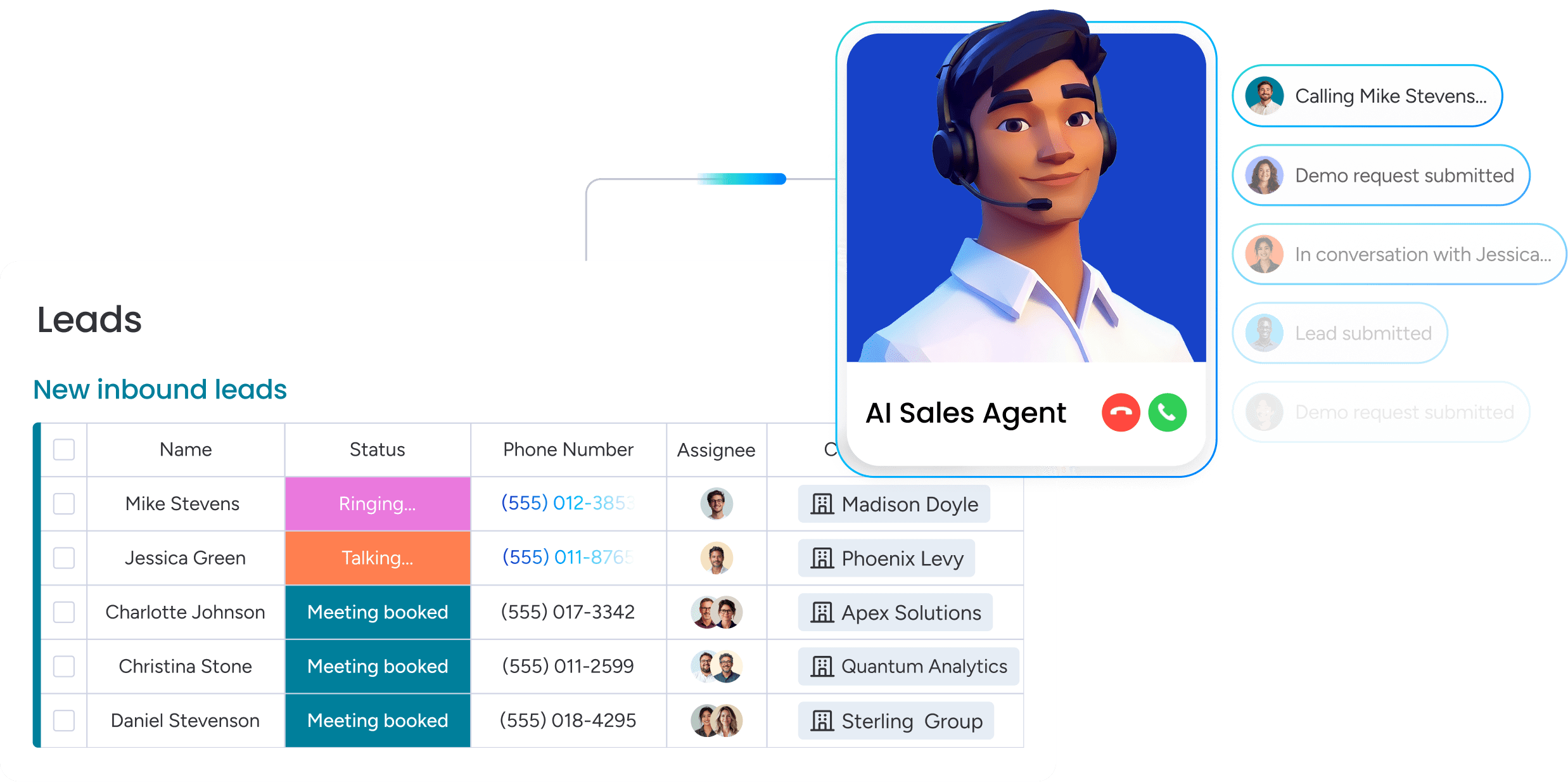
An AI outreach agent operates as an autonomous system that executes prospecting and engagement workflows without the requirement for constant manual supervision. While traditional automation relies on rigid, rule-based logic, these agents utilize advanced data analysis to determine optimal next steps and adapt strategies based on real-time performance metrics.
AI outreach agents perform three core functions that traditionally consume hours of SDR time:
- Research prospects: analyze company data, social profiles, and recent news to understand each prospect’s context.
- Write personalized messages: create outreach that references specific business challenges or opportunities.
- Manage follow-ups: adjust timing and messaging based on prospect behavior patterns.
The primary distinction of an AI outreach agent lies in its sophisticated decision-making capabilities. Rather than adhering to a static script, the system evaluates engagement outcomes and optimizes its approach to maximize conversion likelihood.
Understanding autonomous AI vs. basic automation
Basic automation and AI agents do completely different things. Traditional automation follows scripts with every action mapped out in advance. Prospect opens an email? Send follow-up B in exactly 48 hours. This rigidity limits its ability to interpret subtle cues or adapt to changing circumstances, whereas AI agents are designed for that flexibility.
AI agents work independently; they analyze thousands of interactions to figure out the best next move.
| Capability | Basic automation | AI outreach agents |
|---|---|---|
| Decision-making | Executes predefined rules without evaluation | Assesses multiple factors and chooses optimal actions |
| Personalization | Inserts merge fields like first name and company | Analyzes prospect-specific data and crafts relevant messages |
| Learning ability | Performs identically on day one and day 1,000 | Continuously adjusts approach based on outcomes |
The strategic advantage of autonomous agents becomes evident when compared to standardized automation across three critical performance indicators:
- Decision-making capability: basic automation executes rules without evaluation. AI agents assess engagement levels, industry trends, and timing patterns to choose the most effective action.
- Personalization depth: basic automation inserts merge fields. AI agents analyze funding rounds, technology changes, and hiring patterns to craft contextually relevant messages.
- Learning and adaptation: basic automation performs identically over time. AI agents analyze which subject lines generate opens and which messaging resonates with specific industries.
A practical application of this logic occurs when an AI agent identifies that healthcare prospects engage more frequently with compliance-focused content during specific windows, such as Tuesday mornings. The system then autonomously recalibrates the strategy for that entire segment without the requirement for manual intervention.
How do AI agents learn and adapt over time?
AI outreach agents utilize a sophisticated three-tier learning model to ensure continuous performance improvement. This evolution begins with advanced pattern recognition, where the system analyzes historical campaign data to identify high-performing variables. If specific subject lines achieve a 40% open rate compared to a 22% average, the agent autonomously prioritizes those linguistic structures for future outreach. This is augmented by behavioral response adaptation, which allows the agent to recalibrate content strategies automatically based on cohort-specific preferences, such as prioritizing ROI narratives for mid-market firms while utilizing efficiency-based messaging for enterprise prospects. Finally, multi-variable continuous optimization evaluates send timing, message length, and communication tone to determine the ideal interaction model for each unique prospect profile.
The transformation of raw data into personalized outreach occurs through a structured execution cycle:
- Data aggregation and ingestion: the system synthesizes information from CRM records, social media, corporate websites, and real-time news feeds to establish a comprehensive prospect profile.
- Predictive engagement modeling: pattern recognition algorithms evaluate the enriched data to identify the prospects with the highest statistical likelihood of engagement.
- Contextual content generation: by matching a prospect’s specific business environment with historical success markers, the agent utilizes natural language generation to draft professional, human-centric communications with relevant business context.
- Autonomous sequence orchestration: the agent manages optimal timing and channel selection, continuously refining the sequence based on real-time interactions.
Within solutions like monday CRM, this complex orchestration is visualized through a centralized timeline, providing teams with full transparency into the agent’s decision-making process and ensuring that autonomous actions remain aligned with broader organizational goals.
Data processing and pattern recognition
AI agents pull from five data sources to build complete prospect profiles:
- CRM systems: firmographic data, interaction history, and deal stage information.
- Social media platforms: professional interests, content engagement, and network connections.
- Company websites and news: product launches, funding announcements, leadership changes.
- Technology databases: current solutions indicating integration opportunities.
- Previous campaigns: messaging and timing approaches that worked for similar prospects.
The algorithms analyze this data to spot similarities between current prospects and past wins. Healthcare companies with 200-500 employees posting about compliance? They converted at 35% with regulatory-focused messaging. The system applies that insight to similar prospects.
It also spots what doesn’t work. A segment responds at 8% to feature emails but 24% to outcome messages? The system drops feature messaging for that group.
Natural language generation for personalization
AI outreach agents utilize natural language generation to transform raw prospect data into sophisticated, contextually relevant narratives. This process begins with the automated extraction of critical intelligence, including recent corporate developments, specific role responsibilities, industry-specific challenges, and current technology infrastructure. The system then aligns these variables with communication strategies that have historically yielded high engagement within similar market segments.
For example, when engaging a VP of Sales at a healthcare organization expanding into new regions, the agent can autonomously reference the expansion, acknowledge the operational complexities of cross-regional scaling, and demonstrate how a specific solution maintains consistency. Unlike traditional mail-merge templates that rely on static fields, natural language generation ensures outreach remains conversational through varied sentence structures, industry-accurate terminology, and the elimination of repetitive phrasing.
Strategic integration within solutions like monday CRM facilitates this personalization through two core capabilities:
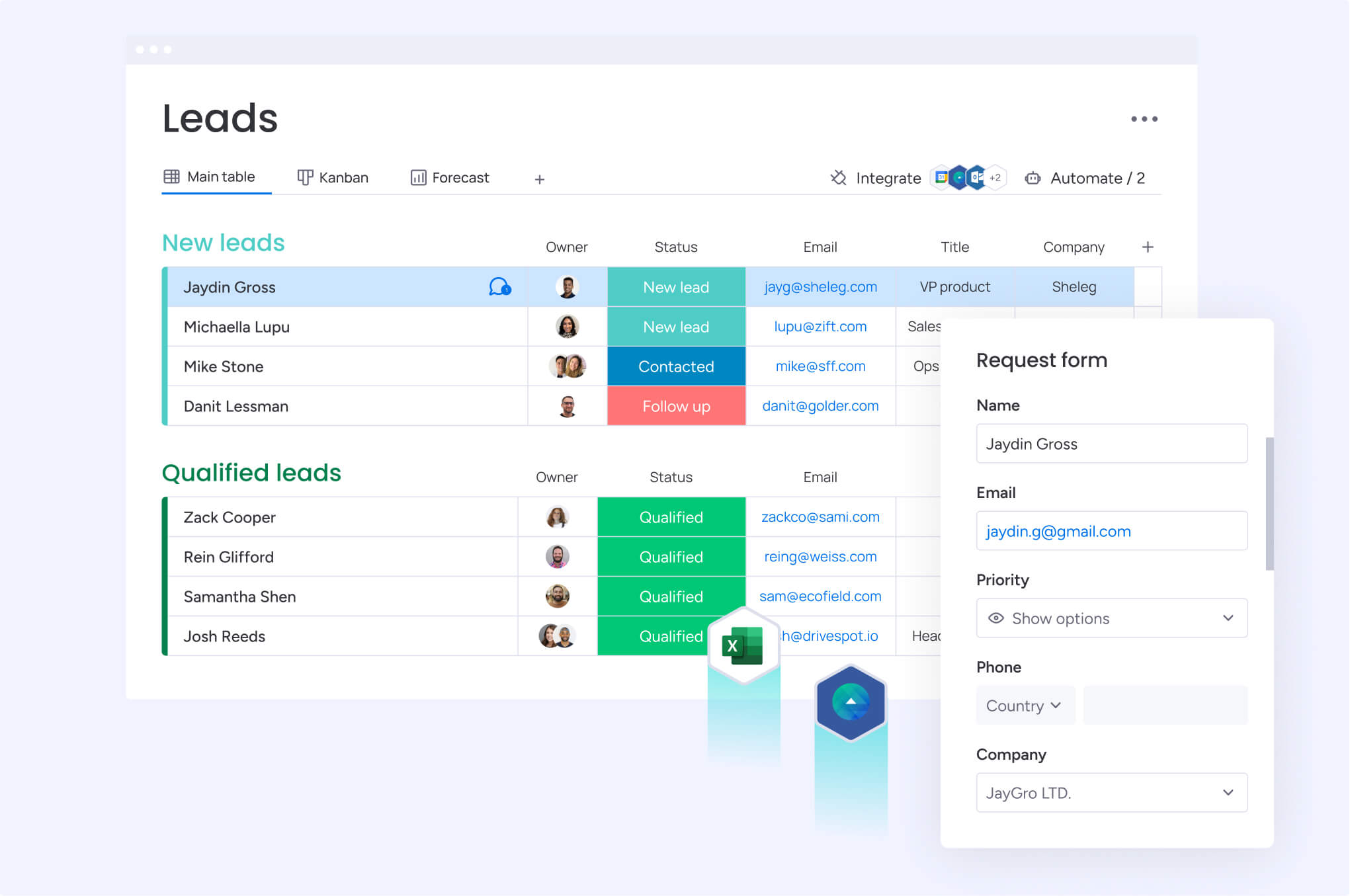
- Context-aware email composition: the AI email assistant generates outreach directly from deal-specific data and prospect profiles, ensuring every message is grounded in the most current account information.
- Comprehensive account synthesis: the timeline summary feature in monday CRM provides AI-generated overviews of all account activity including previous calls, meetings, and notes, supplying the deep context required to craft outreach that resonates with the prospect’s immediate priorities.
Multi-channel campaign orchestration
AI agents coordinate outreach across email, LinkedIn, and phone to create cohesive campaigns where each touchpoint builds on previous interactions. The orchestration process determines optimal channel selection, timing, and messaging based on prospect behavior.
A typical sequence might begin with a LinkedIn connection request referencing a mutual connection. If the prospect accepts but doesn’t respond, the agent waits 48 hours then sends an email acknowledging the connection and introducing a relevant case study. If the prospect opens but doesn’t respond, the agent schedules a phone call three days later with talking points referencing both interactions.
This coordination ensures consistent messaging while respecting prospect preferences. If someone consistently engages via email but ignores LinkedIn messages, the agent shifts resources toward email communication. The system manages frequency across channels, preventing the common mistake of bombarding prospects with simultaneous messages on multiple platforms.
From static sequences to autonomous intelligence: evaluating performance gains
Traditional outreach sales automation and AI outreach agents represent fundamentally different approaches to scaling prospecting activities. Understanding these differences helps revenue teams evaluate which capabilities they need and what improvements they can expect from AI-powered solutions.
| Capability | Traditional automation | AI outreach agents |
|---|---|---|
| Decision making | Follows if-then rules regardless of context | Analyzes engagement signals and selects optimal actions |
| Personalization | Inserts basic merge fields into templates | Generates unique messages addressing actual situations |
| Learning ability | Requires manual updates to improve | Automatically adjusts based on results |
| Adaptability | Executes same workflow regardless of performance | Modifies approach based on prospect segments |
| Data analysis | Reports predefined metrics | Identifies patterns and surfaces insights automatically |
The most significant advantage AI agents provide is improved performance without increasing workload. Traditional automation requires sales operations teams to manually analyze data, identify improvements, and update workflows — typically monthly or quarterly. AI agents perform this analysis continuously and implement improvements automatically.
Revenue teams using AI agents typically see 40-60% improvements in response rates compared to traditional automation. Messages become more relevant and timing becomes more precise as the system learns from outcomes. This happens while simultaneously reducing time spent managing and optimizing campaigns.

How AI outreach agents drive pipeline impact
AI outreach agents deliver measurable improvements across efficiency, scale, quality, and predictability. These four dimensions directly impact revenue team performance and pipeline generation, transforming how sales teams approach prospecting and lead generation.
Save 30-50% of your sales team’s time
AI agents eliminate time-consuming prospecting activities that typically consume 15-20 hours of SDR time weekly. The time savings appear across multiple activities:
- Prospect research: previously required 15-30 minutes per lead, now happens automatically in seconds.
- Email composition: reduced from five to ten minutes per personalized message to instantaneous generation.
- Follow-up management: eliminates daily calendar reviews through full automation.
An SDR who previously spent three hours daily on manual prospecting can reduce this to 45-60 minutes while actually increasing outreach volume. The saved 2+ hours shift to high-value activities: conducting discovery calls, handling complex objections, and progressing qualified opportunities.
This time savings compounds across the entire team. Ten SDRs saving two hours daily generates 100 hours of weekly capacity — equivalent to adding 2.5 full-time SDRs without increasing headcount.
Scale personalized outreach without adding headcount
AI agents handle hundreds of prospects simultaneously while maintaining personalization quality. A human SDR might personalize 20-30 emails daily before quality degrades. An AI agent personalizes 200+ messages daily, each incorporating prospect-specific context like recent news, role challenges, and industry trends.
This scaling capability transforms pipeline generation economics. A company targeting 5,000 prospects quarterly would traditionally require eight to ten SDRs to maintain personalized quality. With AI agents handling personalization, the same coverage requires three to four SDRs who focus on responding to engaged prospects and conducting qualification conversations.
The infrastructure to support such scaled AI applications is increasingly available, with the United States controlling an estimated 74% of global high-end AI compute capacity according to Federal Reserve analysis.
The scaling extends beyond volume to sophistication. AI agents maintain personalization quality across multiple campaigns, industries, and buyer personas simultaneously.
Improve lead quality and conversion rates
AI agents improve lead quality through targeting and qualification before prospects reach human SDRs. The system analyzes behavioral signals including email opens, link clicks, content downloads, website visits, then scores prospects based on engagement and buying intent. This approach aligns with broader adoption trends, as 71% of respondents using AI in marketing and sales report revenue increases according to Stanford’s AI Index 2025.
Pattern recognition identifies which prospect characteristics correlate with successful conversions. If companies with 200-500 employees convert at 28% while those with 50-100 employees convert at 12%, the agent prioritizes larger companies automatically.
Revenue teams typically see 35-50% improvements in meeting-to-opportunity conversion rates because AI agents surface prospects who demonstrate genuine buying intent. This reflects the growing momentum in AI adoption, with 62% of organizations at least experimenting with AI agents according to McKinsey’s Global Survey of 1,993 respondents across 105 countries. The system identifies prospects who engage with bottom-of-funnel content, revisit the website multiple times, or respond with specific questions.
Build more predictable pipeline growth
AI agents create consistent outreach that generates reliable lead flow and enables accurate revenue forecasting. Traditional prospecting suffers from human variability: SDR performance fluctuates based on motivation, skill level, and workload. AI agents maintain consistent activity levels, generating predictable volumes of outreach, responses, and meetings.
This consistency transforms pipeline forecasting. When an AI agent consistently generates 40 qualified meetings monthly from 2,000 touches, revenue leaders can confidently forecast that 4,000 touches will generate 80 meetings.
After three months of operation, the system can predict with 85%+ accuracy how many meetings will result from specific outreach volumes to particular segments. This forecasting capability helps revenue leaders make informed decisions about target setting, headcount planning, and resource allocation.
7 core capabilities of AI outreach platforms
Effective AI outreach agents share seven essential capabilities that distinguish them from basic automation. Revenue teams evaluating AI solutions should assess how comprehensively each platform delivers these capabilities to ensure they select a solution that meets their specific needs.
1. Intelligent lead scoring and prioritization
AI agents analyze multiple data dimensions to score and rank prospects based on conversion likelihood. The scoring incorporates:
- Firmographic signals: company size, industry, growth rate, funding status.
- Technographic data: current technology stack and recent software purchases.
- Behavioral indicators: website visits, content engagement, email interactions.
- Timing signals: leadership changes, expansion announcements, hiring patterns.
A prospect at a Series B company that posted 15 sales positions, uses complementary technology, and visited the pricing page twice receives a significantly higher score than a prospect at a bootstrapped company with no recent activity.
The scoring models continuously refine as the system learns which signals best predict conversion. If prospects engaging with specific content convert at 3x rates, the agent increases that engagement signal’s weight in future calculations.
2. Automated email personalization at scale
AI outreach agents generate highly personalized email content by synthesizing prospect and corporate data into contextually relevant narratives. This process transcends basic mail-merge functionality; agents autonomously incorporate variables such as recent corporate developments, industry-specific challenges, role-based pain points, technological implications, and mutual professional connections.
For instance, a communication directed to a VP of Sales at a healthcare organization undergoing regional expansion might reference the growth trajectory, acknowledge the complexity of scaling operations while adhering to rigorous compliance standards, and demonstrate how a specific solution facilitates process standardization.
Revenue teams utilizing solutions like monday CRM leverage an integrated AI email assistant to compose personalized outreach based on real-time deal context. By analyzing prospect data within the platform, monday CRM generates messages that maintain a professional and conversational tone through varied sentence structures and industry-accurate terminology.
3. Multi-touch campaign management
AI agents orchestrate complex outreach sequences across different timeframes and channels. The system determines optimal timing, frequency, and messaging for each touchpoint based on prospect behavior and industry practices.
The agent adjusts sequences dynamically based on engagement. If someone opens the initial email but doesn’t respond, the agent might accelerate the timeline and send follow-up after 48 hours instead of 72. If a prospect engages on LinkedIn, the agent shifts subsequent touchpoints to prioritize that channel.
4. Smart meeting scheduling and follow-ups
AI agents recognize buying signals in prospect responses and automatically trigger appropriate next steps. When a prospect replies with questions about pricing or features, the agent identifies high intent and immediately sends a calendar link with available times.
The agent detects subtle buying signals that might not include explicit meeting requests. If a prospect asks about integration capabilities, the agent recognizes product evaluation behavior and suggests a brief call to discuss technical requirements.
This automation ensures every interested prospect receives a timely response, maintaining momentum and improving conversion rates. AI agents respond within minutes, maintaining momentum and improving conversion rates from interested prospect to scheduled meeting.
5. Real-time performance optimization
AI outreach agents engage in continuous analysis of campaign performance to facilitate autonomous strategy adjustments. By monitoring critical metrics including open rates, response rates, click-through rates, and meeting conversions, the system identifies the underlying patterns that correlate with successful engagement.
- Granular segment optimization: performance analysis is conducted at the industry, company size, and job role levels; if healthcare prospects prioritize compliance messaging while retail prospects engage with efficiency narratives, advanced platforms like monday CRM apply these insights to future outreach automatically.
- Autonomous performance escalation: systems often realize significant gains in efficacy over time without manual intervention; for example, an agent achieving a 22% response rate in the first month may reach 34% by the second quarter as it refines its approach based on accumulated data.
- Dynamic content recalibration: the system evaluates which specific value propositions and linguistic styles generate the highest conversion rates, ensuring that outreach remains aligned with evolving market preferences.
- Resource allocation efficiency: by identifying high-performing segments in real time, solutions like monday CRM ensure that outreach efforts are prioritized toward the opportunities with the highest statistical likelihood of closure.
6. Cross-platform integration and data sync
AI agents integrate with existing sales technology stacks to maintain data consistency across systems. When an agent sends an email, the activity logs in the CRM. When a prospect responds, the response syncs immediately. When a meeting gets scheduled, the event appears on calendars and updates the deal stage.
This integration eliminates manual data entry and prevents information silos. SDRs don’t check multiple systems to understand prospect history — everything appears in a single CRM record.
Organizations using monday CRM benefit from comprehensive connectivity options linking AI agents with email platforms, calendar applications, and marketing automation. The integration ensures data flows bidirectionally: the AI agent pulls prospect information to personalize outreach, then pushes engagement data back to maintain complete records.
7. Predictive analytics and revenue insights
AI agents provide forward-looking insights helping revenue teams make strategic decisions about resource allocation and campaign strategy. The system analyzes historical data to predict future outcomes: forecasting meetings from specific outreach volumes and identifying which segments convert best.
These insights surface patterns that aren’t obvious from basic reporting. The agent might identify that prospects engaging with specific content convert at 3x rates, or that Tuesday morning outreach generates 40% more responses than Friday sends.
Revenue leaders use these insights to optimize resource allocation. If the system predicts current capacity will generate 120 qualified meetings against a target of 180, leaders can quantify exactly how much additional capacity they need.
How to implement an AI prospecting agent in your sales process
Successful AI outreach implementation requires careful planning and gradual rollout. Revenue teams following a structured implementation process achieve improved results and avoid common pitfalls that can derail adoption and performance.
Step 1: map your current outreach workflow
Document existing prospecting processes to identify automation opportunities and establish baseline metrics. Create a detailed workflow map showing:
- Process steps: how prospects enter the pipeline, who performs research, which systems support activities?
- Time requirements: how long each step takes per prospect?
- Handoff points: where information passes between team members?
- System connections: what information flows between platforms?
This mapping reveals bottlenecks and redundancies. Common discoveries include SDRs spending 45 minutes daily updating CRM records, research duplicating information already available, and follow-up sequences relying on manual calendar reminders.
Establish baseline metrics for measuring AI impact: time spent on prospecting per SDR, daily outreach volume, response rates by segment, meeting booking rates, and cost per qualified lead.
Step 2: define success metrics and KPIs
Establish success criteria balancing efficiency gains with effectiveness improvements. Track metrics across four categories:
- Efficiency metrics: time saved per SDR, outreach volume per day, cost per touch, capacity utilization
- Engagement metrics: open rates, response rates, click-through rates, meeting booking rates
- Quality metrics: meeting-to-opportunity conversion, opportunity-to-closed rates, average deal size
- Pipeline metrics: monthly qualified meetings, pipeline value created, cost per qualified lead
Set realistic improvement targets based on current performance. If response rates average 12%, target 18-22% within three months. If SDRs spend 15 hours weekly on prospecting, target eight to ten hours.
Step 3: select high-impact use cases to start
Begin with specific use cases rather than attempting to automate entire workflows immediately. Effective starting use cases share three characteristics: they address measurable problems, involve repeatable activities, and don’t require complex judgment.
Strong starting use cases include:
- Automated follow-up sequences: for webinar attendees or content downloaders.
- Industry-specific outreach campaigns: to well-defined segments with clear messaging.
- Inbound lead qualification: before routing to SDRs.
- Re-engagement campaigns: for cold prospects who haven’t responded.
Avoid starting with enterprise account-based marketing or highly technical product sales requiring nuanced understanding of organizational dynamics.
Step 4: configure and train your AI agent
Set up the AI agent by integrating data sources, creating messaging guidelines, and establishing workflow parameters. Configuration includes:
- System connections: CRM platforms, email systems, data sources.
- Targeting criteria: ideal customer profile and segmentation rules.
- Message frameworks: brand voice guidelines and positioning.
- Escalation rules: when to involve human SDRs.
- Outreach limits: volume and frequency guardrails.
Provide training data including successful email examples, ideal customer information, product positioning, competitive differentiation, and common objections with responses.
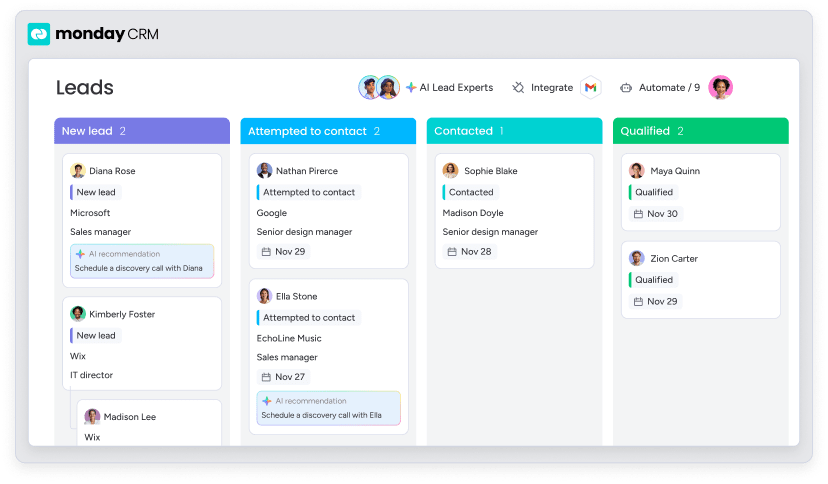
Teams using platforms like monday CRM configure sophisticated AI agents through visual workflow builders and template libraries without requiring developer resources. The platform’s autofill with AI feature allows teams to apply capabilities like sentiment detection and information extraction to any board.
Step 5: launch pilot programs with control groups
Test AI agent performance against existing methods before full deployment. Structure pilots with proper control groups:
- Selection of representative segments: identify target cohorts that reflect standard operating conditions to ensure pilot results are scalable.
- Balanced group distribution: divide prospects into equivalent segments to ensure both the manual team and the AI agent engage with similar lead quality.
- Parallel campaign duration: execute simultaneous outreach for six to eight weeks to gather statistically significant data across the sales cycle.
- Uniformity in metric tracking: utilize solutions like monday CRM to monitor performance indicators for both groups using identical measurement criteria.
Analyze pilot results objectively. If the AI group generates 30% more meetings but those meetings convert at lower rates, investigate whether targeting needs refinement. If response rates are similar but the AI group requires 60% less SDR time, calculate cost savings and capacity implications.
Step 6: scale based on performance data
Expand AI outreach systematically based on pilot results. Identify successful elements: messaging themes generating strong engagement, prospect segments responding well, workflow sequences driving highest conversion, and integration patterns maintaining data quality.
Scale in stages:
- Targeted segment expansion: deploy the system to additional cohorts that share characteristics with successful pilot groups.
- Progressive automation levels: increase the degree of autonomy for workflows that have demonstrated consistent reliability.
- Collaborative workflow training: educate team members on AI-human collaboration to maximize the efficiency of lead hand-offs.
- Data-driven targeting refinement: adjust outreach parameters based on the larger datasets accumulated during the initial rollout.
Monitor performance closely during scaling. If response rates drop more than 15% from pilot levels, pause and investigate. If meeting quality declines, refine qualification criteria. If SDR satisfaction decreases, address workflow issues.
“With monday CRM, we’re finally able to adapt the platform to our needs — not the other way around. It gives us the flexibility to work smarter, cut costs, save time, and scale with confidence.”
Samuel Lobao | Contract Administrator & Special Projects, Strategix
“Now we have a lot less data, but it’s quality data. That change allows us to use AI confidently, without second-guessing the outputs.”
Elizabeth Gerbel | CEO
“Without monday CRM, we’d be chasing updates and fixing errors. Now we’re focused on growing the program — not just keeping up with it."
Quentin Williams | Head of Dropship, Freedom Furniture
“There’s probably about a 70% increase in efficiency in regards to the admin tasks that were removed and automated, which is a huge win for us.“
Kyle Dorman | Department Manager - Operations, Ray White
"monday CRM helps us make sure the right people have immediate visibility into the information they need so we're not wasting time."
Luca Pope | Global Client Solutions Manager at Black Mountain
“In a couple of weeks, all of the team members were using monday CRM fully. The automations and the many integrations, make monday CRM the best CRM in the market right now.”
Nuno Godinho | CIO at VelvChoosing the right outreach AI agent for your team
Selecting an AI outreach solution requires evaluating how well different platforms align with your team’s capabilities, existing systems, and growth plans. The right choice depends on your technical resources, integration requirements, and specific use cases.
Evaluate no-code customization options
No-code customization determines whether revenue teams can modify AI agents independently or rely on technical resources for every adjustment. AI outreach requires continuous refinement — messaging needs updating, targeting criteria shift, and workflow sequences need optimization.
Essential no-code features include:
- Visual workflow builders: drag-and-drop interfaces for rapid campaign creation.
- Template customization interfaces: tools for modifying core messaging frameworks without coding.
- Integration setup wizards: guided configurations for connecting existing software stacks.
- Conditional logic builders: interfaces for creating sophisticated decision trees and automated workflows.
Revenue teams using platforms like monday CRM build complex workflows and customize AI behavior without involving developers. The platform’s visual configuration capabilities eliminate technical barriers, allowing sales operations teams to implement changes in hours rather than weeks.
Assess CRM integration capabilities
Seamless CRM integration is essential because disconnected systems create data silos and manual work that undermine AI value. Poor integration forces SDRs to check multiple systems, requires manual data entry, and creates reporting gaps.
Evaluate integration across multiple dimensions:
- Data synchronization: real-time sync ensuring changes appear immediately.
- Activity logging: automatic capture of all outreach activities.
- Custom field mapping: ability to sync custom data structures.
- Workflow triggers: cross-system automation capabilities.
- Unified reporting: consolidated dashboards showing performance alongside other metrics.
Native AI capabilities are provided by platforms like monday CRM to eliminate integration complexity. By allowing AI agents to operate within the same platform as core CRM functionality, monday CRM ensures absolute data consistency. Every interaction is logged by the platform within a single, unified timeline.
Consider scalability and pricing models
Pricing structures significantly impact total cost as usage grows. AI outreach solutions use various models — per-user, per-contact, per-email, or usage-based — each with different scaling implications.
Evaluate pricing by projecting costs at different usage levels:
- Current cost benchmarking: calculate existing monthly expenditures for legacy outreach tools.
- Projection modeling: estimate costs at 2x and 5x current volumes to identify potential price cliffs.
- Tier limitation analysis: identify which essential features are locked behind higher pricing tiers.
- Hidden cost identification: account for implementation fees, training, and API usage costs.
Understanding complete cost structure prevents surprises as usage grows and enables accurate ROI calculations.
Review security and compliance features
Sales outreach involves handling sensitive prospect data, making security and compliance capabilities essential. AI agents access contact information, communication history, and potentially confidential business details requiring protection.
Key security features to evaluate:
- Data encryption standards: protection for information both at-rest and in-transit.
- Role-based access controls: granular permissions that restrict data visibility to authorized personnel.
- Comprehensive audit trails: logging of all system modifications and data access events.
- Global compliance certifications: adherence to SOC 2, GDPR, CCPA, and regional data residency requirements.
These features protect company and prospect data while ensuring implementation doesn’t create compliance risks.
Best practices for human-AI collaboration in sales
Successful AI outreach requires thoughtful collaboration between human sales professionals and AI agents. The most effective implementations define clear roles where AI handles volume while humans provide judgment and relationship building.
Define clear handoff points between AI and humans
Establish explicit criteria for when AI agents should escalate prospects to human sales professionals. Effective handoff triggers include:
- Explicit requests: meeting inquiries or product demo requests.
- Complex questions: requiring nuanced product knowledge or consultation.
- Objections: involving pricing negotiations or contract terms.
- High-value prospects: warranting personalized attention from senior team members.
- Multiple stakeholders: when buying committees enter the conversation.
Create handoff protocols preserving context and momentum. When escalating, human SDRs should receive:
- Complete interaction history: documentation of all previous touchpoints.
- Key insights: summaries of interests and concerns expressed by the prospect.
- Recommended next steps: actions based on identified engagement patterns.
- Priority level: urgency based on buying signals detected.
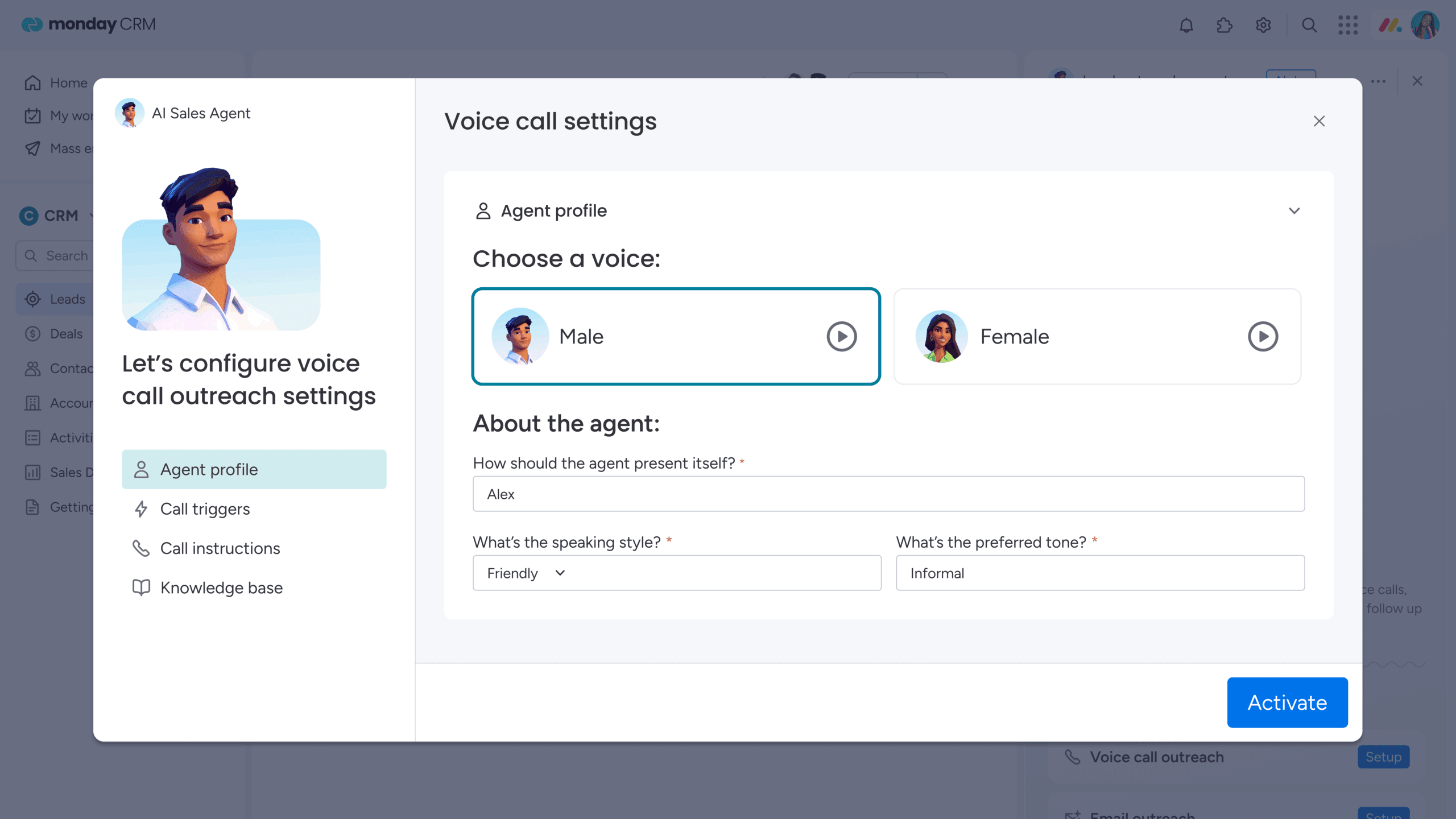
Teams using modern platforms like monday CRM leverage the assign person AI action to facilitate handoffs. The platform allows teams to define teammate roles and skills, helping AI accurately assign the best person for each opportunity.
Establish performance monitoring workflows
Create systematic processes for monitoring AI agent performance. Daily monitoring includes activity volume checks, error rate tracking, and immediate issue alerts for system errors or unusual patterns.
Weekly performance analysis examines:
- Response rate trends: evaluation by segment and campaign type.
- Message quality spot-checks: manual reviews to ensure appropriate tone and relevance.
- Engagement pattern analysis: identification of optimization opportunities.
- Baseline comparison: tracking improvement against initial metrics.
Establish thresholds triggering human intervention. If response rates drop more than 20% from baseline, investigate messaging issues. If meeting booking rates decline, review qualification criteria. If system errors exceed 2% of sends, address technical issues.
Create feedback loops for continuous improvement
Establish mechanisms capturing insights from both AI performance data and human sales team feedback. Regular team reviews create opportunities for SDRs to share observations about:
- Content quality: relevance of AI-generated messaging to prospects.
- Direct prospect feedback: qualitative data received during conversations.
- Successful conversation starters: observations that can inform AI training.
- Handoff optimization: scenarios where the transition process could be improved.
Analyze prospect responses for patterns: which messaging themes generate positive reactions, what objections appear frequently, which value propositions resonate most strongly, and where prospects express confusion.
Win/loss analysis informs AI training by identifying patterns in successful deals. Feed these insights back into AI configuration, updating messaging frameworks, refining targeting criteria, adjusting workflow sequences, and improving handoff protocols.
Comprehensive performance measurement requires tracking both efficiency gains and effectiveness improvements. With flexible platforms like monday CRM, you can build dashboards to track these metrics and ensure you can demonstrate value and optimize performance continuously.
Comprehensive performance measurement requires tracking both efficiency gains and effectiveness improvements across multiple dimensions. Establishing the right metrics and measurement processes ensures you can demonstrate value and optimize performance continuously.
Essential metrics to track
Monitor performance across three metric categories providing complete visibility into AI outreach impact:
- Activity metrics to evaluate operational performance: these track daily outreach volume, consistency, prospect coverage percentage, follow-up completion rates, and the effectiveness of multi-channel coordination.
- Engagement metrics to measure prospect response: these analyze open rates by segment, response types, click-through rates on embedded links, meeting booking rates per 100 touches, and time-to-first-response benchmarks.
- Revenue metrics to demonstrate business impact: these quantify the total qualified meetings generated monthly, meeting-to-opportunity conversion rates, average deal size, total pipeline value created, and the calculated cost per qualified lead.
Establish baseline measurements before AI implementation for each category. Track metrics consistently using the same definitions to ensure accurate trend analysis.
Calculating time and cost savings
Quantify efficiency gains by measuring time investments before and after implementation. Document pre-implementation time for prospect research, email composition, follow-up management, CRM updates, and campaign coordination.
After implementation, measure post-implementation time for the same activities. Calculate the difference to determine time saved per SDR weekly. Value saved time using fully-loaded costs including salary, benefits, and overhead.
If an SDR costs $75,000 annually and saves 10 hours weekly, time savings equal approximately $36,000 annually per SDR. Calculate opportunity cost by determining what SDRs do with saved time. If saved time generates $500,000 in additional pipeline annually, the opportunity value exceeds direct savings.
Monitoring revenue impact and growth
Connect AI outreach activities to revenue outcomes by tracking how AI-sourced opportunities progress through the pipeline. Establish attribution models measuring AI contribution versus other activities.
Track revenue metrics specifically for AI-sourced opportunities:
- Number created monthly: to measure volume consistency.
- Total pipeline value: to quantify revenue potential.
- Average deal size: compared to other sources.
- Win rates: versus opportunities from other channels.
- Closed revenue: directly attributed to AI outreach.
Calculate pipeline efficiency metrics showing how effectively AI converts investment into revenue. Monitor cost per opportunity, pipeline value per dollar invested, return on investment, and payback period.
How does monday CRM power AI-driven sales outreach?
A comprehensive platform for implementing AI-driven sales outreach is provided by monday CRM without requiring technical expertise or complex integrations. Flexible workflow automation, visual management capabilities, and powerful AI features are combined by the platform into a unified system that grows with your team’s needs.
Build custom AI workflows without code
The visual workflow builder enables revenue teams to create sophisticated AI-powered outreach sequences through drag-and-drop configuration. Teams design workflows by connecting blocks representing different actions like sending email, waiting for response, checking engagement, scheduling follow-up, escalating to SDR into sequences executing automatically based on behavior.
AI blocks integrate directly into workflows, adding intelligent capabilities at any point. An outreach workflow might start with AI analyzing prospect data and generating personalized content, followed by a send block delivering the message, then a conditional block checking engagement and leading to different follow-up paths.
Sales operations teams configure AI behavior through intuitive interfaces specifying what data to analyze, what content to generate, and what rules govern decision-making. Changes happen through the same visual interface, enabling rapid iteration without developer resources.
Visualize agent performance with real-time dashboards
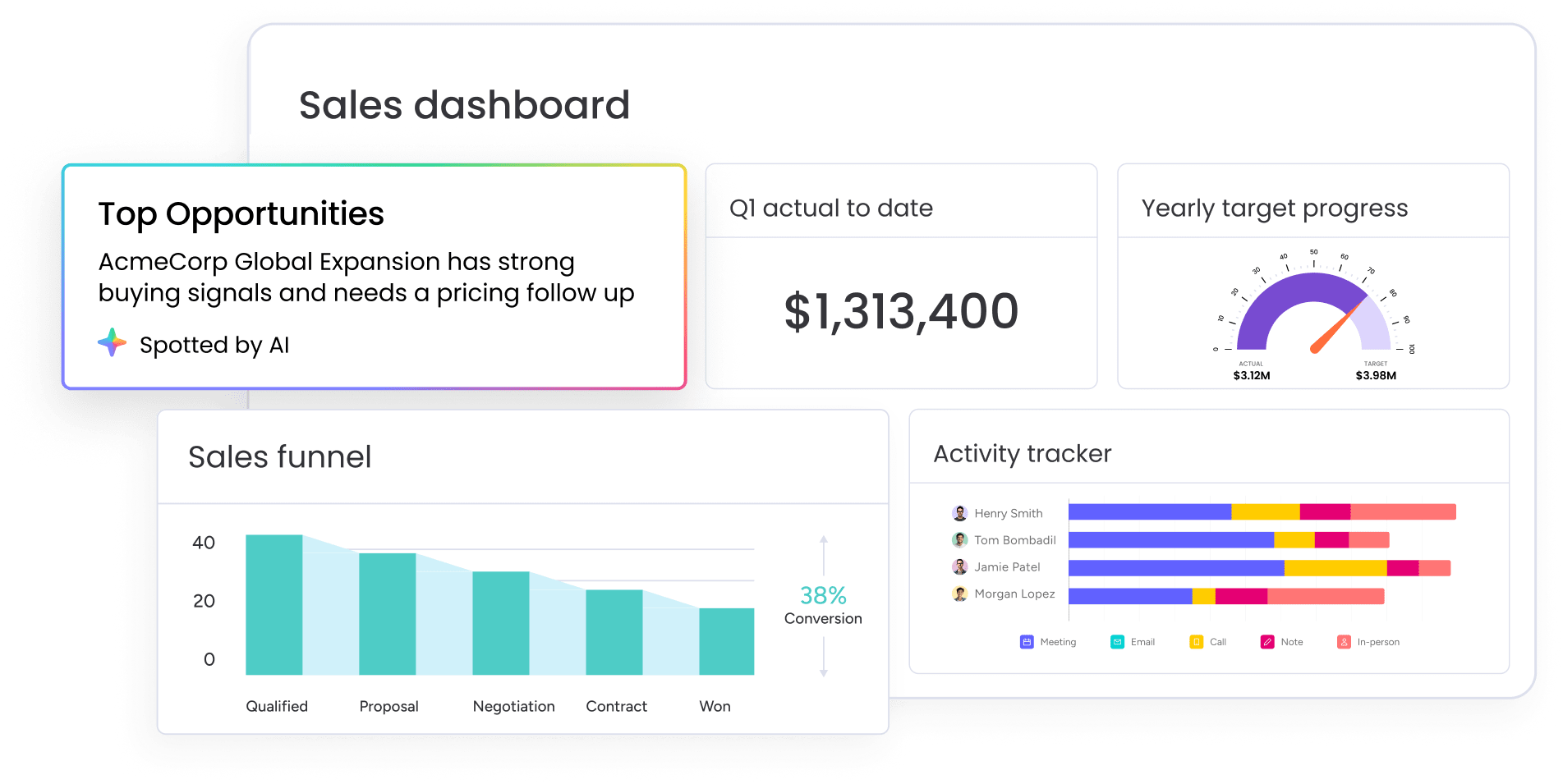
Customizable dashboards provide immediate visibility into AI outreach performance through visual displays surfacing key metrics and trends. Revenue leaders build dashboards selecting widgets showing:
- Outreach volume trends: across time periods and channels.
- Response analytics by segment: to identify top-performing approaches.
- Pipeline attribution: connecting outreach to revenue outcomes.
- Performance comparisons: between AI and manual efforts.
- Activity summaries: for individual team members.
These visualizations transform raw data into actionable insights. Line charts showing response rates over 90 days reveal whether performance is improving or declining. Bar charts comparing rates across industries identify which segments respond best. Funnel visualizations show conversion rates at each stage, highlighting optimization opportunities.
Real-time updates ensure dashboards reflect current performance without manual refreshes. When the AI agent sends new emails, activity metrics update immediately. When prospects respond, engagement data flows directly into visualizations.
Centralize all sales data and communications
Every prospect interaction, email, note, and activity is centralized by monday CRM in one accessible timeline. This eliminates the scattered communication plaguing many sales teams where emails live in one system, notes in another, and call logs somewhere else entirely.
Complete visibility into every touchpoint with prospects is provided by the platform’s timeline feature. Sales reps see the full history, from initial outreach through qualification to closed deal, without switching between systems. This centralization proves especially valuable during handoffs between SDRs and account executives or when deals involve multiple stakeholders.
This centralized approach is enhanced by AI capabilities. Concise overviews of all account activity are generated by the timeline summary feature using AI, helping reps get up to speed on any deal in seconds rather than reading through dozens of emails and notes.
Transform your sales outreach with AI automation
AI outreach agents represent a fundamental shift in how revenue teams approach prospecting and lead generation. These autonomous systems eliminate the manual, repetitive tasks that consume hours of SDR time while delivering personalized outreach at unprecedented scale. The technology moves beyond basic automation to provide genuine intelligence that learns, adapts, and improves performance continuously.
The benefits extend far beyond efficiency gains. Teams implementing AI outreach agents see dramatic improvements in response rates, lead quality, and pipeline predictability. More importantly, they free their human sales professionals to focus on high-value activities like relationship building, complex problem-solving, and strategic account development.
Success requires thoughtful implementation that balances automation with human judgment. The most effective approaches start with specific use cases, establish clear handoff protocols, and create feedback loops that continuously improve performance.
Always remember, teams that follow structured implementation processes while maintaining focus on human-AI collaboration achieve the strongest results.
Frequently asked questions
What is an AI outreach agent and how does it automate sales outreach?
An AI outreach agent automates sales outreach by acting as an autonomous software that handles prospecting, personalization, and follow-ups. It works without manual intervention by analyzing prospect data, generating personalized messages, and managing multi-touch campaigns that adapt based on prospect behavior.
How do AI outreach agents integrate with my CRM and existing sales workflows?
AI outreach agents integrate through APIs and native connectors that sync data bidirectionally with your CRM. They fit into existing workflows by automating repetitive tasks while preserving human touchpoints for complex interactions and relationship building.
What specific processes can AI outreach agents handle?
AI outreach agents handle prospect research, personalized email composition, follow-up sequencing, lead scoring, meeting scheduling, and multi-channel campaign coordination. They also manage data entry, activity logging, and performance tracking automatically.
Do I need coding skills or technical resources to set up AI outreach agents?
No coding skills are required with platforms offering no-code configuration. Visual workflow builders, template libraries, and guided setup wizards allow sales operations teams to configure and modify AI agents without technical expertise.
How can I measure the impact and ROI of using AI outreach agents?
Measure AI outreach ROI by tracking efficiency metrics like time saved per SDR, engagement metrics such as response and meeting booking rates, and revenue metrics including pipeline value created and cost per qualified lead. Compare these against baseline measurements from before implementation.
What's the difference between AI outreach agents and traditional sales automation?
AI outreach agents make autonomous decisions based on data analysis and continuously learn from outcomes, while traditional automation follows predetermined if-then rules. AI agents provide deeper personalization, adapt their approach based on results, and optimize performance automatically without manual intervention.

 Get started