

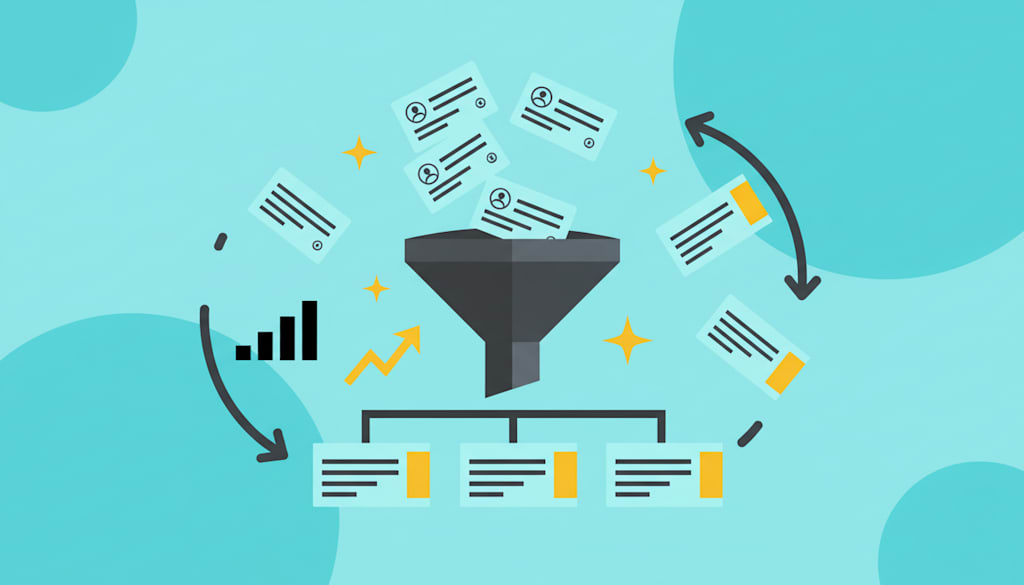
Your sales team sends 200 emails this week — 12 people respond, 3 book meetings, 1 becomes a customer. AI lead prospecting automation changes this equation by scanning multiple data sources simultaneously, scoring prospects against your criteria, and surfacing the most promising opportunities while your team focuses on building relationships and closing deals.
This guide shows you how AI lead prospecting automation works, why revenue teams need it, and how to implement it in 6 steps. You’ll learn how to build AI-ready customer profiles, audit your current systems, and choose an intelligent platform (like monday CRM) that integrates these capabilities into a single workspace.
Key takeaways
- Let AI automation handle data gathering, prospect scoring, and initial qualification while your reps focus on building relationships and closing deals.
- Scale personalized outreach without hiring more people with AI that analyzes prospect data to customize messaging based on company news, tech usage, and buying signals.
- Start with inbound lead qualification to prove value, then expand successful processes based on performance data and team feedback.
- Use visual workflow builders and transparent run histories to automate lead scoring, routing, and message drafting without technical complexity or multiple platforms.
- Go beyond basic demographics to include behavioral signals, technology usage, and organizational triggers that help AI identify your best prospects accurately.
What is AI lead prospecting automation?
AI lead prospecting automation changes how sales teams identify, research, and qualify potential customers. Instead of reps spending hours manually searching databases and copying information between platforms, AI systems handle the heavy lifting 24/7. These systems scan multiple data sources and evaluate prospects against your criteria. They surface the most promising opportunities while your team focuses on building relationships.
This shift rebuilds pipeline building from the ground up. Manual research limits teams to 15-20 prospects per rep daily. AI processes hundreds simultaneously, aggregating data from company databases, social profiles, news feeds, and intent signals into unified prospect profiles. The technology doesn’t just gather data. It recognizes patterns, scores prospects, and triggers actions based on your specific business rules.
How AI lead prospecting automation works: 3 foundational concepts
Before implementing AI prospecting, you need to understand how the technology actually works. These 3 concepts explain how AI identifies prospects, what components power the system, and how automated prospecting compares to manual methods. Understanding these fundamentals helps you make smarter decisions about implementation and sets realistic expectations for your team.
1. AI identifies and qualifies prospects at scale
AI prospecting systems pull information from dozens of sources at once. Company databases, social media profiles, news feeds, job postings, and intent signals feed into a comprehensive view of each prospect. This multi-source approach creates prospect profiles with more data points than any rep could gather manually.
Pattern recognition powers the qualification process. Machine learning algorithms analyze your successful customers and spot shared characteristics: industries, company sizes, technology stacks, and buying behaviors. Each new prospect receives a score based on these fit indicators and buying signals. High-scoring prospects surface immediately while poor-fit prospects get filtered out automatically.
The biggest advantage? Detecting signals humans miss. AI identifies these critical buying indicators:
- Buying signals: Job changes revealing new decision-makers, funding announcements suggesting budget availability, technology adoptions indicating integration needs
- Engagement patterns: Website visits across multiple pages, content downloads on specific topics, email engagement trends over time
- Company triggers: Expansion plans in press releases, leadership changes in target departments, competitor mentions in reviews
- Fit indicators: Company size changes, industry classification updates, technology stack modifications
- Timing signals: Budget cycles based on fiscal year, approaching contract renewals, seasonal buying patterns
2. The core components of AI prospecting systems
Effective AI prospecting requires integrated components that work together. Each element plays a specific role. Missing pieces create bottlenecks.
| Component | Function | Why it matters |
|---|---|---|
| Data foundation | Clean, structured customer and prospect data | AI learns patterns from historical deals and customer attributes |
| Intelligence layer | Machine learning models identifying patterns | Predicts which prospects will most likely convert |
| Integration framework | Connections between CRM, marketing, email, and data sources | Keeps information flowing between systems |
| Workflow automation | Rules and triggers moving prospects through pipeline | Automates actions based on scores, behaviors, and timing |
| Analytics engine | Measures performance and surfaces optimization opportunities | Identifies bottlenecks and improvement areas |
| Human oversight | Processes for reviewing AI recommendations | Handles complex qualification decisions and provides feedback |
These components must work together. AI models become useless without access to CRM data. Powerful automation means nothing if insights don’t reach reps at the right moment.
3. AI-powered prospecting vs. manual research methods
The difference between AI and manual prospecting shows up fast when you compare specific dimensions of the process.
| Dimension | Manual research | AI-powered prospecting |
|---|---|---|
| Time per prospect | 15–30 minutes of research, data entry, and qualification | 30–60 seconds of automated enrichment and scoring |
| Daily prospect capacity | 10–20 prospects per rep maximum | 500+ prospects processed automatically |
| Data sources | 2–3 platforms manually checked | 20+ sources automatically aggregated and synthesized |
| Qualification consistency | Varies by rep skill, experience, and fatigue level | Standardized criteria applied uniformly to every prospect |
| Personalization depth | Surface-level details gathered under time pressure | Multi-dimensional insights from behavioral, firmographic, and intent signals |
| Continuous monitoring | Manual periodic checks when reps remember | Real-time signal detection running 24/7 |
Manual methods slow growth, and qualification quality drops as fatigue sets in throughout the day. AI removes these constraints without sacrificing quality. Automated systems don’t get tired, skip steps, or miss promising prospects. The goal is to augment human judgment by handling the grunt work, allowing reps to focus on what they do best.
Why sales teams need artificial intelligence for lead generation
Market realities make manual prospecting insufficient for revenue teams. Buyers complete most of their research independently before engaging sales. Competitors respond faster than ever. Leadership expects predictable pipeline growth quarter after quarter. AI adoption addresses these pressures directly. It’s not a trend — it’s a practical response to how selling has changed.
1. Reduce manual research time
Sales reps lose dozens of hours weekly to research, data entry, and list building. They toggle between LinkedIn, company websites, news sites, and their CRM, copying information that becomes outdated within months. This invisible time drain kills productivity, even though it rarely shows up in sales metrics.
AI automation handles data gathering, enrichment, and initial qualification automatically. When new leads enter your system, AI pulls company information, identifies decision-makers, checks for buying signals, and scores prospects against your ideal customer profile before reps see the record. What took 20 minutes now happens in seconds.
Revenue leaders using monday CRM see this efficiency improve forecast accuracy and pipeline predictability. When reps spend more time selling and less time researching, activity metrics actually predict future revenue. The platform’s AI capabilities handle the repetitive work that slows teams down.

2. Scale personalized outreach without growing headcount
Traditional prospecting math breaks down fast. Doubling pipeline typically means doubling SDRs — and doubling salaries, benefits, training, and management overhead. Mid-market companies trying to compete with enterprise resources hit this wall fast.
The personalization challenge makes scaling personalized outreach harder. Generic outreach gets ignored. Personalized outreach takes time. Reps face an impossible choice: send 100 templated emails or 20 personalized ones. Neither option hits the volume and quality you need for aggressive targets.
AI resolves this tension by keeping personalization even as volume grows. Systems analyze multiple data points per prospect, customizing messaging based on recent company news, technology usage, job posting patterns, and content engagement to generate leads more effectively.
3. Discover untapped opportunities in your market

Manual research limits teams to obvious prospects and known accounts. Reps work from identical lists and target the same companies. Everyone competes for the same attention. Emerging opportunities go unnoticed because nobody has time to look for them.
AI monitors broader markets nonstop, identifying prospects based on buying signals and fit indicators humans would never spot. Here are the opportunity types AI uncovers:
- Adjacent markets: Companies in related industries showing similar pain points to your best customers
- Expansion accounts: Existing customers’ subsidiaries, new divisions, or recently acquired companies
- Competitive displacement: Prospects showing dissatisfaction with current solutions through reviews or support forums
- Emerging companies: Fast-growing organizations matching your ICP but not yet on standard target lists
- Trigger-based opportunities: Companies experiencing events that create immediate needs
A company hiring 3 sales managers might not appear on any target list, but AI recognizes this hiring pattern as a growth signal. A competitor’s customer complaining on social media might not show up in any database, but AI flags the dissatisfaction as an opportunity worth pursuing.
4. Increase lead quality while cutting costs

Manual qualification isn’t consistent. Different reps apply different standards. The same rep applies different standards at 9 AM versus 4 PM. This inconsistency floods pipelines with poor-fit prospects. They waste sales time and skew forecasts.
AI applies consistent qualification to every prospect based on data. The same criteria, scoring model, and threshold get applied to everyone, no matter the volume or timing. The system automatically filters and prioritizes high-potential opportunities, ensuring only the most qualified prospects reach your reps.
For revenue leaders, this consistency means more predictable conversion rates, shorter sales cycles, and a lower cost per qualified opportunity. Teams can achieve superior outcomes without adding headcount or increasing spend.
5. Enable round-the-clock pipeline building
Human teams operate 8-10 hours daily. That leaves 14-16 hours when opportunities go undetected and prospects go unengaged. Buying signals that fire at 2 AM sit until morning. Form submissions on Friday evening? They wait until Monday. Every delay hands competitors an opening.
AI systems monitor prospects, detect signals, and take action nonstop. They operate continuously to ensure no opportunity is missed. Revenue teams using monday CRM benefit from automation capabilities that work 24/7, processing triggers and executing workflows no matter when signals occur or where prospects are located.
Try monday CRMPrerequisites for successful AI prospecting implementation
Success with AI prospecting depends on getting foundational elements in place before implementation. Teams that skip preparation face longer ramp times, lower adoption rates, and disappointing ROI. Taking time to assess readiness and address gaps pays off once automation begins.
Data readiness
AI quality depends completely on data quality. If your CRM has incomplete records, outdated contacts, and inconsistent formatting, AI will produce unreliable recommendations and inaccurate scores. It’s simple: Garbage in = garbage out.
Start with an honest evaluation of your CRM data. Check how many records have complete company information. Verify how many contacts have accurate email addresses. Review whether industry classifications are consistent or if the same industry appears 5 different ways. Most teams discover their data needs more work than expected.
These indicators show you’re ready for AI implementation:
- CRM adoption rate: 80% or more of sales activities logged in your system
- Data completeness: Core fields populated for 90% or more of records
- Data accuracy: Contact information verified within the last 6 months
- Standardization: Consistent naming conventions, industry classifications, and deal stages
- Historical data: At least 6-12 months of closed deals to establish patterns
Technical infrastructure

AI prospecting requires integration between systems, not new infrastructure. Most mid-market teams already have the technical foundation. The question is whether systems can connect and share data effectively.
Core requirements include:
- Active CRM system: With API access for data exchange
- Email platform: With tracking capabilities for engagement metrics
- Third-party data sources: Ability to connect enrichment services and intent data
- Workflow automation: Capabilities for triggered actions and routing
- Analytics infrastructure: For measuring results and optimization
Team capabilities
Human factors matter more than technical considerations for adoption success. Teams need specific capabilities: process thinking and data interpretation, not coding skills.
Skills assessment should evaluate whether team members can think systematically about workflows, interpret AI recommendations critically, and adjust strategies based on data. The biggest shift? Role evolution. SDR and AE roles shift from research-focused to relationship-focused activities. Reps who previously spent hours gathering information now spend that time on conversations and relationship building.
ROI targets
AI prospecting shows early wins within weeks but full ROI takes 3-6 months. Setting appropriate expectations prevents premature disappointment and keeps organizational support through the learning curve.
Realistic targets for the first 90 days include:
- Weeks 1-4: 30-40% reduction in manual research time per prospect
- Weeks 5-8: 50% increase in prospects contacted per rep daily
- Weeks 9-12: 20-30% improvement in lead qualification accuracy
- Months 4-6: Measurable increase in qualified opportunities created
- Month 6+: Improved conversion rates and shorter sales cycles
How to automate lead prospecting with AI: 6 essential steps
This implementation framework works for teams new to AI prospecting, whether you’re implementing standalone solutions or integrated platforms. The steps build on each other but stay iterative. Teams refine their approach as they learn what works in their specific context.
Step 1: Build AI-ready ideal customer profiles
AI performs only as well as the targeting criteria you provide. Vague ICPs produce vague results. Specific, measurable ICPs enable precise targeting and accurate scoring. Your profiles must go beyond basic demographics to include behavioral and intent signals.
AI-ready ICPs include multiple dimensions for precise targeting:
- Firmographic criteria: Industry vertical, company size range, revenue band, growth stage, geographic location
- Technographic signals: Current technology stack, recent technology adoptions, integration requirements
- Behavioral indicators: Website engagement patterns, content consumption topics, event attendance
- Organizational triggers: Hiring patterns in target departments, funding events, leadership changes
- Pain point indicators: Keywords in job postings, review site mentions, support forum activity
What you’ll have at the end of this step: A list of 8-10 ICP fields your AI will populate automatically, plus a negative ICP list defining who NOT to target
Step 2: Audit your current data and systems
This audit prevents redundant purchases and identifies data gaps that would limit AI effectiveness. Most teams discover they have more solutions than they need and worse data quality than they assumed.
| Audit area | What to evaluate | Success criteria |
|---|---|---|
| CRM data | Completeness, accuracy, standardization | 90%+ core fields populated, updated within 6 months |
| Prospecting solutions | Current usage, overlap, effectiveness | Defined purpose for each, minimal redundancy |
| Data sources | Enrichment services, intent data, news feeds | Access to 3+ quality data sources |
| Integrations | System connections, data flow, sync frequency | Systems connected with real-time or daily sync |
| Workflows | Documented processes, automation level | Repeatable processes ready for automation |
What you’ll have at the end of this step: A data completeness report and deduplication plan identifying gaps to address before implementation
Step 3: Choose the right lead gen AI platforms

Let your specific needs and ICP requirements drive platform selection, not feature lists or vendor marketing. The platform versus point solution decision depends on team size, technical resources, and complexity requirements.
When evaluating AI prospecting platforms, look at these role categories:
- System of record (CRM): Where prospect data lives and deals progress
- Signal sources: Intent data and enrichment services feeding intelligence
- Activation: Outreach and follow-up execution
- Measurement: Dashboards and analytics for performance tracking
What you’ll have at the end of this step: A platform selection decision with documented integration requirements and a clear implementation timeline
Step 4: Create your first automated workflow
Starting with one high-impact workflow builds confidence and proves value before scaling. Inbound lead qualification often makes a strong starting point because it’s high volume, time-consuming, and well-defined.
Here’s how a single lead moves from capture to first email sent:
- Lead capture: New lead submits form on website, triggering the workflow.
- Data enrichment: AI enriches lead data automatically using Extract information action.
- Lead scoring: AI scores lead against ICP criteria using Assign label.
- Lead routing: AI routes lead to the right owner using Assign person based on defined criteria.
- Context gathering: Assigned rep sees AI Timeline Summary showing all communication context.
- Message drafting: Rep uses AI email assistant to draft personalized first touch.
- Human review: Rep reviews, edits, and sends the message.
Let AI draft, but always review before sending. Use text improvement features to adjust tone and length so every message sounds like your team.
What you’ll have at the end of this step: A first workflow map with routing thresholds and a documented process from capture to first touch
Step 5: Launch a controlled pilot program
Pilot programs reduce risk, generate learnings, and build organizational confidence before full rollout. Select 3-5 willing adopters who will give the system a fair chance and represent different team scenarios.
Build trust through human checkpoints during the pilot:
- Rep approval: Reps review and edit AI-written messages before sending
- Weekly manager review: Managers examine mis-scored leads and provide feedback
- RevOps adjustment: Adjust scoring rules and label options based on results
Teams leveraging monday CRM’s Run history feature gain transparency into AI outputs. When something seems off, Run history shows exactly what happened and why, including guidance when AI returns “No result” due to insufficient instructions.
What you’ll have at the end of this step: Documented pilot learnings, refined workflow configurations, and early wins to share with the broader team
Step 6: Scale based on performance insights

Scaling should be data-driven and gradual, expanding successful workflows while refining underperforming ones. Performance analysis evaluates pilot results against pre-defined success criteria.
Troubleshoot common issues using this framework:
| Issue | Likely cause | How to fix |
|---|---|---|
| Reply rates drop | Segmentation labels or messaging prompts need refinement | Review Assign label criteria and email prompt instructions |
| Bounce rates rise | Enrichment or verification process gaps | Check data sources and add verification step |
| Routing is off | Threshold or ICP exclusion issues | Adjust Assign person criteria and update negative ICP list |
| AI outputs are empty | Instructions need more detail | Review Run history and add more informative instructions |
Visual dashboards make it easy to spot issues, compare results, and identify optimization opportunities without technical reporting skills. Teams using monday CRM can monitor performance across teams and adjust strategies based on real-time data.
What you’ll have at the end of this step: A scaling roadmap with performance benchmarks, expansion timelines, and documented optimization processes for continuous improvement

Transform your prospecting approach with monday CRM AI automation
AI lead prospecting automation represents a fundamental shift from manual, time-intensive research to intelligent, scalable pipeline building. Teams that embrace this technology gain competitive advantages through faster prospect identification, consistent qualification, and personalized outreach at scale. The key lies in proper preparation, thoughtful implementation, and continuous optimization based on performance data.

Revenue teams using monday CRM discover that AI capabilities integrate seamlessly into existing workflows, eliminating the complexity of managing multiple point solutions. The platform’s visual workflow builder and transparent Run history features make AI accessible to non-technical teams while providing the oversight needed for confident adoption.
What makes monday CRM different:
- Unified workspace: Unlike fragmented tech stacks that require constant context-switching between tools, monday CRM centralizes your entire prospecting operation in one workspace where AI actions happen alongside your daily sales activities.
- Built-in AI capabilities: Extract information from emails and documents automatically. Assign labels based on prospect fit. Route leads to the right rep using intelligent assignment rules. Draft personalized outreach messages that maintain your brand voice. Generate timeline summaries that give reps instant context before every conversation.
- Complete transparency: Every AI action shows up in Run history, so you can see exactly what happened, why it happened, and how to improve it. When AI returns unexpected results, the system provides clear guidance on refining your instructions.
- No platform jumping: Each AI action connects directly to your prospect records, keeping everything organized and accessible without jumping between platforms.
This visibility builds team confidence and accelerates learning, turning your sales team into power users who understand how to get better results from AI over time. Start with one high-impact workflow, measure results rigorously, and scale based on proven success. Your prospects are already researching solutions — make sure your team finds them first.
Start building a smarter pipeline with AI prospecting automation
AI lead prospecting automation transforms how revenue teams identify and qualify opportunities by handling time-intensive research, applying consistent scoring criteria, and surfacing high-potential prospects automatically. The 6-step framework outlined above — from building AI-ready ICPs to scaling based on performance data — gives you a practical roadmap for implementation that delivers measurable results within weeks.
Ready to see how AI can accelerate your prospecting process? Try monday CRM to experience intelligent lead qualification, automated enrichment, and seamless workflow automation in one unified platform—no complex integrations or technical expertise required.
Try monday CRMFAQs
What are AI lead generation platforms?
AI lead generation tools are platforms that use artificial intelligence to identify, research, and qualify potential customers automatically. They differ from lead prospecting automation in that lead generation focuses on finding new leads, while prospecting focuses on qualifying and engaging existing leads.
What kind of data does AI for sales prospecting rely on?
AI for sales prospecting relies on firmographic data like company size and industry, technographic data including technology stack and recent adoptions, behavioral data such as website visits and content downloads, and intent signals from job postings, funding announcements, and competitor research.
How does AI improve lead generation?
AI improves lead generation through 3 primary mechanisms: speed increases through faster research and outreach, consistency improves through standardized qualification applied to every prospect, and scale expands by handling more leads without adding headcount.
How do I measure AI prospecting success?
Measure AI prospecting success using a tight scorecard including time-to-first-touch, research time per prospect, meeting rate, SQL rate, pipeline created, and bounce or spam rate. Track activity metrics first, then quality metrics, then revenue metrics as the system matures.
Is an all-in-one AI lead generation platform better than a multi-tool stack?
The answer depends on your team's size and technical resources. Consolidation reduces handoffs and context switching, while specialized solutions offer deeper features in specific areas. Teams without dedicated technical resources typically benefit from platforms that handle multiple roles in one place.
Can AI lead generation tools replace intent data platforms?
AI lead generation tools cannot fully replace intent data platforms yet, but they can prioritize leads based on intent signals from other platforms. The most effective approach integrates intent data sources with your CRM's AI capabilities for unified scoring and routing.

 Get started