Your reps can spend half their week building lists, cleaning stale data, and chasing dead-end contacts, and still watch the pipeline stall. More prospecting activity doesn’t automatically mean more closed deals. That’s exactly the gap the right sales prospecting tools are built to close, by replacing manual research and generic outreach with focused, data-driven work that protects a stalled pipeline before it forms.
This article breaks down the 10 best options for sales prospecting in 2026. You’ll see core capabilities, pricing, and ideal fit for each one, plus the factors that actually matter when you evaluate a prospecting platform, from data accuracy and automation to scalability and revenue impact. We start where most teams do, by mapping what a connected system like monday CRM can carry versus a point solution.
Key takeaways
- Automation reclaims selling time: Modern platforms remove manual research and data entry so reps focus on qualified conversations.
- AI agents do the heavy lifting: Autonomous agents source, enrich, and qualify prospects around the clock.
- Data accuracy underpins outreach: Verified emails and direct dials protect deliverability and lift connect rates.
- Multi-channel engagement outperforms single-channel: Email, LinkedIn, and phone sequences raise response rates and keep conversations measurable.
- Tight CRM integration prevents silos: Platforms that sync activity into a CRM cut manual work and keep teams aligned.
What are sales prospecting tools?
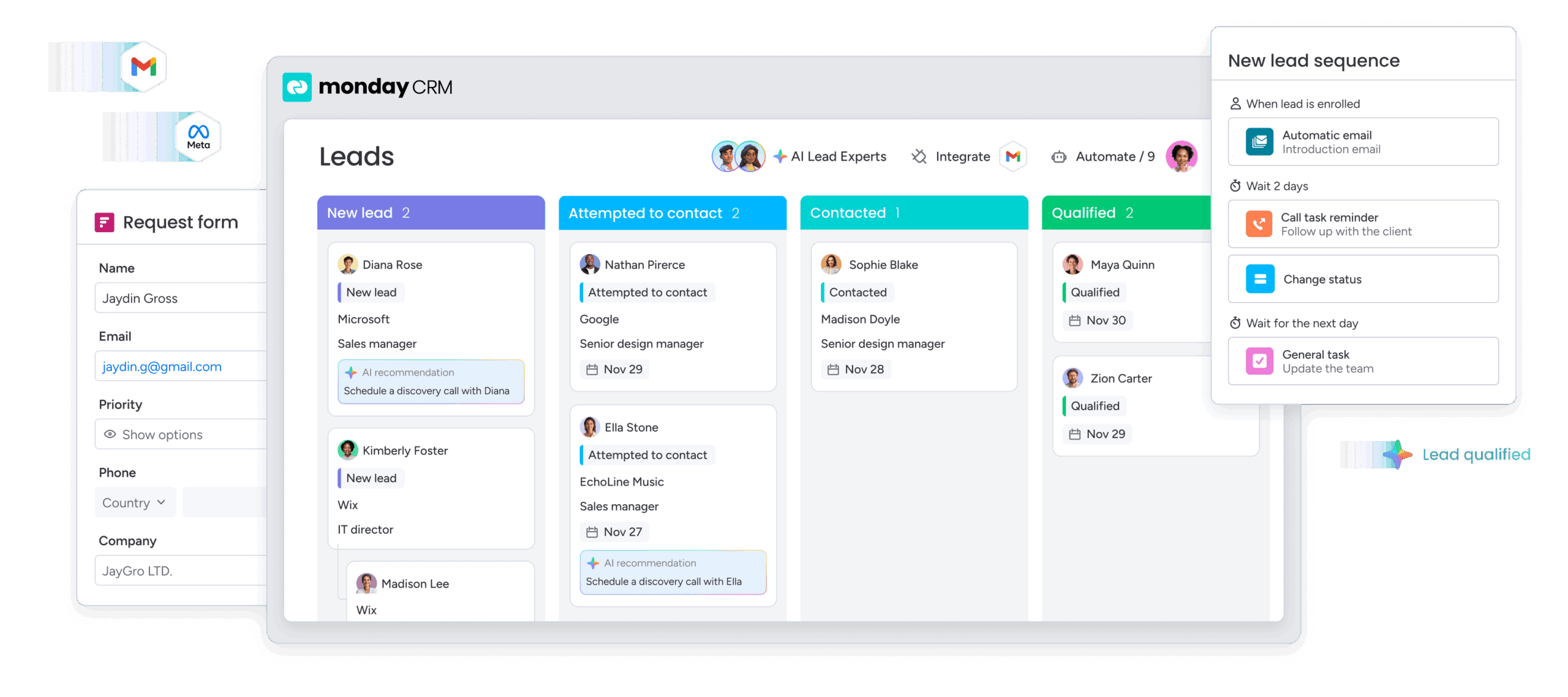 Sales prospecting tools are software platforms that help sales teams find, research, and reach potential customers, then track those conversations toward a sale. In short, they turn scattered manual outreach into a structured, data-driven system.
Sales prospecting platforms streamline sales lead generation by replacing manual research with intelligent automation. Many teams pair a dedicated prospecting tool with broader lead generation software to manage the full funnel from first touch to closed deal. In doing so, these platforms help sales teams identify, research, and engage potential customers through structured, data-driven workflows that remove inefficiencies from traditional prospecting approaches.
By aligning prospect discovery with an ideal customer profile, these platforms keep teams focused on qualified opportunities instead of unproductive outreach.
Contact discovery, enrichment, and outreach sequences run automatically to maintain consistent follow-up cadences throughout the sales cycle.
The result is a more efficient, data-driven pipeline. Real-time analytics improve visibility into campaign performance, while native CRM integrations remove the need for manual data entry. This lets sales teams focus on high-value work such as building relationships and progressing deals toward close.
How to evolve your prospecting playbook?
Traditional sales approaches no longer deliver the results modern teams require. The reason is that today’s buyers conduct extensive research independently before engaging with sales representatives, while sales teams face increasing administrative burdens.
Relying solely on manual sales lead generation processes and legacy methods creates significant gaps in pipeline development and opportunity identification.
To bridge those gaps, advanced prospecting platforms provide the infrastructure needed to meet revenue targets consistently. These tools streamline time-intensive tasks, enable more meaningful prospect engagement, and deliver the operational visibility required for sustainable growth.
The strategic question for sales leaders is not whether to adopt these solutions, but rather how quickly implementation can begin.
- Give reps back their selling time: your best reps shouldn’t act as data-entry clerks. Automating lead research, email discovery, and data entry frees them to focus on selling. They can build targeted prospect lists in minutes instead of hours, gaining valuable selling time every week. With platforms like monday CRM, prospect data stays centralized and automated follow-ups keep conversations moving, so your team stays focused on results.
- Turn cold outreach into warm conversations: generic email blasts no longer work. Smart tools identify prospects who are actively showing buying intent, helping reps focus on the right people. Fewer random conversations lead to shorter sales cycles, higher close rates, and a more confident team.
Key features of a high-performing prospecting platform
Not all prospecting platforms deliver the same impact. A small set of critical capabilities separates platforms that build pipeline momentum from those that introduce friction. The features below define what high-performing sales teams should prioritize.
- CRM integration that works consistently: Prospect activity should sync automatically with the CRM, keeping records accurate and maintaining a single source of truth across teams.
- Reliable, verified contact data: Fresh, accurate contact information protects deliverability, preserves brand reputation, and ensures outreach reaches the right stakeholders.
- Multichannel engagement without losing context: Effective platforms support email, LinkedIn, and phone outreach while maintaining a complete interaction history for each prospect.
- Lead scoring that prioritizes intent: Behavioral signals help sales teams focus attention on prospects most likely to convert, improving efficiency and win rates.
- Timely engagement alerts: Notifications triggered by website visits or content engagement allow sales teams to connect when interest is highest.
- Automation that supports human interaction: Routine follow-ups and reminders are automated so sales reps can invest more time in relationship building.
- Analytics tied directly to revenue outcomes: Reporting connects outreach activity to meetings booked and deals closed, enabling data-backed decisions.
The must-have features to prioritize in 2026
Feature checklists get long fast, so it helps to group them around the prospecting workflow itself. As data quality and AI become the deciding factors in this category, a few capabilities now separate a platform that fills the lead generation sales funnel from one that just stores contacts. Prioritize these when you compare options.
- Data quality and accuracy: Verified, regularly refreshed emails and direct dials keep bounce rates low and connect rates high, which protects sender reputation.
- Contact and intent data: Firmographics, technographics, and buying signals help reps reach in-market accounts at the moment interest spikes.
- Enrichment: Automatic data appends fill gaps in a record so reps open every conversation with full context instead of a name and a guess.
- CRM and tech-stack integration: Native syncs and open APIs push prospect data into your pipeline automatically, so nothing is retyped and nothing is lost.
- Automation and AI: No-code recipes and AI agents handle routing, enrichment, follow-ups, and qualification, freeing reps for the conversations that close.
- Compliance and security: GDPR and CCPA alignment, DNC screening, and certifications such as ISO 27001 and SOC 2 keep outbound legally sound and data protected.
10 best sales prospecting tools for lead generation
Long sales cycles kill momentum. Manual outreach burns out top reps, and another clunky platform is the last thing any team needs. Sales teams deserve software that actually works, not something that delivers spreadsheet-level frustration.
The right platform gets straight to the point. It finds quality leads fast, automates the grunt work without sounding like a robot, and gives teams more time to sell. That’s a data-driven approach that fills pipelines with real opportunities.
So where should you start? The list below focuses on what truly matters: data accurate enough that reps are never caught off guard on a call, and integrations that play nicely with your current setup. The comparison table gives you a fast read on the front-runners before the full breakdowns.
| Platform | Best for | Standout feature | Starting price (monthly) |
|---|---|---|---|
| monday CRM | Teams that want prospecting inside a connected CRM | AI agents plus no-code automation across the full workflow | $12/user/seat |
| Apollo.io | SMBs wanting data and engagement in one platform | All-in-one database plus sequences | $49 per seat |
| LinkedIn Sales Navigator | Relationship-driven B2B selling | Access to the LinkedIn professional graph | $119.99 per seat |
| ZoomInfo | Enterprise sales intelligence | Depth of direct-dial and intent data | Quote-only |
| Cognism | Compliance-first outbound in Europe | Phone-verified Diamond Data | Quote-only |
| Clay | RevOps teams building custom enrichment | Waterfall enrichment across 150+ sources | Free, then from ~$150/month (annual) or ~$167/month (monthly) |
| HubSpot Sales Hub | Inbound-led teams on one customer platform | Prospecting workspace with an AI agent | $20 per seat |
| Lusha | Reps prospecting on LinkedIn | Verified direct dials via browser extension | Free, then $49.90 per seat |
1. monday CRM
Best for: Teams that want prospecting inside a connected CRM
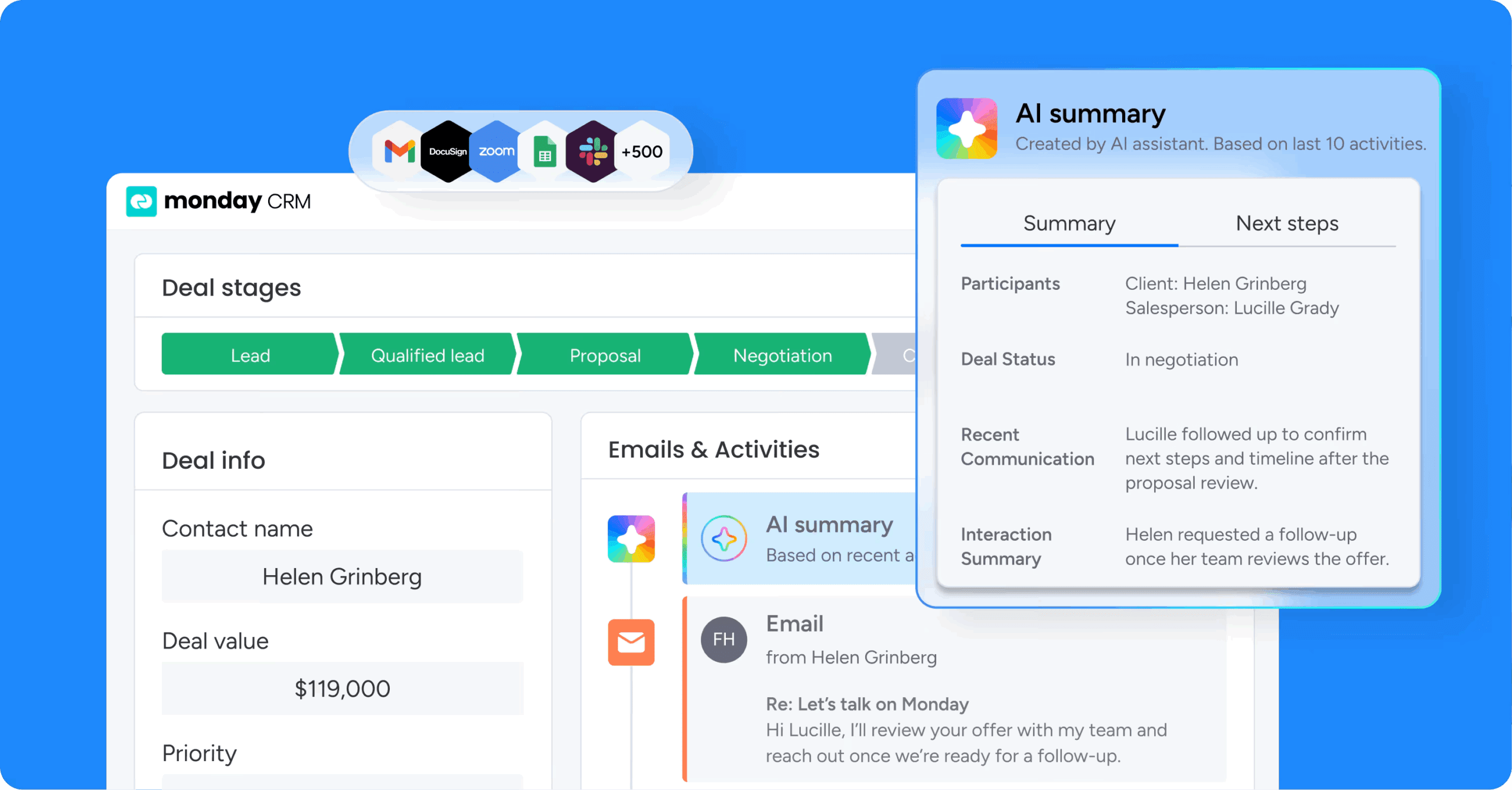
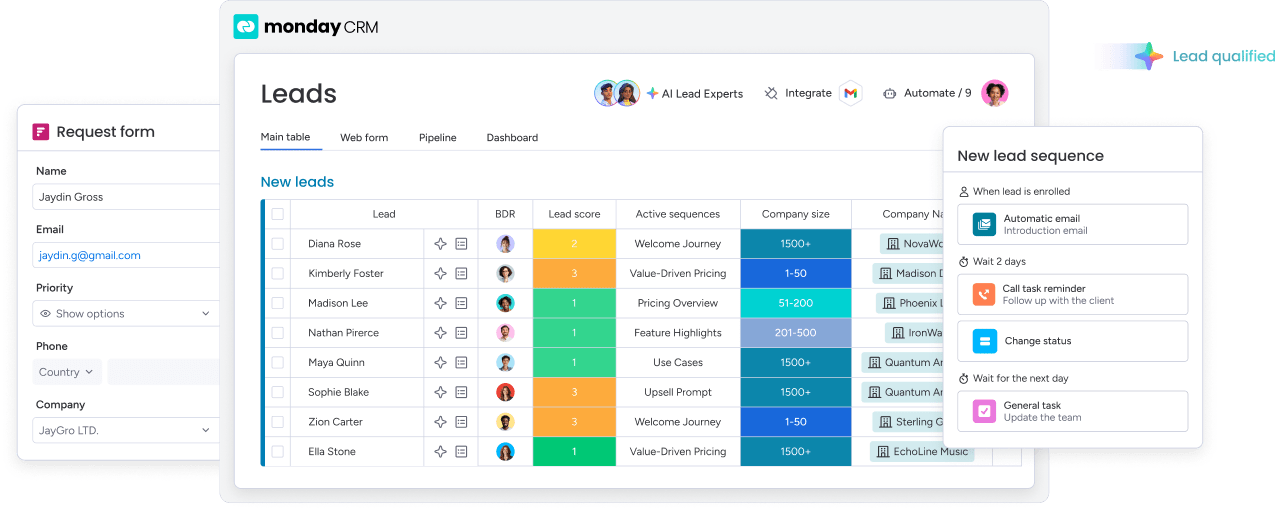
Sales prospecting turns from scattered chaos into a unified command center with monday CRM, where every lead, interaction, and opportunity lives in one place. Built on the monday.com Work OS, it adapts to any sales process instead of forcing teams into rigid workflows.That makes it a strong fit for growing revenue teams who want serious prospecting power without the technical overhead.
Use case
Capture, enrich, qualify, and engage prospects in one customizable platform that grows with your sales process.
Key features
- Native email and sequences: mass email, multi-step sequences, personalization fields, and open and click tracking keep prospects engaged without leaving the CRM.
- AI lead enrichment and scoring: Crunchbase enrichment plus automated scoring surface your hottest opportunities first.
- AI Lead Agent: sources and enriches prospects that match your ICP on a schedule, so the top of your pipeline refills without manual list-building.
- AI Sales Agent: runs initial discovery, qualifies leads by call and SMS around the clock, books meetings, and logs call summaries.
- No-code pipeline boards: drag-and-drop customization adapts to any sales methodology or industry workflow.
Pricing
Plans start at $12 per seat/month billed annually (Basic), with Standard at $17/month, Pro at $28/month, and Ultimate available on a custom quote. monday CRM offers a 14-day free trial, with no permanent free plan.
Why it stands out
- Work OS flexibility: build prospecting workflows that match how your team sells, not the other way around.
- One connected system: prospecting, deals, accounts, and post-sale work share a single platform, so context survives every handoff.
- Adoption teams stick with: an intuitive interface means reps actually log activity, which keeps forecasts honest.
2. Apollo.io
Best for: SMBs wanting data and engagement in one platform
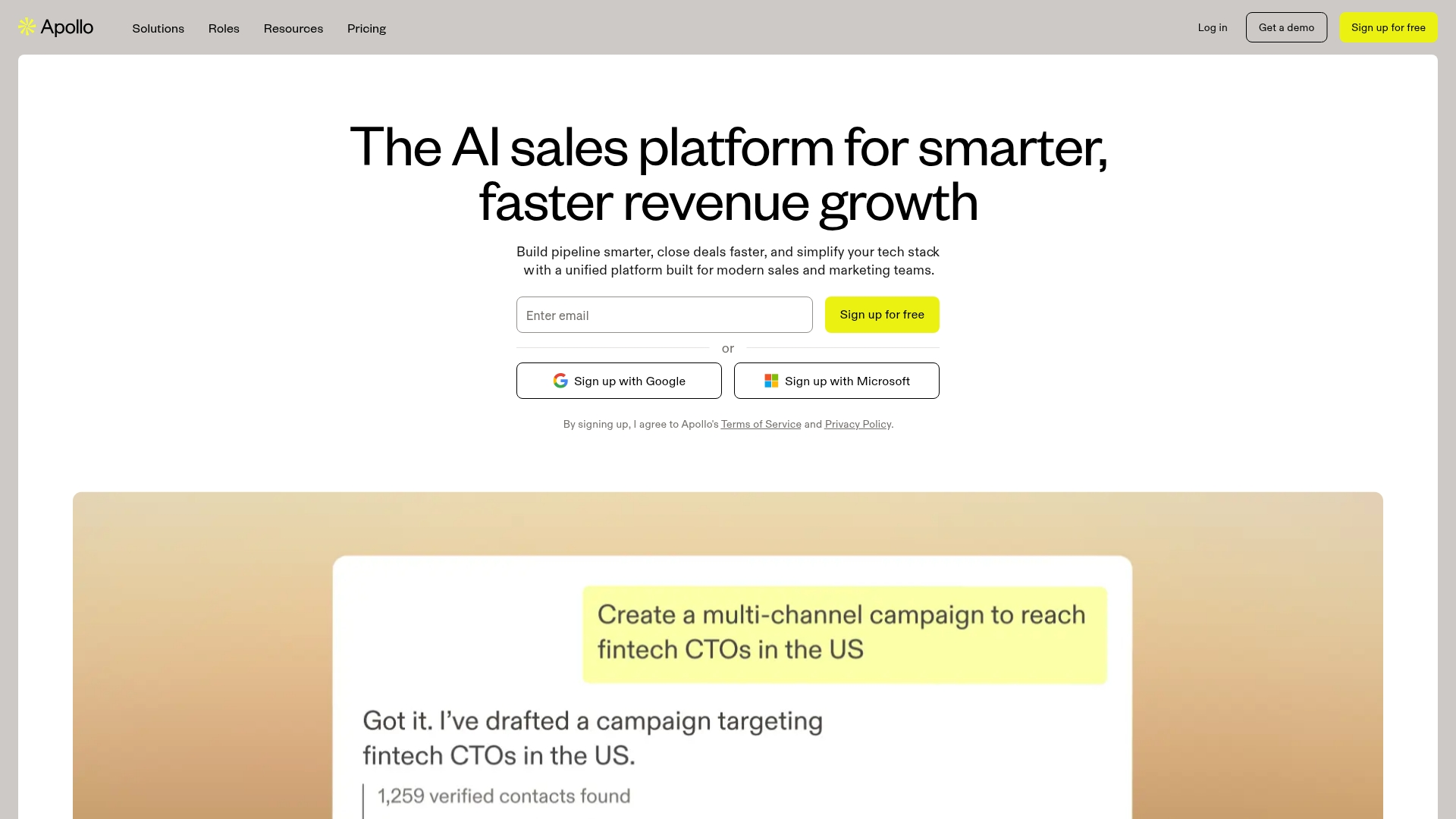 Apollo.io pairs a large contact database with engagement and analytics in one platform, so teams can discover leads, automate outreach, and track campaigns from a single dashboard. It’s used by more than 500,000 companies and leans on a strong deliverability reputation. That makes it a favorite for SMBs and startups that want to replace three tools with one.
Use case
Find, prioritize, and engage prospects end to end without switching between separate data and outreach platforms.
Key features
- Large verified database: roughly 265 to 275 million contacts across about 60 to 70 million companies, with advanced filters for ICP targeting.
- Multi-channel engagement: built-in sequences, a dialer with recording, LinkedIn task automation, and an AI writing assistant.
- Buying intent:intent topics built into search and the Chrome extension to spot in-market accounts.
Pricing
Apollo offers a free plan with limited annual credits and 2 sequences. Paid plans start at $49 per seat/month billed annually (Basic), with Professional at $79 per seat/month and Organization at $119 per seat/month with a minimum of 3 seats.
Considerations
- Apollo reports around 97% email accuracy, but user-reported accuracy tends to run lower, so verify before high-volume sends.
- Access is credit-gated, and heavy export or dialing volume can raise costs quickly.
3. LinkedIn Sales Navigator
Best for: Relationship-driven B2B selling
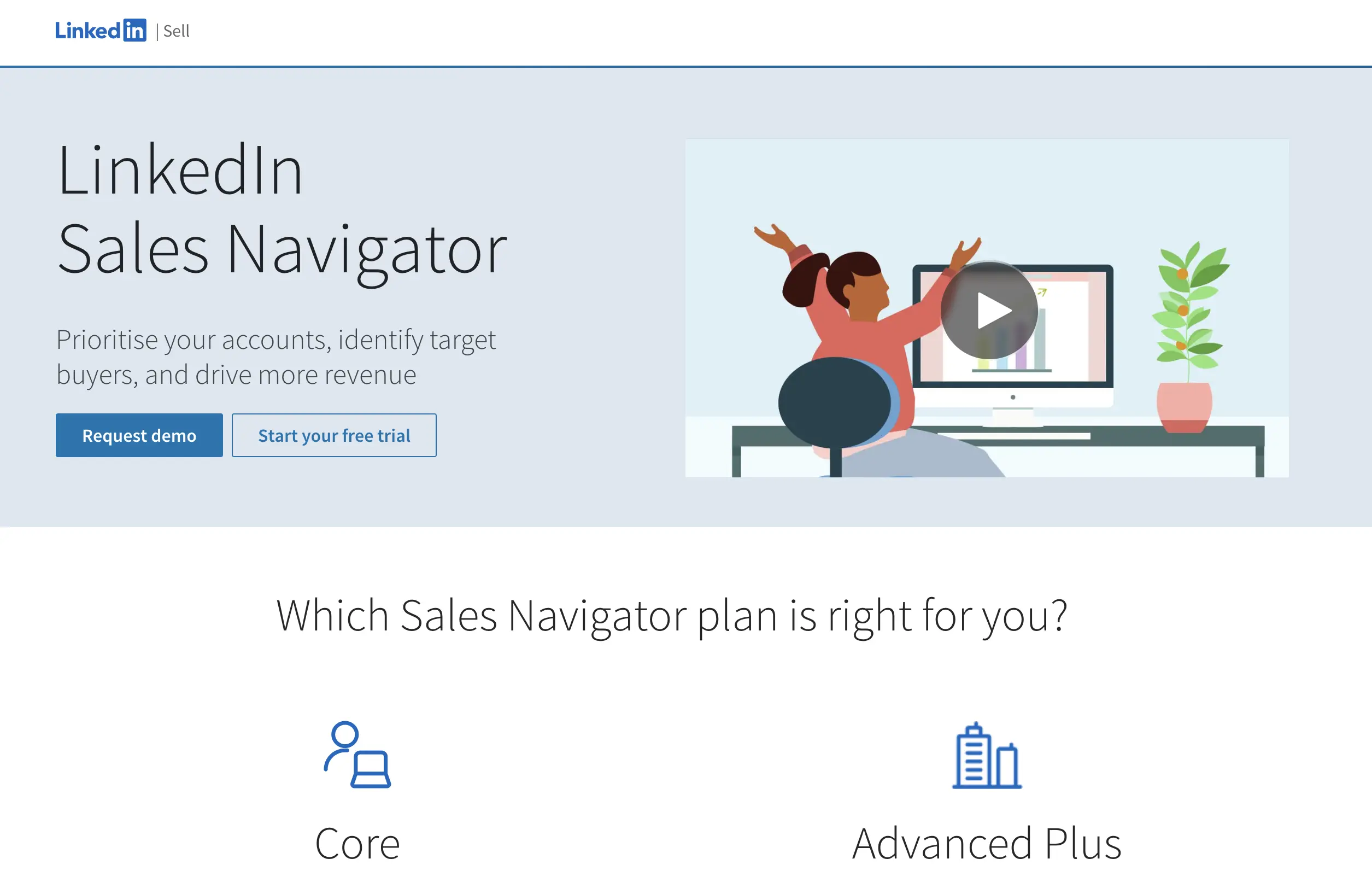 Built on the world’s largest professional network, LinkedIn Sales Navigator is a powerhouse for relationship-driven selling. It specializes in advanced search and real-time buyer signals drawn from first-party, member-maintained data. That makes it a near-default for teams who prioritize warm introductions and social selling.
Use case
Identify high-intent prospects through B2B sales signals and reach them through warm relationship paths.
Key features
- 50+ advanced filters: target by title, seniority, function, geography, industry, headcount, and tenure.
- TeamLink relationship mapping: surfaces warm introduction paths through your colleagues’ networks.
- Real-time alerts: job-change and company signals tell reps when to reach out.
Pricing
Plans start at $119.99 per seat/month (or about $89.99 per seat/month billed annually) for Core, with Advanced at $159.99 per seat/month (or about $149.99 per seat/month annually). Advanced Plus is available on a custom quote and includes CRM sync and data validation.
Considerations
- It provides no native email addresses or direct dials, so you pair it with an enrichment platform to contact prospects at scale.
- Full CRM sync and enrichment sit only in the custom-priced Advanced Plus tier.
4. Cognism
Best for: Compliance-first outbound in Europe
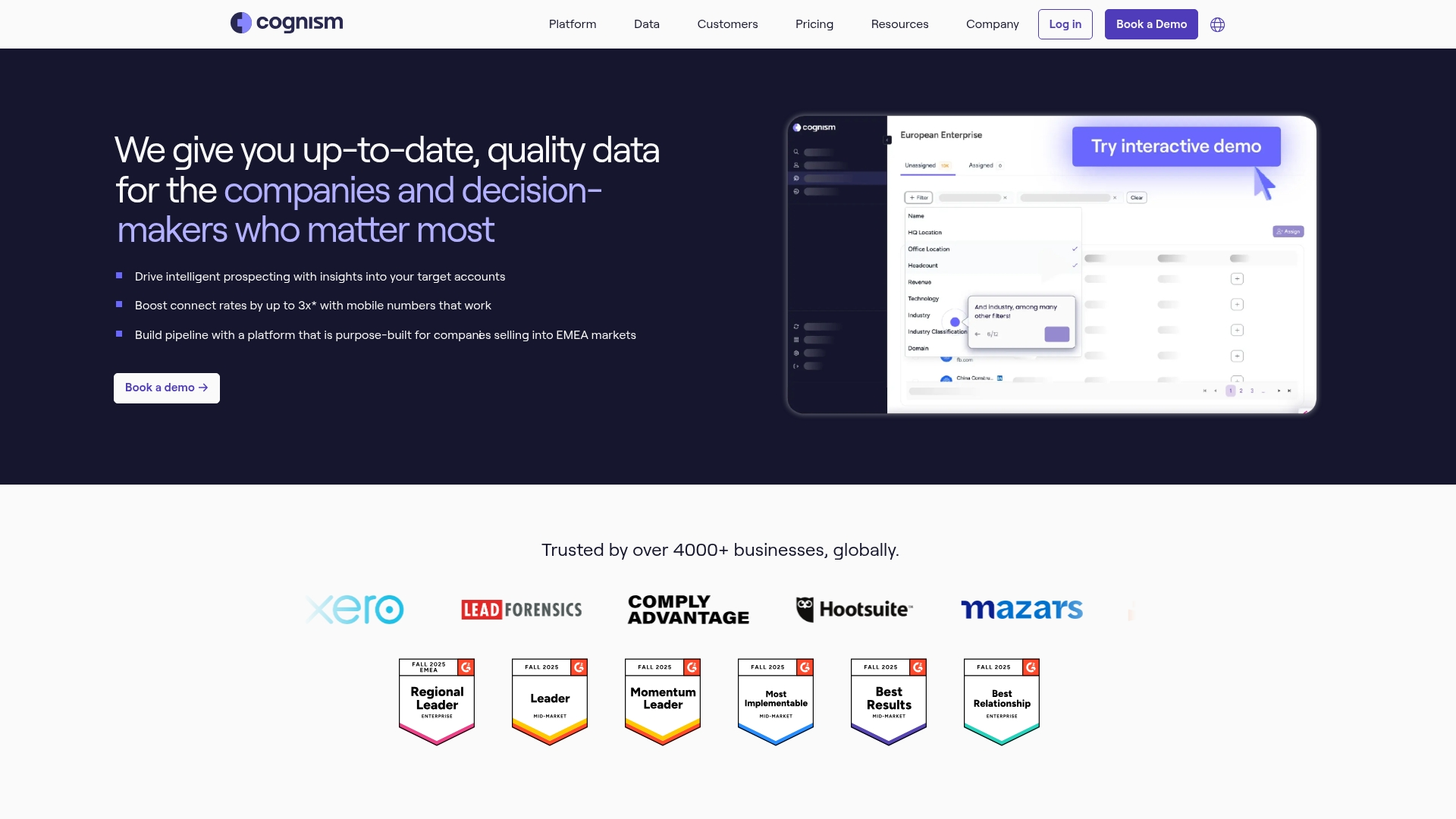 For revenue teams that need accurate, legally sound outreach, Cognism provides phone-verified contact data with a compliance-first approach. It’s strongest in European markets, where GDPR and CCPA adherence is non-negotiable. With Diamond Data mobile verification and DNC screening, it’s built for teams that refuse to compromise on data accuracy or legal safety.
Use case
Prospect with confidence using phone-verified data and compliance guardrails that keep outbound legally sound.
Key features
- Diamond Data phone verification: human-verified mobile numbers lift dial-to-connect rates.
- Intent and contextual signals: Bombora intent plus hiring, funding, and job-change triggers help time outreach.
- Compliance screening: GDPR and CCPA alignment with DNC checking built into every data point.
Pricing
Cognism offers Standard and Pro plans on a quote-only basis, both sold as annual contracts. Standard includes core prospecting workflows and 5 seats, while Pro adds verified mobile data, on-demand verification, and intent data. CRM Enrichment and Data-as-a-Service are available as quote-only add-ons.
Considerations
- Pricing is entirely quote-only and sold as annual contracts, which can create procurement friction.
- US and North America coverage is generally considered less deep than ZoomInfo.
5. ZoomInfo
Best for: Enterprise sales intelligence

Enterprise-grade sales intelligence is the core of ZoomInfo, which combines comprehensive company and contact data with intent signals to pinpoint when prospects are ready to buy. It markets one of the largest B2B databases in the category. That depth makes it a go-to for enterprise teams that need precise targeting and deep prospect intelligence.
Use case
Give enterprise teams detailed prospect intelligence and intent data to reach decision-makers who areshowing buying signals.
Key features
- Comprehensive contact data: direct dials, emails, and org charts for precise decision-maker targeting.
- Streaming intent and signals:intent topics and real-time triggers identify accounts researching solutions in your space.
- WebSights and AI Copilot: de-anonymize website visitors and speed research with account summaries and email drafts.
Pricing
ZoomInfo offers Professional, Advanced, and Elite plans, all quote-only and sales-led. Advanced adds intent data, while Elite includes the full feature set. Pricing is opaque and sold through annual contracts, with no self-serve monthly plan.
Considerations
- ZoomInfo sits at the enterprise end of the market, and five-figure annual contracts are typical, which prices out many smaller teams.
- Pricing is opaque and sold through annual contracts, so there’s no self-serve monthly plan.
6. HubSpot Sales Hub
Best for: Inbound-led teams on one customer platform
 HubSpot Sales Hub folds prospecting, engagement, and CRM data into one AI-guided workspace, so reps stop switching between tools. It specializes in automated prospect monitoring and signal-based outreach. That makes it a natural fit for scaling companies that want to consolidate their sales stackon one customer platform.
Use case
Run prospecting, engagement, and deal management in one workspace to cut context-switching and speed up cycles.
Key features
- Breeze prospecting agent: monitors buying signals like leadership changes and funding, then drafts timed, personalized outreach (beta).
- Unified prospecting workspace: centralizes daily tasks, prioritized actions, and AI guidance in one view.
- Automated sequences: multi-step campaigns with branching, plus meeting scheduling and call integration.
Pricing
HubSpot offers a free plan for up to 2 users. Paid plans start at $20 per seat/month (or about $7 per seat/month billed annually) for Starter, with Professional at $100 per seat/month (or about $90 per seat/month annually) plus a $1,500 onboarding fee, and Enterprise from $150 per seat/month plus a $3,500 onboarding fee.
Considerations
- Advanced prospecting and AI features are gated to higher tiers, limiting access for smaller teams.
- AI features run on consumption-based HubSpot Credits, which add variable cost on top of seat pricing.
7. Clay
Best for: RevOps teams building custom enrichment
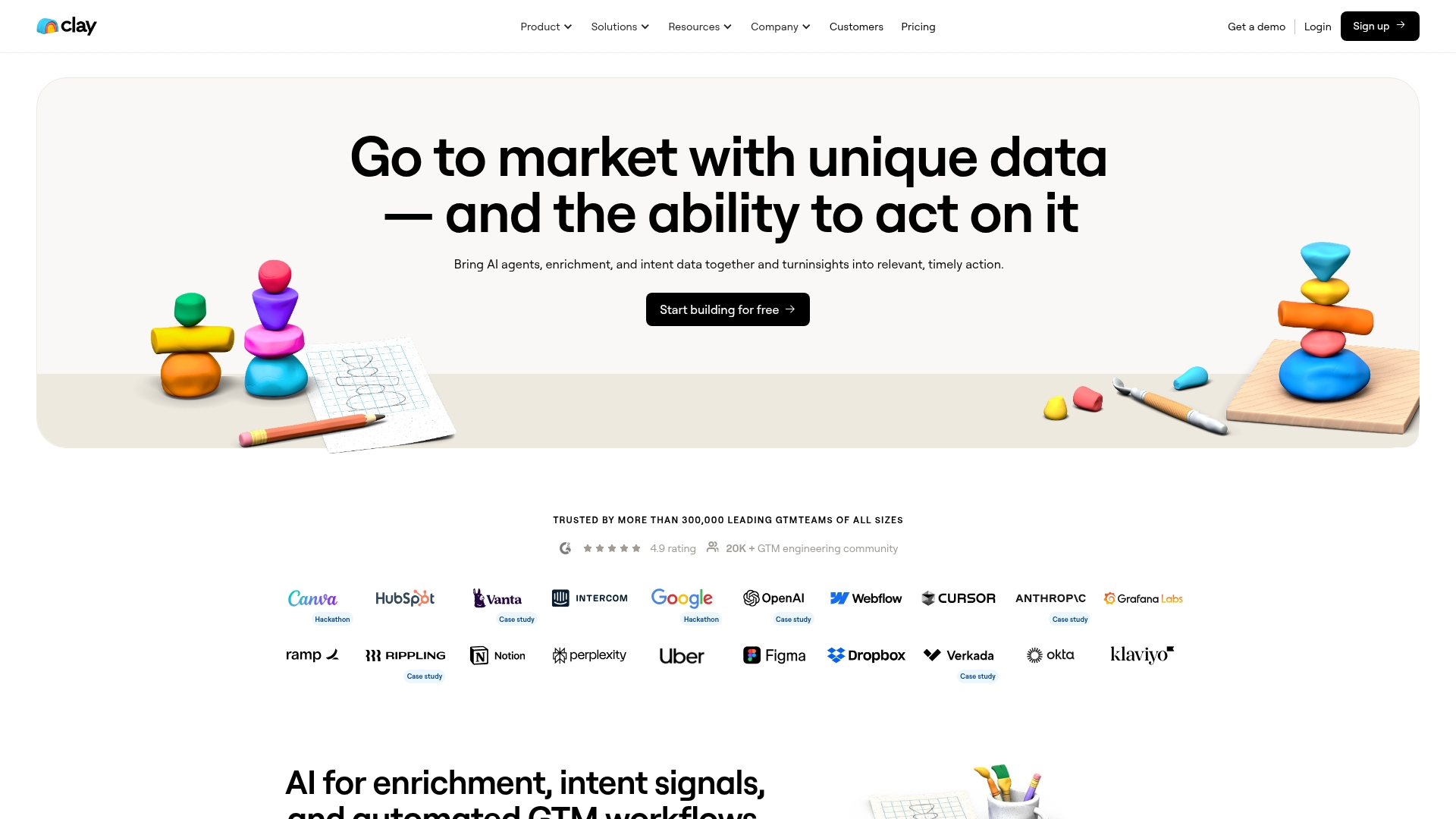 Clay turns prospecting from a data scavenger hunt into a precision operation, merging over 150 data sources with AIresearch agents in spreadsheet-style tables. It specializes in waterfall enrichment and contextual automation. That makes it ideal for RevOps and growth teams that want comprehensive prospect data without the usual coverage gaps.
Use case
Unify enrichment, AI research, and outreach orchestration to prospect anywhere on the web and act on signals.
Key features
- Waterfall enrichment: chain 150+ providers to maximize coverage and reduce gaps.
- Claygent AI research:navigates sites, fills forms, and extracts specific data points for context-aware research.
- Native sequencing: built-in email campaigns with deliverability controls and AI personalization tied to live data.
Pricing
Clay offers a free plan with limited credits and unlimited users. Starter (Launch) runs around $167/month on monthly billing or about $150/month with annual billing, while Pro (Growth) starts around $446/month and is usage-tiered by actions and data credits. Enterprise plans are custom with SSO and dedicated support.
Considerations
- The learning curve is steep, and effective use often needs RevOps skill or a Clay agency.
- Credit-based usage can escalate and is hard to predict at scale.
8. Leadfeeder
Best for: Teams that want to reach prospects already showing interest
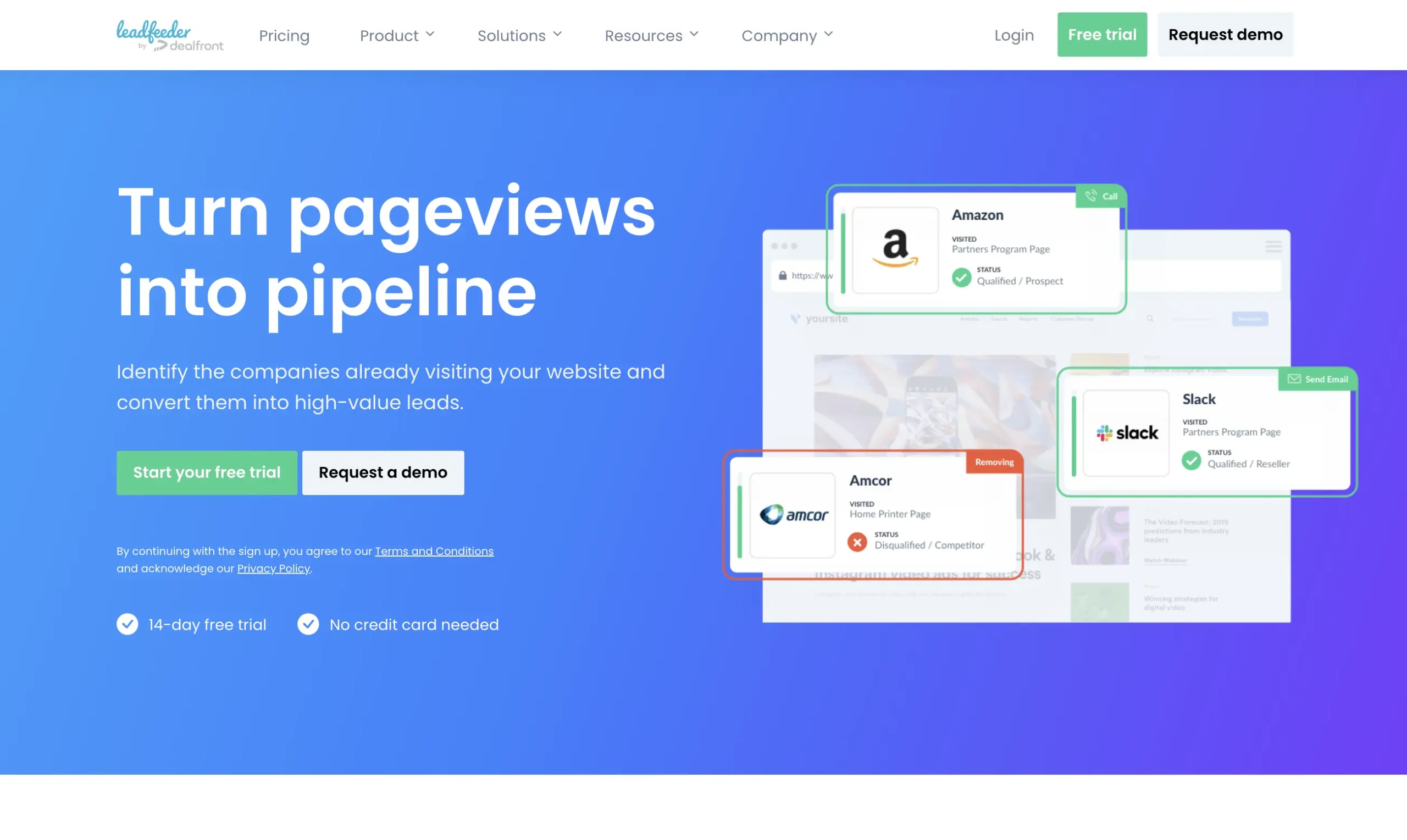 Leadfeeder, now part of the Dealfront platform, identifies the anonymous companies browsing your websiteand turns them into a pipeline of qualified leads. It specializes in real-time visitor tracking and intent signals, with strong European coverage. That makes it ideal for teams that want to reach prospects already showing interest.
Use case
Identify which companies visit your website and track their behavior to prioritize outreach by real buying intent.
Key features
- IP-to-company identification: reveals anonymous visitors with detailed behavioral context.
- Qualification filters: automatic lead scoring prioritizes high-intent accounts by engagement.
- Two-way CRM integrations: real-time alerts on hot leads with native HubSpot, Salesforce, and Pipedrive syncs.
Pricing
Leadfeeder offers a free Lite plan with the last 100 identified companies and 7-day history. Discover is €113/month (or €79/month billed annually), Activate is €527/month (or €369/month billed annually), and Enterprise is quote-only with custom volumes.
Considerations
- Identification works at the company level by default; individual tracking needs opt-ins or form submissions.
- Value depends on meaningful website traffic, so low-traffic sites see limited return.
9. Lusha
Best for: Reps prospecting on LinkedIn
 Lusha focuses on accurate B2B data, delivering real-time contact discovery through a browser extension. It specializes in verified direct dials and emails with a compliance-first posture. That makes it ideal for reps who need quick access to decision-maker details while browsing LinkedIn or company websites.
Use case
Discover verified contacts and run light prospecting workflows that push straight into your existing CRM.
Key features
- AI Flex Search: natural-language queries and automated contact discovery based on your ICP.
- Chrome extension: reveals verified emails and phone numbers on LinkedIn and company sites.
- Intent integration: Bombora Company Surge prioritizes in-market accounts.
Pricing
Lusha offers a free plan with 40 credits. Paid plans start at $49.90 per seat/month (Starter), with Pro at $69.90 per seat/month and Premium at $399.90 per seat/month. Scale is available on a custom quote.
Considerations
- Phone numbers cost 5 credits each versus 1 for an email, so heavy dialers burn credits fast.
- The database is smaller than enterprise incumbents for large-account coverage.
10. Seamless.AI
Best for: Reps who want fresh contact data without the CSV shuffle
 Seamless.AI runs a real-time search engine that finds and verifies B2B emails and cell phones at the moment of search rather than serving from a static list. It specializes in in-browser prospecting with 100+ filters. That makes it a fit for reps who want fresh contact data without the CSV shuffle.
Use case
Build targeted prospect lists quickly with verified emails and directdials while prospecting on LinkedIn and company sites.
Key features
- Real-time search: 100+ filters for precise ICP targeting and instant discovery.
- Chrome extension: one-click lead capture from any pageon the web.
- Live validation: emails and directdials checked before outreach.
Pricing
Seamless.AI offers a free plan with 50 credits for 1 user. Pro and Enterprise plans are quote-only, with Pro including daily credit refresh and unlimited exports, and Enterprise offering unlimited users and custom credits.
Considerations
- Data accuracy is inconsistent, and reviewers report bounced emails despite verified claims.
- Key capabilities such as Buyer Intent and Data Enrichment are paid add-ons that raise the effective cost.
4 types of B2B prospecting platforms you should know
 Prospecting tools aren’t one-size-fits-all. Some find contacts, some automate outreach, and a few run your whole sales process. Using the wrong one is like bringing a screwdriver to a hammer job, a great way to waste time and kill momentum.
| Tool type | Primary functions | Ideal use cases | Example platforms |
|---|---|---|---|
| CRM-integrated prospecting | Lead management, workflow automation, reporting | Centralized sales process, team collaboration | monday CRM |
| Sales intelligence and data | Company and contact research, data enrichment | Targeted list building, account-based selling | Data providers |
| Multi-channel engagement | Outreach automation, sequencing, personalization | Scalable, personalized outbound campaigns | Outreach tools |
| Email discovery and verification | Contact finding, email validation | Building verified lists, ensuring deliverability | Contact finders |
- CRM-integrated prospecting platforms: this is your command center. It handles everything from finding leads to closing deals, all in one place. With solutions like monday CRM, your prospecting tools are built right into your sales system, ending the constant tab-switching and data silos for good. When your prospect data flows straight into your pipeline, the busywork disappears.
- Sales intelligence tools and data providers: these tools are your secret weapon for research. They give you the company and contact data you need to find the right prospects and know what they care about before you ever reach out. This is your go-to for building targeted lists or running account-based plays.
- Multi-channel engagement software: time to put your outreach on autopilot, without sounding like a robot. These platforms automate your emails, calls, and social messages in a smart sequence that keeps the conversation going. It’s perfect for running outbound campaigns that need to feel personal, even when you’re contacting hundreds of prospects.
- Email discovery and verification services: these tools do one thing, and they do it well: find and verify contact info. They make sure your emails hit a real person’s inbox, not a bounce-back report or a spam folder. Use these to build clean lists from scratch or to scrub the data you already have. It’s the simple step that ensures your whole sales effort doesn’t go to waste on bad data.
How to choose the right sales prospecting tools for your business?
Selecting the right prospecting platform requires a strategic approach grounded in your team’s actual needs. Rather than pursuing feature-rich platforms that may not align with your workflow, begin by identifying specific bottlenecks in your current sales process and the operational challenges your team faces daily.
Keep in mind to avoid platforms that force rigid, predefined workflows onto your sales methodology. Implementation complexity should scale appropriately with team size: smaller teams need solutions they can deploy quickly without requiring dedicated administrative resources. Evaluate the total cost of ownership beyond subscription fees, including time invested in configuration, data management, and ongoing training.
Integration capabilities directly impact sales productivity. Since disconnected systems create data silos and force manual data transfer between platforms, they divert valuable time from revenue-generating activities. Prioritize platforms that consolidate prospecting activities and sync with your existing CRM, so prospect data flows automatically into your pipeline without extra manual effort.
How many prospecting platforms does a sales team actually need? For most teams, the honest answer is one connected system plus, at most, one data source that feeds it. Stacking five overlapping tools creates the silos you’re trying to escape, so the goal is coverage of the full workflow, not a longer shopping list. With that in mind, these criteria help you compare options with discipline.
- Map your bottlenecks first: pinpoint where reps lose time today, whether that’s finding prospect details, logging activity, or following up, and shortlist platforms that fix that specific step.
- Check data quality and coverage: confirm the platform delivers verified, refreshed data in your regions and segments so reps chase quality leads, not bounces.
- Demand native CRM integration: a two-way sync keeps records accurate and shortens your sales cycles by removing manual data entry.
- Weigh total cost of ownership: add setup, credits, add-ons, and training time to the seat price before you compare.
- Test adoption with a pilot: if reps won’t use it during a short trial, more features won’t save it.
How to use AI in sales prospecting
The shift toward AI-assisted prospecting is backed by real investment. MarketsandMarkets projects the AI for sales and marketing market will grow from $58 billion in 2025 to more than $240 billion by 2030. That momentum tracks with broader results: in Deloitte’s 2026 State of AI in the Enterprise survey, two-thirds of organizations reported productivity and efficiency gains from AI adoption.
Manual research and data entry reduce momentum across sales teams. AI capabilities within modern platforms help automate repetitive work, allowing teams to focus on relationship building and strategic outreach.
Because AI functions best as a support layer rather than a replacement, it should be used to prioritize high-intent leads and maintain follow-up consistency. By doing so, sales reps remain responsible for the high-level conversations and outcomes that machines cannot replicate.
Efficiency must be paired with quality. With appropriate oversight, AI-driven workflows preserve personalization and relevance while improving speed and consistency.
So can AI really prospect on its own? Increasingly, yes. Can ChatGPT be used for lead generation? It’s genuinely useful for drafting outreach and researching an account, but on its own it can’t find verified contacts, sync with your CRM, or tell you when a prospect opens an email. The real shift in 2026 is purpose-built agents that run the workflow end to end, and it helps to see how each stage maps to a specific capability inside a platform like monday CRM.
- Source: The AI Lead Agent finds, adds, and enriches prospects that match your ICP on a set schedule, so the top of your pipeline management refills without manual list-building.
- Qualify and engage: The AI Sales Agent runs initial discovery, qualifies leads by call and SMS around the clock, books meetings, and logs call summaries, which keeps B2B sales teams responsive without adding headcount.
- Enrich records: AI blocks autofill columns by detecting sentiment, extracting details, summarizing threads, and translating, so every record carries context.
- Capture the conversation: The AI Notetaker transcribes meetings and generates summaries and action items, ending the scramble to remember what a prospect said.
The pattern mirrors what dedicated AI SDR agents promise, with one difference: because these agents live inside the CRM, sourced leads are managed, nurtured, and forecast in the same place they’re found. AI handles the volume, and your reps own the judgment.
5 steps to drive adoption for your new prospecting platform
Driving adoption is often harder than selecting the right prospecting platform. Even the most powerful solution fails to deliver ROI if teams don’t actively use it in their daily workflows. A structured rollout plan helps reduce resistance, build early confidence, and ensure the platform becomes part of how sales teams actually work, not just another system they’re asked to log into. The following five steps focus on practical adoption, measurable impact, and long-term usage.
Step 1: Start with a real-world test drive
Begin with a pilot program rather than a company-wide launch. Select a small group of high-performing reps to test the tool for 30 days and establish clear success metrics: more qualified leads, faster response times, reduced administrative work. Their feedback provides valuable insights into how the platform performs in actual sales scenarios before full deployment.
Step 2: Train for impact, not just features
Focus training on how the platform improves daily workflows, not just its technical capabilities. Conduct hands-on sessions using real accounts, so reps immediately understand the value. If the training doesn’t clearly answer “what’s in it for me?”, adoption will struggle from the start.
Step 3: Connect it to your CRM
Disconnected data creates friction in the sales process. Your new tool must integrate seamlessly with your CRM, eliminating manual data entry that reduces productivity. With modern platforms like monday CRM, you can establish that two-way connection quickly, ensuring data accuracy and maintaining workflow continuity.
Step 4: Build one dashboard to see it all
Consolidate your prospecting and sales KPIs into a single dashboard rather than searching across multiple platforms. This unified view provides complete visibility from initial outreach to closed deals. When teams can see how their activities drive results, platform adoption naturally increases.
Step 5: Track what’s happening and what happened
Monitor both leading indicators (daily activity) and lagging indicators (final results). This dual approach enables you to identify issues early and optimize what’s working effectively. It’s the difference between reactive guesswork and proactive decision-making.
Why monday CRM stands out for sales prospecting
Most platforms in this list win on one slice of prospecting: a bigger database, a sharper dialer, or cleaner cold email. monday CRM takes a different angle. Instead of being another data source you bolt onto your stack, it’s the connected system where sourced leads are actually managed, nurtured, forecast, and closed. That distinction matters, because a verified contact is only valuable once it reaches the right rep and moves through a pipeline you can see.
The platform treats prospecting as one continuous workflow rather than a series of disconnected tasks. Leads flow in from multiple channels, automations handle the routing and follow-up, and AI agents work around the clock to keep your pipeline full. Because everything lives in one place, your team spends less time switching tools and more time having conversations that close deals.
AI Lead Agent sources prospects automatically
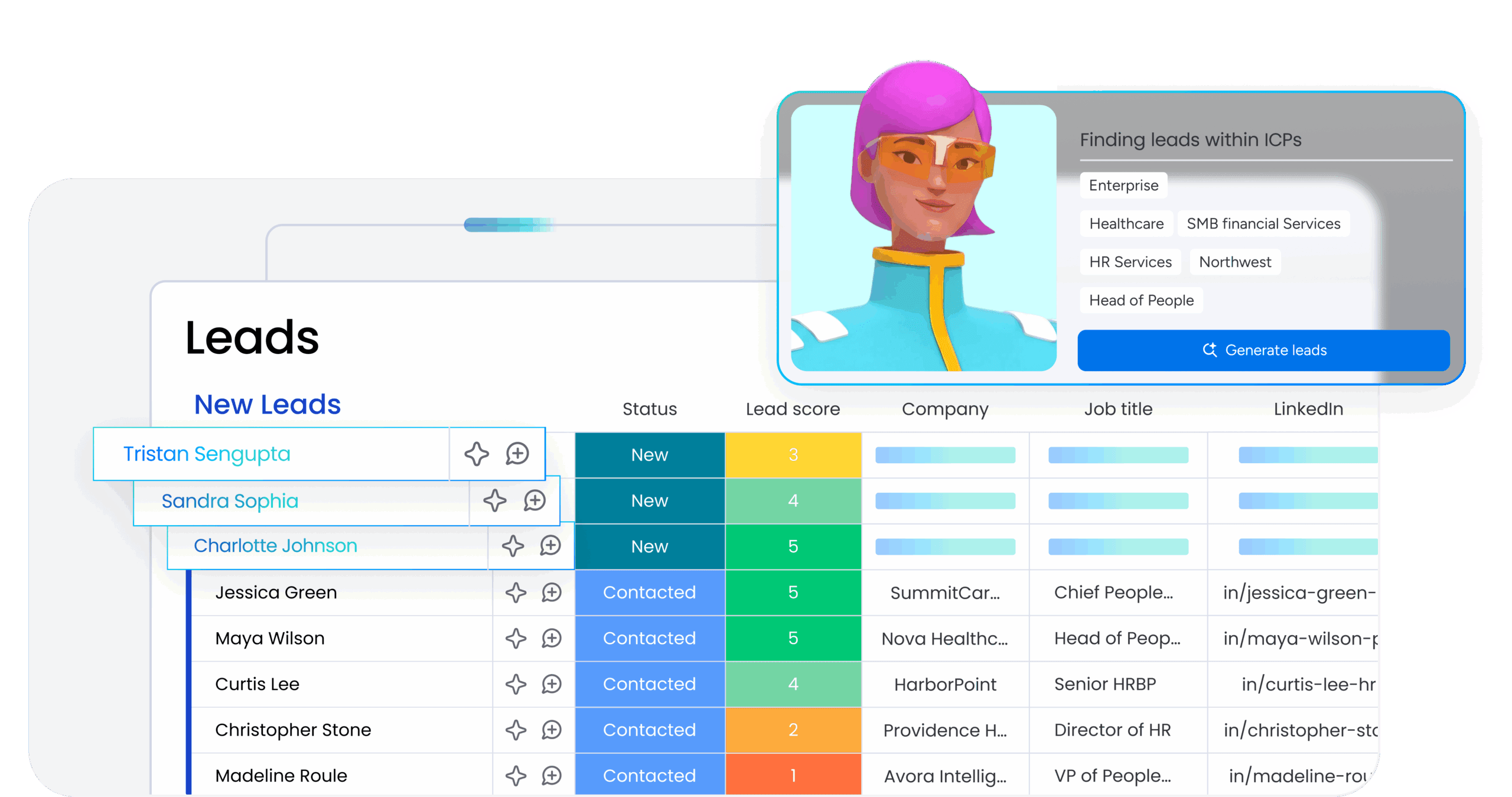
The AI Lead Agent finds, enriches, and adds prospects that match your ideal customer profile on a schedule you set. It runs continuously in the background, so your pipeline refills without manual list-building. Reps wake up to qualified leads already loaded into their boards, ready for outreach.
AI Sales Agent qualifies and books meetings 24/7
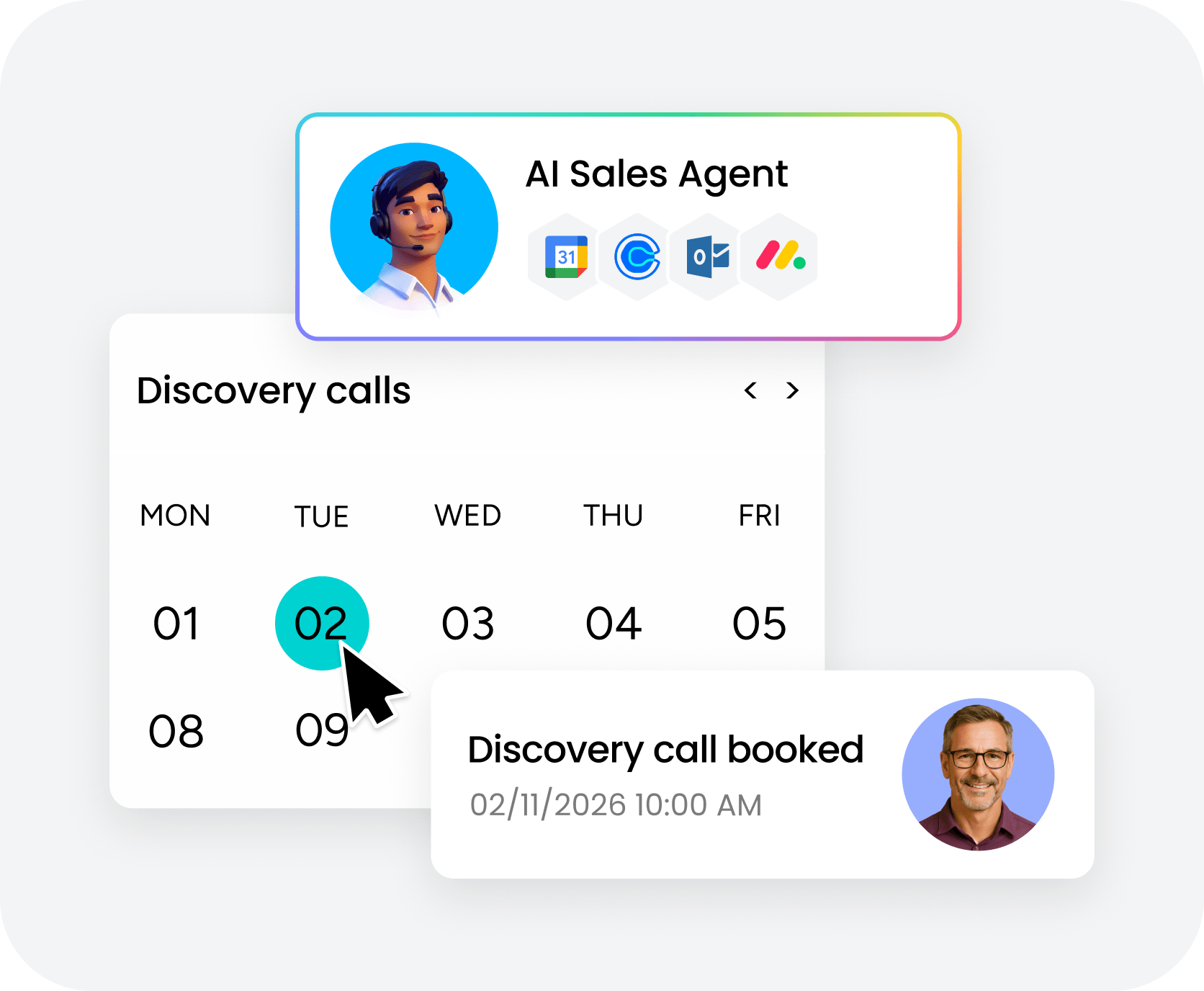
The AI Sales Agent handles initial discovery calls, qualifies inbound leads through phone and SMS, and books meetings directly into your calendar. It works around the clock, so your team stays responsive even outside business hours. Call summaries are logged automatically, keeping every conversation documented without extra effort.
Custom AI agents through Agent Factory

With the Agent Factory, teams deploy ready-made agents like Lead Scorer or Contact Duplicates Finder, or build custom agents tailored to their specific workflow. You can create a prospecting app from a simple prompt using monday vibe, or connect CRM context to external AI through monday MCP. This flexibility lets you automate the exact tasks that slow your team down.
Real-time dashboards that reflect actual activity
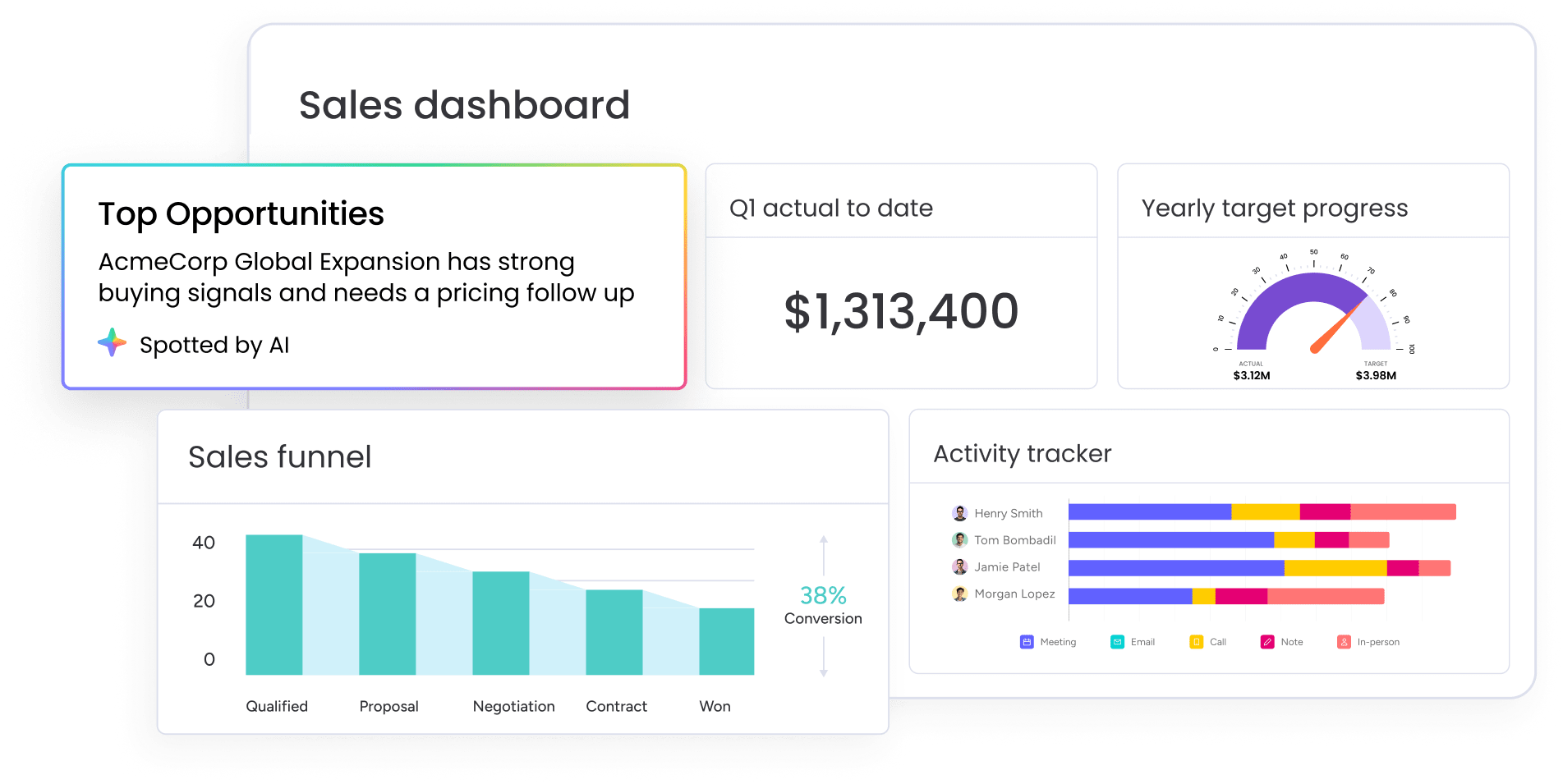
Because activity is logged automatically, funnel, leaderboard, and deal-stage dashboards update in real time. Forecasting reflects what’s actually happening rather than what reps remembered to enter. Sales leaders get complete visibility into pipeline health without chasing updates or cleaning data.
Build your prospecting engine with monday CRM
Prospecting has shifted from a volume game to a precision one. The teams pulling ahead in 2026 aren’t the ones sending the most emails. They’re the ones that source the right accounts, reach them at the right moment, and keep every conversation visible from first touch to closed deal. That takes a connected system, not a drawer full of disconnected point solutions.
Start by identifying the one stage where your reps lose the most time, then pilot a connected approach that fixes it before you expand. Map your prospecting motion, pick the capabilities that match it, and give your team a system that grows with your sales process with monday CRM.
Try monday CRMFAQs
Which tool is best for lead generation?
The best tool is the one your team will actually use. Look for a platform with accurate contact data and powerful automation that fits right into your current workflow. Prioritize solutions that offer verified emails and direct dials, native CRM integration to eliminate manual data entry, and multi-channel engagement across email, LinkedIn, and phone.
What is a sales prospecting tool?
A sales prospecting tool is software that helps your sales team find and connect with the right customers, faster. It automates the grunt work of finding contacts and managing outreach, so your team can focus on selling. These platforms combine contact databases with engagement features like email sequences, lead scoring, and activity trackingto keep your pipeline full.
What are the 5 P's of prospecting?
The 5 P's of prospecting are Purpose, Preparation, Personalization, Persistence, and Performance. Purpose means knowing exactly why you're reaching out. Preparation involves researching your prospect's business challenges. Personalization ensures your message speaks directly to their needs. Persistence keeps you following up consistently without being pushy. Performance tracks what's working so you can refine your approach.
Can ChatGPT be used for lead generation?
ChatGPT can be used for lead generation, but only for parts of it. It's great for drafting emails or researching a company, yet it can't find verified contacts or automate outreach. It won't integrate with your CRM, track engagement metrics, or tell you when a prospect opens your email. Use it as a writing partner to craft compelling messages, not a replacement for a real prospecting platform.
How much do sales prospecting tools cost?
Sales prospecting tools typically cost from $50 to over $200 per user each month, based on features and data access. Entry-level plans offer basic contact discovery and limited credits, while mid-tier options around $100 to $150 per user each month include verified phone numbers, email sequences, and CRM integrations. Enterprise plans with advanced AI featuresand intent data can exceed $200 per user monthly.
What are the best free sales prospecting tools?
The best free sales prospecting tools are good for a test run, but they lack the data quality and automation needed to scale. Most free plans cap you at 5 to 50 contacts per month with limited access to phone numbers, no email sequences, and basic search filters. If you're serious about growth, you need a platform built for it: one that offers verified data, robust automation, and integrations that keep your entire sales process connected.
How does monday CRM approach sales prospecting?
monday CRM approaches sales prospecting as one connected workflow rather than a standalone data platform. Leads enter through forms, campaigns, and imports, then automations route and follow up while AI agents do the heavy lifting: the AI Lead Agent sources and enriches prospects that match your ICP on a schedule, and the AI Sales Agent qualifies leads and books meetings around the clock. Reps engage with native email and sequences, and real-time dashboards keep the whole pipeline visible.