


Your sales team is drowning in manual prospecting work while qualified prospects slip through the cracks. What if autonomous AI systems could handle your entire prospecting workflow — research, outreach, qualification — without constant oversight, learning and improving with every interaction?
This guide covers how AI agents transform pipeline building, the 4 specialized agent types for every sales stage, and the specific benefits that hit your bottom line. You’ll also get a 5-step deployment guide that works seamlessly within your CRM environment, helping you get started in just a few weeks.
Try monday CRMKey takeaways
- AI agents can autonomously handle your entire prospecting workflow 24/7 while your team focuses on closing deals.
- AI agents need accurate CRM information and well-defined ideal customer profiles to make smart decisions about which prospects deserve attention.
- Most teams deploy AI agents within 2-4 weeks without technical complexity, seeing faster lead response times and higher-quality opportunities almost immediately.
- Deploy specialized agents for different pipeline stages: research agents for market intelligence, qualification agents for lead scoring, engagement agents for outreach, and nurturing agents to maintain long-term relationships.
- Native AI capabilities let you work within your existing CRM environment without context-switching between platforms, maintaining visibility and control while agents handle execution.
What are AI agents for lead generation?
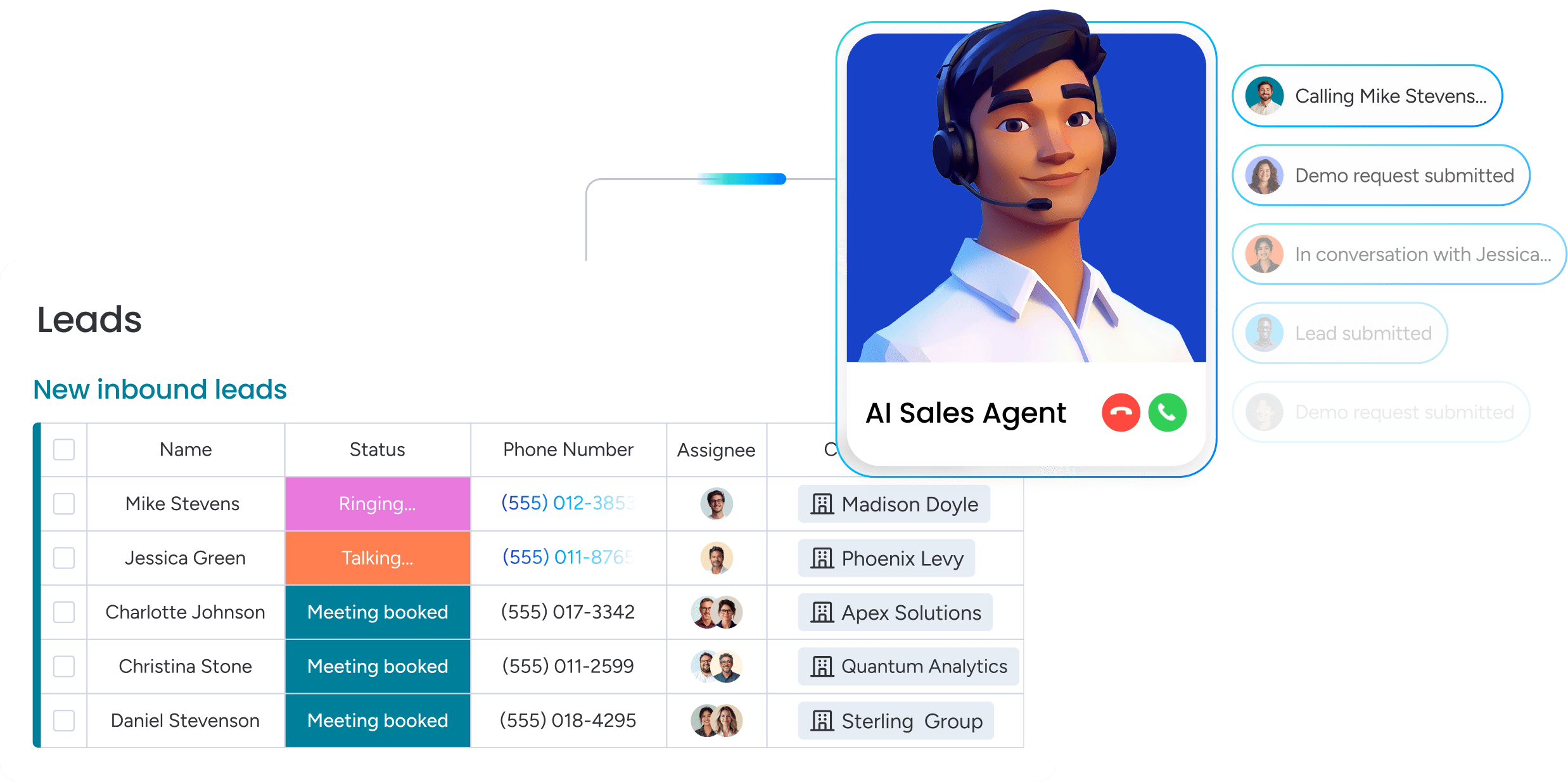
AI agents for lead generation handle your entire prospecting workflow without constant supervision. They’re digital sales employees working 24/7 to identify, qualify, and engage potential customers while you sleep.
Unlike basic automation that follows rigid if-then rules, AI agents make independent decisions based on context and learn from every interaction. In fact, according to McKinsey’s 2025 “The state of AI” report, 62% of organizations are now experimenting with AI agents, with 23% already scaling agentic systems across their operations.
Autonomy is what sets them apart. Traditional automation sends email No. 3 exactly 48 hours after email No. 2, regardless of what’s happening with that prospect. AI agents evaluate multiple signals — recent company news, website activity, engagement patterns — then decide whether to send a follow-up now, wait a week, or change the message entirely.
AI agents vs. traditional lead generation tools
Here’s why this technology fundamentally changes sales pipeline building. These differences change how your team generates and manages leads at scale.
| Aspect | Traditional platforms | AI agents |
|---|---|---|
| Autonomy level | Pre-programmed sequences execute identically for everyone | Independent decisions based on real-time context |
| Learning capability | Static rules requiring manual A/B testing | Continuous improvement from every interaction |
| Human oversight | Constant monitoring and manual adjustments | Exception-based review only |
| Scope | Single-task execution (separate tools for each function) | Multi-step workflow management across entire pipeline |
| Adaptation | Manual updates when performance drops | Self-optimization based on outcomes |
How AI agents work as digital sales employees
AI agents work like digital team members with specific roles — independent but within your rules, collaborating with your human team. They’re not magic — they’re systematic workers following defined decision rules.
Data access and context building to build a foundation
Agents connect to your CRM, marketing automation, website analytics, and external data sources. When evaluating a prospect, an agent simultaneously pulls CRM history, recent website visits, company news, technology stack information, and social activity.
This context-building takes humans 30-45 minutes per prospect. Agents? Seconds.
Decision frameworks and guardrails to keep agents focused
You define the parameters. Agents work within these boundaries, making independent decisions while staying aligned with your business rules and brand standards:
- Ideal customer profile criteria: Company size, industry, technology indicators
- Messaging guidelines: Tone, value propositions, compliance requirements
- Engagement rules: Maximum outreach frequency, channel preferences
- Escalation triggers: When to involve human team members
Automatic execution across the entire workflow
Agents independently handle the following tasks with human oversight:
| Workflow area | Tasks handled by AI agents |
|---|---|
| Company research | Firmographic data, recent news, organizational structure |
| Contact enrichment | Missing information, outdated fields, additional stakeholders |
| Lead scoring | Continuous evaluation against qualification criteria |
| Personalized messaging | Context-specific outreach referencing company situations |
| Follow-up management | Adaptive sequences based on prospect behavior |
| CRM updates | Automatic data maintenance and activity logging |
Continuous learning to improve performance
Every interaction generates performance data that agents analyze and apply to future decisions. If healthcare prospects respond better to compliance-focused messaging on Tuesday mornings, the agent adjusts automatically. No campaign updates needed.
This learning happens across all dimensions of your outreach strategy. The result is continuous performance improvement without manual intervention. Your lead generation becomes more effective over time as agents refine their approach based on what actually works with your specific audience.
Essential capabilities of lead generation agents
Real AI agents need specific capabilities for true autonomy. These work together. The combination matters, not individual features. Effective AI agents for lead generation require these foundational capabilities:
- Natural language processing: Understanding and generating human-quality communication, analyzing intent and sentiment
- Multi-source data synthesis: Pulling from CRM, websites, news, social media to build comprehensive profiles
- Contextual decision-making: Evaluating multiple variables simultaneously rather than following rigid rules
- Adaptive learning: Analyzing performance data and automatically adjusting approach
- Workflow orchestration: Managing multi-step processes across different systems
- Exception handling: Recognizing situations requiring human judgment
Important considerations before deploying AI agents
AI agents are powerful, but their effectiveness depends on the foundation you give them.
Agents rely heavily on accurate CRM data, clearly defined ideal customer profiles, and well-documented sales rules. Teams with outdated contact records, inconsistent qualification criteria, or unclear handoff processes may see weaker results until these gaps are addressed.
AI agents also work best as collaborators, not unchecked operators. Clear guardrails — such as outreach limits, compliance rules, and escalation triggers — are essential to ensure agents act in line with your brand, regulations, and sales strategy.
How AI agents transform pipeline building

AI agents turn pipeline building from manual work into a continuous system that improves on its own. For mid-market teams without enough headcount to maintain consistent outbound, this solves predictability, efficiency, and resource problems.
From manual tasks to autonomous execution
Your sales team spends most of their time on activities that don’t generate revenue. Research, data entry, and administrative tasks consume hours that could focus on selling. AI agents eliminate this burden by executing tasks independently.
Lead scoring and prioritization changes fundamentally. Instead of weekly reviews to determine follow-up priority, agents continuously evaluate every prospect against your criteria and engagement signals. High-value opportunities route to reps instantly when they qualify.
Here’s the impact on research and enrichment workflows:
| Manual approach | Agent-driven approach |
|---|---|
| SDRs spend 30–45 minutes per prospect | Agents gather information in seconds |
| Research quality varies by rep skill | Consistent, comprehensive research |
| 20–30 prospects researched daily per rep | Hundreds researched simultaneously |
| Information outdated between research and outreach | Real-time data ensures current context |
With AI agents, CRM hygiene becomes automatic. Agents maintain data accuracy and activity records automatically. Every interaction gets captured, so every field stays current.
Real-time lead intelligence and enrichment

Agents provide continuous prospect intelligence instead of static snapshots that go stale immediately. This capability has become increasingly valuable, as a McKinsey survey on AI search found that 50% of consumers now intentionally seek out AI-powered search engines for purchase decisions, requiring businesses to adapt their engagement strategies accordingly.
This solves the predictability challenge by ensuring that forecasting and resource allocation are based on accurate, real-time intelligence. Continuous monitoring means agents track prospect companies around the clock for funding announcements, leadership changes, tech implementations, expansion news, and competitor mentions. When these signals emerge, agents immediately flag opportunities or adjust engagement strategies — a prospect initially scored as low-priority might elevate instantly when expansion plans surface.
Dynamic qualification replaces static scoring entirely. Traditional lead scoring assigns a number at capture and leaves it unchanged, but agents continuously reassess qualification as new information emerges, creating a living system that reflects current reality. This means your team always works with the most accurate view of every opportunity in your pipeline.
Example: How a qualification agent reprioritizes a lead in real time
Consider a B2B SaaS company selling compliance software to healthcare organizations. A hospital system enters the CRM through a content download and is initially scored as low priority due to company size and limited engagement. Two weeks later, the qualification agent detects a funding announcement and a leadership change in the compliance department through external data monitoring.
Based on these new signals, the agent automatically updates the lead score, flags increased buying intent, and routes the opportunity to a sales rep with full context — including the triggering events and recommended messaging angle. What would have remained a dormant lead in a traditional system becomes an active sales opportunity without any manual review or list re-scoring.
Continuous pipeline optimization
Agents improve pipeline generation by learning and optimizing. The system gets better at generating qualified opportunities with less waste.
Message and content refinement happens automatically. Agents analyze response patterns across prospect segments:
- Subject lines: What generates opens?
- Message structures: What drives responses?
- Value propositions: What resonate with different roles?
- Calls-to-action: What produces meetings?
These insights apply to future prospects automatically — no manual A/B test setup needed. Agents identify optimal outreach timing and follow-up intervals for different prospect types, applying these patterns automatically.
Try monday CRM4 types of AI agents for every pipeline stage
Effective AI agent deployment uses multiple specialized agents instead of one general-purpose platform. Each agent type focuses on specific pipeline stages, with handoffs that mirror how sales teams organize roles.
These 4 types let you build a comprehensive system covering your entire pipeline:
1. Research agents for market intelligence
Research agents identify and gather information on potential prospects before outreach. They continuously scan for companies and contacts matching your ICP, building qualified prospect databases for engagement.
Key capabilities for research agents include:
- Market scanning: Industry news, funding databases, technology adoptions
- Company profiling: Firmographic data, organizational structure, growth indicators
- Contact identification: Decision-makers, influencers, buying committees
- Signal detection: Leadership changes, expansion announcements, competitive situations
2. Qualification agents for lead scoring
Qualification agents evaluate raw leads against your ideal customer profile and buying signals to determine priority and routing. They continuously reassess leads as new information emerges, so your team focuses on the right opportunities.
These agents handle multiple qualification dimensions:
- ICP matching: Company size, industry, technology fit
- Intent analysis: Behavioral signals, content engagement, website activity
- Dynamic scoring: Continuous updates as circumstances change
- Routing logic: Inside sales, field sales, or nurturing sequences
3. Engagement agents for personalized outreach
Engagement agents initiate and manage early-stage conversations with qualified prospects through automated outreach. They handle initial outreach that used to require SDR time, creating personalized messages based on prospect context.
Engagement agents excel at:
- Message personalization: Company-specific references and value propositions
- Channel orchestration: Email, LinkedIn, multi-touch sequences
- Response handling: Initial replies, meeting scheduling, objection responses
- Handoff management: Warm transfers to human reps when qualified

4. Nurturing agents for pipeline velocity
Nurturing agents maintain engagement with prospects not ready to buy immediately. They prevent pipeline leakage and accelerate deals that would otherwise stall, keeping prospects warm until they’re ready to buy.
These agents manage long-term relationships through:
- Trigger-based engagement: Responding to circumstance changes
- Content personalization: Role and industry-specific resources
- Relationship maintenance: Value-added touchpoints without being pushy
- Re-qualification: Identifying when prospects become sales-ready

7 key benefits of AI agent lead generation
AI agents turn lead generation from a resource-constrained process into something scalable and predictable. Each benefit tackles specific pain points sales leaders face daily, improving pipeline performance and team productivity.
- Round-the-clock pipeline generation: Your pipeline grows continuously, capturing opportunities whenever prospects engage or buying signals emerge. While your team sleeps, agents research companies, qualify leads, and send initial outreach.
- Superior lead quality through AI filtering: Sales reps spend time only on prospects with genuine fit and buying potential. AI agents filter out poor-fit leads before they reach your team — better win rates, shorter sales cycles.
- Instant lead response and follow-up: Every prospect receives immediate, personalized responses regardless of engagement timing through automated lead follow-up. Speed-to-lead jumps when agents handle initial responses within minutes, not hours or days.
- Personalization that scales infinitely: Every prospect gets messaging tailored to their specific company context, even when you’re reaching thousands at once. Agents reference recent news, company initiatives, and role-specific pain points in every message.
- Lower cost per qualified opportunity: Organizations generate more qualified opportunities at lower cost compared to traditional SDR models using lead generation software. In fact, McKinsey documented one company’s deployment whose AI agents generated 40% higher conversion rates and 30% faster lead execution once fully implemented.
- Amplified sales team productivity: Sales reps can dedicate significantly more of their time to activities that generate revenue. Agents handle research, qualification, and initial outreach. Reps focus on building relationships and closing deals.
- Predictable revenue growth: Sales leaders get consistent pipeline flow and can forecast revenue accurately. When lead generation becomes systematic and scalable, pipeline predictability follows.
5 steps to deploy AI agents without technical complexity
Most mid-market teams complete AI agent deployment in 2-4 weeks with this straightforward process. No data science team required. This proven approach cuts risk and boosts your chances of successful implementation.
Step 1: Map your ideal customer profile
Start by defining your target. Analyze your top 20-30 customers by revenue, profitability, and retention to define your ideal customer profile.
Identify the common characteristics that matter:
- Company attributes: Size, industry, growth stage
- Technology indicators: Current stack, recent implementations
- Organizational signals: Team structure, decision-making process
- Behavioral patterns: Buying triggers, evaluation criteria
Step 2: Audit current lead generation workflows

Document your current process end-to-end. Identify where your team spends hours on research, manual outreach, data entry, and follow-up coordination. These time-sucking, low-value activities become your sales automation priorities.
Map out:
- Time allocation: Where reps spend their hours
- Bottlenecks: Where leads get stuck
- Quality issues: Where bad data or poor handoffs hurt conversion
- Repetitive tasks: What happens the same way every time
Step 3: Select your AI agent platform
Evaluate platforms against practical criteria for success:
- CRM integration depth: Look for native integration that works seamlessly within your existing system rather than bolt-on tools that create data silos and require constant switching between platforms.
- No-code configuration: Ensure your sales team can set up and modify agent behavior without requiring IT support or technical expertise.
- Learning capabilities: Choose agents that automatically improve their performance over time by analyzing outcomes and adjusting their approach without manual intervention.
- Customization options: Verify that you can adapt the platform to match your specific sales process instead of forcing your team to change how they work.
- Transparency: Select a platform that shows you exactly why agents make specific decisions, score leads certain ways, or take particular actions — no black box algorithms.
- Scalability: Make sure the solution can handle increasing prospect volumes and additional team members as your organization grows.
Revenue teams using monday CRM get agents that work within their existing workflow environment, so your team can manage everything from a single, unified platform.
Step 4: Configure agents with your business rules
Define your requirements in agent-readable terms:
- Qualification criteria: What makes a good lead for your business
- Messaging frameworks: Value propositions by persona and industry
- Workflow rules: Timing preferences, channel selection, follow-up cadence
- Guardrails: Maximum outreach frequency, compliance requirements, escalation triggers
Start simple; you can add sophistication as you learn what works.
Step 5: Launch, monitor, and optimize
Start with a controlled launch using part of your prospect database. This lets you test performance before full deployment.
Establish monitoring dashboards tracking for the following metrics:
- Volume metrics: Leads processed, messages sent, responses received
- Quality indicators: Qualification accuracy, message relevance
- Efficiency gains: Time saved, coverage increased
- Business outcomes: Meetings booked, pipeline generated
Review agent decisions regularly during the first weeks, and fine-tune based on what you learn.
Learn more: How to build AI agents for beginners
Try monday CRMGet AI agent lead generation built into your workflow with monday CRM
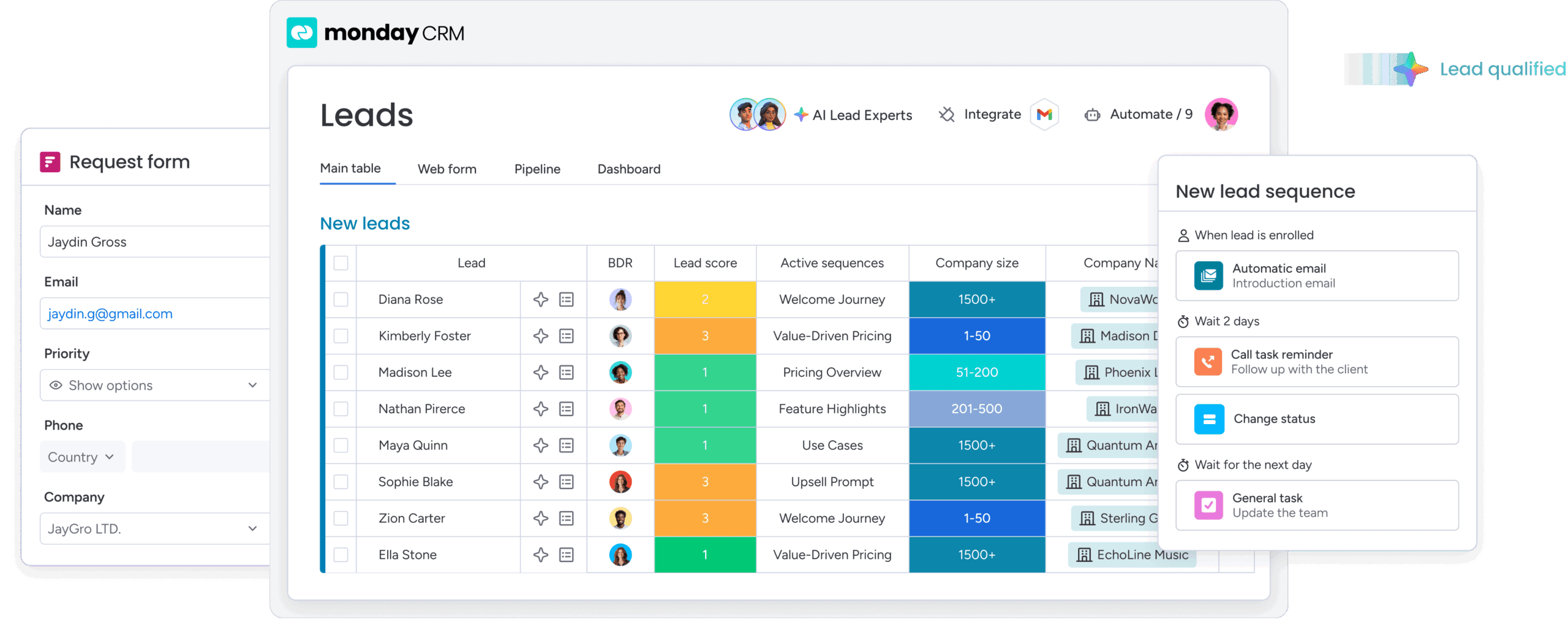
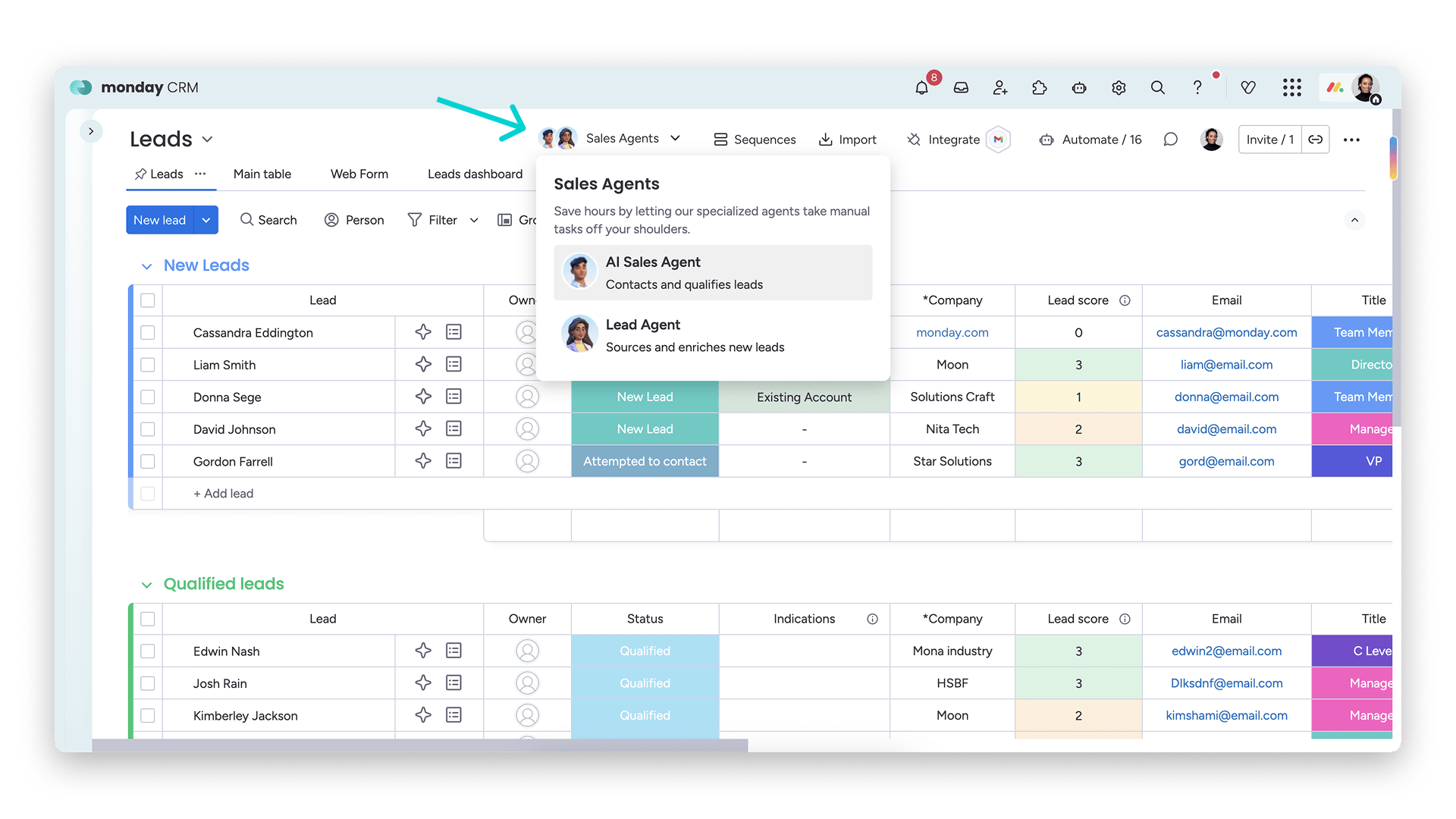
With monday CRM, you get AI agent capabilities natively within your existing sales environment, eliminating the complexity of managing multiple disconnected tools. Your team gets intelligent automation without leaving the platform they already use daily.
Here’s what makes monday CRM’s AI agent approach different:
- Native integration means zero context-switching: Agents work directly within your CRM boards, so your team maintains complete visibility while automation handles execution in the background.
- No-code configuration puts control in your hands: Sales leaders and ops teams configure agent behavior, qualification rules, and messaging frameworks without technical resources or IT involvement.
- Unified data environment ensures accuracy: Agents access the same contact records, activity history, and deal information your team uses, eliminating data sync issues that plague bolt-on solutions.
- Transparent decision-making builds trust: See exactly why agents scored leads, sent specific messages, or escalated opportunities — no black box algorithms.
- Flexible workflow automation adapts to your process: Configure agents to match how your team actually works instead of forcing your process into rigid templates.
Start building your AI-powered pipeline today
AI agents represent a fundamental shift in how sales teams build pipeline — and the technology is accessible to teams like yours. Success comes down to 3 essentials: quality CRM data and a well-defined ICP so agents make smart decisions, ongoing optimization as your business evolves, and the right platform that works within your existing workflows without technical complexity.
Ready to transform your lead generation with AI agents that work natively in your CRM? Try monday CRM and see how intelligent automation can generate qualified pipeline while your team focuses on closing deals.
Try monday CRMFAQs
What is the difference between AI agents and chatbots for lead generation?
Chatbots respond to website visitors using scripted conversation flows. AI agents proactively execute entire lead generation workflows — research, qualification, outreach, and decision-making based on real-time data.
How long does it take to implement AI agents for lead generation?
Most mid-market organizations deploy AI agents within 2-4 weeks, depending on ICP documentation, CRM data quality, and sales process complexity. Teams with well-documented processes and clean CRM data often finish deployment in under 2 weeks.
Can AI agents replace SDRs entirely?
AI agents handle many SDR tasks effectively but work best as force multipliers instead of complete replacements. Complex conversations, relationship building with strategic accounts, and politically sensitive situations still need human expertise and judgment.
What data do AI agents need to be effective?
AI agents require CRM data including contact records and activity history, behavioral data from website analytics and email engagement, and external data sources for company news and technology stack information. Performance correlates directly with data quality and completeness.
How do AI agents handle compliance and data privacy?
AI agents operate within configured compliance frameworks, respecting opt-out requests, communication preferences, and required cooling-off periods. Enterprise-grade platforms include built-in compliance features with audit trails and data retention controls.
What ROI can organizations expect from AI agent lead generation?
Organizations typically see significant reduction in cost per qualified opportunity, increased qualified meetings per sales resource, and measurable improvements in lead-to-opportunity conversion rates within the first quarter of deployment.

 Get started