

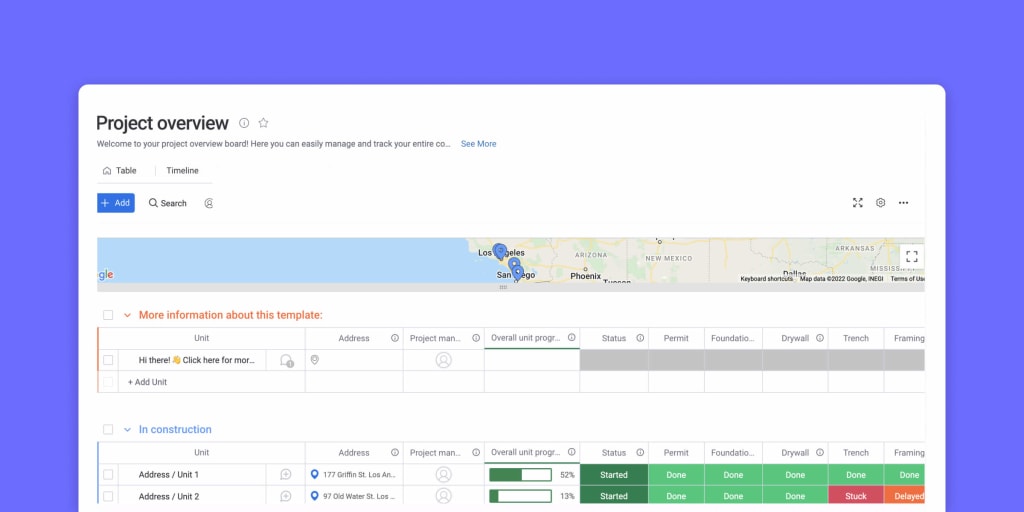
Downloadable free Excel construction templates give project managers, general contractors, and estimators a fast, familiar way to plan budgets, track schedules, and organize field data without buying new software. They’re proven, flexible, and easy to share across the office and the job site. For many crews, a well-built spreadsheet is still where a new project first takes shape.
The catch is that spreadsheets sprawl. As jobs grow, teams juggle dozens of file versions, updates get lost in email, and small tracking gaps turn into schedule slips and budget overruns. The right templates, used with a clear process, keep your numbers and timelines under control from bid to closeout. And when your projects outgrow static files, monday AI Workspace takes those same templates live, turning manual tracking into connected boards with real-time dashboards, automated alerts, and AI that flags risk before it spreads, so your data works harder than a spreadsheet alone ever could.
Key takeaways
-
Free Excel construction templates cover every phase: estimating and budgeting, scheduling, daily reporting, and closeout logs
-
Structure beats guesswork: a consistent template turns scattered notes into repeatable, comparable records across every project
-
Spreadsheets have real limits: manual updates, version conflicts, and no automated alerts create risk as projects scale
-
Choose templates by phase and role: match each template to the decision it supports, whether that’s pricing a bid or tracking cost variance
-
monday AI Workspace extends Excel templates: it adds live dashboards, no-code automations, and AI that flags risk, so your data works harder than a static file can
What are free Excel construction templates?
You can download free Excel construction templates from software vendors, industry associations, and template libraries that publish them without a paywall. They’re pre-built spreadsheets, formatted for construction work, that you fill in with your own project data. Each one gives you ready-made columns, formulas, and layouts for a specific job, so you don’t start from a blank sheet.
A construction template standardizes how you capture information. Instead of every estimator or superintendent inventing a format, the whole team records costs, dates, and field notes the same way. That consistency makes reports easier to read and helps you spot problems early.
Because Excel is already on nearly every office machine, these templates carry almost no adoption cost. Your team knows how to enter a value, sort a column, and share a file. That familiarity is exactly why so many construction workflows still begin in a spreadsheet, even at large firms.
The most useful templates map to real construction tasks. Here are the types you’ll reach for most often:
-
Budgeting template: tracks planned spend against actual costs by line item
-
Timeline or schedule template: sequences tasks, durations, and deadlines across the project
-
Checklist template: confirms that steps, inspections, and handoffs actually happen
-
General contractor checklist: covers permits, subcontractor coordination, and site readiness in one place
-
Daily report template: logs crews, weather, deliveries, and work completed each day
-
Submittal log: tracks the status of shop drawings, samples, and approvals
-
Schedule of values: breaks the contract sum into billable line items for progress billing
-
Material list: itemizes quantities, unit costs, and suppliers for procurement
Why use free Excel construction templates?
Templates do more than save setup time. They protect your margins, your records, and your team’s alignment when a project has hundreds of moving parts. A good template also captures hard-won knowledge, so lessons from your last job carry into the next. Here’s where they earn their place.
Help you manage your financial and time budget
Cost and schedule control is the heart of construction management, and templates give you a running view of both. A budget template shows variance the moment actual costs drift from your estimate, so you can act before a small gap widens. The stakes are real: McKinsey’s July 2025 review of more than 300 billion-dollar-plus megaprojects found average cost overruns of roughly 80% and schedule delays of about 50%. Those figures describe megaprojects specifically, but the lesson scales down: disciplined tracking keeps time and money on plan.
Store and keep track of important documentation
Construction generates a constant stream of records, from daily reports to submittals and change orders. A template gives each document a consistent home and format, so anyone can find and read it. Manual spreadsheets carry a real risk here, though: when files get emailed around, version control breaks down, and updates get lost, leaving crews working from stale numbers.
Keep your team organized
A shared template sets one clear structure for how work gets recorded and reported. Estimators, superintendents, and office staff all read the same columns and speak the same language. That shared format reduces confusion and keeps everyone focused on the same priorities.
Standardize repeatable workflows
Most construction work repeats across projects, and templates capture that repeatable structure. Once you’ve refined a daily report or a schedule of values, you reuse it on the next job instead of rebuilding it. Standardizing your workflows also makes it faster to onboard new team members and compare performance across projects. When every job follows the same structure, a new estimator or superintendent can be productive quickly instead of learning a fresh format each time.
Eight downloadable free Excel construction templates to try
Each template below solves a specific problem at a specific project phase. Use this list to build a starter set that covers estimating, scheduling, field tracking, and closeout. Match each one to the decision it supports.
You don’t need every template on day one. Start with the two or three that address your biggest current headache, then add the rest as your process matures. The set below works well together, so data from one can inform the next.
-
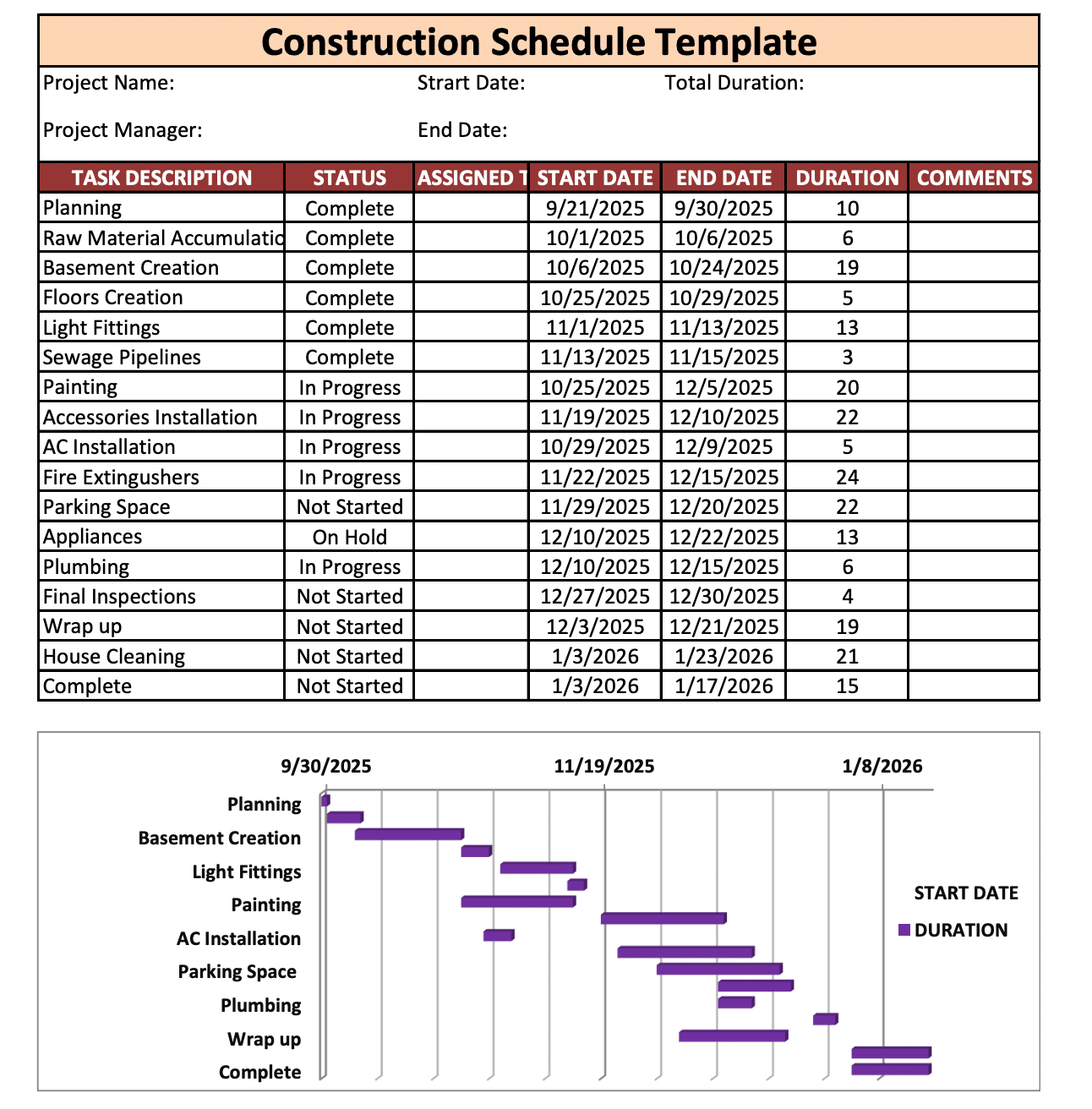
Construction schedule template: free Excel templates for residential construction schedules exist, and a good one maps every task, duration, and dependency from foundation to final walkthrough. Many include a Gantt chart so you can see overlapping trades and the critical path at a glance. Use it at kickoff to sequence work, then update it weekly to keep your project timeline honest

-
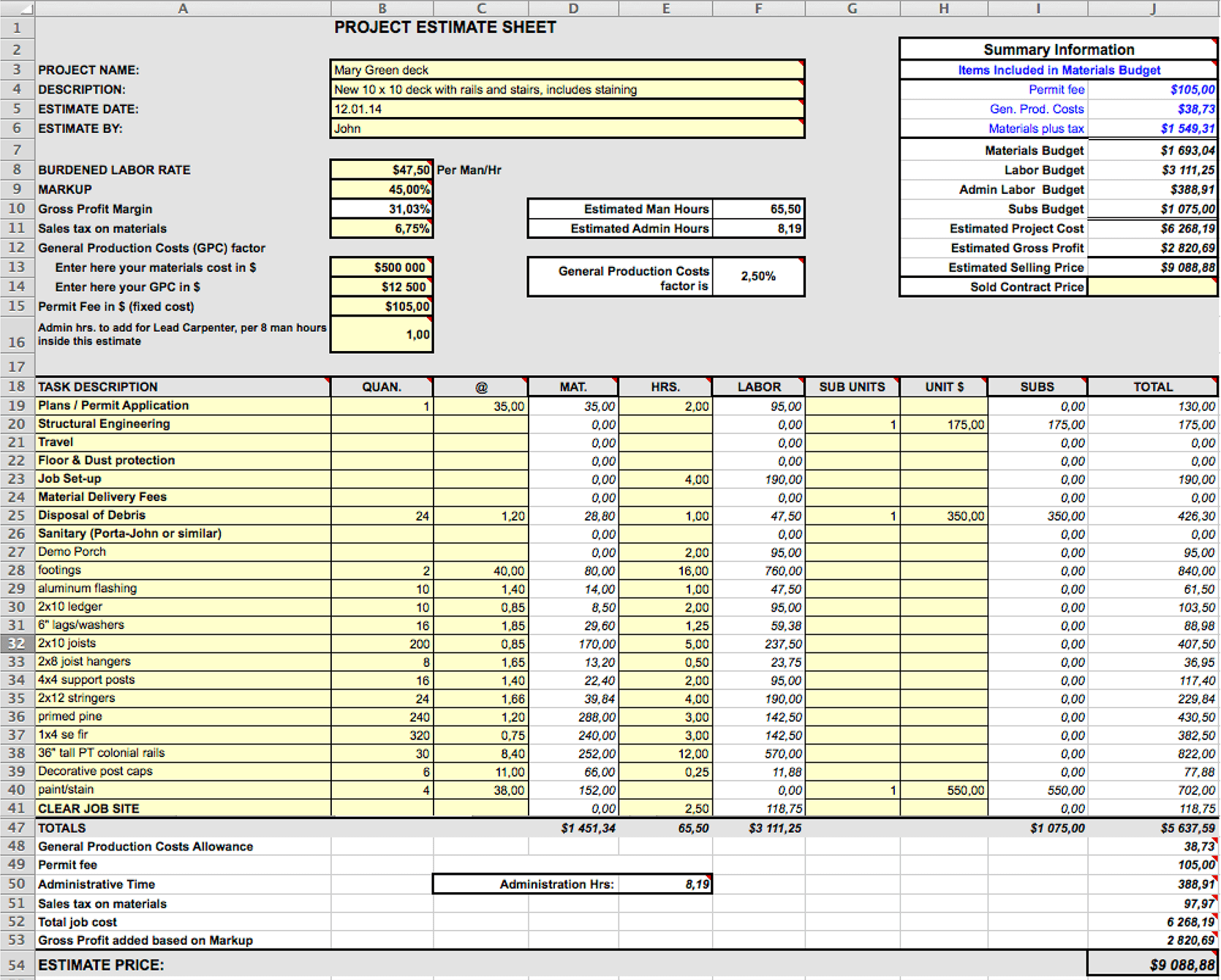
Labor and materials cost estimate template: this template breaks a job into quantities, unit costs, and totals for both labor and materials. It gives estimators a structured way to price work and compare supplier quotes. Use it during bidding to build an accurate number, then again during buyout to check that actual costs hold
-
Construction budget template: a budget template tracks planned spend against actual cost by line item and flags the variance. It turns your approved estimate into a live control document for the whole project. Use it throughout the job to catch overruns early and defend change orders with clear records
-
Construction project management and tracking template: this template consolidates tasks, owners, statuses, and due dates so you can see the whole project in one view. It’s the backbone for coordinating trades and reporting progress to owners. If you outgrow the spreadsheet, a dedicated construction project tracking template or a construction roadmap template gives you the same structure with live updates
-
Construction daily report template: a daily report captures crews on site, weather, deliveries, equipment, and work completed each day. It’s your first line of defense in a dispute and a running record of productivity. Use it daily so you document gaps and delays while the details are fresh
-
Submittal log template: a submittal log tracks shop drawings, product data, and samples through review and approval. It shows what’s outstanding, who owns it, and when it’s due. Use it to keep approvals from becoming the reason a trade misses its start date
-
Schedule of values template: a schedule of values breaks the total contract sum into billable line items tied to completed work. It’s the basis for progress billing and payment applications. Use it to bill accurately, track earned value, and keep cash flow steady across a long project
-
Construction material list template: a material list itemizes every quantity, unit cost, and supplier your project needs. It supports procurement, ordering, and delivery scheduling in one place. Use it to avoid both shortages that stall crews and over-ordering that ties up cash
How to create a construction schedule in Excel
You create a construction schedule in Excel by listing every task in order, assigning durations and dates, then linking dependent tasks so the timeline updates as work shifts. Follow these steps to build one from scratch.
-
List your tasks: break the project into phases, then into the specific tasks each phase requires, from site prep to punch list
-
Set durations: estimate how many days each task takes, using past projects and crew capacity as your guide
-
Add start and end dates: enter a start date for the first task, then calculate end dates from duration for each row
-
Map dependencies: note which tasks can’t begin until others finish, so a delay in one shows its downstream impact
-
Assign owners: add a column for the responsible crew or subcontractor to keep accountability clear
-
Build a visual timeline: use bar charts or conditional formatting to turn your date columns into a readable Gantt view
-
Update weekly: record actual progress against planned dates so the schedule stays a decision-making document, not a static plan
Keep the schedule in a shared location and set one owner for updates. That habit prevents the version conflicts that make spreadsheet schedules drift out of date. It also gives your crews one trusted place to check what’s next, which cuts down on the calls and texts that eat a superintendent’s day.
As the job progresses, protect your original plan by saving a baseline before you start editing dates. Comparing actual progress against that baseline shows you whether you’re gaining or losing time, and by how much. That comparison is the earliest warning you’ll get that a deadline is at risk.
How to choose the right construction template
The right template depends on your phase and the decision you need to make. Start by naming the problem, then pick the template built to solve it. The table below maps common template types to their best use and the columns that matter most.
|
Template type |
Best for |
Key columns |
|---|---|---|
|
Construction schedule |
Sequencing tasks and deadlines |
Task, start date, end date, duration, dependencies |
|
Budget template |
Tracking cost against estimate |
Line item, budgeted, actual, variance |
|
Cost estimate |
Bidding and pricing work |
Item, quantity, unit cost, total |
|
Daily report |
Logging field activity |
Date, crew, weather, work done, delays |
|
Submittal log |
Tracking approvals |
Submittal number, description, status, due date |
Once you’ve matched the template to the task, check that it fits how your team already works. A template you’ll actually maintain is more useful than a more detailed one that nobody updates. Look for clear column headers, formulas that automatically calculate totals and variance, and enough room to add fields as the project grows.
It also helps to think about the full set, not one file at a time. Your estimate should feed your budget, and your budget should tie back to your schedule of values. When your templates share the same structure, moving data between phases takes minutes instead of a full rebuild.
Limitations of free Excel construction templates
Free Excel templates are a strong starting point, and knowing their limits helps you plan around them. Most of these constraints show up as a project scales and more people depend on the same file. Here’s what to watch for so you can stay ahead of them.
-
Manual updates: every number and date changes only when someone types it in, which takes time and invites errors
-
Version control: keeping field and office copies in sync is hard when files travel by email and live on different machines
-
No automated alerts: a spreadsheet won’t tell you when a task slips or a budget line crosses its threshold
-
Limited real-time collaboration: most Excel files aren’t built for many people to edit and trust the same data at once
-
No live dashboards: turning raw rows into a current, visual picture of progress means rebuilding charts by hand
None of these limits make spreadsheets a poor choice. They simply mark the point where a connected platform can carry the same data further, keeping it accurate and visible as your projects grow. The signal to watch for is effort: when maintaining the file takes more time than the file saves, it’s worth exploring a platform that keeps your data live.
How monday AI Workspace goes beyond Excel construction templates
Growing construction teams face a challenge: a static file can’t keep pace with a live job. When crews, costs, and approvals all change daily, manual updates and scattered versions start to cost you time and money. That’s where a connected platform changes the picture, giving you the structure of a template plus the movement of real work. Purpose-built construction management software keeps the same data you’d track in Excel accurate, shared, and always current.
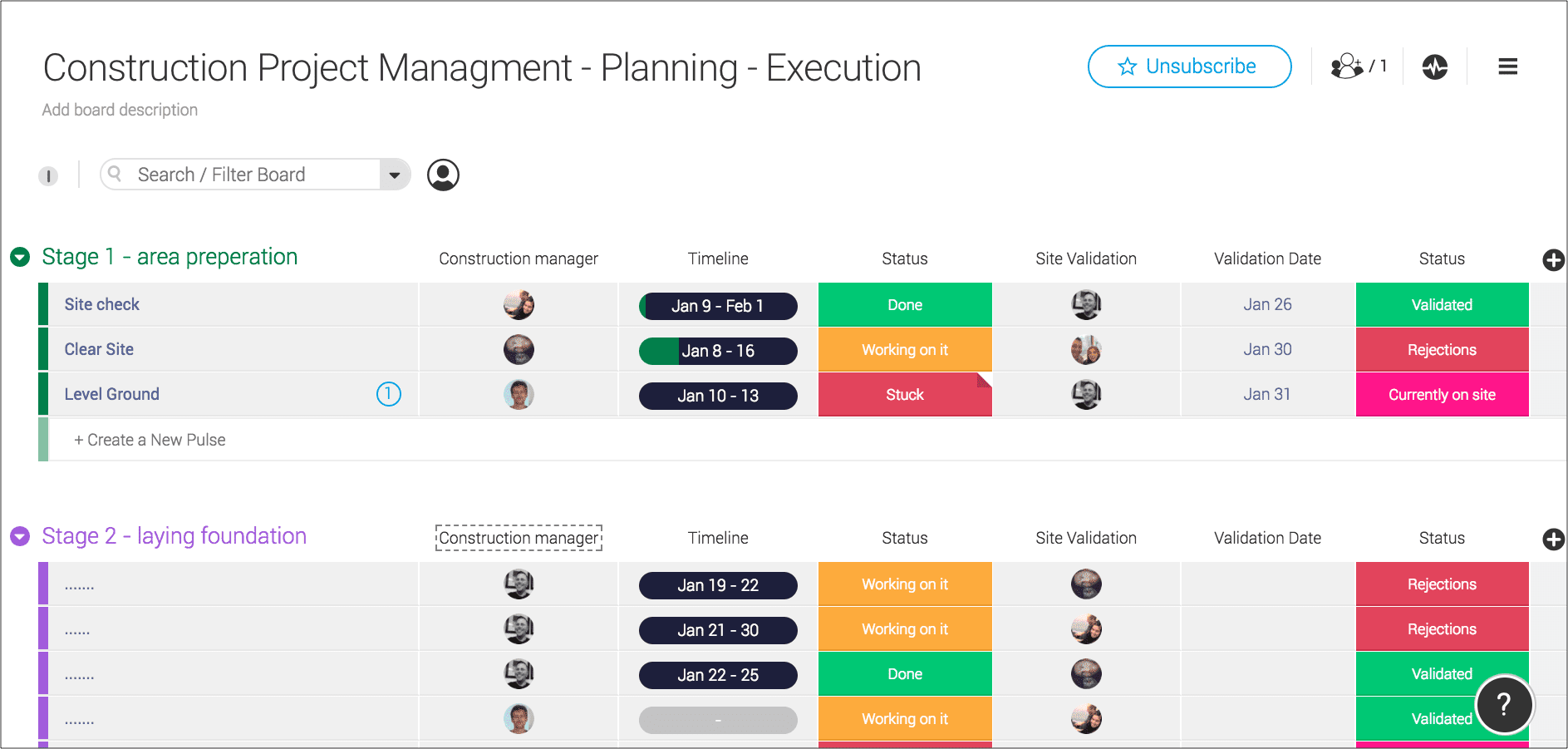
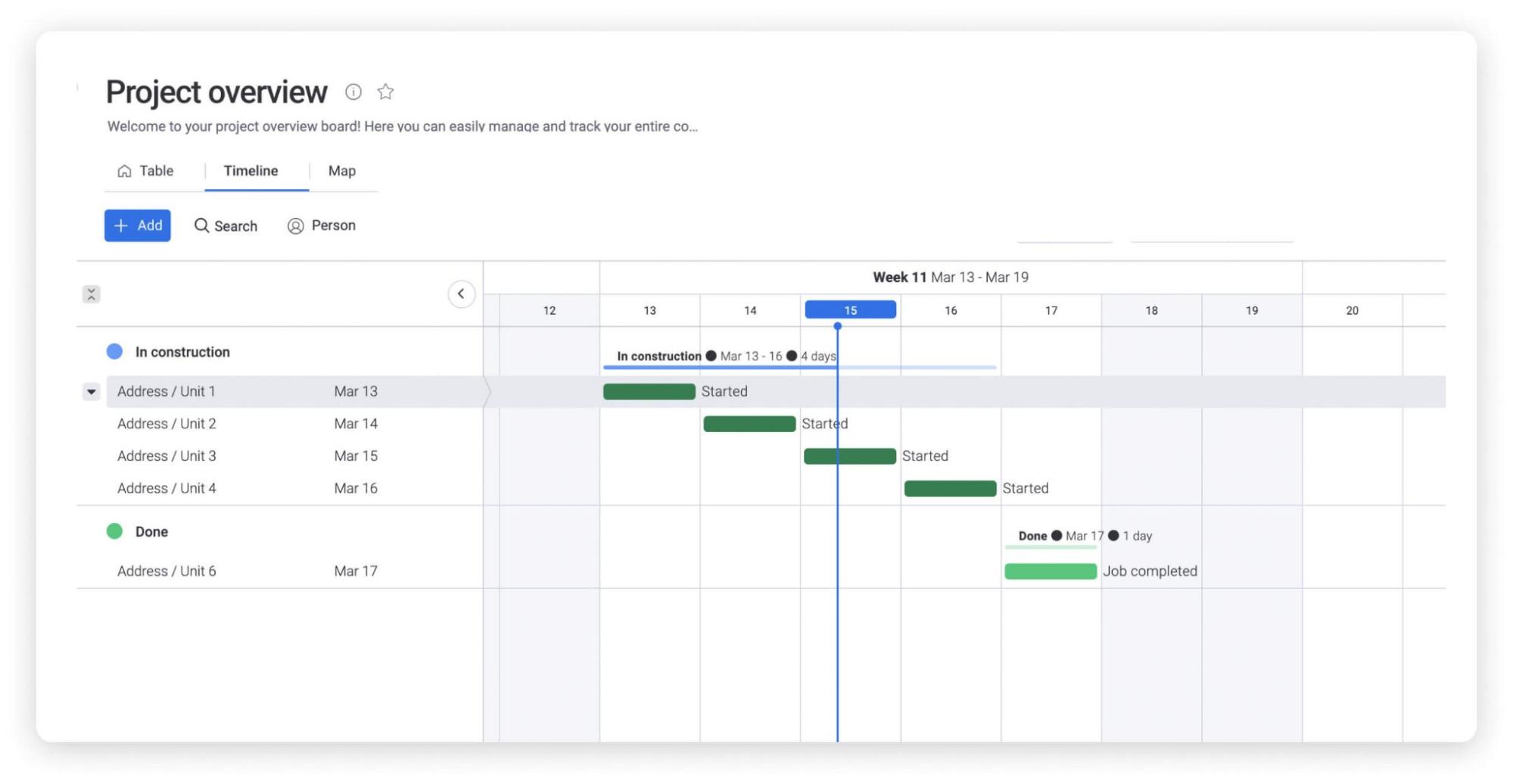
monday AI Workspace starts with the scheduling depth field teams need. You get Gantt views with task dependencies, baselines, critical path, and milestones, so a shift in one trade shows its full downstream impact. You can view the same project through 15+ board views, including Kanban, Timeline, Calendar, Workload, and Map, and give each role the view that fits their work.
Reporting turns live as well. Dashboards pull from 10+ widgets to show budget versus actual, workload, and progress in real time, so owners and PMs can rely on one current source of truth. Instead of rebuilding charts by hand each week, you watch the numbers update as your team logs work. No-code automations handle the manual chase: they send alerts when a task slips, a budget line crosses a threshold, or a submittal comes due. Templated boards let you launch a new project with your standards already built in, and 200+ integrations connect the rest of your stack, including importing your existing Excel sheets so nothing gets left behind.
Intake and documentation stay in the same place, too. WorkForms captures RFIs and field requests as structured items on your boards, so a field request lands as a trackable item instead of a buried email. Workdocs keeps specs, meeting notes, and plans connected to live data, updating as the underlying board changes. For teams standardizing their construction management, that means fewer handoffs between a document and the work it describes.
AI is woven through it all, and it works alongside your team rather than replacing anyone. monday sidekick acts as a context-aware assistant that can summarize a project, build a dashboard, or draft a report from a plain-language request; Sidekick keeps you in control with approvals on impactful changes. monday agents add task-specific workers that fire on triggers and run end-to-end: a Risk Analyzer, for example, can watch your boards and surface schedule or budget risk before it spreads, and Agents refer their findings back to your team to decide. With monday vibe, you describe the app you need in plain language and Vibe builds it natively on your data, whether that’s a custom submittal tracker or a budget dashboard. And monday MCP connects assistants like Claude or ChatGPT to your workspace, so they can read and act on your project data within your existing permissions.
The table below sums up how a static template and a connected platform handle the same construction work:
|
Capability |
Free Excel construction template |
monday AI Workspace |
|---|---|---|
|
Scheduling and Gantt |
Manual Gantt built from date columns and charts |
Gantt views with dependencies, baselines, critical path, and milestones |
|
Budget tracking |
Formulas calculate variance when someone updates the sheet |
Live budget versus actual that updates as work is logged |
|
Real-time collaboration |
Limited; files are emailed and copies drift out of sync |
One shared source of truth across field and office |
|
Automated alerts |
None; you spot slips by scanning the file |
No-code automations flag slipped tasks, budget thresholds, and due submittals |
|
Dashboards and reporting |
Charts rebuilt by hand each reporting cycle |
Dashboards with 10+ widgets refresh in real time |
|
Document and RFI intake |
Requests arrive as emails and separate files |
WorkForms captures RFIs as trackable items; workdocs stay tied to live data |
|
AI assistance |
None |
Sidekick, Agents, Vibe, and MCP work alongside your team on project data |
Building a connected construction workflow
Your goal on every project is the same: finish on time, on budget, and with a clean record you can stand behind. Downloadable free Excel construction templates get you moving quickly and bring structure to estimating, scheduling, and field tracking. They’re a smart, low-cost foundation for any crew, and for many projects they’ll take you a long way.
As your projects grow, that foundation can grow with you. Moving your templates onto a connected platform keeps the same data live, shared, and watched by AI that flags risk early, so people and agents move each job forward together. Start with the templates you need today, and you’ll have a clear path to the connected construction workflow you’ll want tomorrow. Whichever stage you’re at, the aim stays the same: keep your budgets, schedules, and records accurate enough to trust when the pressure’s on.
FAQs
Does Excel have free construction templates?
Yes, Excel has free construction templates available through Microsoft's template gallery, software vendors, and industry template libraries. You can find pre-built spreadsheets for budgets, schedules, estimates, daily reports, and more. Download the one that fits your phase, then customize the columns and formulas to match your project.
How do you track construction costs?
You track construction costs by recording every budgeted line item, then logging actual spend against it as the job progresses. A budget template calculates the variance so you can see overruns early. For live tracking across a team, an automatically updating dashboard keeps everyone working from current numbers.
What is the best free Excel template for estimating construction costs?
The best free Excel template for estimating construction costs is a labor and materials cost estimate template with columns for item, quantity, unit cost, and total. It gives estimators a structured way to price work and compare quotes. Choose one that separates labor and materials so you can pinpoint where costs move.
How does monday AI Workspace handle construction templates?
monday AI Workspace turns static templates into live, connected boards with Gantt scheduling, real-time dashboards, and automated alerts. You can import existing Excel sheets and launch new projects from templated boards. Your data stays current and shared across field and office, rather than locked in separate file versions.
Can AI help build a custom construction tracker?
Yes, AI can help build a custom construction tracker. With monday vibe, you describe the tracker you need in plain language, and it builds a working app natively on your data, such as a submittal tracker or a budget dashboard. You stay in control of permissions and how you share the app.
Is construction management software worth it over free templates?
Construction management software is worth it when spreadsheets can't keep pace with live projects. The global construction management software market was valued at $7.7 billion in 2025 and is projected to reach $16.4 billion by 2033, a 10.2% CAGR that signals rapid digital adoption. For growing teams, that shift reflects real gains in visibility and control.
 Get started