


Planning a trip should feel exciting, not like another project to manage. But between comparing flights, sorting through hotel options, and figuring out what’s actually worth doing, it can quickly start to feel overwhelming. AI agents change that by acting as your behind-the-scenes travel team, taking care of the details while you focus on the experience itself.
These digital assistants can research destinations, build itineraries, track prices, and even uncover hidden gems that match your style of travel. The beauty is that you can build your own crew — each agent with its own specialty — working together to make planning effortless.
In this guide, we’ll explore the best AI agents for trip planning in 2026, what makes them stand out, and how to use them to transform travel prep from a chore into part of the adventure.
Key takeaways
- Turn trip planning into a team effort: AI agents can split travel planning into focused roles, handling flights, accommodation, itineraries, and budgeting so no single task feels overwhelming.
- Get more than recommendations: the best AI travel agents don’t just suggest ideas, they connect details across dates, locations, and preferences to keep plans consistent and realistic.
- Travel your way, not a template’s: AI agents can be tailored to your personal travel style, whether you prioritize cost, comfort, food, flexibility, or packed itineraries.
- Start simple, then go deeper: most AI travel tools let you begin with basic planning and gradually add more advanced features as trips become more complex.
What makes the best AI travel planning agent?
A great AI travel planner feels less like a tool and more like a skilled teammate who understands how you like to travel. Picture one agent focused on finding the perfect flight, another uncovering hidden local gems, and a third keeping an eye on your budget — all working together to build a trip that fits you perfectly.
The best agents learn your habits and adapt on the fly. They can spot a flight delay before you do, suggest a quicker route, or find a last-minute dinner reservation when plans change. It’s like having a travel assistant who always knows your next move.
What separates a truly helpful agent from a glorified search bar comes down to capability. A top performer can:
- Understand natural conversation and respond intuitively.
- Connect to real-time data for the most accurate options.
- Streamline booking so you never leave the chat.
You stay in charge of the vision — your AI team simply handles the details.
Evaluating the best AI trip planner tools: our method
Not every AI travel tool that promises a seamless trip can actually deliver one. To find the standouts, we put each platform through a hands-on review that focused on how well it performs in real-world use, not just in polished demos.
We looked at how these agents respond to natural requests, adapt on the fly, and turn vague ideas into organized plans that make sense. Speed, accuracy, and personalization all mattered — but so did the experience of using them. If a platform made planning feel more complicated, it didn’t make the cut.
The result is a shortlist of tools that genuinely help you plan smarter, travel smoother, and spend less time buried in tabs.
Top 9 AI gents for planning your perfect trip
After running our real-world travel tests, a handful of standout platforms proved they can actually make planning effortless. These AI agents go beyond surface-level suggestions — they organize flights, fine-tune itineraries, and uncover local gems without the usual stress.
Each one brings something different to the journey. Some excel at speed and simplicity, others at depth and personalization. Whether you’re chasing the best deal, managing a family trip, or curating a once-in-a-lifetime getaway, these are the solutions that make it all click into place.
1. ChatGPT
For turning a research marathon into a simple conversation, ChatGPT excels. It’s a pro at whipping up detailed itineraries for complex trips and giving you the scoop on cultural nuances. For paid users, its new Agent Mode acts like a junior assistant that can help research and book your trip — all with you in the driver’s seat.

Use case: ChatGPT serves as a conversational travel planning assistant that creates detailed, day-by-day itineraries through natural dialogue while providing cultural insights and budget breakdowns.
Key features
- Conversational itinerary building: refine travel plans through back-and-forth dialogue, adjusting everything from pace to budget with simple follow-up questions.
- Cultural context and insights: get local customs, etiquette tips, and hidden gems that typical booking sites miss.
- Agent Mode capabilities: available on paid plans (Plus, Team, and Enterprise), this feature lets ChatGPT research, plan, and assist with booking your trip. It works with your oversight, so you’re always the one calling the shots on final bookings.
Pricing
- Free: $0/month – unlimited messages with the basic ChatGPT model, but with limited access to advanced features.
- Plus: $20/month per user – access to advanced models, faster responses, and powerful features like Agent Mode.
- Team: $25/month per user (billed annually) – includes everything in Plus, with added features for team collaboration and admin controls.
- Enterprise: contact sales – custom pricing and solutions for large organizations.
- Discounts: some are available for nonprofits.
Considerations
- Information can be outdated, especially on the free plan. Studies show 90% of AI-generated itineraries contain at least one error, so always double-check key details.
- It can create unrealistic schedules with a poor grasp of travel times, requiring you to manually fact-check the logistics.
- The most powerful features, including Agent Mode and access to the latest models, are only available to paid subscribers.
2. Google Gemini
Leveraging the full might of Google’s ecosystem, Gemini acts as a travel-savvy teammate already plugged into Maps, Flights, Hotels, and even your Gmail. It excels at weaving these services together to generate comprehensive travel plans, making it ideal for travelers who want a holistic view without juggling a dozen different apps.

Use case: Gemini taps into real-time data from Google Maps, Flights, and Hotels, and can even pull your flight and hotel confirmations straight from Gmail to build a personalized itinerary. You can also give it a screenshot of a landmark and ask it to create a walking tour around it.
Key features
- Real-time travel data: get up-to-the-minute flight prices, hotel availability, and location info directly from Google’s services.
- Personalized itinerary generation: creates detailed day-by-day plans by analyzing your Gmail confirmations and travel preferences.
- Custom AI travel agents (Gems): build your own specialized “Gems” for free to act as dedicated travel planners tailored to your specific style.
- Multi-modal planning: plan your trip using more than just text—use images, screenshots, and visual searches to get ideas.
Pricing
- Free: $0/month – basic Gemini access and the ability to create your own custom “Gems.”
- Gemini Advanced: $19.99/month – unlocks the more powerful Gemini 1.5 Pro model for handling more complex requests and higher usage limits.
- Project Mariner (Early Access): advanced trip planning automation is available through early access programs, but these are currently US-only.
Considerations
- It can still dream up restaurants or attractions that don’t actually exist, so a quick fact-check is always a good idea.
- The mobile experience can feel a bit like a scavenger hunt, sending you through multiple links to get things done.
- The most powerful automation features are still in early access and only available in the US for now.
3. Layla AI
For travelers who find inspiration visually, Layla AI merges itinerary creation with a stream of creator-generated video content. This approach makes the platform perfect for those who want both practical planning and a true feel for their destination before they even pack their bags.

Use case: Layla AI serves as a comprehensive AI travel planner that generates custom day-by-day itineraries while integrating booking capabilities and visual inspiration through travel creator content.
Key features
- Conversational itinerary creation: chat with the AI to build personalized travel plans based on your dates, budget, and interests.
- Visual destination discovery: browse interactive video maps featuring content from travel creators to get authentic destination insights.
- Integrated booking platform: book flights, hotels, and activities directly through partnerships with Skyscanner, Booking.com, and other major travel services.
Pricing
- Free plan: basic trip planning tools and itinerary creation.
- Premium subscription: $49/year for unlimited access to all advanced planning features.
Considerations
- Generated itineraries can sometimes feel generic and may require manual refinement to add depth and personalization.
- The platform heavily relies on internet connectivity with limited offline functionality for accessing your travel plans.
4. Mindtrip
Focused fully on collaborative planning, Mindtrip turns the solitary task of trip organization into a social, real-time experience for groups. The platform excels at coordinating group trips and surfacing community-driven recommendations, allowing travelers to plan together and discover hidden gems through crowdsourced insights.

Use case: Mindtrip excels at turning travel inspiration from any source — photos, links, or ideas — into detailed, shareable itineraries that groups can collaborate on in real-time.
Key features
- Start Anywhere™ planning: create custom itineraries from photos, screenshots, or any inspirational content you find online.
- Group chat integration: real-time collaboration with travel companions through built-in messaging and shared editing.
- Community recommendations: access crowdsourced suggestions and itineraries from other travelers and local experts.
Pricing
- Consumer platform: free to use with revenue generated through booking partner affiliates.
- Creator program: Earn up to $10,000/month by monetizing travel content and itineraries.
- Business packages: custom pricing available for destination larger scale marketing operations and tourism boards.
Considerations
- AI-generated itineraries can sometimes be overpacked without accounting for realistic travel times between locations.
- Booking links may occasionally time out or fail to load, requiring users to complete reservations elsewhere.
5. GuideGeek by Matador
GuideGeek meets you where you already are—WhatsApp, Instagram, and Messenger—delivering expert travel planning without requiring a new app. This platform specializes in conversational trip planning through popular messaging apps, making it ideal for travelers who want personalized itineraries with maximum convenience.

Use case: GuideGeek serves as your personal travel genius, combining AI technology with Matador Network’s extensive travel expertise to plan complete trips through simple text conversations.
Key features
- Messaging app integration: plan trips directly through WhatsApp, Instagram, or Facebook Messenger without downloading a separate app.
- Human-verified recommendations: AI responses are monitored and refined by travel experts, achieving 98% accuracy in suggestions.
- Real-time travel data: access current information on flights, hotels, restaurants, and local events with integrated booking capabilities.
Pricing
- Consumer version: free for all users.
- GuideGeek for Brands: custom pricing for destination marketing organizations and travel businesses.
Considerations
- Limited conversation memory may require repeating information during longer planning sessions.
- Requires stable internet connection and active use of supported messaging platforms.
6. TripAdvisor Trip Builder
Harnessing the collective wisdom of over a billion traveler reviews, TripAdvisor’s free Trip Builder crafts itineraries grounded in real-world experience. This tool specializes in creating personalized plans for destinations worldwide, making it perfect for travelers who want crowd-sourced insights without the hefty price tag of traditional travel agents.

Use case: TripAdvisor Trip Builder leverages the world’s largest collection of traveler reviews to generate AI-powered itineraries that surface hidden gems and authentic experiences you won’t find in generic travel guides.
Key features
- Review-powered recommendations: AI analyzes millions of authentic traveler reviews to suggest restaurants, attractions, and accommodations tailored to your interests.
- Flexible itinerary building: start with categorized suggestions, then customize your day-by-day plan with the ability to save, edit, and share with travel companions.
- Integrated booking ecosystem: seamlessly book experiences through Viator and restaurant reservations through TheFork directly from your itinerary.
Pricing
- Free access: complete trip planning service at no cost to users.
Considerations
- Limited customization options don’t account for specific budget constraints, dietary restrictions, or accessibility needs.
- Generated itineraries lack crucial logistical details like transportation between locations, walking times, or public transit options.
7. Wonderplan
With an emphasis on speed and simplicity, Wonderplan generates comprehensive itineraries from just a few initial prompts. This free platform specializes in automated itinerary generation and budget optimization, making it perfect for travelers who want a complete plan without the research hassle.
Essentially, the AI handles the heavy lifting so you can focus on the excitement of your upcoming trip.
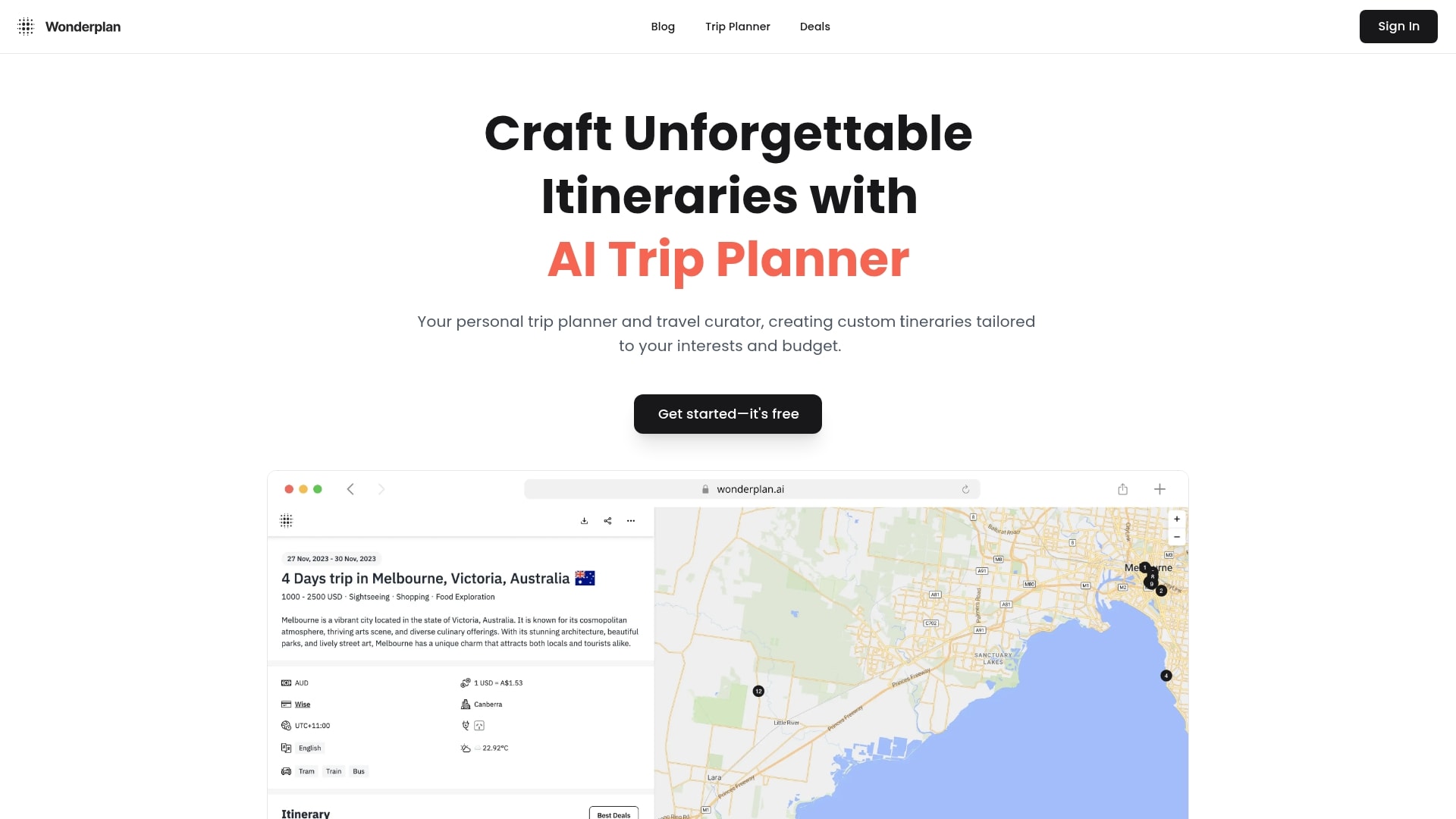
Use case: Wonderplan serves as your virtual travel agent, using artificial intelligence to create personalized day-by-day itineraries complete with activities, dining recommendations, and accommodation suggestions based on your preferences and budget.
Key features
- One-click itinerary generation: creates complete travel plans from minimal input like destination, dates, and interests.
- Budget-conscious planning: finds cost-effective combinations of accommodations, activities, and dining options.
- Real-time collaboration: allows multiple travelers to edit and discuss itineraries simultaneously for group trips.
Pricing
- Free plan: complete access to all AI trip planning features at no cost.
Considerations
- Recommendations can sometimes be generic and lack the nuanced insights of local expertise.
- No direct booking integration with major travel platforms, requiring users to book separately through external sites.
8. Kayak on ChatGPT
By integrating Kayak’s massive travel database into a conversational interface, this tool lets you find flights and hotels by simply describing what you want. The combination of Kayak’s data and ChatGPT’s conversational AI is perfect for travelers who want personalized suggestions without wrestling with complex search forms.

Use case: Kayak on ChatGPT excels at turning vague travel ideas into actionable plans through conversational queries like “Where can I party for New Year’s Eve?” or “Find me beach resorts where it’s warm in December.”
Key features
- Natural language search: ask open-ended questions about destinations, budgets, and preferences instead of filling out rigid search forms.
- Personalized recommendations: get tailored suggestions for flights, hotels, and activities based on the preferences you share during your conversation.
- Real-time pricing: access up-to-date availability and pricing information directly from Kayak’s extensive travel database.
Pricing
- Kayak’s AI Mode: free on the Kayak website (available in English to US users).
- ChatGPT Integration: requires a ChatGPT Plus subscription ($20/month) to access the Kayak GPT.
Considerations
- Limited availability: Kayak’s AI features are currently available only in English to users in the US.
- No flexible dates: cannot handle flexible date searches, which limits options for travelers with adaptable schedules.
- Text-based interface: lacks the visual richness of traditional travel websites with photos and interactive maps.
9. Gondola
Rounding off our list, Gondola operates as a strategic tool for the points-savvy traveler, optimizing hotel bookings by calculating the real value of loyalty rewards versus cash.
The platform specializes in comparing rates across 700,000+ properties, making it ideal for frequent travelers who want to squeeze every ounce of value from their loyalty programs.

Use case: Gondola serves as your AI-powered travel agent that automatically tracks loyalty points across multiple programs and finds the best hotel deals by comparing cash prices with points redemption values.
Key features
- Unified points tracking: automatically syncs with Gmail or Outlook to track loyalty points across hotel, airline, and credit card programs in one dashboard.
- Smart rate comparison: shows side-by-side cash versus points rates with cents-per-point valuations to help you make the most cost-effective booking decisions.
- Direct booking benefits: Books directly with hotels so you earn loyalty points, elite night credits, and status benefits while getting 3% back in Gondola Cash.
Pricing
- Gondola Free: free.
- Gondola PRO: $9.99/month with first two weeks free.
- Gondola for Business: contact for pricing.
Considerations
- Currently limited to hotel bookings only, with flight support still in development.
- Points tracking accuracy can sometimes lag behind specialized tools like AwardWallet, and the platform only supports Gmail and Outlook for automatic syncing.
Best free AI travel planner options 2026
You don’t need to pay upfront to see whether AI can make trip planning easier. Many travel-focused AI tools offer free tiers that let you test the basics and understand where they actually save time.
Good places to start include:
- ChatGPT for quick itinerary ideas, destination research, and refining plans through conversation
- Google Gemini for real-time flight prices, hotel availability, and location-based suggestions
- Gondola for experimenting with structured planning, letting you test simple, task-focused travel agents at no cost
Free plans usually come with limits, such as capped usage or fewer coordination features. That’s rarely a problem for planning a single trip, but frequent travelers may want more flexibility over time.
The best approach is to start free, test what genuinely reduces planning effort, and upgrade only when a solutions proves it can handle your travel style consistently.
How to use AI for travel planning like a pro
Expecting one AI to plan your entire trip is like asking a single person to be your guide, accountant, and travel agent. The best results come when you treat your AI tools as a coordinated team, each handling a specific part of the job.
You’re the project manager, setting direction and keeping everything running smoothly. Once your agents know their roles, the process becomes easier, faster, and even a little fun. Here’s how to get the most out of your digital travel team.
Give your team a clear mission
Vague requests get you vague results. Giving your AI a clear, detailed mission is the difference between a generic travel guide and a personalized itinerary that feels like it was made just for you.
Instead of ‘plan a trip to Italy,’ try this: ‘Find a 10-day cultural trip to Italy for two in September, under $3k. Focus on art and food in Rome and Florence, but skip the big tourist traps.’ Now your AI has a job it can actually do, and you get results you can actually use.
Verify and cross-reference
Your AI agents are fantastic researchers, but they don’t see the “Closed for Renovations” sign taped to the door. Treat their suggestions as a well-researched first draft, not the final word. This keeps you in control.
Always do a quick gut-check. Cross-reference flight prices on the actual airline site and scan recent reviews before booking. A few clicks are all it takes to confirm your team’s intel is solid and save you from a headache later.
Assemble your AI travel team
The quest for a single, all-knowing AI is a fool’s errand. The smartest travelers assemble a small team of specialized agents. Use one for creative brainstorming, another for price comparisons, and a third for tracking flight alerts.
This is where you become the director. Once your agents have gathered the intel, you need a way to manage the moving parts.
A platform like Gondola lets you build your own custom helpers to track bookings, manage your itinerary, and keep everything organized in one place.
AI trip planning agent capabilities
Understanding the precise capabilities of an AI travel team is key to using them effectively.
These agents are your tireless researchers, the ones who sift through endless options to build a plan that fits your budget, timeline, and that non-negotiable need for a great coffee shop.
They turn your scattered ideas —”beaches, but also culture, and no early flights” —into a perfect, actionable itinerary. They’re also the brains of the operation, but you’re still the one holding the credit card.
Where your travel team shines
AI travel agents are especially good at taking rough plans and turning them into something clear, structured, and ready to use. Instead of juggling tabs and notes, they pull everything together into one coordinated view — saving hours of manual research.
They’re particularly effective when coordinating complex trips that involve multiple destinations, tight timelines, or shifting priorities. When plans evolve or details change, AI agents can quickly rework itineraries without you starting from scratch.
They shine at:
- Itinerary building: turning ideas into day-by-day plans with timing, transport options, and logical pacing.
- Personalized recommendations: finding flights, hotels, and experiences that match your travel style, diet, and budget.
- Multi-destination planning: mapping efficient routes and transitions across cities or countries.
- Budget optimization: combining flights, stays, and activities to maximize value.
- Adapting to last-minute changes: reshuffling plans when flights move, weather shifts, or schedules change.
Where you’re still the boss
AI travel tools are excellent planners, but they’re not decision-makers. They surface options, flag trade-offs, and keep everything organized — while you remain in control of the final outcome.
You’re still responsible for:
- Final bookings: AI agents don’t complete purchases or manage payments.
- Price confirmation: fares and availability can change between planning and checkout.
- Local verification: pop-up closures, new venues, or seasonal changes may need a quick human check.
- Travel disruptions: cancellations, delays, or emergencies still require your judgment.
- Group decision-making: resolving competing preferences often needs a human call.
The sweet spot is partnership: AI handles the planning pressure, while you make the calls that matter. That balance is what makes AI travel planning powerful — without giving up control
Frequently asked questions
Can AI travel agents book flights and hotels directly?
No, most AI agents act as powerful research assistants that find the best options and send you to the booking site to finalize. They handle the legwork, but you always have the final say on the booking.
Which AI trip planner works best for budget travelers?
Some of the best AI trip planners for budget travelers are Wonderplan, Trip Planner AI, and Skyscanner because they help optimize itineraries while tracking costs and finding cheaper travel dates. These tools use AI to suggest affordable activities, compare flights and hotels, and generate personalized itineraries that stay within your budget.
How accurate are AI recommendations for international travel?
AI is highly accurate for planning itineraries and finding attractions. However, you should always personally verify critical details like visa requirements and local travel advisories.
Do AI travel planners work for last-minute trip planning?
Yes, AI agents are perfect for last-minute trips because they generate complete itineraries in minutes. Their speed makes spontaneous travel planning fast and stress-free.
Can AI help plan trips for travelers with disabilities?
You can instruct your AI agent to find accessible options, but it's crucial to verify those details directly with venues and hotels. Use the AI for initial research, then confirm personally.
How do AI travel planners handle group travel with different preferences?
Most AI travel planners let you collect and balance multiple preferences by analyzing each traveler’s input, such as budget, interests, and pace. The best tools use this data to create itinerary options that work for everyone, suggesting compromises or parallel activities when needed.

 Get started