


Flight confirmations buried in your inbox. Hotel details saved in a note-taking app. Restaurant recommendations scattered across group chats. Planning a trip or event should feel exciting, but it often turns into a search for details across too many places.
An itinerary template solves that problem by giving you one reusable structure for every moving piece. Instead of starting from scratch each time, you can add your dates, destinations, accommodations, transportation, activities, and notes into a clear framework. The result is a trip plan that keeps everyone aligned and makes important details easier to find when needed.
In this guide, you’ll learn what an itinerary template should include, explore different itinerary template types for travel, business, events, and daily planning, and walk through the steps to create your own. You’ll also see how monday.com’s AI Work Platform can help turn itinerary planning into a collaborative workflow with customizable boards, timelines, dashboards, automations, and real-time updates.
Whether you’re coordinating a family vacation, a multi-city business trip, or a company offsite, the right itinerary template gives you a planning system you can reuse again and again.
Get started with monday.comKey takeaways
- A well-built itinerary template saves time by giving every trip, event, or schedule a reliable starting point
- The best itinerary template depends on the occasion. Business travel, vacations, flights, events, and daily schedules each need different fields and levels of detail
- A useful itinerary template should include dates, times, transportation, accommodations, activities, budget information, emergency contacts, and notes
- monday.com’s AI Work Platform helps teams and groups manage itineraries in one connected workspace with boards, timelines, dashboards, automations, integrations, and AI-powered support
What benefits can you get from an itinerary template?
Compared to a static paper or printed itinerary, an itinerary template helps streamline the process of creating detailed schedules.The templates are pre-formatted, which saves you the time of setting up tables in documents or finessing fonts to ensure the information is easy to scan. Plus, using an itinerary template ensures all information is accessible via a single document.
For example, someone planning a business trip can use a travel itinerary template to input travel, lodging, and transportation details into a single document. The completed template is saved in Google Sheets, Outlook, or another program. When your employee heads out on their business trip, they can easily access their itinerary to verify details in one simple step.
Depending on the trip type, itineraries vary in structure. For each kind of trip, you may have specific categories you’d like to add. Often, it helps to get an idea of existing templates before choosing or creating one.
There are several types of itinerary templates
Itineraries or itinerary planners can cover events from business trips to vacations. Travelers or professionals can use them for professional meetings or weekends on the town with friends. Here are a few scenarios you could use one.
Business trip itinerary template
Business trip itinerary templates leave space for information such as travel dates, flight times, airport and lodging locations, and transportation details. Business trip itineraries are especially helpful for employees and clients traveling in unfamiliar cities, states, and countries thanks to the ability to input specific information.
Pre-formatted fields allow anyone to add times and locations for business meetings and planned events.
Flight itinerary template
Flight itinerary templates are pre-formatted with sections to input passenger names, flight dates, flight times, flight numbers, and gate numbers. When applicable, these itineraries might also include meal preferences along with connecting flight and ground transportation information. Flight itinerary templates are helpful tools for business trips, vacations, and personal travel.
Vacation itinerary template
Vacation itinerary templates let you input every detail of your upcoming vacation in chronological order, starting with travel dates and flight information. Vacation itinerary templates provide pre-formatted sections for hotel and lodging, transportation, and activities and events. A vacation itinerary helps travelers stay on schedule with planned activities, and it serves as a reliable point-to-point guide.
For those wanting customizable, easy-to-use itinerary templates, there’s another option. You may want to look for a tool that helps you manage trips with one click and keep notes and itinerary-related documents in one place.
monday.com offers flexible, customizable itinerary templates
monday.com’s itinerary template helps you stay on track when organizing business trips, personal travel, business meetings, and daily schedules. Whether you manage a team of professionals or run a small business from home, our itinerary template is designed to help you streamline scheduling processes by:
- Starting with a format: An existing format allows you to enter information right away without having to think about formatting. Each time you create an itinerary with a template, you may save seconds or even minutes, and that efficiency can add up.
- Consolidating information: Keep all notes, important files, and travel requirements in a single location, ensuring easy, on-demand access for trip planners and travelers alike.
- Creating reusable structure: Access and reuse information for future itineraries. Book a similar business trip or host another webinar on the same topic without reinventing the wheel.
All of monday.com’s templates are customizable and easy to integrate into Google Sheets for enhanced flexibility.
Knowing where you’re going and what you have to do there is sometimes half the battle of travel or attending an event. But a few other tools can be equally as valuable as itinerary templates in keeping you organized. That’s why monday.com offers many other customizable templates that pair well with itinerary tools.
A few related templates
Related templates that can serve as supplemental documents for itinerary templates include expense reports, conference agendas, and vacation planning templates. Similar to itinerary templates, these related templates help users create precise documents. Here’s a rundown on how these templates can help organize your schedules and track your expenses.
Expense report template
An expense report template is a pre-formatted spreadsheet that lets you input your business or personal expenses. While specific details can vary, expense report templates typically include sections for payment dates, amounts paid, subtotals, and payment methods. Often used in conjunction with budget templates, expense report templates let employers and individuals create and maintain easily accessible, accurate financial records.
Conference agenda template
Conference agenda templates let users input dates, times, locations, and event details for business conferences. These templates are often used hand-in-hand with business trip itinerary templates to help ensure employees and clients adhere to daily schedules. Specific template designs and graphics can vary, but most conference agenda templates feature pre-formatted sections that include opening ceremony details, public speaker details, meal break details and times, and activity details.
Vacation planning template
Vacation planning templates are often used with vacation itinerary templates. A vacation planning template generally includes preformatted sections and columns designated for budgeting, along with headers for travel dates, locations, and activities. Some vacation planning templates include separate sections for vacation itineraries so users have access to every detail in a single document.
How to create a travel itinerary template in seven steps
Creating an itinerary template is easier when you follow a clear process. The goal is to gather your information once, organize it into a format you can reuse, and ensure everyone involved can access the latest version.
Step 1: Define trip dates and destinations
Start with the basics: travel dates, departure city, destination or destinations, and the overall purpose of the trip. These details form the backbone of your itinerary template.
If you are planning a multi-city trip, list each destination in order. If you are planning an event, list the event date, venue, setup times, and key schedule blocks. If you are planning business travel, add meeting dates and locations early so the rest of the itinerary can be built around them.
Step 2: Research activities, attractions, and logistics
Once the dates and destinations are clear, research what needs to happen at each stop. Look up opening hours, travel times, ticket requirements, local holidays, restaurant availability, and weather considerations.
For business travel, this may mean checking client office locations, meeting times, transportation options, and expense policies. For vacations, it may mean researching tours, restaurants, neighborhoods, and must-see attractions.
Doing this research early helps you avoid overbooked days and unrealistic travel windows.
Step 3: Choose your itinerary template format
The best format depends on how complex the trip is and how many people need access.
A simple document may work for a solo weekend trip. A spreadsheet can work for budget-heavy planning or group comparisons. A travel app can be helpful for personal travel details. A work management platform is often better when multiple people need real-time access, shared updates, timelines, budgets, and task ownership.
If the itinerary will change often, choose a format that is easy to update and share.
Step 4: Build a day-by-day structure
Create a section, row, or group for each day of the trip or event. Include the date, location, main activities, travel windows, and any notes for that day.
For a vacation itinerary template, you might include morning, afternoon, and evening blocks. For business travel, you might organize the day around meetings and transportation. For an event itinerary, you may need hour-by-hour timing.
The structure should make the plan easy to scan. Someone should be able to look at the itinerary and quickly understand where they need to be and when.
Step 5: Add transportation and accommodation details
Add the details people usually scramble to find: flight numbers, train times, rental car pickup details, hotel addresses, confirmation numbers, check-in times, and transfer information.
This is one of the most useful parts of any itinerary template. When these details are stored in one place, no one has to search through email confirmations at the airport, hotel lobby, or venue entrance.
Step 6: Build in buffer time
Travel rarely goes exactly as planned. Flights get delayed, traffic builds, check-ins take longer than expected, and group coordination always takes more time than one person traveling alone.
Add buffer time between major activities, especially when changing locations. For most trips, 30 to 60 minutes between important events gives you room to adjust without throwing off the entire day.
Buffer time is not wasted time. It is what keeps the itinerary realistic.
Step 7: Share the itinerary and keep it updated
Once the itinerary is built, share it with everyone who needs it. Make sure they can access the latest version, especially if plans are likely to change.
Avoid emailing a static file that becomes outdated as soon as a flight changes or a reservation moves. A shared, editable itinerary gives everyone the same view and reduces the “Can you send me that again?” cycle.
Get started with monday.comHow to plan and manage itineraries with monday.com’s AI Work Platform
Planning a trip in a static document works until details start changing. A flight time shifts, a hotel confirmation comes in late, someone adds a dinner reservation, or a travel companion asks for the check-in time again.
When itinerary planning involves multiple people, changing details, and real budgets, monday.com’s AI Work Platform gives teams and groups a more connected way to manage the plan.
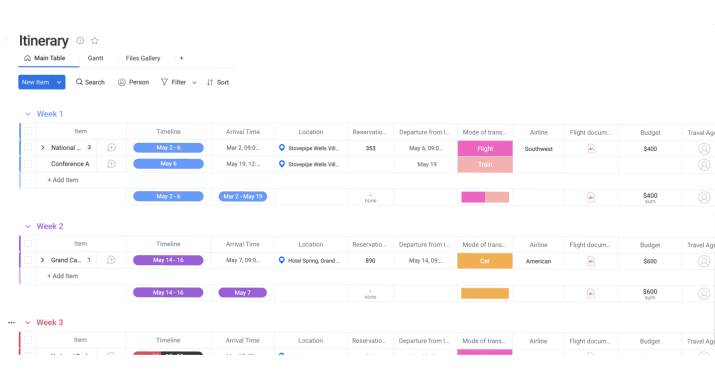
Customizable templates give you a head start. Pre-built itinerary boards include columns for dates, locations, transportation, status, and budget. You can add, remove, or rearrange columns to match your trip’s unique needs. Instead of reformatting a spreadsheet every time, you start with a ready-made structure and customize from there.
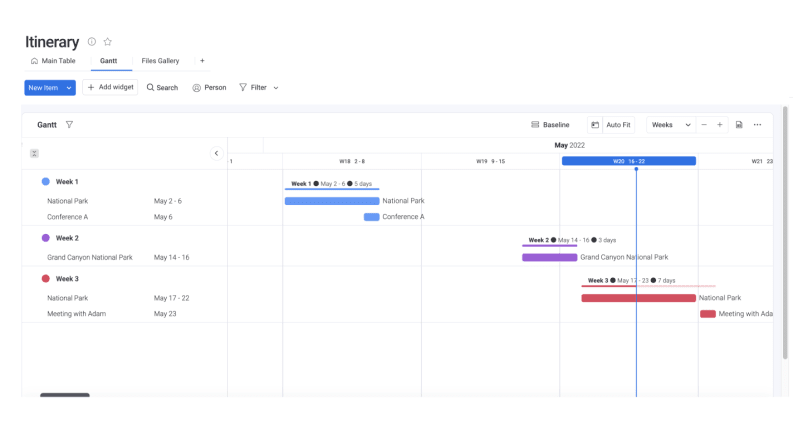
Timeline and Gantt views let you visualize multi-day itineraries chronologically. You can see overlapping activities, spot scheduling conflicts, and drag items to adjust timing without switching between tabs or manually recalculating dates. For complex trips with dependencies (a hotel checkout that must happen before an afternoon flight, for example), Gantt views make the sequence obvious at a glance.
Automations handle the repetitive parts of trip coordination. Set up rules to auto-notify travel companions of schedule changes, send departure reminders the night before, or flag overdue bookings that need attention. With 200+ automation recipes available, you can automate as much or as little as your trip requires.
Dashboards provide a real-time overview of your entire trip. Budget tracking widgets show spending against your plan, status summaries highlight what is confirmed versus pending, and you can share dashboard views with anyone who needs visibility without giving them edit access to the full board.
Integrations connect your itinerary to the platforms you already use. Pull booking confirmations from Gmail or Outlook directly into your board, sync events with Google Calendar, and share updates through Slack. With 200+ native integrations, your itinerary stays up to date without manual effort.
monday workdocs let you embed boards into planning documents, combining narrative notes (restaurant research, packing lists, travel tips) with structured itinerary data. It is one workspace where both the overview and the details live side by side.
monday vibe takes a different approach entirely. Describe your trip in natural language — “a 5-day family road trip through Northern California with two kids” — and AI builds a custom itinerary app for you. For a deeper look at how AI trip planners are changing travel planning, explore the latest tools and capabilities available. No coding, no configuration. You get a tailored workspace in seconds and refine it from there.
monday agents automate scheduling, meeting coordination, and trip logistics with AI agents that work in the background. Need to coordinate arrival times across five travelers in different time zones? An agent can handle the back-and-forth and update the board when everything is confirmed.
Get started with monday.comFAQs
What should an itinerary template include?
An itinerary template should include dates and times, transportation details, accommodation information, activities and events, budget tracking, emergency contacts, and notes or documents. For business travel, it may also include meeting details, client addresses, expense categories, and travel policy notes.
How detailed should a travel itinerary be?
A travel itinerary should be detailed enough to keep important logistics clear, but flexible enough to allow changes. Flights, hotels, reservations, meetings, and ticketed activities should be specific. Free time and optional activities can stay more flexible.
What is the difference between an itinerary and an itinerary template?
An itinerary is a complete travel or event plan with specific dates, bookings, and activities. An itinerary template is the reusable structure behind that plan. You can use the same template for multiple trips by updating the details each time.
Can I use an itinerary template for business and personal travel?
Yes. An itinerary template can be adapted for both business and personal travel. For business trips, include meeting details, client information, travel policies, and expense categories. For personal trips, focus on transportation, accommodations, activities, dining, budget, and notes.
How do I share my itinerary with travel companions?
The easiest way to share an itinerary is through a cloud-based document or collaborative platform where everyone can access the latest version. In monday.com, you can share a board or dashboard, set permissions, and keep travel companions or team members updated in real time.
How does monday.com help with itinerary planning?
monday.com helps with itinerary planning by giving teams customizable boards, timeline and Gantt views, dashboards, automations, integrations, and AI-powered support. You can manage trip details, owners, deadlines, budgets, documents, and updates in one connected workspace.

 Get started