


Think of an orchestra where every musician is a virtuoso but nobody’s holding a baton. That’s what most organizations look like today when it comes to AI: marketing has an agent scoring leads, IT has one triaging tickets, sales has one summarizing calls, all skilled, none in sync. AI orchestration is the conductor that turns those solo performances into a coordinated symphony of work. Orchestration connects your agents, your data, and your workflows into one unified system. Rather than a collection of AI experiments running in separate departments, you get agents that hand off work to each other, share context across teams, and keep people in control at the decisions that matter.
Here’s what we’ll cover: how AI orchestration works, the key components involved, and the patterns that make it work across departments. You’ll also find real-world examples across marketing, sales, IT, PMO, and customer support. By the end, you’ll have a practical foundation for evaluating what coordinated AI actually looks like inside your organization with monday agents.
Key takeaways
- Orchestration is what makes AI actually work at scale: Individual AI agents are useful alone, but an orchestration layer connects them so their work adds up to real business outcomes across every team.
- Governance isn’t optional, build it in from day one: Define what each agent can access and do, set human approval checkpoints, and log every action before your first workflow goes live.
- Start small, then expand: Pick one workflow that crosses at least two departments, prove the value, then use that foundation to scale across the organization.
- Your data quality determines your results: Agents working with incomplete or inconsistent data will produce wrong answers fast, audit and clean your data sources before deploying any orchestration.
- A unified AI Work Platform accelerates orchestration for every team: With ready-made agents for marketing, sales, IT, HR, and PMO, plus a no-code builder for custom needs, teams can deploy coordinated AI workflows without writing a single line of code.
What is AI orchestration?
AI orchestration is the coordination layer that manages multiple AI agents, models, and automated workflows so they work together instead of operating in silos. It determines which agent handles which part of a process, passes context between them, enforces rules, and ensures the overall workflow produces a coherent outcome.
Picture a conductor leading an orchestra. Each musician is skilled on their own, but without a conductor coordinating tempo and transitions, you get noise instead of music.
AI orchestration takes individually capable agents and turns their combined effort into coordinated, purposeful work.
AI orchestration sits above individual AI agents and automations. Where a single agent might score leads, summarize meetings, or draft content, orchestration manages the bigger picture:
- Which agent activates first
- What data it receives
- How its output feeds into the next agent’s work
- What happens when something goes wrong along the way
It handles conditional logic, error recovery, and dynamic re-routing across multiple steps, data sources, and departments.
Here’s why that distinction matters. “Using AI” might mean deploying a chatbot or automating a single process. AI orchestration is about coordinating multiple agents (autonomous software programs that can perceive, decide, and act on specific objectives) across connected workflows. The orchestration layer manages how they interact, so their combined output delivers more than any single agent could alone.
How does AI orchestration work?
Integration provides the raw material. Workflow sequencing puts it to use. Governance keeps everything safe and accountable.
Step 1: Connect AI across platforms and data sources
Orchestration begins by connecting AI agents to the data and systems they need. Most organizations store information across CRMs, project boards, communication channels, documents, and spreadsheets. These systems rarely connect on their own. That means people and agents working within them only see a fraction of the full picture.
Here’s a concrete example:
- A sales team’s CRM contains deal data
- The marketing team tracks campaign performance on a separate board
- Customer support logs tickets in yet another system
With orchestration in place, an AI agent analyzing pipeline health gains visibility beyond CRM data. With orchestration, that same agent can cross-reference marketing engagement signals and support ticket sentiment to produce a complete picture of whether a deal is healthy or at risk.
The foundation that makes this possible is a shared data layer; a structured, unified pool of information that gives AI agents cross-departmental context. Instead of each agent operating within a single platform, a shared data layer lets agents see across the entire organization. Richer context means more useful outcomes.
Step 2: Sequence AI actions across multi-step workflows
Orchestration manages sequences of AI actions that span multiple steps and teams. A single business outcome like launching a product requires research, content creation, approval routing, campaign scheduling, and performance tracking. AI orchestration breaks this into discrete steps, assigns each to the right agent, and manages the handoffs between them.
Here’s how an orchestrated product launch workflow unfolds:
- A research agent scans competitor activity and summarizes findings into a structured brief.
- A content agent drafts campaign messaging based on those findings, aligned with brand guidelines and target audience.
- The orchestrator routes the draft to a human reviewer for approval, pausing the workflow until sign-off.
- Once approved, a scheduling agent publishes the campaign across channels with the correct timing and targeting.
- An insights agent monitors performance post-launch and flags anomalies, like a sudden drop in engagement or an unexpected spike in a specific segment.
The orchestrator manages the transitions between steps, ensuring each agent receives the output of the previous one as input. Here’s the difference between orchestration and simple automation:
- Traditional automation follows a fixed path: “when X happens, do Y.”
- AI orchestration handles conditional logic (if the reviewer rejects the draft, route it back to the content agent with feedback), error recovery (if the scheduling agent encounters a publishing failure, retry or alert a human), and dynamic re-routing (if performance data suggests a different channel is outperforming, adjust the distribution).
Step 3: Enforce governance and oversight at every stage
Orchestration includes a governance layer that controls what agents can and cannot do. Without governance, scaling AI across departments introduces real risk. Agents could access sensitive data, make unauthorized changes, or produce outputs that conflict with compliance requirements. Orchestration embeds these controls directly into the workflow instead of adding them later.
Three governance concepts form the backbone of responsible orchestration. These help you evaluate whether an orchestration approach can scale safely:
- Permissions: Each agent operates within defined boundaries, accessing only the data and systems it has been authorized to use. A marketing content agent, for example, can read campaign performance data but cannot modify financial records or HR files.
- Human-in-the-loop checkpoints: Critical decisions or high-stakes actions require human approval before the orchestrator proceeds. Publishing customer-facing content, approving budget allocations, or escalating a service incident to a client all benefit from a human review step built into the workflow.
- Audit trails: Every action taken by every agent is logged, creating a transparent record of what happened, when, and why. If a question arises about how a decision was made or a record was changed, the audit trail provides a direct answer.
These controls aren’t optional add-ons. They’re structural requirements for any organization that wants to scale AI responsibly. Governance embedded in the orchestration layer means that every new agent and every new workflow inherits the same standards automatically.
Key components of an AI orchestration layer
An AI orchestration layer includes several interconnected components, each with a distinct role. These components help you evaluate platforms, design workflows, and anticipate where complexity will emerge as you scale.
The orchestrator
The orchestrator is the central decision-making engine. It receives incoming requests or triggers, determines which agents to activate, sequences their actions, and manages the flow of data between them. Think of it as an air traffic controller: it doesn’t fly the planes, but it decides which plane takes off, when, and in what order. It reroutes traffic when conditions change.
The orchestrator handles three core functions:
- Routing logic: Deciding which agent is best suited for a given step based on the type of work, the data involved, and the current state of the workflow.
- Error handling: Determining what happens when an agent fails or returns an unexpected result — whether to retry, escalate to a human, or reroute to an alternative agent.
- State management: Keeping track of where a workflow currently stands, which steps are complete, which are in progress, and what data has been produced so far.
Without the orchestrator, agents operate independently. With it, they work as a coordinated system.
Specialized AI agents
Specialized agents are purpose-built to handle specific types of work. Unlike a general-purpose AI assistant that tries to do everything, each specialized agent has a defined role and access to relevant knowledge. Orchestration’s power comes from combining these specialists into coordinated workflows where each agent contributes its expertise.
Common categories of specialized agents:
- Research agents: Scan external sources to monitor trends, competitors, or market conditions. They gather and structure information that other agents or people use to make decisions.
- Reporting agents: Summarize data, generate status updates, and distribute reports. They turn raw information into digestible formats for stakeholders at every level.
- Insights agents: Analyze patterns across datasets and flag risks or opportunities. They surface what matters before it becomes urgent.
- Process optimization agents: Identify redundancies, suggest improvements, and clean up outdated data. They keep workflows lean and accurate over time.
Learn more: Types of AI agents
Shared context and state management
Shared context is a common pool of information that all agents in an orchestrated workflow can access. State management tracks the current status of a workflow: which steps are complete, which are in progress, and what data has been produced.
If a lead scoring agent identifies a high-priority prospect, the shared context ensures that the follow-up scheduling agent knows the lead’s score, the account history, and the sales rep assigned — without requiring a human to manually transfer that information. The scheduling agent picks up exactly where the scoring agent left off.
Shared context prevents agents from operating in silos:
- Without it: Every agent needs its own data pipeline, its own integrations, and its own understanding of the current situation.
- With it: Agents collaborate like teammates who share the same project board.
Policy engine and guardrails
The policy engine enforces organizational rules. This includes data access policies, action permissions, and compliance rules that ensure outputs meet regulatory or internal standards.
Guardrails prevent agents from taking actions outside their authorized scope. A guardrail might prevent a content-generating agent from publishing directly to a customer-facing channel without human review. Another might restrict a data analysis agent to read-only access on financial boards. These boundaries are configured once and enforced automatically across every workflow the agent participates in.
Observability and monitoring
Observability is the ability to see what every agent is doing in real time and review what it has done historically. Monitoring dashboards track agent performance, workflow completion rates, error frequencies, and resource usage, giving operations teams a real-time view of how orchestration is performing across the organization.
As organizations scale from a few agents to dozens or hundreds, observability becomes essential. It’s how you:
- Identify bottlenecks (an agent that consistently takes too long)
- Debug failures (a workflow that stalls at a specific handoff)
- Continuously improve orchestrated workflows based on real performance data rather than guesswork
AI orchestration vs. AI agents and workflow automation
AI orchestration overlaps with several related concepts. AI agents, workflow automation, and MLOps all play roles in the broader AI ecosystem, but they serve different purposes. Understanding where orchestration fits helps you make informed decisions about what your organization actually needs.
The following table provides a quick comparison. Use it as a reference point as you evaluate which capabilities your organization requires:
| Dimension | AI orchestration | AI agents |
|---|---|---|
| Primary function | Coordinates multiple agents and workflows into unified outcomes | Performs specific autonomous actions within a defined scope |
| Scope | Cross-department, multi-agent, multi-step | Single-agent, single-domain |
| Decision-making | Dynamic routing, conditional logic, adaptive sequencing | Autonomous within its defined role |
| Human involvement | Strategic oversight, checkpoint approvals | Minimal once configured |
| Best suited for | Coordinating AI at enterprise scale across teams | Automating specific repeatable actions |
AI orchestration vs. AI agents
AI agents are the individual workers; AI orchestration is the system that coordinates them. An agent can score leads, summarize meetings, or draft content independently — it’s skilled at its specific job. Orchestration determines when each agent activates, what data it receives, and how its output feeds into the next step of a larger process.
Think of it this way:
- An AI agent is like a skilled specialist on a team: a designer, an analyst, or a researcher.
- AI orchestration is the project manager who assigns work, manages dependencies, and ensures the specialists’ contributions add up to a finished deliverable.
You need both, but the orchestration layer is what turns individual capability into organizational impact. Without it, you end up with a collection of capable agents that don’t talk to each other, each producing good work in isolation, but with nobody connecting the dots between them.
AI orchestration vs. workflow automation
Traditional workflow automation follows rigid, predefined rules: “when X happens, do Y.” It works well for repetitive, predictable processes, like sending a welcome email when a new contact is added, or moving an item to “Done” when a checkbox is marked. These automations are valuable, but they don’t adapt when conditions change.
AI orchestration adds intelligence to this foundation. It can evaluate conditions, choose between multiple possible next steps, adapt when circumstances shift, and coordinate AI agents that make autonomous decisions within their scope.
Here’s the practical difference:
- Workflow automation routes every new support ticket to the same queue.
- Orchestrated workflow has an AI agent classify the ticket by intent and urgency, route it to the appropriate team, check the knowledge base for existing solutions, and escalate to a human only if the agent cannot resolve it.
The orchestrated version handles variability; the automated version handles repetition.
AI orchestration vs. MLOps
MLOps (machine learning operations) focuses on the lifecycle of machine learning models: training, testing, deploying, and monitoring them in production. It’s a discipline for data science and engineering teams who build the AI models themselves.
AI orchestration operates at a higher level. It coordinates the agents and workflows that use those models to accomplish business objectives. MLOps ensures a model works correctly; orchestration ensures the model’s output gets routed to the right agent, combined with the right context, and delivered to the right person at the right time. These are complementary disciplines; MLOps powers the engine, orchestration drives the car.
Benefits of AI orchestration for cross-functional teams
The value of AI orchestration becomes most apparent when organizations move beyond isolated AI experiments and deploy agents across multiple departments. A single agent handling a single process delivers incremental gains. Orchestrated agents working across the organization deliver compounding impact.
Scalability from pilots to enterprise-wide operations
Most organizations start with a single AI pilot: one agent handling one process in one department. The challenge is scaling from that pilot to dozens of agents working across the entire organization. Without orchestration, each new agent requires custom integration, manual data handoffs, and ad hoc governance.
AI orchestration provides the infrastructure to scale without chaos. New agents plug into an existing framework with shared context, predefined policies, and established monitoring. The governance, data access, and observability that worked for your first five agents work for your fiftieth.
Cross-department coordination and real-time visibility
Orchestration enables agents in different departments to share context and coordinate actions in real time. When a sales agent updates a deal stage, a marketing agent can automatically adjust campaign targeting. When an IT agent resolves a service ticket, a PMO agent can update the project status.
Orchestration provides a single view of all AI activity across the organization, so leaders can see what agents are doing, where workflows are stalled, and how AI is contributing to business outcomes.
Built-in governance and compliance
Orchestration embeds governance into the workflow itself rather than treating it as a separate layer. Every agent action is logged, every data access is permissioned, and every critical decision includes a human checkpoint.
Without built-in governance, scaling AI increases exposure to data breaches, unauthorized actions, and compliance violations. 32% of organizations’ data security incidents now involve generative AI tools, according to Microsoft’s 2026 Data Security Index. With orchestration, governance scales alongside the agents.
Faster execution through parallel agent workflows
Orchestration can run multiple agents simultaneously rather than sequentially. When steps in a workflow are independent of each other, the orchestrator launches them in parallel, compressing multi-hour processes into minutes.
During a product launch, a research agent, a content agent, and a competitive analysis agent can all work simultaneously. The orchestrator collects their outputs and passes them to the next stage together. What would have been a multi-day sequential process compresses into hours.
AI orchestration examples across departments
AI orchestration delivers the most value when it connects workflows across departmental boundaries. Each example below shows how orchestrated agents work together to produce outcomes that no single agent could achieve alone, and how the handoffs between agents eliminate the manual coordination that typically slows cross-functional work. With monday agents, teams can deploy these orchestrated workflows using ready-made agents designed for each department, all working from a shared data layer that spans the entire organization.
Try monday agentsMarketing and campaign orchestration
An orchestrated marketing workflow connects research, creation, approval, and performance monitoring into a single coordinated process. A market research agent identifies trending topics and competitor positioning, then hands off a structured brief to a content agent that generates campaign copy. The orchestrator routes drafts to a human reviewer for approval, pausing until sign-off. Once approved, an asset generation agent creates supporting visuals aligned with brand guidelines, and a performance insights agent monitors campaign metrics post-launch, flagging underperformance or unexpected trends.
Sales and CRM orchestration
An orchestrated sales workflow keeps the pipeline accurate and the team focused without requiring manual data entry at every step. A lead scoring agent evaluates incoming leads based on fit, intent, and engagement signals, while a duplicate detection agent identifies and merges redundant contact records. The orchestrator routes high-scoring leads to the appropriate sales rep and schedules follow-up actions. A meeting summarizer agent captures call notes and updates the CRM record automatically, while an insights agent analyzes pipeline health and flags deals at risk of stalling.
IT and service operations orchestration
An orchestrated IT service workflow reduces mean time to resolution by eliminating manual triage and routing while ensuring SLA compliance through continuous monitoring. An intake and triage agent classifies incoming tickets by intent, urgency, and required expertise, automatically setting SLAs and matching knowledge base articles. A knowledge agent searches for existing solutions and attaches relevant articles to the ticket, resolving common requests directly when possible.
Project management and PMO orchestration
An orchestrated PMO workflow gives project leaders a real-time, cross-project view without requiring manual status collection from individual project managers. A status reporter agent automatically generates project updates highlighting progress, risks, and blockers across all active projects. A risk analyzer agent proactively flags items nearing deadlines and identifies dependency conflicts that could cascade across projects. A meeting scheduler agent coordinates stakeholder check-ins by finding available times and sending invitations with relevant context attached.
Customer support orchestration
An orchestrated customer support workflow enables teams to respond proactively to at-risk customers rather than reactively after escalation. A sentiment detection agent monitors incoming tickets, emails, and feedback for negative sentiment shifts in real time. The orchestrator prioritizes flagged interactions and routes them to senior support staff with full context about the customer’s history and current issue. A response drafting agent consults the knowledge base and prepares a suggested resolution, saving the human agent research time.
5 AI orchestration patterns and when to use them
Orchestration patterns are reusable architectural approaches for coordinating AI agents. They’re standardized ways of structuring how agents interact within a workflow. Choosing the right pattern depends on the nature of the work: whether steps must happen in order, can run simultaneously, or require dynamic adaptation based on real-time conditions.
Pattern 1: Sequential orchestration
Sequential orchestration is a pattern where agents execute one after another in a fixed order, with each agent’s output serving as the next agent’s input. It works like an assembly line: each station completes its work before passing the result to the next.
- Best for: Workflows where each step depends on the previous step’s output — data collection → analysis → report generation → distribution.
- Tradeoff: Simple and predictable, but slower because steps cannot overlap.
- Choose this when: Order matters more than speed.
Pattern 2: Concurrent orchestration
Concurrent orchestration is a pattern where multiple agents execute simultaneously on independent sub-processes. The orchestrator launches them in parallel and aggregates their results once all agents complete their work.
- Best for: Workflows where multiple independent inputs are needed before a decision can be made, like gathering competitive intelligence, customer feedback, and market data simultaneously before a strategy session.
- Key benefit: If three agents each take an hour to complete their work, concurrent orchestration delivers all three outputs in one hour instead of three.
- Choose this when: Speed matters and steps don’t depend on each other.
Pattern 3: Handoff orchestration
Handoff orchestration is a pattern where one agent completes its work and transfers responsibility to the next agent, along with all relevant context. The key distinction from sequential orchestration is that handoff orchestration involves a transfer of ownership, not just data, the receiving agent takes full responsibility for the next phase of work.
- Best for: Workflows that cross departmental boundaries. Marketing qualifies a lead and hands it off to sales with full context about the lead’s engagement history, content interactions, and scoring rationale.
- Key benefit: The sales agent doesn’t just receive a data point; it receives ownership of the relationship along with everything it needs to act effectively.
- Choose this when: Work crosses team or department lines and context continuity is critical.
Pattern 4: Group orchestration
Group orchestration is a pattern where multiple agents collaborate on the same objective simultaneously, each contributing a different perspective or capability. The orchestrator synthesizes their contributions into a unified output.
- Best for: Complex decisions that benefit from multiple viewpoints, evaluating a vendor, for example, where one agent assesses pricing, another reviews security compliance, and a third analyzes customer reviews.
- Key benefit: The orchestrator combines these perspectives into a single assessment that’s more comprehensive than any individual agent could produce alone.
- Choose this when: A decision requires diverse inputs that need to be weighed together.
Pattern 5: Adaptive orchestration
Adaptive orchestration is a pattern where the orchestrator dynamically adjusts the workflow based on real-time conditions. It can re-route work, activate additional agents, or skip steps based on what is happening in the moment.
- Best for: Unpredictable workflows where conditions change frequently. Incident response is a classic example — the severity of an issue determines which agents are activated and in what order.
- How it works: A low-severity incident might only trigger a triage agent and a knowledge base search. A critical incident activates an escalation agent, an alert agent, and a post-mortem scheduling agent simultaneously.
- Choose this when: Workflows need to respond to variability rather than follow a fixed path.
How people and AI agents collaborate in orchestrated workflows
Orchestration is not about replacing people with agents. It’s about redesigning how work gets done so people and agents each contribute what they do best. The most effective orchestrated workflows are designed around a specific division of labor.
Here’s how responsibilities typically divide between people and agents in well-designed orchestrated workflows:
- People set direction: They define goals, strategies, priorities, and quality standards. These are the decisions that require judgment, context about organizational values, and an understanding of what “good” looks like beyond what data can measure.
- Agents handle execution: Research, data processing, report generation, routine communications, and monitoring are all areas where agents excel. They handle the volume, speed, and consistency-dependent work that would otherwise consume hours of human time.
- People make judgment calls: Approving high-stakes decisions, resolving ambiguities, handling situations that require empathy or creativity, and navigating the gray areas where rules don’t neatly apply remain firmly in human hands.
- Agents provide continuous coverage: They operate around the clock, monitoring for changes, risks, and opportunities that need human attention. A risk analyzer doesn’t go home at 5 PM. A sentiment detector doesn’t miss a weekend ticket.
The “human-in-the-loop” model is the practical framework that makes this collaboration work. Agents execute autonomously within defined guardrails, but the orchestrator pauses at designated checkpoints for human review and approval:
- A content agent drafts campaign copy, but a human approves it before publication.
- A lead scoring agent prioritizes prospects, but a human reviews the top-tier list before outreach begins.
This model ensures that AI amplifies human capacity without removing human judgment from critical decisions. People spend their time on strategic, creative, and relationship-driven work. Agents handle the repetitive, data-intensive, and time-sensitive work that would otherwise create bottlenecks. Together, they accomplish more than either could alone, and the orchestration layer is what makes the collaboration seamless rather than chaotic.
Learn more: AI agent orchestration
How to evaluate AI orchestration platforms
Choosing an AI orchestration platform requires evaluating capabilities that go beyond basic AI features. Gartner forecasts that 40% of enterprise applications will feature task-specific AI agents by end of 2026, up from less than 5% in 2025, but actual usage in most organizations is still in single digits. The right platform should support cross-department coordination, governance at scale, and adoption across teams with varying technical skill levels. Here’s what to look for:
- Cross-department data access: Does the platform provide a shared data layer spanning sales, marketing, operations, IT, HR, and other functions? Platforms that silo data by department turn orchestration into disconnected automations rather than a unified system.
- Governance and permissions: Can administrators define role-based permissions, require human approval at critical stages, access complete audit trails, and rely on compliance certifications like SOC 2 Type II, ISO 27001, GDPR, and HIPAA?
- Integration capabilities: Does the platform support open protocols like MCP (Model Context Protocol) for connecting external AI assistants, plus 200+ native integrations with existing business systems?
- Adoption readiness: Can business users configure agents and workflows through no-code builders and natural language interfaces, or does setup require consultants and developers? Platforms with low barriers to entry — including free plans for testing — enable adoption across the organization rather than limiting it to teams with technical resources.
7 best practices for implementing AI orchestration
Successful AI orchestration requires a deliberate implementation approach. These best practices are drawn from common patterns in organizations that have scaled AI from isolated experiments to enterprise-wide operations.
Start with a focused, well-defined workflow
Begin with a single, well-understood workflow rather than attempting to orchestrate across the entire organization at once. Choose a workflow that involves multiple steps, crosses at least one departmental boundary, and has measurable outcomes.
Prioritize data quality and accessibility
AI agents produce unreliable outputs when they work with incomplete, outdated, or inconsistent data. Before deploying orchestration, audit the data sources agents will access. Ensure records are deduplicated, fields are consistently formatted, and data flows between systems are reliable.
Build with a modular, reusable architecture
Design agents and workflows as modular components that can be reused across different orchestrated workflows. A meeting summarizer agent built for sales should be reusable for PMO or HR without rebuilding it from scratch.
Establish governance and security from day one
Do not defer governance until after deployment. Define permissions, access controls, human-in-the-loop checkpoints, and audit requirements before the first agent goes live.
Invest in observability early
Implement monitoring and logging from the start, not after problems emerge. Track agent performance, workflow completion rates, error frequencies, and data quality metrics from the first workflow you deploy.
Train teams to orchestrate AI alongside their work
Orchestration changes how teams work, not just what software they use. Invest in training that helps team members understand how to interact with agents, when to intervene, and how to interpret agent outputs.
Iterate from assistance toward full autonomy
Start with agents that assist people, suggesting actions, drafting outputs for review, flagging items for attention, and gradually increase agent autonomy as trust and confidence build.
Orchestrate AI agents across every department with monday agents
Throughout this guide, we’ve covered the principles, patterns, and best practices of AI orchestration. Implementing orchestration in practice requires a platform purpose-built for cross-department coordination, one where agents, data, and people operate within a single connected system.
monday agents brings AI orchestration to life across your entire organization. Teams can deploy coordinated workflows that span marketing, sales, IT, PMO, HR, and operations without writing code. Agents work from a shared data layer that gives them cross-functional context, so the output of one team’s AI work becomes the input for another’s.
Ready-made agents for every department
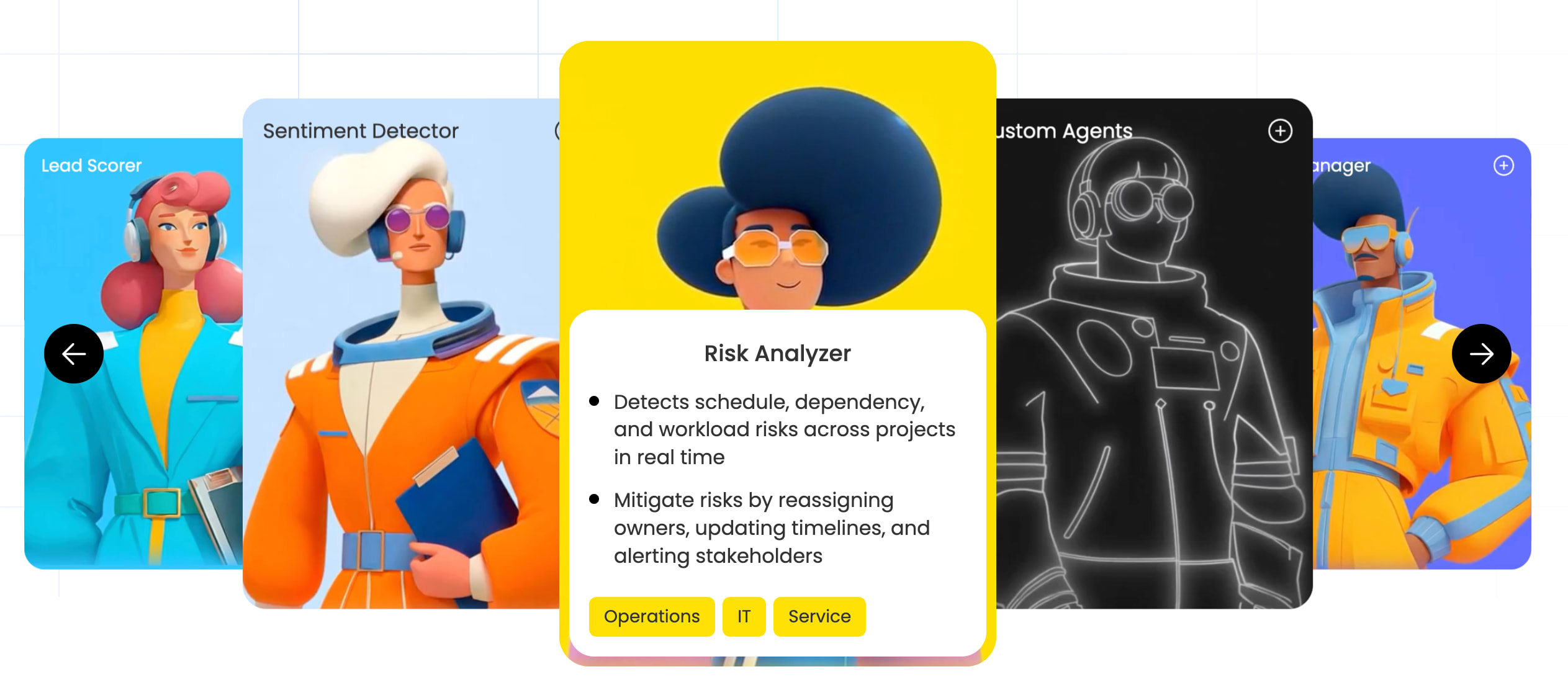
monday agents includes specialized AI agents designed for common workflows across marketing, sales, IT, PMO, product, and HR. Each agent handles specific tasks autonomously while keeping people in control of critical decisions. Marketing teams deploy a Competitor Research Agent that tracks competitors and consolidates signals into structured snapshots. Sales teams use a Lead Scorer that evaluates prospects using fit, intent, and engagement signals. IT teams rely on a Ticket Assignment agent that detects intent, urgency, and required expertise to route requests.
No-code custom agent builder
For workflows beyond ready-made agents, the mondayagents builder lets any team member create custom AI agents through a three-step process: describe the agent’s role and triggers, connect the relevant knowledge and integrations, then test and refine. Agents use the docs, PDFs, and boards you define as context, so every action is grounded in your real work and guidelines.
Cross-department context with one shared data layer
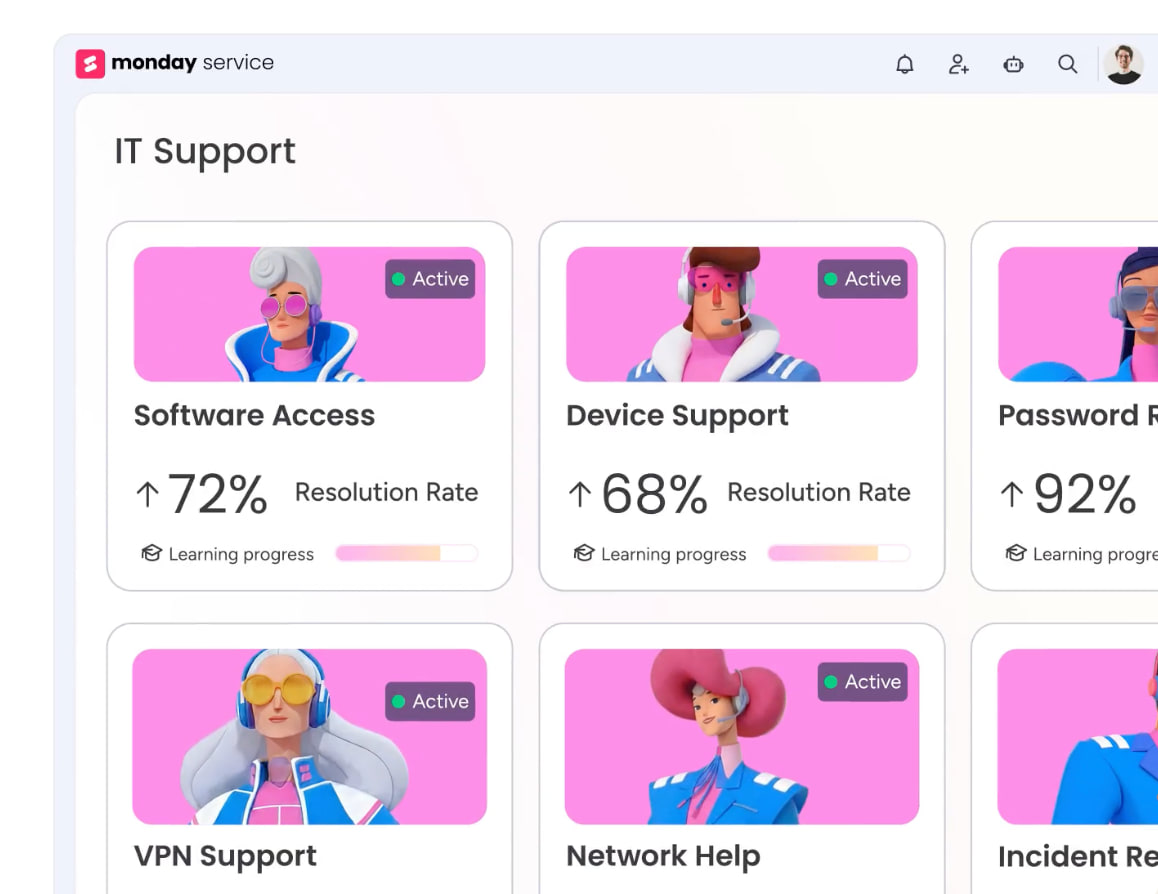
A key differentiator for orchestration on mondayagents is a structured, shared data layer that spans marketing, sales, operations, IT, HR, and every other department. An agent helping marketing can see sales pipeline data. An agent planning a sprint can see support tickets. An executive dashboard can aggregate insights from every team, all within the same system.
monday MCP for intelligent orchestration across platforms
With monday MCP (Model Context Protocol), orchestration extends beyond the platform itself. It connects external AI assistants like Claude, ChatGPT, Microsoft Copilot, Cursor, and others to monday agents workspaces through a secure, standardized protocol. Generate sprint summaries and team performance reports directly from boards. Ask for rollups across Product, Marketing, and Operations boards and get answers that span departments.
Enterprise-grade trust and transparent governance
Governance and trust capabilities on monday agents are built directly into the orchestration experience. Explicitly decide what each agent can and cannot do, both inside monday agents and across external integrations. Define exactly which data each agent can access and whether it can edit, create, or only read information. SOC 2 Type II, ISO/IEC 27001, ISO/IEC 27701, GDPR, and HIPAA certifications provide enterprise-grade security foundations.
How to move from fragmented AI experiments to organization-wide impact
Most organizations run AI experiments in pockets: a lead scoring agent here, a content generator there, a chatbot in support. The real opportunity lies in connecting them.AI orchestration is the coordination layer that connects agents, data sources, and people into a system where one team’s AI output becomes another’s input. Organizations that orchestrate AI across departments will outpace those that deploy it in silos.
Despite more than $250 billion invested in AI globally in 2025, only 25% of companies say AI is having a transformative impact, according to the World Economic Forum. Adding AI without coordinated workflows rarely delivers organization-wide results. monday agents provides the shared context, governance, and adoption readiness to make orchestration work across every department.
Try monday agentsFAQs
How much does AI orchestration cost to implement?
Costs depend on the platform, number of agents, and scope of deployment. Some platforms, like monday.com, include AI orchestration capabilities, including MCP, at no additional cost across all plans, while enterprise-focused platforms may require significant licensing and consulting investment.
Do small businesses need AI orchestration or is it only for enterprises?
Small businesses benefit from AI orchestration when they use multiple AI agents across functions like sales, marketing, and operations. Orchestration platforms with free plans and no-code configuration make it accessible to teams of any size, not just large enterprises with dedicated technical staff.
What technical skills are required to set up AI orchestration?
Platforms with no-code agent builders and natural language configuration enable business users to set up orchestrated workflows using intuitive interfaces alone. More complex custom integrations may require API knowledge, but the core orchestration setup is designed for non-technical teams.
How long does it take to see results from AI orchestration?
Organizations typically see results from a focused initial workflow within days to weeks, depending on data readiness and workflow complexity. Scaling orchestration across multiple departments is an iterative process that compounds value over time as more agents and workflows are connected.
Can AI orchestration work with AI models and platforms already in use?
AI orchestration platforms designed with open protocols, such as MCP (Model Context Protocol), can connect to existing AI models like Claude, GPT, and Gemini, as well as existing business systems through APIs and native integrations. This allows organizations to orchestrate AI across their current technology stack without replacing existing investments.

 Get started