


Your newest hire just started today. They are sitting at their desk with a laptop, a stack of forms, and absolutely no idea where to begin. Meanwhile, their manager is scrambling to find training materials, IT is still setting up access credentials, and HR is wondering if anyone remembered to order business cards. Sound familiar?
This chaos isn’t just frustrating — it’s expensive. Poor integration can cost organizations up to twice an employee’s annual salary when they leave within the first 90 days. But when you get it right, this process becomes your secret weapon; new hires ramp faster, culture sticks, and business results follow. The difference lies in treating the experience as a journey, not a checklist.
We will show you how to design a program that actually scales. You will discover what every initiative needs, how to map a 30-60-90 day roadmap, and how to make it work for in-person and remote teams alike. This guide also covers practical steps for implementing cross-functional workflows that keep everyone aligned and accountable throughout the entire transition.
Key takeaways
- Extend the onboarding timeline beyond the first week: Real onboarding takes 90 days or more; it is about building long-term retention and ramping up productivity, not just filing administrative paperwork.
- Win the experience before day one even begins: Handle IT setup and documentation during the pre-boarding phase so new hires can focus entirely on people and culture from the very start.
- Unify the cross-functional onboarding workflow: Use monday work management to bring HR, IT, and hiring managers together in one place with automated workflows that scale as your company grows.
- Design clear, milestone-based progression roadmaps: Build the program around 30-60-90 day goals, moving intentionally from initial learning to active contributing and, finally, to full independence.
- Foster meaningful remote connections by design: Virtual onboarding requires structured video calls, welcome packages, and dedicated culture channels to replace the spontaneous office moments that happen in person.
What is the onboarding process?

Onboarding is the strategic method of integrating new employees into your team, culture, and workflows to ensure they feel a sense of belonging. This experience begins before the first day and extends through the initial 90 days and beyond, transforming new hires into productive team members who understand their roles and deliver results.
Onboarding is a long-term journey rather than a single event. While administrative paperwork is necessary, the primary goal is helping people find their place and understand their objectives so they can begin delivering value faster.
Understanding employee onboarding vs. orientation
Distinguishing between orientation and onboarding allows you to build programs that stick rather than “first days” that employees quickly forget. The table below highlights the operational differences between these two foundational stages of the employee experience.
| Aspect | Orientation | Onboarding |
|---|---|---|
| Duration | One-time event (1-2 days) | Ongoing process (3-12 months) |
| Focus | Compliance, paperwork, logistics | Role clarity, social integration, culture |
| Content | General company policies and benefits | Job-specific training and goal setting |
| Outcome | Employee is legally ready to work | Employee is productive and engaged |
| Communication | One-way information delivery | Two-way dialogue and feedback loops |
Orientation handles immediate logistics as a subset of onboarding, while onboarding builds the foundation for long-term success.
How long effective onboarding should take
Data indicates that programs lasting longer than a week drive higher retention and accelerate productivity. A well-defined timeline maintains support long after the initial “honeymoon phase” ends.
- First day: Administrative completion, hardware setup, and initial team introductions.
- First week: Role-specific training, understanding workflows, and observing cultural norms.
- 30-60-90 days: Progressive responsibility, regular feedback, and transition from learning to contributing.
- Six months to one year: For complex or leadership roles, continued mentorship and development planning.
Core components every onboarding process needs
Effective programs require several synchronized elements to remain consistent across departments. Skipping these foundational pieces can slow down new hires and frustrate hiring managers:
- Pre-boarding preparation: Activities between offer acceptance and start date, including document collection and equipment provisioning.
- Structured learning paths: Defined curricula guiding new hires through required knowledge and skills.
- Mentorship assignment: Pairing with a peer buddy provides a safe space for questions.
- Feedback mechanisms: Regular check-ins to gauge sentiment and address roadblocks early, especially considering 26% of employees reported receiving no feedback in the past year.
- Progress tracking: Digital platforms providing visibility into completed and pending activities.
Onboarding is a long-term journey rather than a single event. While administrative paperwork is necessary, the primary goal is helping people find their place and understand their objectives so they can begin delivering value faster.
Why strategic onboarding drives business growth
Most companies see onboarding as a cost. But done right, it drives revenue. Companies that invest in onboarding see real improvements in performance and it shows up in the numbers. Great onboarding changes your business in three key ways.
Accelerating time-to-productivity
Good onboarding cuts the time it takes new hires to get up to speed. Give people comprehensive docs, easy-to-find resources, and defined workflows, and you’ll remove the friction that usually slows them down.
When sales reps close deals two weeks faster or developers ship code a month sooner, the impact across your team adds up fast. Define what success looks like at week two, month one, and month three, so people know exactly what they’re aiming for.
Building employee retention from day one
The first 90 days are the most vulnerable period for employee turnover, with only about 46% of candidates who accept an offer still with the organization six months after starting in Europe. A solid welcome process makes people feel safe and invested from day one.
A structured, welcoming onboarding process reinforces their decision to join and builds confidence from the start. Replacing an employee can cost up to twice their annual salary, particularly given that 39.2 million quits occurred in the U.S. in 2026, accounting for 62.0% of all separations. Investing in onboarding is the best way to avoid the high cost of losing people early.
Creating consistent culture at scale
As you grow, keeping culture consistent gets harder. Onboarding is how you pass on your culture — making sure every new hire gets the same message, no matter where they are or which team they join.
A centralized process keeps your mission and values consistent, so they’re not left up to interpretation. Build rituals like founder chats or cross-team intros into your process so every new hire feels connected to the bigger picture.
Pre-boarding: winning before day one
Onboarding starts the moment someone signs your offer, not when they show up on day one. The time between offer acceptance and day one is your chance to build excitement and handle logistics — and you can make the most of it with the right approach.
Digital document collection and compliance
Handle administrative tasks remotely before day one so new hires can focus on what matters — meeting their team and learning the culture. A digital checklist lets people complete required forms at their own pace, from their own space, without the stress of first-day paperwork overload.
Organizations should:
- Collect tax forms and policy acknowledgments: Before the start date.
- Initiate background checks: To ensure clearance is granted.
- Prepare access credentials: To prevent delays that frustrate new hires on Day 1.
IT provisioning and access setup
A fully functional tech setup is crucial for maintaining momentum and enabling productivity from day one. IT prep needs to be tight so people can be productive from day one.
Essential preparation includes:
- Hardware delivery: Laptops and peripherals ordered, configured, and shipped to arrive at least two days before start date.
- Account creation: Email, communication platforms, and role-specific software accounts created and tested.
- Credential verification: Test drive of all login credentials to prevent first-morning troubleshooting.
Manager preparation and team readiness
Hiring managers matter most in onboarding, but they’re usually the least prepared. A clear prep timeline makes sure the team’s ready when the new hire arrives.
Key preparation steps:
- Team notification: Inform team of start date, role, and background to prepare a warm welcome.
- Workspace setup: Ensure employee’s workspace is ready and inviting.
- Content preparation: Select first week’s assignments and initial reading materials.
First day excellence: creating lasting impressions
Day one sets the tone for everything that follows. It should make people feel like they made the right choice and like they belong. By the end of day one, people should feel informed, connected, and pumped.
Streamlining administrative requirements
While pre-boarding handles much paperwork, some activities require in-person or real-time attention. These should be handled efficiently to maximize time for connection:
- Document verification: Quick and respectful physical verification for I-9 compliance.
- Access distribution: Immediate handover of access cards or digital keys.
- Benefits clarification: Brief session to answer specific questions about compensation packages.
Delivering engaging company introductions
Company introductions should move beyond dry presentations of history. They must connect the company’s past to its future and the employee’s role in it.
Effective approaches include:
- Interactive storytelling: Using video, customer testimonials, and interactive timelines makes company history memorable.
- Purpose connection: Explicitly linking the company’s mission to the specific work the new hire will be doing creates immediate purpose.
- Value demonstration: Sharing real stories of employees demonstrating company values is more powerful than listing them on a slide.
Facilitating meaningful team connections
Social integration matters just as much as technical training — maybe more. Structured introductions eliminate the awkwardness of being “the new person” and replace it with genuine belonging.
Connection strategies that actually work:
- Coordinated lunch: Creates a relaxed environment for non-work conversation.
- Role explanation meeting: Team members explain their roles and how they’ll interact with the new hire.
- Network mapping: Identifying key people outside the immediate team helps the new hire understand the broader network.
Your 30-60-90 day roadmap

A 30-60-90 day plan is the definitive framework for successful onboarding. It shifts focus from inputs to outcomes, providing a shared vision of success for both managers and employees. This roadmap ensures progressive development and integration.
Days 1-30: foundation building
The first month is dedicated to absorption. The priority is for the new hire to understand the organization’s “who, what, and why” while establishing their initial footprint.
- Knowledge acquisition: Completing all core training modules and gaining proficiency in the software stack.
- Relationship building: Meeting with key stakeholders and understanding cross-functional dependencies.
- Cultural assimilation: Participating in team rituals and demonstrating understanding of company values.
Days 31-60: active contribution
In the second month, the focus shifts toward independence. The employee begins taking ownership of specific tasks with decreasing supervision.
Development priorities are:
- Project ownership: Taking lead on smaller projects or distinct components of larger initiatives.
- Process improvement: Encouraging the fresh perspective of the new hire to identify inefficiencies.
- Skill deepening: Engaging in advanced training for specialized methodologies relevant to the role.
Days 61-90: full integration
By the third month, the employee should operate as an autonomous team member, contributing at full capacity and looking toward the future.
Integration milestones include:
- Independent execution: Managing full workload with standard supervision levels.
- Long-term goal setting: Establishing performance goals for the remainder of the year.
- Mentorship transition: Shifting the employee from being the mentee to potentially helping newer hires with basic questions.
7 steps to design your scalable onboarding process
Designing an onboarding process that scales requires a product mindset. You are building a system that must serve diverse users efficiently across multiple departments. This seven-step approach provides a proven framework for any growing organization.
Step 1: audit your current onboarding experience
To begin, you must recognize that you cannot improve what you don’t understand. An audit reveals the critical gaps between your intended process and the daily reality for new hires.
Essential audit activities are:
- Survey recent hires: About what they wish they’d known sooner.
- Interview managers: To identify where they feel unsupported or overwhelmed.
- Analyze turnover data: Within the first 90 days to pinpoint problem areas.
Step 2: map your ideal employee journey
Once you have identified those gaps, the next move is to visualize the entire journey. This map serves as the strategic blueprint for the entire program by identifying every critical touchpoint.
Journey mapping includes:
- Touchpoint identification: Every interaction from offer letter to 90-day review.
- Moment planning: Memorable experiences that elevate the journey, such as welcome packages or first wins.
- Stakeholder assignment: Clear ownership for each step of the journey.
Step 3: build department-specific playbooks
With the journey mapped, you can then move toward execution. While company culture is universal, workflows are specific; therefore, playbooks ensure relevance across different teams while maintaining a shared foundation.
Playbook development:
- Universal foundation: Define the 80% of onboarding that’s consistent across roles.
- Role-specific customization: Create the 20% that’s tailored for sales, engineering, and support.
- Manager flexibility: Allow room for team-specific rituals and adaptations.
Step 4: establish cross-functional ownership
Because one department cannot do it alone, you must establish that onboarding is a team sport. Using a RACI matrix ensures that no activity falls through the cracks between departments.
Ownership structure is:
- HR: Owns process, culture, and compliance.
- IT: Owns platforms, hardware, and access.
- Manager: Owns role definition, performance, and team integration.
- Buddy: Owns social connection and informal Q&A.
Step 5: create milestone-based checklists
To turn that ownership into action, implement checklists as an antidote to chaos. These reduce cognitive load and ensure that every new hire receives a consistent, high-quality experience.
Checklist best practices are:
- Action-oriented items: Break down activities into daily and weekly actions, starting every item with a verb.
- Shared visibility: Use a digital platform where progress is visible to both hire and manager.
- Clear milestones: Define specific completion criteria for each phase.
Step 6: implement measurement systems
As your process goes live, you must begin to transform onboarding from a “feeling” into a science. Establishing KPIs allows for objective evaluation and, more importantly, executive buy-in.
Key metrics to track:
- Time-to-productivity: How quickly new hires reach full performance capacity.
- Training completion rates: Which modules are completed and which create bottlenecks.
- Sentiment tracking: Standardized surveys at Week one and Month one to monitor satisfaction trends.
Step 7: design continuous improvement loops
Finally, remember that a static process eventually fails. Regular review cycles ensure the program evolves alongside the company and remains competitive in the 2026 talent market.
Improvement mechanisms include:
- Quarterly reviews: Onboarding committee meets to analyze data and feedback.
- Iterative adjustments: Small improvements to content and process based on recent cohort feedback.
- Competitive benchmarking: Ensure the process remains aligned with industry standards for talent acquisition.
To begin, you must recognize that you cannot improve what you don’t understand. An audit reveals the critical gaps between your intended process and the daily reality for new hires.
Remote and hybrid onboarding excellence
Onboarding a distributed team requires intentionality. Without physical proximity, you must manufacture moments of connection that happen organically in an office. The key is creating engaging virtual experiences that build lasting relationships from day one.
Virtual first-day experiences that connect
Because the first impression is critical, the virtual first day must be high-energy and highly structured to prevent a sense of isolation. Every interaction should proactively reinforce the new hire’s decision to join your organization.
Connection strategies:
- Team video calls: Scheduled calls with the whole team replace the office walk-around.
- Digital workspace tours: Guided walkthroughs of platforms and tools replace physical office tours.
- Welcome package timing: Company merchandise arriving on Day one creates tangible connection to the remote company.
Asynchronous learning components
To accommodate teams that often span multiple time zones, learning materials must be accessible on demand. This approach allows new hires to progress at their own optimal pace without being stalled by scheduling conflicts.
Asynchronous elements:
- Recorded presentations: Core content available for viewing at the hire’s optimal time.
- Interactive courses: Self-paced progression through material without waiting for live trainers.
- Robust internal documentation: Comprehensive wiki for answering questions when colleagues are offline.
Digital culture building strategies
Ultimately, culture in a remote environment lives in how you communicate. Intentional design creates the informal connections that build a true sense of belonging.
Culture-building tactics:
- Random pairing: Connecting new hires with colleagues for non-work chats replicates water cooler moments.
- Dedicated channels: Specific communication spaces for shout-outs, pet photos, or hobby sharing build community.
- Culture carriers: Designated team members proactively reach out to new hires to ensure no one falls through cracks.
Scale your onboarding with the monday work management
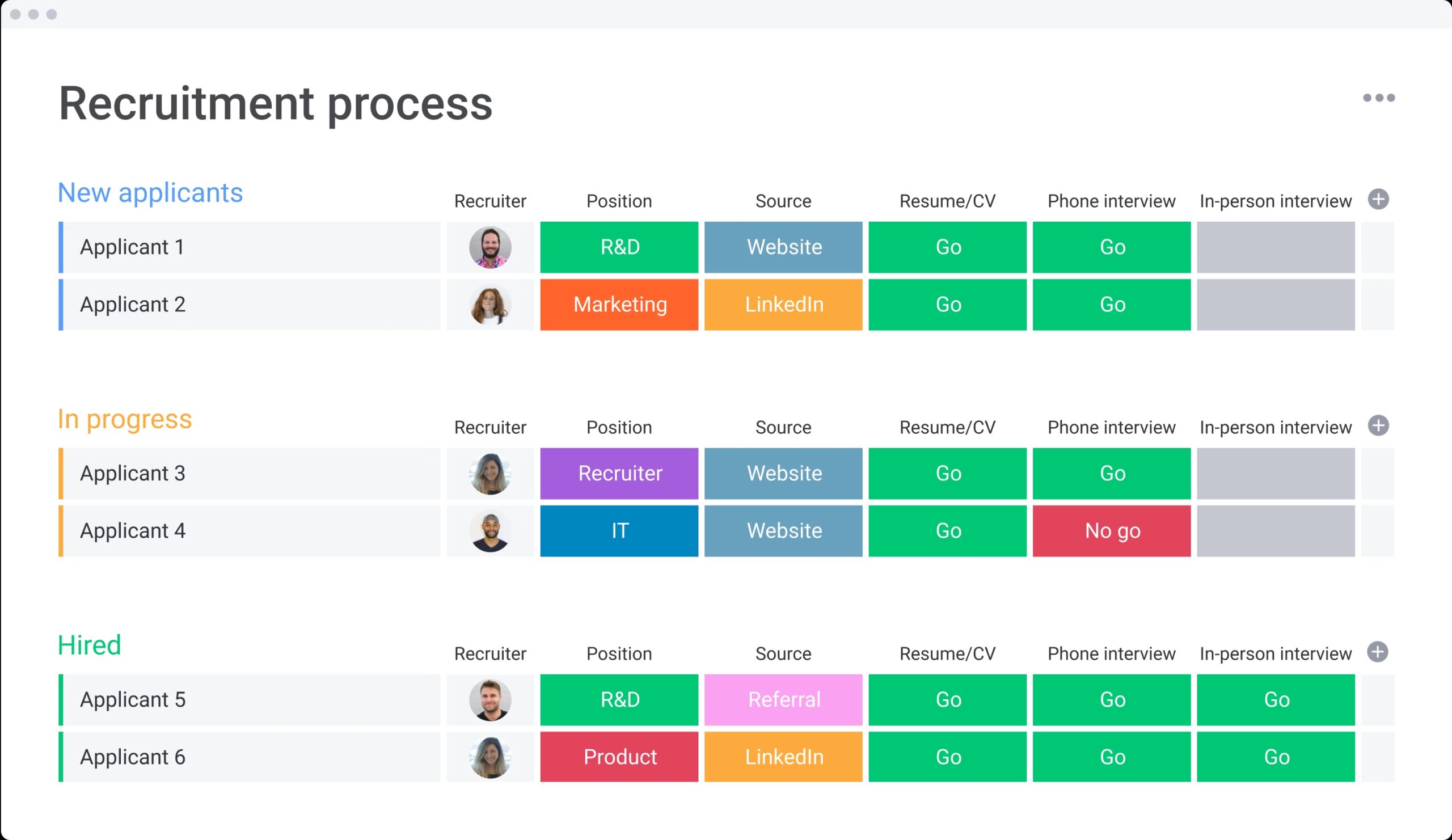
Managing a complex, cross-functional onboarding process requires a platform that unifies people, data, and workflows. monday work management serves as the operating system for your entire program, connecting HR, IT, and hiring managers in a single, collaborative workspace. Here’s how the platform transforms fragmented handoffs into a coordinated experience.
Cross-department visibility in one platform
Onboarding often fails in the handoffs between departments. With monday work management, you get a unified view where every stakeholder can see the status of every hire, eliminating confusion and ensuring accountability.
Visibility benefits include:
- HR dashboard view: Leaders see progress of all active onboardings at a glance, identifying bottlenecks instantly.
- Department-specific views: IT focuses on provisioning while managers focus on training and integration.
- Clear accountability: Everyone knows exactly who’s responsible for what at every stage.
Automated workflows that grow with you
The platform’s automation capabilities remove manual grunt work, ensuring consistency and reliability regardless of hiring volume.
Automation advantages are:
- Status-triggered actions: When a status changes to “Hired,” the system automatically creates IT activities and sends welcome emails.
- Role-based customization: Workflows adapt automatically; engineers get different checklists than sales reps.
- Scalable processes: Whether onboarding one person or one hundred, automation handles the volume without missing steps.
AI-powered insights for continuous improvement
monday work management leverages AI to make onboarding smarter and more efficient, providing data-driven insights that improve the experience over time.
AI capabilities are listed below:
- Intelligent routing: AI organizes incoming requests and documents, directing them to correct workflows.
- Performance analysis: The system identifies which parts of onboarding cause delays or bottlenecks.
- Content assistance: AI helps draft welcome emails and update training materials based on new information.

“monday.com has been a life-changer. It gives us transparency, accountability, and a centralized place to manage projects across the globe".
Kendra Seier | Project Manager
“monday.com is the link that holds our business together — connecting our support office and stores with the visibility to move fast, stay consistent, and understand the impact on revenue.”
Duncan McHugh | Chief Operations OfficerDriving employee retention and performance through strategic onboarding
Strategic onboarding transforms new hire integration from an administrative burden into a competitive advantage. When executed with intention and supported by the right platform, onboarding accelerates productivity, strengthens culture, and reduces costly turnover.
The organizations that thrive understand onboarding as an investment in their future workforce. Current data indicates that in some markets, a significant number of candidates who accept an offer are no longer with the organization six months later. By creating structured, engaging experiences that extend well beyond the first week, you build a foundation for long-term employee success and business growth.
Teams that coordinate their onboarding efforts on monday work management experience smoother handoffs, greater visibility, and more consistent outcomes. The platform’s automation and AI capabilities ensure your process scales efficiently while maintaining the personal touch that makes new hires feel valued and prepared for success.
Frequently asked questions
What are the 5 C's of strategic onboarding?
The five C's of strategic onboarding are Compliance, Clarification, Culture, Connection, and Check-back. These cover legal requirements, role expectations, social integration, and continuous feedback throughout the onboarding journey.
How does poor onboarding impact company performance?
Poor onboarding impacts company performance by increasing employee turnover costs, extending time to productivity, and diluting company culture. It leads to higher recruitment expenses and reduced team morale.
What's the difference between onboarding and employee training?
Onboarding is the broad process of integrating new hires into the organization and culture. Employee training is a specific subset focused on teaching technical skills and job-specific knowledge.
How many new hires can one coordinator effectively manage?
A single coordinator can effectively manage 15-20 concurrent new hires if supported by robust automation and a strong manager-led process. This depends on organizational complexity and available technology.
When should the onboarding process actually begin?
The onboarding process begins the moment the candidate accepts the job offer. This pre-boarding phase is critical for building excitement and handling administrative tasks before Day 1.
What role does AI play in modern onboarding?
AI enhances modern onboarding by automating administrative activities, personalizing learning paths, and providing predictive analytics on retention risk. It streamlines document processing and enables intelligent assignment routing.

 Get started