


Artificial intelligence transforms service operations by routing tickets instantly to the right expert, analyzing sentiment in real-time, and suggesting solutions before agents even ask. Modern IT help desks have evolved from break-fix centers into strategic engines that power entire organizations, driving efficiency across every department and proving their value as business enablers rather than cost centers.
Legacy tools that once served growing teams now create bottlenecks: slowing resolutions, blocking cross-department collaboration, and forcing your best people to waste time on manual tasks that modern platforms automate effortlessly. Organizations seeking connected workplaces need platforms that unify IT, HR, and facilities operations in one ecosystem, breaking down silos and enabling the kind of seamless collaboration that accelerates problem-solving and elevates service delivery.
This comprehensive comparison examines 12 leading alternatives to Spiceworks, breaking down essential features, pricing structures, integration capabilities, and selection criteria for teams ready to scale their service operations. Whether you’re a mid-market company hitting growth ceilings or an enterprise seeking to consolidate your service stack, you’ll find the insights you need to make a confident decision that transforms how your organization delivers support.
Key takeaways
- Modern service desks outgrow free tools: Spiceworks is a solid starting point, but growing teams quickly hit performance ceilings and manual process bottlenecks that modern AI-powered platforms eliminate.
- Connected platforms accelerate resolutions: the best alternatives unify IT, HR, and facilities teams in one workspace, breaking down silos and enabling cross-department collaboration that speeds up problem-solving.
- AI transforms service delivery: intelligent automation handles ticket triage, routing, and responses instantly, freeing your team to focus on high-impact work instead of repetitive manual tasks.
- Transparent pricing drives better decisions: look beyond “free” plans to platforms that deliver immediate value with clear pricing, avoiding hidden costs and feature limitations that slow your growth.
- No-code customization empowers teams: the right platform like monday service adapts to your unique workflows without technical expertise, letting you build and adjust processes in minutes instead of waiting on IT resources.
Why do growing IT teams move beyond Spiceworks?
Spiceworks serves as an effective entry point for IT teams building service processes on limited budgets. However, as organizations scale and ticket volumes increase, limitations begin to emerge. Features that initially made it an attractive free option (such as its ad-supported model) can create obstacles that impact team productivity during critical service moments.
Growing organizations often encounter performance constraints precisely when platform reliability matters most, while teams find themselves managing repetitive manual processes that modern platforms automate through AI capabilities. The challenge isn’t team capability; it’s ensuring your platform can support your team’s expertise and your organization’s evolving requirements. Effective service delivery requires systems that eliminate bottlenecks rather than create them.
The real game-changer is moving from an isolated help desk to a connected service hub where IT works seamlessly with other departments like HR and Facilities. When you break down those silos, you accelerate resolutions for everyone and prove IT’s value across the entire business. It’s time for a platform that grows with you, turning your IT team into the strategic powerhouse it’s meant to be.
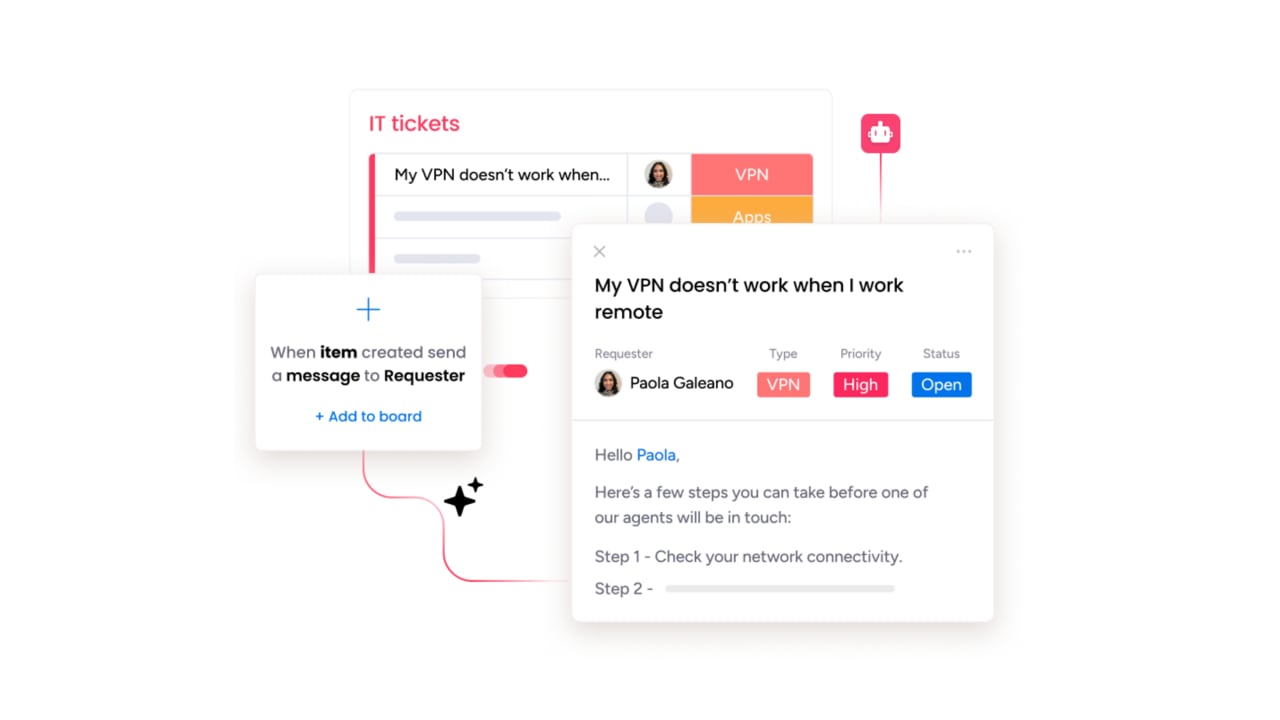
The real cost of free help desk software
That “free” price tag, while tempting, often conceals a significant bill in lost productivity and technical debt. These hidden costs manifest as real-world operational drags that create more work, not less, embodying the classic case of getting what you pay for.
When teams are mired in repetitive tasks like manual ticket assignment, the loss isn’t just measured in minutes; it’s a loss of momentum. Such small inefficiencies quickly snowball, leaving critical requests waiting and jeopardizing the service promises central to your team’s mission.
Trading in that technical debt for a smarter way of working is a strategic imperative. By empowering teams with a platform like monday service, you invest in measurable returns through faster resolutions, higher satisfaction, and the kind of streamlined operations that simplify everyone’s job.
12 leading Spiceworks alternatives for service teams
Your team deserves a service platform that moves as fast as you do, and finding a tool that can keep pace with your ambition is critical. While Spiceworks may have been a solid starting point, modern service delivery demands a more connected and intelligent approach. This means platforms built for speed, seamless collaboration, and real, measurable growth.
The best alternatives function as more than simple ticketing systems; they are central hubs where the entire organization can synchronize to solve problems faster. Consider the power of effortlessly automating routine tasks with built-in AI or customizing workflows with a few clicks with no code required. These solutions are engineered to help you deliver exceptional service without the operational headaches, letting your team focus on what they do best.
The following section examines leading platforms that enable teams to streamline operations and address evolving service management requirements.
1. monday service
With AI-powered automation at its core, monday service transforms service operations by streamlining everything from ticket triage to resolution. Built on the flexible monday.com Work OS, it connects IT, HR, and business teams in one unified platform that scales with your organization. This no-code approach means you can customize workflows without technical expertise while maintaining enterprise-grade security and compliance.
Example:
Delivering enterprise service management that unifies ticketing, incident management, and customer portals across all departments, monday service comes with embedded AI that accelerates resolution times.
Key features:
- AI-powered ticket triage: automatically categorizes, prioritizes, and routes tickets with sentiment analysis and suggested responses.
- Branded customer portal: with self-service capabilities, knowledge base integration, and “My tickets” view for requesters.
- Cross-department collaboration tools: that connect service operations with broader business projects and workflows.
Pricing:
- Standard: $31/seat/month (billed annually), includes 250 automation actions/month, up to ten portal users.
- Pro: $45/seat/month (billed annually),includes 5,000 automation actions/month, up to 100 portal users.
- Enterprise: contact sales, unlimited portal users, SAML SSO, HIPAA compliance options.
- Annual billing: saves 18% compared to monthly plans.
- Plans start: from three users minimum.
- AI credits: for advanced workflows available as add-on.
Why it stands out:
- Many AI features: on service boards consume zero AI credits, making advanced automation more cost-effective than competitors.
- Unified Work OS: connects service operations with CRM, project management, and development workflows in one platform.
- No-code customization: enables rapid deployment and adaptation without IT dependency or complex implementations.
2. Zendesk
Bringing a mature feature set and extensive integration ecosystem to the table, Zendesk offers enterprise-grade help desk capabilities. The platform excels at omnichannel support, making it an ideal choice for organizations seeking to create unified customer and employee service experiences across all touchpoints.

Example:
Zendesk’s AI-powered Resolution Platform unifies ticketing, knowledge management, and omnichannel support to help organizations deliver faster resolutions across email, chat, phone, and social media channels.
Key features:
- Omnichannel support: integrates email, chat, phone, and social media, providing a seamless experience across communication channels.
- Advanced reporting: offers comprehensive analytics and performance metrics to monitor service quality and agent productivity.
- Marketplace integrations: supports a wide range of third-party apps, making it easy to extend functionality and connect with existing tools.
Pricing:
- Support Team: $19/agent/month (annual billing).
- Support Professional: $55/agent/month (annual billing).
- Support Enterprise: $115/agent/month (annual billing).
- Suite Team: $55/agent/month (annual billing).
- Suite Growth: $89/agent/month (annual billing).
- Suite Professional: $115/agent/month (annual billing).
- Suite Enterprise/Enterprise Plus: contact sales for pricing.
- Add-ons available: Copilot ($50/agent/month), Quality Assurance ($35/agent/month), Workforce Management ($25/agent/month).
- Annual billing discount: you can typically save up to 20% with annual plans, though this can vary by region.
Considerations:
- Add-on dependency: advanced features like AI copilots, quality assurance, and workforce management require paid add-ons that can significantly increase total costs.
- Feature gating: some routing capabilities and enterprise customizations are only available on higher-tier plans, potentially limiting functionality for smaller teams.
3. Freshservice
By combining an intuitive design with robust automation, Freshservice provides AI-powered IT service management that transforms how organizations handle support. The platform is accessible for both technical teams and business users across departments, and its native AI, built into every workflow, empowers teams to resolve issues faster while reducing manual workload.

Example:
Freshservice excels at providing unified ITSM, ITAM, and ESM capabilities with embedded AI that automates ticket routing, generates response suggestions, and delivers proactive insights across IT and business teams.
Key features:
- Freddy AI automation: automatically categorizes tickets, suggests responses, and provides intelligent routing to reduce manual workload and accelerate resolution times.
- Omnichannel support: integrates seamlessly with Slack, Microsoft Teams, email, and mobile apps to meet users wherever they work.
- Unified platform: combines IT service management, asset management, and enterprise service management in one solution to eliminate tool sprawl.
Pricing:
- Starter: $19/agent/month (annual billing).
- Growth: $49/agent/month (annual billing).
- Pro: $99/agent/month (annual billing).
- Enterprise: custom pricing (contact sales).
- 14-day free trial: available.
- Additional costs: for SaaS Management add-on (per employee pricing) and Connector App task packs ($40 per 2,500 tasks).
Considerations:
- Reporting limitations: some users report constraints in advanced reporting capabilities and occasional dashboard performance issues at high ticket volumes.
- Complex licensing structure: separate pricing for IT agents versus business team add-ons can be confusing and may increase total cost as usage scales.
4. ManageEngine ServiceDesk Plus
For organizations with complex infrastructure and regulatory requirements, ManageEngine ServiceDesk Plus offers comprehensive ITSM capabilities with deep asset management integration. The platform specializes in dual deployment options (cloud and on-premises) and features robust native integrations across the ManageEngine ecosystem, making it ideal for mid-market to enterprise organizations.

Example:
ManageEngine ServiceDesk Plus empowers IT teams to streamline service delivery through ITIL-aligned processes, visual workflows, and integrated asset management across multiple sites and departments.
Key features:
- Asset lifecycle management: tracks hardware and software assets throughout their entire lifecycle with automated discovery and compliance monitoring.
- Visual workflow automation: creates custom request and approval flows with time-based actions, transitions, and automated escalations.
- Multi-site ESM capabilities: manages up to 15 service desk instances across different departments from a unified portal.
Pricing:
- Standard (Cloud): $13/month per technician.
- Professional (Cloud): $27/month per technician.
- Enterprise (Cloud): $67/month per technician.
- Standard (On-premises): free for up to five technicians.
- Annual subscription discounts: available.
- Add-ons required: for advanced features like Service Catalog, Problem Management, and CMDB in lower tiers.
Considerations:
- Feature gating: requires Enterprise edition or paid add-ons for advanced ITSM capabilities like problem management and change control.
- UI complexity: technician-based licensing model can increase costs as teams scale compared to end-user-based alternatives.
5. Jira Service Management
By seamlessly connecting IT operations with software development workflows, Jira Service Management transforms how development-focused teams handle service delivery. Built on Atlassian’s proven platform, it excels at bridging the gap between DevOps teams and service management, making it the go-to choice for tech-savvy organizations that need their help desk to speak the same language as their development tools.

Example:
Jira Service Management delivers PinkVERIFY-certified ITIL processes with native integration across Atlassian’s development ecosystem, making it ideal for organizations that want their service management to work hand-in-hand with their software development lifecycle.
Key features:
- DevOps integration: links service requests directly to Jira Software issues and Confluence documentation for seamless collaboration between IT and development teams.
- Omnichannel support: manages tickets through email, web portals, Slack, and Microsoft Teams with AI-powered virtual agents for automated first-line support.
- Assets and configuration management: tracks IT assets and configuration items with automated discovery and linking to incidents for faster root-cause analysis.
Pricing:
- Free: $0/month for up to three agents with unlimited requesters.
- Standard: $20/agent/month with basic automation and SLA management.
- Premium: $51.42/agent/month including AI virtual agent, advanced automation, and 99.9% uptime SLA.
- Enterprise: custom annual pricing with 99.95% uptime SLA and advanced analytics.
- Additional costs: may apply for Atlassian Guard (SSO/SCIM), extra virtual agent conversations, and expanded Assets objects.
Considerations:
- Feature limitations on lower tiers: key capabilities like multi-help centers, AI virtual agents, and advanced Assets management require Premium or Enterprise plans, which can significantly increase costs.
- Automation constraints: free and Standard plans have monthly automation limits (500 and 5,000 rule runs respectively) that may restrict heavy automation users.
6. SysAid
Specializing in “agentic” AI capabilities and comprehensive automation, SysAid delivers an AI-powered IT service management platform that transforms how organizations handle support. It is an ideal solution for mid-market and enterprise teams looking to accelerate resolution times while significantly reducing manual workload.

Example:
SysAid empowers IT teams to deliver faster, smarter service through native AI agents that handle everything from ticket categorization to automated resolutions across 42 languages.
Key features:
- AI-powered ticket management: intelligent categorization, sentiment detection, and automated summarization streamline agent workflows.
- Self-service portal with chatbot: 24/7 conversational support reduces ticket volume while improving user satisfaction.
- Comprehensive asset management: tracks IT assets with automated inventory updates and ties them directly to support tickets.
Pricing:
- Standard (Help Desk): quote-based pricing for AI-assisted ticketing, multi-channel intake, and basic asset management.
- Pro (ITSM): quote-based pricing for broader ITIL processes and customizable AI agents.
- Enterprise: quote-based pricing for advanced customization and organization-wide automation.
- Professional onboarding: available as separate one-time fee.
- Pricing varies: based on users and managed assets.
Considerations:
- Pricing transparency limitations: quote-only model makes cost comparison challenging.
- Third-party dependencies: some advanced features like remote control and discovery require additional third-party licenses.
7. SolarWinds Service Desk
With its transparent pricing, unlimited requestors, and native CMDB integration, SolarWinds Service Desk delivers comprehensive IT service management. The platform’s focus on built-in AI and asset management makes it an ideal choice for infrastructure-focused organizations seeking to streamline their service operations.
Example:
SolarWinds Service Desk streamlines IT service delivery through AI-powered incident management, automated asset discovery, and ITIL-aligned workflows that reduce resolution times and improve customer satisfaction.
Key features:
- AI-assisted incident management: smart categorization, automatic routing, and sentiment monitoring accelerate ticket resolution.
- Native asset management and CMDB: visual dependency mapping and automated discovery provide complete infrastructure visibility.
- Multi-region deployment: data residency options across US, EU, and Australia with SOC 2 and ISO 27001 compliance.
Pricing:
- Essentials: $39/technician/month (annual billing).
- Advanced: $79/technician/month (annual billing).
- Premier: $99/technician/month (annual billing).
- Unlimited requestors: included across all tiers.
- Asset management pricing: available upon request.
- 30-day free trial: available.
Considerations:
- Advanced AI features and visual CMDB: require Premier tier subscription.
- Some premium capabilities: currently limited to US and EU data centers only.
8. Zoho Desk
Offering deep CRM integration at a fraction of the cost of its enterprise competitors, Zoho Desk provides comprehensive help desk capabilities with powerful omnichannel support. The platform is perfect for growing businesses that need enterprise-grade features like AI-powered automation without the enterprise price tag, allowing teams to scale their support operations confidently with transparent pricing and no vendor lock-in.

Example:
Zoho Desk provides context-aware omnichannel support with built-in AI assistance and workflow automation, enabling teams to deliver personalized customer service across email, chat, phone, and social media from a unified interface.
Key features:
- Omnichannel support: manages tickets from email, live chat, phone, social media, and instant messaging platforms like WhatsApp and Instagram in one unified workspace.
- AI-powered automation: Zia AI provides sentiment analysis, auto-tagging, and Answer Bot capabilities to accelerate ticket resolution and improve agent productivity.
- Blueprint process designer: visual workflow builder that guides agents through standardized support processes to ensure consistent service delivery.
Pricing:
- Free: $0/month for up to three agents.
- Express: $7/agent/month (annual billing).
- Standard: $14/agent/month (annual billing).
- Professional: $23/agent/month (annual billing).
- Enterprise: $40/agent/month (annual billing).
- Additional costs: may apply for premium support (20-25% of license fee), telephony minutes, and WhatsApp/IM messaging credits.
Considerations:
- AI features like Answer Bot and Zia: are limited to specific data centers and may not be available in all regions.
- Some advanced capabilities: like multi-brand portals and skills-based routing are restricted to higher-tier plans, potentially increasing costs for growing teams.
9. HappyFox
Emphasizing fast implementation and unlimited-agent pricing options, HappyFox delivers customer-centric service management with powerful knowledge management and AI-driven automation. This approach makes it ideal for growing teams that need to scale support operations quickly. With 14+ years of founder-led focus on simplicity, HappyFox serves 12,000+ companies across 70+ countries.
Example:
HappyFox empowers organizations to streamline omnichannel support operations with embedded AI features that accelerate ticket resolution and reduce agent workload.
Key features:
- Omnichannel ticketing: centralizes email, chat, phone, social media, and WhatsApp support in one unified platform.
- AI-powered automation: features AI Answers, AI Resolve, and Copilot for instant responses, ticket summaries, and smart prioritization.
- Multilingual knowledge base: supports 39+ languages with inline article suggestions and customizable support centers.
Pricing:
- Basic: $24/agent/month (limited to five agents maximum).
- Team, Pro, Enterprise Pro: pricing available through contact form.
- Unlimited-agent plans: Scale, Scale Plus, and Ultimate options with ticket volume limits starting at 1M tickets.
- Service Desk Team: $69/agent/month.
- Service Desk Pro: $89/agent/month.
- Discounts: 10% off for non-profits and educational institutions on annual subscriptions.
Considerations:
- Help desk pricing requires form submission: rather than transparent list prices, which can slow comparison shopping.
- WhatsApp support requires third-party Twilio integration: adding dependency on external channel provider.
10. Atera
By unifying help desk, remote monitoring, and management in one AI-powered platform, Atera transforms IT service delivery for managed service providers and internal IT teams. It eliminates tool sprawl while accelerating resolution times through intelligent automation and device-level context. The platform’s per-technician pricing model with unlimited endpoints makes it especially attractive for organizations managing large device inventories.

Example:
Atera serves MSPs and internal IT departments who need integrated RMM, PSA, and help desk capabilities with AI-driven automation to streamline service delivery and reduce manual workload.
Key features:
- All-in-one platform: combines ticketing, remote monitoring, patch management, and billing in a single interface.
- AI-powered automation: features AI Copilot for technician assistance and IT Autopilot for end-user self-service ticket deflection.
- Omnichannel support: accepts tickets via email, branded portals, Microsoft Teams, Slack, and Windows desktop agent.
Pricing:
- MSP Pro: starting at $129/month per technician (annual billing).
- MSP Growth, Power, Superpower: quote-based pricing for advanced features.
- IT Department Professional: starting at $149/month per technician (annual billing).
- IT Department Expert, Master, Enterprise: quote-based for larger organizations.
- Annual billing: offers up to 16% discount versus monthly plans.
- AI Copilot and Network Discovery: available as paid add-ons.
Considerations:
- Windows-only Helpdesk Agent: limits cross-platform ticket submission capabilities.
- Per-technician pricing: may be less economical for teams with many technicians but fewer devices compared to per-endpoint models.
11. Lansweeper
Leveraging comprehensive IT asset discovery as a powerful foundation for service management, Lansweeper combines deep device intelligence with help desk capabilities. The platform specializes in agentless discovery across IT, OT, IoT, and cloud environments, making it ideal for organizations that need accurate asset data to fuel their service operations. With over 20,000 customers and 80+ million discovered devices, Lansweeper has established itself as the go-to source of truth for asset intelligence.

Example:
Lansweeper empowers IT teams to enrich service desk tickets with comprehensive asset context, reducing resolution times through accurate device, software, and user information.
Key features:
- Comprehensive asset discovery: automatically discovers and inventories all devices across networks using agentless, agent-based, and passive scanning methods.
- Service desk integration: links detailed asset data directly with support tickets in popular platforms like Jira Service Management, Freshservice, and ManageEngine ServiceDesk Plus.
- Security and compliance insights: identifies vulnerabilities, tracks software licenses, and monitors compliance gaps across the entire IT infrastructure.
Pricing:
- Free: up to 100 assets with unlimited user seats and community support.
- Starter: from $199/month (billed annually) for 2,000 assets with service desk ticket enrichment.
- Pro: from $379/month (billed annually) for 2,000–9,000 assets with vulnerability insights and all integrations.
- Enterprise: quote-based pricing starting at 10,000 assets with full API access and dedicated customer success manager.
Considerations:
- Native help desk functionality: is only available in the on-premises version and is in maintenance mode, not being developed for cloud deployment.
- Email authentication issues: can arise with Microsoft 365 changes, requiring periodic reconfiguration and technical troubleshooting.
12. NinjaOne
By combining help desk functionality with comprehensive endpoint management in one unified platform, NinjaOne transforms IT service delivery for both internal IT teams and managed service providers. The platform eliminates the typical tool-switching that slows down resolution times. With context-rich ticketing that automatically pulls device health data and enables one-click remediation, NinjaOne turns reactive support into proactive problem-solving.

Example:
NinjaOne delivers unified IT operations where help desk tickets automatically include device context and enable direct remediation without switching between multiple tools.
Key features:
- Context-rich ticketing: automatically populates tickets with live device inventory, health status, and historical data for faster diagnosis.
- One-click remediation: enables technicians to remotely access devices, run scripts, and perform fixes directly from within tickets.
- Self-service portal: allows end users to track tickets, access remote support, and restore files independently when backup is enabled.
Pricing:
- Per-device pricing: ranges from $1.50/device/month (10,000+ endpoints) to $3.75/device/month (50 or fewer endpoints).
- Quote-based: exact pricing varies by product mix and volume with bulk discounts available.
- 14-day free trial: available for testing the platform.
- No hidden fees: all onboarding, training, and support included in pricing.
Considerations:
- Limited pricing transparency: while price ranges are published, exact costs require quotes and vary significantly based on product bundle selection.
- ITSM scope limitations: advanced ITIL processes like complex change management may require integrations with dedicated ITSM platforms rather than native functionality.
The building blocks of a great service desk
A modern service desk does more than fix what’s broken; it is the operational heartbeat that keeps an entire organization in sync and moving at full speed. This ultimate support system is designed to make work feel effortless for everyone. When executed correctly, it doesn’t just solve problems, but creates a smoother, more connected workplace.
The key is bringing everything together in one place. Intelligent ticketing that automatically finds the right expert for the job, paired with a self-service portal that empowers people to find their own answers instantly, forms the core. This is then complemented by real-time analytics that provide a clear, honest look at performance, so you always know where to focus your energy.
This unified approach transforms service from a reactive chore into a proactive strategy. It means faster resolutions, happier teams, and a service operation that doesn’t just keep up but actively helps everyone level up.
AI capabilities that accelerate service delivery
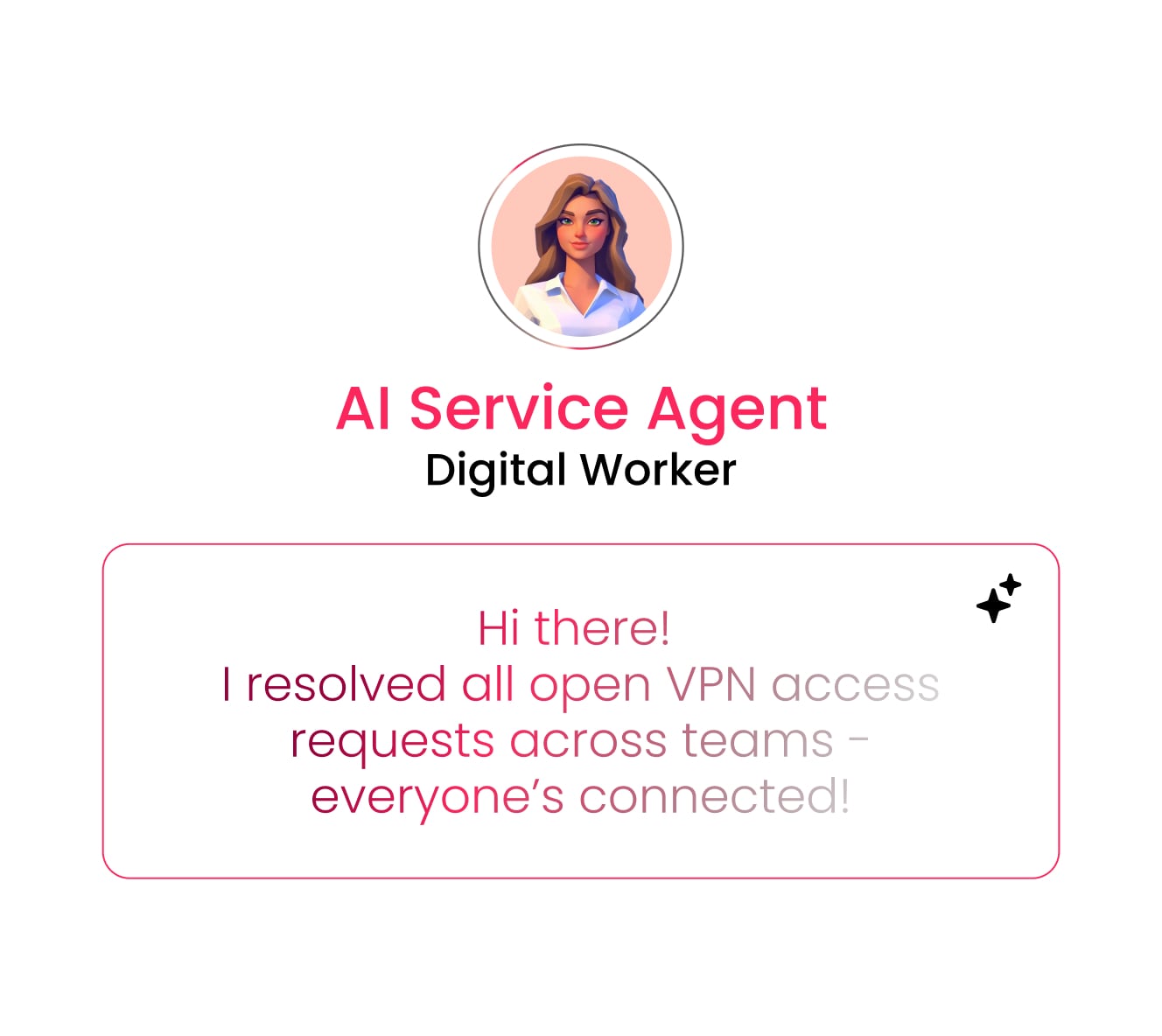
Artificial intelligence is your team’s new strategic asset, enabling a shift from putting out fires to preventing them altogether. This involves smart, predictive assistance that frees your team to focus on high-impact work instead of being buried in endless ticket queues. This is how service delivery becomes faster, smarter, and significantly less chaotic.
With this technology, every ticket can instantly land with the perfect person, while an AI copilot helps every agent respond like a seasoned pro by suggesting answers and surfacing the right information. New teammates get up to speed in a snap, and your veterans can focus their expertise on solving the truly complex issues that require a human touch.
This is where you can truly get ahead of the game, spotting trends before they become full-blown problems and connecting dots that humans might miss. You stop waiting for things to break and start fixing the root cause. This evolution turns the service desk from a cost center into the strategic powerhouse it was always meant to be.
Help desk software pricing breakdown
Navigating the complexities of software pricing requires clarity. Finding the right fit is about more than just a monthly fee; it’s about unlocking real value for your team without getting bogged down by hidden costs or confusing tiers. Transparent pricing should empower your team to grow, not hold it back.
While “free” plans are tempting, they often cap the very tools growing teams need most, like powerful automations and seamless integrations, which can create more work, not less. The focus should be on delivering immediate impact with plans built for scale, because your service operations are too important for a temporary fix. A truly great platform accelerates your resolution times from day one.
As you scale, you shouldn’t have to choose between powerful features and a sensible budget. That’s why solutions like monday service pack enterprise-level capabilities like SLA tracking and asset management into a clear price, avoiding the surprise implementation fees and training costs common elsewhere. Ultimately, the best investment is a platform that’s so intuitive your team can start optimizing operations immediately, saving you time and money right from the get-go.
How to select the right Spiceworks alternative?
Choosing a new platform should feel less like a replacement and more like a promotion for your whole team. The goal is to select a tool that not only solves today’s service headaches but also gets everyone excited to deliver amazing support. Here’s how to pick a winner that scales with your ambition.
- Think about your future team: consider where your team is today, but build for where you’re headed tomorrow — the right platform handles current needs like simple ticket routing with ease while offering advanced automation and analytics ready for when you need them.
- Separate your must-haves from your nice-to-haves: define your team’s playbook by nailing the fundamentals like automated routing and SLA tracking first, then layer in game-changing AI and analytics to truly elevate your service.
- Look for value, not just cost: a platform your team genuinely loves to use saves a fortune in training time and lost productivity, making it far more valuable than a cheaper but clunkier alternative that gives back less than it takes.
- Plan a migration that builds momentum: a smart, phased rollout gets a pilot team onboarded quickly, gathers their wins, and builds momentum across the entire organization, letting you move fast without breaking things.

Smooth migration from Spiceworks to modern platforms
Moving on from Spiceworks doesn’t have to be stressful. A clear, guided migration path transforms a complex project into a series of simple, manageable steps, complete with powerful import tools and dedicated support resources to facilitate the transition.
The migration process brings all valuable historical data, from ticket records to user profiles and knowledge base articles, directly into your new monday service workspace. The flexible import process handles Spiceworks data cleanly, with smart validation that flags any potential issues before they become obstacles. This approach ensures your team experiences zero service interruptions.
Organizations control the migration timeline and approach. The platform supports phased rollouts department by department or full-scale launches when teams are ready; the choice depends on your specific requirements. Comprehensive training and hands-on support resources help teams get up to speed and achieve their service delivery goals quickly.
Why does monday service transform service operations?
Your team’s workflow is unique, so your service platform should be too. With monday service, you can adapt the platform to your needs, empowering your teams to design their ideal service desk instead of getting stuck in a rigid, pre-built box. This is all about giving you the flexibility to build processes that actually match how your business operates and grows.
Every part of your organization connects through monday service, because great service isn’t just about closing tickets. Imagine your IT, HR, and facilities teams all collaborating from one shared space: that’s the power of a truly unified platform. With intuitive visual boards and no-code automations, anyone on your team can build and adjust workflows in minutes.
This is where service delivery becomes a true growth engine for the business. Beyond isolated ticket queues, monday service creates a connected workspace where everyone sees how their work contributes to the bigger picture. This shared context empowers your teams to prioritize with confidence, resolve issues faster, and see their direct impact on the company’s success.

"Our team LOVES the monday service platform and we’re already exploring how we could incorporate it for other departments, too. It has streamlined our workflow in a way that both our team and customers appreciate."
Andrew Marshall | VP Operations
״monday service provides clear insights into requests volume and types, response times, and trends - helping us continuously improve operations"
Grant De Waal-Dubla | CIO
"The biggest value for us is speed and flexibility. You can get up and running in days, change anything instantly, and see everything in real time. And you don’t need a dedicated admin to do it."
Clive Camilleri | Head of People Tech & OperationsLaunch your connected service platform today
Modern service operations require platforms that empower teams to deliver exceptional support. With automation handling routine tasks and seamless cross-team collaboration, your team can focus on high-value work that drives real business impact.
Flexibility provided by monday service make it possible to customize workflows to your needs and the visibility to track performance in real time, transforming your service operations from reactive troubleshooting into a strategic, efficient system.
Frequently asked questions
Can I migrate my Spiceworks data to other platforms?
Yes, most modern service platforms support data migration from Spiceworks. You can typically import your ticket history, user records, and knowledge base articles to ensure a seamless transition without losing valuable data.
Which Spiceworks competitors offer the best mobile experience?
Platforms like Freshservice, Zendesk, and monday service offer robust mobile apps with full ticket management capabilities and offline access. Their native experiences are optimized for agents who need to resolve issues from anywhere.
How quickly can teams switch from Spiceworks help desk software?
Most teams complete their migration from Spiceworks in two to six weeks, depending on data volume and the complexity of your setup. Cloud-based solutions significantly accelerate this timeline by removing the need for hardware installation.
Are there alternatives to Spiceworks with one-time licensing?
While some vendors still offer perpetual licenses, the industry standard has shifted to subscription models. Subscriptions provide more value through continuous updates, ongoing support, and access to the latest features.
Which platforms integrate seamlessly with Microsoft Teams?
Zendesk, Freshservice, and monday service offer deep, native integrations with Microsoft Teams. This allows teams to create tickets, get notifications, and collaborate on resolutions without ever leaving the Teams environment.
What security standards should Spiceworks alternatives meet?
Look for platforms with key security certifications like SOC 2 and ISO 27001, along with GDPR compliance. These standards are critical for protecting your organization's data and meeting regulatory requirements.

 Get started