


Facilities teams juggling maintenance requests, vendor contracts, and space planning across disconnected systems know the cost of playing catch-up. What would your team accomplish if every maintenance request, vendor contract, and space plan lived in 1 connected platform? The right facilities management software shifts you from reactive firefighting to proactive optimization, giving your team the visibility and automation they need to manage buildings strategically rather than scrambling to keep the lights on.
This guide breaks down the essential features, key benefits, and 5 leading platforms for 2026. We also explore how AI agents and predictive analytics are reshaping facility operations and share a clear 5-step implementation plan to get your team up and running. We’ll also have a look at how monday service brings all of these capabilities together in a single connected workspace designed for cross-departmental collaboration.
Key takeaways
- Facilities management software: Centralizes maintenance, space planning, vendor coordination, and compliance into a single operational center for your buildings
- 5 platforms compared: monday service, ServiceNow, IBM TRIRIGA, MRI Software, and FMX cover every scale from mid-market to enterprise IWMS
- AI is reshaping facility operations: Autonomous agents handling routine requests, predictive maintenance reducing equipment failures, and natural language app builders empowering non-technical teams
- Implementation does not need to take months: A structured 5-step approach helps teams go live in days to weeks with the right platform
- Choosing the right platform: Depends on your operational complexity, AI readiness, and total cost of ownership, not just feature checklists
What is facilities management software
Facilities management software acts as the operational command center for your buildings, converting disconnected spreadsheets, email threads, and siloed requests into a single, streamlined workflow. It empowers your team to shift from reacting to problems to preventing them, enhancing both efficiency and strategic oversight across every facility you manage.
Is your organization still managing facilities with a patchwork of spreadsheets and email threads? Modern platforms consolidate multiple categories of facility management into one system. Here are the 6 primary types you should understand:
- CMMS (computerized maintenance management system): Focused on work orders, preventive maintenance scheduling, and asset tracking, the backbone of maintenance operations
- CAFM (computer-aided facility management): Specializes in space management, move coordination, desk reservations, and workplace experience optimization
- FMS (facility management system): A general-purpose platform covering day-to-day operations including maintenance, vendor management, and service request handling
- IWMS (integrated workplace management system): Enterprise-grade platforms spanning real estate portfolio management, capital planning, lease administration, sustainability tracking, and full maintenance operations
- MES (maintenance engineering system): Focused on equipment reliability and condition-based maintenance strategies, often used in manufacturing and industrial settings
- Office space management: Purpose-built for hybrid workplace needs — desk booking, room reservations, occupancy analytics, and neighborhood planning
The difference between CMMS and FMS
A CMMS handles the maintenance engine, work orders, preventive schedules, and asset tracking, while an FMS or broader facilities management platform layers on space planning, vendor coordination, compliance, and cross-departmental workflows. In practice, the lines between these categories are blurring.
Modern platforms increasingly consolidate CMMS, CAFM, and space management into a single connected system focused on keeping operations running smoothly. When a facility request requires input from IT or HR, having all stakeholders converge in one workspace accelerates resolution and streamlines handoff processes.
Key benefits of facility management platforms
The right facilities management platform changes how your team operates, shifting from reactive firefighting to strategic optimization. Here are the core benefits that make the investment worthwhile.
Transform reactive operations into strategic assets
Reactive maintenance often ends up costing more than proactive strategies when you factor in emergency repairs. A connected facility management platform empowers you to get ahead of issues, turning routine maintenance into an opportunity to optimize every piece of equipment and square foot of space you manage. Your physical assets actively contribute to your organization’s success instead of draining its resources.
Centralize operations in a single, visual workspace
Your team can manage everything from work orders to preventive maintenance schedules with complete clarity. A centralized platform connects people and data, ensuring that information flows seamlessly from the initial request to the final resolution without anything getting lost in translation. When facility managers, technicians, and stakeholders all work from the same real-time view, collaboration becomes effortless and decisions happen faster.
Reduce costs and eliminate information silos
The results are tangible: teams can dramatically reduce maintenance costs and extend the lifespan of their equipment. With a connected service management platform, the advantage is amplified by linking facility operations directly to the rest of the business — IT, HR, finance, and vendor teams all share the same workspace. This provides total visibility and breaks down the information silos that standalone systems were not designed to address.
Must-have features in facilities management software
The right facilities management software transforms how your team operates. Instead of reacting to problems as they arise, you gain the capabilities to anticipate needs, optimize resources, and deliver an exceptional workplace experience. Here are the essential features that separate basic maintenance trackers from true operational command centers:
- Work order management: Capture, assign, and track maintenance requests from submission to completion with full visibility into status, priority, and resolution time
- Preventive maintenance scheduling: Automate routine maintenance based on time intervals or usage metrics to prevent equipment failures before they disrupt operations
- Asset tracking and lifecycle management: Monitor equipment health, maintenance history, and warranty information to maximize asset lifespan and make informed replacement decisions
- Space planning and optimization: Analyze occupancy data, manage desk reservations, and optimize facility layouts based on real utilization patterns
- AI-powered predictive capabilities: Analyze historical data patterns and IoT sensor feeds to anticipate equipment failures and schedule proactive maintenance before costly breakdowns occur
- Smart building and IoT integration: Connect HVAC, lighting, security, and occupancy sensors to your facilities platform for real-time environment monitoring and automated responses
- KPI reporting and analytics: Track mean time to repair (MTTR), preventive maintenance completion rates, cost per work order, and energy consumption to continuously improve operations
- Integration capabilities: Connect seamlessly with communication platforms, financial systems, HR software, and building management systems to create a single source of truth
- Mobile accessibility: Enable technicians to receive assignments, update work orders, and access asset information directly from mobile devices in the field
5 best facilities management software platforms for 2026
We evaluated platforms across ease of use, AI capabilities, customization depth, pricing transparency, and cross-departmental connectivity. The list spans enterprise IWMS solutions to mid-market CMMS platforms, giving you options at every scale. Here is how they compare at a glance:
| Platform | Best for | AI capabilities | Pricing model | Implementation time |
|---|---|---|---|---|
| monday service | Cross-departmental FM teams | AI Service Workforce, AI agents, sidekick, Vibe | From $31/seat/mo | Days to weeks |
| ServiceNow | Enterprises with complex, multi-departmental service | Now Assist, AI space optimization | Quote-based (premium) | Months (certified partner) |
| IBM TRIRIGA | Regulated industries, complex portfolios | Watson AI, IoT Smart Building | Quote-based (AppPoint licensing) | 6 - 18 months |
| MRI Software | Real estate + FM integration | MRI Agora Insights, IoT sensor integration | CMMS from $60/mo; IWMS quote-based | Weeks (CMMS) to months (IWMS) |
| FMX | K-12 education, mid-market | Basic analytics | Quote-based (enrollment option for K-12) | Weeks |
1. monday service
Best for: Cross-departmental FM teams seeking AI-powered automation, no-code customization, and fast implementation.
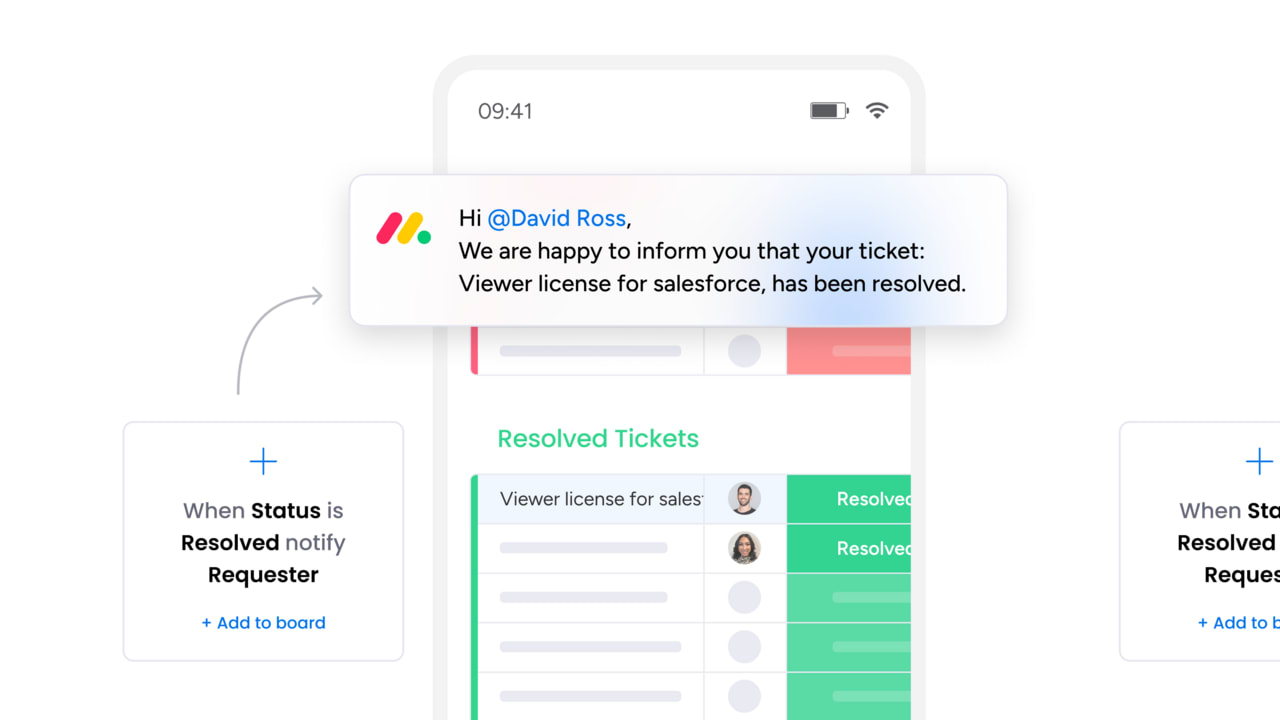
monday service transforms facility operations through AI-powered automation and cross-departmental workflow design. The platform centralizes maintenance, space planning, vendor coordination, and compliance tracking in one visual workspacethat connects facilities with IT, HR, and finance teams. With AI-powered triage, no-code workflow builders, and real-time analytics dashboards monitoring SLAs and resolution times, most teams go live in days rather than months.
Pricing
Plans start at $31/seat/month (Standard) and $45/seat/month (Pro) with monthly billing, plus an Enterprise tier available through sales. 18% discount with annual billing, 3-seat minimum, and 14-day free trial included.
Advanced AI features
- AI service workforce: Purpose-built AI agents handle facility requests autonomously with configurable guardrails and full audit trails, from processing maintenance requests to generating compliance reports
- monday sidekick: AI assistant that summarizes ticket context, recommends next steps, drafts replies, and finds similar resolved tickets so your team spends less time on repetitive work
- monday vibe: AI-powered no-code app builder that creates custom facility management applications from natural language prompts, non-technical facility managers can build inspection forms, vendor evaluation dashboards, and maintenance tracking apps without writing code
Facilities management software features
- Asset and equipment tracking: Monitor equipment status, schedule maintenance, and manage staff availability to prevent scheduling conflicts and optimize resource allocation
- Customer Portal:Self-service workspace where employees submit facility requests, access knowledge bases, and track ticket status through customizable portals that reduce administrative burden
- Compliance monitoring: Track safety regulations, maintenance certifications, and audit requirements with automated reporting to ensure facility standards are consistently met
2. ServiceNow Facility Management
Best for: Large enterprises with complex, multi-departmental service operations requiring deep customization and enterprise-grade governance.

ServiceNow delivers enterprise workplace operations through its Workplace Service Delivery and Enterprise Asset Management modules, built on the Now Platform. The platform’s strength lies in its unified service model that connects facilities management with IT, HR, and finance operations on a single data architecture, enabling seamless cross-departmental workflows, shared service catalogs, and enterprise-wide analytics for organizations already invested in the ServiceNow ecosystem.
Key features
- Space management with AI-powered optimization: Plan, optimize, and report on space usage with real-time analytics, 3D indoor mapping, and AI-driven recommendations for space reconfigurations based on utilization data
- Automated maintenance workflows: Create and manage preventive and corrective maintenance plans across multiple locations with intelligent work order routing and a mobile technician app
- Employee experience portal: Deliver self-service capabilities for desk reservations, meeting room bookings, and service requests through a unified mobile-friendly interface
Pricing
ServiceNow is positioned in the premium tier with quote-based pricing. Contact ServiceNow directly for personalized quotes.
Considerations
- Enterprise-level investment required: Platform licensing, module fees, and implementation typically involve certified ServiceNow partners and multi-month projects, best suited for organizations with dedicated IT budgets
- Designed for the Now Platform ecosystem: Advanced customization requires specialized knowledge, making the platform a stronger fit for organizations already invested in the ServiceNow ecosystem
3. IBM TRIRIGA
Best for: Regulated industries and organizations with complex, distributed real estate portfolios requiring comprehensive IWMS capabilities.
IBM TRIRIGA delivers comprehensive integrated workplace management system (IWMS) capabilities, now delivered as part of the IBM Maximo Application Suite (MAS). The platform specializes in AI-driven space optimization, IoT-powered smart building management, and FASB/IFRS 16 lease accounting compliance, serving as a single source of truth for managing corporate real estate and facilities. Leveraging IoT data and Watson AI, TRIRIGA optimizes space utilization, ensures lease accounting compliance, and controls operational costs for Fortune 100 companies and government agencies.
Key features
- AI-powered space optimization: Real-time occupancy monitoring using IoT sensors, WiFi, and badge data to provide strategic insights for space planning and utilization across entire portfolios
- Comprehensive maintenance management: Automated workflows via Maximo integration for both preventive and corrective maintenance with predictive and condition-based strategies
- Full IWMS coverage:Capital project lifecycle management, lease administration (FASB/IFRS 16 compliant), and sustainability tracking in a single platform
Pricing
TRIRIGA uses IBM’s AppPoint licensing model as part of the Maximo Application Suite, with pricing based on user count, modules activated, and deployment model. Contact IBM sales for enterprise quotes.
Considerations
- Enterprise deployment timeline: Full implementations typically take 6 to 18 months with IBM-certified consultants, requiring dedicated project management and resource planning
- Platform consolidation in progress: Organizations on standalone TRIRIGA licenses should plan for migration to the Maximo Application Suite as IBM consolidates its IWMS offerings
4. MRI Software
Best for: Real estate owners, operators, and corporate facility management teams requiring an open, connected ecosystem with deep integration capabilities.

MRI Software delivers comprehensive facilities management through its open and connected ecosystem, uniquely serving both real estate owners and operators alongside corporate facility management occupiers. MRI provides a suite of products including MRI Evolution (enterprise IWMS), MRI NETfacilities (cloud-based CMMS), and MRI Angus (building operations). The platform centralizes facilities operations from maintenance management to space optimization, empowering property owners and facility managers to reduce costs, boost ROI, and create more engaging stakeholder experiences through data-driven decision-making across 60,000+ FM team members.
Key features
- Asset lifecycle management: Track fixed and portable assets throughout their entire lifecycle with multi-tiered registers and automated maintenance scheduling
- AI-powered analytics via MRI Agora Insights: Predictive analytics and IoT sensor integration for smart building management, real-time equipment monitoring, and space utilization analysis
- Open ecosystem with 400+ integration partners: Connect with ERP, HR, BIM, and enterprise systems through a pre-built integration network designed to eliminate vendor lock-in
Pricing
MRI NETfacilities (cloud-based CMMS) offers tiered plans from $60/month to $304/month with annual billing options. MRI Evolution (enterprise IWMS) pricing is quote-based through MRI sales.
Considerations
- Designed for supported implementation:The platform’s depth of features performs optimally with dedicated IT support or an experienced administrator on the team
- Product portfolio fragmentation: MRI’s suite includes multiple distinct products (Evolution, NETfacilities, Angus) with some inconsistency in UI and data models across the portfolio
5. FMX facility management
Best for: K-12 education, higher education, government, and mid-market organizations with limited IT resources seeking ease of use and fast implementation.
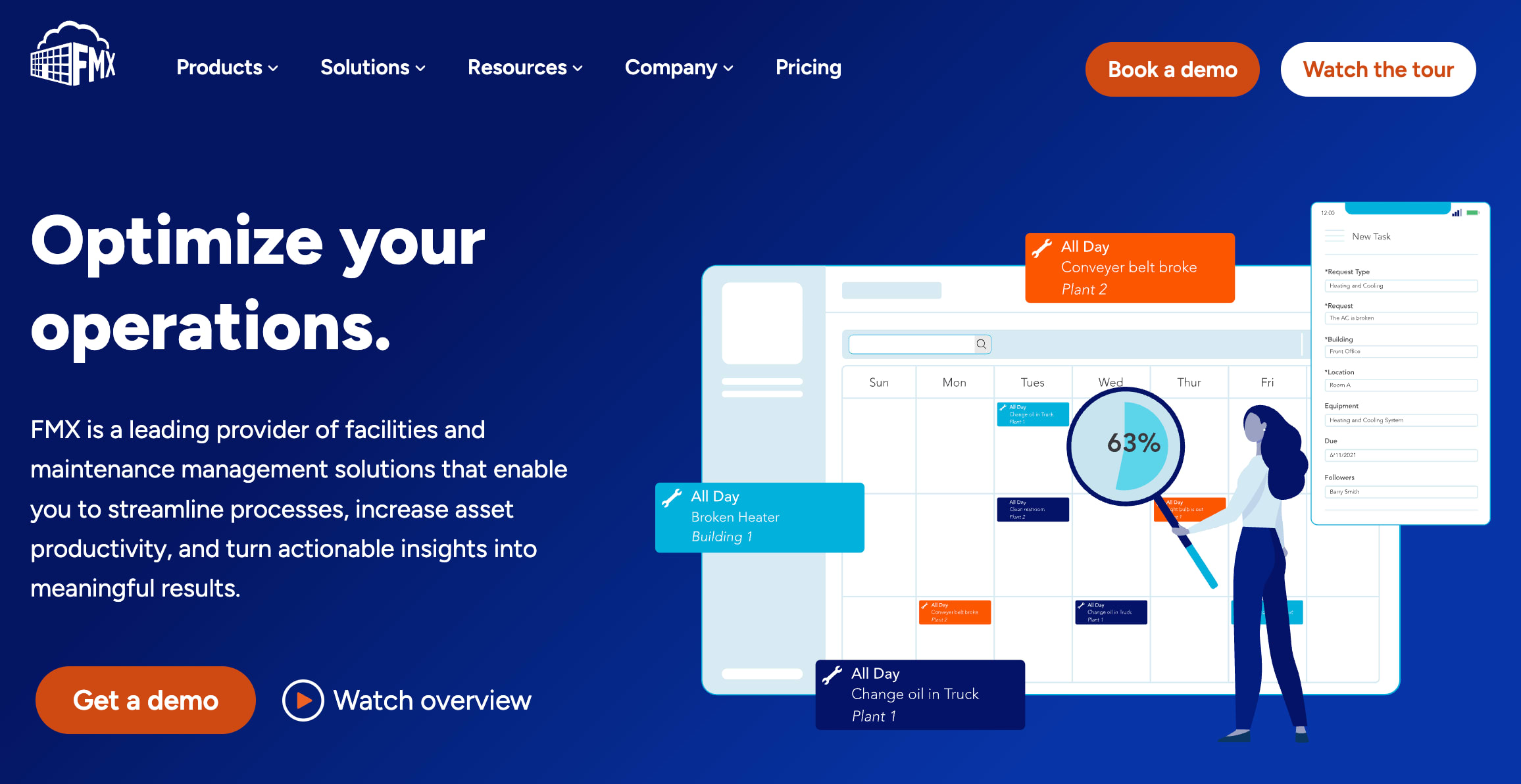
FMX delivers cloud-based facilities management software designed for ease of use and fast implementation. FMX specializes in K-12 education, higher education, government, and mid-market organizations with limited IT resources. The platform streamlines facility operations by consolidating work order management, preventive maintenance, asset tracking, and facility scheduling into one intuitive platform that requires minimal technical expertise to operate, making it a go-to choice for school districts and mid-market organizations.
Key features
- Work order management: Automatic routing, approval chains, and SLA tracking for efficient task assignment and resolutionwith mobile technician access
- Preventive maintenance scheduling: Calendar-based interface with automated work order generation and mobile accessibility for techniciansin the field
- Facility scheduling and rental management:Interactive floor plans, QR code asset tagging, and community rental management for organizations that monetize facility space
Pricing
FMX offers custom pricing based on number of users and selected features. K-12 districts receive enrollment-based pricing tied to student enrollment numbers, with purchasing co-op availability through 1GPA, TIPS-USA, AEPA, and Ohio Schools Council contracts.
Considerations
- Optimized for mid-market and education sectors: Best suited for teams focused on maintenance and scheduling rather than enterprise-scale lease administration, capital project management, or deep sustainability reporting
- Growing analytics capabilities: AI/ML predictive features and IoT integration are evolving and may require supplemental solutions for advanced enterprise requirements
Additional guidance on choosing the right facilities management platform
With 5 strong contenders on the table, how do you narrow the field? The answer depends on 3 factors: your operational complexity, your AI readiness, and your total cost of ownership. Many organizations pay for features their teams never use, while missing capabilities that could save thousands in reactive maintenance costs.
Match the platform to your operational complexity
Not every organization needs an enterprise IWMS, and not every team can afford to wait months for implementation. Here is how to align platform choice with operational reality:
- Small or single-site teams: Prioritize ease of use, fast implementation, and affordable per-seat pricing. FMX and per-seat SaaS platforms with standard tiers are strong starting points
- Multi-site enterprises: Need IWMS-level depth with lease administration, capital planning, and sustainability tracking. IBM TRIRIGA and MRI Evolution serve this tier
- Cross-departmental organizations: Need connectivity between facilities, IT, HR, and finance on a single platform. Look for platforms that unify service delivery across departments
Evaluate AI and automation readiness
AI capabilities in facilities management exist on a spectrum, and the right level depends on your team’s maturity and goals:
- Basic: Rule-based ticket routing, status notifications, and scheduled maintenance reminders
- Intermediate: AI-powered categorization, sentiment detection, and suggested responses that reduce manual triage
- Advanced: Autonomous AI agents, predictive maintenance, and natural language app building — available on select platforms in this guide
Consider total cost of ownership
The sticker price of a platform tells only part of the story. Evaluate the full investment before committing:
- Per-seat SaaS pricing vs. enterprise licensing: Per-seat SaaS platforms (typically $30 — $60/seat/month) offer predictable costs; enterprise IWMS platforms often run into 6 figures annually
- Implementation costs: Some teams go live in days with no-code platforms; others invest months and hundreds of thousands of dollars with certified consultants
- Ongoing administration needs: Self-serve no-code platforms reduce the need for dedicated admins, while enterprise IWMS platforms often require specialized staff
Is there a free CMMS? Most platforms offer free trials (typically 14 days) but true free-forever plans typically limit users, features, or sites. For organizations with active maintenance needs, a paid platform typically delivers ROI within months through reduced reactive maintenance costs.
5 steps to implementing facilities management software
Implementation does not need to take months. With the right platform and a structured approach, most teams go live in days to weeks rather than quarters. The key is breaking the process into manageable phases that build momentum while minimizing disruption to daily operations. Here is a 5-step framework that works whether you are deploying a lightweight CMMS or a comprehensive IWMS.
Step 1: Audit your current workflows and pain points
Start by mapping out your current processes — the efficient ones, the manual workarounds, and the ones that exist only in someone’s memory. Document how requests flow from submission to resolution, where bottlenecks occur, and which systems (or spreadsheets) your team relies on. This baseline gives you a clear picture of what needs to change and measurable starting points to track progress against.
Step 2: Define measurable success criteria
Turn your goals into specific, trackable metrics. Are you targeting a 30% reduction in average resolution time? A 50% increase in preventive maintenance completion rates? Defining these criteria upfront ensures every stakeholder agrees on what success looks like and gives your team clear milestones to celebrate along the way.
Step 3: Clean and migrate your data
Treat this as a fresh start for your operational data. Decide which asset records, maintenance histories, and vendor details make the cut, then clean and organize them for migration. Moving data in manageable phases reduces risk and prevents the overwhelm of a big-bang migration. A flexible platform structure makes this process straightforward, setting your team up with a clean foundation from day one.
Step 4: Build workflows and train your team
This is where your investment starts paying off. Use no-code workflow builders to create processes that match how your team actually works — maintenance approvals, safety inspections, vendor coordination — so processes align with how your team actually works. Because visual, drag-and-drop platforms are intuitive by design, training focuses on hands-on practice rather than lengthy certification courses. No-code workflow builders on modern platforms let most teams configure their core processes in days.
Step 5: Launch, monitor, and optimize continuously
Your work does not end at launch. Track adoption rates, monitor SLA performance, and use real-time analytics to identify quick wins and areas for improvement. This continuous feedback loop ensures your system gets more valuable every week, evolving alongside your team’s needs and your organization’s growth. Real-time dashboards give facility managers instant visibility into the metrics that matter.
How monday service transforms facility management
The most effective facilities platforms resolve routine maintenance requests before your team even sees them. monday service makes that possible by uniting all facility operations on one intelligent platform that connects with IT, HR, and every service team across your organization.
AI Service Workforce for facilities

monday service’s AI workforce deploys purpose-built agents that handle facility requests autonomously, freeing your team to focus on strategic improvements instead of repetitive triage. Build custom agents to triage and route facility repair requests, suggest solutions from the knowledge base, and escalate complex issues to the right technician.
No-code customization with monday vibe
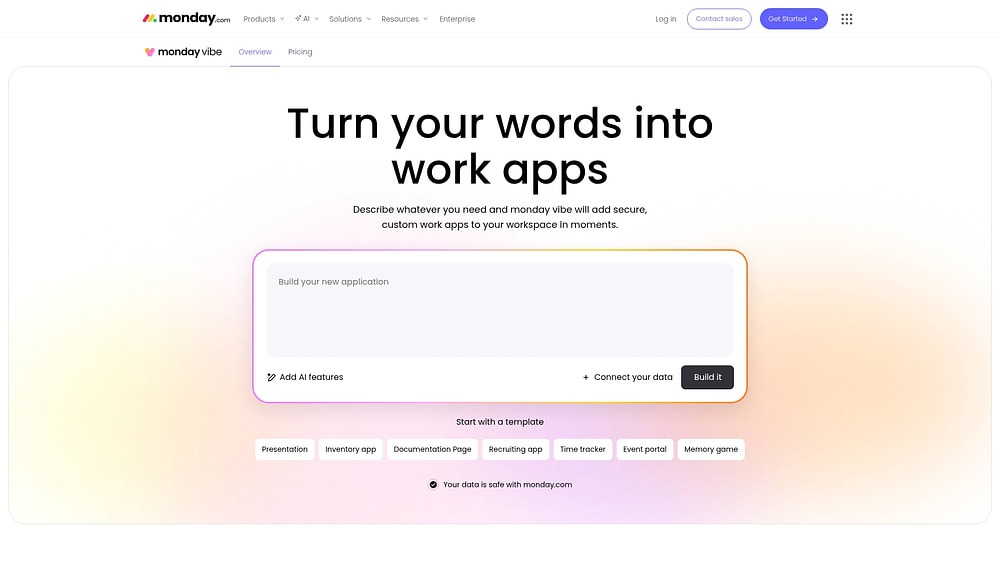
monday vibe is an AI-powered no-code app builder that lets facility managers create custom applications from natural language prompts. Need an inspection form for your safety audit? A vendor evaluation dashboard? A maintenance tracking app tailored to your campus? Describe what you need, and monday vibe builds it.
Connected intelligence
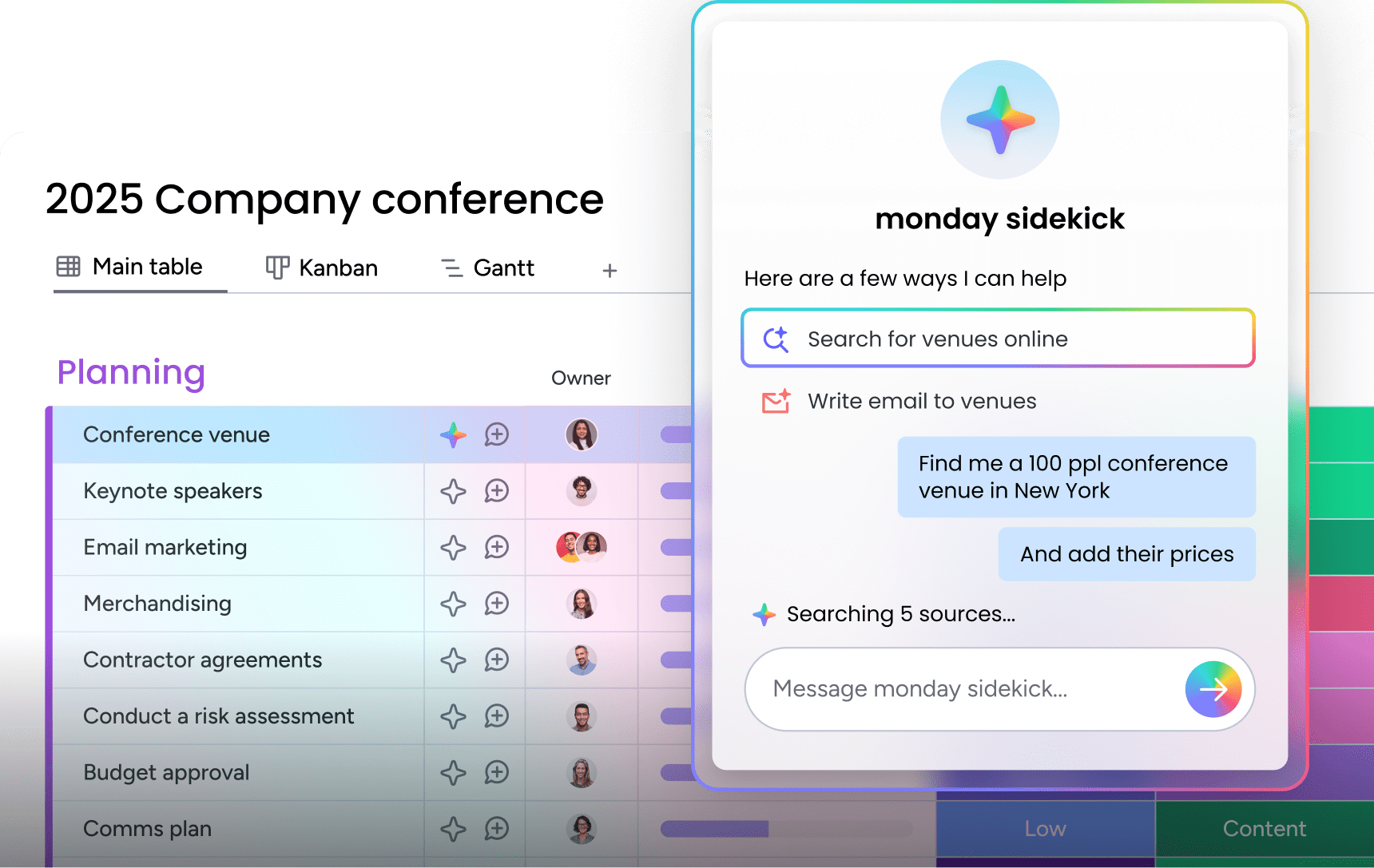
The real power of monday service emerges when AI, automation, and cross-departmental visibility work together:
- monday MCP connects your workspace to external AI assistants like Claude, ChatGPT, Cursor, and Copilot Studio for enhanced analysis and automation
- monday agents execute work autonomously with configurable guardrails, from processing maintenance requests to generating compliance reports with full audit trails
- monday sidekick provides AI-assisted ticket summarization, suggested replies, and similar-ticket lookup so your team resolves issues faster with more context
From day one, the platform connects facilities, IT, and HR on one workspace, unlocking visibility into how everything interconnects, from maintenance schedules to space planning and beyond. This is how facility managers shift from operational firefighting to strategic leadership.

"Our team LOVES the monday service platform and we’re already exploring how we could incorporate it for other departments, too. It has streamlined our workflow in a way that both our team and customers appreciate."
Andrew Marshall | VP Operations
״monday service provides clear insights into requests volume and types, response times, and trends - helping us continuously improve operations"
Grant De Waal-Dubla | CIO
"The biggest value for us is speed and flexibility. You can get up and running in days, change anything instantly, and see everything in real time. And you don’t need a dedicated admin to do it."
Clive Camilleri | Head of People Tech & OperationsFinding the right facilities management platform for your team
The right facilities management software transforms your team from reactive problem-solvers into strategic operators who anticipate needs, optimize resources, and deliver exceptional workplace experiences. The 5 platforms in this guide offer a clear starting point, whether you need a purpose-built CMMS or an AI-powered platform connecting facilities with every department.
As AI agents and predictive analytics mature, proactive facilities teams will gain a decisive advantage. monday service brings these capabilities together in a single connected workspace, empowering facility managers to shift from operational firefighting to strategic leadership while keeping stakeholders aligned across IT, HR, and beyond.
Try monday serviceFAQs
What is the difference between CMMS and facilities management software?
CMMS (computerized maintenance management system) focuses specifically on maintenance operations like work orders, preventive scheduling, and asset tracking. Facilities management software is broader, including all CMMS capabilities plus space planning, vendor management, compliance tracking, and cross-departmental workflows. Modern platforms consolidate both, so teams don't need separate systems for maintenance and facility operations.
How much does facility management software cost?
Pricing varies widely based on platform tier and organizational needs. Entry-level SaaS platforms start around $30 to $60/seat/month, with monday service Standard at $31/seat/month and Pro at $45/seat/month. Enterprise IWMS platforms like IBM TRIRIGA and ServiceNow are quote-based and can run into 6 figures annually. Always evaluate total cost of ownership, not just the sticker price.
Can small businesses benefit from facility management platforms?
Small businesses absolutely benefit by centralizing asset tracking, maintenance requests, and vendor management in one place. Modern platforms feature no-code interfaces that don't require dedicated IT resources, making them accessible for any team size.Look for platforms offering low minimum seat counts and free trials, like monday service's 14-day trial with a 3-seat minimum.
What training is required for facility management software?
Training requirements depend on platform complexity. No-code platforms like monday service typically require days of hands-on onboarding, with most teams operational within the first week. Enterprise IWMS platforms often require specialized training, certifications, and dedicated administrators. Most providers offer setup guidance, video tutorials, and ongoing support resources to ensure smooth adoption regardless of technical background.
How does cloud-based facility management software ensure data security?
Cloud-basedfacility management platforms secure your data with enterprise-grade measures including end-to-end encryption, regular backups, role-based access controls, and compliance with industry standards. Leading platforms maintain SOC 2 Type II and ISO 27001 certifications, with monday service also supporting HIPAA compliance for healthcare environments. These security protocols often exceed what most organizations can implement with on-premise infrastructure.
Is there a free facilities management software option?
Free facilities management software options exist, but most platforms offer free trials rather than free-forever plans. monday service includes a 14-day free trial. True free-forever options typically limit users, features, or the number of sites you can manage. For organizations with active maintenance needs, a paid platform typically delivers ROI within months through reduced reactive maintenance costs.

 Get started