

Visual collaboration platforms have become essential for teams that brainstorm, plan, and map workflows together. From product roadmaps sketched on infinite canvases to retrospective boards covered in virtual sticky notes, the way teams think together has moved permanently online. Miro sits at the center of this category as the most recognized name in digital whiteboarding, but one size rarely fits every team’s needs.
This article breaks down what Miro offers today, where it falls short for certain teams, and what to evaluate when considering an alternative. You’ll also find a curated list of 10 strong options, including monday.com’s AI Work Platform, each suited to different workflows, budgets, and team sizes, so you can make a confident choice without testing every platform yourself.
Get startedKey takeaways
- Miro excels at whiteboarding but lacks native project execution and workflow management features, pushing teams toward additional platforms.
- The strongest alternatives combine visual collaboration with project tracking, automations, and reporting, eliminating context-switching between separate platforms.
- Free-plan limitations, including Miro’s cap at 3 editable boards, are a primary driver for teams evaluating a switch.
- Evaluation criteria should include collaboration depth, integrations, pricing transparency, and execution capabilities.
- monday.com’s AI Work Platform pairs WorkCanvas by monday.com with 15+ views, no-code automations, and AI-powered features, connecting brainstorming directly to project delivery.
What is Miro and why do teams look for alternatives?
Miro is a visual collaboration and online whiteboard platform built for teams that need to brainstorm, diagram, and workshop together in real time. Its infinite canvas supports sticky notes, flowcharts, wireframes, mind maps, and templates for design sprints, retrospectives, and strategy sessions. Miro integrates with platforms like Figma, Jira, Slack, Google Workspace, and Microsoft Teams, making it a popular choice for distributed teams across industries.
So why do teams seek a Miro alternative? 4 pain points come up repeatedly:
- Free plan restrictions: The 3-board limit on the free plan forces teams into paid tiers earlier than expected.
- Escalating per-seat costs: Pricing scales quickly as organizations grow; a 50-person team on the Business plan faces $1,000 per month for whiteboarding alone.
- Feature complexity: Miro’s feature set has expanded significantly, and teams that only need simple whiteboarding can find the interface overwhelming.
- No native project management: Perhaps most significant, Miro has no native project management or execution capabilities. Teams brainstorm on the canvas, then switch to a separate platform to assign owners, set deadlines, and track progress, creating a gap between ideation and action.
What to look for in a Miro alternative
Choosing a Miro replacement starts with understanding your team’s workflow, not just how you brainstorm, but what happens after the brainstorm ends. How do you choose the right whiteboard platform for your team when every vendor claims to do it all? These 6 criteria will help you evaluate what’s important.
- Real-time collaboration depth: Look for simultaneous editing, inline comments, cursor presence, and notifications that keep distributed team members in sync, not just shared view access.
- Integration ecosystem: The platform should connect with your existing workflow. Compatibility with Slack, Jira, Google Workspace, Microsoft Teams, and design platforms like Figma reduces friction and context-switching.
- Execution capabilities: Can you move from a brainstorm to tracked action items with owners, deadlines, and status updates? Platforms that bridge ideation and delivery eliminate the need for a second project management subscription.
- Pricing transparency: Evaluate per-seat costs, free-tier generosity, and hidden add-ons. Some platforms bundle whiteboarding into broader work management subscriptions, offering more value per dollar.
- Ease of adoption: Consider the learning curve, available templates, and onboarding resources. A platform that requires weeks of training will slow down your team before it speeds them up.
- AI and automation features: AI-assisted content generation, smart suggestions, and workflow automations are now expected features for teams evaluating any work platform. Platforms investing in AI today will deliver compounding value over time.
10 top alternatives to Miro in 2026
Before diving into each platform, here’s a comparison table to help you scan the landscape quickly. Pricing and plan details are current as of mid-2026 and may vary by region or plan changes.
| Platform | Best for | Free plan | Starting price | Key differentiator |
|---|---|---|---|---|
| monday.com's AI Work Platform | Teams that need visual collaboration + project execution | Yes (up to 2 seats) | $9/seat/mo | WorkCanvas + 15+ views + AI suite |
| FigJam | Design teams already using Figma | Yes (3 files) | $5/seat/mo (Figma plan) | Deep Figma integration |
| Mural | Enterprise workshops and facilitated sessions | Yes (limited) | $12/member/mo | Facilitation features |
| Whimsical | Lightweight wireframing and flowcharts | Yes (limited) | $10/seat/mo | Speed and simplicity |
| Lucidspark | Brainstorming within the Lucid ecosystem | Yes (limited) | $7.95/user/mo | Lucidchart integration |
| ClickUp Whiteboards | Teams already using ClickUp for PM | Yes (limited) | $7/member/mo | Embedded in ClickUp PM |
| Microsoft Whiteboard | Microsoft 365 organizations | Included with M365 | Included with M365 | Native Teams integration |
| Canva Whiteboards | Marketing and creative teams | Yes | $13/mo (Canva Pro) | Design asset library |
| Excalidraw | Developers and open-source advocates | Yes (fully free) | Free / self-hosted | Open-source, hand-drawn aesthetic |
| Conceptboard | Compliance-heavy and regulated teams | Yes (limited) | $6/user/mo | ISO-certified, GDPR-compliant |
1. monday.com’s AI Work Platform
The AI Work Platform combines visual collaboration through WorkCanvas by monday.com with full project execution capabilities, letting teams move from brainstorming to tracked deliverables without switching platforms.
Key features include:
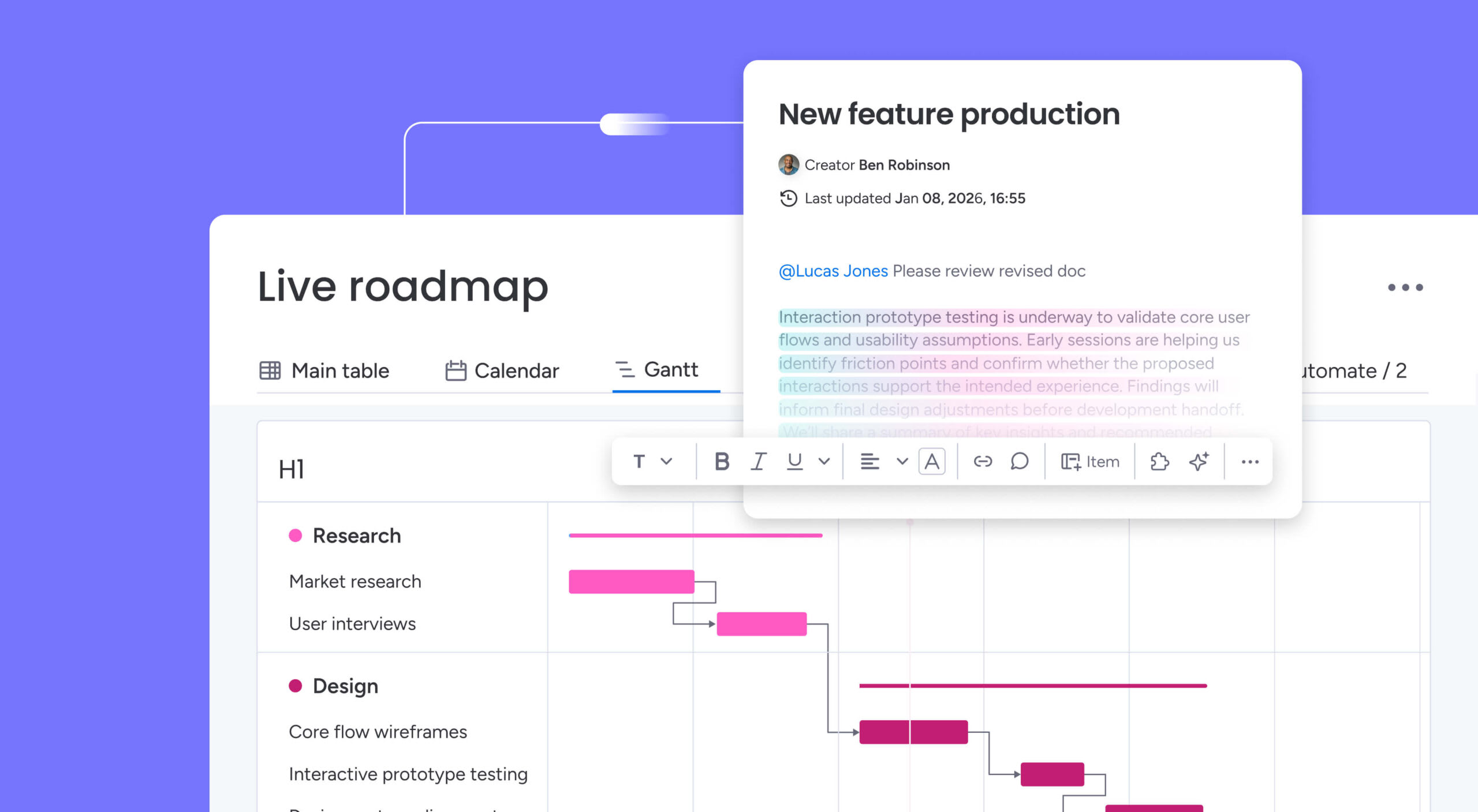
- WorkCanvas by monday.com: A dedicated visual collaboration canvas for brainstorming, diagramming, and planning that connects directly to project boards, turning ideas into tracked deliverables with owners, timelines, and automated workflows.
- 15+ board views: Gantt, Kanban, Timeline, Workload, Calendar, and more, giving teams flexible ways to visualize and manage work.
- Dashboards and reporting: Real-time dashboards with 10+ widget types provide performance visibility across projects and portfolios.
- 200+ integrations: Connect to your existing tech stack, including Slack, Jira, Google Workspace, Microsoft Teams, and design platforms.
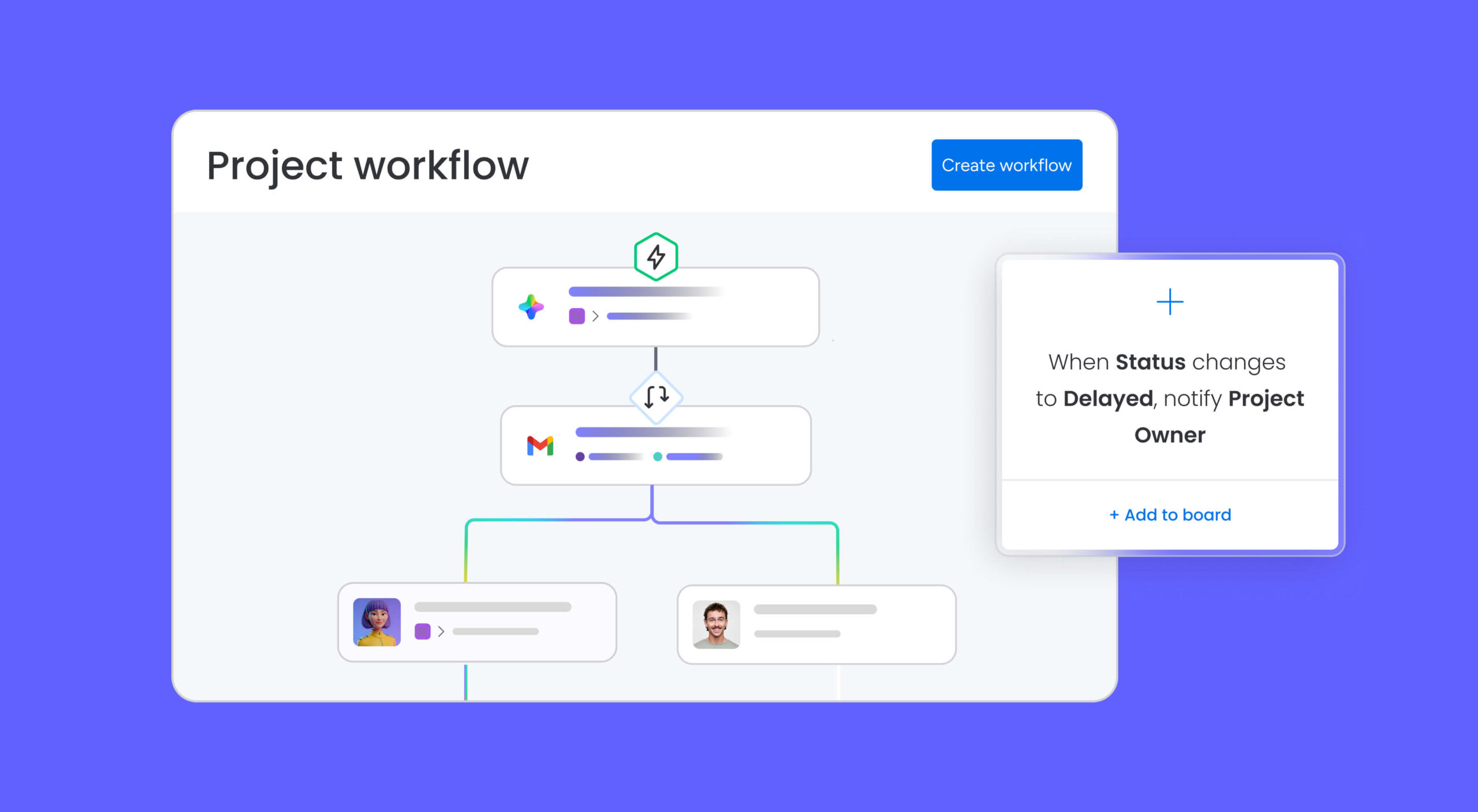
- No-code automations: Eliminate repetitive manual updates with workflow automations that route work, send notifications, and update statuses automatically.
- AI-powered features: monday sidekick assists with content drafting and workflow suggestions, monday agents automate routine work execution, monday vibe lets you build custom apps from natural language prompts, and monday MCP connects external AI assistants like Claude and ChatGPT to your workspace.
Pricing starts with a free plan (up to 2 seats), with paid plans beginning at $9 per seat per month.
- Strengths: Full AI Work Platform that goes far beyond whiteboarding, with AI-native features, visual canvas integrated with execution workflows, 200+ integrations, and strong ease-of-use ratings.
- Considerations: The visual canvas is one feature within a broader platform, and teams seeking only a standalone whiteboard may find the full platform more extensive than they need.
2. FigJam by Figma
FigJam is a natural Miro alternative for design teams already working in Figma. FigJam provides collaborative whiteboards with sticky notes, connectors, stamps, and drawing capabilities — all tightly integrated with Figma’s design environment. Jumping between a FigJam brainstorm and a Figma prototype takes a single click, which keeps design workflows fluid.
The free plan includes 3 FigJam files, and paid access comes bundled with Figma’s Professional plan at $5 per seat per month. The interface is intentionally simple, making onboarding fast even for non-designers joining a workshop.
- Strengths: Seamless Figma integration, intuitive interface, generous free tier, and fast onboarding for cross-functional collaborators.
- Considerations: Limited value for teams not using Figma. No native project management capabilities; brainstorms stay on the board unless manually transferred elsewhere.
3. Mural
Mural positions itself as the enterprise-grade facilitation platform, and its feature set reflects that focus. Guided templates, built-in timers, voting mechanisms, and facilitation superpowers (like private mode and summoning participants) make it a strong choice for structured workshops, design thinking sessions, and large-scale retrospectives.
Enterprise security certifications and SSO support make Mural popular with organizations that have strict compliance requirements. Pricing starts at $12 per member per month for the Team+ plan, with Enterprise tiers available for larger deployments.
- Strengths: Purpose-built facilitation features, enterprise security, and structured workshop templates that guide participants through exercises.
- Considerations: Expensive at scale compared to alternatives. Narrowly focused on facilitation rather than ongoing project execution. Once the workshop ends, teams still need a separate platform to track outcomes.
4. Whimsical
Whimsical is designed for speed. Its focused feature set covers flowcharts, wireframes, mind maps, and sticky notes without the feature bloat that can slow down simpler brainstorming sessions. The interface is minimal by design: you open it, start drawing, and the platform stays out of your way.
Pricing begins at $10 per seat per month, with a limited free plan available. Whimsical appeals to product managers and designers who need quick, polished diagrams without spending time configuring a complex canvas.
- Strengths: Fast, focused, and visually polished. Excellent for flowcharts and wireframes with minimal setup time.
- Considerations: Limited collaboration features at scale. No project management layer. The platform is purpose-built for diagramming, not workflow execution.
5. Lucidspark
Lucidspark is the brainstorming companion within the Lucid ecosystem, complementing Lucidchart’s diagramming capabilities. Teams that already use Lucidchart for technical diagrams and architecture maps can extend their workflow into Lucidspark for ideation, then push refined ideas back to Lucidchart for detailed documentation.
Pricing starts at $7.95 per user per month. The integration between Lucidspark and Lucidchart is the primary selling point; teams outside the Lucid ecosystem may find fewer reasons to choose it over broader alternatives.
- Strengths: Tight Lucidchart integration, collaborative brainstorming features, and competitive pricing.
- Considerations: Most valuable when paired with Lucidchart. Standalone brainstorming features are comparable but not differentiated from other options on this list.
6. ClickUp Whiteboards
Paid plans start at $7 per member per month. The whiteboard functionality is solid for basic brainstorming and planning, though ClickUp’s G2 ease-of-use rating of 8.1/10 suggests a steeper learning curve compared to dedicated whiteboard platforms.
- Strengths: No extra cost for existing ClickUp users, direct connection between whiteboard elements and project items.
- Considerations: Whiteboard features are less mature than dedicated platforms. The broader ClickUp interface can feel complex for teams primarily seeking a simple visual collaboration experience.
7. Microsoft Whiteboard
Can Microsoft Whiteboard replace Miro? For basic whiteboarding within a Microsoft 365 environment, it’s a viable and cost-effective option. Microsoft Whiteboard is included with Microsoft 365 subscriptions at no additional cost, and its native integration with Microsoft Teams means teams can launch a whiteboard directly within a meeting.
The platform supports sticky notes, shapes, templates, and ink input, with real-time collaboration for distributed teams. However, its feature depth lags behind dedicated whiteboard platforms. Template variety is limited, and advanced facilitation features like voting, timers, and guided workshops are absent.
- Strengths: Zero incremental cost for M365 organizations, native Teams integration, and familiar Microsoft interface.
- Considerations: Feature depth is limited compared to dedicated platforms. Teams outside the Microsoft ecosystem won’t benefit from its core integration advantage.
8. Canva Whiteboards
Canva Whiteboards bring visual collaboration into Canva’s design-first environment. Marketing and creative teams that already use Canva for social graphics, presentations, and brand assets can brainstorm on a shared canvas and pull in design elements (icons, photos, brand templates) without switching applications.
The whiteboard feature is available on Canva’s free plan, with expanded capabilities on Canva Pro at $13 per month. The design asset library is the standout differentiator, though teams needing project management or workflow execution will need a separate platform for that.
- Strengths: Massive design asset library, intuitive drag-and-drop interface, and accessible pricing.
- Considerations: Not built for workflow management or project tracking. Collaboration features are lighter than dedicated whiteboard platforms.
9. Excalidraw
Excalidraw is a fully free, open-source whiteboard with a distinctive hand-drawn aesthetic that developers and small teams find appealing. It runs in the browser with no account required, offers real-time collaboration, and can be self-hosted for organizations that prioritize data privacy.
The simplicity is the point. There are no enterprise features, no integrations marketplace, and no project management capabilities. For teams that want a no-frills, privacy-friendly whiteboard and nothing more, Excalidraw delivers exactly that.
- Strengths: Completely free, open-source, self-hostable, and privacy-friendly. No account required to start.
- Considerations: No native project management, limited enterprise features, and no vendor support.
10. Conceptboard
Conceptboard targets teams in regulated industries that need visual collaboration with compliance guarantees. The platform is ISO 27001 certified and GDPR-compliant, with data hosting options in Europe, a requirement for many organizations in healthcare, finance, and government.
Pricing starts at $6 per user per month, making it one of the more affordable options on this list. The feature set covers visual project management, real-time collaboration, and approval workflows, though the integration ecosystem is smaller than broader platforms.
- Strengths: ISO-certified, GDPR-compliant, and affordable. Strong fit for compliance-heavy organizations.
- Considerations: Smaller integration ecosystem and less brand recognition compared to other platforms on this list.
What challenges does switching from Miro address?
What happens when your whiteboard can’t keep up with your workflow? For many teams, Miro serves the brainstorming phase well, but gaps appear when it’s time to act on those ideas. Switching to a broader platform can address several recurring pain points that standalone whiteboarding creates.
Bridging the gap between brainstorming and execution
Miro is strong for ideation, but the moment a brainstorm ends, teams often copy sticky notes into a separate project management platform, re-entering information and losing context along the way. Alternatives with built-in project tracking let you convert canvas elements into tracked deliverables with owners, project deadlines, and status updates, without leaving the platform. This eliminates the manual handoff that slows down follow-through.
Managing costs as teams scale
Per-seat pricing compounds quickly. A team of 30 on Miro’s Business plan pays $600 per month for whiteboarding capabilities alone. Some alternatives bundle visual collaboration into broader work management subscriptions, meaning teams get whiteboarding, project tracking, automations, and reporting for a comparable or lower per-seat cost. Evaluating total cost of ownership (not just whiteboard pricing) reveals significant savings for growing organizations.
Reducing platform sprawl
Using a whiteboard alongside a separate project management platform, a docs platform, and a reporting platform means constant context-switching. Each additional subscription adds cognitive overhead, onboarding complexity, and integration maintenance. Consolidated platforms that combine visual collaboration with project execution, documentation, and dashboards reduce overhead and keep information in one place.
Getting started without limits
Miro’s 3-board cap on its free plan forces early upgrade decisions. Teams evaluating whether the platform fits their workflow run into restrictions before they’ve had a chance to fully test it. Alternatives with more generous free tiers, including some that offer unlimited boards or bundled features at no cost — let teams evaluate before committing budget.

What are the main benefits of using a visual collaboration platform?
Why do teams invest in visual collaboration when they already have chat, docs, and video calls? Because visuals create shared understanding in ways that text-based communication cannot. The benefits extend across team sizes, industries, and working styles.
Aligning distributed teams around shared visuals
Canvases, diagrams, and timelines make abstract ideas concrete. When a remote product team maps a user journey on a shared canvas, every stakeholder, from designers to engineers to executives, sees the same picture. This alignment is difficult to achieve through written documents or slide decks alone, especially for hybrid and fully remote teams operating across time zones.
Accelerating decision-making with real-time input
Simultaneous editing and inline commenting compress feedback cycles from days to minutes. Instead of circulating a PDF, waiting for email responses, and reconciling conflicting edits, teams collaborate live on the same canvas. Decisions that used to require three rounds of review can happen in a single session.
Connecting ideas to outcomes
The strongest platforms let teams move from sticky notes to structured projects without switching contexts. A brainstorm session about Q3 priorities can become a set of tracked initiatives with owners, timelines, and automated status updates, all on the same platform. This connection between ideation and execution is what separates visual collaboration from simple whiteboarding.
Which teams benefit from visual collaboration platforms?
Visual collaboration isn’t limited to design teams. Any group that thinks, plans, or solves problems together can benefit from a shared visual workspace. Here are the teams that see the most impact.
- Product and design teams: mapping user journeys, wireframing interfaces, running design sprints, and planning sprint ceremonies on shared canvases.
- Marketing teams: brainstorming campaign concepts, building content calendars, running brand workshops, and collaborating on creative briefs.
- Operations teams: mapping processes, optimizing workflows, aligning stakeholders, and documenting standard operating procedures visually.
- Engineering teams: creating architecture diagrams, running retrospectives, planning sprints, and documenting system dependencies.
- Leadership and strategy teams: planning roadmaps, aligning OKRs, visualizing portfolio performance, and running strategic offsites.
What processes are part of monday.com's AI Work Platform?
Once the brainstorm ends, the real work begins. The AI Work Platform is designed to carry ideas from the canvas through every stage of execution: planning, tracking, automating, documenting, and reporting. Here’s how the platform’s core processes connect visual collaboration to project delivery.
- Project planning and tracking: Gantt, Timeline, and Kanban views give teams structured delivery frameworks. Each view offers a different lens on the same data; switch from a high-level timeline to a detailed Kanban board without duplicating information.
- Resource management: The Workload view provides capacity planning across teams, showing who’s overloaded and who has bandwidth. Managers can redistribute work before bottlenecks form.
- Workflow automation: No-code automations route work, send notifications, update statuses, and trigger actions across boards. Teams spend less time on manual updates and more time on meaningful work.
- Collaborative documentation: monday workdocs turn meeting notes and brainstorm outputs into living documents connected to boards. Changes to a doc update the associated project, and changes to a project reflect in the doc.
- Reporting and dashboards: Real-time dashboards with 10+ widget types (charts, numbers, timelines, workload breakdowns) give teams and leaders performance visibility without manual report building.
For teams evaluating a project management approach that connects to visual collaboration, these processes are what turn a whiteboard sketch into a delivered outcome.
How monday.com's AI Work Platform features support visual collaboration and beyond
Where standalone whiteboards stop at ideation, the AI Work Platform extends into execution, automation, and intelligence. This section covers the three feature categories that make the platform a comprehensive Miro replacement for teams that need more than a canvas.
WorkCanvas by monday.com: your visual collaboration space
WorkCanvas by monday.com is where brainstorming, diagramming, and planning happen directly on the monday.com platform. Teams can sketch workflows, map out project structures, run ideation sessions, and build visual plans on an infinite canvas.
What makes it different from standalone whiteboards is what happens next: ideas created on the canvas connect to monday.com boards, so brainstorm outputs become tracked projects with owners, timelines, and automated workflows. The difference between “what if” and “who’s doing this by when” disappears.
15+ views, dashboards, and automations for every workflow
Gantt, Kanban, Timeline, Workload, Calendar, and more. These 15+ views let teams visualize the same project data in whatever format fits their working style. Dashboards with 10+ widget types (charts, numbers, timelines, workload breakdowns) provide real-time performance visibility across projects and portfolios.
Over 200 integrations connect the platform to the rest of your technology stack, and no-code automations eliminate the repetitive status updates, notifications, and handoffs that drain time. For teams building Gantt charts or tracking complex portfolios, this execution layer is what standalone whiteboards lack.
AI-powered features that work alongside your team
The platform’s AI suite handles the routine so teams focus on creative and strategic work. monday sidekick is a context-aware AI assistant that drafts content, locates insights, and suggests next steps based on project data. monday agents automate work execution, updating statuses, routing approvals, and handling handoffs that used to require manual intervention. monday vibe lets anyone build custom work apps from natural language prompts, no coding required. And monday MCP connects external AI assistants like Claude and ChatGPT directly to your workspace, so teams can use their preferred AI alongside their projects.

Find the right visual collaboration platform for your team
The right choice depends on where your team spends most of its time. If you need a focused whiteboard for design sprints and nothing else, platforms like FigJam or Whimsical deliver that with minimal overhead. If your organization runs on Microsoft 365, the included Whiteboard may be enough for basic brainstorming. And if your team needs visual collaboration connected to full project delivery, with tracked deliverables, automations, AI-powered features, and 200+ integrations — the monday.com AI Work Platform with WorkCanvas by monday.com is built for exactly that.
Start with your team’s workflow. Map the journey from brainstorm to delivered outcome, then choose the platform that supports every step, not just the first one.
Get startedFAQs about Miro alternatives
What is the most popular free alternative to Miro?
The most popular free alternatives to Miro include Excalidraw (fully free and open-source), Microsoft Whiteboard (included with Microsoft 365 subscriptions), and monday.com's AI Work Platform (free plan with WorkCanvas access for up to 2 seats). Miro's own free plan limits teams to 3 editable boards, making these alternatives attractive for teams that need more flexibility without an immediate upgrade.
Is FigJam an alternative to Miro?
Yes, FigJam is a strong alternative to Miro for design teams already using Figma. FigJam offers collaborative whiteboards with tight Figma integration, making it easy to move between brainstorming and design work. However, FigJam lacks native project management features, so teams needing execution capabilities will need a separate platform.
Can Microsoft Whiteboard replace Miro?
Microsoft Whiteboard can replace Miro for basic whiteboarding within a Microsoft 365 environment, especially for teams already using Teams for communication. For advanced features like extensive template libraries, facilitation capabilities, and deep integrations beyond the Microsoft ecosystem, dedicated platforms offer more functionality.
What is the most affordable Miro alternative for remote teams?
The most affordable Miro alternatives for remote teams include Excalidraw (completely free), Microsoft Whiteboard (included with M365), and Conceptboard (starting at $6 per user per month). Platforms that combine whiteboarding with project management, like monday.com's AI Work Platform, can reduce total cost by replacing multiple subscriptions with a single platform.
Can I use a Miro alternative for project management?
Yes, you can use certain Miro alternatives for project management, though standalone whiteboard platforms typically lack those features. Platforms like the AI Work Platform integrate visual collaboration through WorkCanvas by monday.com with full project tracking, no-code automations, and real-time reporting, making them a single platform for ideation through delivery.
What is the difference between Miro and Mural?
The difference between Miro and Mural comes down to focus. Miro is a general-purpose visual collaboration platform with broad integrations and flexible use cases. Mural specializes in facilitated workshops and enterprise-grade sessions, offering guided templates, built-in timers, and voting mechanisms designed for structured group exercises.
 Get started