


A signed contract is what turns a vague vendor arrangement into an accountable, on-time, on-budget deliverable. It sets the scope, fixes the price or the rate, and spells out who does what by when. Understanding the types of contracts in project management is how you match the right agreement to the right job, so you know exactly where the risk sits before any work begins.
This guide breaks down the main contract types, their variants, and who carries the risk in each. You’ll get a clear framework for choosing the right model, a walk-through of the contract lifecycle, and a practical look at how the monday.com AI Work Platform keeps every agreement, budget, and vendor status in one place.
Key takeaways
- The 3 primary types of contracts in project management are fixed price, time and materials, and cost reimbursable, and each shifts cost risk differently between buyer and seller.
- Fixed price contracts put the risk on the seller and suit well-defined scope, while cost reimbursable and time and materials contracts put more risk on the buyer and suit evolving or uncertain work.
- Beyond the big 3, unit price and incentive contracts handle variable-quantity work and performance-based rewards.
- Choosing the right contract type comes down to how clear your scope is, how much risk you can absorb, and how predictable you need costs to be.
- You can centralize contract tracking, budgets, and vendor status on the monday.com AI Work Platform, with automations for renewals and AI agents that flag risk and report on progress.
What is a contract in project management?
A contract in project management is a legally binding agreement between a buyer and a seller or supplier that defines scope, deliverables, timelines, and payment. It’s the official document that turns a handshake into enforceable terms both sides agree to follow.
According to the Project Management Institute, a contract between parties can be oral or written and is a legally binding agreement that defines their relationship. Within project management, there are various types of contracts, including fixed price contracts, time and material contracts, and cost reimbursable contracts. The contract dictates the timeframe within which the deal or transaction takes place, what payment will be and when the payment is due.
A well-written contract typically spells out the scope of work, the specific deliverables, key milestones, and the payment terms so both parties know what to expect at every stage.
Why contracts matter in project management
A proper contract provides a legal framework that removes uncertainty about timelines, payment, and responsibilities. It spells out what work is required, who owns each task, when deadlines fall, and how payment happens. That clarity builds trust between buyer and supplier and forms the foundation of sound procurement management, where clear terms keep supplier relationships accountable.
Beyond building trust, a contract is the reference point everyone returns to when questions come up. It governs several specific areas of the working relationship, and knowing what it covers helps you spot gaps before they cause disputes.
- Scope of work: The exact tasks, deliverables, and boundaries of what’s included
- Responsibilities: Who owns each part of the project on both the buyer and seller side
- Deadlines: The timeline, milestones, and dates work is expected to be delivered
- Payment: How much is owed, on what basis, and when it’s due
- Risk allocation: Which party absorbs cost overruns, delays, or unexpected expenses
- Dispute resolution: The agreed process for handling disagreements if they arise
3 main types of contracts in project management
Project management has 3 primary contract types. Each balances cost, flexibility, and risk differently, so the right choice depends on how clearly you can define the work up front.
| Contract type | How it works | When to use it |
|---|---|---|
| Fixed price (FP) | Sets an agreed price for a defined scope of work | Scope and deliverables are clear and unlikely to change |
| Time and materials (T&M) | Charges agreed labor rates plus material costs based on actual usage | Requirements may evolve or the total effort is difficult to estimate |
| Cost reimbursable (CR) | Reimburses allowable project costs plus an agreed fee | Scope or costs are highly uncertain, such as exploratory R&D |
Fixed price (FP) contracts
Fixed price contracts work when scope is clearly defined. The seller bears most of the cost risk if actual expenses exceed the agreed price, subject to the contract’s adjustment and change provisions. The seller profits if they finish under budget but absorbs all cost risk if expenses run over.
Common FP contract variants include:
- Firm fixed price contract
- Fixed price incentive fee
- Fixed price with economic price adjustment
Choose fixed price when scope is well-defined and stable, like building a road or implementing off-the-shelf software. The seller bears the cost risk, and you know your total budget before work starts.
Time and materials (T&M) contracts
T&M contracts bill based on agreed hourly rates and material costs. The contract sets the rates up front, then the final price depends on actual hours worked and materials used. This suits projects where scope isn’t fully clear at the start.
Use time and materials when scope will evolve, which is common in agile software builds, creative work, or staff augmentation. The buyer carries more risk since total cost rises with hours and materials. A not-to-exceed clause caps that exposure by setting a ceiling the final bill can’t cross.
Cost reimbursable (CR) contracts
Cost reimbursable contracts have the buyer pay all project costs plus a fee to the supplier. This model works when the work is too uncertain to price accurately up front. The buyer carries more of the cost risk and must monitor expenses closely because final costs are less predictable.
Common CR contract variants include:
- Cost plus percentage of cost (restricted or prohibited in some procurement environments)
- Cost plus fixed fee
- Cost plus incentive fee
- Cost plus award fee (CPAF)
Choose cost reimbursable when scope is genuinely uncertain, like early-stage research and development or drug development. The buyer bears the cost risk but gains the flexibility to pursue exploratory work without forcing an estimate nobody can accurately make.
Get StartedOther contract types to know: Unit price and incentive contracts
The big 3 cover most projects, but 2 more contract types come up often enough to know well. Both solve problems the standard models handle poorly, and understanding when each applies rounds out your toolkit for scoping vendor agreements.
Unit price contracts
These shine on large infrastructure and repair work, where you can price each task cleanly but the total volume depends on conditions you discover as you go. The contract sets a fixed rate per unit — per cubic meter of concrete, per linear foot of pipe, or per repair—and the final cost scales with actual quantity delivered.
This model shares risk between buyer and seller: the per-unit rate stays locked, but total spend rises or falls with volume.
Incentive contracts
These are worth the extra negotiation effort when hitting an early deadline or beating a cost target carries real value for the buyer. They layer performance-based rewards on top of a base price, so the seller earns a bonus for finishing ahead of schedule, under budget, or above a quality threshold.
A fixed price incentive fee contract, for example, combines a fixed price base with an incentive tied to results. Used well, incentive contracts give you more control over outcomes than a plain fixed price or cost reimbursable deal alone.
How to choose the right project contract type

The difference between time and materials and cost reimbursable contracts is that T&M bills fixed hourly and material rates, while cost reimbursable pays actual costs plus a fee. That distinction matters when you’re choosing a model, because it changes both how predictable your costs are and where the risk lands.
The right contract type usually comes down to a few practical questions. How clearly can you define the scope today? How much cost risk can you absorb if things change? And how predictable do your costs need to be for budgeting and approval? The table below maps the main contract types against those factors so you can compare them at a glance.
| Contract type | Best when | Who bears more cost risk | Cost predictability |
|---|---|---|---|
| Fixed price | Scope is well-defined and stable | Seller | High |
| Time and materials | Scope is evolving or flexible | Buyer; an NTE clause can limit exposure | Moderate |
| Cost reimbursable | Scope is uncertain, such as research and development | Buyer | Low |
| Unit price | Quantity varies but per-unit cost is known | Shared; total cost scales with quantity | Moderate |
| Incentive | You want to reward specific performance targets | Shared; depends on incentive structure | Moderate |
As a rule of thumb, the clearer your scope, the more you can push toward fixed price and shift risk to the seller. The murkier the work, the more a cost reimbursable or time and materials model protects both sides from pricing something nobody can predict. Weigh scope clarity, risk tolerance, and project variability together rather than in isolation, since a project with tight budgets but shifting requirements may need a not-to-exceed T&M contract to balance the 2.
Finally, factor in how much oversight you can commit to. Cost reimbursable and time and materials contracts demand active cost monitoring on the buyer’s side, so choose them only if you have the capacity to keep up with project cost tracking. If you’d rather set terms once and step back, a fixed price or unit price contract asks far less of your day-to-day attention.
Get StartedThe 5 stages of the contract lifecycle
A contract isn’t a one-time document you sign and forget. It moves through a predictable lifecycle, and managing each stage well is what keeps a project on track from kickoff to close. The stages of a contract can be broken down into 5 areas from inception to completion.
- Creation: The parties develop the contract terms based on the project scope, requirements, responsibilities, and commercial conditions.
- Negotiation: In the negotiation stage, the seller presents the proposed contract to the buyer. They discuss any changes the buyer would like to see before they feel comfortable entering into the agreement.
- Signatures and award: This is the part of the process where both parties agree to the terms outlined in the contract and sign in acceptance.
- Execution and administration: All parties must carry out the duties they agreed to as part of the contract. This may include performance monitoring, managing disputes, and adhering to a specified budget.
- Close-out and renewal: When a contract expiry date approaches, there are a couple of options for the involved parties to consider. They can renew the contract with the same terms and conditions or they can re-negotiate the existing terms. If a contract expires and there is no renewal, the contract must be closed-out and all parties must be notified. In some cases, a party may have obligations that continue after the contract’s expiry.
Managing project contracts with monday's AI Work Platform
Knowing the contract types is one thing; keeping them organized across a live portfolio is another. Contracts scattered across email threads, spreadsheets, and shared drives are where renewal dates slip and cost overruns hide. The monday.com AI Work Platform gives you one connected place to track every agreement and the work tied to it, which matters most on cost reimbursable and T&M projects where cost overruns are the main risk. For contract-heavy portfolios, dedicated AI contract management software can take that automation further, flagging risk clauses and non-standard terms across every agreement your team is tracking.
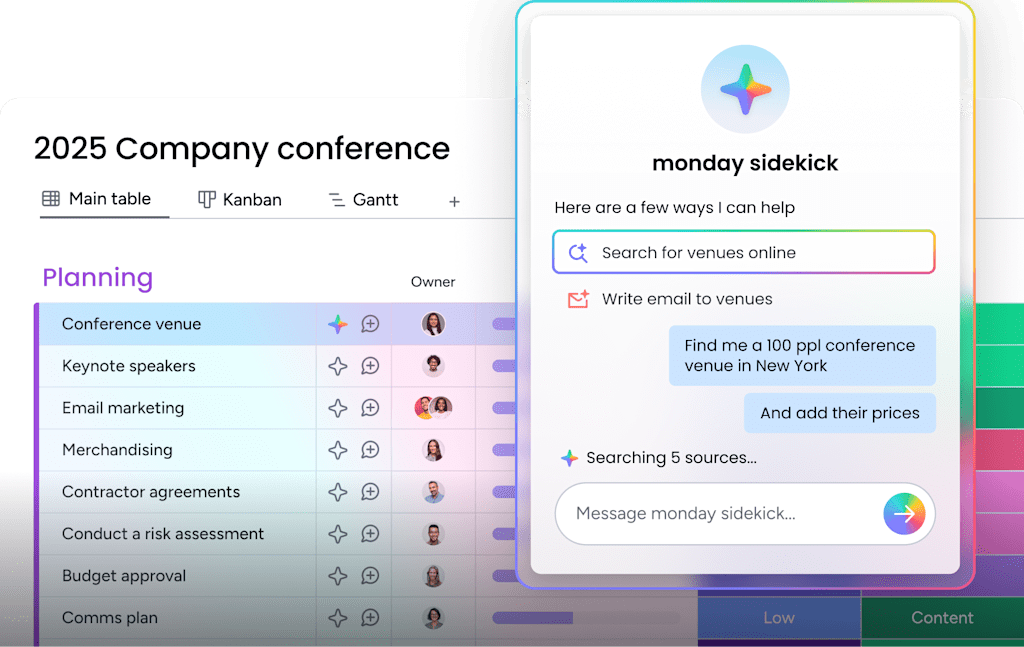
The core problem with manual contract management is that the contract and the project it governs live in separate places. Your agreement sits in a document while the actual work, spend, and deadlines move somewhere else, so the 2 drift apart. Connecting them means every payment milestone and renewal date sits alongside the tasks it depends on, and everyone involved sees the same current picture. Here’s how the platform maps to the everyday challenges of managing project contracts.
- Central visibility: dashboards and boards let you track every contract, milestone, and payment in one place, so nothing gets buried in someone’s inbox.
- Budget and cost control: budget tracking and formula columns monitor spend against contract value in real time, giving you early warning before a cost reimbursable or T&M project runs over.
- Automations: set automatic reminders for renewal and expiry dates, route approvals to the right people, and trigger status changes so no deadline passes unnoticed.
- monday vibe: describe what you need in plain language and build a custom contract or vendor tracker app from a prompt, with no code required.
- monday agents: The Vendor Research agent can analyze procurement requirements and prioritize supplier options, while Risk Analyzer and Status Reporter help flag project risks and generate progress updates.
- monday MCP: connect AI assistants like Claude and ChatGPT so they can securely act on your contract data within the permissions you set.
Taken together, these capabilities close the gap between the contract terms you negotiated and how the project actually runs. Instead of chasing status in meetings or discovering a missed renewal after the fact, you get the visibility and early warnings that keep cost and risk in check. The practical difference shows up when you compare managing contracts by hand against managing them on a connected platform.
| Capability | Manual or spreadsheets | monday.com’s AI Work Platform |
|---|---|---|
| Visibility | Contracts spread across files and inboxes | Every contract on shared boards and dashboards |
| Renewal reminders | Manual calendar entries that are easy to miss | Automated reminders before expiry dates |
| Budget tracking | Formulas maintained by hand and updated late | Live spend tracked against contract value |
| Collaboration | Version conflicts and email back-and-forth | Real-time updates in one shared workspace |
| Risk flagging | Issues spotted only when someone checks | Agents help surface approaching deadlines and project risks |
The same visibility extends to the projects those contracts support. You can start with a single project template to map every phase and deadline, or scale up with the project portfolio management template to track budgets across teams. When work spans several initiatives at once, the platform makes it possible to manage multiple projects from one shared view.
Learn more: AI contract renewal agent
Turning contract clarity into project success
Choosing among the types of contracts in project management isn’t a paperwork formality. It’s the decision that sets how risk, cost, and accountability play out over the entire project. Match a fixed price contract to well-defined work, a T&M or cost reimbursable model to evolving scope, and you’ve protected both sides before the first task starts.
Clarity on paper only pays off if you can act on it day to day. Pairing the right contract type with a system that keeps agreements, budgets, and vendor status visible is what turns a signed document into on-time, on-budget delivery. That’s the point where contract clarity stops being theory and starts driving real project success.
Get StartedFAQs
What are the main types of contracts in project management?
The three main contract types in project management are fixed price, time and materials, and cost reimbursable. Each also has variants, such as firm-fixed-price, fixed-price incentive, cost-plus-fixed-fee, and cost-plus-incentive-fee contracts.
What is an example of a contract in project management?
A construction project with a fully defined scope may use a fixed-price contract, while an evolving software project may use a time-and-materials contract. Research projects with uncertain costs may use a cost-reimbursable agreement.
How does monday.com AI Work Platform help manage project contracts?
It centralizes contracts, budgets, and vendor status on shared boards and dashboards. Automations handle renewal reminders and approvals, while AI agents flag risks and generate status updates for you.
 Get started