


Your marketing team launches five campaigns this quarter. Two exceed expectations, one barely breaks even, and two completely miss the mark. Sound familiar? This scenario plays out across organizations every day. It happens not because teams lack talent or effort, but because marketing activities often operate in isolation rather than as a coordinated system.
Marketing management changes this dynamic entirely by creating strategic oversight that connects individual campaigns to business outcomes. It’s the discipline of planning, coordinating, and optimizing all marketing activities to work together toward shared goals. Instead of managing campaigns one by one, marketing management treats your entire marketing portfolio as an interconnected system where decisions about budget, timing, and resources drive measurable business impact.
This post breaks down what marketing management looks like in practice, from strategic planning and resource allocation to performance measurement and team coordination. We’ll examine the essential skills that separate effective marketing managers from campaign executors, explore how AI transforms portfolio optimization, and show you frameworks for building marketing management capabilities that scale.
Key takeaways
- Connect marketing activities to business outcomes: set goals that directly support revenue targets and pipeline growth, not just marketing metrics like impressions or clicks.
- Coordinate your entire marketing portfolio: manage multiple campaigns simultaneously while ensuring they work together toward shared objectives instead of competing for resources.
- Use monday work management to unify marketing execution: centralize campaign planning, resource allocation, and performance tracking in one platform so teams stay aligned without switching between multiple systems.
- Build cross-functional collaboration from day one: establish shared KPIs with sales, product, and other departments so marketing drives business results, not just departmental goals.
- Leverage AI for strategic decision-making: automate routine analysis and reporting so you can focus on portfolio optimization, resource allocation, and strategic planning that drives growth.
What is marketing management?
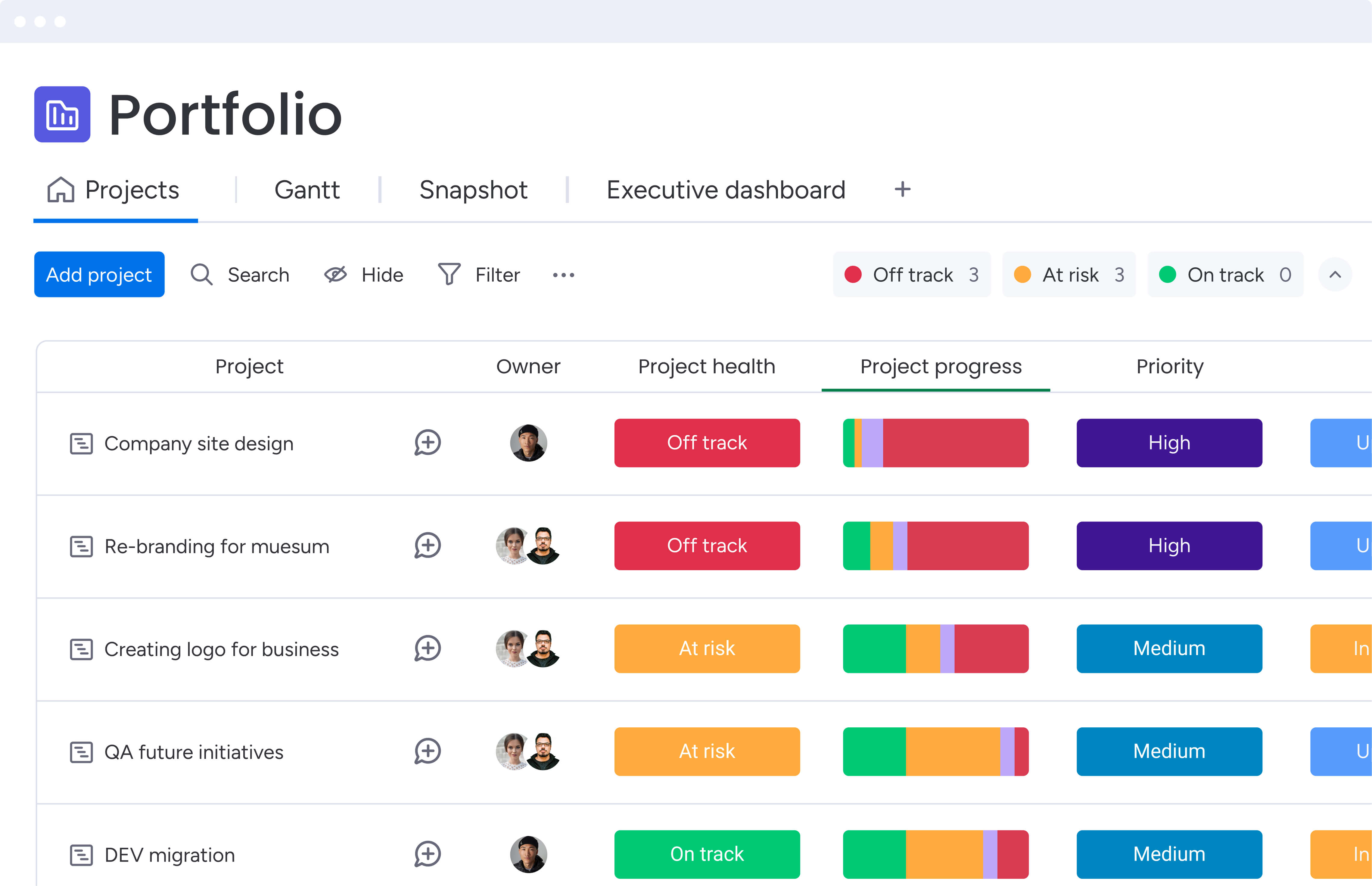
Marketing management brings order to chaos by coordinating all your marketing activities toward specific business goals. Essentially, it’s about planning smart, executing with purpose, and constantly fine-tuning your approach across channels to deliver what your business actually needs.
Three key elements separate successful marketing management from the rest. Master these, and you’ll transform scattered campaigns into a coordinated system that delivers real results.
- Strategic planning: sets the direction for all marketing activities. Marketing managers define objectives that connect to business outcomes, conduct market research to inform decisions, and establish metrics that measure meaningful progress.For example, a marketing manager might set a quarterly goal to increase qualified leads by 30% to support the sales team’s revenue targets, then map out the campaign mix needed to achieve that number.
- Resource coordination: involves managing budgets across multiple campaigns, assigning team members based on skills and capacity, and orchestrating timelines to ensure initiatives launch on schedule. For example, coordinating a product launch requires allocating budget across paid media, content creation, and events while ensuring the right specialists work on each component.
- Performance optimization: means continuously measuring results, identifying what’s working, and adjusting strategies based on data. Marketing managers use real-time dashboards to track campaign performance across channels, analyze which initiatives deliver the strongest ROI, and reallocate resources from underperforming areas to high-impact opportunities.
Marketing management isn’t just nice to have anymore — it’s critical. Your customers now jump between social platforms, your website, email, and retail experiences in a single day, meaning you need to coordinate these touchpoints while making data-driven decisions about where to invest resources.
Marketing management vs marketing: key distinctions that matter
Distinguishing between marketing management and general marketing execution helps you build teams where roles are well-defined and everyone can work in sync.
This side-by-side comparison in the table below should give you the clarity you need. We’ll also shine a light on some other key distinctions you should be aware of, especially in relation to strategic leadership and portfolio oversight.
Dimension Marketing management Marketing execution
Primary focus Strategic direction and resource allocation Campaign creation and implementation
Timeline Quarterly and annual planning cycles Project-based timelines (weeks to months)
Decision authority Budget distribution, team priorities, strategic pivots Creative direction, channel tactics, content calendars
Success metrics Marketing-influenced revenue, portfolio ROI, strategic goal achievement Campaign-specific KPIs, channel performance, deliverable completion
Collaboration scope Cross-functional coordination with sales, product, finance Within marketing team and with external vendors
Strategic leadership vs campaign execution
Marketing management focuses on setting direction, allocating resources across initiatives, and ensuring all marketing activities align with business objectives. A marketing manager decides which campaigns to prioritize, how much budget each receives, and how they connect to quarterly revenue goals. Marketing execution focuses on creating and implementing specific campaigns. A marketer might spend weeks perfecting a product launch campaign, while the marketing manager ensures that launch fits into the broader portfolio strategy and supports the sales team’s pipeline needs.
Portfolio oversight vs individual projects
This essentially involves coordinating multiple campaigns, channels, and initiatives simultaneously while maintaining strategic coherence. A marketing manager oversees Q4 campaigns across five different channels, ensures they complement each other to reach the right audiences, and optimizes budget allocation based on performance. Marketing execution typically focuses on single projects or campaigns from start to finish.
Cross-functional impact vs department-specific work
Marketing management requires collaboration across sales, product, finance, and other departments to ensure marketing drives business outcomes. Managers in this sector typically participate in revenue planning meetings, align campaign timing with product launches, and coordinate with sales on lead qualification criteria.
Further, marketing execution often stays within marketing team boundaries, focusing on deliverables and channel-specific metrics.
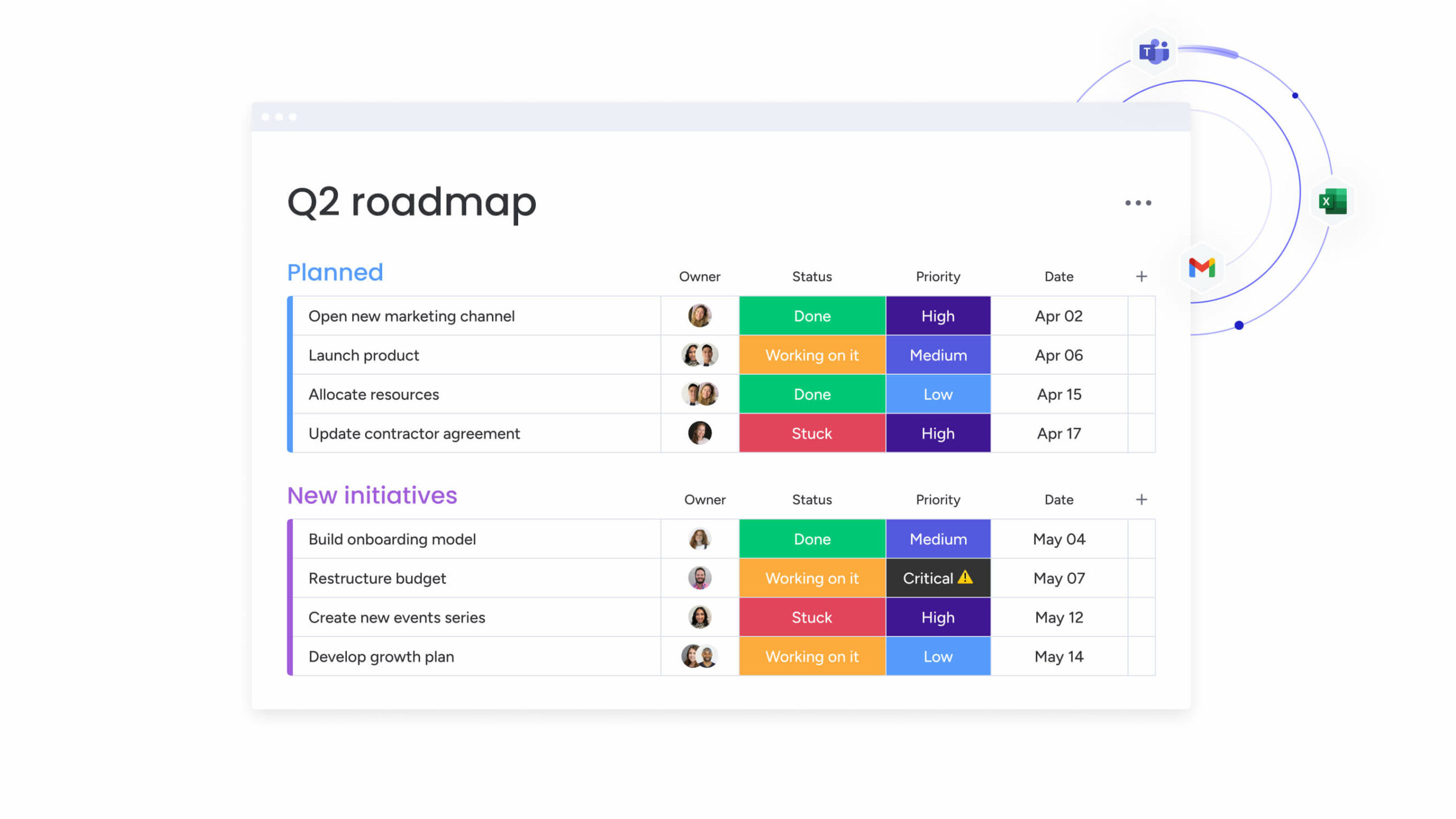
The 7 essential types of marketing management
1. Product marketing management
Product marketing management connects product development to real market demand. Teams in this function own positioning, messaging, and go-to-market strategy, ensuring products are launched with clear differentiation and buyer relevance.
Responsibilities typically include competitive analysis, value proposition development, and cross-functional launch coordination. Tools like monday work management help product marketers centralize competitive insights, manage launch timelines, and align deliverables across product, sales, and marketing teams.
2. Brand marketing management
Brand marketing management focuses on long-term brand strength rather than short-term conversion. It ensures consistency across all customer touchpoints while building trust, recognition, and preference over time.
Brand marketing managers define brand guidelines, manage reputation, and lead campaigns designed to shape perception. Success is measured through metrics like brand awareness, consideration, and preference, rather than immediate pipeline impact.
3. Digital marketing management
Digital marketing management oversees all online channels and how they work together as a system. This includes website performance, social media, paid advertising, and the broader digital customer journey.
Digital marketing managers allocate budget across channels, optimize performance, and ensure messaging remains consistent. With monday work management, teams can visualize cross-channel performance, automate reporting, and maintain alignment across active digital initiatives.
4. Content marketing management
Content marketing management plans and delivers content that supports the entire buyer journey. The focus is on attracting, educating, and nurturing audiences with content tied to business objectives.
Content marketing managers define content strategy, manage editorial calendars across formats and channels, and measure how content contributes to pipeline and revenue, not just engagement.
5. Growth marketing management
Growth marketing management is centered on scalable experimentation and continuous improvement. It prioritizes acquisition, retention, and expansion through rapid testing and data analysis.
Growth marketing managers run ongoing A/B tests across channels, analyze performance trends, and optimize the full customer lifecycle from awareness through advocacy.
6. Performance marketing management
Performance marketing management drives results through highly measurable, ROI-focused campaigns. It concentrates on channels where outcomes can be directly tracked and optimized.
Performance marketing managers manage paid campaigns across search, social, and display, optimize toward defined conversion actions, and ensure spend is tightly connected to business results.
7. Marketing operations management
Marketing operations management enables everything else to run efficiently. It owns the systems, processes, and data infrastructure that support execution at scale.
Marketing operations managers manage the marketing technology stack, define workflows and approval processes, maintain data quality, and provide analytics for performance measurement. monday work management supports these efforts through customizable automations, centralized project tracking, and real-time dashboards that keep teams aligned.
The four-step marketing management process
Strong marketing management follows a clear operating model, not a loose set of best practices. This four-step process outlines how marketing leaders move from strategic direction to coordinated execution, then use performance data to refine decisions over time. It provides structure without rigidity, helping teams stay aligned while adapting to changing priorities.
Stage Key activities Stakeholders involved Typical duration
Strategic planning Market research, goal setting, budget planning, priority alignment Marketing leadership, sales leadership, finance, executive team two–four weeks per quarter
Resource allocation Budget distribution, team assignments, timeline development, vendor selection Marketing managers, team leads, HR, procurement one–two weeks
Campaign development Campaign creation, cross-channel coordination, messaging alignment, dependency mapping Marketing team, creative agencies, sales enablement, product marketing four–eight weeks per campaign
Continuous optimization Performance monitoring, A/B testing, budget reallocation, strategy refinement Marketing analysts, campaign managers, marketing leadership Ongoing throughout quarter
Step 1: strategic planning and goal setting
Strategic planning sets clear direction for what marketing is responsible for delivering. The goal is to define priorities and success metrics before campaigns are planned or budgets are assigned.
Marketing managers anchor objectives to business outcomes, not channel activity. Goals should support revenue, pipeline, retention, or market expansion with clear ownership and timeframes.
For example, “increase qualified leads by 25% in Q2 to support a $2M sales pipeline” provides clearer direction than broad goals like “increase awareness.”
This step focuses on three essentials:
- Market insight: understanding customer needs and competitive dynamics.
- Baseline performance: reviewing past results to set realistic targets
- Success metrics: defining KPIs leadership will use to measure impact
Step 2: resource allocation and team orchestration
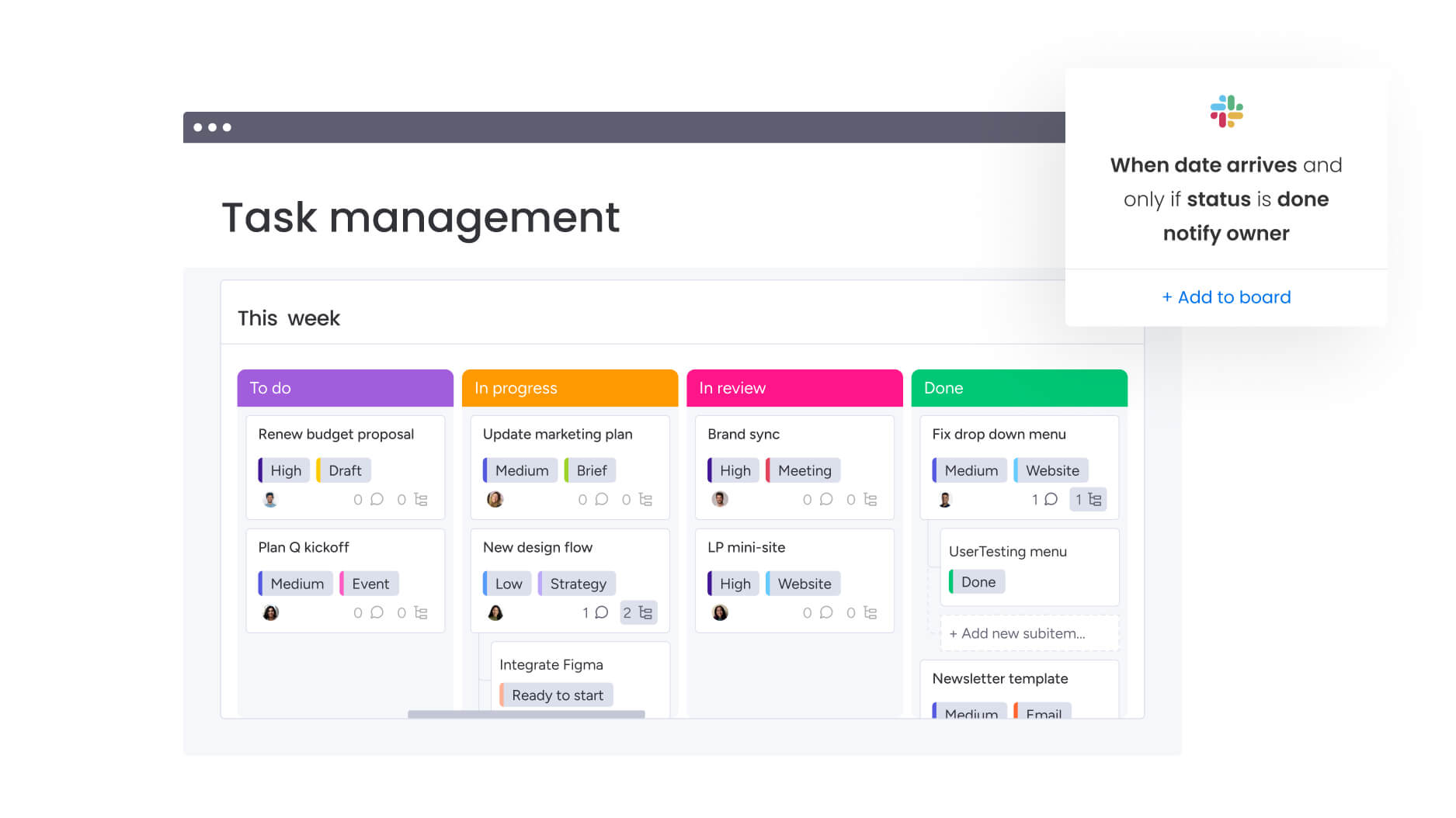
Smart budget allocation isn’t about copying last quarter’s spreadsheet. The best marketing managers might put nearly half their budget into channels they know deliver leads, carve out a similar chunk for testing new opportunities, and save the rest for brand-building that pays off down the road. The exact mix changes based on your business reality.
Teams coordinate resource allocation on monday work management by:
- Capacity visualization: seeing team availability and workload distribution.
- Budget tracking: monitoring spend across initiatives in real-time.
- Skills matching: ensuring the right expertise aligns with each project requirement.
Step 3: campaign portfolio development
Marketing managers coordinate multiple initiatives simultaneously while ensuring strategic coherence across the portfolio. This involves developing campaigns that target different audience segments or buyer journey stages, maintaining consistent messaging and brand experience across channels, and optimizing the campaign mix based on performance data and strategic priorities.
Step 4: continuous optimization and adaptation
Marketing managers monitor performance across the portfolio and make data-driven adjustments to improve results. This stage involves analyzing which campaigns and channels deliver the strongest return, conducting A/B tests to improve conversion rates and efficiency, and reallocating resources from underperforming initiatives to high-performing ones. monday work management’s dashboards provide real-time visibility into campaign performance, enabling quick pivots and immediate resource reallocation.
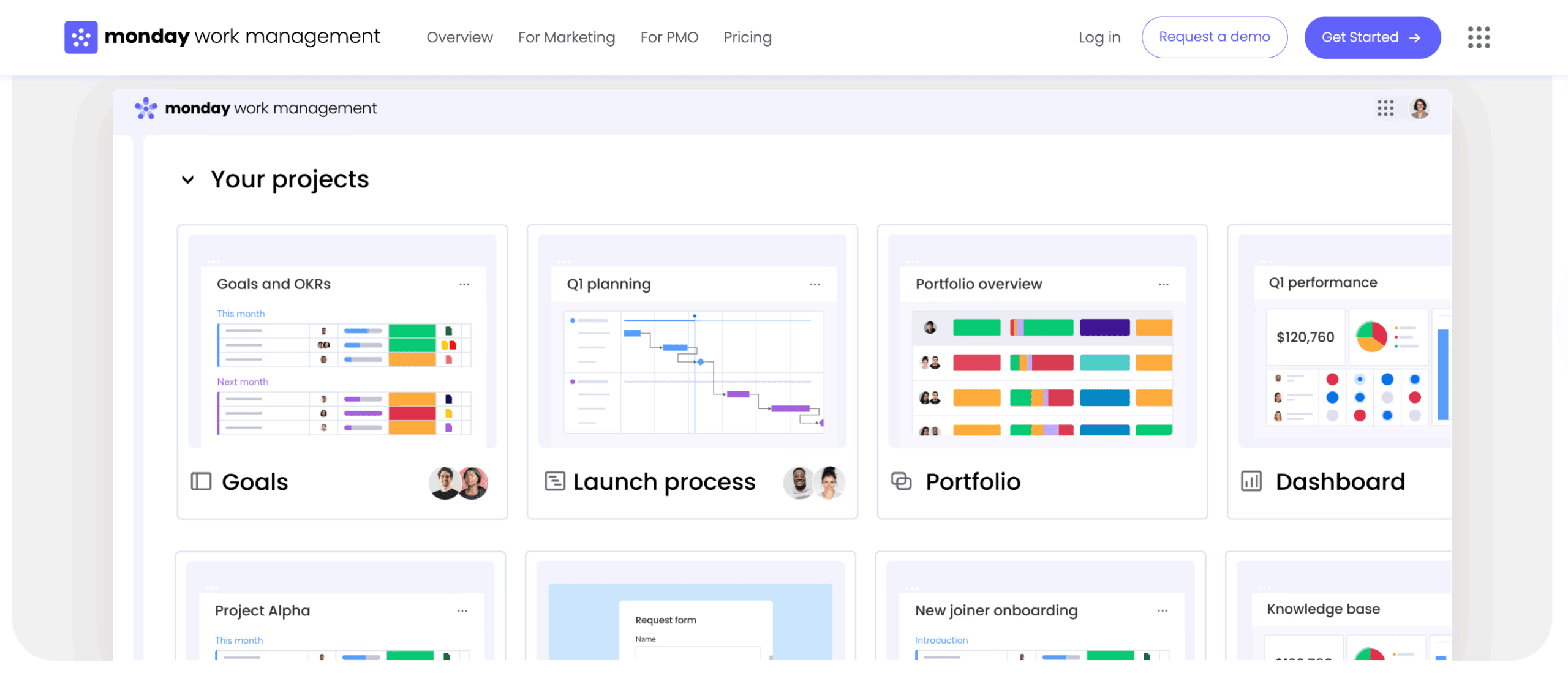
5 critical skills for marketing management excellence
Effective marketing management depends on more than campaign expertise. These five skills enable marketing managers to coordinate portfolios, align with the business, and drive measurable impact at scale.
1. Strategic business thinking
Marketing managers must connect daily activity to revenue, pipeline, and long-term growth. Strategic thinking ensures campaigns are built around business outcomes, not isolated channel metrics.
Key capabilities include:
- Market analysis: identifying growth opportunities and competitive threats
- Decision balance: managing short-term performance alongside long-term brand value
- Business translation: turning commercial goals into clear marketing priorities
Strong strategic thinkers know when to invest in demand capture and when to build demand creation, adjusting the mix as business needs evolve.
2. Data-driven decision making
Modern marketing management is guided by evidence, not instinct. Managers must interpret performance data to understand what works, why it works, and where to invest next.
This involves:
- Evaluating lead quality and downstream conversion, not just volume
- Testing assumptions and validating strategy with real results
- Assessing ROI across campaigns, channels, and time horizons
Rather than reporting activity, effective managers use data to inform prioritization, budget shifts, and portfolio optimization.
3. Leadership and people management
Marketing managers succeed through their teams. Strong leadership creates clarity, accountability, and momentum across complex workloads.
Core leadership responsibilities include:
- Expectation setting: defining goals, success criteria, and ownership
- Talent development: coaching team members and supporting skill growth
- Stakeholder trust: building strong relationships across sales, product, and leadership
The best managers align work to strengths, delegate intentionally, and create environments where teams can perform consistently under pressure.
4. Technology and automation mastery
Marketing managers must understand how technology enables scale, consistency, and visibility. This does not require deep technical expertise, but it does require strong judgment about systems and workflows.
Effective managers:
- Use automation to reduce manual work and execution risk
- Integrate tools to maintain clean data flows and reporting
- Centralize planning, execution, and performance tracking
Teams using monday work management streamline workflows, automate approvals, and maintain full visibility across campaigns without jumping between systems.
5. Cross-functional collaboration
Marketing management operates across the organization, not in isolation. Success depends on alignment with sales, product, finance, and customer success.
This skill includes:
- Relationship building: creating trust and shared ownership
- Value communication: explaining marketing impact in business terms
- Process design: enabling smooth handoffs and shared workflows
High-performing marketing managers maintain regular alignment with sales on lead quality, coordinate launches with product teams, and collaborate with customer success to support retention and expansion.
Try monday work managementHow AI transforms marketing management
AI has moved marketing management from reactive oversight to proactive control. Instead of waiting for reports or end-of-quarter reviews, marketing managers can now see what’s working, what’s at risk, and where to act — in real time. The advantage is no longer access to data, but the ability to turn it into timely decisions.
- AI-powered portfolio optimization gives managers a unified view of performance across campaigns, channels, and objectives. By analyzing early signals and historical patterns, AI highlights which initiatives are driving high-quality leads, which are likely to miss targets, and where budget shifts will deliver the greatest return. With monday work management, marketing leaders can automatically categorize campaign data, surface insights from reports, and identify optimization opportunities across the entire portfolio without manual analysis.
- Intelligent resource allocation ensures teams are deployed effectively as workloads change. AI evaluates skills, availability, past performance, and capacity to recommend assignments that balance delivery speed with sustainability. This reduces execution risk by identifying over-allocation early, helping managers prevent burnout and missed deadlines while keeping priorities on track.
- Predictive performance analytics allows managers to adjust before results decline. Rather than reacting to underperformance after it appears in dashboards, AI forecasts outcomes based on early trends and recommends specific actions to improve results. Teams use these insights to summarize complex performance data, detect shifts in customer sentiment, and focus attention where it will have the greatest impact.
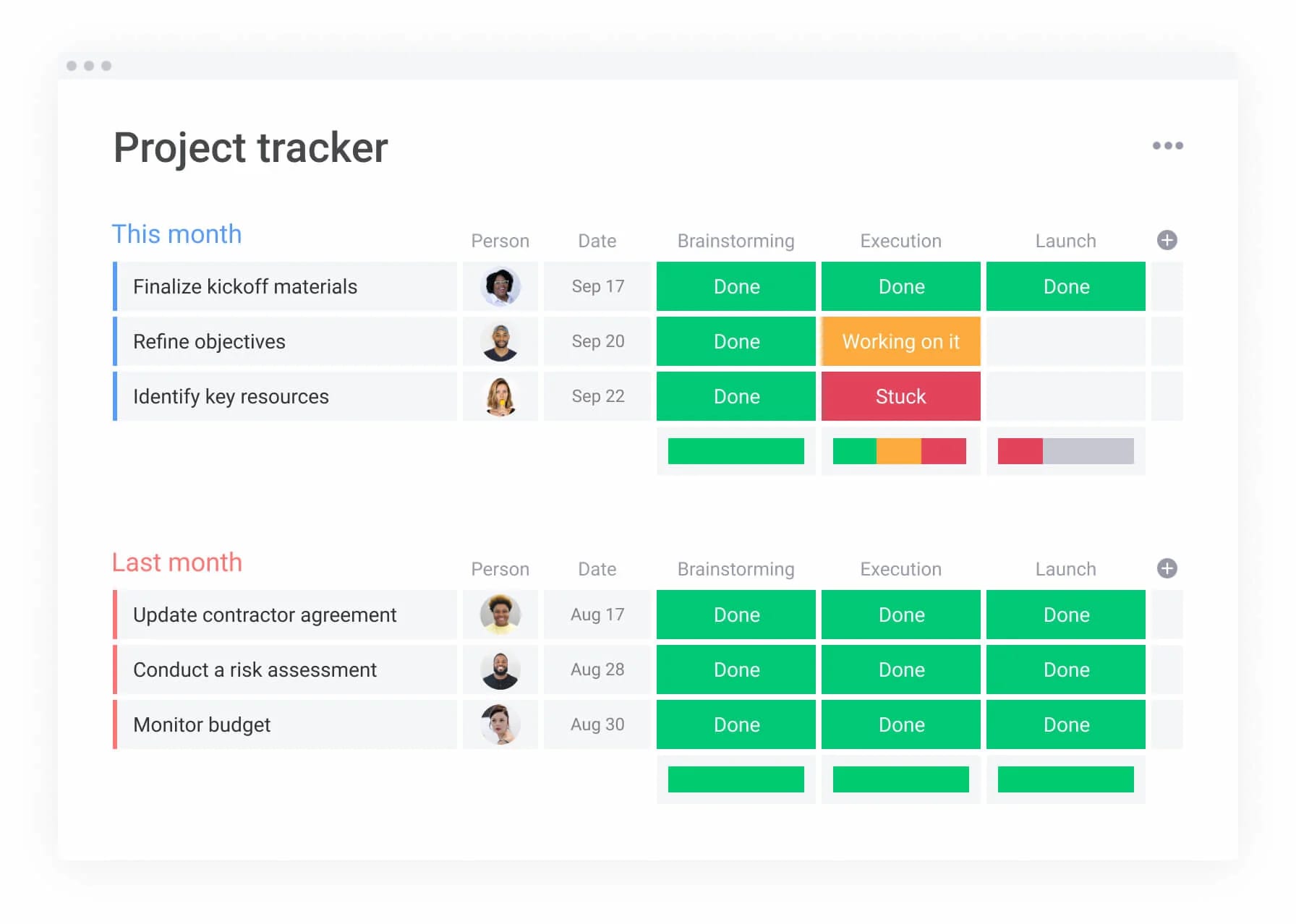
- Automated risk detection adds another layer of control across the marketing portfolio. AI continuously monitors budgets, timelines, and performance against benchmarks, flagging potential issues before they escalate. In monday work management, this means real-time alerts on budget overruns, delayed dependencies, or performance drops — enabling faster course correction and more confident decision-making.
Building your marketing management strategy: a practical framework
Marketing managers build effective strategies by following a four-step framework that connects daily activities to business outcomes. This framework provides a structured approach to moving from scattered marketing efforts to coordinated execution.
Step 1: define business-aligned objectives
Marketing objectives must tie directly to business goals rather than existing in isolation. A strong marketing objective might be “increase qualified leads by 25% in Qtwo to support the sales team’s $2M pipeline target” rather than vague goals like “improve brand awareness.”
This requires:
- Outcome connection: understanding how marketing activities influence business results.
- SMART goal setting: creating specific, measurable, achievable, relevant, and time-bound objectives.
- Executive alignment: establishing success metrics that matter to leadership.
Step 2: map your marketing portfolio architecture
Marketing managers inventory all current marketing activities to understand the full scope of work and identify optimization opportunities. This involves cataloging every active campaign, ongoing program, and marketing initiative, then categorizing activities by objective, audience, channel, and business unit. monday work management helps teams visualize their entire marketing portfolio, identify gaps and overlaps, and ensure resources align with strategic priorities.
Step 3: establish governance and workflows
It’s vital that processes are created that enable efficient execution while maintaining quality and strategic alignment. This involves:
- Approval workflows: balancing speed with necessary oversight.
- Role definition: establishing clear ownership for key responsibilities.
- Review cycles: setting regular checkpoints to monitor progress.
- Communication protocols: keeping stakeholders informed without overwhelming them.
Teams using monday work management automate these governance workflows, ensuring consistent execution without manual oversight.
Step 4: create measurement systems
Marketing managers build infrastructure to track performance and generate insights that inform decisions. This involves identifying the metrics that matter most for each objective, building dashboards that provide real-time visibility into portfolio performance, establishing automated reporting that delivers insights without manual data compilation, and creating regular review processes where teams analyze results and adjust strategies.
Marketing management solutions: essential capabilities
Behind every effective marketing operation sits a tech stack built on four key pillars. Knowing what each brings to the table helps you invest in tools that actually work together instead of creating more headaches.
Capability category Primary benefits Typical examples
Marketing automation and AI Scale personalization, automate workflows, predict outcomes Email nurturing, lead scoring, customer journey orchestration, campaign optimization
Analytics and business intelligence Measure performance, attribute revenue, generate insights Campaign ROI analysis, channel performance tracking, customer behavior analysis, executive reporting
Work management Coordinate execution, manage resources, provide visibility Campaign planning, project tracking, resource allocation, cross-functional collaboration
Integration and data unification Connect systems, centralize data, ensure consistency CRM-marketing automation sync, cross-channel attribution, unified customer profiles, automated reporting
Marketing automation and AI
These platforms remove manual effort while improving relevance and speed across campaigns.
- Automate email campaigns, lead nurturing, and cross-channel journeys
- Score leads based on behavior and engagement signals
- Trigger personalized communications from real-time customer actions
- Surface AI-powered insights that improve campaign performance and pipeline impact
Analytics and business intelligence
Analytics tools translate activity into outcomes by connecting performance data to business results.
- Track traffic, conversions, and customer behavior across channels
- Attribute revenue to marketing touchpoints across the buyer journey
- Calculate marketing ROI and cost efficiency by campaign and channel
- Identify which initiatives drive the highest-quality leads and revenue
Work management
Work management systems coordinate execution across teams, timelines, and priorities.
- Centralize visibility into campaigns, projects, and dependencies
- Allocate resources based on skills, capacity, and deadlines
- Track progress against milestones to prevent bottlenecks
- Align cross-functional teams without relying on manual updates
monday work management brings these capabilities together by giving marketing leaders a real-time view of what’s in progress, what’s at risk, and where teams need support.
Integration and data unification
Integration ensures every system works from the same source of truth.
- Sync CRM, marketing automation, analytics, and collaboration tools
- Centralize data from multiple platforms into shared workflows
- Maintain consistent, accurate information across teams and reports
- Reduce manual data handoffs and reporting friction
monday work management integrates with 200+ tools including Microsoft Teams, Gmail, Slack, Jira, and Salesforce, enabling teams to manage complex marketing operations from a single, connected workspace.
Unified marketing management: breaking down silos for results
Marketing management delivers its greatest impact when marketing operates as part of the wider business system, not as a standalone function. Breaking down silos creates alignment across revenue, product, and operations, ensuring marketing efforts translate into measurable outcomes.
Connect marketing to business operations
Marketing leaders align goals and metrics with the teams responsible for revenue, delivery, and growth.
- Align marketing KPIs with sales quotas and pipeline targets.
- Coordinate campaign timing with product launches and feature releases.
- Tie marketing investment to financial targets and budget cycles.
- Track how leads move from acquisition through pipeline to revenue.
This shift moves marketing beyond reporting lead volume toward demonstrating direct contribution to business performance.
Create shared visibility across teams
Unified visibility ensures every stakeholder sees what matters to them, without relying on manual updates.
- Sales leaders view lead flow, pipeline contribution, and campaign impact.
- Product teams access market feedback and competitive insights.
- Executives see how marketing spend translates into business outcomes.
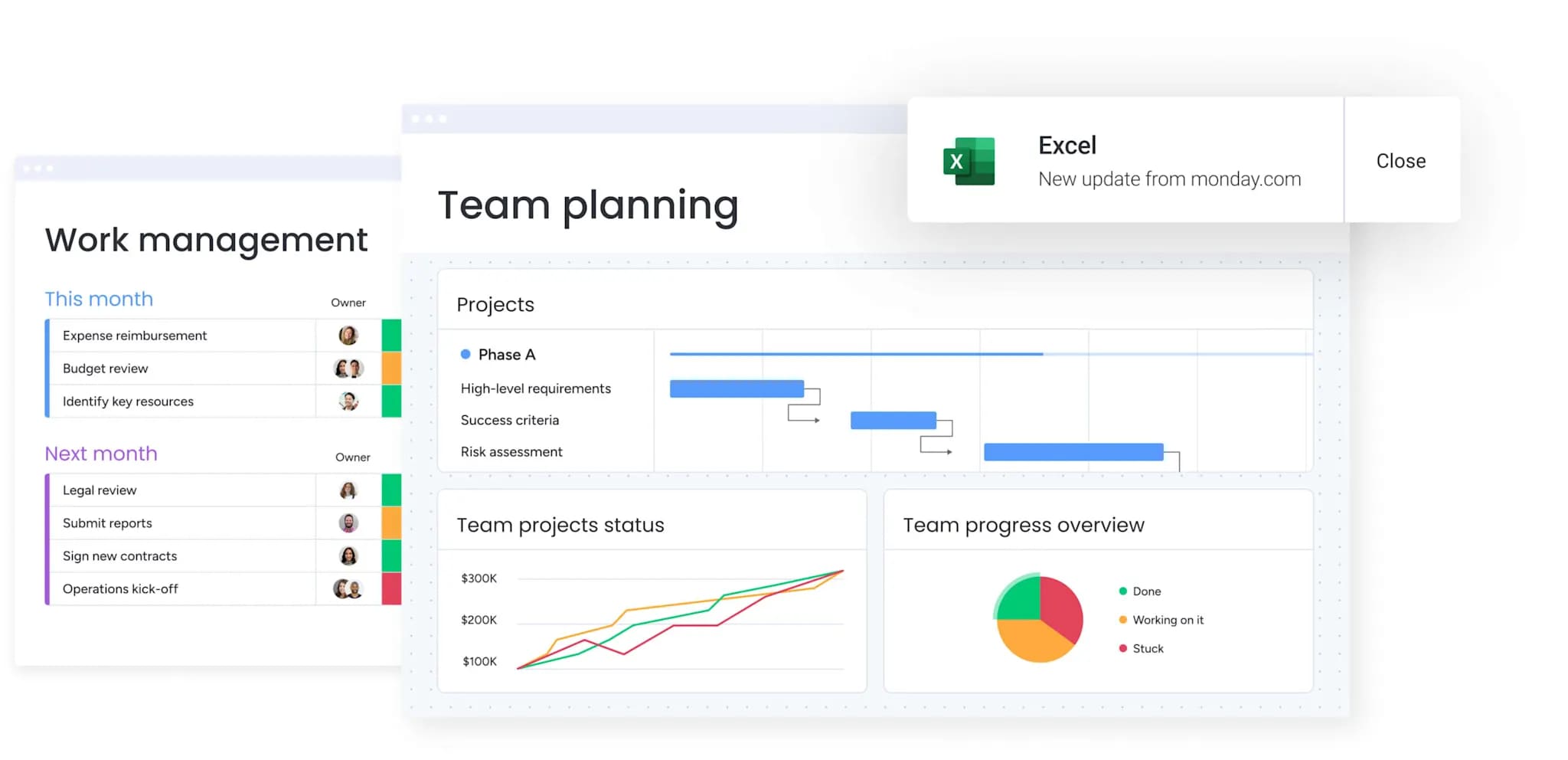
monday work management dashboards provide live, high-level views of budgets, goals, timelines, and resources using customizable, drag-and-drop widgets tailored to different stakeholders.
Design cross-department workflows
Cross-functional workflows remove friction at handoff points and keep execution moving smoothly across teams.
- Lead management: define clear qualification, ownership, and follow-up rules between marketing and sales.
- Launch coordination: align marketing, product, sales, and customer success around shared timelines.
- Communication automation: reduce manual updates through integrated notifications and status tracking.
Well-designed workflows replace ad hoc coordination with repeatable, scalable processes.
Enable real-time collaboration
Modern marketing management depends on fast, coordinated responses to changing conditions.
- Establish shared channels for rapid cross-functional communication.
- Create decision frameworks that allow teams to move without delays.
- Build feedback loops that surface insights as they happen.
Measuring marketing management impact with advanced analytics
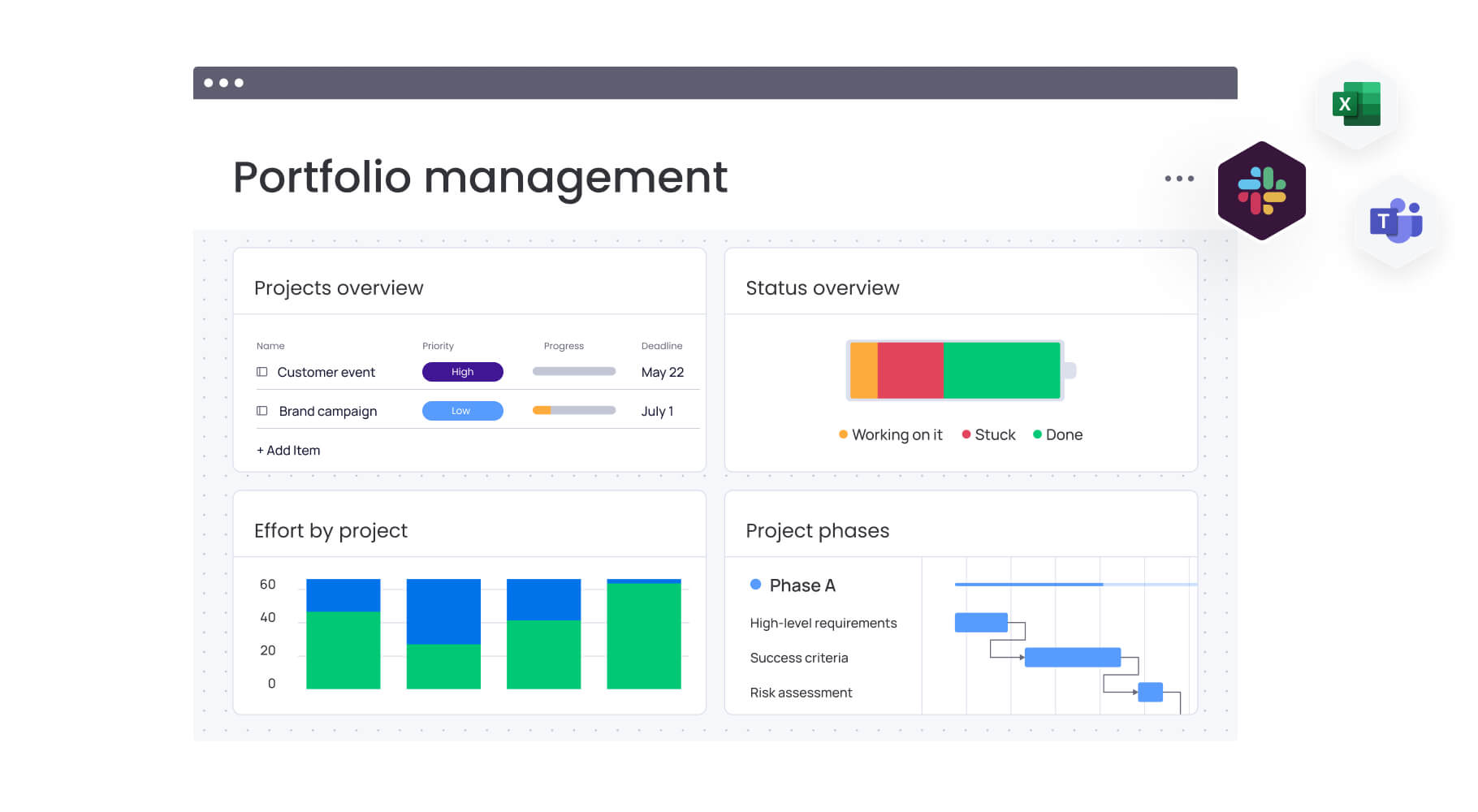
Marketing management proves its value through measurement that connects activity to outcomes. Advanced analytics help leaders optimize the full marketing portfolio, make smarter investment decisions, and clearly demonstrate impact on business growth.
Business-aligned performance measurement
Effective measurement starts by tying marketing metrics directly to strategic objectives, not isolated channel performance.
Business objective Key marketing metrics Supporting indicators
Revenue growth Marketing-influenced revenue, marketing-sourced pipeline, customer acquisition cost Lead volume by quality tier, conversion rates by stage, average deal size
Market expansion New market penetration rate, share of voice in target segments, brand awareness in new markets Campaign reach in target segments, competitive win rates, website traffic from target markets
Customer retention Customer lifetime value, retention rate by acquisition channel, expansion revenue from existing customers Product adoption rates, customer satisfaction scores, renewal rates
Operational efficiency Marketing ROI, cost per qualified lead, campaign efficiency ratios Budget utilization rates, team productivity metrics, automation adoption rates
This approach ensures marketing performance is evaluated based on contribution to growth, not surface-level activity.
Marketing performance metrics that matter
High-performing marketing managers focus on portfolio-level indicators rather than vanity metrics.
- Marketing-influenced revenue: captures how marketing contributes across the full customer journey, not just last touch.
- Customer acquisition cost: reflects total investment across channels, teams, and tools.
- ROI by initiative: shows which campaigns and programs justify increased investment.
These metrics support smarter prioritization and more confident budget decisions.
Executive dashboard best practices
Dashboards should explain performance, not overwhelm stakeholders with data.
- Lead with one primary business metric, supported by clear context.
- Prioritize outcomes such as qualified pipeline and revenue impact over activity counts.
- Use visual cues to surface trends, risks, and opportunities quickly.
Well-designed dashboards make performance patterns immediately obvious and support faster decision-making.
Portfolio-level ROI analysis
Understanding true marketing effectiveness requires looking beyond individual campaigns.
- Attribution modeling: accounts for multiple touchpoints across long buying journeys.
- Incrementality testing: isolates the actual impact of marketing activity.
- Cohort analysis: shows how returns compound over time across different investments.
This view helps leaders optimize the portfolio as a system, not a collection of tactics.
Continuous performance monitoring
Ongoing visibility enables proactive optimization instead of reactive fixes.
- Automated alerts flag deviations from expected performance ranges.
- Regular review cycles turn insights into action, not reports.
- Feedback loops ensure learnings are applied consistently across teams.
monday work management’s Portfolio Risk Insights continuously scan projects for budget, timeline, and performance risks, allowing teams to address issues early without manual analysis.
Scaling marketing management across your organization
Marketing management delivers the most impact when it scales beyond individual teams. The goal is to create consistent ways of planning, prioritizing, and measuring work, while still giving teams flexibility in how they execute.
High-performing organizations start small, prove what works, and then scale successful frameworks across teams. This approach builds momentum and avoids the disruption that comes from forcing wholesale change.
monday work management supports this scale by standardizing the fundamentals without slowing teams down. Shared templates, workflows, and dashboards create alignment across product marketing, digital, content, and brand teams, while still allowing each function to adapt execution to its needs.
Cross-team visibility ensures campaigns no longer compete for resources or operate in silos. Leaders can see priorities, capacity, and performance across the entire marketing portfolio, while automated updates keep stakeholders aligned without manual reporting.
As marketing management scales, teams move from reactive execution to coordinated delivery. With clearer visibility, stronger collaboration, and connected workflows, marketing operates as a single system that consistently supports business growth.
The content in this article is provided for informational purposes only and, to the best of monday.com‘s knowledge, the information provided in this article is accurate and up-to-date at the time of publication. That said, monday.com encourages readers to verify all information directly.
Frequently asked questions
How is the role of a marketing manager changing with AI?
AI is automating routine analysis, reporting, and data processing tasks that once consumed a large portion of a marketing manager’s time. As a result, marketing managers are shifting toward higher-value work such as strategic decision-making, portfolio optimization, and cross-functional leadership.
What’s the difference between marketing management and marketing operations?
The difference lies in strategic ownership versus execution enablement.
How do you implement marketing management across multiple teams?
Start by establishing shared goals and metrics that all marketing teams work toward, then create centralized visibility through unified dashboards and regular cross-team coordination meetings. Use collaborative work management platforms to coordinate activities, share resources across teams, and maintain alignment on priorities.
Which marketing management certifications provide the most value?
Digital marketing certifications from Google, HubSpot, and Facebook provide practical skills in specific channels and platforms, while MBA programs or marketing management courses from institutions like the American Marketing Association offer strategic frameworks. The most valuable certifications combine strategic thinking with hands-on experience in marketing technology, data analysis, and cross-functional leadership.
How do you successfully transition from marketing to marketing management?
Develop strategic thinking skills by understanding how marketing activities connect to business outcomes and learning to make portfolio-level decisions rather than focusing on individual campaigns. Gain experience coordinating multiple projects simultaneously, build leadership capabilities through mentoring and cross-functional collaboration, and master marketing technology platforms that enable portfolio oversight.
What marketing management software delivers the strongest ROI?
Platforms that combine project management, resource allocation, performance tracking, and AI-powered insights in one unified system typically deliver the highest ROI by eliminating data silos and manual coordination work. Look for solutions that offer cross-functional collaboration features, customizable workflows that adapt to your specific processes, and integration capabilities that connect to your existing marketing technology stack.

 Get started