


Tech projects move fast, but risks move faster. When your team is juggling multiple releases, dependencies shift overnight, and a single overlooked vulnerability can delay launch by weeks. Project managers need visibility into what could go wrong before it actually does.
Great risk management platforms do more than log problems after they appear — they link risks directly to your workflows, development pipelines, and team resources so you can act quickly. This integration means you can spot patterns across projects, automate responses to common risk scenarios, and keep stakeholders informed from a single, centralized platform.
In this guide, you’ll discover what actually works for tech teams managing risk, see how top platforms stack up on integrations and automation, and learn practical steps for implementing a system that grows with your projects. You’ll see real examples of how teams streamline risk tracking and discover practical steps for connecting risk management to your existing development workflows.
Key takeaways
- Stop losing critical risks in scattered tools: centralize risk tracking alongside project execution so nothing slips through the cracks between spreadsheets, emails, and development platforms.
- Catch problems before they derail projects: use AI-powered risk identification and automated alerts to spot resource conflicts, timeline issues, and dependency bottlenecks early.
- Connect risk data directly to your tech stack: monday work management integrates with Jira, GitHub, and 200+ other tools to pull development risks into your project workflows automatically.
- Save 3+ hours per week with automated workflows: set up no-code automations that trigger risk alerts, assign mitigation actions, and escalate issues based on your criteria.
- Get real-time visibility across your entire portfolio: transform complex risk data into visual dashboards that show which projects need attention and where mitigation efforts should focus.
What makes project managers choose monday work management for risk management in tech projects?
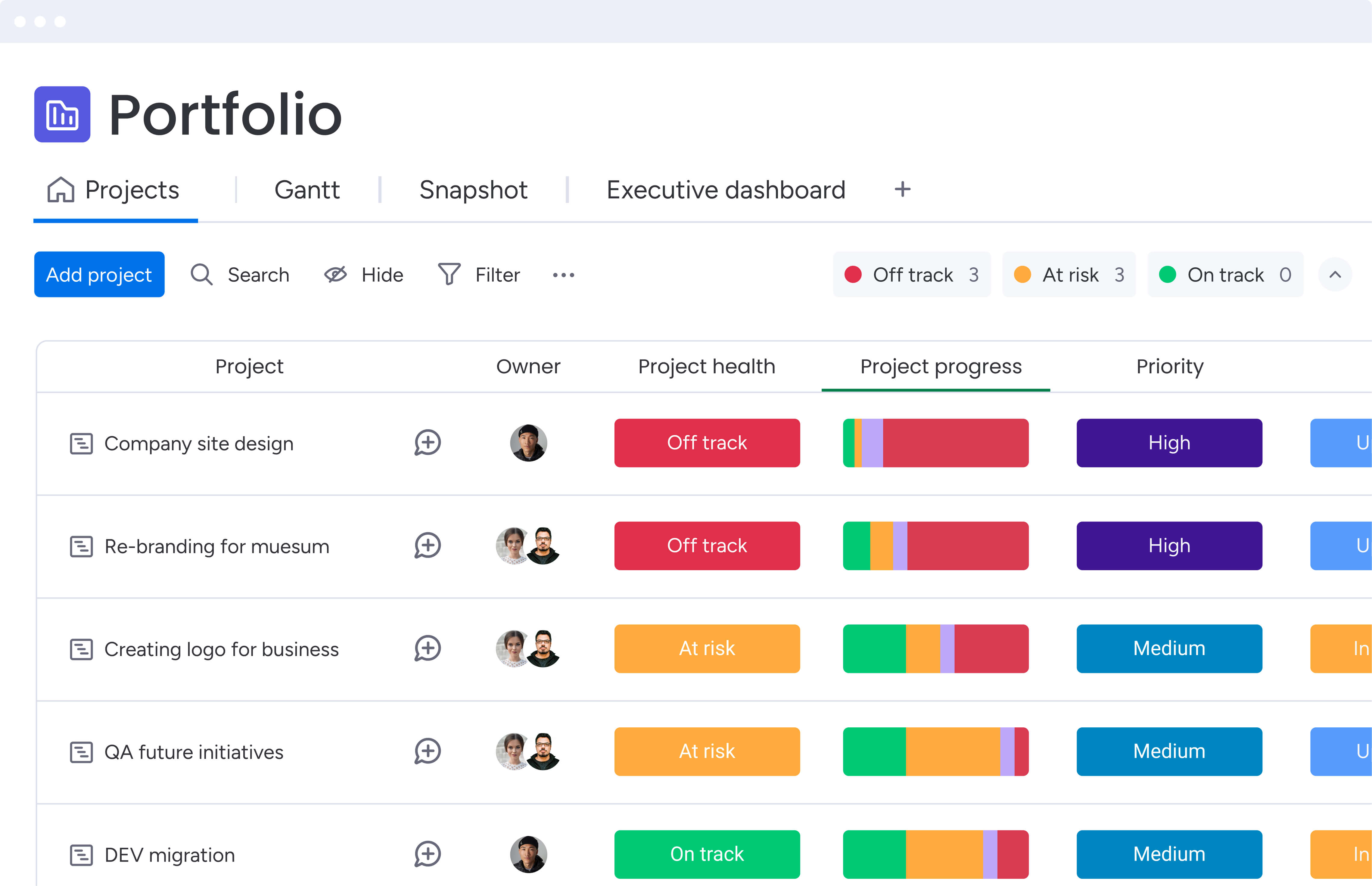
Project managers in tech choose monday work management because it centralizes risk management alongside project execution, eliminating the scattered tools problem that plagues PMO departments. Unlike standalone risk management software, the platform connects risk data directly to project timelines, resource allocation, and team workflows.
This centralized approach enables you to identify dependencies between risks across different initiatives, track mitigation progress in real time, and communicate risk status to stakeholders without switching platforms.
he visual dashboards also transform complex risk data into actionable insights that keep projects on schedule and within budget.
Playtech’s PMO department achieved a 26% increase in efficiency and saves three hours per person per week by using monday work management to monitor risks and issues with ease. Their project managers can now see at any time if they’re operating within set parameters and adjust accordingly. This capability was impossible with their previous scattered toolset.
Top features of monday work management for risk management in tech projects
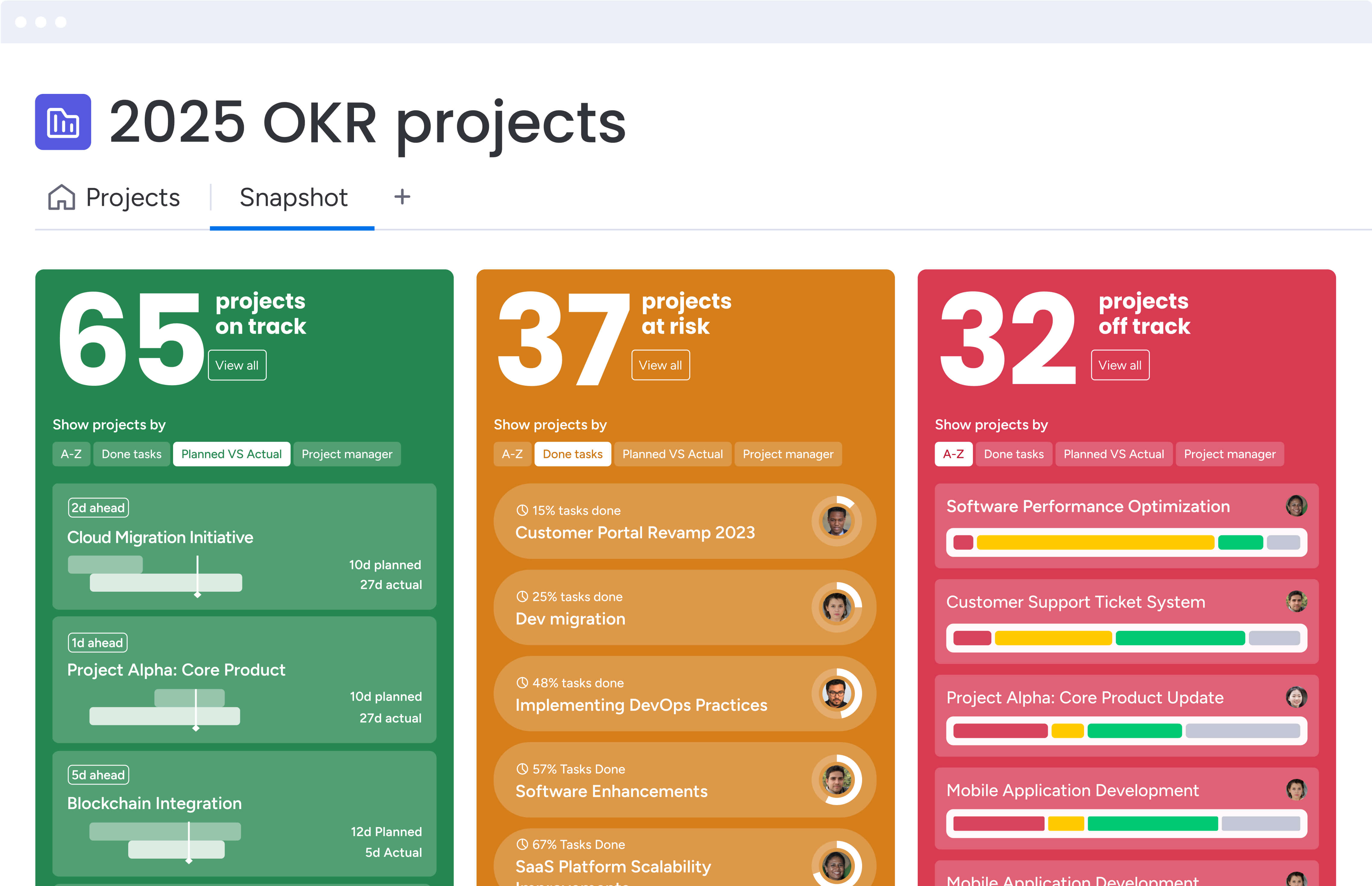
These six core features transform how tech project managers identify, track, and mitigate risks across their project portfolios. Each capability addresses specific pain points that arise when managing complex technical initiatives with multiple stakeholders and dependencies.
Real-time risk dashboards
The intelligent monday work management platform provides customizable dashboards that visualize risk data across your entire project portfolio. You can create widgets that display risk severity, probability scores, mitigation status, and risk trends over time. The platform supports multiple view options including:
- Gantt charts: timeline-based risk visualization.
- Kanban boards: risk workflow management.
- Calendar views: risk deadline tracking.
- Timeline views: project milestone integration.
For project managers in tech, this means you can quickly identify which risks are blocking critical path items, which projects have the highest risk exposure, and where your mitigation efforts should be focused. The visual nature of these dashboards makes it easy to communicate risk status during sprint reviews, stakeholder meetings, and executive briefings without creating separate presentation materials.
AI-powered risk identification
The platform’s AI capabilities analyze org-wide data to flag risks early across every project, team, and timeline. AI Blocks identify patterns in your project data that indicate potential risks, such as:
- Resource overallocation: team capacity conflicts.
- Timeline conflicts: competing project deadlines.
- Dependency bottlenecks: critical path disruptions.
This proactive risk identification is particularly valuable for project managers overseeing multiple tech projects simultaneously. The AI continuously monitors your portfolio and sends automated alerts when it detects risk indicators, allowing you to intervene before minor issues become project-threatening problems. You can also use AI to categorize incoming project requests and assign risk labels at scale.
Automated risk workflows
monday work management allows you to create no-code automations that trigger risk alerts, assign mitigation tasks, and escalate issues based on your defined criteria. You can set up rules like:
- “When risk severity changes to High, notify PMO lead and create mitigation task”.
- “When project deadline is two weeks away and status is not On Track, alert stakeholders”.
These automations eliminate the manual overhead of risk monitoring and ensure nothing falls through the cracks. You can standardize your risk response processes across all projects while maintaining the flexibility to customize workflows for specific project types or teams.
The platform further supports complex automation recipes that can chain multiple actions together.
Integration with development tools
Utilize monday work management and integrates seamlessly with the tools tech teams already use, including Jira, GitHub, GitLab, Azure DevOps, Slack, Microsoft Teams, and over 200 other applications.
These integrations allow you to pull risk-relevant data from your development pipeline directly into your risk management workflows.
This integration capability solves a critical pain point for project managers in tech. The visibility gap between project management and development execution disappears.
With Jira integrated into monday work management, you can:
- See what technical teams are working on in real time.
- Track technical debt as a risk category.
- Monitor development risks alongside project-level risks.
All without forcing developers to change their workflows.
Collaborative risk registers
The sophisticated platform provides a centralized risk register that your entire team can access, update, and collaborate on in real time. You can create detailed risk cards that include:
- Descriptions: clear risk definitions.
- Impact assessments: business consequence analysis.
- Likelihood scores: probability ratings.
- Priority levels: risk ranking systems.
- Mitigation plans: action item tracking.
- Ownership assignments: accountability structure.
When you’re managing cross-functional tech teams, this collaborative approach means everyone sees risks right away — whether they’re spotted by developers, QA engineers, or product managers. monday’s risk registers reflect what we believe matters most: putting crucial information in front of the right people without barriers or gatekeeping.
Resource allocation risk management
monday work management includes built-in resource management capabilities that help you identify and mitigate resource-related risks. The Workload view shows team capacity across multiple projects, allowing you to spot overallocation before it leads to burnout or missed deadlines. You can track:
- Resource availability: team member schedules.
- Skills mapping: capability requirements.
- Allocation tracking: real-time capacity monitoring.
Tech PMs juggling multiple projects with shared team members will find this feature a lifesaver — especially when sprint priorities change mid-flight. See your team’s workload at a glance, spot who’s overbooked before burnout hits, and back up your project priority calls with real capacity data.
How a project manager in tech benefits from monday work management
The connected monday work management platform delivers real results in areas tech PMs care about most. You’ll see the difference in finished projects, happier teams, and fewer late nights fixing preventable problems.
- Time savings: project managers save an average of 60 hours per employee yearly with project risk management features in monday work management. Automated risk alerts, centralized data, and integrated workflows eliminate the time spent manually tracking risks across spreadsheets and email threads.
- Cost efficiency: companies save real money by catching and fixing problems early. Playtech’s PMO saves money by receiving automated notifications when they can release external resources, preventing unnecessary costs.
- Compliance and accuracy: keep your risk data accurate and audit-ready in one central place — so you’re always prepared for compliance reviews. The platform’s transparency means all stakeholders can see the same risk information, reducing discrepancies and improving accountability.
- Productivity improvements: teams experience 26% increases in efficiency when using monday work management for risk and project management. By reducing context-switching between tools and automating routine risk monitoring tasks, Project managers can focus on strategic risk mitigation rather than administrative overhead.
- Output quality improvements: improved risk visibility leads to superior project outcomes. McDonald’s Australia achieved a 25% reduction in project management timelines, while Playtech saw a 23% increase in meeting KPIs. Both improvements are attributable to enhanced risk identification and response.
- Visibility and tracking improvements: real-time dashboards provide instant visibility into risk status across all projects. Project managers can drill down from portfolio-level risk views to individual risk details, understanding exactly where attention is needed and tracking mitigation progress without manual status reports.
How to manage tech project risks with monday work management
This step-by-step implementation guide shows you how to establish a comprehensive risk management plan for your tech projects. Each step builds on the previous one, creating a complete risk management system that scales with your organization.
Step 1: set up your centralized risk register
Create a dedicated board for risk management using monday work management’s customizable risk register template. Configure columns for:
- Risk description: clear problem statement.
- Category: technical debt, security, resource, timeline.
- Probability: likelihood assessment.
- Impact: business consequence rating.
- Priority score: combined risk ranking.
- Owner: responsible team member.
- Mitigation status: progress tracking.
Use the platform’s formula column to automatically calculate risk scores based on probability and impact.
Step 2: integrate your development tools
Connect monday work management with Jira, GitHub, or your preferred development platform to automatically pull in technical risks. Set up two-way syncing so that:
- Issues flagged in your development tools appear in your risk register.
- Mitigation tasks created in monday work management flow back to your dev team’s workflow.
This integration ensures no technical risks are missed and maintains workflow continuity for your development teams.
Step 3: configure automated risk alerts
Build automation recipes that trigger notifications when risks escalate. Set rules to:
- Alert stakeholders when a high-priority risk’s mitigation deadline approaches.
- Notify teams when a new critical risk is identified.
- Escalate when multiple risks affect the same project milestone.
Use the platform’s workflow automation to assign mitigation tasks automatically based on risk category and severity.
Step 4: create portfolio-level risk dashboards
Build executive dashboards that aggregate risk data across all your tech projects. Include widgets showing:
- Total risk exposure: portfolio-wide risk metrics.
- Risks by category: technical, resource, timeline breakdowns.
- Mitigation progress: action item completion rates.
- Risk trends over time: historical analysis.
Configure filters so stakeholders can view risks by project, team, or severity level.
Step 5: establish risk review workflows
Use monday work management’s timeline and calendar views to schedule regular risk reviews. Create recurring tasks for:
- Risk assessment updates: weekly or bi-weekly reviews.
- Mitigation progress checks: status verification.
- Stakeholder communications: regular reporting.
Link risks to project milestones so you can see how risk status affects delivery timelines.
Step 6: connect risks to resource planning
Leverage the Workload view to identify resource allocation risks. Flag situations where:
- Team members are overallocated: capacity conflicts.
- Critical skills are unavailable: capability gaps.
- Key project phases lack coverage: resource shortfalls.
Use this visibility to proactively adjust resource plans and mitigate capacity-related risks before they impact delivery.
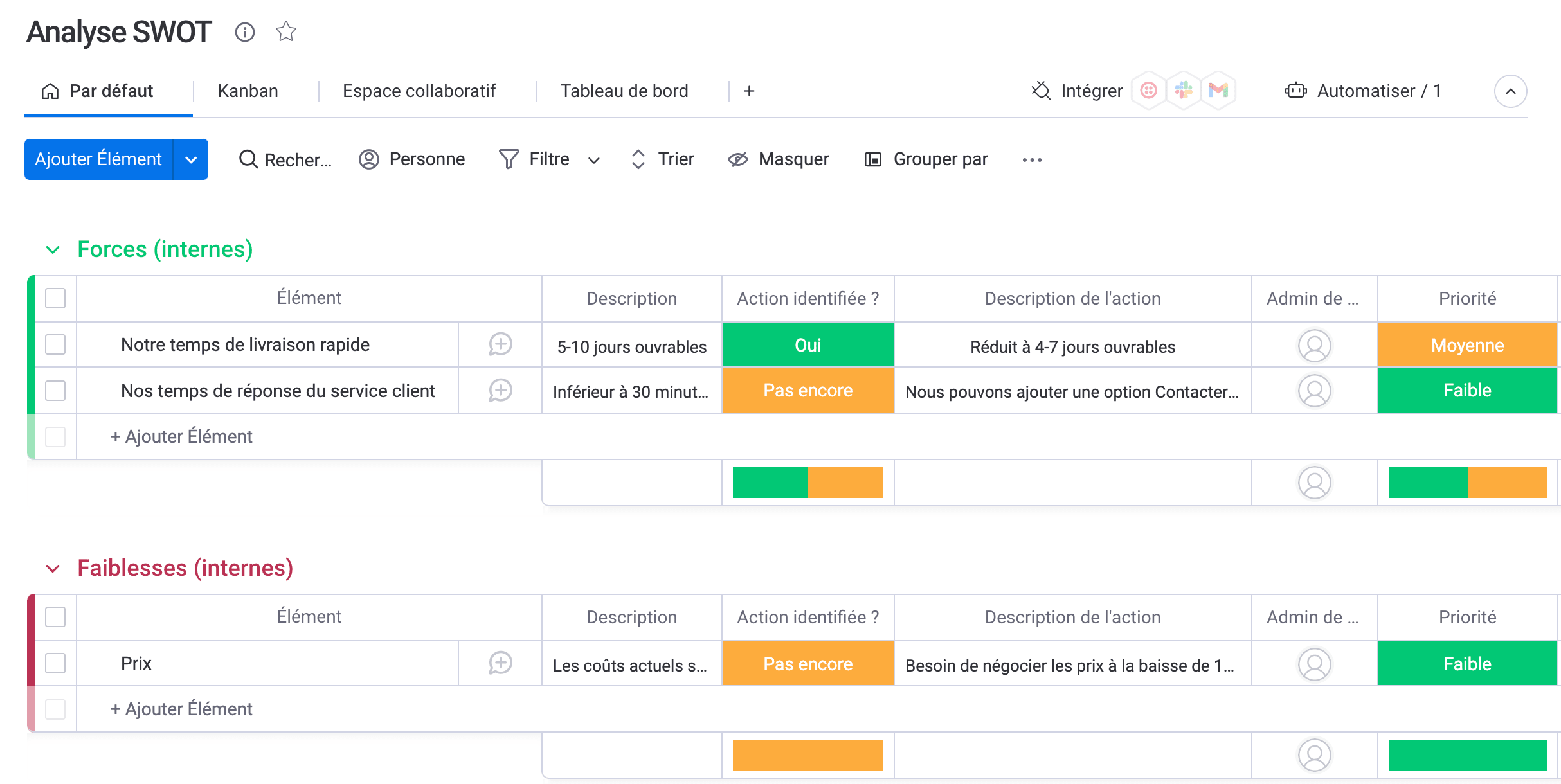
Comparison table: monday work management vs competing platforms for tech project risk management
When evaluating risk management platforms for tech projects, it’s essential to compare features, integration capabilities, and implementation timelines. The following table highlights how monday work management stacks up against other popular options in the market.
| Feature | monday work management | Asana | Wrike |
|---|---|---|---|
| Campaign management views | Kanban, Gantt, Calendar, Timeline, Workload, Dashboard | Board, List, Timeline, Calendar | Board, Table, Gantt, Calendar |
| Compliance workflow automation | Advanced multi-stage approvals with audit trails | Basic approval workflows | Custom request forms with approvals |
| Resource management | Built-in Workload view with capacity planning | Workload (Business+ only) | Resource management (add-on) |
| Financial services integrations | 200+ native integrations including financial systems | 100+ native integrations | 400+ integrations |
| Real-time dashboards | Unlimited custom dashboards with AI-powered insights | Limited dashboards (Business+ only) | Custom dashboards (higher tiers) |
| Price per user/month | $12-$24 (Standard to Pro) | $13.49-$30.49 | $10-$24.80 |
| Implementation time | Less than 4 months | 2-4 months typical | 3-6 months typical |
| G2 rating | 4.7/5 (12K+ reviews) | 4.3/5 | 4.2/5 |
| Team size support | Unlimited users, optimized for 50-100+ teams | Best for smaller teams | Scales well for enterprise |
| Compliance features | Enterprise-grade security, SOC 2, GDPR, audit logs | SOC 2, GDPR compliant | SOC 2, GDPR, HIPAA |
How Playtech's PMO transformed their project risk management
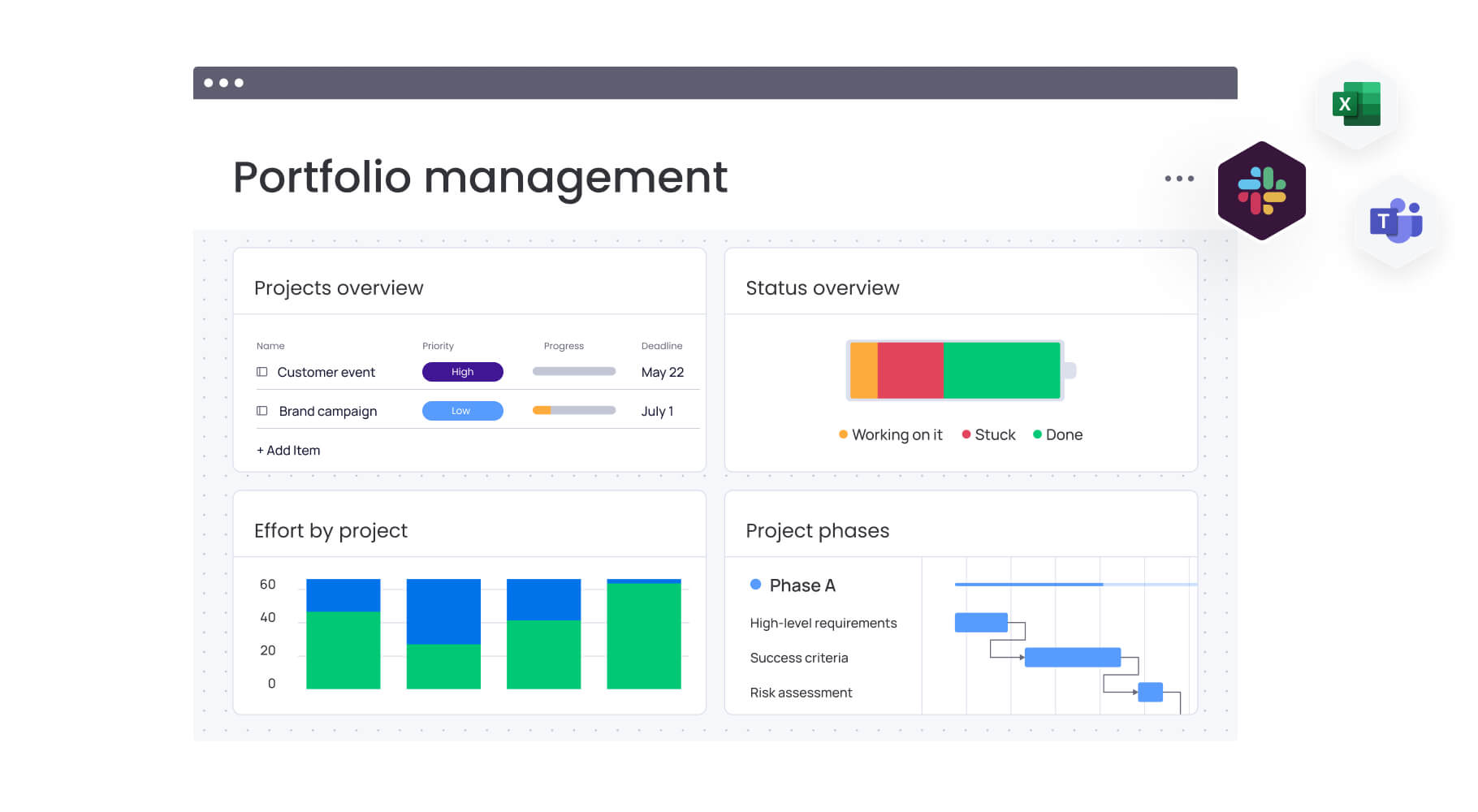
This real-world case study demonstrates how a leading gaming software company overcame scattered risk management challenges and achieved measurable improvements in efficiency and project outcomes.
The challenge
When Yossi Shamir joined Playtech as Head of Projects, the PMO department was managing countless client projects using spreadsheets, email, and notepads. As the gaming software industry underwent digital transformation, clients began demanding more frequent updates and faster results.
The team was losing opportunities to reduce costs and improve efficiency, and it was becoming increasingly challenging to keep up with client expectations while managing risks effectively. Key challenges included:
- No good way to track preliminary project discussions.
- Sometimes booking resources for projects that weren’t yet defined.
- Couldn’t present management with project costs in an effective way.
- Lacked visibility into whether projects were operating within their initial parameters.
The solution
Playtech implemented monday work management to bring their established methodology to life and manage projects from initiation to closure in one place. They created separate boards for project opportunities, management approvals, and active projects to maintain organized workflows.
The PMO used monday work management’s formula columns to calculate project costs much quicker than before, with pre-defined formulas supporting baseline and estimation cost calculations. For risk management specifically, Playtech:
- Set up custom notifications that alert relevant people when issues arise.
- Created a powerful board showing cost vs. time calculations.
- Integrated with Jira to give non-technical team members visibility into development progress.
The results
The implementation delivered significant measurable improvements:
- 26% increase in efficiency across the PMO department.
- 49% increase in collaboration and transparency with stakeholders.
- 23% increase in meeting KPIs through improved risk monitoring.
- Three hours saved per person per week through centralized workflows.
Ready to transform your tech project risk management?
Effective project risk management in tech projects requires more than just tracking issues — it demands a unified platform that connects risk data to project execution, resource allocation, and team workflows.
monday work management delivers this integration by centralizing risk management alongside project delivery, giving PMs the visibility and control they need to prevent issues before they impact outcomes.
The platform’s AI-powered risk identification, automated workflows, and seamless integration with development tools eliminate the scattered approach that leaves critical risks hidden in spreadsheets and email threads by providing real-time risk tracking. With real-time dashboards and collaborative risk registers, teams can spot dependencies, track mitigation progress, and communicate status to stakeholders without switching between multiple tools.
Organizations like Playtech have proven that this unified approach delivers measurable results: 26% efficiency improvements, significant time savings, and better project outcomes.
For tech PMs ready to transform their risk management approach, the intuitive platform provides the comprehensive solution that scales with organizational growth and complexity.
The content in this article is provided for informational purposes only and, to the best of monday.com’s knowledge, the information provided in this article is accurate and up-to-date at the time of publication. That said, monday.com encourages readers to verify all information directly.
Frequently asked questions
Can monday work management handle both project-level and portfolio-level risk management?
Yes, monday work management is designed to manage risks at multiple levels. You can track individual project risks while also creating portfolio-level dashboards that aggregate risk data across all your tech projects. The platform's hierarchical structure allows you to connect project-specific risks to broader portfolio risks, aligning perfectly with enterprise risk management principles. This multi-level approach is particularly valuable for PMO departments overseeing multiple concurrent initiatives.
How does monday work management integrate with CI/CD pipelines and DevOps tools?
monday work management integrates with major DevOps and development tools including Jira, GitHub, GitLab, Azure DevOps, and Bitbucket. These integrations allow you to automatically pull technical risks, bugs, and issues from your development pipeline into your risk management workflows. You can set up two-way syncing so that mitigation tasks created in monday work management appear in your developers' tools, and status updates flow back automatically.
What's the implementation timeline for tech teams adopting monday work management?
Organizations achieve value in less than four months with monday work management. The platform's intuitive interface means teams become comfortable with it within two weeks to a month. For tech teams specifically, the availability of pre-built templates for project management and risk tracking accelerates implementation. You can start with basic risk tracking and progressively add more sophisticated workflows as your team's adoption grows.
How do you track technical debt as a risk category in monday work management?
You can create custom risk categories in monday work management, including technical debt. Set up a dedicated column for risk type and include "Technical Debt" as an option alongside other categories like security risks, resource risks, or timeline risks. Use the platform's tagging and filtering capabilities to view all technical debt risks across your portfolio. You can also integrate with code quality tools to automatically create risk items when technical debt metrics exceed your thresholds.
Does monday work management support Agile and Scrum risk management methodologies?
Yes, monday work management fully supports Agile and Scrum methodologies for risk management. You can track risks at the sprint level, link risks to specific user stories or epics, and visualize risk burndown alongside your sprint burndown. The platform's flexibility allows you to incorporate risk reviews into your sprint ceremonies, and the Kanban view works perfectly for managing risk mitigation tasks through your team's workflow stages.
What risk metrics and KPIs can project managers track in monday work management?
Project managers can track comprehensive risk metrics including total risk exposure, risk velocity (rate of new risks identified), mitigation completion rate, average time to resolve risks, risks by category, risks by project, and risk trend analysis over time. The platform's dashboard widgets support custom formulas, so you can calculate metrics specific to your organization's risk framework. You can also track leading indicators like overdue mitigation tasks or risks without assigned owners.

 Get started