


Traditional project management assumes we can predict the future and stick to the plan. Agile methodology flips this assumption. Instead of betting everything on upfront planning, agile breaks work into short cycles where teams build, test, and adjust based on real feedback.
This guide explores the core principles of agile. We’ll see real examples across different industries, and learn how to build an agile transformation in monday.com that delivers measurable results for your organization.
Try monday.comKey takeaways
- Break large projects into small, manageable sprints. Deliver value continuously through 2-4 week cycles instead of waiting months for final deliverables.
- Embrace change as a competitive advantage. Treat plans as hypotheses to test and adjust when markets shift, using them as adaptable guides for informed decision-making.
- Build cross-functional teams with all necessary skills. Create self-sufficient units of 5-9 people who can deliver complete solutions without waiting for handoffs between departments.
- Scale agile practices with a unified platform. Visualize workflows through Kanban boards, automate sprint ceremonies, and connect teams across departments with unified dashboards and real-time collaboration.
- Measure progress through working solutions, not documentation. Focus on delivering functional results that customers can use and provide feedback on, keeping documentation lean and just-in-time.
What is agile methodology?
Agile methodology is an iterative approach to project management that prioritizes flexibility, collaboration, and continuous delivery over rigid planning. Traditional methods rely on massive deliveries at project end. An Agile process breaks work into small increments called sprints that deliver value continuously.
Teams gather feedback early, adjust to changing requirements in real time, and aligns the final output with business needs. Originally formalized in software, agile has evolved into a universal management philosophy. It replaces command-and-control structures with autonomous, cross-functional teams who own their workflows.
What does agile look like in modern work?
Agile planning is less about code and more about organizational responsiveness. It’s a feedback loop where strategy informs execution, and execution data immediately informs strategy.
Different departments apply agile principles to their daily operations in practical ways:
- Marketing: Teams launch micro-campaigns to test messaging before committing full budgets
- HR: Recruiters use Kanban boards to track candidates through hiring pipelines, adjusting criteria based on interview feedback
- Operations: Facilities teams manage requests in sprints, prioritizing urgent maintenance while progressing on long-term upgrades
- PMO: Portfolio managers coordinate multiple agile teams, ensuring strategic alignment while maintaining team autonomy
Agile requires more discipline than traditional methods because it demands constant communication and regular review cycles.
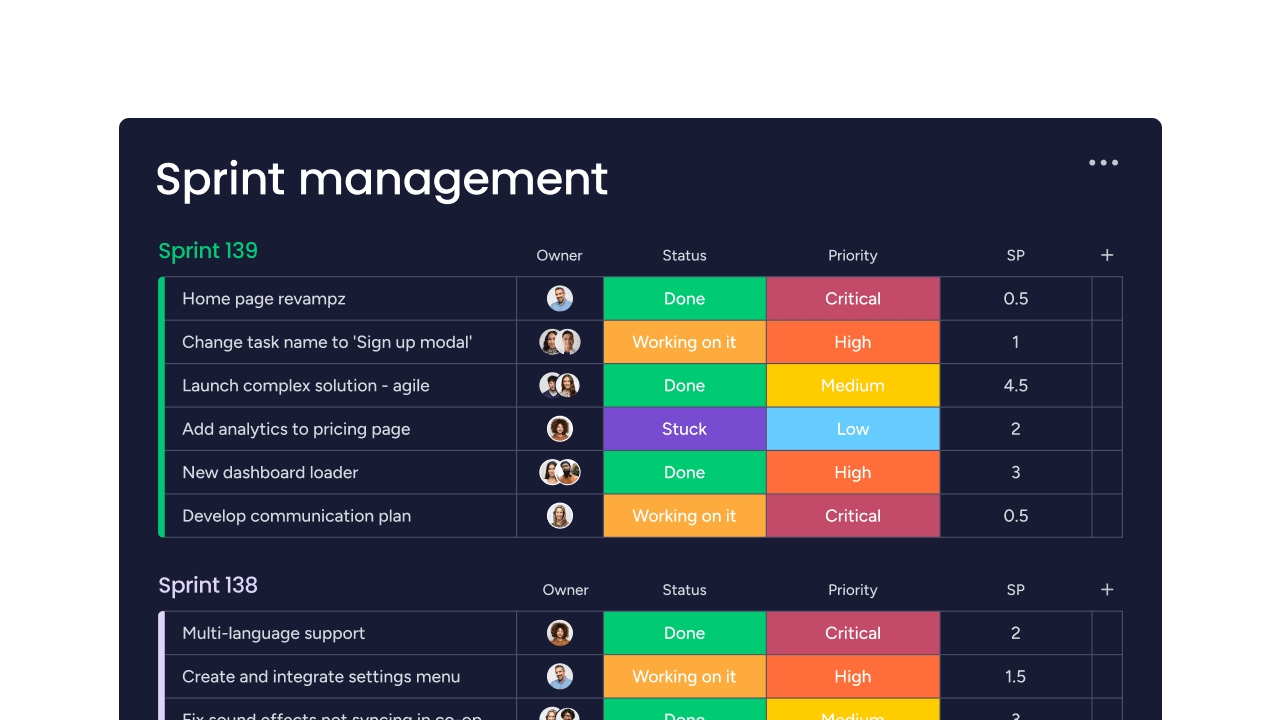
How agile methodology works
Agile runs on continuous improvement cycles rather than straight lines to completion. The mechanics are simple: break large initiatives into small, actionable items. Teams prioritize these items in a backlog, then select them for fixed timeboxes, usually 2-4 weeks.
The agile cycle repeats every sprint, with each of the following phases building on insights from the last.
- Plan: Select high-priority items from the backlog based on business value and team capacity
- Execute: The team completes work collaboratively with continuous communication and daily standups
- Review: Demonstrate completed work to stakeholders and gather feedback. This is where agile diverges from traditional methods that delay feedback until project end when changes cost more and take longer
- Gather feedback from multiple sources: Stakeholder feedback matches the product to the business vision; customer feedback validates that solutions solve actual problems, and team feedback improves workflow efficiency
- Retrospective: Discuss what went well and what needs improvement, then apply those lessons to the next sprint
Teams catch issues early, adjust quickly, and deliver work that meets actual needs rather than original assumptions.
Core values of the agile manifesto
The Agile Manifesto prioritizes adaptability and human connection over rigid bureaucracy. These values guide how teams work and decide in dynamic environments.
Individuals and interactions over processes and tools
Processes and tools support teams but shouldn’t dictate how they work. When a process becomes a bottleneck, agile teams are empowered to change it immediately.
Success comes from high-bandwidth communication between people:
- Direct collaboration: Developers talking directly to designers
- Cross-functional alignment: Sales collaborating with product teams
- Operational integration: Marketing aligning with operations
The best platforms facilitate these interactions, removing friction so people focus on solving problems together rather than managing handoffs between silos.
Working software over comprehensive documentation
This translates to “working solutions” in business context. A comprehensive marketing plan means nothing if no campaigns are live. A perfect project charter is useless if teams aren’t delivering value.
Documentation isn’t abandoned; it’s kept lean and created just-in-time. Progress is measured by delivered outcomes, not checked boxes on planning documents. Teams document what’s necessary for clarity and compliance, but they prioritize getting functional results into the world.
Customer collaboration over contract negotiation
Traditional projects treat detailed specifications as contracts but Agile treats customers as partners. This partnership reduces friction around scope discussions because teams expect and plan for change. Teams build what customers actually need based on ongoing collaboration, rather than what they thought they needed months ago when the project started.
Responding to change over following a plan
Plans provide direction, but blind adherence is dangerous. Agile teams plan thoroughly, then treat plans as hypotheses to be tested and adjusted.
When market conditions shift or new data emerges, the plan updates immediately. While traditional competitors execute plans made 6 months ago, agile organizations have already pivoted to capture new opportunities. This flexibility becomes a competitive advantage in fast-moving markets.
Try monday.comKey benefits of adopting agile methodology
Agile delivers tangible business impacts that compound as teams mature. These benefits transform how organizations operate and compete.
The measurable advantages of agile adoption include:
- Accelerated delivery: Teams release usable value faster by focusing on small batches and eliminating work in progress
- Enhanced quality: Frequent testing and review cycles catch defects within days, not months
- Improved collaboration: Daily standups and shared visual boards break down walls between roles and departments
- Greater adaptability: Teams can pivot backlogs immediately when competitors launch features or markets shift
- Increased customer satisfaction: Regular progress updates and customer involvement build trust and ensure relevance
- Optimized resource utilization: Limiting work in progress reduces context-switching and burnout
- Measurable business outcomes: Velocity and throughput metrics directly correlate to business output
Platforms like monday.com multiply these benefits by visualizing work, automating rituals, and maintaining transparency across teams.
Agile vs. waterfall methodology
Choosing between agile and waterfall depends on the type of work and cost of change. Their fundamental differences help organizations select the right approach for each situation.
| Aspect | Agile methodology | Waterfall methodology |
|---|---|---|
| Planning approach | Iterative; plans evolve with the project | Linear; detailed planning upfront |
| Flexibility level | High; changes are welcomed and expected | Low; changes are costly and difficult |
| Delivery model | Continuous increments of value | Single delivery at project end |
| Testing approach | Continuous throughout each cycle | Performed at the end during UAT |
| Stakeholder involvement | High; continuous feedback loop | Low; primarily at start and finish |
| Risk management | Risks identified early via iterations | Risks often discovered late in testing |
| Best for | Projects where solutions aren't fully known, innovation is required, or markets are volatile—product development, marketing campaigns, and digital transformation | Projects with fixed requirements, strict regulatory compliance, or physical construction where outcomes are known and paths are predictable |
Popular agile frameworks
Team size, product complexity, and culture determine which framework works best. Each framework emphasizes different aspects of agile principles but keeps the core focus on iterative delivery and continuous improvement.
The most widely adopted frameworks include:
- Scrum: Uses fixed-length sprints with defined roles like Scrum Master and Product Owner. Best for teams needing structure and predictable cadences.
- Kanban: Focuses on visualizing work and limiting work-in-progress without fixed sprints. Ideal for support teams and operations with continuous flow.
- Lean: Eliminates waste in meetings, documentation, and waiting time. Emphasizes delivering value fast with minimal overhead.
- Extreme Programming (XP): Emphasizes technical practices like pair programming and test-driven development for high-quality code.
- Scrumban: Combines Scrum’s structure with Kanban’s flow visualization. Works well for teams transitioning between frameworks.
- Scaled Agile Framework (SAFe): Coordinates multiple agile teams in large enterprises with portfolio-level planning and governance.
Many organizations customize frameworks to fit their needs, taking elements from multiple approaches to create their unique implementation.
Try monday.comHow to implement agile methodology
Agile implementation requires deliberate execution and organizational commitment. These steps create a roadmap for transitioning from traditional project management to agile practices.
Step 1: Evaluate your organization’s agile readiness
Assess your culture before changing processes. Agile requires psychological safety where teams feel safe to fail and learn. Check if leadership will decentralize decision-making and if stakeholders are available for regular collaboration.
Identify readiness gaps like rigid approval chains or limited stakeholder availability. Address these barriers early to smooth the transition.
Step 2: Select the right agile framework
Match the framework to your work type. Creative agencies might struggle with Scrum’s rigid ceremonies but thrive with Kanban’s flow. Software teams building complex products often need Scrum’s structure.
Pilot a framework with one project to test fit before organization-wide rollout. Early wins reduce risk and build confidence.
Step 3: Form cross-functional agile teams
Build self-sufficient units containing all skills necessary to deliver value. Include design, development, content, and quality assurance capabilities within each team.
Keep teams small, typically 5-9 people, to minimize communication overhead and maintain velocity. This size allows quick decisions and strong collaboration.
Step 4: Establish agile rituals and artifacts
Set up your work rhythm with scheduled standups, sprint planning, and retrospectives. Standardize templates for backlogs and user stories to ensure consistency.
Organizations using monday.com can automate these rituals with sprint templates, standup reminders, and retrospective boards. Processes support work rather than distract from it.
Step 5: Measure and refine your agile process
Track velocity to understand how much work teams complete per sprint. Monitor cycle time to see how long items take from start to finish. Use retrospectives for qualitative insights on team health and process improvements.
This data combination allows continuous refinement, scaling what works and adjusting what doesn’t.

Agile methodology across industries
Agile principles adapt to any function where teams face complex work with changing variables. The application varies by industry, but the core benefits stay consistent.
Agile marketing teams
Marketing teams replace annual plans with quarterly strategies and 2-week execution sprints. They test headlines, channels, and creative assets rapidly, using analytics feedback to determine each sprint’s focus.
Marketing aligns tightly with product releases and reacts instantly to market trends. Campaign performance data feeds directly into the next sprint’s priorities.
Agile in HR and people operations
HR teams treat employees as customers, rolling out new policies in pilot groups before full implementation. Recruitment operates like a sales funnel managed on Kanban boards, providing visibility into time-to-hire and pipeline bottlenecks.
HR shifts from a compliance function to a responsive service delivery team that continuously improves based on employee feedback.
Agile for business operations
Operations teams use Kanban to visualize request flow, from procurement to legal reviews, identifying where work gets stuck. Regular retrospectives help re-engineer processes for efficiency.
Waste drops, internal service levels improve, and delivery times become predictable for internal customers.

Scale agile with monday.com
monday.com provides the operating system for agile organizations. It offers flexibility to support any framework while delivering the structure needed for scale. The platform moves beyond simple tracking to become a unified workspace where strategy, execution, and collaboration happen simultaneously.
See work your way with visual workflow management
The platform offers versatile views that adapt to team preferences. A single dataset can display as a Kanban board for daily flow, a Gantt chart for roadmap planning, or a workload view for capacity planning.
Developers, marketers, and executives all see data in formats that make sense to them, delivering transparency without rigid interfaces.
Eliminate manual busywork with automated agile ceremonies
Automation handles repetitive agile mechanics. Recipes automatically move items to sprint backlogs when tagged, notify teams when blockers appear, or archive completed items at sprint end.
AI Blocks assist by breaking down large epics into user stories and generating acceptance criteria, significantly reducing sprint planning prep time.
Learn more: AI Agile project management
Break down silos with cross-department collaboration
monday.com connects disparate teams through mirrored boards and unified dashboards. Marketing campaigns link to product development milestones, ensuring launch activities sync with engineering releases.
A single source of truth across the organization eliminates silos that traditionally slow agile adoption.
Launch faster with ready-to-use agile templates
Teams accelerate setup with pre-built templates for Scrum, Kanban, Bug Tracking, and Sprint Retrospectives. These templates include built-in automations and views based on best practices but stay fully customizable.
Organizations create their own template libraries to standardize agile practices across departments but allow team-level customization.
Try monday.comBuild your agile transformation roadmap
Agile isn’t a destination; it’s a continuous evolution. Start small with one team, one sprint, and one framework. Take the time to learn what works and adjust what doesn’t before you scale gradually. The organizations that succeed with agile don’t wait for perfect conditions; they begin with imperfect action and improve through iteration.
monday.com adapts to your chosen framework and automates the mechanics of keeping your teams connected, without forcing you into rigid processes. Whether running your first sprint or coordinating dozens of agile teams, you get the visibility and flexibility needed to deliver real business value.
Try monday.comFAQs
What is the difference between agile and Scrum?
The difference between agile and Scrum is that agile is the overarching philosophy focused on iterative delivery and flexibility, while Scrum is a specific framework with defined roles and rituals used to implement agile principles.
Can agile methodology work for non-software projects?
Yes, agile principles successfully apply to marketing, HR, construction, and manufacturing. Any project requiring adaptability and customer feedback benefits from agile approaches.
How long does it take to implement agile methodology?
Initial ceremony adoption happens in weeks, but cultural transformation typically takes 6-12 months. Teams often see efficiency gains within first sprints while organizational agility matures over time.
What size team works best with agile methodology?
Ideal agile team size is 5-9 people. Larger projects coordinate multiple small teams rather than creating one massive group to maintain communication efficiency.
How do you measure success in agile methodology?
Success is measured through Cycle Time for speed, Velocity for consistency, Defect Rate for quality, and Customer Satisfaction scores for value delivery.
What certifications are available for agile methodology?
Popular certifications include Certified ScrumMaster (CSM), PMI Agile Certified Practitioner (PMI-ACP), and SAFe Agilist, which validate framework knowledge and aid career advancement.

 Get started