


Your leadership team just approved an ambitious growth strategy, yet six months later, progress often feels scattered. This disconnect occurs in the difficult space between high-level vision and day-to-day execution. Mapping big-picture goals to daily reality is the only way to translate an inspiring strategy into actual momentum.
A 5-year plan template bridges this gap by transforming vague goals into defined milestones and interconnected workflows. It moves beyond mere target-setting to build a system where every project contributes to the organization’s “North Star.” By integrating strategy into work management, you ensure every department pulls in the same direction.
The article below explores how to build 5-year plan templates that drive execution through strategic frameworks and progress tracking. You will discover how to create flexible plans that align cross-functional teams and maintain focus on high-impact initiatives. These steps will help you transform a static document into a living system for measurable progress.
Key takeaways
- Connect your vision to daily work: Transform strategic goals into active project workflows so every team member sees how their tasks contribute to long-term success.
- Break 5-year goals into annual milestones: Create specific, measurable checkpoints that build momentum and prevent overwhelming teams with distant objectives.
- Plan for change with quarterly reviews: Adapt your strategy based on real data and market shifts while maintaining focus on core objectives.
- Align departments around shared metrics: Use cross-functional workflows and transparent progress tracking to prevent silos from derailing organizational goals.
- Automate progress tracking: Replace manual reporting with real-time dashboards and AI-powered insights that flag risks before they impact timelines, using platforms like monday work management.
What is a 5-year plan template?

A 5-year plan template is a strategic framework that bridges the gap between long-term vision and daily execution. The best templates are living systems that turn big ideas into measurable milestones, quarterly goals, and workflows teams can actually use. That way, every action your team takes pushes toward your biggest goals.
Modern templates move beyond simple goal-setting to incorporate execution tracking, progress monitoring, and resource allocation. They give teams a standard format so marketing, operations, and product can work toward the same goals without stepping on each other’s toes.
When connected to a work management platform, planning becomes ongoing instead of a once-a-year scramble. You adjust as you go, based on real-time data.
Business 5-year plan template
Business-level templates focus on organizational growth, market expansion, and operational scaling. They’re blueprints for the whole company, spelling out revenue targets, market positioning, and the operational muscle you’ll need to grow.
The most critical elements for long-term success include:
- Revenue and financial targets: Specific annual recurring revenue or EBITDA goals, such as achieving $50M ARR by year five or maintaining 20% year-over-year profitability.
- Market expansion: Concrete plans for entering new territories or verticals, like expanding operations into three new APAC markets by year three.
- Departmental alignment: A structure where company goals cascade into department-level objectives, ensuring alignment from C-suite to individual contributors.
Career development 5-year plan template
Career planning templates map out how employees can grow professionally while tapping into opportunities inside the company. Therefore, they turn fuzzy career dreams into concrete steps, which keeps people engaged and sticking around because they can see a real future here.
Career templates typically include:
- Skill development: Milestones for acquiring certifications or technical abilities, such as completing an MBA program while maintaining current role responsibilities.
- Role progression: Specific targets for advancement, like transitioning from individual contributor to team lead by year two.
- Network expansion: Goals for mentorship and industry presence, ensuring professional visibility grows alongside technical capability.
Personal growth 5-year plan template
In contrast, personal growth templates look at the whole picture: career, health, relationships, and money. As a result, they help prevent burnout by making sure your career doesn’t steamroll everything else that matters.
Personal planning elements often cover:
- Financial planning: Objectives like achieving financial independence or saving for a home down payment by year three.
- Health and lifestyle: Goals such as completing marathon training or establishing work-life balance boundaries.
- Relationship building: Dedicated focus on nurturing personal connections and community involvement.
Why 5-year plans connect strategy to daily work
Traditional strategic plans are often created with excitement, then never looked at again. But how do you ensure your vision actually drives daily decisions?
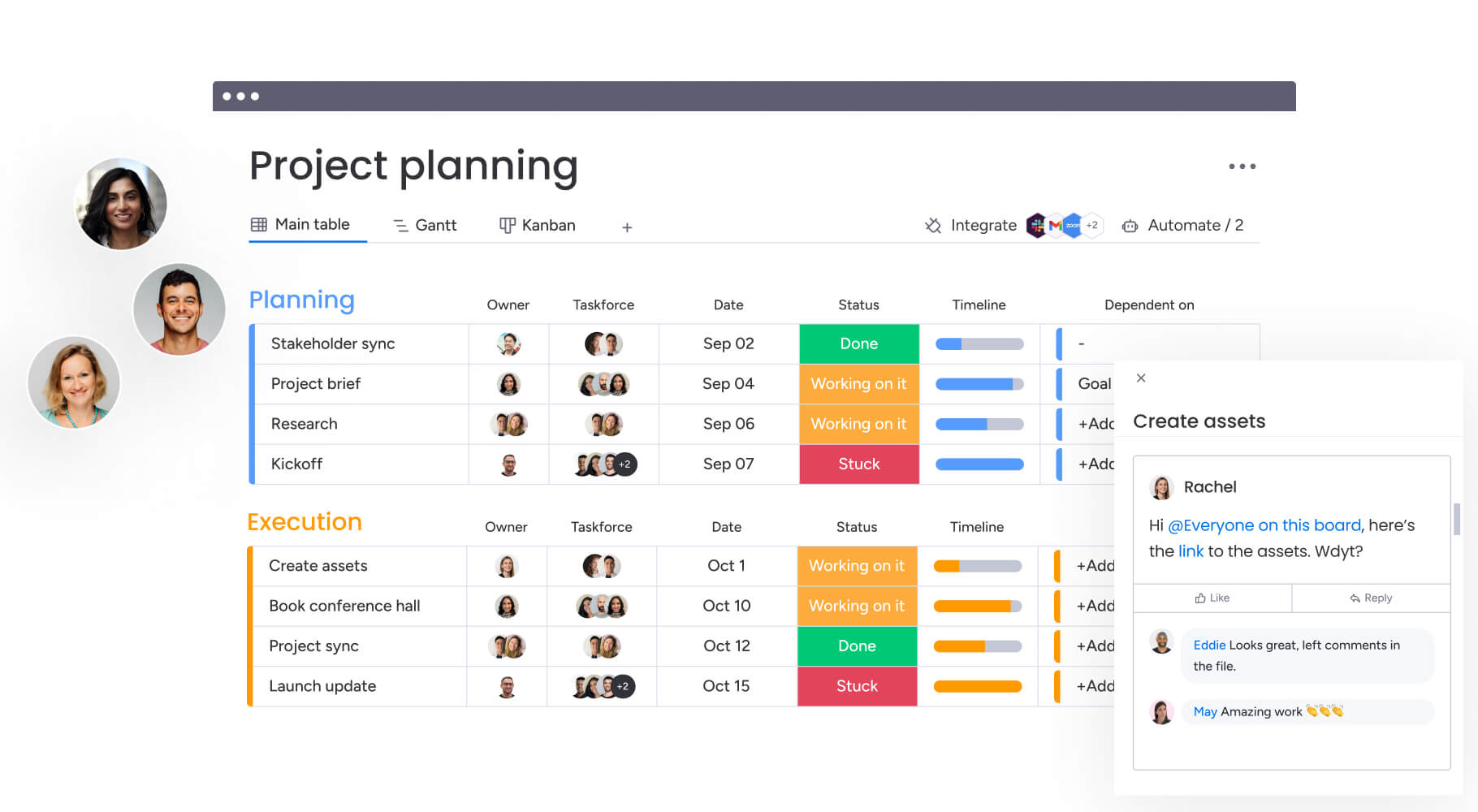
Modern 5-year plans fix this by connecting big-picture vision directly to the systems teams use daily. This connection matters for three critical reasons:
- Business moves fast, so your planning needs to keep up: When strategy connects to execution, you can shift direction fast without losing track of where you’re headed.
- Complex work needs multiple departments working together: One shared plan means when something slips in one department, everyone else sees it right away and can adjust.
- When strategy connects to daily work, you can course-correct as you go: Leaders no longer wait for quarterly reports to see if strategies are working. They see progress instantly through live dashboards.
Work management platforms make this happen by turning static goals into active workflows. When strategic goals are updated within a central platform, workflows and timelines can adjust automatically. Everyone works from the same playbook.
Essential components of actionable 5-year plan templates
A 5-year plan that works needs specific building blocks to survive the jump from boardroom to frontline. These pieces work together so you can plan, track, and adjust strategy across your whole organization.
Strategic vision and north star metrics
Your strategic vision points the way for the next five years. North star metrics are the numbers that show whether you’re getting closer to that vision.
Most organizations pick 3-5 north star metrics tied to their biggest priorities:
- Customer centricity: Metrics like Customer Satisfaction Score or Net Promoter Score ensure growth doesn’t compromise quality.
- Market dominance: Indicators such as market share percentage track competitive positioning.
- Internal health: Metrics like employee retention rate measure the sustainability of culture during scaling.
Annual milestones with measurable outcomes
You can’t knock out 5-year goals in one sprint. However, break them into annual checkpoints, and suddenly they’re manageable targets that keep momentum going. Each milestone must be specific, measurable, achievable, relevant, and time-bound to ensure accountability.
Consider progressive scaling approaches:
- Year one: Establish foundation with 10% market share.
- Year two: Expand operations achieving 15% market share.
- Year three: Consolidate gains and optimize processes.
Or capability building sequences:
- Year one: Hire core AI team.
- Year two: Deploy first proprietary AI model.
- Year three: Scale AI across all departments.
Resource allocation and capacity planning
A plan without adequate resources cannot succeed. This section outlines the allocation of personnel, budget, and technology across your 5-year timeline. It identifies resource requirements before they become bottlenecks, accounting for hiring timelines, budget cycles, and technology implementation schedules.
Teams using monday work management leverage the Workload widget for precise planning, scheduling, and allocation. Managers can balance workloads to ensure the right people are available for critical milestones while maintaining sustainable capacity.
Risk scenarios and contingency plans
Strong plans anticipate where things might break. This section spots potential risks (market shifts, competitive threats, resource shortages) and maps out how to respond. Regular risk checks keep you from getting blindsided.
Portfolio Risk Insights scans all your project boards and flags risks by severity, fast. Teams can spot critical issues at a glance instead of digging through data manually.
AI integration roadmap
A comprehensive 5-year plan requires a dedicated AI strategy. This section outlines the adoption of AI and digital tools to enhance execution capabilities.
AI integration typically covers:
- Process automation: Implement AI-powered capabilities to reduce administrative overhead by 30%.
- Skill development: Upskill 50% of the workforce in generative AI prompting by year two.
- Customer experience: Develop AI-enhanced service capabilities to handle 80% of routine inquiries.
Progress tracking dashboard
Real-time visibility keeps your strategy from drifting off course. By using a progress dashboard, you gain a live view of how execution is actually unfolding, specifically regarding milestone progress, resource utilization, and risk signals. Executives get the high-level view, while managers get the operational details.
With monday work management, live project data shows up automatically: budget, goals, schedules, and resources. Drag and drop widgets to customize dashboards, so you see data your way and decide faster.
Your strategic vision points the way for the next five years. North star metrics are the numbers that show whether you’re getting closer to that vision.
7 steps to build your 5-year plan
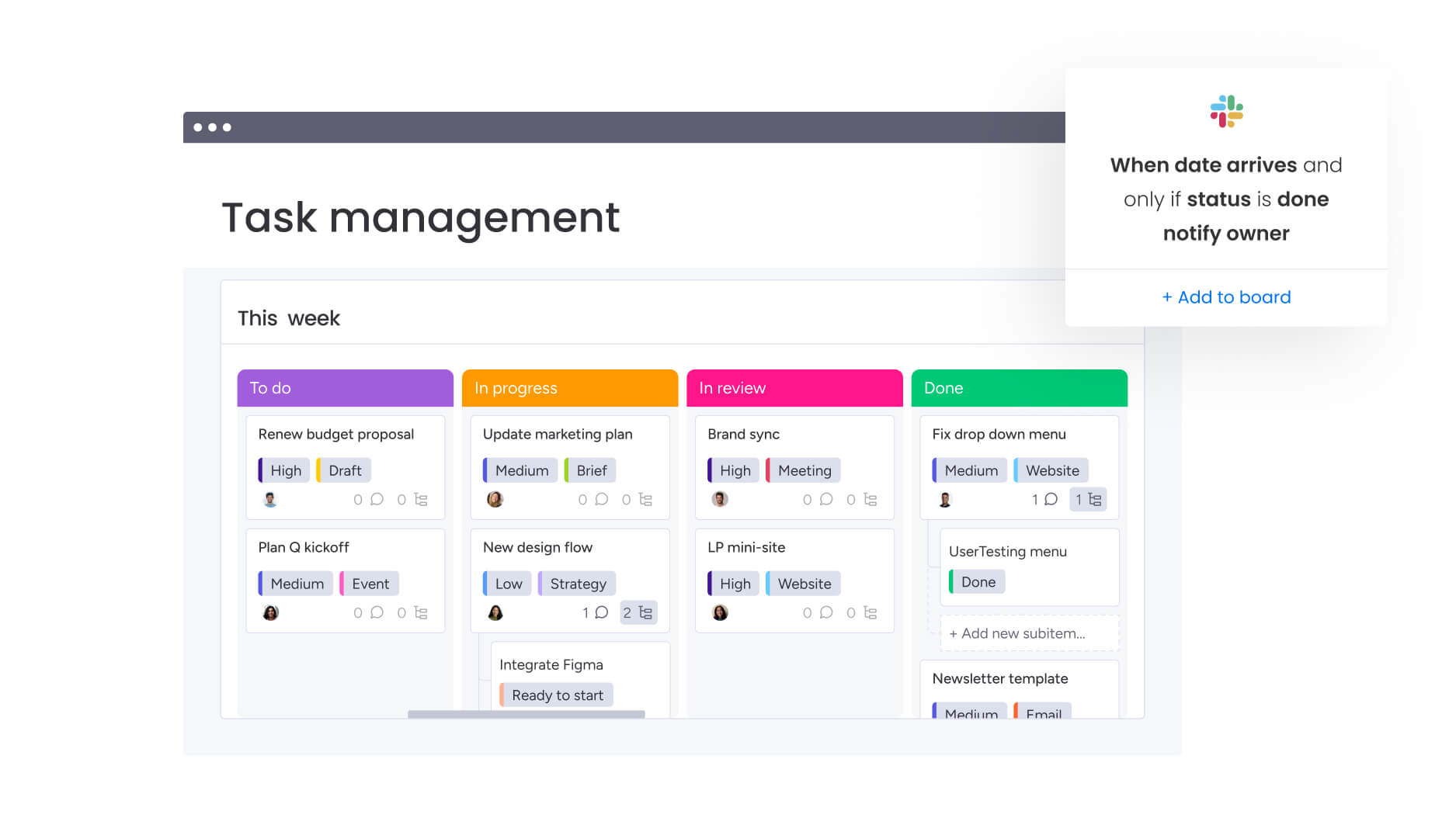
Building a 5-year plan is a step-by-step process from big vision to concrete action. Follow these steps to build a foundation for ongoing management and keep your plan alive instead of letting it collect dust.
Step 1: set your strategic north star
Start by defining your vision and main objectives. They’ll guide every decision that follows. That means nailing down core values, figuring out market positioning, and spelling out long-term goals.
Next, get key stakeholders involved so leadership’s on the same page. You’ll end up with concrete statements that turn big ambitions into a clear destination.
Step 2: baseline your current state
Before planning where to go, figure out where you are. Assess your current capabilities, financial health, operational capacity, and competitive landscape.
Honest analysis backed by data shows what you’re good at and what needs work. Therefore, get input from multiple departments so you see the full picture of where you’re starting.
Step 3: define 5-year measurable objectives
Once you understand your baseline, turn your strategic vision into specific, measurable goals with clear success criteria. Set goals that push growth and improvement without crushing morale.
Balance financial, operational, and strategic goals, and tie them directly to what each department owns.
Step 4: map annual milestones and key results
Next, break 5-year goals into annual checkpoints with specific deliverables. These milestones build toward bigger goals, factoring in what depends on what and what capabilities you need first.
Quarterly checkpoints connect annual goals to the planning cycles teams already use.
Step 5: plan resource allocation across years
Strategic objectives must be supported by a clear roadmap for people, capital, and technology. By mapping these resources across the 5-year timeline, you can identify potential gaps and determine necessary investments well in advance.
Furthermore, timing this allocation to match milestone delivery, while accounting for hiring lead times and budget approval cycles, prevents projects from falling behind schedule.
Step 6: build quarterly review rhythms
Because market conditions can shift rapidly, regular reviews are necessary to keep the plan relevant and execution on track.
Quarterly reviews let you check progress, spot obstacles, and adjust the plan. They balance accountability with the flexibility to adapt when conditions change.
Step 7: link strategic goals to daily execution
The final step connects high-level objectives to project management and daily workflows. Now everyone can see how their work connects to strategic outcomes.
With monday work management, teams can map project objectives, needs, and scope from idea to execution, assigning ownership so project goals tie back to company goals.
Strategic objectives must be supported by a clear roadmap for people, capital, and technology. By mapping these resources across the 5-year timeline, you can identify potential gaps and determine necessary investments well in advance.
5-year plan examples that drive results
The following examples demonstrate how organizations structure and execute their 5-year plans. These cases illustrate the framework’s flexibility and the practical elements that drive measurable results.
Enterprise transformation 5-year plan example
One large organization’s plan focuses on modernizing infrastructure and automating processes.
| Component | Details |
|---|---|
| Primary objective | Migrate 80% of operations to cloud infrastructure by year three |
| Secondary objective | Achieve 50% automation of routine processes by year five |
| Key metrics | Cost savings targets, efficiency improvements, system uptime |
| Structure | Annual milestones for legacy system decommissioning, new platform implementation, workforce training |
Marketing department 5-year plan example
A marketing team’s plan focuses on brand growth, lead generation, and capability development, similar to a business development plan. It covers scaling the team, adopting martech tools, and shifting campaign strategies from broad awareness to targeted account-based marketing.
Key objectives include:
- Brand leadership: Establish thought leadership in three key market segments.
- Digital transformation: Achieve 40% of leads through digital channels by year four.
- Performance metrics: Lead generation targets, brand awareness scores, marketing ROI.
Individual career growth 5-year plan example
A career plan maps your path from individual contributor to leader. It balances building technical skills with developing soft skills and expanding your network.
Career milestones typically include:
- Year two: Complete advanced certification.
- Year four: Lead cross-functional team.
- Ongoing: Project leadership opportunities, mentorship activities, compensation progression.
Build cross-functional alignment in your 5-year plan
Silos are the enemy of long-term strategy. How do you get departments working together toward the same goals?
To keep everyone aligned, spot interdependencies early. Shared metrics and clear collaboration rules prevent department priorities from clashing with company goals. Mapping cross-functional workflows provides visibility into how work passes between teams, ensuring resource sharing supports the overall plan.
Organizations using monday work management build cross-departmental workflows, allowing them to focus on achieving efficient work processes from strategy to execution. With all business units and data connected in one workspace, teams get real-time insights, from potential risks to work progress, to make accurate decisions.
This transparency ensures delays in one department are immediately visible to others, allowing for real-time adjustments.
Make your 5-year plan dynamic with rolling updates

A static 5-year plan is a liability in a fast-moving market. Rolling forecasts and adaptive planning allow organizations to incorporate new information without losing strategic focus. This approach balances plan stability with necessary adjustments based on performance data and new opportunities.
Minor adjustments occur quarterly, while major revisions happen annually. The table below demonstrates how traditional and dynamic planning compare:
| Aspect | Traditional planning | Dynamic planning |
|---|---|---|
| Plan updates | Annual or semi-annual | Real-time with rolling updates |
| Progress tracking | Manual reports and spreadsheets | Automated dashboards with live data |
| Cross-team coordination | Email and meetings | Shared workspaces with real-time collaboration |
| Risk management | Quarterly reviews | AI-powered continuous monitoring |
| Resource allocation | Static annual budgets | Dynamic allocation with workload optimization |
| Goal alignment | Top-down communication | Transparent goal tracking with visible line-of-sight |
Communication protocols ensure that when plans change, every stakeholder stays aligned. Teams using monday work management leverage automations to handle repetitive notifications, sending approval notifications and reminders automatically so teams focus on strategic work rather than administrative updates.
Change your 5-year vision into measurable progress with monday work management
Strategic planning capabilities on monday work management turn static 5-year plans into dynamic execution systems. The platform provides infrastructure needed to turn strategy into reality.
Strategic planning capabilities
Goals and strategy management happens where work occurs. Company and team-level goals are set within the platform using collaborative Workdocs, timelines, and dashboards. This ensures strategy is documented where the work happens, not in a separate file.
In addition, Portfolio management provides high-level visibility across all projects and programs. This bird’s-eye view allows detection of bottlenecks and dependencies across the entire 5-year portfolio.
The Workload widget enables precise resource planning, scheduling, and allocation. Managers optimize team utilization, ensuring the right people are available for critical milestones without risking burnout.
Execution and tracking features
Projects are managed from ideation to execution with ownership, deadlines, and stakeholder updates. Every workflow links to a larger objective. Meanwhile, automated, real-time dashboards display project data via customizable widgets. Executives monitor budgets, goals, schedules, and resources at a glance.
Repetitive workflows, approval processes, and progress notifications are automated, reducing administrative drag and speeding up execution.
AI-powered enhancements
AI blocks categorize and analyze project risks across portfolios, flagging potential issues before they derail timelines. AI summarizes project status and extracts key insights from project data, providing instant visibility on plan health. Intelligent algorithms suggest optimal resource allocation based on skills, availability, and project requirements.
Integration and collaboration
Teams collaborate across departments within shared workspaces, breaking down silos and ensuring real-time alignment. The platform connects with existing applications like Microsoft Teams, Slack, and other business systems, creating the monday Work OS. Enterprise-grade security and multi-level access controls protect sensitive strategic data.

“monday.com has been a life-changer. It gives us transparency, accountability, and a centralized place to manage projects across the globe".
Kendra Seier | Project Manager
“monday.com is the link that holds our business together — connecting our support office and stores with the visibility to move fast, stay consistent, and understand the impact on revenue.”
Duncan McHugh | Chief Operations OfficerTurn your strategic vision into operational reality
A 5-year plan only succeeds when it survives the transition from the boardroom to the frontline. Leading organizations treat their templates as living systems that evolve with the market while staying anchored to core objectives. By bridging the gap between strategy and daily tasks, you transform a static document into a framework that guides every decision.
Implementing review rhythms and cross-functional alignment ensures your strategy remains relevant over the long term. This structured approach improves visibility and confirms that every task contributes to the bigger picture. When teams understand the “why” behind their daily work, execution becomes significantly faster and more predictable.
Eliminating the disconnect between vision and reality requires an infrastructure that supports dynamic growth. Integrating monday work management provides the central workspace needed to link strategic milestones to project execution, turning ambitious 5-year goals into measurable, day-to-day progress.
Frequently asked questions
How often should I review and update my 5-year plan?
To determine how often you should review and update your 5-year plan, a good rhythm is to conduct quarterly reviews to assess progress and identify immediate obstacles. Major updates should occur annually to adjust for market changes and performance data, ensuring the long-term vision remains relevant while allowing for tactical adjustments throughout the year.
What's the difference between a 3-year and 5-year strategic plan?
The difference between a 3-year and a 5-year strategic plan is their scope and timeline. While three-year plans typically focus on immediate operational improvements, market positioning, and efficiency gains, five-year plans allow for longer-term transformation initiatives, major capability development, and structural changes that require extended timelines to mature and deliver full value.
How do I plan for uncertainty over 5 years?
Planning for uncertainty involves scenario planning and building flexibility into resource allocation. Creating contingency plans for various market conditions allows your organization to pivot tactics while maintaining focus on core strategic objectives through adaptive frameworks.
Should departments have separate 5-year plans?
Departments should have distinct plans that align directly with overall organizational objectives. Visible connections between departmental goals and company-wide strategic priorities ensure coordinated execution and prevent siloed efforts that could undermine organizational success.
What metrics best track 5-year plan progress?
A combination of leading indicators like project completion rates and resource utilization with lagging indicators such as revenue growth and market share provides comprehensive visibility. Leading indicators offer early warning signals while lagging indicators measure final outcomes and strategic achievement.
How do I integrate AI initiatives into my 5-year plan?
AI adoption should be planned as a phased implementation, starting with process automation and progressing to advanced analytics. Organizations using monday work management's AI capabilities support this integration by automating project tracking and providing intelligent resource allocation insights from day one.

 Get started