


Mondays often start the same way: teams scattered across different priorities, half-finished tasks from last week, and everyone wondering what to tackle first. It feels chaotic, and by Friday, progress can feel smaller than expected. The real problem isn’t effort; it’s how work is organized and shared across the team.
Weekly goals solve this by giving the week a clear rhythm. They’re short enough to stay urgent but long enough to get meaningful work done. They also create a shared focal point that turns scattered effort into coordinated progress.
Below, we explore practical ways to set weekly goals that actually stick, how many to aim for, and a simple 5‑step process to turn big-picture strategy into actionable results. This guide will also show how to connect weekly focus to broader business priorities, keeping the team aligned, productive, and moving forward without burning out.
Key takeaways
- Focus on 3–5 weekly goals maximum: Limiting the number of goals helps teams maintain focus, deliver higher-quality results, and avoid spreading themselves too thin.
- Align weekly goals with broader objectives: Connecting short-term goals to quarterly or strategic priorities ensures that daily efforts contribute to meaningful business outcomes.
- Use mid-week checkpoints to stay on track: Regular reviews during the week help identify blockers early and provide opportunities to adjust before deadlines.
- Assign clear ownership with shared accountability: Every goal should have a dedicated champion to coordinate work while keeping the team informed of progress and dependencies.
- Leverage systems for visibility and workload management: Platforms like monday work management enable teams to track progress in real time, balance capacity, and coordinate cross-functional dependencies effectively.
What are weekly goals for teams?
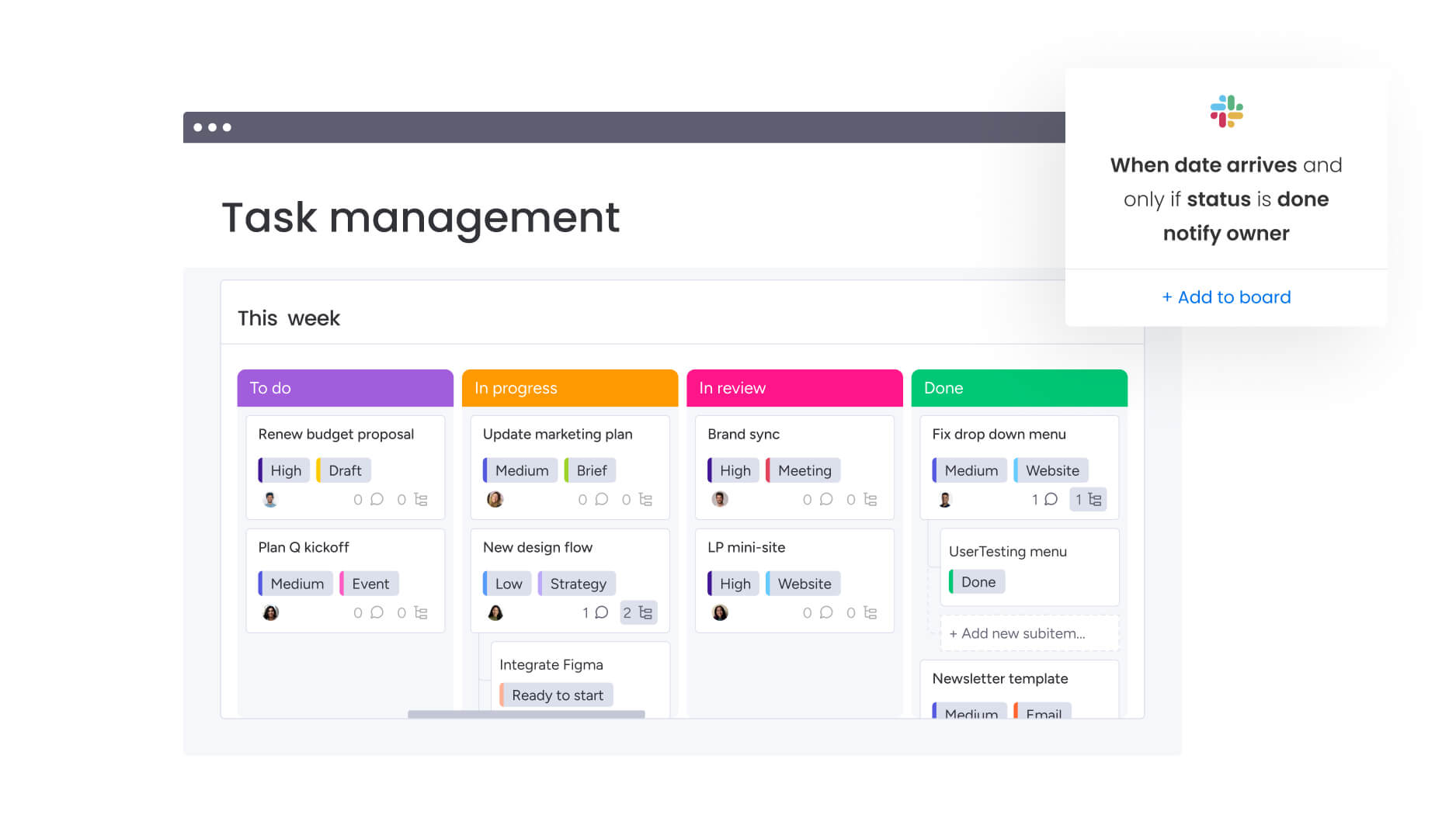
Weekly goals are short-term objectives that a team focuses on over a seven-day period. They bridge the gap between daily tasks and monthly targets, creating a steady rhythm that keeps everyone aligned and moving forward.
Unlike personal to-do lists, weekly team goals require collaboration, shared responsibility, and a clear sense of accountability.
Weekly goals are the operational heartbeat of your team. They break down big-picture strategies into concrete actions while staying flexible enough to adapt when priorities shift. For cross-functional teams, this seven-day cycle provides structure without the pressure of distant deadlines.
The most effective weekly goals share three key qualities:
- Specificity: Everyone knows exactly what success looks like by week’s end.
- Shared ownership: Multiple team members contribute to achieving the goal.
- Strategic alignment: Each goal ties directly to broader business objectives.
Moving beyond individual task lists
Personal assignments lists create silos; everyone is busy, but progress is hidden. This often leaves teams working in isolation, making it hard to see how individual contributions fit into the bigger picture. Weekly goals shift this dynamic by highlighting progress and clarifying dependencies.
For instance, marketing may need design assets for a campaign while operations waits for finance input. Weekly goals force teams to sync early, reducing last-minute bottlenecks. Platforms like monday work management make these connections visible on shared boards, with automatic updates that prevent items from falling through the cracks.
Individual versus team approaches differ in these ways:
| Individual approach | Team weekly goals |
|---|---|
| Tasks live in personal notebooks or apps | Goals visible to the entire team |
| Success is measured by items checked off | Success is measured by outcomes achieved |
| Dependencies discovered mid-week | Dependencies mapped upfront |
| Progress updates happen in meetings | Progress visible in real-time |
Why do 7 days work best?
A seven-day cycle strikes the perfect balance, long enough to accomplish meaningful work, short enough to maintain urgency. Planning beyond a week often leads to overcommitment, while underestimating complexity slows execution.
The weekly rhythm naturally aligns with work patterns:
- Monday: Fresh energy for planning and setting priorities.
- Mid-week: Checkpoints catch issues before they escalate.
- Friday: Closure and celebration of completed work.
This cadence builds momentum without burnout. Teams get 52 chances each year to course-correct, compared to just twelve opportunities with monthly cycles. That’s why agile teams favor shorter, outcome-driven sprints.
Weekly goals are the operational heartbeat of your team. They break down big-picture strategies into concrete actions while staying flexible enough to adapt when priorities shift. For cross-functional teams, this seven-day cycle provides structure without the pressure of distant deadlines.
3 strategic advantages over daily task management
Daily task lists can feel productive, but they often keep teams trapped in busywork. Weekly goals shift the focus from reactive firefighting to proactive progress.
Instead of asking, “what needs doing today?” you ask, “which outcomes will move us forward this week?” This subtle change transforms how teams prioritize work and ensures effort aligns with impact.
1. Enhanced team focus and productivity
When teams set weekly goals together, everyone knows what matters most and how their work connects to others’. Alignment reduces task-switching and prevents wasted effort.
For example:
- Without weekly goals: Marketing runs campaigns while product finalizes features, and support scrambles to catch up.
- With weekly goals: Marketing, product, and support align on launch milestones, moving in sync instead of sequentially.
Using monday work management, teams link goals across departments, get automatic notifications when dependencies are completed, and track progress on shared dashboards.
2. Improved cross-functional collaboration
Weekly goals encourage early and consistent collaboration. When sales need marketing collateral, teams communicate proactively, avoiding last-minute rushes.
Structured collaboration brings measurable benefits:
- Reduced miscommunication: Clear goals minimize assumptions.
- Faster problem-solving: Challenges surface before they block progress.
- Shared wins: Teams celebrate results together.
3. Greater visibility into team capacity
Weekly goals provide a transparent view of workload, showing exactly how much work is in progress. Managers can distribute tasks evenly, preventing bottlenecks and burnout.
Teams can plan better by:
- Checking bandwidth: Verify availability before assigning new work.
- Confirming capacity: Ensure resources exist before committing to deadlines.
- Balancing assignments: Distribute work during planning for a sustainable pace.
Workload views on monday work management automate this process, ensuring teams stay productive without overloading anyone.
How many weekly goals should you set?
Finding the right balance is essential. Setting too few goals may leave potential untapped, while setting too many can compromise quality and completion rates. For most teams, three to five goals per week provides the optimal balance between ambition and achievability.
Why does this range work best?
This target isn’t arbitrary; it is based on how modern teams actually function. Limiting yourself to a handful of objectives creates enough focus to drive significant outcomes without overextending capacity or diluting effort across too many fronts.
This limit has real benefits:
- Deeper focus: Teams can dedicate meaningful time to each goal.
- Better quality: Fewer goals mean higher standards for each.
- Clearer communication: Everyone can remember and discuss the five goals easily.
Scaling goal quantity by team size
The optimal number of weekly goals isn’t one-size-fits-all; it depends on your team’s size, structure, and the complexity of work you’re managing. Smaller teams benefit from tighter focus, while larger teams can handle more goals by distributing ownership across sub-groups. Here’s how to calibrate your approach:
| Team size | Recommended goals | Approach |
|---|---|---|
| Small (3-5 people) | 2-3 goals | Focus on one major initiative at a time |
| Medium (6-12 people) | 3-5 goals | Balance across functional areas |
| Large (13+ people) | 3-5 umbrella goals | Break down into sub-team deliverables |
Large teams often set broad goals that are divided into actionable sub-goals for smaller squads. For example, a 20-person department might have four weekly goals, with each five-person team owning one specific deliverable.
Balancing stretch goals with achievable wins
Weekly goals shouldn’t all be the same difficulty. Combine stretch goals with achievable wins using the 70/30 rule:
- 70% achievable goals: Maintain momentum and build confidence.
- 30% stretch goals: Encourage growth, learning, and innovation.
This approach avoids two common pitfalls: teams either stagnate or burn out. A balanced mix keeps energy high while driving progress and improvement.
5 steps to set effective team weekly goals
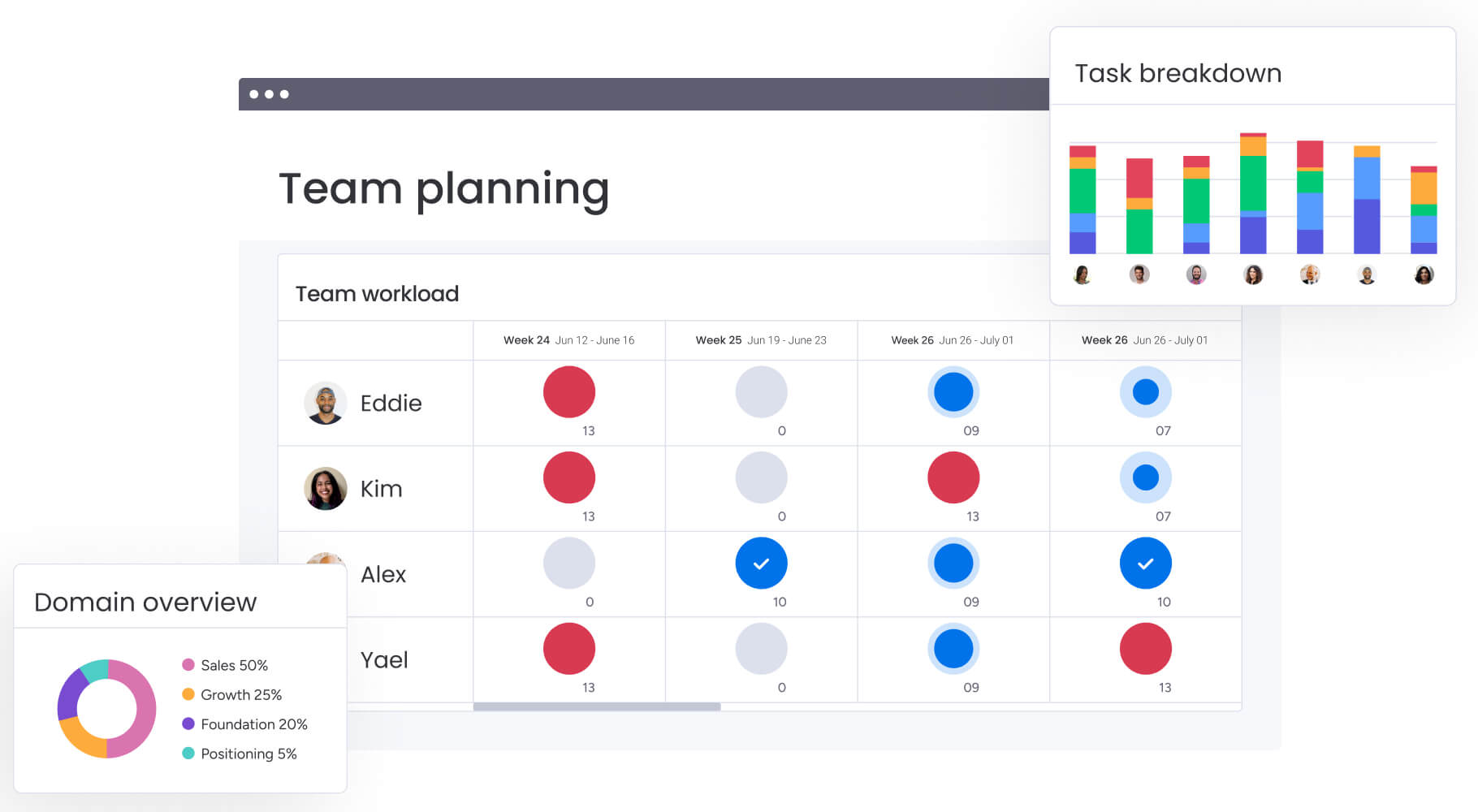
Good intentions aren’t enough to achieve weekly goals. Teams need a clear, repeatable process that turns strategy into action and keeps everyone on the same page. A systematic approach creates consistency, improves results, and builds momentum over time.
Step 1: review last week’s performance
Start by looking at what happened last week. Which goals were completed, which were missed, and most importantly, why? Focus on patterns rather than individual mistakes to prevent repeating them.
Key areas to examine include:
- Completion rates: Identify which goals consistently succeed or stall.
- Resource allocation: See where time and effort were spent.
- Blockers: Document obstacles that slowed progress.
Dashboards on monday work management make this process visual, highlighting trends and recurring bottlenecks so discussions are data-driven rather than based on guesswork.
Step 2: define specific, measurable objectives
Vague goals produce vague results. Instead, define objectives that are specific, measurable, and clearly actionable. For instance, “Improve customer satisfaction” is unclear, while “Resolve 90% of support tickets within 24 hours” gives precise direction.
Effective weekly goals answer three questions:
- What exactly will be accomplished: Define the specific deliverable or outcome.
- How completion will be measured: Establish clear success criteria.
- Who benefits from the outcome: Identify the stakeholder or customer impact.
A goal-setting template helps ensure clarity and keeps the team focused on results rather than general intentions.
Step 3: assign direct ownership
Every goal needs a dedicated champion. They don’t do all the work themselves, but they coordinate the team, remove roadblocks, and ensure progress stays on track.
Ownership ensures accountability and smoother execution:
- Single point of accountability: One person is responsible for the outcome.
- Coordination responsibility: The owner manages dependencies and communication.
- Capacity verification: Confirm the owner has bandwidth to deliver.
Resource management features on monday work management make it easy to verify capacity before goals are assigned, ensuring realistic commitments.
Step 4: establish mid-week checkpoints
Mid-week check-ins, usually on Wednesday or Thursday, prevent last-minute surprises. These short sessions focus on solving problems early instead of just reporting status.
Checkpoints address two main questions:
- Track progress: Are we on track to hit our goals?
- Identify needs: What support is needed to stay on course?
These sessions help teams course-correct quickly and maintain momentum without waiting until the week ends.
Step 5: connect goals to quarterly priorities
Before finalizing weekly goals, confirm they tie directly to quarterly objectives. If a goal doesn’t serve a larger priority, it’s better to cut it. This alignment ensures daily work drives meaningful progress toward company goals.
A systematic approach creates consistency, improves results, and builds momentum over time.
Connecting weekly goals to company OKRs
Teams maintain this connection on monday work management by linking weekly goals to OKRs and strategic initiatives. This creates visibility from daily tasks all the way up to company objectives, ensuring everyone understands how their work contributes to bigger results.
Cascading objectives into weekly actions
Strategic objectives cascade down like a waterfall, annual goals break into quarterly key results, which translate into monthly milestones, and finally, weekly goals. Each goal should clearly contribute to the level above it.
For example, an annual objective to expand market presence might cascade as:
- Quarterly Key Result: Launch in three new regions.
- Monthly Milestone: Complete regional market analysis.
- Weekly Goal: Interview ten customers in the target region.
Using linked boards and portfolio views on monday work management, teams can visualize how each weekly goal drives larger outcomes.
Managing cross-functional dependencies
Many goals rely on input from multiple teams. Product launches, marketing campaigns, and financial planning all require coordination across departments. Weekly goals make dependencies clear and manageable.
Successful dependency management involves:
- Visibility: Everyone sees what others are working on.
- Communication: Channels for early coordination are defined.
- Accountability: Handoffs and deadlines are explicit.
This approach reduces surprises and ensures smooth collaboration across teams.
Measuring contribution to key results
Completing goals is not enough; teams need to understand their impact on quarterly KPIs. Every weekly goal should clearly contribute to business outcomes.
For instance:
- Weak connection: “Launch email campaign.”
- Strong connection: “Generate 50 qualified leads through email campaign.”
The second example directly links weekly effort to measurable revenue impact, making the strategic value clear.
Tracking and optimizing weekly goal performance
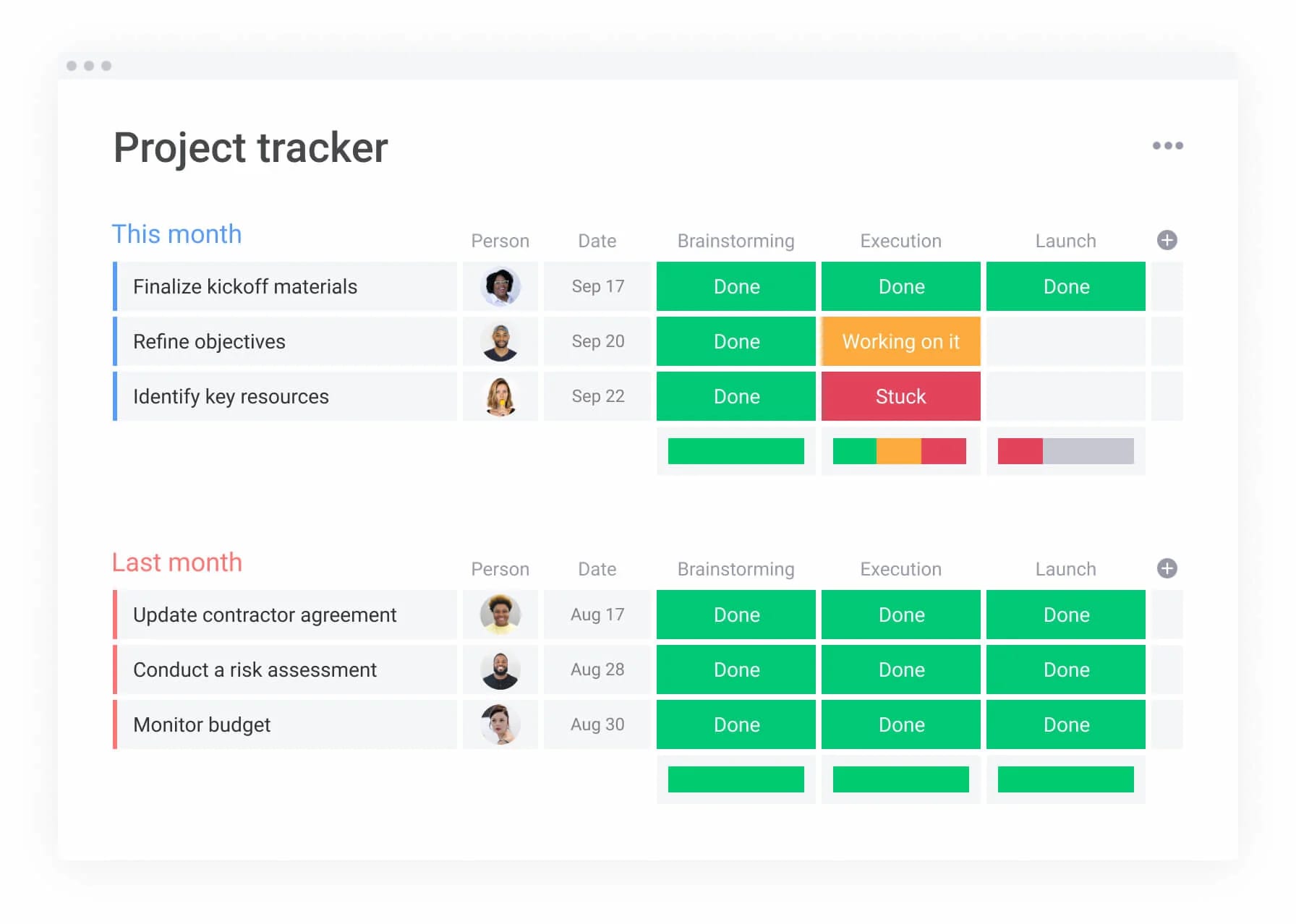
Setting goals is only the beginning. The real work happens in the follow-through: tracking progress as it unfolds, analyzing patterns in what succeeds or stalls, and refining your approach based on what the data reveals. This continuous cycle transforms goal-setting from a planning exercise into a disciplined practice that drives consistent results.
Real-time goal dashboards
Static reports are often outdated by the time they’re reviewed. Real-time dashboards provide instant visibility into progress, team capacity, and potential risks.
Dashboards track:
- Leading indicators: Tasks completed, time invested, blockers identified.
- Lagging indicators: Goals achieved, quality metrics, business impact.
Together, they provide a complete picture of team health. Reporting capabilities on monday work management pull this data automatically, eliminating manual compilation while ensuring decisions are based on current reality and helping teams track progress effectively.
Leading productive weekly reviews
Weekly reviews should energize teams, not exhaust them. Keep sessions under 30 minutes and focus on learning.
Structure discussions around three questions:
- What worked well: Identify successes worth repeating.
- What slowed progress: Document obstacles that created friction.
- What to adjust: Plan changes based on this week’s insights.
These reviews help teams continuously improve without turning goal tracking into a chore.
Data-driven goal adjustments
Historical data reveals real team capacity. If goals are consistently missed, you may be overcommitting; if everything is always completed, you may not be pushing hard enough. Target an 80–90% achievement rate for balance.
Data informs adjustments in:
- Goal complexity: Identify patterns in success or failure.
- Timing: Schedule tasks for optimal efficiency.
- Resource allocation: Understand the effort required for different activities.
This analysis turns weekly goal-setting into a structured, measurable practice.
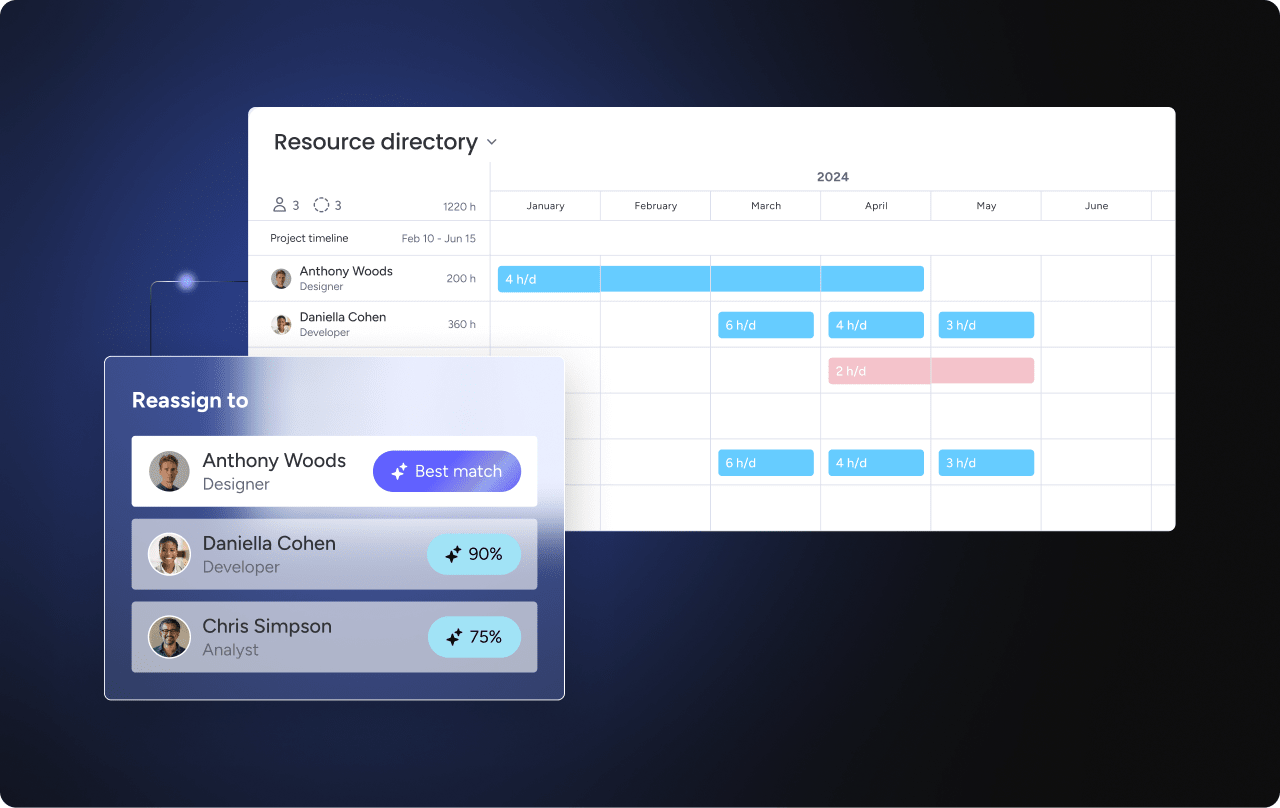
How does AI support weekly goal achievement?
Artificial intelligence moves beyond automation to become a strategic partner in goal management. Instead of just tracking what happened, AI predicts what will happen and suggests what should happen next. This intelligence helps teams make proactive decisions rather than reactive adjustments.
Smart goal recommendations based on velocity
AI analyzes your team’s historical performance to predict realistic capacity for the upcoming week. It considers factors like past completion rates, seasonal patterns, and individual workloads to recommend appropriate goal volumes and complexity.
When teams use AI blocks on monday work management, the system can:
- Categorize incoming requests: Sort by urgency and strategic importance.
- Extract key requirements: Pull essential details from project briefs.
- Suggest goal priorities: Recommend focus areas based on strategic alignment.
This intelligence helps teams focus on what matters most rather than what seems most urgent.
Automated progress tracking
Manual status updates waste time and create information lag. AI monitors progress continuously, detecting when goals veer off track before humans notice. It identifies patterns like slowing velocity or increasing blockers that signal risk.
The automation goes beyond simple tracking:
- Pattern recognition: AI spots recurring issues across similar goals.
- Risk prediction: Early warning when goals might miss deadlines.
- Resource optimization: Suggestions for rebalancing workloads.
Predictive insights for prioritization
AI doesn’t just track the current state; it predicts the future state. By analyzing dependencies, resource availability, and historical patterns, it forecasts which goals are most likely to succeed and which need intervention.
These predictions help teams make proactive adjustments:
- Resource reallocation: Move capacity to at-risk goals before it’s too late.
- Dependency management: Flag potential bottlenecks before they occur.
- Timeline adjustments: Recommend realistic deadlines based on actual capacity.
Product Power-ups on monday work management surface these insights automatically, turning reactive management into proactive leadership.

“monday.com has been a life-changer. It gives us transparency, accountability, and a centralized place to manage projects across the globe".
Kendra Seier | Project Manager
“monday.com is the link that holds our business together — connecting our support office and stores with the visibility to move fast, stay consistent, and understand the impact on revenue.”
Duncan McHugh | Chief Operations OfficerDrive your team’s weekly results with monday work management
Managing weekly goals can feel chaotic, especially when teams juggle multiple priorities, hidden dependencies, and tight deadlines. monday work management connects daily work to broader business objectives, making progress visible and predictable while reducing complexity.
Key features and benefits include:
- Unified goal visibility: Link weekly goals to strategic objectives for clear alignment from individual tasks to company outcomes.
- Automated progress tracking: Monitor completion, blockers, and resource use in real time, reducing reliance on manual updates.
- Intelligent workload balancing: Identify capacity gaps and prevent overloading team members before it becomes a problem.
- Cross-functional coordination: Manage dependencies across teams with shared boards and synchronized timelines.
- Predictive insights: Leverage AI to anticipate risks, recommend priorities, and optimize resource allocation.
With these capabilities, teams gain clarity, maintain focus, and make measurable progress toward strategic goals without added complexity, turning weekly planning into a source of efficiency and impact.
Frequently asked questions
What is an example of a weekly goal?
An example of a weekly goal is "Complete user research interviews with ten customers and compile insights into actionable product recommendations by Friday." This goal is specific, measurable, time-bound, and requires team coordination.
How do you write effective weekly goals?
Effective weekly goals must be specific, measurable, achievable, relevant, and time-bound (SMART). Define clear ownership, success criteria, and ensure the goal fits within a seven-day timeframe while connecting to broader objectives.
What's the difference between weekly goals and daily tasks?
Weekly goals focus on outcomes you want to achieve by week's end, while daily tasks are specific actions needed to reach those outcomes. Goals define the destination; tasks map the journey.
How many weekly goals should a team have?
Most teams perform best with three to five weekly goals. This range provides enough focus to make meaningful progress while avoiding the dilution that comes from juggling too many priorities simultaneously.
How do you track weekly goal progress?
Track weekly goal progress through real-time dashboards that show completion status, resource allocation, and blockers. Use mid-week checkpoints to identify at-risk goals and automated reporting to maintain visibility without manual updates.
When should you adjust weekly goals mid-week?
Adjust weekly goals mid-week when new information significantly changes priorities, external factors make the original goal impossible, or resources become unavailable. Document changes to learn from patterns over time.

 Get started