


Email marketing used to be a numbers game — success was measured by the size of your list. Today, customers expect personalized communication that understands their needs at every step, and success is measured by delivering the right message at the right moment, turning initial interest into lasting loyalty.
This guide walks through proven email marketing examples for every stage of the customer journey. You’ll learn everything from welcome sequences that make a strong first impression to AI-powered campaigns that drive revenue and re-engagement flows that win back inactive subscribers. You’ll also see how AI-powered software like monday campaigns can help you launch campaigns in minutes rather than hours or days.
Try monday campaignsKey takeaways
- Welcome emails are your most important campaigns because they set the tone for your entire relationship and have the highest engagement rates of any email type.
- Personalization at scale drives real results, and you can use AI to automatically customize content, send times, and product recommendations for each subscriber based on their behavior.
- Send a series of gentle reminders within hours of cart abandonment to address common purchase barriers and recover lost sales.
- Lifecycle campaigns nurture relationships over time, guiding subscribers from first signup through loyal customer with targeted content that matches their journey stage.
- Create, launch, and optimize email campaigns in minutes with monday campaigns AI-powered suggestions and native CRM integration, which connects marketing to sales.
Quick look: The best email marketing campaign type for your goals
Email marketing isn’t one-size-fits-all. The campaign type you choose determines whether you’re building relationships, driving immediate sales, or re-engaging dormant subscribers. Each type serves a distinct purpose in your overall strategy.
Here’s a quick look at the email marketing campaign types we’ll cover and when to use them:
| Campaign type | Primary goal | Best for | Typical timing |
|---|---|---|---|
| Welcome emails | Make strong first impressions | New subscribers | Immediately after signup |
| Promotional campaigns | Drive immediate revenue | Product launches, sales, seasonal events | Strategic moments throughout the year |
| Newsletters | Build long-term engagement | Ongoing relationship building | Weekly or monthly |
| Cart abandonment | Recover lost sales | Shoppers who didn’t complete purchase | 1–72 hours after abandonment |
| Re-engagement | Win back inactive subscribers | Subscribers who stopped engaging | After 3–6 months of inactivity |
| AI-powered personalization | Maximize relevance at scale | All campaign types | Ongoing optimization |
| Lifecycle campaigns | Guide customers through journey | Leads, new customers, loyal customers | Triggered by customer stage |
Now let’s look at each type of email marketing example in more depth.
Welcome email examples that convert new subscribers
Welcome emails are automated messages sent immediately after someone joins your email list. They introduce your brand, set expectations, and guide new subscribers toward their first action.
Think of welcome emails as your digital handshake. You have seconds to make an impression that determines whether subscribers engage or ignore future messages.
First impression welcome emails
A first impression welcome email is a single, automated message sent within minutes of signup. It acknowledges the subscription and delivers immediate value through a discount, resource, or clear next step.
To make a strong impact, your first email should be focused and easy to scan. The most effective first-impression emails share a few key elements designed to deliver immediate value and guide the subscriber:
- Personalized greeting: Use the subscriber’s name and reference how they joined your list.
- Clear value statement: Remind them what they’ll receive as a subscriber.
- Single call-to-action: Guide them to explore products, read content, or claim an offer.
For example, an e-commerce brand might send “Welcome to [Brand], Sarah! Here’s 10% off your first order” with a prominent shop button. A SaaS company could share “Your account is ready — let’s get started” with a link to the dashboard.
Multi-step welcome series
A multi-step welcome series spreads your introduction across 3–5 emails over one to two weeks. Each email serves a specific purpose without overwhelming new subscribers.
Here’s a proven sequence that builds engagement:
- Email 1 (Day 1): Welcome and set expectations
- Email 2 (Day 3): Share your most popular content or products
- Email 3 (Day 7): Include social proof through testimonials or case studies
- Email 4 (Day 10): Offer exclusive content or a special discount
- Email 5 (Day 14): Invite feedback or encourage community participation
Software like monday campaigns automates these sequences based on subscriber behavior, tracking opens and clicks to trigger the next email at the optimal time.
Personalized onboarding sequences
Personalized onboarding uses subscriber data to create unique paths. Different signup sources, stated preferences, or early behaviors trigger different email sequences.
A fitness app might create 3 distinct paths:
- Beginners: Focus on basic tutorials and encouragement
- Intermediate users: Share workout plans and nutrition tips
- Advanced athletes: Highlight performance tracking and community challenges
This segmentation ensures every subscriber receives relevant content from day one.
Promotional email campaign examples that drive revenue
Promotional emails announce sales, launches, or special offers to drive immediate purchases. They balance urgency with value to encourage action without appearing desperate. The key is timing and relevance. Send too many promotions and subscribers tune out. Send too few and you miss revenue opportunities.
Flash sale and limited-time offers
Flash sales create urgency through scarcity. These campaigns typically run for 24–48 hours with significant discounts or exclusive access.
Effective flash sale emails include:
- Countdown timers: Visual urgency showing exactly when the sale ends
- Limited quantities: “Only 50 items available” or “While supplies last”
- Clear discount amounts: “Save 40%” works better than “Big savings”
- Multiple product options: Feature bestsellers and new arrivals
Subject lines like “24 hours only: Everything 50% off” or “Flash sale starts now” create immediate interest. The email body should load quickly with product images and direct purchase links.
Product launch announcements
Product launches build excitement around new offerings. The best campaigns create anticipation before launch day and maintain momentum afterward.
A typical launch sequence includes:
- Pre-launch teaser: “Something exciting is coming next week”
- Launch day reveal: “Introducing [Product] — available now”
- Feature highlight: “5 ways [Product] solves your biggest challenge”
- Social proof follow-up: “See why customers love [Product]”
With monday campaigns, you can schedule these emails for optimal engagement times. Plus, AI analyzes when your audience typically opens emails to maximize launch day impact.
Seasonal campaign examples
Seasonal campaigns tie promotions to holidays, events, or time-based needs. They feel natural because subscribers expect them and are already in a buying mindset.
The key is starting early. Send preview emails before the main event to build anticipation. Then follow with reminder emails as deadlines approach.
Valentine’s Day campaigns
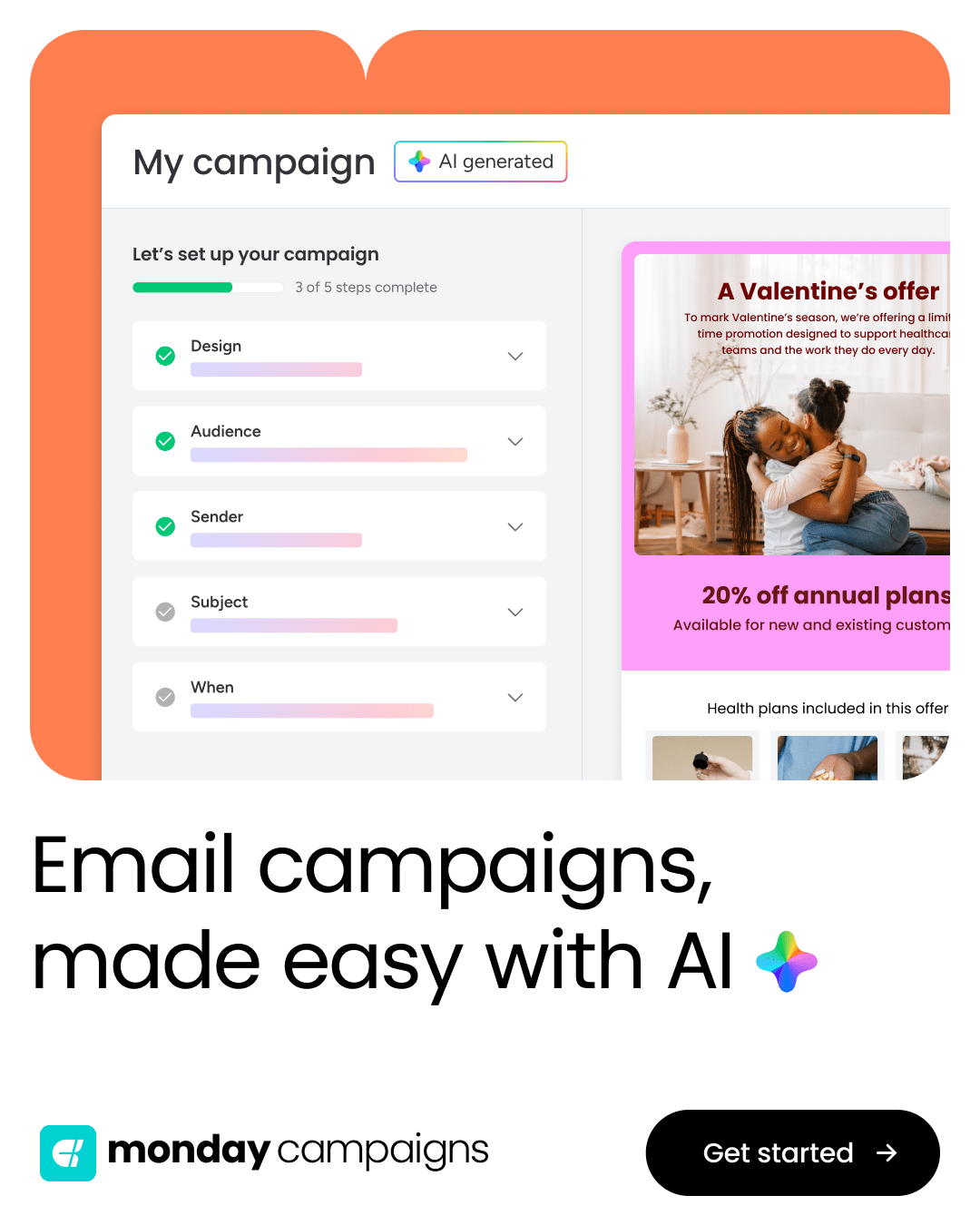
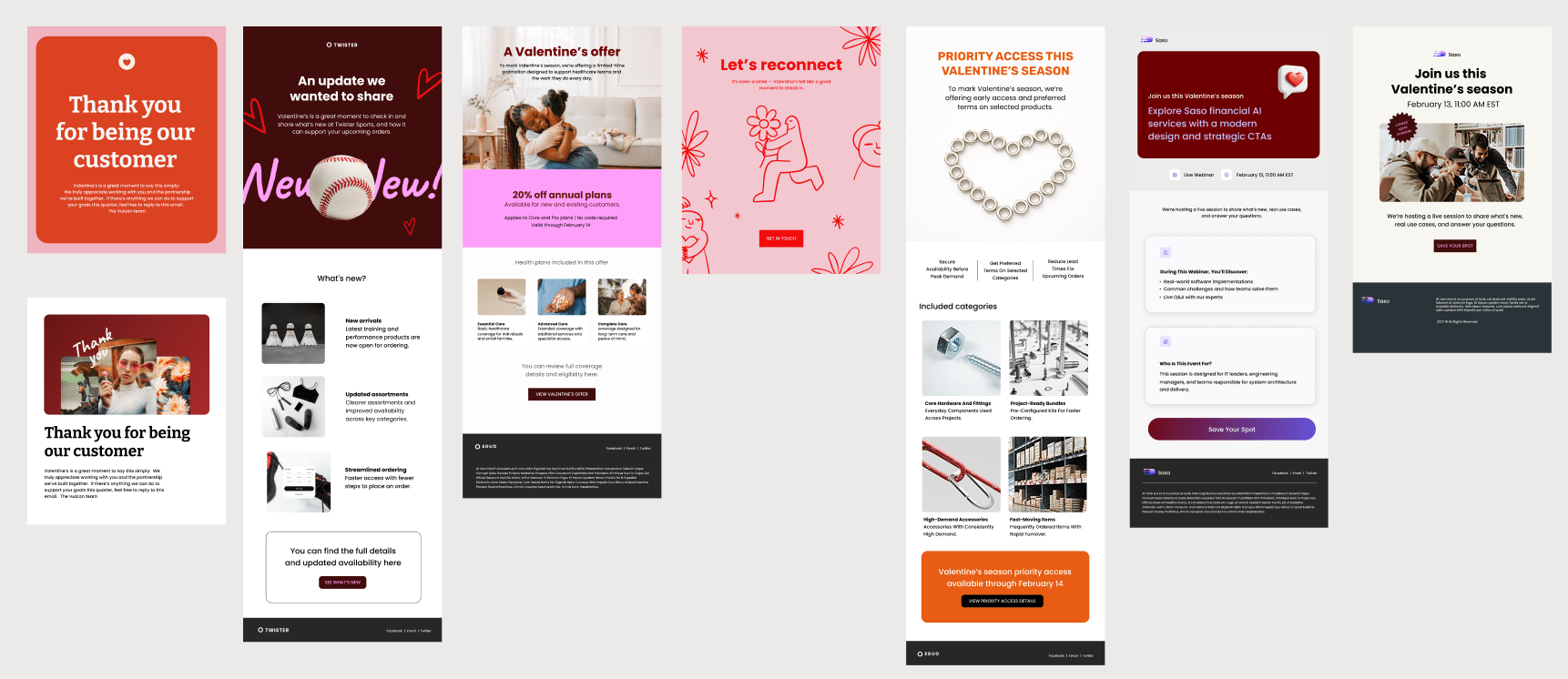
Valentine’s Day email campaigns work for both romantic gifts and self-care messaging. Start your sequence 2 weeks before February 14th to capture early planners while avoiding last-minute shipping anxiety.
Effective Valentine’s campaigns include:
- Segmented messaging: Target by purchase history and demographics. Jewelry brands send “Find the perfect gift for her” to one segment while promoting “Treat yourself this Valentine’s Day” to another.
- Urgency-driven subject lines: “Don’t wait — Valentine’s shipping deadlines inside” creates pressure without feeling pushy.
- Organized gift guides: Structure by price point, relationship stage, or recipient type to simplify decision-making.
- Bestseller highlights: Feature top products prominently with clear delivery guarantees.
- Last-chance reminders: Send a final “Last chance for Valentine’s delivery” email 3–4 days before the holiday to capture procrastinators.
Summer seasonal campaigns
Summer campaigns align with vacation planning, outdoor activities, and seasonal lifestyle changes. Start Memorial Day weekend and maintain momentum through Labor Day.
Build summer engagement with:
- Travel-focused content: Promote destination guides and booking deals for vacation planners.
- Outdoor product highlights: Feature camping gear, beach essentials, and summer sports equipment.
- B2B summer themes: Leverage seasonal messaging like “Automate your workflow before vacation” or “Summer learning: Free webinar series.”
- Key date campaigns: Time promotions around Memorial Day weekend, the Fourth of July, and Labor Day weekend.
- Mini-season approach: Treat each holiday as a distinct opportunity with unique shopping behaviors and promotional expectations.
Back-to-school campaigns
Back-to-school campaigns target parents, students, and teachers from mid-July through early September. Different audiences need different messaging and timing.
Segment your back-to-school campaigns by:
- Parents of younger children: Focus on organization and preparation themes like “Get ready for kindergarten with these essentials.”
- High school and college students: Emphasize independence and style with “Dorm room must-haves under $50.”
- Teachers: Highlight classroom supplies and productivity tools.
- Peak promotional timing: Push main campaigns in late July and early August when most families actively shop.
- Last-chance campaigns: Follow up in late August for forgotten items and last-minute needs.
Black Friday and Cyber Monday campaigns

(Source)
Black Friday and Cyber Monday represent the biggest revenue opportunity of the year for most e-commerce brands. Your email strategy should span the entire week, not just 2 days.
Build an effective BFCM email sequence with:
- Preview emails: Send Monday or Tuesday with “Our Black Friday deals revealed” to build anticipation and let subscribers plan purchases.
- Black Friday launch: Deliver early Friday morning with your strongest offers and clearest CTAs.
- Distinct Cyber Monday messaging: Introduce new deals, extend popular offers that sold out, or create online-exclusive bundles.
- Differentiated subject lines: “Cyber Monday: New deals just added” or “Online-only: Extra 20% off everything” separate Monday from Friday.
- Extended promotions: Consider a “Cyber Week” approach to maximize the revenue window.
Christmas and winter holiday campaigns
Christmas campaigns require the longest runway of any seasonal promotion. Begin holiday messaging in early November with gift guides and early-bird discounts for organized shoppers.
Structure your holiday campaign with:
- Early November focus: Launch gift inspiration content and early-bird discounts for organized shoppers.
- Mid-November promotions: Introduce main holiday sales and special offers.
- Late November urgency: Emphasize shipping deadlines to ensure delivery by Christmas, using language like “Order by X” so shoppers know their timeframe to order.
- Early December last-minute options: Target procrastinators with digital gifts or express shipping.
- Behavioral segmentation: Recommend products based on past purchases — children’s toys for previous toy buyers, home décor for décor shoppers.
- Shipping deadline calendars: Include in every December email to reduce anxiety and support inquiries.
New Year campaigns
New Year campaigns capitalize on resolution energy and fresh-start motivation. Fitness, organization, productivity, and self-improvement products perform exceptionally well in January.
Launch effective New Year campaigns with:
- Early timing advantage: Start your sequence on December 27 while competitors pause holiday promotions.
- Goal-setting focus: Lead with planning and inspiration like “Make 2027 your best year yet.”
- Resolution-aligned products: Connect offerings to common goals — fitness brands send “Your 30-day workout plan starts now” with equipment recommendations.
- Outcome-based messaging: Link products to resolution results rather than just offering discounts.
- Special January pricing: Productivity software might share “Organize your entire life in one platform” with limited-time offers.
Newsletter examples that build long-term engagement
Newsletters deliver consistent value without pushing sales. They keep your brand visible while building trust through helpful content. Think of newsletters as relationship builders. Each issue strengthens the connection between your brand and subscribers.
Educational content newsletters
Educational newsletters teach subscribers something new. They position your brand as an expert while solving reader problems.
Strong educational content includes:
- How-to guides: Step-by-step instructions for common challenges
- Industry insights: Trends and analysis your audience cares about
- Tool recommendations: Resources that make their work easier
- Case studies: Real examples of success using your methods
For example, a marketing agency might share “5 ways to improve your social media engagement” with actionable tips. A financial advisor could explain “Understanding market volatility” in simple terms.
Curated industry updates
Curated newsletters save readers time by filtering important news. You become their trusted source for staying informed.
Effective curation includes:
- Brief summaries: 2–3 sentences explaining why each item matters
- Diverse sources: Mix mainstream and niche publications
- Clear categories: Group similar topics together
- Your perspective: Add commentary that shows your expertise
With monday campaigns, you can track which links get clicked most to shape future curation to match subscriber interests.
Interactive newsletter formats
Interactive elements turn passive readers into active participants. They boost engagement while gathering valuable feedback.
Popular interactive features:
- Polls: “Which topic should we cover next?”
- Quizzes: “Test your industry knowledge”
- Surveys: “Help us serve you better”
- User-generated content: Feature subscriber stories or tips
Remember that not all email clients support advanced interactivity. Always include fallback content for a seamless experience.
Try monday campaignsCart abandonment email examples that recover lost sales

(Source)
Cart abandonment emails remind shoppers about items they left behind. They address common purchase barriers to complete the sale. According to Statista, the top reasons that 40% of shoppers abandoned carts in 2025 included unexpected costs (shipping, taxes, fees), slow delivery times, requirement for account creation, credit card safety concerns, and complicated checkout processes.
Single reminder emails
Single reminder emails work best when sent within 1–3 hours of abandonment. They gently nudge without being pushy.
Key elements include:
- Product images: Show exactly what they left behind.
- Direct checkout link: Offer one click to complete purchase.
- Shipping information: Address cost concerns upfront.
- Customer service: Offer help with questions.
Subject lines like “You left something behind” or “Your cart is waiting” feel helpful rather than salesy.
Multi-touch abandonment series
Multi-touch series spread reminders across several days, and each email takes a different angle to address various concerns.
Here’s a proven 3-email sequence:
- Email 1 (3 hours): Simple reminder with product images
- Email 2 (24 hours): Add customer reviews and benefits
- Email 3 (72 hours): Create urgency or offer incentive
With monday campaigns, you can track which emails drive the most recoveries and adjust timing and messaging based on real performance data.
Incentivized recovery campaigns
Incentives can push hesitant shoppers to complete purchases. Use them strategically to avoid training customers to always wait for discounts.
Common incentives include:
- Percentage discounts: “Complete your order for 10% off”
- Free shipping: “We’ll cover shipping on this order”
- Bonus items: “Free gift with purchase”
- Extended returns: “60-day return window”
Pro tip: Reserve incentives for high-value carts or customers who’ve abandoned multiple times.
Re-engagement campaign examples that win back customers
Re-engagement campaigns target inactive subscribers before removing them from your list. They protect deliverability while giving subscribers a reason to stay. Most brands define inactive as no opens or clicks for 3–6 months, but the exact timeframe depends on your typical sending frequency.
Win-back email sequences
Win-back sequences acknowledge the relationship has cooled and offer reasons to reconnect. They balance persistence with respect for subscriber preferences.
Effective win-back emails use:
- Personal tone: “We miss you” feels more genuine than “You’re inactive”
- Value reminders: Highlight what subscribers miss by not engaging
- Preference options: Let them reduce frequency instead of unsubscribing
- Clear deadline: “We’ll remove you in 30 days unless you confirm”
Space these emails 1–2 weeks apart to avoid overwhelming inactive subscribers.
Preference update campaigns
Preference centers let subscribers control their experience. They reduce unsubscribes by offering alternatives to complete opt-out.
Options to include:
- Email frequency: Daily, weekly, or monthly
- Content types: Promotions, newsletters, or updates only
- Product categories: Which products interest them most
- Pause option: Temporary break without unsubscribing
Using monday campaigns, you can automatically update subscriber preferences across all campaigns, and changes take effect immediately without manual updates.
Sunset flow examples
Sunset flows are final attempts before removing inactive subscribers. They protect sender reputation by maintaining a clean list.
The final email should:
- State intentions clearly: “This is our last email unless you want to stay”
- Make staying easy: One-click reconfirmation
- Respect their choice: Thank them if they leave
- Leave the door open: “You can always resubscribe”
Clean lists improve deliverability for engaged subscribers. It’s better to have 1,000 engaged subscribers than 10,000 who never open your emails.
AI-powered email examples for personalization at scale

AI transforms email marketing by personalizing every message automatically. It analyzes data to predict what each subscriber wants to see. Recent implementations show that AI-driven email sequences led to a 210% improvement in targeting at-risk customers and an 800% increase in customer satisfaction.
Traditional email personalization uses basic fields like name and location. AI goes deeper by understanding behavior patterns and preferences.
Dynamic content personalization
Dynamic content changes based on subscriber data. Different people see different products, offers, or messages in the same email.
AI-powered personalization includes:
- Product recommendations: Based on browsing and purchase history
- Location-based offers: Local events or weather-specific products
- Behavioral triggers: Content based on recent website actions
- Predictive interests: What they’re likely to want next
For example, a clothing retailer shows winter coats to cold-climate subscribers while displaying swimwear to those in warm areas.
Predictive send-time optimization
Send-time optimization uses AI to determine when each subscriber typically opens emails. It sends to each person at their optimal time rather than batch sending.
Benefits include:
- Higher open rates: Emails arrive when subscribers check inbox.
- Increased engagement: Fresh emails get more attention.
- Reduced competition: Avoid crowded morning send times.
- Global optimization: Automatically adjust for time zones.
AI learns from each subscriber’s behavior over time, as open patterns on weekdays might differ from weekends.
AI-generated subject line examples
AI generates and tests subject lines to find what resonates with your audience. It learns from past performance to improve future campaigns.
AI excels at creating:
- Personalized variations: Different subject lines for different segments
- Emotional triggers: Language that drives curiosity or urgency
- Length optimization: Shorter for mobile, longer for desktop
- A/B test variations: Multiple options to test simultaneously
With software like monday campaigns, AI suggests subject lines based on your campaign goals and learns your brand voice to maintain consistency while optimizing performance.
Try monday campaignsLifecycle email marketing campaign examples
Lifecycle campaigns deliver different messages based on where customers are in their journey. They guide people from awareness through purchase to loyalty. Each stage requires different content and calls-to-action. What works for new leads fails for loyal customers.
Lead nurturing sequences
Lead nurturing educates prospects who aren’t ready to buy. It builds trust through valuable content rather than sales pitches.
Effective nurturing includes:
- Educational content: Solve problems they’re facing.
- Social proof: Show how others succeeded.
- Gradual progression: Move from awareness to consideration.
- Clear next steps: Guide them toward conversion.
Space emails 3–5 days apart to maintain presence without overwhelming.
Post-purchase follow-up series
Post-purchase emails turn buyers into repeat customers. They ensure satisfaction while encouraging future purchases.
Essential post-purchase emails:
- Order confirmation: Immediate reassurance with details
- Shipping updates: Tracking information and delivery estimates
- Product education: Tips for getting maximum value
- Review requests: Gather feedback and testimonials
- Cross-sell suggestions: Complementary products they might need
These emails reduce buyer’s remorse and support inquiries while building loyalty.
Customer retention campaigns
Retention campaigns keep existing customers engaged and purchasing. They cost less than acquiring new customers while generating more revenue.
Retention strategies include:
- VIP programs: Exclusive benefits for best customers
- Anniversary emails: Celebrate their first purchase date
- Reorder reminders: For consumable products
- Loyalty rewards: Points or discounts for continued purchases
Connect to your CRM with monday campaigns to track customer value and trigger appropriate retention campaigns. High-value customers might receive different offers than occasional buyers.
Email design examples and subject lines that boost opens

Email design affects whether messages get read and acted upon. Mobile-first design is essential since most emails open on phones.
Good design guides readers through your message to the call-to-action, while a strategic layout enhances engagement and boosts conversions.
High-converting subject line formulas
Subject lines determine whether emails get opened or deleted. The best formulas create curiosity while setting clear expectations.
Proven formulas include:
- Questions: “Ready to save 30% on your order?”
- Urgency: “Last chance: Sale ends tonight”
- Personalization: “John, your exclusive offer inside”
- Benefits: “Cut your workload in half with these tips”
- Curiosity: “The mistake most marketers make”
Test different formulas to find what resonates with your audience. The most effective formulas are tailored to your specific audience, as e-commerce and B2B subscribers respond differently.
Mobile-first email designs
Mobile-first design ensures emails look great on small screens. This means single columns, large text, and touch-friendly buttons.
Essential mobile design elements:
- Single column layout: No side-by-side content
- 16px minimum font: Easy reading without zooming
- 44px button height: Comfortable finger tapping
- Compressed images: Fast loading on cellular networks
monday campaigns’ email editor previews designs across devices. You see exactly how emails appear before sending.
Interactive email elements
Interactive elements increase engagement by encouraging clicks within the email. They work best for surveys, product browsing, and content discovery.
Popular interactive features:
- Image carousels: Swipe through multiple products
- Accordion menus: Expand sections for more detail
- Hover effects: Reveal information on desktop
- Embedded video: Play without leaving email
Always include fallback versions for email clients that don’t support interactivity. A static image works when dynamic content fails.
How to measure email marketing success
Measuring performance reveals what works and what needs improvement. Focus on metrics that connect to business goals rather than vanity numbers.
Different campaigns require different success metrics. Welcome emails might prioritize engagement while promotional emails focus on revenue.
Key performance metrics to monitor

Track these core email marketing metrics for every campaign:
| Metric | What it measures |
|---|---|
| Open rate | Percentage of recipients who opened your email |
| Click rate | Percentage who clicked any link |
| Conversion rate | Percentage who completed the desired action |
| Unsubscribe rate | Percentage who opted out |
| Revenue per email | Total revenue divided by emails sent |
Compare metrics to your baseline rather than industry averages, because your audience is unique.
Revenue attribution methods
Attribution connects email campaigns to actual sales. It proves ROI and guides future investment.
Common attribution models:
- First-touch: Credits the first email in customer journey
- Last-touch: Credits the final email before purchase
- Multi-touch: Distributes credit across all touchpoints
- Time-decay: Gives more credit to recent interactions
With monday campaigns, you can track attribution automatically through the CRM integration to see which campaigns drive the most valuable customers.
A/B testing strategies
A/B testing compares 2 versions to determine which one is more effective. Test one element at a time for clear results.
Here are some elements to test:
- Subject lines: Different formulas or lengths
- Send times: Morning versus afternoon
- Content length: Short versus detailed
- CTA placement: Top versus bottom
- Personalization: Generic versus customized
Run tests for at least one week with sufficient volume for statistical significance.
Launch successful email campaigns fast with monday campaigns
With monday campaigns, you get AI automation with CRM integration to streamline email marketing so you can create, send, and optimize campaigns from one platform. The platform helps you act on customer moments — not just send scheduled emails. Whether it’s Valentine’s Day, a re-engagement opportunity, or a simple thank-you, teams can turn timely moments into relevant campaigns without switching tools or workflows.
Here’s how you can launch campaigns in minutes instead of hours:
AI-powered campaign creation

AI handles time-consuming tasks so you focus on strategy. In monday campaigns, AI can generate copy, suggests segments, and optimizes timing automatically.
- Subject line generation: Get multiple options based on campaign goals.
- Content suggestions: Generate on-brand copy that resonates.
- Segment recommendations: Find the right audience fast.
- Send time optimization: Deliver emails when subscribers engage most.
The AI learns from every campaign to improve future suggestions. Your results continuously improve over time without extra effort.
CRM integration for smarter targeting
Native CRM integration means your email and sales data work together. You see the complete customer journey from first email to closed deal. Because campaigns are launched directly from the CRM, teams don’t need to export lists, sync tools, or lose context — customer data, segmentation, and sending all live in one place.
Benefits of integration:
- Behavioral triggers: Send based on CRM activities.
- Lead scoring: Prioritize hot prospects automatically.
- Sales alignment: Share campaign results with sales team.
- Revenue tracking: Connect emails to actual sales.
This connection unifies marketing and sales data, giving everyone a shared view of the customer. Everyone works from the same unified customer view.
Templates that convert
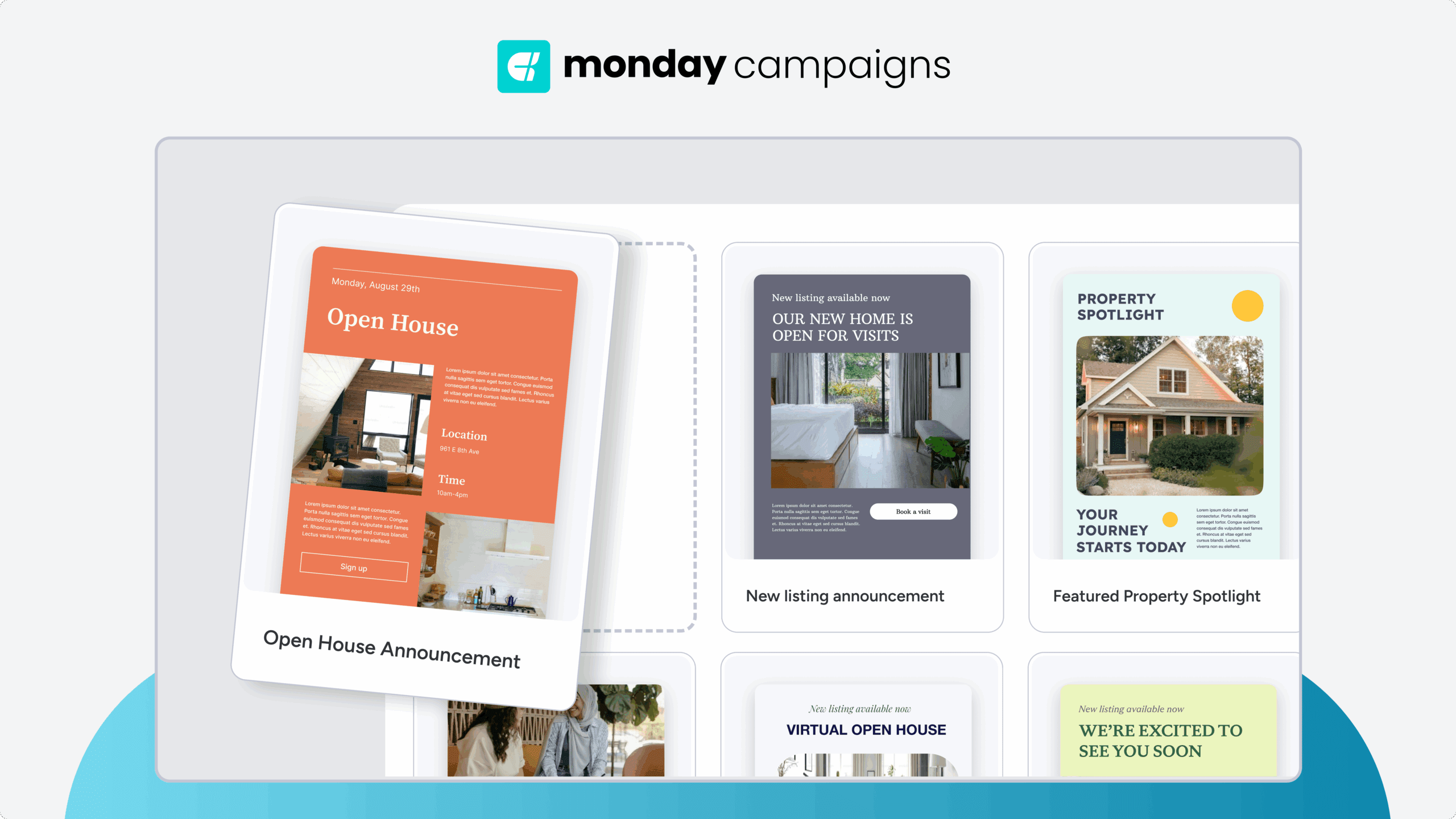
Pre-built templates in monday campaigns remove both design friction and decision fatigue — giving teams confidence to launch customer-facing campaigns quickly, even for seasonal or one-off moments.
Here are just some of the email templates available:
- Welcome series: Multi-step onboarding flows
- Promotional campaigns: Sales and product launches
- Newsletters: Educational and curated content
- Re-engagement: Win-back and preference updates
Each template includes placeholder content and suggested timing. Customize them in minutes or use as-is for quick launches.

"With monday campaigns, we can launch professional emails in minutes and instantly see who engaged. Our sales team follows up directly with those showing interest - making outreach faster and more effective."
Michael Fitzpatrick | National Workplace Training ManagerTurn great email examples into revenue results
Email marketing success isn’t about sending more messages — it’s about sending the right messages at the right time. Each example email campaign in this article provides a framework you can adapt to your business, whether you’re recovering abandoned carts, re-engaging inactive subscribers, or building long-term loyalty through newsletters.
With monday campaigns, it’s easier than ever to put these strategies into action. The platform combines AI-powered automation with native CRM integration, so you can create, launch, and optimize campaigns in minutes instead of hours. Focus on strategy and content while the platform handles technical complexity, send-time optimization, and performance tracking.
Try monday campaignsFAQs
How often should I send marketing emails to my subscribers?
The ideal email frequency depends on your content quality and audience expectations. Most brands succeed with weekly newsletters and 2–3 promotional emails per month. Test different frequencies and monitor unsubscribe rates to find your sweet spot.
What is the best time to send email marketing campaigns?
The best send time varies by audience, but Tuesday through Thursday between 10 AM and 2 PM typically performs well. Use send time optimization to automatically deliver emails when each subscriber is most likely to engage based on their past behavior.
How do I prevent my marketing emails from going to spam folders?
Prevent spam filtering by maintaining a clean list, using authentication protocols like SPF and DKIM, and avoiding spam trigger words. Encourage subscribers to add your email address to their contacts and consistently send from the same domain.
What email marketing metrics should I track for campaign success?
Track open rate, click rate, conversion rate, unsubscribe rate, and revenue per email to measure campaign success. Focus on metrics that align with your specific campaign goals rather than tracking everything available.
How do I effectively segment my email list for targeted campaigns?
Segment your list based on demographics, purchase history, engagement level, and stated preferences. Start with basic segments like new versus existing customers, then refine based on behavior patterns and campaign performance.
What makes a welcome email series effective for new subscribers?
An effective welcome series delivers immediate value, sets clear expectations, and guides subscribers toward their first meaningful action. Send the first email within minutes of signup and space subsequent emails over 1–2 weeks to maintain engagement without overwhelming.

 Get started