


For startups, every marketing dollar has to count — and email is one of the few channels where you can build a direct line to your audience without paying for each touch. The problem is that most early-stage teams are flying blind. Email marketing is often run by a founder or a one-person team, and it’s hard to tell which campaigns are driving pipeline and which are just generating opens.
This guide shows you how to build revenue-focused email marketing campaigns from day one: how to grow your list from scratch, which campaign types move subscribers toward purchase, and how AI can personalize at scale while connecting every send to real outcomes.
Try monday campaignsKey takeaways
- Email marketing delivers the highest ROI for startups because you own your list and don’t pay for each interaction — start with just 100-200 engaged subscribers to see real results.
- Focus on just 6 essential campaign types — not dozens — so small startup teams can prioritize what actually moves revenue instead of spreading effort too thin.
- Build your email list from zero by creating valuable lead magnets like templates, guides, and free trials that solve real problems and demonstrate immediate value.
- Track revenue-focused metrics early, even before you have “perfect” data — startups that wait too long to connect email to revenue end up guessing instead of learning.
- AI-powered personalization creates targeted campaigns in minutes while platforms like monday campaigns connect directly to your CRM for complete sales visibility, eliminating the usual disconnect between marketing efforts and actual revenue.
How email marketing drives sustainable revenue for startups
Email marketing is the practice of sending targeted messages to subscribers who’ve opted into your list. For startups, this means building direct relationships with potential customers without paying for each interaction.
With an email list, you own a direct line to your audience. This gives you full control over your reach and ensures you always have access to your customers, independent of algorithm changes or platform policies. This ownership creates a compounding asset that grows more valuable over time.
The economics make email particularly attractive for cash-strapped startups. You need minimal upfront investment — just an email platform and time to create content. Yet email consistently delivers higher conversion rates than other digital channels.
Unlike mature companies, startups don’t have historical benchmarks or large datasets. That’s why early email marketing success comes from tight feedback loops — sending smaller campaigns, learning fast, and improving weekly instead of quarterly.

If you’re pre-product-market fit, your goal is learning: which messages, offers, and audiences convert. Post-PMF, your goal shifts to scaling: segmentation, automation, and repeatable revenue.
6 essential email campaign types that convert subscribers into customers
Different email types serve specific purposes in moving subscribers from awareness to purchase. Understanding when to use each type helps you maximize impact without overwhelming your audience.
1. Welcome email sequences
Welcome sequences are automated emails sent to new subscribers immediately after they join your list. These messages set expectations and build trust when engagement is highest.
Your welcome sequence needs to deliver value fast. Here’s how:
- Send the first email instantly to confirm their subscription and provide any promised content.
- Follow up within 24-48 hours with your brand story and what makes you different.
- Include social proof like customer testimonials or case studies in the third email.
Most effective welcome sequences contain 3-5 emails sent over 7-10 days. Space them out to maintain momentum without overwhelming new subscribers.
Startup tip: If you’re pre-product-market fit, keep your welcome sequence short (2–3 emails). Over-educating too early can distract from learning why people signed up in the first place.
2. Educational content series
Educational emails teach subscribers something valuable related to your product or industry. These build trust by helping before selling.
Match your educational content to your audience’s biggest challenges. SaaS companies might share productivity tips or workflow templates. e-commerce brands could offer style guides or product care instructions. The key is providing actionable advice subscribers can use immediately.
Structure your series around a defined learning path. Start with foundational concepts, then build to more advanced topics. Each email should stand alone while contributing to the broader educational journey.
3. Product launch announcements
Launch email campaigns generate excitement for new offerings through strategic sequencing. Start with a teaser that hints at what’s coming without revealing everything. Send your main announcement on launch day with clear benefits and compelling visuals. Follow up with social proof from early customers or beta testers.
Time your sequence carefully to build anticipation without losing momentum. A typical launch might include:
- Teaser email: 3 days before launch
- Main announcement: Launch day
- Social proof: 2 days after launch
- Last chance: 5-7 days after launch
Startup tip: Early launches don’t need polished announcements. Focus on clarity and feedback, not perfection — especially for beta features or MVP updates.
4. Abandoned cart recovery
Cart abandonment emails target shoppers who added items but didn’t complete their purchase. These automated messages recover revenue that would otherwise be lost.
- Send your first reminder within an hour while purchase intent remains strong. Show the abandoned items with a direct link back to checkout.
- Your second email (24 hours later) can address common objections like shipping costs or return policies.
- The final reminder (72 hours later) might include a small discount or highlight limited stock.
Personalization dramatically improves recovery rates. Reference specific products, suggest complementary items, and adjust messaging based on cart value. The CRM integration in monday campaigns enables this personalization by connecting purchase history with email engagement.
5. Customer success stories
Success stories demonstrate real results from actual customers. These emails work especially well for startups without widespread brand recognition.
- Structure each story to resonate with prospects facing similar challenges.
- Describe the customer’s initial problem in terms your audience recognizes.
- Detail how they used your product to solve it.
- Quantify the results with specific metrics like time saved or revenue increased.
Collect stories systematically by reaching out after key milestones. Use surveys for initial feedback, then follow up with detailed interviews for the most compelling cases.
6. Win-back campaigns
Win-back emails target subscribers who’ve stopped engaging with your emails. These campaigns attempt to re-engage inactive contacts before they’re completely lost.
Identify inactive subscribers based on engagement over 30, 60, or 90 days. Send a targeted sequence acknowledging their absence and offering reasons to return. This might include exclusive offers, product updates, or simply asking for feedback about why they disengaged.
Give subscribers clear options to update preferences or reduce email frequency. This respects their choice while potentially salvaging the relationship.
Startup tip: Don’t over-invest in win-back campaigns until you have consistent engagement benchmarks. Early churn is often a signal to fix onboarding, not reactivation.
Build your email list from zero using proven startup strategies
For many startups, list growth starts with founder-led marketing — personal outreach, early users, and community engagement — before paid acquisition ever makes sense. Growing an email list from nothing requires offering value before asking for contact information. Focus on what your target audience needs most, then create resources that address those needs.
Create high-value lead magnets
Lead magnets are free resources offered in exchange for email addresses. They work because they demonstrate immediate value before asking for a purchase.
Choose lead magnets based on your audience’s most pressing problems and your unique expertise:
- Templates and checklists: Low effort to create, high perceived value
- Free trials: Perfect for SaaS companies to demonstrate product value
- Guides and ebooks: Ideal for complex topics requiring detailed explanation
- Webinars: Great for showcasing expertise in real-time
Your lead magnet should naturally lead to your paid offering. An email marketing template might lead to your full campaign management service. A productivity guide could showcase problems your software solves.
Optimize sign-up forms for conversion
Sign-up forms need to minimize friction while maximizing perceived value. Every extra field or unclear benefit reduces conversion rates.
Place forms where engaged visitors are most likely to see them. Include forms above the fold on high-traffic pages, in blog post content where interest peaks, and as exit-intent popups to capture leaving visitors.
Write benefit-focused copy that explains exactly what subscribers receive. Replace generic phrases like “Join our newsletter” with specific value propositions like “Get weekly startup growth tactics that actually work.”
Leverage existing channels
Your current touchpoints offer warm audiences already familiar with your brand. These people are more likely to subscribe than cold traffic.
Convert social media followers by promoting lead magnets in posts and stories. Include sign-up links in your bio and run targeted ads to followers highlighting subscriber-only benefits. Your website visitors can be captured through strategic form placement and compelling offers.
Don’t overlook in-person opportunities. Collect emails at networking events, conferences, and webinars. Partner with complementary businesses to co-host events or share audiences. Even customer support interactions can include invitations to join your list for ongoing value.
Choose the right email marketing software
The right email platform prevents costly migrations later while providing room to grow. Focus on capabilities that automate work and provide insights rather than just basic sending features.
Common startup mistake: Choosing the cheapest tool with the fewest features — then migrating 6 months later. Early-stage startups need tools that can grow with them, even if they don’t use every feature on day one.
Must-have features for rapid growth

Essential features enable sophisticated campaigns without requiring technical expertise or large teams:
- Automation: Streamlines repetitive workflows like welcome sequences
- Segmentation: Enables targeted messaging based on behavior and attributes
- Analytics: Provides visibility into what’s working and what isn’t
- Mobile optimization: Ensures emails display properly on all devices
- Integration capabilities: Connects with your other essential platforms
- Deliverability features: Helps emails reach inboxes instead of spam folders
- Scalable pricing: Grows with your business without breaking budgets
Automation that scales with you
Marketing automation multiplies your impact by handling repetitive processes in the background. Essential workflows include welcome series for new subscribers, abandoned cart recovery for e-commerce, re-engagement campaigns for inactive contacts, and post-purchase follow-ups for customer retention.
Set these up once, then let them run continuously. A well-designed automation might convert at a consistent rate for months without additional work. Multiply this across multiple workflows and the time savings become substantial.
CRM integration capabilities
Email marketing becomes exponentially more powerful when connected to your CRM. This integration enables real-time data flow between marketing and sales efforts.
Benefits of CRM integration include:
- Dynamic lead scoring: Email engagement automatically updates contact scores
- Behavioral tracking: Sales sees which content prospects engaged with
- Revenue attribution: Connect email campaigns directly to closed deals
- Unified customer view: See the complete journey from subscriber to customer
Software like monday campaigns offers native CRM integration, eliminating the need for complex third-party connectors. Data flows seamlessly between your campaigns and sales pipeline.
7 email marketing best practices for maximum ROI
Following proven practices separates high-performing campaigns from those that underdeliver. These fundamentals apply across all industries and business models.
1. Set revenue-focused campaign goals
Connect every campaign to business outcomes rather than vanity metrics through a comprehensive email marketing strategy. Track metrics that directly impact your bottom line like cost per acquisition through email, conversion rate from subscriber to customer, revenue per email sent, and customer lifetime value from email-acquired customers.
Calculate these metrics regularly to understand which campaigns drive real value. Use the insights to double down on what works and eliminate what doesn’t.
2. Segment audiences with dynamic data
Sending identical messages to your entire list ignores the reality that different subscribers have different needs. Effective segmentation creates targeted groups based on:
- Behavior: Past purchases, email engagement, website activity
- Demographics: Location, company size, job role
- Lifecycle stage: New subscriber, active customer, at-risk account
- Interests: Content downloads, webinar attendance, product views
Define your criteria once and let the platform maintain accurate segments in real-time.
3. Write subject lines that drive opens
Your subject line determines whether subscribers open or ignore your email. Test different approaches to find what resonates with your audience.
Proven email subject line formulas focus on:
- Benefits: “Cut customer acquisition costs by 50%”
- Curiosity: “The surprising reason customers aren’t buying”
- Personalization: “[Name], your custom growth plan is ready”
- Urgency: “24 hours left to claim your spot”
- Questions: “Ready to scale your startup?”
Avoid all caps, excessive punctuation, false promises, and generic phrases that give no reason to open.
4. Design mobile-first email templates
More than half of emails open on mobile devices, particularly important given that U.S. retail e-commerce sales reached $310.3 billion in Q3 2025, representing roughly 16.4% of total retail sales. Design for small screens first, then adapt for desktop.
Mobile optimization requires responsive design that adjusts automatically, single-column layouts for easy scrolling, large tap-friendly buttons, short scannable paragraphs, and compressed images that load quickly. Test every email on multiple devices before sending.
5. Automate your highest-impact workflows
Identify workflows that provide consistent value when automated. Priority automations include welcome series, abandoned cart recovery, win-back campaigns, and post-purchase follow-ups.
Each automated workflow compounds value over time. A welcome series might convert new subscribers at a steady rate for months without manual intervention.
6. Test everything with AI insights
For startups, testing isn’t about statistical perfection — it’s about fast learning. Use A/B testing to validate one change at a time, and let AI surface patterns in subject lines, timing, and segments so you can improve with limited data.
7. Track metrics that matter to revenue
Focus on metrics that connect to business growth:
| Metric | What it measures | Why it matters for startups |
|---|---|---|
| Click-through rate (CTR) | How many subscribers clicked a link | Indicates whether your messaging motivates action beyond opens |
| Click-to-open rate (CTOR) | Engagement among people who opened | Shows how compelling your content is once the email is opened |
| Conversion rate | Percentage of subscribers who completed a goal (signup, purchase, demo) | Directly ties email performance to revenue or pipeline |
| Revenue per email | Total revenue divided by emails sent | Helps startups understand true financial impact, not vanity engagement |
| Customer lifetime value (CLV) | Total revenue generated per customer over time | Shows whether email-acquired customers are worth scaling |
| List growth rate | Speed at which your email list is growing | Signals whether you’re building a sustainable owned channel |
| Unsubscribe rate | How many subscribers opt out | Early warning sign that messaging or frequency needs adjustment |
Monitor these consistently to spot trends and optimize accordingly.
Try monday campaignsMaster email deliverability from day one
Deliverability determines whether your emails reach inboxes or disappear into spam folders. Poor deliverability wastes every other optimization effort. Startups launching from brand-new domains are especially vulnerable to deliverability issues — which makes early setup and warming non-negotiable.
Set up SPF, DKIM, and DMARC authentication
Email authentication proves your legitimacy to receiving servers. These technical protocols work together to verify your identity and protect against spoofing, which is increasingly critical as phishing remains the top method scammers use, making authenticated email essential for protecting your startup’s reputation and subscriber trust, making authenticated email essential for protecting your startup’s reputation and subscriber trust.
- SPF (Sender Policy Framework) lists which servers can send email from your domain.
- DKIM (DomainKeys Identified Mail) adds a digital signature proving emails haven’t been altered.
- DMARC (Domain-based Message Authentication, Reporting & Conformance) tells receivers how to handle failed authentication.
Skipping authentication setup risks spam filtering, domain blacklisting, and severely limited reach. Set these up correctly from day one to establish trust.
Warm your domain strategically
New domains lack reputation history with email providers. Build reputation gradually by starting with small volumes to engaged subscribers and increasing slowly over several weeks.
- Week 1: Send 20-30 emails daily to your most engaged contacts.
- Week 2: Increase to 50-100 emails daily.
- Week 3: Expand to 200-300 emails daily.
- Week 4: Scale to 500+ emails daily.
Watch for warning signs like increased bounce rates, dropping open rates, or spam folder placement. These indicate you’re warming too quickly.
Stay out of spam folders
Multiple factors influence inbox placement. Avoid common spam triggers through careful content creation, consistent sending patterns, and list hygiene.
Content best practices include:
- Balanced text-to-image ratios: Never send image-only emails
- Functional links: Test every link before sending
- Clean subject lines: Avoid spam trigger words and excessive punctuation
- Clear unsubscribe options: Make opting out simple and immediate
Maintain consistent sending schedules rather than sporadic blasts. Never purchase lists or add contacts without permission. These practices generate complaints that damage your sender reputation permanently. Once your foundation is solid — list quality, segmentation, and deliverability — AI helps you scale personalization without scaling headcount.

AI enables startups to deliver sophisticated personalization without large teams. What once required extensive manual effort now happens automatically at scale.
Generate on-brand content instantly
AI content generation creates compelling copy in seconds while maintaining brand consistency. Applications include subject line variations, body copy for different segments, product recommendations based on behavior, dynamic offers based on inventory or seasonality, and call-to-action optimization.
Smart CRM software like monday campaigns uses AI to learn your brand voice and generates content that feels authentic, not robotic. This accelerates campaign creation without sacrificing quality.
Create dynamic segments automatically
Static segments require constant manual updates. Dynamic segmentation adjusts automatically based on changing subscriber behavior. AI-powered segments might include:
- Recent purchasers (last 30 days)
- Engaged subscribers (high open/click rates)
- At-risk customers (declining engagement)
- Frequent browsers (high site activity without purchase)
These segments update in real-time as subscriber behavior changes.
Optimize send times with machine learning

Sending when subscribers are most likely to engage dramatically improves results. Machine learning analyzes individual patterns to determine optimal send times for each contact.
The system continuously improves predictions based on actual engagement data. Rather than blasting everyone simultaneously, each subscriber receives emails when they’re most likely to open and act.
How monday campaigns transforms startup email marketing
Startup-specific challenges like limited resources and tight timelines require solutions that work smarter, not harder — which is exactly what monday campaigns delivers through AI-powered efficiency and native integrations. The platform simplifies complex processes while maintaining the sophistication needed for growth.
Plus, monday campaigns is built for startups that need enterprise-grade visibility without enterprise-level complexity or headcount.
Launch campaigns in minutes, not hours
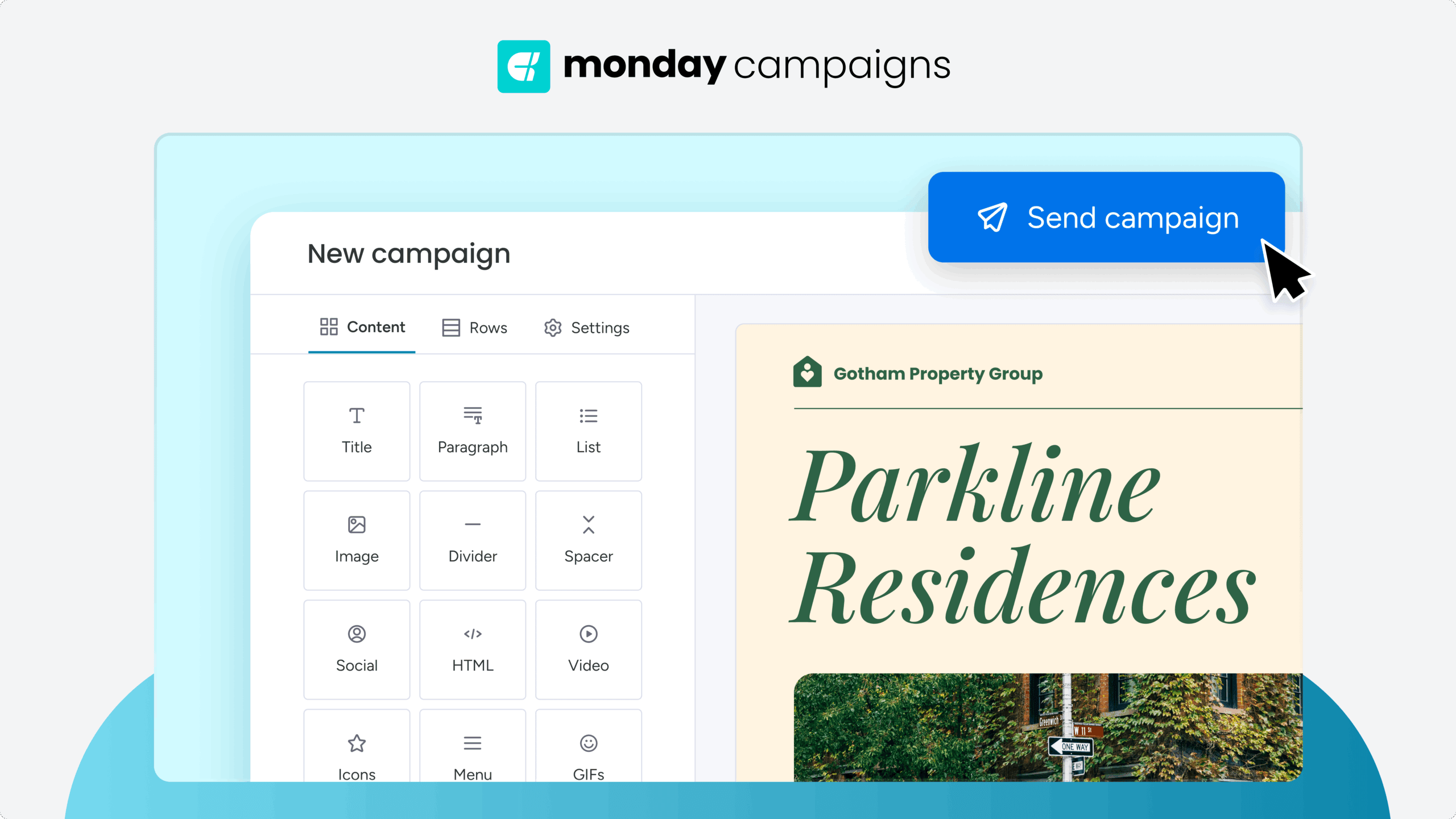
Traditional campaign creation involves multiple time-consuming steps, but monday campaigns accelerates every stage through pre-built templates, AI content generation, and automated audience selection.
What typically takes hours now happens in minutes. This speed enables startups to respond quickly to opportunities and test more ideas with the same resources.
AI that understands your brand voice
Maintaining consistent brand voice challenges resource-limited startups. With monday campaigns, AI learns from your existing content to generate new messages that feel authentic.
Whether creating welcome sequences or promotional campaigns, every email reflects your unique tone and values. This consistency builds trust while saving creative time.
See email impact on your sales pipeline
Disconnected marketing and sales data creates blind spots, but monday campaigns’ native CRM integration provides complete visibility from first email to closed deal.
Track how email engagement influences pipeline progression. See which campaigns generate qualified leads. Understand the full customer journey without switching between platforms. This unified view enables optimization based on actual revenue impact, not just engagement metrics.
Start building email campaigns that actually drive revenue
Email marketing isn’t just another channel for startups — it’s your highest-ROI path to sustainable growth. By focusing on the 6 essential campaign types, building your list strategically, and tracking metrics that connect to actual revenue, you create a compounding asset that grows more valuable over time. The key is starting with engaged subscribers, automating what matters, and using AI to personalize at scale without burning through resources.
With monday campaigns, you can eliminate the usual disconnect between marketing effort and business results. With native CRM integration, AI-powered content generation, and complete pipeline visibility, you’ll launch sophisticated campaigns in minutes while seeing exactly how each email impacts your bottom line. Give it a try today.
Try monday campaignsFAQs
How much should startups budget for email marketing campaigns?
Startups should allocate 10-20% of their total marketing budget to email campaigns. Email typically delivers higher ROI at lower cost than paid advertising or social media marketing, making it ideal for budget-conscious startups.
What email list size do startups need to begin email marketing?
A list of 100-200 engaged subscribers is enough to start email marketing effectively. Quality matters more than quantity — a small list of interested prospects converts more efficiently than a large list of unengaged contacts.
How many emails should startups send per week to subscribers?
Startups should send 1-3 emails per week to maintain engagement without overwhelming subscribers. The exact frequency depends on your content quality and audience preferences, so test different schedules to find your optimal cadence.
Can AI really write effective email content for startups?
AI can generate high-performing email content when properly configured with brand guidelines and audience insights. The most effective approach combines AI-generated drafts with human review to ensure authenticity and strategic alignment.
When will startups see ROI from email marketing efforts?
Most startups see measurable ROI from email marketing within 3-6 months of consistent effort. Results depend on list quality, campaign frequency, and how well you optimize based on performance data.
How do small startups handle GDPR compliance for email marketing?
Small startups handle GDPR compliance by obtaining explicit consent before adding contacts, providing clear unsubscribe options in every email, and storing subscriber data securely. Most email platforms including monday campaigns offer built-in compliance features that simplify these requirements.

 Get started