


Not long ago, campaign strategy relied on last quarter’s data and educated guesses. Today, artificial intelligence delivers real-time customer insights that can reshape a campaign in minutes, not months. The challenge is no longer finding data, but keeping up with the AI breakthroughs that turn that data into revenue. Staying ahead requires a new approach to learning.
This is where AI newsletters come in. They filter the noise and deliver actionable intelligence directly to your inbox. This guide explores the best AI newsletters for 2026, helping you find the right sources to match your role and campaign goals. We’ll walk through how to build a learning strategy that turns insights into action, from quick tests to full-scale campaigns.
Try monday campaignsKey takeaways
- Start with 3–5 AI newsletters that match your role and campaign goals to stay informed without information overload.
- Turn newsletter ideas into results by testing one tactic at a time in real campaigns.
- Match newsletters to your role — email specialists, content leaders, and campaign operators need different AI insights.
- Prioritize business-focused newsletters that translate AI developments into tactics you can use immediately.
Why campaign marketers should read AI newsletters
AI newsletters are curated email updates that deliver the latest artificial intelligence trends, solutions, and strategies directly to your inbox. For campaign marketers, these newsletters translate complex AI developments into practical tactics you can use immediately to improve email performance, audience targeting, and campaign ROI.
The right AI newsletters save you hours of research time while keeping you ahead of competitors. They filter through the noise to deliver actionable insights that directly impact your campaigns.
Stay ahead of campaign innovation
Early access to AI innovations gives you a competitive edge. When you discover new personalization techniques or automation strategies before they become mainstream, you can test and implement them while competitors are still catching up. This advantage is particularly valuable given that 71% of companies now report using generative AI in at least one business function, according to McKinsey, with marketing and sales being the most common application.
AI newsletters spotlight emerging capabilities like predictive audience segmentation and automated A/B testing. This knowledge helps you experiment with approaches that boost engagement and conversion rates before everyone else adopts them.
Bridge the AI implementation gap
Understanding AI concepts is one thing — applying them to your campaigns is another. AI newsletters bridge this gap by breaking down technical concepts into practical steps you can follow. With 94% of organizations not yet having advanced their gen-AI maturity, this practical guidance becomes essential for closing the implementation gap.
For instance, when a newsletter explains how to use AI for email segmentation, it doesn’t just describe the technology. It shows you which platforms to use, how to set them up, and what results to expect.
Make data-driven ROI decisions
Every AI platform promises transformation, but which ones actually deliver value? AI newsletters provide case studies and real-world examples that help you evaluate potential returns before investing time or budget. This evaluation becomes crucial as McKinsey reports that 72% of CMOs plan to increase their marketing budgets relative to sales in 2026, intensifying pressure to demonstrate ROI on AI investments.
By reading about other marketers’ successes and failures, you can make informed decisions about which AI solutions deserve your attention. This knowledge helps you make sound investments and accelerates your path to measurable campaign improvements.
The 12 best AI newslettersfor campaign marketers in 2026
Finding the right AI newsletters means matching your learning style, experience level, and campaign goals with the right content sources. Use this table to narrow your shortlist, then dive into the breakdowns below to see which newsletters are worth your time.
| Newsletter | Key focus | Best for | Frequency |
|---|---|---|---|
| The Rundown AI | AI news translated into practical business and marketing use cases | Campaign marketers who want fast, testable tactics | Daily |
| Marketing AI Institute | Marketing-specific AI strategy, case studies, and expert analysis | Marketers focused on ROI, predictive analytics, and long-term adoption | Weekly |
| There’s An AI For That | Discovery of AI tools mapped to specific marketing problems | Campaign operators evaluating tools and workflows | Varies |
| Superhuman AI | Bite-sized AI updates and platform changes | Busy marketers who need quick awareness without deep dives | Daily |
| The AI Optimist | Strategic AI adoption, leadership, and organizational change | Marketing leaders and team leads driving AI transformation | Weekly |
| Ben’s Bites | Plain-English AI explanations and product updates | Teams new to AI who want clarity without jargon | Daily |
| The Neuron | Balanced technical and practical AI insights, including ethics | Marketers working closely with data or technical teams | Varies |
| TLDR AI | Concise summaries of major AI model and platform updates | Campaign marketers collaborating with engineers or data teams | Daily |
| Not A Bot | Creative uses of generative AI for content and campaigns | Content-forward campaign teams and creative marketers | Weekly |
| Mindstream | AI-driven marketing automation and workflow optimization | Campaign ops and lifecycle marketers | Weekly |
| The Batch | Academic AI research translated into real-world applications | Marketers who want evidence-backed decision-making | Weekly |
| AI Breakfast | Deep dives into major AI topics and frameworks | Marketers who want structured, in-depth learning | Weekly |
1. The Rundown AI
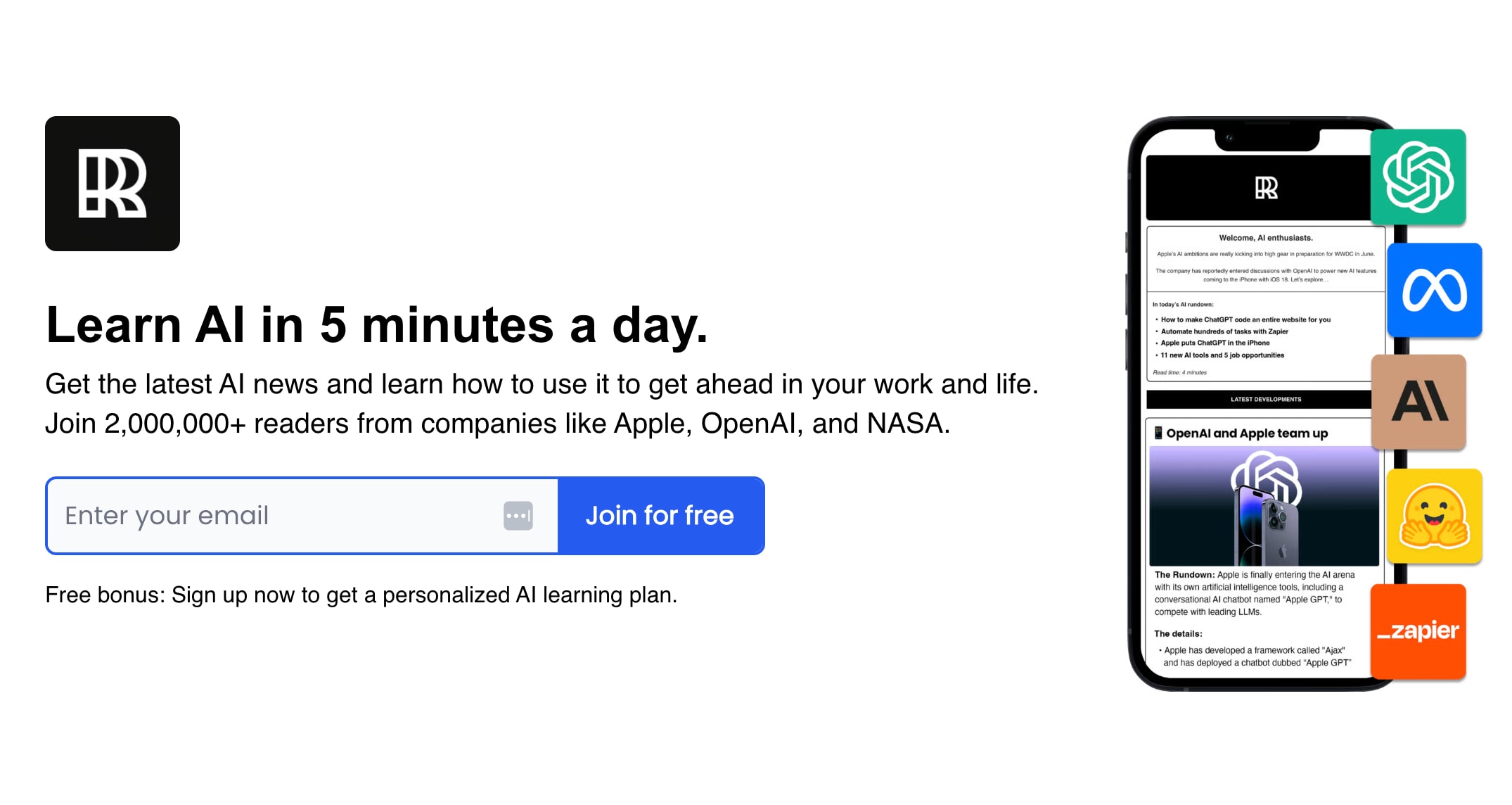
The Rundown AI translates AI news into business applications you can use immediately. Each daily edition covers personalization strategies, campaign automation, and audience segmentation techniques that directly improve campaign performance.
Recent editions have broken down how to use AI-powered predictive send time optimization to increase email open rates by 15-20%. They don’t just explain the concept — they walk you through which platforms support this feature and how to set it up in under 30 minutes.
Why it’s worth reading: The Rundown AI cuts through AI hype to focus on what actually works. If you’re tired of theoretical discussions and want tactics you can test this week, this newsletter delivers exactly that.
2. Marketing AI Institute
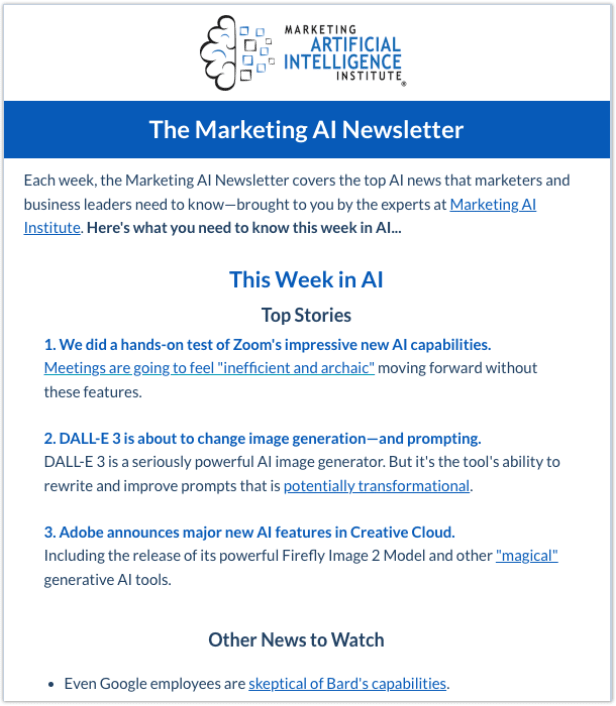
The Marketing AI Institute focuses exclusively on marketing applications of AI in its This Week in AI Newsletter. Weekly issues dive deep into predictive analytics, omnichannel integration, and campaign optimization strategies backed by expert interviews and case studies.
Their case study breakdowns show real companies achieving specific results — like how a B2B software company used AI-powered lead scoring to increase qualified leads by 34% while reducing manual review time by 60%.
Why it’s worth reading: This newsletter bridges the gap between AI possibility and marketing reality. The expert interviews provide insider perspectives you won’t find anywhere else, helping you avoid costly mistakes and accelerate successful implementation.
3. There’s An AI For That

This newsletter curates AI tools that solve specific marketing challenges. Each issue of There’s An AI For That introduces solutions for creative generation, audience targeting, and workflow automation that address common campaign pain points.
They recently featured a comparison of 5 AI tools for generating email subject lines, complete with pricing, integration capabilities, and real performance benchmarks from actual campaigns.
Why it’s worth reading: Instead of spending hours researching tools, you get curated recommendations with honest assessments. This newsletter saves you research time and helps you discover solutions you didn’t know existed.
4. Superhuman AI

Superhuman AI delivers bite-sized updates perfect for busy marketers. In just 3 minutes of reading, you’ll understand the day’s most important AI developments and their implications for campaign strategy.
When major platforms like Google or Meta release new AI advertising features, Superhuman AI explains what changed, why it matters, and which campaign types will benefit most — all in a quick, scannable format.
Why it’s worth reading: You don’t have time to read everything, but you can’t afford to miss important updates. This newsletter respects your schedule while keeping you informed on developments that actually impact your campaigns.
5. The AI Optimist

Marketing leaders turn to The AI Optimist for strategic guidance on AI adoption. Content covers change management, team upskilling, and building AI-powered growth strategies that align with business objectives.
Recent editions have outlined frameworks for calculating AI ROI that go beyond efficiency metrics to measure revenue impact, customer lifetime value improvements, and competitive positioning gains.
Why it’s worth reading: If you’re leading AI adoption for your team or organization, this newsletter provides the strategic perspective you need to build buy-in, allocate resources effectively, and demonstrate measurable business value.
6. Ben’s Bites

Ben’s Bites and Ben’s Bites Pro makes AI accessible through conversational writing and practical examples. The approachable tone helps teams new to AI build confidence before diving into technical resources.
They excel at explaining complex AI concepts through relatable analogies — like comparing different AI models to kitchen appliances, each designed for specific tasks rather than one-size-fits-all solutions.
Why it’s worth reading: If AI terminology intimidates you or your team, Ben’s Bites removes that barrier. The friendly, jargon-free approach builds genuine understanding rather than surface-level familiarity.
7. The Neuron

The Neuron balances technical explanations with practical applications. Regular features include AI model explainers, campaign case studies, and ethical considerations that give marketers comprehensive understanding.
Their “AI Ethics in Marketing” series addresses real dilemmas like balancing personalization with privacy, helping you navigate regulatory requirements while maintaining customer trust.
Why it’s worth reading: This newsletter doesn’t shy away from complexity, but it makes technical concepts accessible. You’ll understand not just what to do, but why it works and what considerations matter for responsible implementation.
8. TLDR AI

TLDR AI provides technical summaries that help marketers collaborate with data science teams. Coverage includes algorithm updates and platform changes linked to marketing applications.
When OpenAI or other major providers release model updates, TLDR AI explains the technical improvements and translates them into specific marketing use cases — like how GPT-4’s enhanced reasoning improves dynamic email content generation.
Why it’s worth reading: If you work with technical teams or want to speak their language, this newsletter gives you the vocabulary and understanding to have productive conversations about AI implementation and capabilities.
9. Not A Bot
Not A Bot showcases creative AI applications for content generation and campaign optimization. Subscribers discover new ways to use generative AI for email copy and dynamic visual assets.
They regularly feature before-and-after examples showing how marketers used AI to transform generic campaign copy into personalized, high-converting messages — complete with the prompts and processes used.
Why it’s worth reading: Creativity meets practicality here. You’ll see innovative applications that spark ideas while getting the tactical details needed to replicate success in your own campaigns.
10. Mindstream

Mindstream specializes in AI-driven marketing automation. Each issue provides actionable tips for workflow optimization, lead nurturing, and campaign orchestration you can implement immediately.
Recent editions have detailed step-by-step automation workflows, like setting up AI-powered lead nurturing sequences that adapt messaging based on engagement patterns and behavioral signals.
Why it’s worth reading: If you’re building or optimizing marketing automation, Mindstream provides blueprints you can follow. The tactical focus means you spend less time figuring out implementation and more time seeing results.
11. The Batch
The Batch translates academic AI research into practical marketing tactics. Summaries of recent studies come with commentary on applying findings to campaign design and measurement.
They’ve covered research on how AI-generated personalization affects customer perception, providing evidence-based guidance on when to disclose AI usage and how to maintain authenticity in automated communications.
Why it’s worth reading: Research-backed insights help you make smarter decisions. Instead of following trends blindly, you’ll understand the science behind what works and apply proven principles to your campaigns.
12. AI Breakfast

AI Breakfast offers weekly deep dives into major AI topics. Each edition examines themes like personalization frameworks or automation best practices with actionable takeaways for marketers.
Their comprehensive guides on topics like “Building an AI-Powered Content Calendar” provide end-to-end frameworks covering strategy, tool selection, implementation steps, and measurement approaches.
Why it’s worth reading: When you need to go deep on a specific topic, AI Breakfast delivers thorough analysis without overwhelming detail. The weekly format gives you time to digest and apply insights before the next edition arrives.
Choose AI newsletters that match your marketing role
Your job responsibilities determine which AI insights will drive the most immediate value. Matching newsletters to your role ensures you focus learning time on applicable content.
Email marketing specialists
Email specialists need practical guidance on using AI to improve deliverability, personalization, and engagement metrics. The right newsletters provide specific tactics for optimizing email campaigns:
- The Rundown AI: Daily personalization and automation updates
- Mindstream: Email deliverability and segmentation automation tips
- Marketing AI Institute: Predictive send times and content optimization strategies
- Not A Bot: Creative approaches using generative AI
Content marketing leaders
Content leaders require insights on AI-powered creation, optimization, and distribution. The right newsletters help you balance creative inspiration with practical implementation guidance for your entire content engine. These newsletters balance creative inspiration with implementation guidance:
- Not A Bot: AI applications for content generation and copywriting
- Ben’s Bites: Approachable coverage of content ideation tools
- The Neuron: Technical insights for optimizing content workflows
- The Batch: Research-backed content planning strategies
Campaign operations managers
Operations managers focus on workflow optimization and AI integration. These resources provide guidance on streamlining processes:
- Mindstream: Workflow automation and campaign orchestration
- There’s An AI For That: Tools for process improvement
- TLDR AI: Technical integration guidance
- The Neuron: Operational AI adoption coverage
Marketing directors and VPs
Leadership requires strategic insights for AI investment and team development. These newsletters provide big-picture analysis:
- The AI Optimist: AI’s role in marketing transformation
- Marketing AI Institute: High-level strategy and ROI analysis
- AI Breakfast: Comprehensive weekly strategic analysis
- The Batch: Research-backed investment guidance
How to choose the right mix of AI newsletters
How many newsletters should you actually subscribe to? The answer depends on your available time, learning goals, and current AI knowledge level.
Evaluate your AI knowledge level
Start by honestly assessing where you stand with AI understanding. This self-evaluation helps you choose newsletters that match your learning curve without overwhelming or boring you.
Consider these questions to guide your selection:
- Foundation: Do you need AI basics explained or are you ready for advanced applications?
- Focus: Are you seeking inspiration, tactical guides, or strategic frameworks?
- Collaboration: How often do you work with technical teams on AI projects?
- Scope: Do you want specialized knowledge or broad AI marketing coverage?
Align newsletters with campaign goals
Different campaign objectives require different AI insights. Match your newsletter choices to current priorities for faster application of what you learn.
Campaign goal alignment examples:
- Lead generation: The Rundown AI and There’s An AI For That for targeting tactics
- Customer retention: Marketing AI Institute and Mindstream for personalization workflows
- Brand awareness: Not A Bot and Ben’s Bites for creative AI applications
Balance inspiration with implementation
The most effective learning combines visionary content with practical guidance. Too much theory leaves you inspired but stuck. Too many tactics create information overload without strategic context.
From AI newsletter insight to live campaign
Reading AI newsletters only creates value when insights make it out of your inbox and into real campaigns. The highest-performing campaign marketers don’t treat newsletters as passive education — they use them as a steady source of testable ideas.
The shift is simple: Stop reading for awareness and start reading for application.
When an AI newsletter surfaces a new tactic — like predictive send times, dynamic segmentation, or AI-assisted subject line testing — the goal isn’t to bookmark it for later. The goal is to translate that idea into a concrete campaign experiment while the insight is still fresh.
A practical workflow looks like this:
- Identify one specific tactic or idea from a newsletter.
- Tie it to a real campaign objective (engagement, conversions, retention).
- Launch a small test rather than a full rollout.
- Measure results, then scale what works.
This approach turns AI newsletters into a continuous learning engine — not just something you skim and forget. Instead of chasing trends, you build momentum by consistently testing, learning, and improving campaign performance.
Turn AI learning into measurable results with monday campaigns
Once you have a campaign idea inspired by an AI newsletter, execution speed becomes the bottleneck. This is where monday campaigns fits naturally into the loop.
Because monday campaigns uses AI and is built directly on CRM data, you can move from insight to execution without switching tools, exporting lists, or rebuilding workflows. A personalization or segmentation idea you read about in the morning can become a live test campaign the same day.
With monday campaigns, newsletter-driven ideas become actionable because you can:
- Build targeted audiences using live CRM data instead of static lists.
- Launch email campaigns with a drag-and-drop builder — no coding required.
- Use AI-assisted content and timing suggestions to test ideas quickly.
- Track opens, clicks, and engagement in the same system where campaigns are planned.
Most importantly, results don’t disappear into disconnected reports. Every test feeds performance data back into your campaign workflow, making it easy to see which AI-inspired tactics actually move the needle.
Over time, this creates a true learning loop:
- AI newsletters spark new ideas.
- monday campaigns turns ideas into experiments.
- Campaign results guide what you test next.
Instead of consuming AI content in isolation, you turn it into a repeatable system for campaign improvement — one where learning, execution, and measurement happen in the same place.
Your next step in AI-driven marketing
The right AI newsletters give you a steady stream of ideas worth testing. Start with 3 to 5 that match your role and current campaign goals. Read them consistently, but more importantly, build a habit of moving insights from your inbox into actual experiments.
The marketers who get the most value aren’t just staying informed — they’re creating a loop between learning and doing. They read about a tactic, test it in a real campaign, measure what happens, and use those results to guide what they try next.
If you’re looking for a place to run those tests without the usual friction, monday campaigns makes it straightforward to go from idea to live campaign using your existing CRM data.
Try monday campaignsFAQs
How many AI newsletters should campaign marketers realistically subscribe to?
To answer how many AI newsletters campaign marketers should realistically subscribe to, most benefit from a curated list of 3 to 5. This range provides diverse perspectives without causing information overload. Start with 2 or 3 core newsletters, then gradually add specialized sources as your capacity and interests grow.
When is the optimal time for marketers to read AI newsletters?
The optimal time for reading AI newsletters is during weekly planning sessions, particularly Monday mornings or Friday afternoons. Reading during these strategic windows helps you immediately apply insights to upcoming campaigns. Many marketers also scan daily newsletters during their morning routine for breaking developments.
Do AI newsletters actually improve email campaign performance?
AI newsletters directly contribute to campaign improvements by introducing new tactics, tools, and optimization strategies. The key is systematically testing and implementing insights rather than passively consuming content. Marketers who actively apply newsletter insights often see measurable improvements in engagement and conversion rates.
Should marketing teams share AI newsletter subscriptions or maintain individual subscriptions?
Both approaches work well — individual subscriptions allow personalized learning while team sharing promotes alignment. Many successful teams use a hybrid model where individuals subscribe based on their roles, then share key insights during team meetings. This maximizes both personal development and collective knowledge building.
How can campaign marketers avoid AI newsletter information overload?
Prevent overload by carefully curating subscriptions and setting dedicated reading times. Use email folders to organize newsletters, focus on actionable insights aligned with current goals, and regularly unsubscribe from sources providing limited value. Quality matters more than quantity.
Which AI newsletters for marketers are free versus paid?
Ben's Bites, The Rundown AI, and TLDR AI offer comprehensive free editions. Marketing AI Institute and The Batch provide both free and premium paid tiers with deeper analysis. Most free newsletters deliver sufficient insights for meaningful campaign improvements without requiring paid upgrades.

 Get started