

A marketing team launches a brilliant campaign. The messaging is sharp, the creative is compelling, and early metrics look promising. Then reality hits: the email team is promoting a different value proposition, social media is using outdated pricing, and the sales team is unaware the campaign even exists. This scenario plays out daily in organizations worldwide.
These disconnected efforts signal marketing silos, where teams operate in isolation despite working toward the same business goals. Marketing silos create organizational barriers that prevent departments from sharing information, coordinating strategies, and building on each other’s work. The result is wasted budget, confused customers, and missed revenue opportunities that compound over time.
Eliminating silos is essential for competitive speed, brand consistency, and resource efficiency. A centralized work management platform serves as the central command center, connecting strategic planning directly to daily execution. Transform fragmented efforts into unified results by leveraging the ultimate solution for comprehensive marketing operations.
Key takeaways
- Marketing silos cost real money through duplicated work and missed opportunities: teams unknowingly hire separate agencies for similar projects and lose prospects during handoffs, directly impacting your bottom line.
- Misaligned team incentives create natural barriers between departments: when content teams focus on traffic while demand generation targets lead quality, conflicting goals prevent collaboration and hurt overall performance.
- Connected data systems close information gaps across marketing channels: connect your CRM, email platform, and analytics so updates flow automatically between systems, giving everyone access to the same real-time insights.
- Cross-functional teams structured around outcomes break down silos by design: replace separate channel teams with integrated squads focused on customer segments, making collaboration essential for success rather than optional.
- Unified work management platforms connect your entire marketing stack: solutions like monday work management let you manage campaigns from planning to execution in one workspace with automated handoffs and real-time dashboards that keep all teams aligned.

What are marketing silos?
Marketing silos are organizational barriers that stop different marketing functions from sharing information, resources, and strategies. These divisions create isolated pockets where teams work independently, duplicating efforts and missing chances to collaborate.
Within this structure, specialized teams such as social media, content marketing, and paid advertising operate with distinct goals, metrics, and workflows. This fragmentation leads to inconsistent messaging, wasted resources, and a disjointed customer experience, as teams remain unaware of each other’s activities.
Understanding siloed marketing teams
Marketing silos show up when teams get so focused on their specific functions that they forget the bigger organizational strategy. The email marketing team develops campaigns without knowing what content marketing has planned. The SEO team optimizes pages while the paid search team bids on the same keywords, competing against each other instead of working together.
This isolation creates real problems that get worse over time:
- Conflicting messaging: product launches might have three different messaging strategies across channels because teams never aligned.
- Budget waste: multiple teams commission similar creative assets without coordination.
- Data fragmentation: customer information sits in disconnected systems, making it impossible to understand the complete buyer journey.
Channel silos vs organizational silos
Understanding the difference between channel-specific silos and broader organizational disconnects helps you pinpoint where fragmentation happens in your business. Each type needs a different fix:
| Aspect | Channel silos | Organizational silos |
|---|---|---|
| Scope | Within marketing department only | Across multiple departments |
| Primary cause | Specialized platforms and metrics | Rigid hierarchy and separate goals |
| Common symptom | Conflicting messages across channels | Marketing-sales misalignment |
| Data impact | Fragmented engagement metrics | Incomplete customer journey view |
| Resolution complexity | Moderate | High |
Channel silos emerge when each marketing channel operates independently with its own tools and success metrics. Organizational silos run deeper, creating walls between entire departments like marketing, sales, and customer success.
Why do marketing silos matter more than ever?
Today’s complex B2B buying cycles make marketing silos even more damaging. Your prospects interact with multiple touchpoints across months of research and evaluation. When your marketing data remains disconnected from sales interactions, you lose the context needed to nurture these relationships effectively.
AI and automation can actually worsen these divisions without the right management. Disconnected AI tools optimizing for narrow metrics might produce conflicting content at an accelerated pace. Without unified oversight, your marketing becomes a collection of competing voices rather than a cohesive strategy.
This challenge is evident in McKinsey’s findings that 71% of merchants report AI merchandising tools have had limited or no impact, often due to unintegrated, function-specific implementations.

The real business impact of marketing silos
Marketing silos damage your bottom line through lost revenue, weakened brand equity, and higher operational risk. Recognizing these impacts allows for building a strong business case for integration and securing the necessary resources for change.
Revenue loss from duplicated efforts
When teams work in isolation, they duplicate work. For example, two teams might unknowingly hire separate agencies for similar projects or three departments could be paying for overlapping software licenses. Your content team might create assets that your demand generation team never discovers or uses.
According to McKinsey’s 2026 Global Merchant Survey, merchants spend 40% of their time on low-value activities and reconciling data across siloed systems, highlighting the operational drag caused by fragmented operations.
These duplications drain your budget and productivity:
- Direct costs: multiple software subscriptions, redundant agency fees, duplicated content creation.
- Opportunity costs: time spent on redundant work instead of strategic initiatives.
- Resource waste: talented team members focused on repetitive tasks rather than innovation.
Brand damage from inconsistent messaging
Your brand suffers when different teams tell different stories. A prospect might receive a discount email immediately after purchasing at full price because your email system doesn’t sync with your e-commerce platform. Your social media might promote features that your website hasn’t updated yet.
These inconsistencies signal disorganization and chip away at trust. The damage goes beyond individual interactions. When messaging conflicts across channels, prospects question your credibility. They wonder which version of your story is true. This confusion increases friction in the buying process and gives competitors an advantage.
Missed opportunities in customer journey optimization
Silos create gaps where valuable prospects fall through. A visitor might engage deeply with your educational content but never trigger sales outreach because your marketing automation doesn’t connect to your CRM. A high-value account might show buying signals across multiple channels, but no one sees the complete picture.
These missed handoffs create ripple effects:
- Lower conversion rates: prospects don’t receive timely follow-up.
- Increased acquisition costs: more spend required to compensate for leakage.
- Longer sales cycles: lack of coordination delays deal progression.
Hidden costs of compliance failures
Data privacy regulations need a complete view of customer consent and data usage. When customer information lives in isolated spreadsheets and disconnected platforms, maintaining compliance becomes nearly impossible. A customer who opts out in one system might still receive messages from another, exposing your organization to significant penalties.
Beyond fines, compliance failures damage reputation and customer relationships. Trust, once broken, takes years to rebuild. The financial stakes are substantial, as demonstrated by recent FTC enforcement seeking significant monetary relief for consumers affected by deceptive practices enabled by disconnected systems.
How do marketing silos form and persist?
Silos rarely form on purpose. They emerge naturally as organizations grow, specialize, and adopt new technologies without thinking through integration. Recognizing these root causes helps you fix the real issues, not just treat symptoms.
Technology fragmentation creates data islands
Most enterprise marketing stacks include dozens of specialized platforms. Each tool excels at its specific function but wasn’t designed to share data with the others. Your social media scheduling platform doesn’t talk to your email automation system. Your analytics dashboard can’t access your project management data.
Without native integrations or connected data, each platform becomes an island. Teams rely on manual exports and periodic reports, ensuring decisions are always based on incomplete or outdated information. The very tools meant to improve efficiency end up creating new barriers to collaboration.
Misaligned incentives drive team isolation
Organizational structures often reinforce silos through conflicting KPIs and success metrics. When the content team is measured on traffic volume while the demand generation team is measured on lead quality, their goals naturally diverge.
Consider how these misalignments play out:
- Content team: optimizes for clicks and shares, potentially attracting unqualified traffic.
- Paid media team: focuses on cost per click, may sacrifice quality for volume.
- Email team: prioritizes open rates over revenue impact.
- Sales team: reject leads that don’t meet their specific criteria.
Each team succeeds according to their metrics while the organization struggles to achieve its broader goals.
Growth without governance
Fast growth usually prioritizes speed over process. New teams form quickly to address immediate needs, adopting whatever tools and workflows help them deliver fast. What starts as agility turns into chaos when these quick fixes harden into rigid, incompatible systems.
Without central oversight or standard processes, each team develops its own way of working. These methods might be perfectly logical in isolation but create friction when teams need to collaborate. Without shared standards, gaining a unified view of marketing performance or customer behavior becomes a significant challenge.
The emergence of shadow workflows
Individual contributors create their own systems when organizational tools don’t meet their needs. Personal spreadsheets, private project trackers, and undocumented processes proliferate. This shadow IT might help individuals be productive, but it traps institutional knowledge in inaccessible locations.
When team members leave, their knowledge and systems leave with them. The remaining team must rebuild from scratch, often recreating the same shadow systems that caused the problem initially.
Identifying marketing silos in your organization
Spotting silos means looking beyond the org chart to see how work actually flows across your company. Catching silos early lets you fix them before they become permanent and harder to break.
4 warning signs of siloed marketing
Watch for these signs that silos are hurting your marketing effectiveness:
- Recurring data discrepancies: different teams report conflicting numbers for the same campaign, requiring lengthy reconciliation meetings to determine accuracy.
- Customer confusion: support tickets reveal customers receiving contradictory messages or being asked for information they’ve already provided.
- Slow reaction times: simple strategy pivots take weeks because coordination requires navigating multiple approval chains and systems.
- Defensive attitudes: teams blame other departments for problems rather than collaborating on solutions.
Quick silo assessment framework
Check your organization’s integration health using this framework. Rate each area to identify where silos are most problematic:
| Assessment area | Healthy integration | Siloed operation |
|---|---|---|
| Data access | Real-time access to relevant data | Multi-day wait for data requests |
| Platform connectivity | Automatic syncing between systems | Manual data exports and imports |
| Goal alignment | Shared revenue-focused KPIs | Function-specific metrics only |
| Communication | Collaboration in shared workspaces | Heavy reliance on email threads |
| Process standardization | Consistent workflows across teams | Each team has unique processes |
Measuring the true cost of fragmentation
Putting numbers on silo impact turns abstract problems into urgent priorities. Track these metrics to calculate the real cost of fragmentation:
- Content waste rate: measures the percentage of created assets that never get used by other teams.
- Campaign cycle time: tracks how long it takes from ideation to launch, with longer timelines indicating friction between teams.
- Lead leakage rate: quantifies prospects lost during handoffs between marketing and sales systems.
Attach dollar values to these inefficiencies. If your content waste rate is 40% and you spend $500,000 annually on content creation, you’re wasting $200,000. These concrete numbers help you get executive buy-in for integration projects.
5 strategies to break down marketing silos
Breaking down silos requires coordinated action across technology, process, and culture. These strategies tackle the structural, behavioral, and tech sides of fragmentation to create lasting change.
1. Build unified data architecture
Creating one source of truth starts with connecting your scattered platforms. This means connecting your tools so information flows automatically between them. When your CRM updates, your marketing automation should know immediately.
Furthermore, when a campaign launches, every team should see its performance in real-time.
Focus on these integration priorities:
- Critical data flows: customer data, campaign performance, lead status.
- Bidirectional syncing: changes in any system update all connected platforms.
- Real-time updates: eliminate delays between data creation and availability.
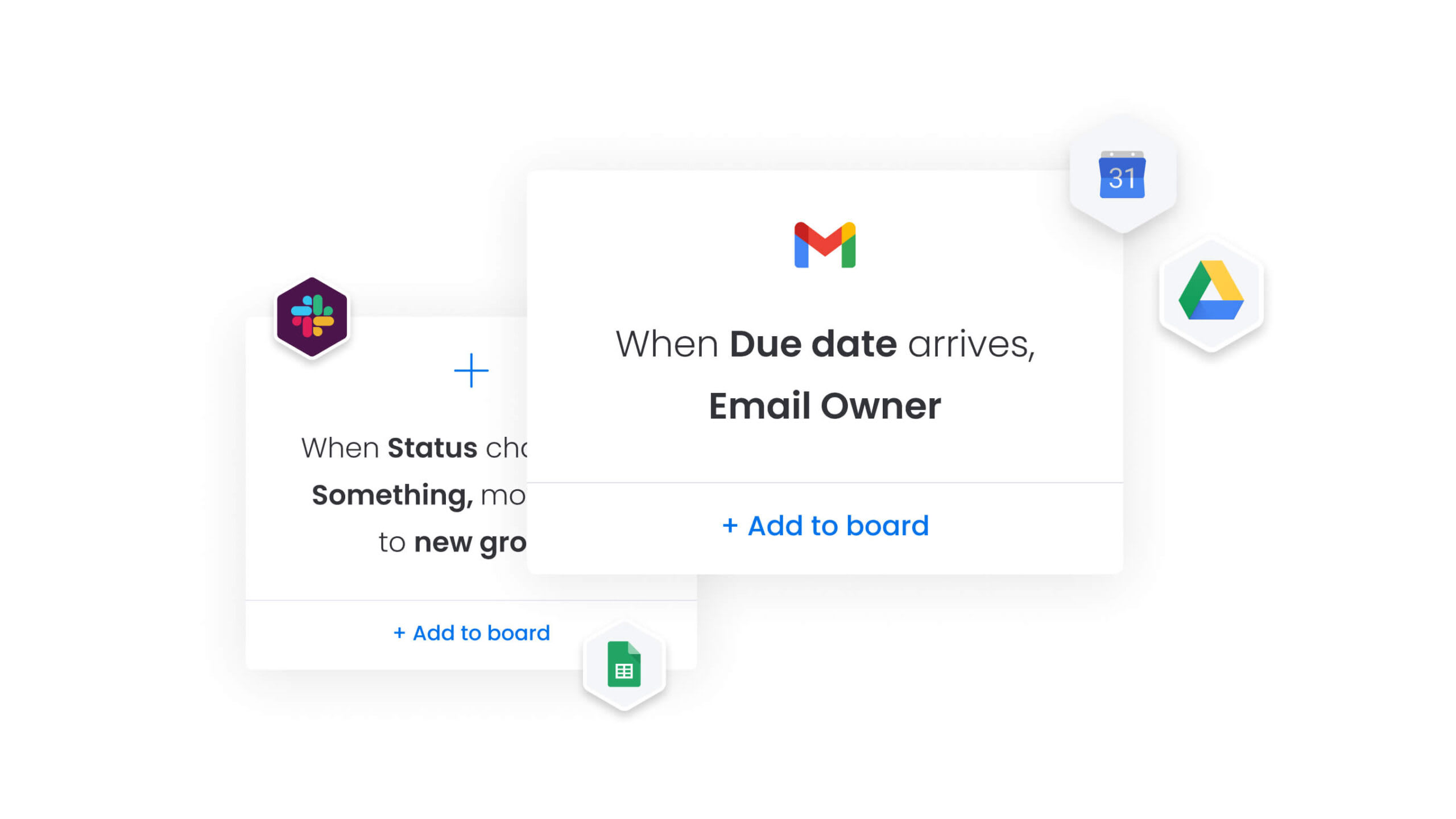
Organizations using solutions like monday work management connect their entire marketing stack through native integrations and APIs, ensuring updates in one system immediately reflect everywhere else.
2. Create cross-functional marketing teams
Restructure around outcomes rather than functions. Instead of separate channel teams, form integrated squads focused on specific customer segments or business objectives. Each squad includes members from different disciplines working toward shared goals.
This structure naturally pushes teams to collaborate:
- Shared accountability: success depends on collective performance.
- Built-in communication: daily interaction replaces formal handoffs.
- Unified perspective: diverse skills applied to common challenges.
These teams break down barriers by design, making collaboration the path of least resistance.
3. Align teams with shared KPIs
People follow incentives. Replace function-specific metrics with shared KPIs that reward collective success. Instead of measuring the content team on output volume, measure them on revenue influence. Instead of tracking email open rates, track pipeline contribution.
Effective shared metrics include:
- Marketing-sourced revenue: total revenue generated from marketing efforts.
- Customer acquisition cost: complete cost across all channels.
- Pipeline velocity: speed from first touch to closed deal.
- Customer lifetime value: long-term impact of marketing activities.
When everyone’s success depends on the same outcomes, collaboration isn’t optional anymore.
4. Implement integrated work management
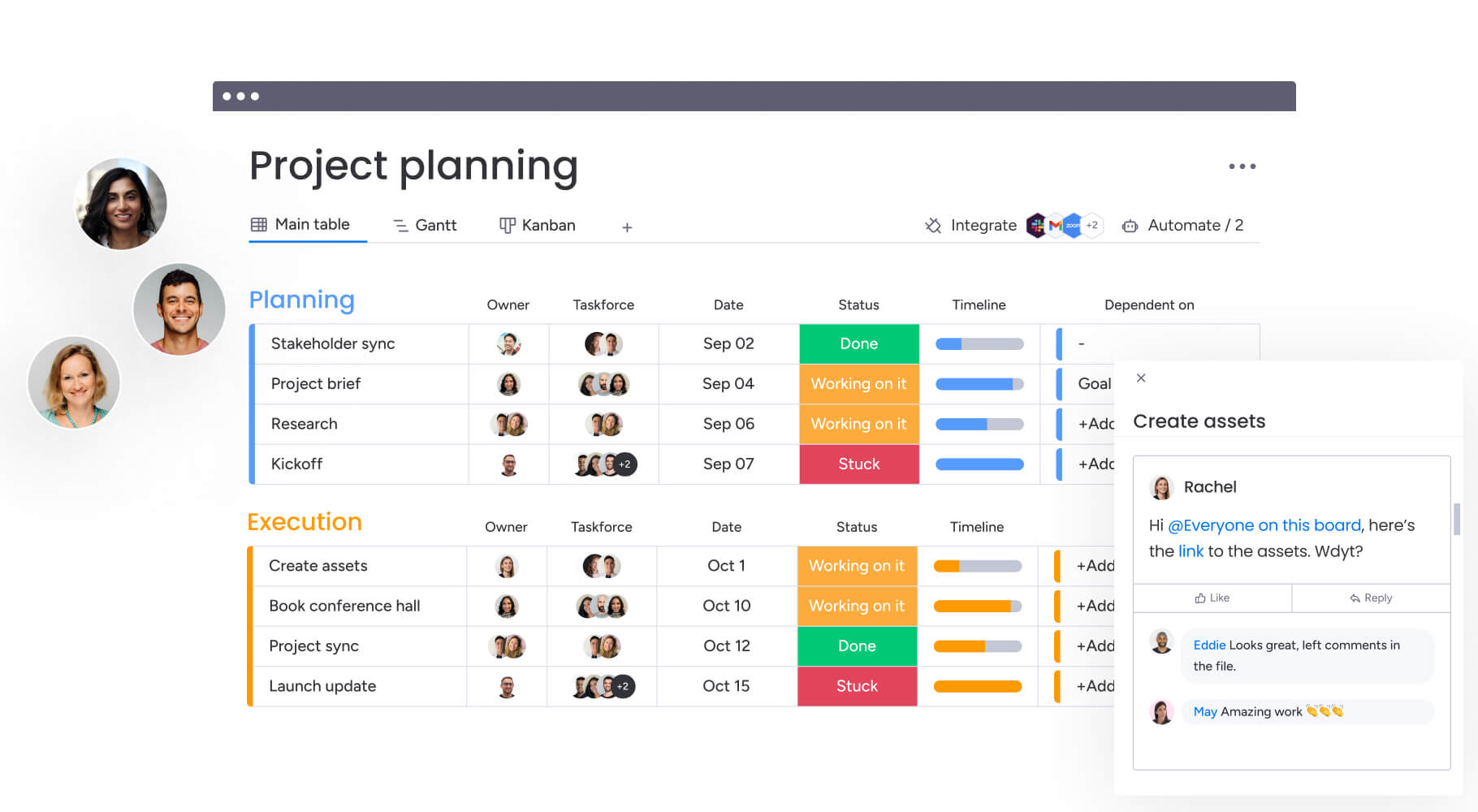
A centralized work management platform replaces scattered spreadsheets and disconnected tools with one workspace. All campaigns, projects, and assets live in one location where any team member can see status, understand dependencies, and access necessary resources through effective campaign management.
This visibility changes how teams operate. Modern platforms like monday work management provide visual workflows that span departments, with automated handoffs and real-time dashboards displaying project health, resource allocation, and performance metrics. As a result, teams stop chasing updates and start collaborating proactively.
5. Lead culture change from the top
Technology and process changes don’t stick without cultural transformation. Leadership must model collaborative behavior, reward cross-team wins, and actively dismantle territorial attitudes. This means transparent decision-making, public recognition for collaboration, and zero tolerance for information hoarding.
Create psychological safety where teams feel comfortable sharing work-in-progress and seeking input early. Celebrate failures that lead to learning. Make collaboration visible and valued at every level of the organization.

Using AI to eliminate marketing silos
AI is both a risk and an opportunity when it comes to silos. Used strategically, AI connects scattered teams and systems, but poor implementation creates new silos.
When AI creates new silos
Easy access to AI tools can fragment operations further if each team adopts different platforms. When the content team uses one AI writing assistant while the social team uses another, and neither integrates with your core systems, you’ve created new automated silos.
These disconnected AI tools can accelerate the production of inconsistent content. Different models trained on different data produce varying tones and messaging. Without governance, AI amplifies existing fragmentation rather than solving it.
AI-powered integration solutions
Enterprise AI platforms can unify instead of divide. AI integration layers ingest data from multiple sources and synthesize it into actionable insights. Natural language processing can standardize how different teams describe the same concepts. Machine learning can identify patterns across disconnected datasets.
Within platforms like monday work management, AI blocks provide standardized capabilities that all teams can access. Whether categorizing feedback, summarizing campaign performance, or extracting insights from documents, teams use the same AI foundation, ensuring consistency while maintaining flexibility.
Digital workers as silo breakers
AI agents that operate as digital workers provide continuous coordination across teams. These digital workers monitor dependencies, flag conflicts, and ensure information flows between departments without human intervention.
A digital worker might automatically:
- Detect misalignment: flag when campaign messaging differs from sales materials.
- Route information: share relevant updates with affected teams instantly.
- Suggest connections: identify opportunities for teams to collaborate.
- Maintain consistency: ensure brand guidelines are followed across channels.
By automating coordination work, digital workers keep teams aligned without adding admin work.
Creating sustainable cross-department workflows
Breaking silos is only the start. Long-term success requires designing workflows that resist fragmentation as your organization grows.
Designing processes for collaboration
Bake collaboration requirements directly into your workflows. Make cross-team input mandatory at specific stages. Require sign-offs from affected departments before work proceeds. Design handoffs that automatically trigger notifications and transfer ownership.
Effective collaborative workflows include:
- Defined handoff points: clear moments where work transfers between teams.
- Automatic notifications: system-triggered alerts when input is needed.
- Shared visibility: all stakeholders can see progress and blockers.
- Built-in feedback loops: regular checkpoints for alignment.
These structural elements make collaboration unavoidable, not optional.
Automating cross-team handoffs
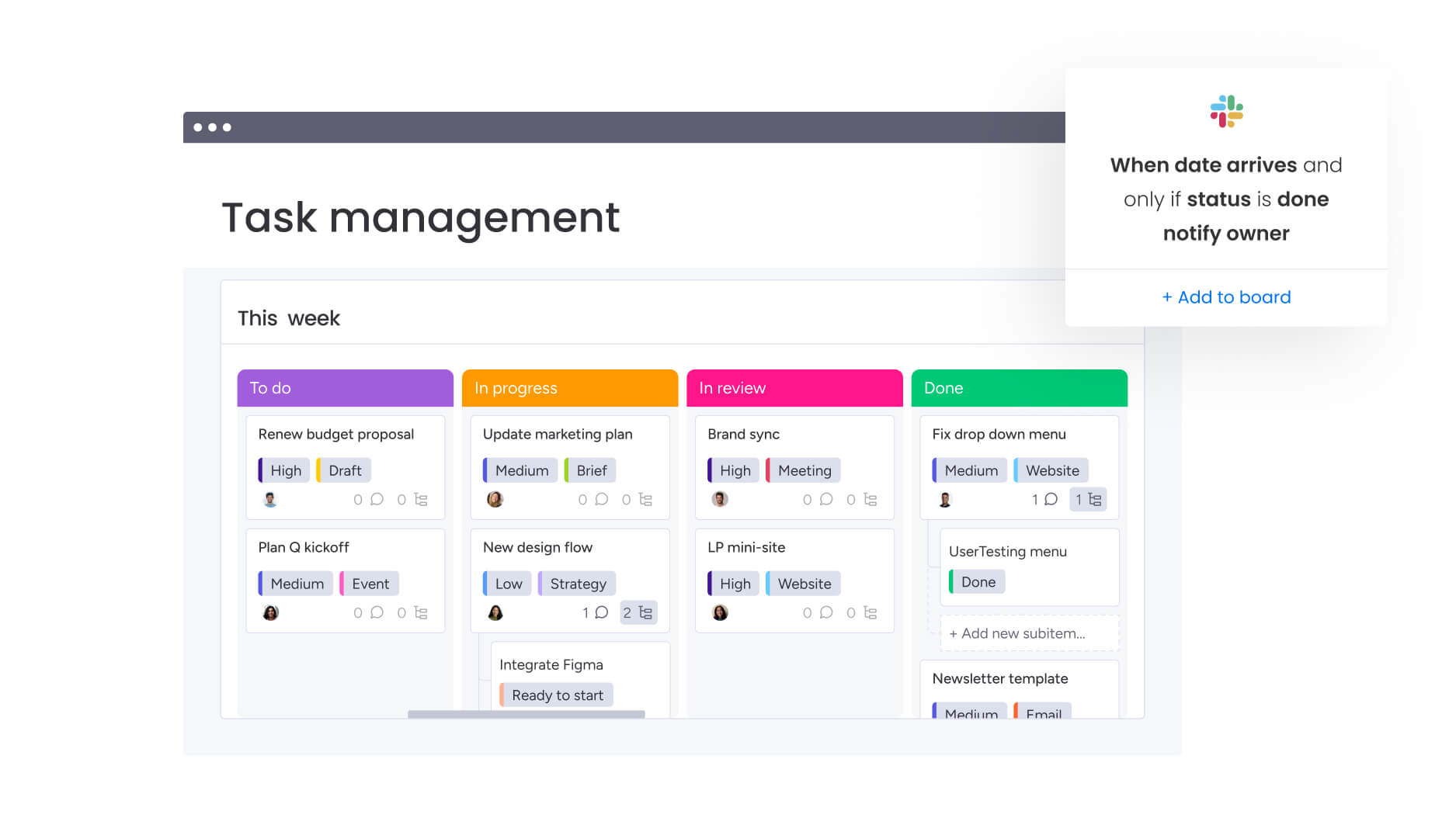
Manual handoffs introduce opportunities for silos to re-emerge. Automation addresses these gaps by maintaining consistent workflow progression between teams without requiring manual intervention. When the design team completes an asset, automation notifies copywriters, updates project status, and routes tasks to the appropriate queue.
These automations are enabled through no-code workflows in platforms like monday work management that connect actions across boards and teams. Status changes trigger notifications, completed tasks generate new assignments, and approved work advances automatically to the next stage.
Monitoring integration health
Organizations need to regularly check their integration effectiveness. Track metrics that reveal collaboration health:
- Cross-team project participation: percentage of projects involving multiple departments.
- Handoff completion time: speed of work transfer between teams.
- Integration point performance: success rate of automated workflows.
- Collaboration feedback scores: team satisfaction with cross-functional processes.
Regular monitoring helps you spot emerging silos before they harden. When metrics show degradation, you can intervene quickly to restore alignment.

“monday.com has been a life-changer. It gives us transparency, accountability, and a centralized place to manage projects across the globe".
Kendra Seier | Project Manager
“monday.com is the link that holds our business together — connecting our support office and stores with the visibility to move fast, stay consistent, and understand the impact on revenue.”
Duncan McHugh | Chief Operations OfficerBuilding a unified marketing ecosystem
Moving from fragmented operations to unified marketing requires both strategic vision and tactical execution. Organizations that eliminate silos create competitive advantages through faster execution, consistent customer experiences, and smarter resource use.
When marketing teams work as one ecosystem, they respond faster to market changes and customer needs. Campaigns launch with consistent messaging across all channels. Customer data flows seamlessly from first touch to closed deal, enabling personalized experiences at scale. Resources focus on high-impact activities rather than duplicated efforts.
The operational foundation to unify marketing teams, data, and processes into a cohesive ecosystem comes from monday work management, which drives results through comprehensive marketing metrics. The platform serves as a central command center where strategy connects directly to execution, enabling marketing teams to manage everything from campaign planning to creative production within the same environment.
Frequently asked questions
What is silo marketing?
Silo marketing refers to a fragmented state where different marketing teams operate independently without sharing data, strategies, or resources, resulting in inefficient operations and inconsistent customer experiences.
What are the three types of silos?
The three primary types are organizational silos (departments isolated from each other), channel silos (marketing channels operating independently), and data silos (information trapped in disconnected software platforms).
How do you identify marketing silos?
Marketing silos reveal themselves through inconsistent brand messaging, duplicate work across teams, conflicting data in reports, and slow execution due to poor communication between departments.
Can small businesses have marketing silos?
Yes, small businesses develop silos when individual employees hoard knowledge or when companies adopt multiple disconnected tools without an integration strategy, even with smaller team sizes.
What's the difference between marketing silos and data silos?
Marketing silos refer to the isolation of teams and workflows, while data silos specifically describe information trapped within software systems that cannot communicate with each other.
How does monday work management help eliminate marketing silos?
By providing a unified workspace connecting teams, integrating data from multiple platforms, and automating cross-functional workflows, monday work management eliminates silos to ensure visibility and collaboration across all marketing activities.

 Get started