

Marketing gets complicated fast at enterprise scale.
It’s no longer just about launching campaigns. It’s about aligning regions, business units, product teams, compliance requirements, budgets, and timelines — all at once. One disconnected workflow or inconsistent message can ripple across the organization.
Enterprise marketing exists to bring order to that complexity.
It connects high-level strategy to day-to-day execution across global teams. It protects brand consistency while still giving local teams room to adapt. And it ensures performance is measured in terms leadership actually cares about — revenue impact, growth, and long-term value.
This article explores what enterprise marketing really means in practice, how it differs from traditional marketing, and why structure becomes just as important as creativity at scale. It covers the core components that keep large organizations aligned, the strategic benefits enterprise marketing unlocks, and the frameworks, governance models, and technology that make it sustainable.
Key takeaways
- Enterprise marketing coordinates complexity across organizations: It requires aligning campaigns, teams, and resources across multiple regions and business units while maintaining brand consistency.
- Strong governance and standardized processes are essential: Unified brand guidelines, approval workflows, and cross-functional coordination ensure quality and compliance at scale.
- Data-driven decision making drives impact: Leveraging analytics, performance metrics, and AI-powered insights helps optimize campaigns, measure ROI, and anticipate market trends.
- Technology integration enables efficiency: Powerful platforms such as monday work management connect teams, workflows, and data, providing real-time visibility and reducing operational silos.
- Continuous optimization improves outcomes: Iterative testing, feedback loops, and agile operations allow enterprises to refine strategy and execution across global markets.
What is enterprise marketing?
Enterprise marketing means coordinating marketing across large organizations with many moving parts: different departments, regions, and stakeholders all need to stay aligned. Solid governance, repeatable processes, and connected technology are essential to keep brand messaging consistent without limiting local teams.
Traditional marketing focuses on a single market or channel. However, enterprise marketing runs campaigns across business units, manages resources at scale, and ensures every initiative aligns with the company’s strategic objectives.
This requires coordinating hundreds of concurrent campaigns, thousands of assets, and teams distributed across multiple time zones, all while maintaining governance and measuring impact.
The core components of enterprise marketing
Enterprise marketing success depends on five foundational elements that work together to drive results at scale. Understanding these components helps organizations identify gaps and invest in what truly drives meaningful outcomes.
- Brand governance: Maintaining unified standards, voice, and visual identity across all touchpoints prevents dilution and confusion.
- Cross-functional coordination: Aligning marketing with sales, product, and customer success ensures seamless execution.
- Resource optimization: Strategic allocation of budget, talent, and technology maximizes ROI and minimizes waste.
- Technology integration: Connected platforms create a single source of truth for reporting and insights.
- Performance measurement: Tracking impact across complex customer journeys validates investments and guides decisions.
How enterprise marketing transforms business outcomes
Enterprise marketing is more than promotion: it makes the organization operate efficiently. It also drives revenue by ensuring market entry strategies and campaigns achieve their intended impact, all while protecting brand reputation by enforcing compliance and quality standards.
Most importantly, enterprise marketing bridges leadership objectives with team execution. Strategy is translated into actionable work, allowing organizations to coordinate thousands of initiatives without sacrificing creativity or speed.
Traditional marketing focuses on a single market or channel. However, enterprise marketing runs campaigns across business units, manages resources at scale, and ensures every initiative aligns with the company’s strategic objectives.
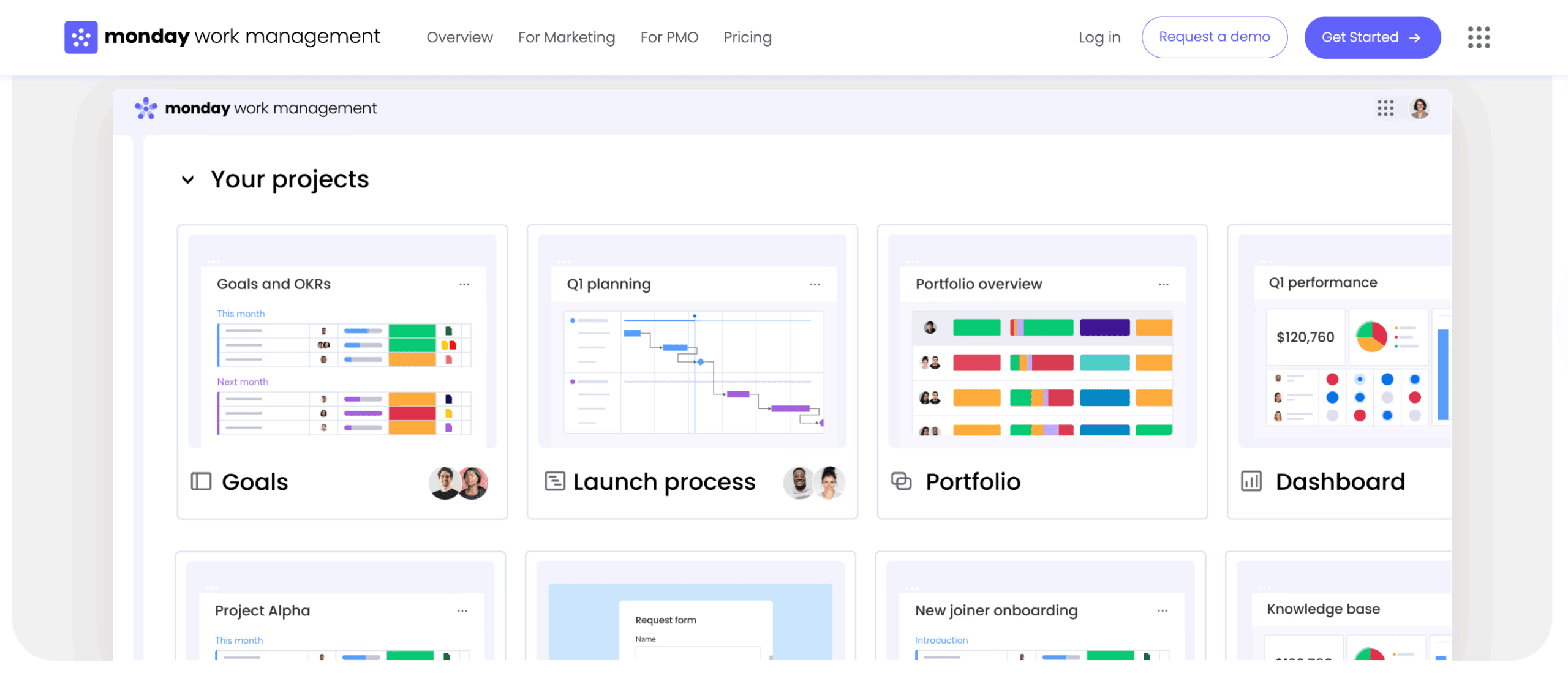
How enterprise marketing differs from traditional marketing
Organizational structure and governance
Enterprise marketing relies on dedicated roles such as marketing operations managers, brand governance leads, and marketing technology specialists: these positions are rarely found in traditional teams, which typically collaborate informally.
This structure provides defined accountability and standardized processes: local teams still have the flexibility to adapt strategies for their markets. Decisions can then be made quickly while maintaining oversight that protects the global brand.
Try monday work management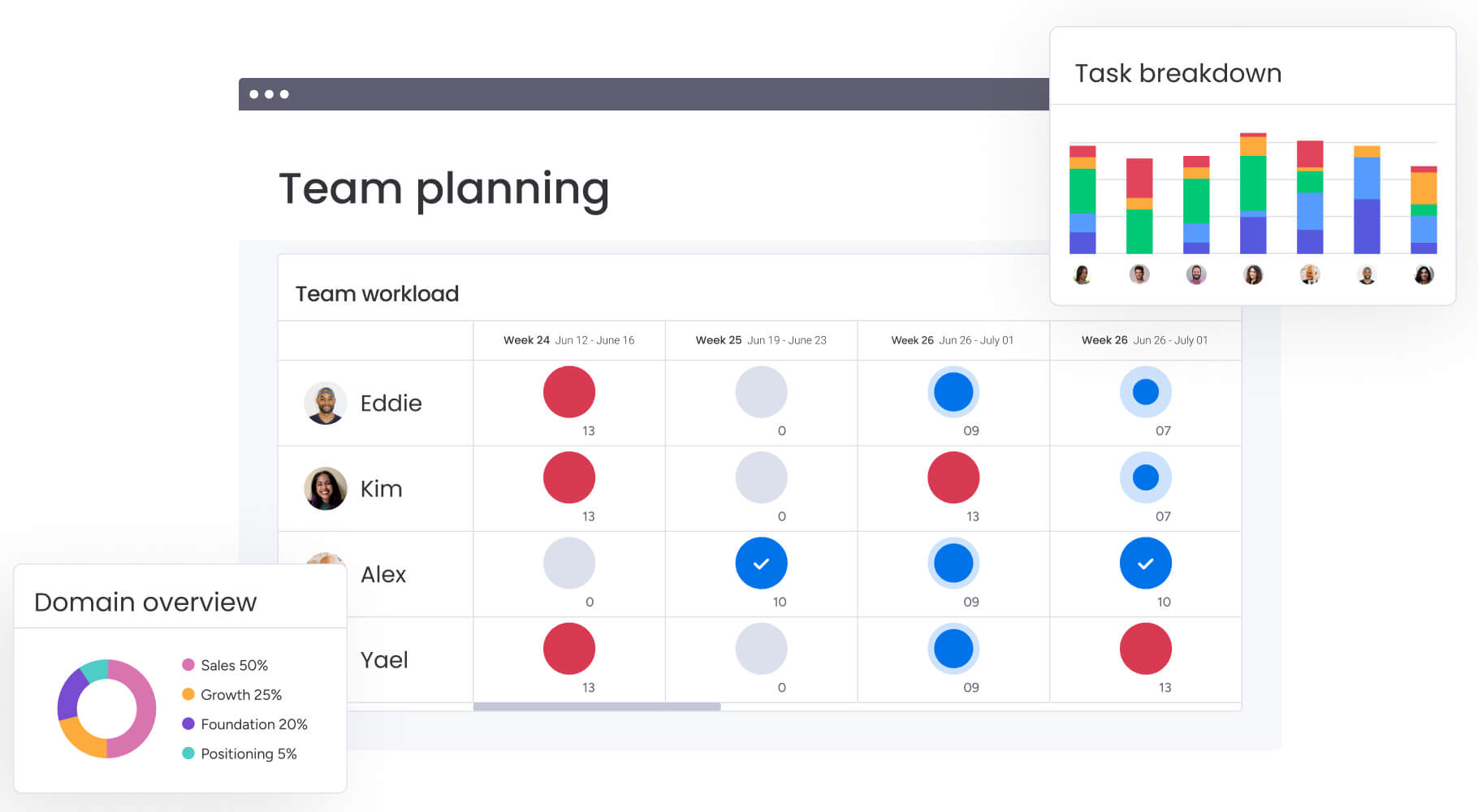
How enterprise marketing strengthens performance at scale
Enterprise marketing goes beyond coordination. When structured intentionally, it changes how the organization performs. It removes friction, protects brand integrity, sharpens execution, and creates measurable impact leadership can connect directly to revenue, efficiency, and long-term growth.
1. Unified brand presence across markets
Enterprise marketing protects consistency across every touchpoint, region, and business unit. That consistency builds recognition and trust, reinforcing premium positioning. Whether a customer engages in New York or Singapore, the experience feels aligned, intentional, and unmistakably on-brand.
2. Optimized resource allocation
Centralized planning reduces duplication and directs budget toward high-impact initiatives. Teams using monday work management can visualize capacity across departments, preventing burnout, minimizing idle time, and ensuring every investment supports strategic priorities.
3. Data-driven insights at scale
Bringing data together from multiple systems creates a complete view of customer behavior and market trends. Larger datasets enable deeper analytics and smarter personalization, giving enterprise organizations insight smaller competitors struggle to replicate.
4. Enhanced customer experience
Aligned messaging and standardized workflows create consistency across channels. From first interaction through post-purchase engagement, customers experience clarity and continuity, increasing satisfaction and lifetime value.
5. Accelerated market response
Integrated systems and shared visibility make rapid execution possible. When new opportunities or threats emerge, campaigns can be adjusted or launched in days instead of weeks.
6. Improved cross-functional collaboration
Connected workflows reduce silos between marketing, sales, product, and customer success. Shared goals and transparent execution ensure launches and campaigns receive coordinated support across every customer-facing team.
7. Measurable ROI across investments
Unified reporting provides full visibility into performance. Accurate attribution enables leaders to double down on what works, refine what does not, and make decisions grounded in data rather than assumption.
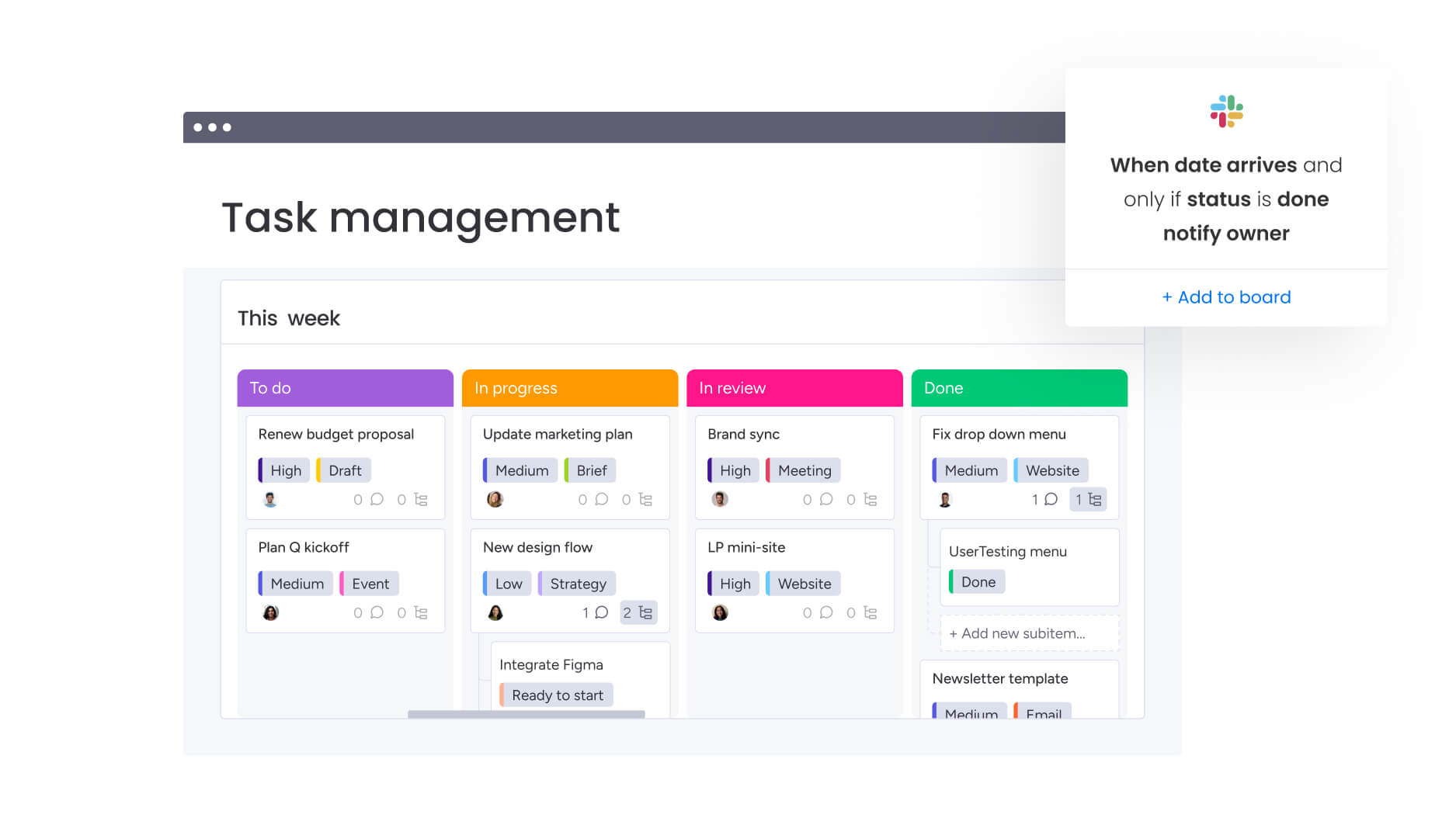
6 proven enterprise marketing strategies
Building enterprise marketing that delivers results requires addressing the challenges of scale and complexity. The strategies below help organizations move from scattered efforts to coordinated execution that drives measurable impact.
1. Implement unified brand governance
Establishing a governance framework maintains consistency while allowing teams to adapt when necessary. Effective governance includes:
- Comprehensive guidelines: Clear standards for voice, visual identity, and messaging.
- Centralized asset management: Single source of truth for approved materials.
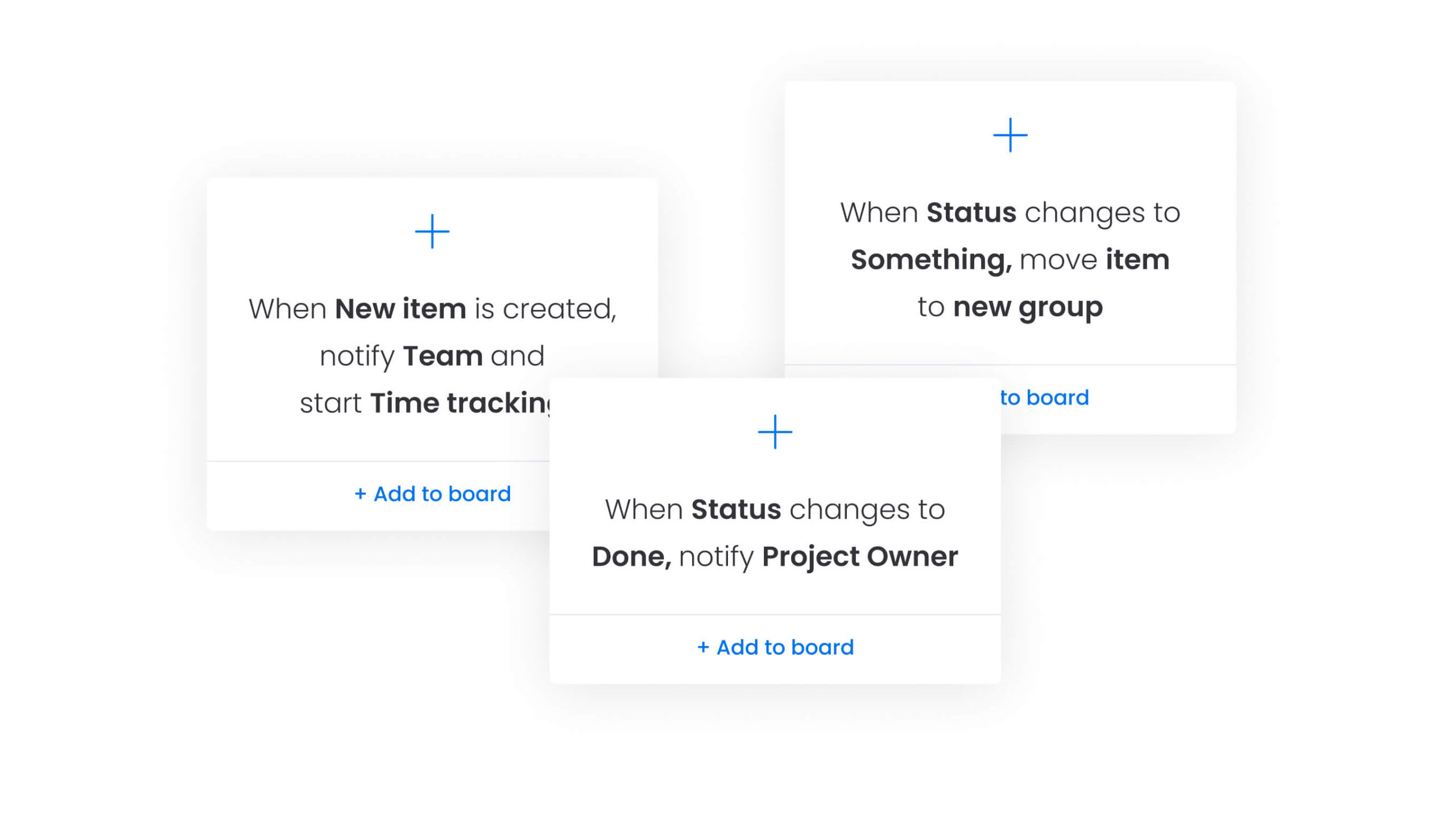
- Automated approval workflows: Streamlined processes that maintain quality without slowing execution.
This approach balances central control with local flexibility, allowing regional teams to act quickly within clear boundaries.
2. Build integrated technology stacks
Technology must scale with the organization and integrate seamlessly with existing systems. Core components include marketing automation, customer data platforms, and collaboration systems that work together.
Modern platforms like monday work management support integration through API connections and pre-built integrations, breaking down data silos.
3. Establish cross-functional workflows
Standardized processes for campaign development, content creation, and lead management keep departments operating efficiently. These workflows remove bottlenecks without sacrificing quality. Teams can embed these processes using managed templates that ensure compliance automatically.
4. Create data-driven decision frameworks
Marketing decisions should be based on analysis rather than intuition. Key elements include:
- Defining key metrics: Establishing clear success indicators.
- Data governance policies: Ensuring accuracy and accessibility.
- Reporting structures: Connecting insights to strategic planning.
This framework balances performance data with market insights for informed decision-making.
5. Develop agile marketing operations
Organizing teams into autonomous squads allows large organizations to move with startup speed. Agile marketing operations include iterative planning, rapid testing, and continuous optimization while maintaining necessary enterprise governance.
6. Foster continuous optimization culture
Regular performance reviews, structured testing, and knowledge-sharing ensure insights from one market can be applied globally. Feedback loops allow ongoing refinement of both strategy and execution.
Try monday work managementTechnology must scale with the organization and integrate seamlessly with existing systems. Core components include marketing automation, customer data platforms, and collaboration systems that work together.
How to build your enterprise marketing framework
Enterprise marketing does not fall into place on its own. As organizations grow, complexity grows with them. Without structure, alignment slips and execution slows. A clear, scalable framework keeps teams coordinated, strategy focused, and performance steady as the business expands.
Assess organizational readiness
Evaluate your current marketing capabilities, technology infrastructure, and organizational structure. Identify gaps in marketing maturity, process standardization, and system integration. Secure executive sponsorship early to guide change management and gain alignment across leadership teams.
Define strategic objectives and KPIs
Align marketing initiatives with business goals through clear objectives and measurable key performance indicators. Track both marketing performance: lead velocity, conversion rates, and engagement; and business impact: revenue contribution, market share, and customer growth.
These metrics serve as a roadmap for prioritizing initiatives and allocating resources effectively.
Design cross-functional governance
Establish decision-making processes that balance speed with stakeholder input. This includes:
- Steering committees: Executive oversight and strategic direction.
- Centers of excellence: Subject matter expertise and best practices.
- Operational working groups: Day-to-day coordination and execution.
The goal is to reduce bottlenecks while ensuring stakeholders contribute to critical decisions and maintain organizational alignment.
Select and integrate technology platforms
Choose platforms that scale with organizational complexity and support seamless execution. Consider:
- Scalability: Can it manage your campaign volume and data needs?
- Integration: Does it connect with your existing systems and processes?
- Security: Does it meet enterprise compliance requirements?
- Usability: Will teams adopt it consistently across workflows?
Teams often begin with a work management platform like monday work management to coordinate efforts before adding specialized marketing systems.
Implement standardized processes
Document repeatable processes for essential marketing activities and train teams to follow them. Processes should provide compliance and control while allowing creative flexibility. Managed templates help teams standardize hundreds of projects and update them in real time across departments.
Monitor and optimize performance
Use regular performance reviews and stakeholder feedback to identify opportunities for improvement. This approach turns implementation from a one-time initiative into a cycle of continuous optimization and refinement.
Essential enterprise marketing management capabilities
Enterprise marketing at scale demands more than good intentions. Coordinating global initiatives and managing high campaign volume requires specific capabilities built for complexity.
When those foundations are in place, teams execute consistently, stay aligned across regions, and maintain quality without slowing down.
Marketing automation and orchestration
These platforms handle campaign management, lead nurturing, and cross-channel orchestration at scale. Essential capabilities include:
- Contact management: Managing millions of customer profiles.
- Complex workflows: Executing advanced nurture sequences.
- Advanced segmentation: Targeting based on behavior, demographics, and engagement.
Automation must integrate with your broader technology stack to avoid creating silos.
Analytics and business intelligence
Analytics platforms consolidate data from multiple sources for a complete performance view. These solutions provide attribution modeling, predictive analytics, and real-time reporting, helping leaders make data-driven decisions that extend beyond individual channels.
Collaboration and workflow management
Platforms for cross-functional coordination support project management, task dependencies, and resource allocation. Key features include automated approvals, dependency tracking, and real-time communication.
Intelligent platforms like monday work management connect distributed teams and ensure alignment on priorities.
AI and machine learning capabilities
AI enhances marketing operations across platforms, providing:
- Predictive analytics: Forecasting customer behavior and market trends.
- Content optimization: Improving messaging and creative automatically.
- Automated segmentation: Identifying high-value audience groups.
AI-powered enterprise marketing transformation
AI is no longer just an add-on. In 2026 it’s completely reshaping how enterprise marketing operates at scale. AI enables capabilities that human teams alone cannot manage across hundreds of concurrent initiatives.
Predictive analytics for campaign optimization
AI evaluates historical data to optimize audience segmentation, channel mix, and budget allocation before campaigns launch. Enterprise marketers shift from reactive to proactive strategies, anticipating customer behavior and market trends with precision that was previously unattainable.
Automated personalization at scale
Machine learning algorithms deliver hyper-relevant content to millions of customers simultaneously. This automated personalization increases operational efficiency while enhancing the customer experience, ensuring the right message reaches the right audience at the right time.
Risk management across portfolios
AI supports enterprise teams in identifying and mitigating risks across global portfolios. Systems monitor brand safety, compliance, and performance anomalies in real time. Portfolio Risk Insights on monday work management scans project boards daily, highlighting potential issues by severity and providing context, ownership, and recommended mitigation actions.
Digital workers for marketing operations
AI-powered digital workers manage routine tasks such as data entry, campaign analysis, and performance reporting. The Campaign Manager Digital Worker offers budget recommendations based on performance, while the Project Analyzer tracks timelines to flag potential delays.
These clever digital assistants allow human teams to focus on strategy and creative innovation.
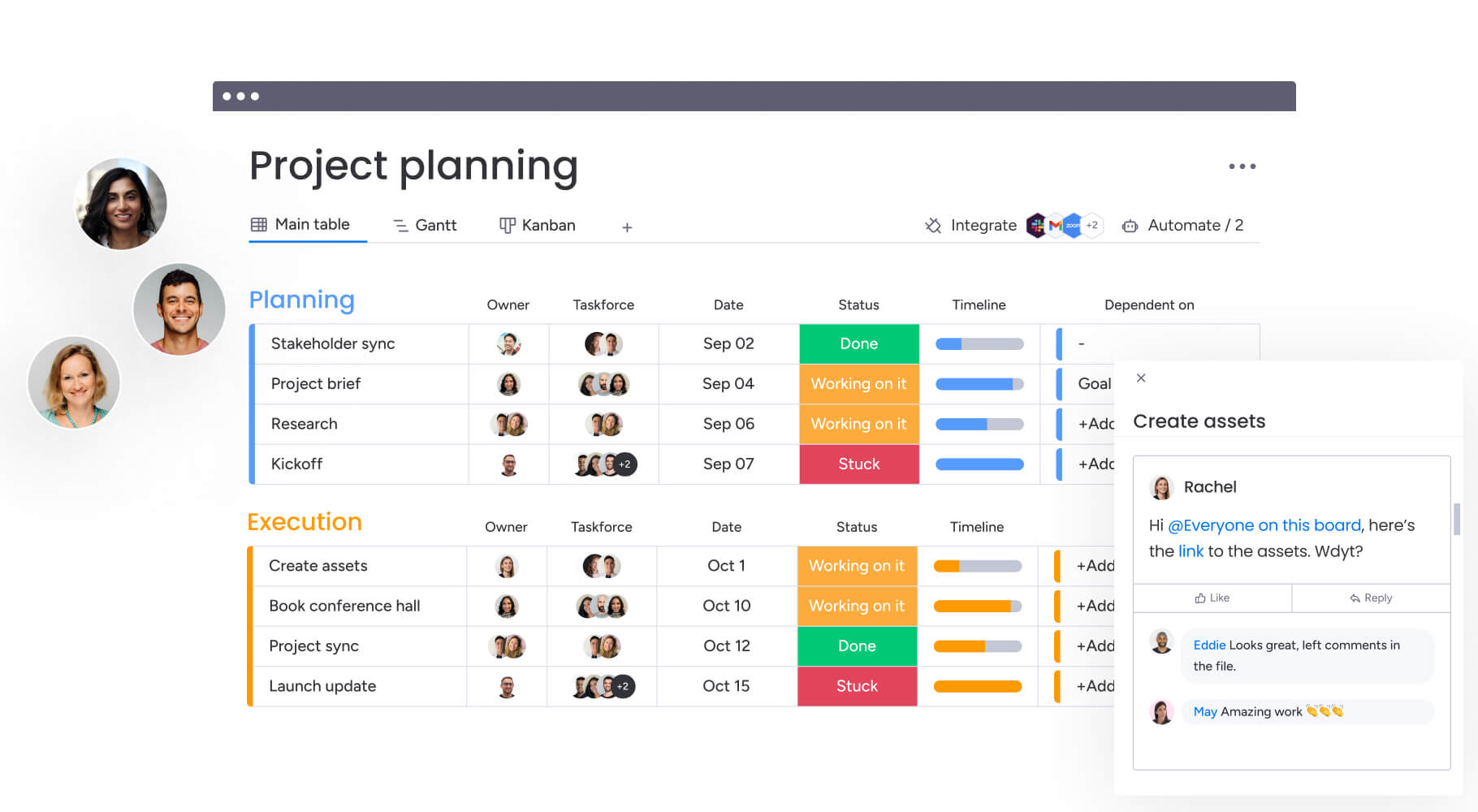
Take control of enterprise marketing with monday work management
Enterprise marketing cannot run on scattered tools and status meetings. At scale, execution needs visibility, structure, and real accountability. monday work management connects strategy to daily work so marketing leaders can see what is happening across regions, teams, and campaigns in real time.
Eliminate silos with connected workflows
Shared boards and transparent tracking replace fragmented communication. Cross-project dependencies link campaigns to product launches and regional initiatives, so nothing moves in isolation. Managed templates standardize execution without removing flexibility, while portfolio views provide a single source of truth across all initiatives.
Scale operations without losing oversight
Growth increases volume and complexity. Resource management and capacity views make it clear who is overloaded and where support is needed. AI-powered portfolio insights surface risks across hundreds of projects before they escalate. Automation handles repetitive coordination, while enterprise-grade security maintains compliance and control.
Move faster with built-in AI support
AI strengthens execution across the platform. The Campaign Manager Digital Worker recommends budget adjustments based on live performance data. The Project Analyzer flags timeline risks before deadlines slip. AI Blocks categorize leads and summarize reports instantly, giving teams clarity without manual effort.
Enterprise marketing becomes manageable when strategy, execution, and insight operate in one connected environment.

“monday.com has been a life-changer. It gives us transparency, accountability, and a centralized place to manage projects across the globe".
Kendra Seier | Project Manager
“monday.com is the link that holds our business together — connecting our support office and stores with the visibility to move fast, stay consistent, and understand the impact on revenue.”
Duncan McHugh | Chief Operations OfficerBuild enterprise marketing that actually scales
Enterprise marketing is not just a bigger version of traditional marketing. It changes how teams operate. More markets, more stakeholders, more compliance requirements, more data. Without structure, complexity slows everything down.
Organizations that approach enterprise marketing intentionally gain a clear advantage. Brand stays consistent across regions. Resources are allocated with precision. Decisions are based on real performance data, not guesswork. Growth feels coordinated instead of chaotic.
Making that shift requires more than new campaigns. It demands connected systems, defined governance, and workflows that scale without creating friction. The balance is simple in theory but difficult in practice: standardize what protects the brand and performance, allow flexibility where markets require it.
monday work management gives marketing leaders the visibility and control needed to manage hundreds of concurrent initiatives without losing agility. Strategy, execution, resources, and insights live in one connected environment, so teams move faster with confidence.
Try monday work managementFrequently asked questions
What role does marketing play in a private enterprise system?
Marketing drives revenue growth by identifying customer needs, creating demand for products and services, and building brand value to support competitive positioning and pricing.
What is the difference between enterprise marketing and enterprise advertising?
Enterprise marketing involves strategic coordination of all marketing activities across large organizations. Enterprise advertising focuses specifically on paid campaigns and media buying at scale.
How do you measure enterprise marketing success?
Success is measured using business impact metrics such as revenue attribution, customer acquisition cost, and lifetime value, alongside operational efficiency indicators like campaign velocity, resource utilization, and collaboration scores.
What skills do enterprise marketing managers need?
Managers require strategic thinking, cross-functional collaboration, data analysis, technology proficiency, and change management expertise to coordinate complex global operations.
How long does it take to implement enterprise marketing?
Implementation typically takes six to eighteen months, depending on organizational size and complexity, with initial improvements visible within three to six months.
What are common enterprise marketing mistakes to avoid?
Common mistakes include siloed operations, lack of standardized processes, insufficient technology integration, poor data governance, and misalignment of marketing activities with business objectives.

 Get started