


Your sales team closes deals every month. But something’s off — you can’t pinpoint where your best customers actually come from. Which marketing campaigns actually drive revenue? Where do your best customers come from? When budget planning season arrives, you’re stuck making educated guesses about where to invest next year’s resources.
Understanding lead sources? It changes everything. A lead source is the specific channel, method, or touchpoint where prospects first discover your business. When you track lead sources properly, you can see which channels produce the highest-quality prospects, calculate real ROI for each marketing investment, and make data-driven decisions about resource allocation.
Below we’ll walk through the lead source types that drive B2B revenue, shining a light on how to track and optimize them for maximum impact. You’ll also see how to avoid common tracking mistakes — and how a smart, automated platform can capture the insights you actually need.
Key takeaways
- Understand what a lead source actually is: a lead source shows where a prospect first discovered your business, giving you clear visibility into what drives pipeline and revenue.
- Track lead sources to improve forecasting accuracy: knowing which sources consistently convert helps revenue teams predict pipeline health and plan growth with confidence.
- Measure lead quality, not just volume: evaluate conversion rates, deal size, and customer lifetime value by source to focus investment on what generates revenue.
- Use multi-touch attribution for B2B buying journeys: track every meaningful touchpoint since most deals involve multiple channels before closing.
- Automate lead source tracking with monday CRM: capture source data automatically, standardize naming, and use AI to surface insights without manual work.
What is a lead source?

A lead source is where a prospect first finds you — the specific channel or touchpoint that starts the relationship. It’s the answer to that fundamental question every sales team asks: “Where did this prospect come from?”
Picture tracking visitors to a physical store. Did they see your billboard on the highway? Did a friend recommend you? Or did they find you through a Google search? In sales, this tracking becomes the foundation for understanding which marketing efforts and channels actually bring in potential customers.
Lead sources connect directly to your sales pipeline by providing the starting point for every customer relationship. When sales teams know where prospects originate, they can:
- Measure which marketing investments generate real results.
- Identify which channels produce the highest-quality leads.
- Determine where to focus resources for maximum impact.
This data turns basic tracking into real intelligence — the kind that shapes your budget, priorities, and growth plans.
Why lead sources matter for revenue teams
Lead source data affects everything: forecast accuracy, resource allocation, and the pipeline reports you show executives. In fact, only 3% of CMOs can attribute more than half of their marketing spend, even as 72% plan to increase marketing budgets relative to sales in 2026 — underscoring why dependable lead-source and attribution data are critical for credible forecasting and executive reporting.
Without knowing where leads come from, teams operate blindly. They can’t replicate success or fix underperforming channels.
For revenue leaders, the problems pile up fast:
- Forecasting becomes guesswork: you can’t predict pipeline health when you don’t know which sources consistently deliver.
- Resource allocation stays reactive: teams spread effort evenly instead of focusing on what works.
- Executive reporting lacks credibility: board presentations rely on anecdotes rather than data.
Small sales teams face their own challenges. Manual tracking in spreadsheets leads to errors and wasted time. Without visibility into which channels convert, they waste limited budgets on marketing that doesn’t deliver results.
How lead sources power your sales pipeline
Lead source data flows through your sales pipeline from initial contact to closed deal, creating a traceable path that reveals which sources produce the highest-quality leads and generate the most revenue. This connection allows sales teams to track not just volume but outcomes.
Which sources close faster? Which generate larger deals? Which require more nurturing? The answers shape everything from daily sales activities to quarterly planning.
The data helps with forecasting by showing predictable patterns in conversion rates and sales cycles by source. It also informs resource allocation decisions, helping leaders:
- Deploy sales effort where it generates the highest return.
- Adjust marketing spend based on actual revenue impact rather than guesswork.
Lead source vs lead generation and lead channel
These terms shape how you track performance and make decisions. When lead source, lead generation, and lead channel get blurred together, reporting breaks down and teams argue over attribution.
The table below breaks down how each concept differs and how they work together.
| Concept | Definition | Example |
|---|---|---|
| Lead source | The specific, trackable point of origin for a prospect | Q4 2024 product demo webinar |
| Lead generation | The strategic process and activities designed to attract potential customers | SEO and content strategy |
| Lead channel | The broader category or medium through which prospects discover your business | Social media, email marketing |
- Lead source: captures the exact webpage, email campaign, event, or touchpoint where first contact occurred. Good lead source tracking captures granular details like “Q4 2024 Product Demo Webinar” rather than just “webinar.”
- Lead generation: encompasses all the marketing efforts, campaigns, and tactics used to create interest and drive prospects to engage. It’s the methodology behind attracting prospects.
- Lead channel: represents high-level groupings like “social media,” “email marketing,” or “paid advertising.” Multiple lead sources can exist within a single channel. LinkedIn, Twitter, and Facebook are all sources within the social media channel.
Types of lead sources for sales teams
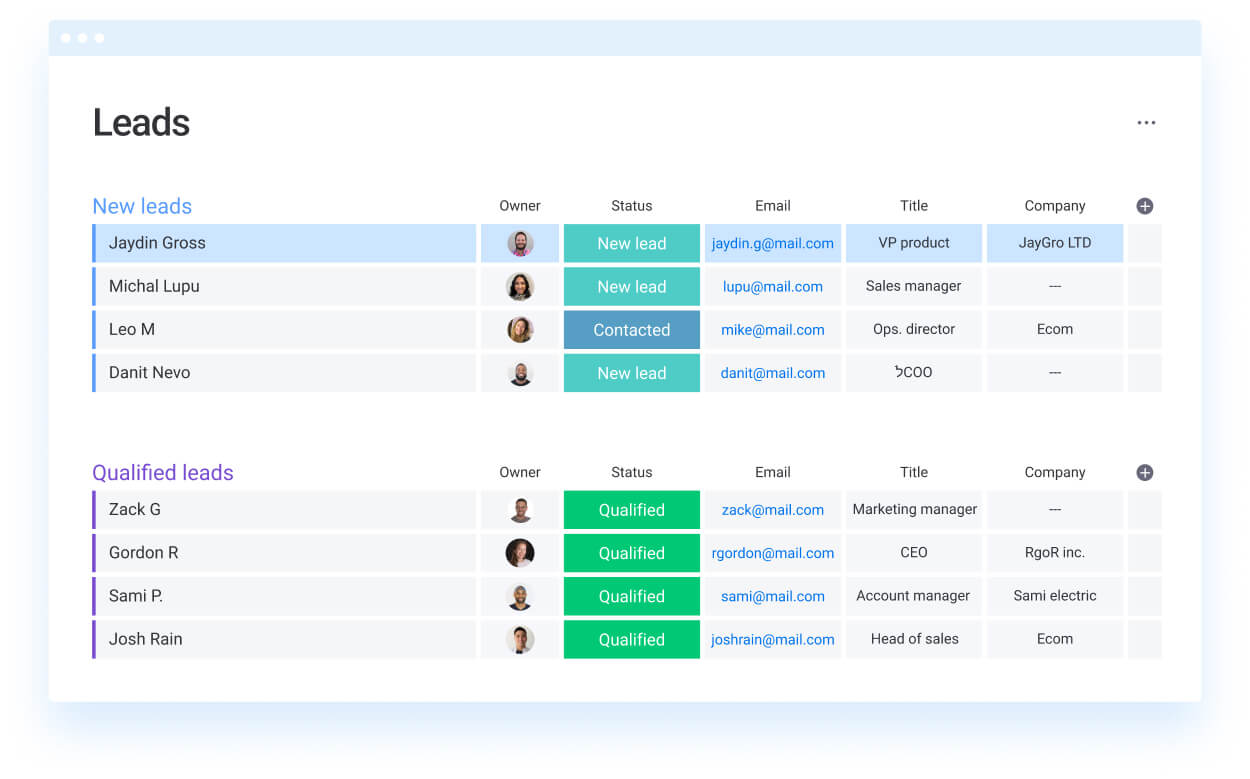
Sales teams organize their lead sources into three main categories that help build comprehensive tracking systems and identify gaps in lead generation strategy. The best sales teams mix all three types. It spreads risk and opens up more opportunities.
Know these categories and you’ll spot gaps — channels you’re not using that could pay off.
Inbound lead sources
Inbound lead sources are channels where prospects actively seek out your business or content. These leads convert faster because they came looking for you — higher intent means shorter sales cycles.
Common inbound sources that drive results:
- Organic search: prospects finding your business through Google searches for solutions to their problems.
- Content downloads: leads who request whitepapers, guides, templates, or other valuable resources.
- Website contact forms: visitors who reach out directly through your site’s contact page or demo request forms.
- Product trial signups: prospects who register for free trials or freemium versions of your product.
Inbound leads often convert faster because they’re already interested and have self-qualified to some degree by taking action to find you. Revenue teams leveraging platforms like monday CRM can automatically capture and categorize these inbound sources, ensuring every lead is accounted for while AI enriches the data for faster follow-up.
Outbound lead sources
Outbound lead sources are channels where your team proactively reaches out to potential customers. They take more work upfront, but you can reach prospects who’d never find you otherwise.
Key outbound sources that generate pipeline:
- Cold email campaigns: direct outreach to targeted prospects based on ideal customer profiles.
- Sales development calls: phone-based prospecting efforts where SDRs or BDRs reach out to qualified prospects.
- LinkedIn outreach: social selling through professional networks, including connection requests and direct messages.
- Direct mail campaigns: physical mailings to targeted accounts, often used for high-value prospects.
Outbound takes patience — longer nurturing, more relationship-building. But you get access to decision-makers who aren’t Googling solutions yet. With solutions like monday CRM, the visual pipeline makes it easy to track these longer sales cycles and identify which outbound sources eventually convert to revenue.
Digital and self-service sources
This category encompasses online channels where prospects can learn about and engage with your business independently. These sources mix both approaches.
Modern digital sources driving B2B sales leads:
- Social media engagement: prospects discovering your business through social posts, comments, shares, or paid social advertising.
- Online reviews and directories: leads from platforms like G2, Capterra, or industry-specific review sites.
- Chatbot interactions: prospects who engage with AI-powered chat on your website or through messaging platforms.
- Community forums: prospects who discover your business through participation in industry forums or online discussion groups.
B2B buyers expect self-service now. They want to research on their own terms before talking to sales.
Try monday CRM
Top lead source examples that drive B2B revenue
B2B sales teams rely on multiple lead source types to keep pipeline consistent and resilient. Each category plays a different role in how prospects discover your business, signal intent, and move toward a sales conversation. Relying on a single source creates risk, while combining the right mix creates momentum.
Below are the main types of lead sources and how each supports revenue growth.
1. Organic search (SEO)
Prospects find your business through unpaid Google search results when looking for solutions to their problems. Search is a dominant discovery channel, with SearchGov alone supporting over 200 million searches a year across roughly one-third of federal domains. This source:
- Captures high-intent prospects.
- Provides cost-effective long-term results.
- Builds credibility through search rankings.
Content you publish today keeps working for months — even years — as SEO kicks in.
2. Paid search advertising
Prospects click on your paid Google or Bing ads when searching for relevant keywords. This source:
- Delivers immediate visibility.
- Provides highly targeted reach.
- Offers measurable ROI through detailed analytics.
You control the message, the audience, and the spend. Paid search scales as you invest more.
3. Social media engagement
Prospects discover your business through posts, comments, or shares on platforms like LinkedIn, Twitter, or industry forums. This source:
- Builds relationships over time.
- Showcases expertise through consistent content.
- Reaches prospects in their preferred digital environments.
4. Email marketing campaigns
Prospects respond to targeted email campaigns, newsletters, or automated sequences. This source:
- Enables direct communication.
- Allows personalization at scale.
- Provides measurable engagement through open rates and click-throughs.
Segment your list, tailor the message. Email’s one of the best ways to nurture leads without burning budget.
5. Content marketing assets
Prospects discover your business through valuable content like blog posts, whitepapers, case studies, or videos. This source:
- Demonstrates expertise.
- Builds trust through education.
- Attracts prospects during their research phase when they’re forming opinions about solutions.
6. Customer referral programs
Existing customers recommend your business to their network through formal referral programs or informal word-of-mouth. This source:
- Carries high trust factor.
- Produces shorter sales cycles.
- Typically generates higher-value deals.
Referral leads often have the highest conversion rates because they come pre-qualified by someone who knows both your solution and the prospect’s needs, making them highly qualified leads.
7. Industry events and trade shows
Prospects meet your team at conferences, trade shows, or industry meetups. This source:
- Enables face-to-face relationship building.
- Allows immediate qualification through conversations.
- Provides access to decision-makers who might be difficult to reach otherwise.
8. Educational webinars
Prospects register for and attend online educational sessions hosted by your company. This source:
- Demonstrates expertise through live teaching.
- Allows for real-time engagement and questions.
- Attracts prospects actively seeking solutions.
Platforms like monday CRM can help teams track webinar attendees through the entire sales cycle, showing which topics generate the most qualified opportunities.
9. Strategic cold outreach
Your sales team proactively contacts targeted prospects through research-based, personalized outreach. This source:
- Reaches prospects who might never find you organically.
- Allows for precise targeting based on ideal customer profiles.
- Can accelerate sales cycles by creating urgency.
10. Partner channel networks
Prospects learn about your business through partnerships, integrations, or reseller relationships. This source:
- Leverages existing trust relationships.
- Expands market reach into new segments.
- Often results in qualified leads because partners understand both your solution and their customers’ needs.
11. Direct website traffic
Prospects visit your website directly by typing your URL or through bookmarks, often after hearing about you offline or through untracked channels. This source:
- Indicates brand awareness.
- Suggests previous research or recommendations.
12. Industry review platforms
Prospects discover your business through platforms like G2, Capterra, or industry-specific review sites where they research and compare solutions. This source:
- Captures prospects in active buying mode.
- Builds credibility through customer reviews.
13. Product trials and demos
Prospects request free trials, demos, or proof-of-concept opportunities to evaluate your solution hands-on. This source:
- Signals high intent.
- Provides hands-on experience with your product.
- Creates natural next steps in the sales process.
14. Social selling on LinkedIn
Prospects engage with your sales team’s professional content, connection requests, or direct messages on LinkedIn. This source:
- Builds professional relationships gradually.
- Allows for targeted outreach based on job titles and companies.
15. AI-powered chat and voice
Prospects interact with chatbots, voice assistants, or AI-powered tools on your website or through other channels. This source:
- Provides 24/7 availability.
- Offers immediate response to questions.
- Qualifies prospects outside business hours.
Teams using monday CRM can leverage AI capabilities to automatically categorize and assign these leads based on conversation content and intent signals.
How lead source tracking transforms sales performance
Lead source tracking tells you where to spend your time, money, and energy. Without it, you’re guessing. With it, you know. With it, they can optimize every aspect of their go-to-market strategy based on what actually works.
Unlock accurate sales forecasting
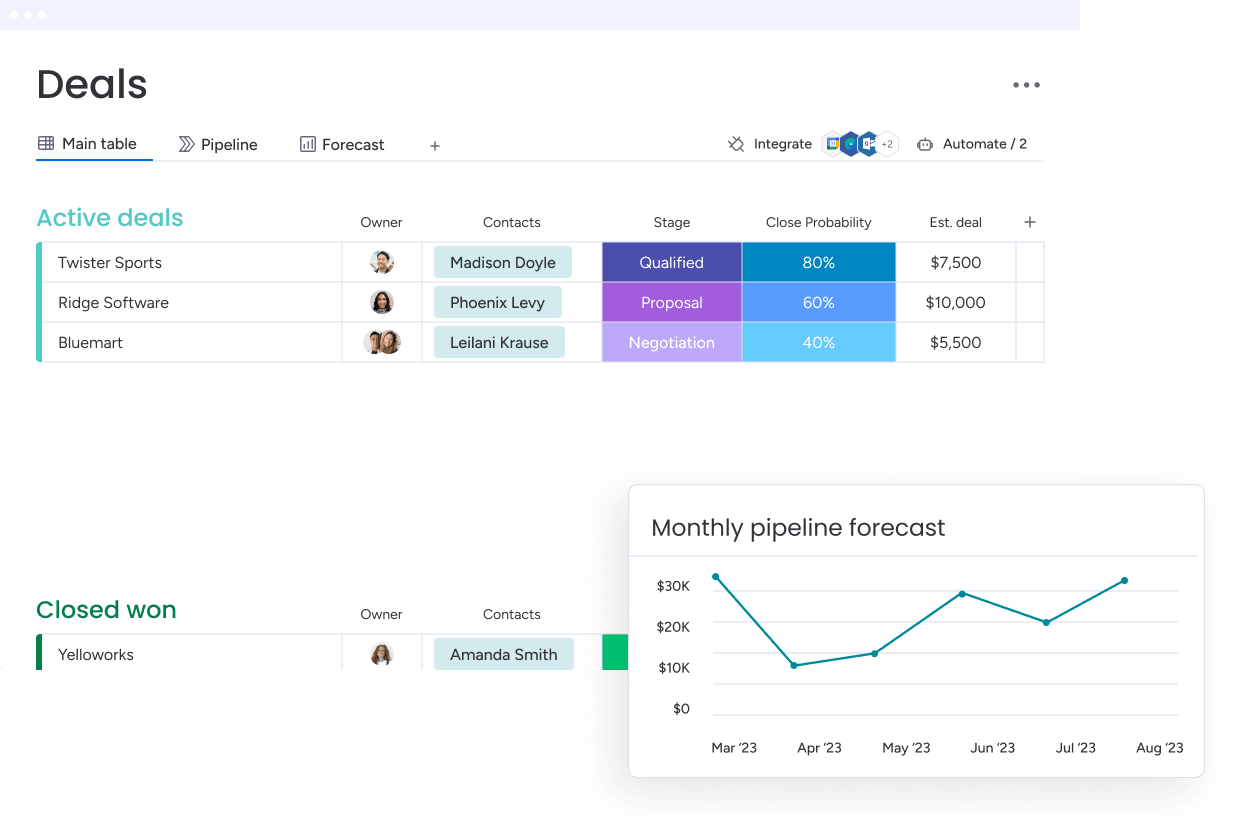
Lead source data shows you patterns: which sources convert, how long deals take, how big they close. Sales leaders can predict future revenue more accurately when they understand which sources consistently produce deals and how long those deals typically take to close.
Knowing that webinar leads convert faster than cold outreach leads helps with pipeline planning. If you need to hit quarterly targets, you know to prioritize webinar promotion in the preceding months. You’ll spot seasonal trends too — so you can ramp up when things slow down.
Maximize marketing ROI and budget allocation
Track lead sources and you’ll see which marketing channels pay off. Calculate cost-per-lead and CAC by source — then follow the money. Teams can make data-driven budget decisions instead of spreading resources evenly or following industry trends.
Discovering that content marketing generates leads at half the cost of paid advertising might shift budget allocation toward content creation and SEO. Show executives exactly which investments drive revenue. That’s how you defend your budget.
Revenue teams find that monday CRM’s customizable dashboards make it easy to visualize ROI by source and share insights across the organization.
Accelerate lead quality and conversion rates
Tracking lead sources helps identify which channels produce the highest-quality prospects based on conversion rates, deal sizes, and customer lifetime value. Sales teams can prioritize their time by focusing on sources that historically convert at higher rates or generate larger deals.
Enable predictable revenue growth
Track consistently and patterns emerge. You’ll know what to do when it’s time to scale. Connect marketing to sales outcomes and planning gets easier. So does deciding where to put your resources.
Reliable lead source data creates alignment across sales and marketing. It replaces assumptions with shared insight and gives teams a clear path to scale what works.

How to track lead sources in your CRM system
Proper lead source tracking requires both technical configuration and team training to ensure data quality. Set it up right and it’s gold. Mess it up and you’re stuck with garbage data.
Here’s five easy steps to follow that will help you track lead sources accurately in your CRM:
Step 1: map your lead source categories
Create a comprehensive list of all current and planned lead sources before setting up tracking in your CRM as part of your lead management system. Get sales and marketing in the room. You need both perspectives so nothing falls through.
Use consistent naming conventions that balance granularity with simplicity. Good naming conventions include the channel, campaign, and timeframe: “Webinar_ProductDemo_Q42024” identifies the source at a glance. Bad naming? Abbreviations and vague labels nobody understands.
Create a hierarchy that groups related sources:
- Channels: paid advertising.
- Sources: Google Ads.
- Campaigns: Q4 product launch.
Now you can zoom in or out depending on what you need to see.
Step 2: automate lead source capture
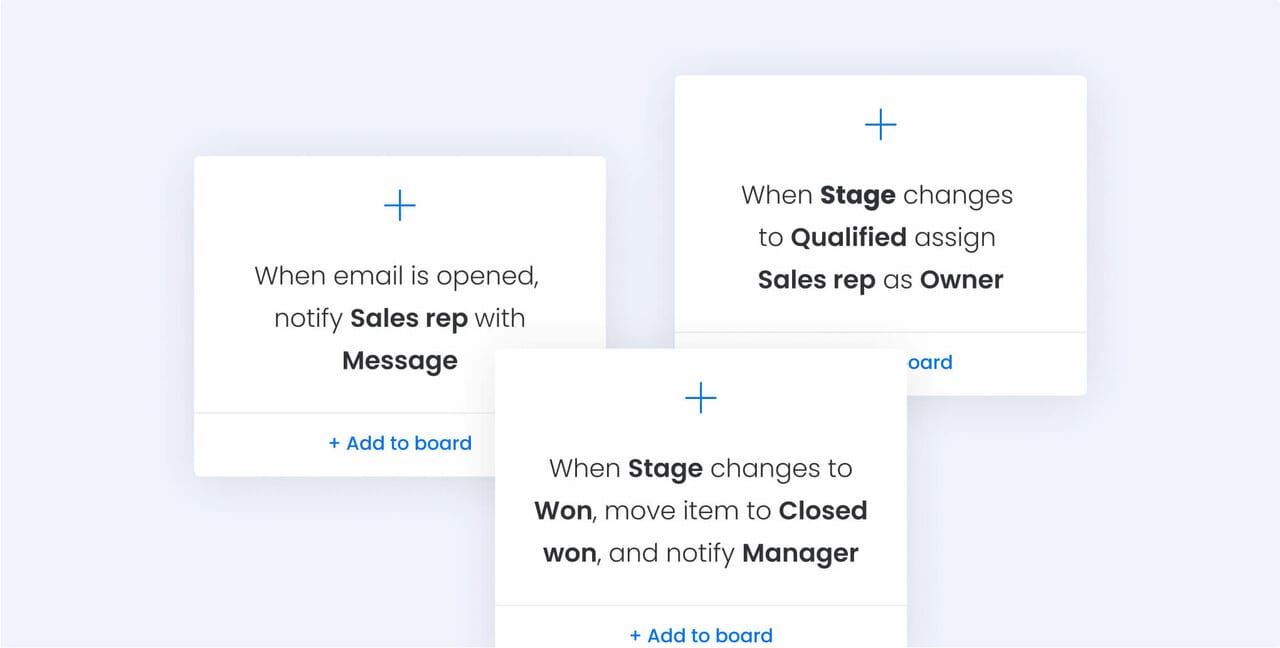
Automate source tracking with form fields, UTM parameters, and CRM integrations. Less manual entry, fewer mistakes. Capture source data at the moment of first contact.
Use hidden form fields on landing pages that automatically populate with UTM parameter values from the URL. When prospects click a link from an email campaign, the form captures the source without requiring them to select it manually.
Teams using monday CRM can collect leads via website forms, social ad campaigns, or other sources with automated capture.
Step 3: implement smart lead scoring
Assign different point values to leads based on their source, reflecting the historical quality and conversion rates of each channel through lead scoring. Scoring tells your team who to call first. No guesswork, just data.
Weight sources based on data. If referral leads convert at 45% while cold outreach converts at 12%, assign referral leads 3x the points. Layer in company size, job title, and engagement behavior. Now you’re prioritizing like a pro.
With monday CRM, AI helps you instantly understand lead quality by analyzing source data and engagement patterns, so your team can focus on the prospects most likely to convert. The platform’s autofill features use AI to detect sentiment, extract information, and assign the right people to the right leads for optimal resource allocation.
Step 4: configure multi-touch attribution
Track multiple touchpoints in the customer journey, not just the first or last interaction. B2B deals don’t close in one call. They take weeks, sometimes months, with dozens of touchpoints.
Set up systems that capture all significant interactions between initial contact and closed deal:
- Track email opens.
- Monitor content downloads.
- Record webinar attendance.
- Log demo requests.
- Note pricing page visits.
Configure your CRM to maintain a complete interaction history that shows the sequence and timing of touchpoints. Short sales cycle? First-touch or last-touch might work. Long, complex B2B deals? You need multi-touch. For long sales cycles, multi-touch attribution provides the most complete picture of what influences buying decisions.
Step 5: launch real-time reporting
Build dashboards that show lead source performance in real time. Reps, managers, and execs all need different views. Sales reps need daily views of their pipeline by source, managers need weekly performance summaries, and executives need monthly ROI analysis.
Key metrics to track in real-time:
- Lead volume by source: see which channels generate the most opportunities.
- Conversion rates at each stage: identify where leads from different sources drop off.
- Average deal size: understand which sources drive larger deals.
- Sales cycle length: know which sources close faster.
- Cost per acquisition: calculate true ROI for each channel.
It’s also important to configure alerts for significant changes so stakeholders receive immediate notification when a previously strong source suddenly drops in quality or volume.
Try monday CRM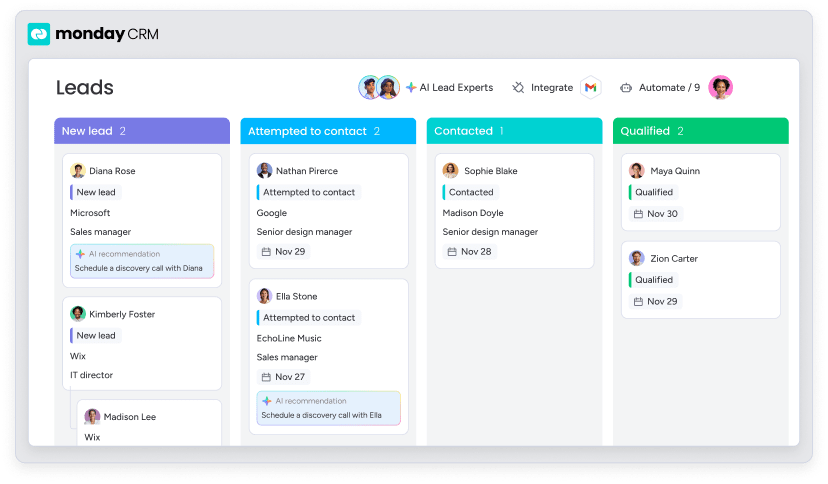
7 lead source management strategies for revenue teams
Lead source management isn’t set-it-and-forget-it. You’ve got to stay on it. Use these strategies and your tracking gets better over time — cleaner data, aligned teams, stronger results.
Stick with these and your tracking scales as you grow.
Strategy 1: create consistent source naming conventions
Standardized naming across all systems and team members prevents the data fragmentation that makes analysis impossible. Inconsistent naming leads to situations where “Webinar,” “webinar,” “Web,” and “WEBINAR” all appear as separate sources in reports.
Create a naming convention document that includes:
- Templates for different source types.
- Examples of proper usage.
- Rules for campaign naming.
Train all team members who create campaigns or enter lead data on proper usage. Assign one person as the naming convention owner who approves new source names before they’re used.
Strategy 2: deploy multi-touch attribution models
Don’t give all the credit to one touchpoint. Most buyers hit multiple channels before they convert. Single-touch attribution creates blind spots by ignoring most of the buyer’s journey.
Choose the right model based on your sales cycle length and complexity:
- Short sales cycles: first-touch or last-touch attribution might work fine.
- Long, complex B2B sales cycles: multi-touch attribution is essential.
Strategy 3: measure quality alongside quantity
Volume’s not everything. Track quality too, or you’ll waste time chasing leads that never close. 1,000 leads at 2% conversion? That’s 20 deals. 100 leads at 30%? That’s 30 deals. Quality wins.
Key quality indicators to monitor:
- Conversion rates at each pipeline stage: which sources move through the funnel smoothly?
- Average deal size: which sources generate enterprise vs SMB deals?
- Sales cycle length: which sources close quickly vs require extensive nurturing?
- Customer lifetime value: which sources produce loyal, expanding customers?
- Customer retention rates by source: which sources generate customers who stay.
Focus on revenue per source, not just lead count.
Strategy 4: unite sales and marketing definitions
Get sales and marketing on the same page about definitions and tracking. It kills disputes and bad decisions before they start. Create shared definitions for every lead source that both teams agree on.
Hold regular review meetings where sales and marketing:
- Examine lead source data together
- Discuss attribution questions
- Refine definitions as needed
Same data, same definitions. Now both teams can actually optimize the funnel together. Teams using solutions like monday CRM benefit from centralized data that both departments can access and trust.
Strategy 5: optimize sources through quarterly reviews
Review performance quarterly. Look for trends, opportunities, and problems before they cost you. Quarterly’s the sweet spot — enough data to see patterns, not so long that bad sources burn your budget.
Examine performance data across multiple dimensions:
- Lead volume trends.
- Conversion rate changes.
- Deal size evolution.
- Sales cycle shifts.
- Cost per acquisition movements.
Create action plans based on findings.
Strategy 6: harness AI for predictive lead insights
AI spots patterns in your data that you’d never catch manually. It predicts which sources will perform before you waste budget. Feed AI your deal history and it’ll tell you which sources work best when the market shifts.
The AI capabilities in monday CRM analyze lead patterns automatically, providing predictive insights that help teams prioritize high-value prospects. The platform’s AI can:
- Summarize communication timelines.
- Compose emails.
- Auto-fill columns based on source data and engagement history.
Strategy 7: build your lead source playbook
Write down what works. Build a playbook so new team members don’t have to guess. Include:
- Naming conventions.
- Tracking procedures.
- Quality standards.
- Optimization strategies.
Keep the playbook updated as you learn and evolve. Reference it during onboarding and training. Review it quarterly during performance reviews to add new learnings and remove outdated practices.
Common lead source tracking pitfalls and how to avoid them
These mistakes might look small at first. However, give them time and they’ll wreck your visibility into what’s working. Avoid these pitfalls below and your tracking actually works. Miss them and you’re flying blind.
Single-touch attribution blindness
Relying only on first-touch or last-touch attribution creates an incomplete picture of the customer journey and leads to poor investment decisions. First-touch attribution says organic search drives everything. So you pour money into SEO and ignore the webinars and calls that close deals. Bad move.
The solution: implement multi-touch attribution that shows the complete journey. Prospects might discover you through organic search, engage with multiple content pieces, attend a webinar, and finally convert after a sales call. Multi-touch attribution reveals that all these touchpoints contributed to the outcome.
Volume over quality obsession
Focusing solely on lead quantity metrics without considering quality leads to poor resource allocation and disappointing ROI. A surge in lead volume might seem like a win, but if conversion rates drop and deals take longer to close, the initial success is misleading.
The solution: track quality metrics alongside volume. Monitor conversion rates, deal sizes, sales cycle length, and customer lifetime value by source. Optimize for revenue per source, not lead count. Revenue teams using monday CRM can create custom dashboards that highlight quality metrics, ensuring teams focus on what drives revenue rather than vanity metrics.
Chaotic naming conventions
Messy naming conventions? Good luck analyzing anything accurately. Your reports become a mess — dozens of tiny sources, zero useful patterns.
The solution: establish and maintain naming standards from the start. Review source names quarterly to identify and consolidate variations.
Missing offline source data
Skip offline sources — events, calls, referrals — and you’ve got blind spots everywhere. Miss offline sources and they vanish from your data. Or worse, they get credited to the wrong channel.
The solution: implement systems to capture offline source data consistently:
- Use unique phone numbers for different campaigns.
- Train sales reps to ask “How did you hear about us?” during initial conversations.
Disconnected revenue attribution
Don’t connect sources to revenue and you’ll never know real ROI. Teams track leads by source but can’t answer “Which sources generate the most revenue?”
Lead source tracking breaks down when teams overlook the basics. Fixing those gaps early is what keeps data usable as your pipeline grows.
Essential lead source metrics for sales success
Track what predicts the future (leading indicators) and what shows results (lagging indicators). You need both. These metrics tell you where to optimize and where to invest.
Know which metrics matter and you’ll track what actually moves the business.
Source-specific conversion rates
Conversion rates show how many leads move to the next stage. Calculate them by source. Track conversions at every stage. You’ll see where each source crushes it — and where it falls apart.
Calculate conversion rates by dividing the number of leads that reach the next stage by the total number of leads from that source. Use conversion rate data to:
- Set realistic pipeline targets.
- Allocate sales resources effectively.
Customer acquisition cost by channel
CAC is what it costs to land a customer through each source — marketing, sales time, overhead, all of it. Calculate CAC by dividing total costs by the number of customers acquired.
Compare CAC to customer lifetime value (LTV) to determine profitability:
- Healthy LTV:CAC ratio: typically 3:1 or higher.
- Account for all costs: both direct costs like ad spend and indirect costs like sales team time.
Lead velocity and pipeline speed
Lead velocity shows how fast leads move through your pipeline by source. Speed matters. It affects your forecast, your resource plan, and your cash flow.
Identify bottlenecks by comparing velocity across stages. If leads from a certain source move quickly through qualification but stall in proposal stage, investigate why. Teams using platforms like monday CRM can visualize pipeline velocity with customizable widgets that show exactly where leads slow down.
Revenue attribution by source
Revenue attribution shows which sources actually make money. It’s the metric that matters most. Track revenue attribution over time to understand:
- Source performance trends.
- Seasonality patterns.
Compare attributed revenue to costs to calculate ROI. Use this data to make informed decisions about budget allocation and resource investment.
Lead-to-customer success ratio
This metric goes beyond conversion. It tracks whether customers from each source stick around and succeed. Track customer success metrics by source including:
- Retention rate after a year.
- Average customer lifetime value.
- Expansion revenue percentage.
- Customer satisfaction scores.
Use this data to optimize beyond acquisition — all the way through the customer’s life with you. A source that brings customers who stay and grow? Invest more, even if the conversion rate looks average.
How AI and automation revolutionize lead source management
Artificial intelligence and automation technologies transform how sales teams track, analyze, and optimize their lead sources by processing more data, identifying patterns humans might miss, and taking action faster than manual processes allow. These technologies eliminate the manual burden of lead source tracking while providing deeper insights than traditional methods.
Modern AI capabilities make sophisticated lead source analysis accessible to teams without data science expertise.
Instant lead scoring and smart prioritization
AI automatically scores leads based on source data, historical performance, and behavioral signals, helping sales teams prioritize their follow-up efforts without manual analysis. AI scoring considers dozens of factors simultaneously including:
- Source quality based on historical conversion rates.
- Engagement behavior.
- Company fit criteria.
- Timing signals.
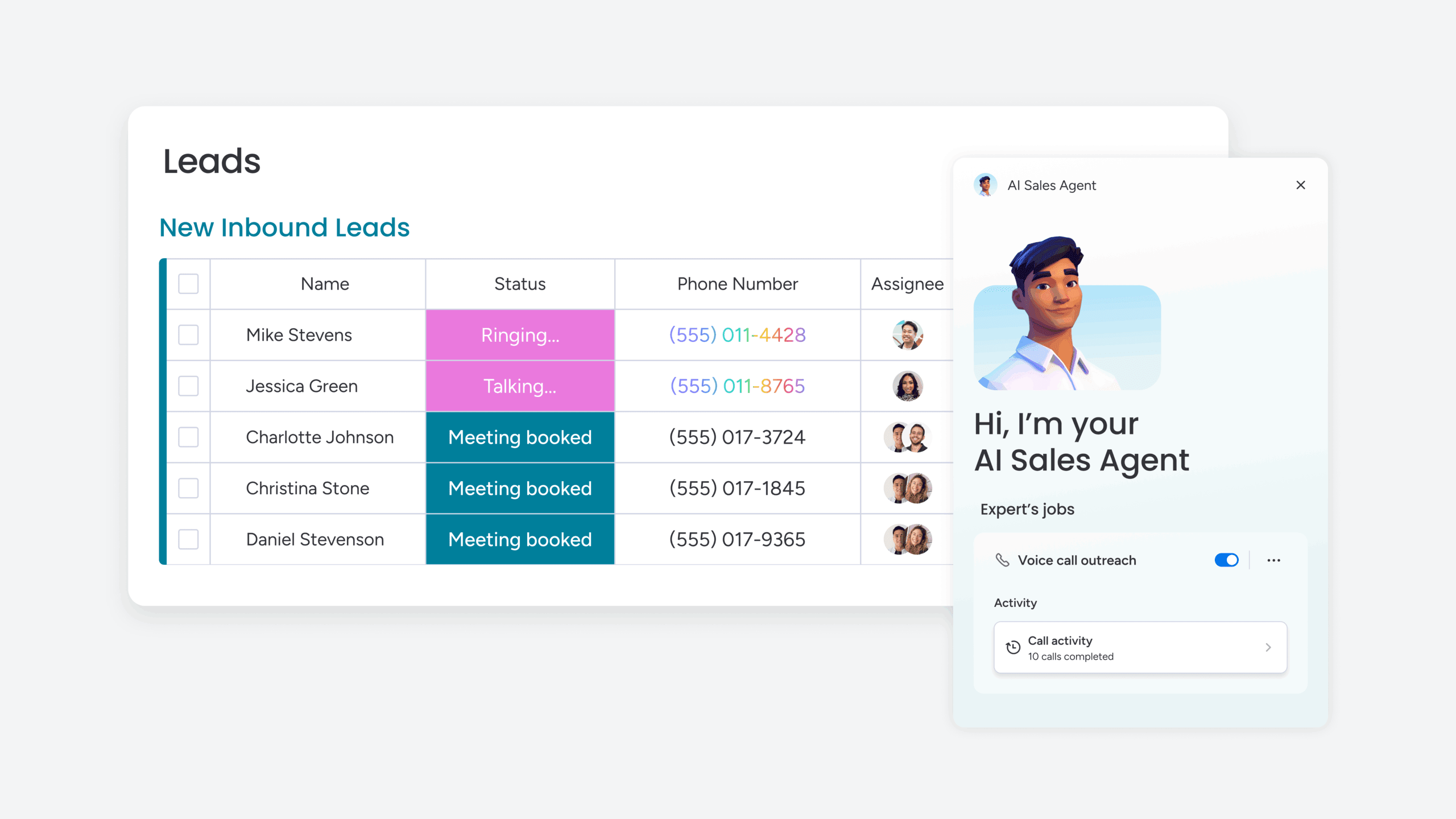
The AI-powered capabilities in monday CRM include the ability to assign labels and assign people automatically based on source data and defined criteria. The platform’s AI analyzes patterns to identify high-value prospects, ensuring sales reps always focus on the most promising opportunities.
Predictive analytics for source optimization
AI analyzes historical data to predict which lead sources will perform best under different conditions, helping teams optimize their marketing mix and resource allocation proactively. Predictive models identify patterns that humans miss in large datasets including:
- Seasonal trends.
- Market condition impacts.
- Source combinations that work best together.
The AI continuously monitors actual performance against predictions, refining its models as it learns. When predictions don’t match reality, the system investigates why and adjusts future forecasts accordingly.
Automated multi-stakeholder attribution
AI automatically tracks and attributes complex, multi-touch customer journeys without manual intervention, providing more accurate attribution data while reducing administrative burden. The system tracks every touchpoint automatically including:
- Website visits.
- Content downloads.
- Email engagement.
- Webinar attendance.
- Sales calls.
- Demo requests.

“With monday CRM, we’re finally able to adapt the platform to our needs — not the other way around. It gives us the flexibility to work smarter, cut costs, save time, and scale with confidence.”
Samuel Lobao | Contract Administrator & Special Projects, Strategix
“Now we have a lot less data, but it’s quality data. That change allows us to use AI confidently, without second-guessing the outputs.”
Elizabeth Gerbel | CEO
“Without monday CRM, we’d be chasing updates and fixing errors. Now we’re focused on growing the program — not just keeping up with it."
Quentin Williams | Head of Dropship, Freedom Furniture
“There’s probably about a 70% increase in efficiency in regards to the admin tasks that were removed and automated, which is a huge win for us.“
Kyle Dorman | Department Manager - Operations, Ray White
"monday CRM helps us make sure the right people have immediate visibility into the information they need so we're not wasting time."
Luca Pope | Global Client Solutions Manager at Black Mountain
“In a couple of weeks, all of the team members were using monday CRM fully. The automations and the many integrations, make monday CRM the best CRM in the market right now.”
Nuno Godinho | CIO at VelvTransform your lead tracking with smart CRM technology
Lead source tracking only works when it’s consistent, visible, and reliable. When teams rely on spreadsheets or manual entry, tracking quickly becomes fragmented and error-prone. Modern CRM platforms turn lead source data into a system teams can trust — one that supports real decisions instead of creating friction.
Teams that invest in proper lead source tracking see measurable gains across forecasting, prioritization, and revenue planning. With monday CRM, lead source data is captured automatically, enriched with AI, and made visible across the entire sales pipeline.
-
Clear visibility at every stage: see lead sources directly in the pipeline so teams can spot patterns, bottlenecks, and high-performing channels without digging through reports.
-
Consistent data without manual work: automate source capture, updates, and handoffs to eliminate naming errors and incomplete records.
-
Actionable insights powered by AI: identify which sources convert faster, produce larger deals, or require more nurturing without manual analysis.
-
Views tailored to every role: sales reps, managers, and revenue leaders each see the lead source data that matters most to them, without unnecessary noise.
By combining automation, AI-driven insights, and visual pipeline management, monday CRM turns lead source tracking from a maintenance task into a reliable input for smarter decisions — helping teams focus less on fixing data and more on growing revenue.
Try monday CRMFrequently asked questions
How do you identify the original source of a lead?
The original lead source is identified by tracking where a prospect first discovered or engaged with your business, typically captured through form fields, UTM parameters, or CRM integrations at the moment of first contact.
What is the most effective lead source for B2B sales teams?
The most effective lead source varies by industry and business model, but referrals and organic search typically generate the highest-quality leads with the best conversion rates and largest deal sizes.
How many lead sources should a company track?
Most companies should track 8-15 distinct lead sources to balance useful granularity with manageable complexity, focusing on sources that generate meaningful volume or high-value prospects.
Can you change a lead source after initial assignment?
While lead sources can technically be changed in most CRM systems, it's generally not recommended as it compromises data integrity and historical analysis that teams rely on for optimization decisions.
What is the difference between first-touch and multi-touch attribution?
First-touch attribution credits only the initial source where a prospect was discovered, while multi-touch attribution recognizes multiple interactions throughout the customer journey and distributes credit across touchpoints.
How do you track lead sources from offline marketing efforts?
Offline lead sources can be tracked through unique phone numbers for different campaigns, promotional codes that prospects mention, dedicated landing pages with specific URLs, or by training sales teams to ask prospects how they heard about the company during initial conversations.
How does monday CRM simplify lead source tracking compared to other platforms?
monday CRM uses visual pipelines and automated workflows to capture and display lead source data without requiring complex technical setup, making it easier for teams to maintain consistent tracking and gain actionable insights through AI-powered analytics.

 Get started