


Your customers are telling you exactly what they need to close, renew, and expand — but only if you have the right systems to capture it. When feedback flows through the right channels and reaches the right teams at the right time, revenue teams can turn customer voices into pipeline wins, stronger renewals, and expansion opportunities.
This guide covers 8 voice of the customer practices that connect feedback directly to revenue outcomes. You’ll learn how to set revenue-focused VoC goals, capture feedback across every touchpoint, use AI to surface insights automatically, and build workflows that turn customer intelligence into action — all from a single platform that keeps sales and customer success aligned.
Key takeaways
- Tie VoC to revenue metrics like churn rate, win rate, or forecast accuracy, so your team knows exactly what to act on.
- Capture feedback at every stage, including objections on discovery calls, support ticket themes, and renewal conversations.
- Segment feedback by account value and deal stage and prioritize accordingly to protect your most important revenue.
- Centralize feedback and automate follow-through with a unified platform with AI-powered sentiment detection, automatic routing, and real-time dashboards.
- Always close the loop, because customers who feel heard renew and expand and teams who track VoC outcomes build the proof needed to keep the program funded and growing.
What is voice of the customer for revenue teams?
Voice of the customer (VoC) for revenue teams is the systematic practice of capturing, analyzing, and acting on customer feedback across the entire revenue journey. It starts at first contact and runs through renewal and expansion — way beyond traditional satisfaction surveys or annual NPS scores.
For sales, customer success, and revenue operations teams, VoC encompasses every signal that reveals what customers think, need, and experience. These signals include:
- Objections raised during discovery calls
- Feature requests logged in support tickets
- Sentiment shifts detected in email threads
- Usage patterns that indicate adoption or disengagement
Each signal can change how you prioritize deals, retain customers, and spot expansion plays.
VoC works as a revenue intelligence layer. It connects what customers say, what they do, and what they need with how revenue teams allocate resources, forecast outcomes, and prioritize actions. The goal isn’t to collect more feedback. It’s to turn customer voices into predictable revenue actions.
Learn more: Revenue vs sales
How VoC connects sales, service, and success
Voice of the customer connects pre-sale, post-sale, and support functions. This gives every team access to complete, shared information. Without it, teams face misaligned expectations, repeated conversations, and missed opportunities. Here’s how it works:
- Sales captures objections and requests: A prospect mentions a competitor feature during discovery. The rep logs it in the CRM with context about why it matters to the deal.
- Customer success addresses gaps proactively: During onboarding, the success manager sees the logged concern and addresses it before the customer raises it again.
- Support escalates patterns: The support team notices the same feature gap appearing in multiple tickets. They escalate to product with quantified demand, not just anecdotal complaints.
- Product and marketing close the loop: Product prioritizes the feature. Marketing creates content addressing the specific example. The customer renews and expands because they see their feedback reflected in the roadmap.
This loop prevents churn by catching concerns before they escalate. It creates expansion opportunities by surfacing unmet needs and reduces friction across handoffs because every team knows what customers actually care about.
How customer voices shape the revenue journey
Customer feedback influences decisions at every stage of the revenue journey. Knowing which signals matter at each stage helps teams act fast and smart.
| Revenue stage | VoC signals | Revenue actions enabled |
|---|---|---|
| Prospecting/qualification | Lost deal feedback, competitor mentions, objection themes | Refine targeting criteria, adjust messaging, update ideal customer profile |
| Negotiation | Pricing concerns, implementation questions, stakeholder objections | Tailor proposals, involve right resources, address blockers before they stall deals |
| Onboarding | Early adoption feedback, training requests, confusion points | Flag at-risk accounts, adjust onboarding approach, identify quick wins |
| Adoption | Product usage patterns, feature requests, support ticket themes | Predict renewal likelihood, prioritize success outreach, identify product gaps |
| Renewal | Sentiment trends, QBR feedback, support interaction volume | Intervene on at-risk accounts 60+ days before renewal, prepare retention offers |
| Expansion | Feature requests, new use case mentions, positive sentiment signals | Identify upsell-ready accounts, tailor expansion proposals, time outreach appropriately |
Connect feedback at each stage to specific decisions. VoC enables decisions like “prioritize this deal for executive engagement because sentiment dropped after the demo” or “reach out to this account now because their support ticket volume tripled this month.”
Why voice of the customer matters for revenue teams
VoC directly impacts the metrics revenue leaders report on — pipeline predictability, forecast accuracy, customer retention, and expansion revenue. Each benefit below ties to a specific, measurable outcome.
Pipeline visibility
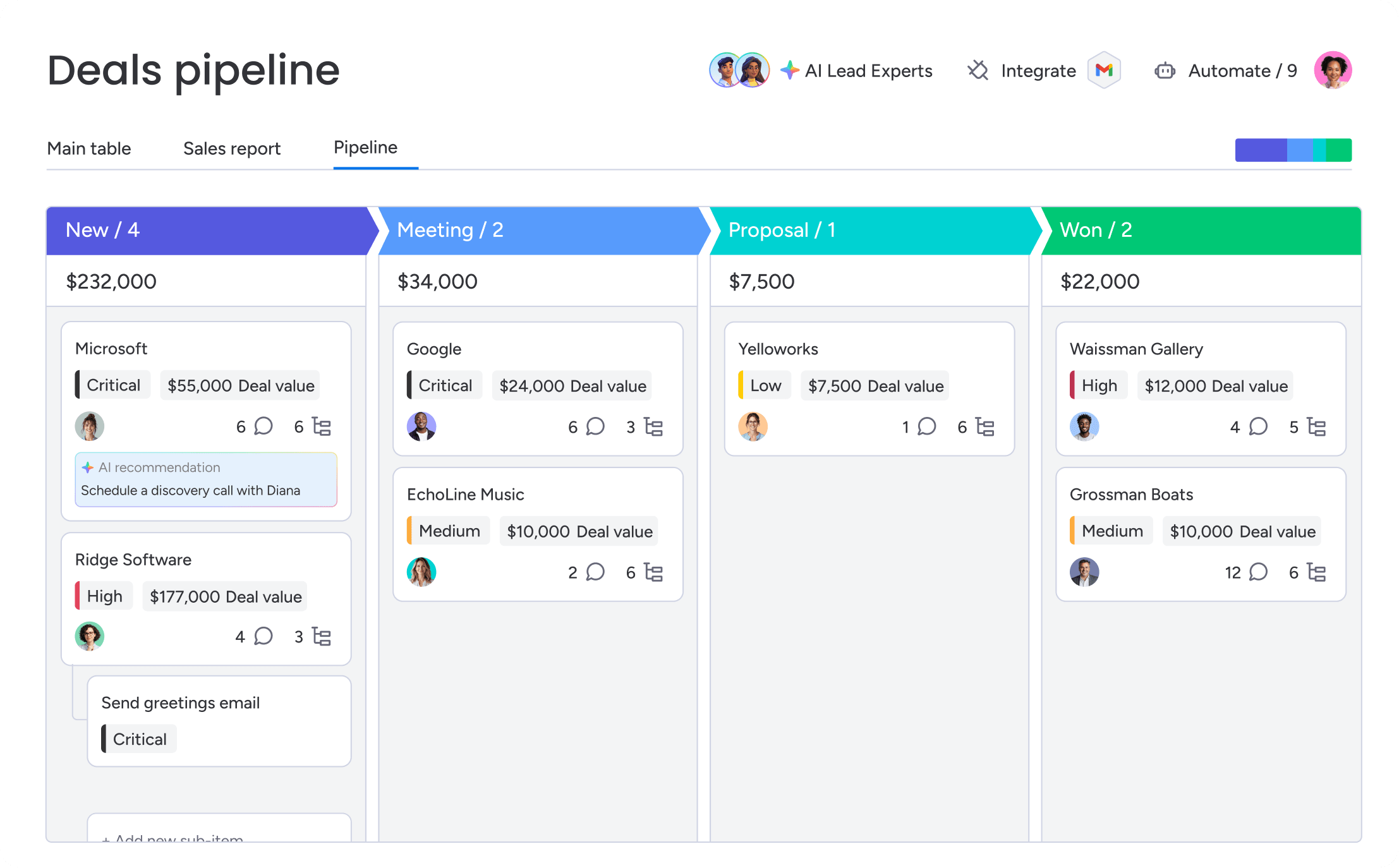
VoC improves pipeline visibility by revealing deal risks, buyer concerns, and competitive threats earlier in the sales cycle. Instead of relying only on rep-reported deal stages and probability scores, revenue leaders see what’s actually happening in each opportunity.
VoC provides signals like:
- Objection themes: Which concerns appear repeatedly across deals in the same segment or stage
- Competitive mentions: Which competitors are being evaluated and what specific comparisons prospects make
- Feature gaps: Which capabilities prospects ask about that the product doesn’t currently offer
- Stakeholder sentiment: How different buying committee members feel about the deal based on call analysis
Learn more: AI account signal agent
Sales forecasting
VoC data improves forecast accuracy by adding context to pipeline metrics. For example, a deal marked as “90% likely to close” in the CRM might look healthy based on stage and timeline — but VoC analysis of recent call transcripts could reveal unresolved concerns about pricing, implementation, or stakeholder alignment.
This layer helps revenue leaders:
- Identify deals at risk of slipping despite positive stage indicators.
- Spot opportunities more likely to close than their stage suggests.
- Make more accurate commit/upside/pipeline calls during forecast reviews.
- Reduce end-of-quarter surprises by catching warning signs earlier.
Customer retention
VoC helps revenue teams spot churn risks early by tracking sentiment trends, support ticket themes, and product usage signals. According to the PwC 2025 Customer Experience Survey, 29% of consumers say they stopped buying from a brand because of a poor customer experience.
Customer success teams use these consumer insights to prioritize outreach, address concerns early, and intervene before accounts churn. Key retention signals VoC reveals:
- Declining NPS or CSAT scores
- Support ticket volume spikes
- Product usage drops
- Negative sentiment in communications
Example: When a customer submits 4 support tickets in 2 weeks about the same feature, VoC flags the account as at-risk. Customer success reaches out within 48 hours, discovers the customer is evaluating alternatives, and addresses the concern with a workaround and roadmap update.
Expansion opportunities
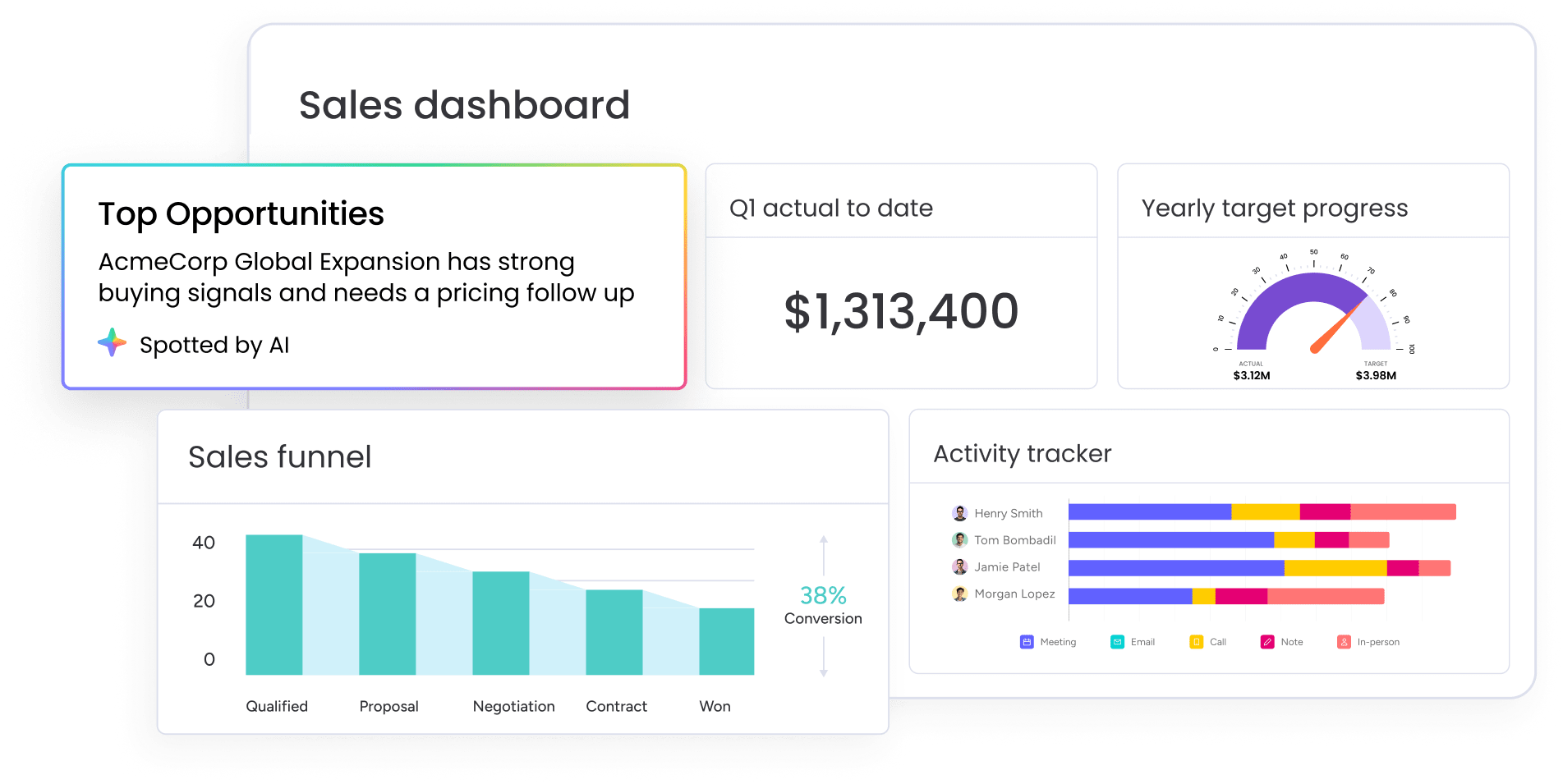
VoC helps revenue teams spot upsell and cross-sell opportunities by revealing feature requests, use case expansions, and positive sentiment signals. Instead of waiting for customers to ask about additional products or seats, revenue teams can identify accounts ready for expansion conversations.
Expansion readiness signals include:
- Feature requests for capabilities in higher tiers
- New use case mentions
- Positive sentiment trends
- High product usage
- Success stories shared voluntarily
Example: During a quarterly business review, a customer mentions they’re expanding their sales team and need to onboard 15 new reps. VoC analysis flags the account as expansion-ready, and the account manager reaches out with a tailored proposal for additional seats and training.
8 voice of the customer best practices for revenue teams
These practices help revenue teams move from collecting feedback to acting on it in ways that directly impact pipeline, retention, and expansion. Each practice addresses real challenges revenue teams face when operationalizing VoC.
1. Set revenue-focused VoC goals
A VoC strategy should be tied to specific revenue outcomes, not just customer satisfaction scores. “Improve customer experience” is too vague to drive action or measure success. Revenue teams need goals that connect VoC efforts to metrics they already own.
| Revenue goal | VoC signal | KPI to track |
|---|---|---|
| Reduce churn | Negative sentiment, support escalations, declining usage | Churn rate |
| Increase win rates | Objection patterns, competitor mentions | Sales win rate |
| Improve forecasting | Deal sentiment, stakeholder engagement | Forecast accuracy |
| Drive expansion | Feature requests, new use cases, positive sentiment | Expansion revenue |
| Improve onboarding | Adoption challenges, training requests | Time-to-value |
Here are some specific revenue-focused VoC goal examples:
- Reduce churn in accounts with <$50K ARR by 15% in Q2 by identifying and intervening on at-risk accounts 60 days before renewal.
- Increase win rates in enterprise deals by 10% by addressing the top 3 objections identified through call analysis.
- Identify $500K in expansion pipeline by analyzing feature requests and flagging accounts ready for upsell conversations.
- Improve forecast accuracy by 20% by incorporating sentiment signals into deal scoring.
Start with 1 or 2 measurable goals that match your current business priorities. Trying to improve everything at once kills focus and makes it harder to prove VoC impact.
2. Capture feedback across every customer touchpoint
Capture feedback from every interaction across the revenue journey, not just post-purchase surveys. Map all customer touchpoints and capture feedback consistently at each stage.
| Touchpoint | Feedback to capture | Who captures it |
|---|---|---|
| Sales calls | Objections, competitor mentions, feature requests, buying criteria | Sales reps |
| Demos | Product feedback, use case questions, pricing concerns, stakeholder reactions | Sales engineers, AEs |
| Support tickets | Bug reports, feature gaps, usability issues, frustration indicators | Support team |
| Onboarding | Adoption challenges, training needs, early wins, confusion points | Customer success |
| QBRs | Strategic priorities, expansion opportunities, renewal sentiment, relationship health | Customer success |
| Renewal conversations | Satisfaction levels, competitive evaluation, budget concerns | Account managers |
Eliminate gaps where you’re not capturing feedback. If prospects mention competitors during demos but that info never makes it to the CRM, you’re losing valuable competitive intelligence.
3. Pair VoC surveys with conversation data
Combining surveys with other data sources gives you the full story. A low NPS score tells you a customer is unhappy, but not why. Conversation data from calls, emails, and support interactions shows you the context behind the numbers.
Surveys give you:
- Quantifiable sentiment scores (NPS, CSAT)
- Structured responses
- Benchmarkable data over time
- Easy aggregation across accounts
Conversation data gives you:
- Unfiltered feedback in the customer’s own words
- Context about specific situations
- Objections customers don’t mention in surveys
- Sentiment signals from tone and language
monday CRM centralizes both survey responses and conversation data in 1 system. The Emails & Activities timeline shows full communication history by account, deal, or contact. AI Timeline Summary condenses long threads into key points before calls, making it easier to connect quantitative scores with qualitative context.
4. Centralize feedback in your CRM
Put VoC data in the same system where revenue teams manage deals, accounts, and customer relationships. When feedback is scattered across survey platforms, support systems, call recording software, and spreadsheets, teams waste time switching systems and miss connections.
When feedback is scattered, teams waste time and miss connections. Bringing all VoC data into the same system where you manage deals and accounts creates a single source of truth. This gives you several key advantages:
- Contextual access: Sales reps see recent support tickets and survey responses when preparing for calls.
- Account-level views: Customer success managers see all feedback for an account in 1 place.
- Cross-team visibility: Product teams can see which feature requests come from high-value accounts.
- Historical tracking: Leaders can see how sentiment has changed over time for any account.
monday CRM provides this centralized view through connected deals, accounts, contacts, and activities. Email integration captures customer communications automatically, and activity logging tracks calls, meetings, and notes in context. When a rep opens an account record, they see recent support tickets, survey responses, call notes, and email threads in 1 view.
Try monday CRM5. Segment VoC insights by account, stage, and value
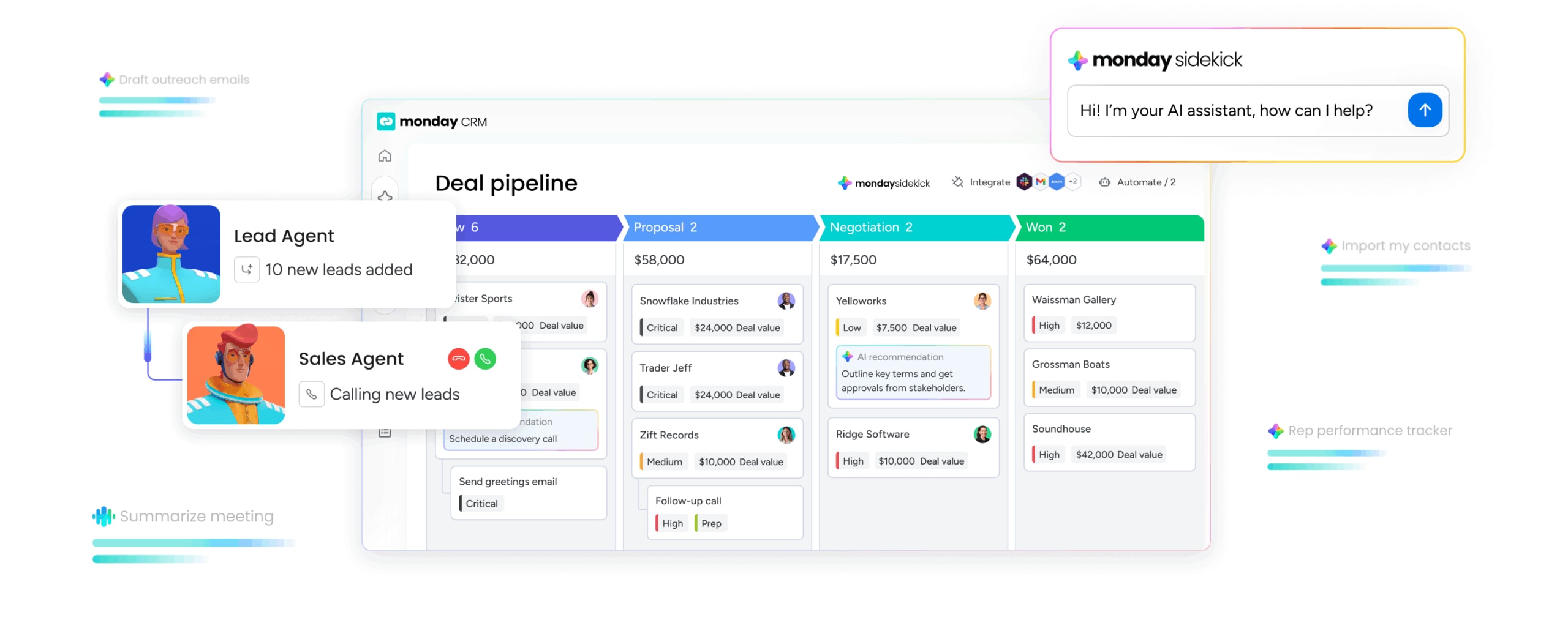
Not all feedback carries the same weight. A feature request from a $500K enterprise account carries different weight than the same request from a $5K SMB account. Segment VoC insights to prioritize which feedback to act on first.
Segment feedback by:
- Account size: Enterprise customers often have different concerns and response-time expectations than SMB customers.
- Deal stage: Prospects in negotiation need different attention than customers in adoption.
- Customer lifetime value (CLV): High-value accounts may warrant more personalized follow-up and faster response times.
- Product usage: Power users have different feedback than occasional users, and their input may be more actionable.
- Industry or segment: Feedback patterns often cluster by vertical, revealing segment-specific needs.
Segmentation helps revenue teams give high-value accounts faster responses, tailor messaging by segment, spot patterns in specific customer groups, and prioritize product feedback based on revenue impact.
6. Use AI to detect sentiment and summarize themes

AI-powered analysis allows you to process high volumes of customer feedback automatically. A revenue team might have thousands of support tickets, hundreds of call recordings, and dozens of survey responses each month. AI analysis can process this volume to detect sentiment trends and reveal recurring themes automatically.
AI capabilities for VoC analysis:
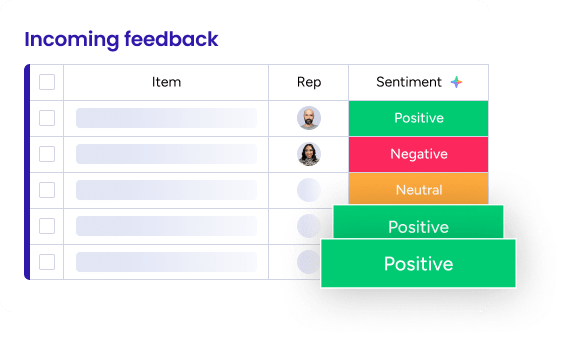
- Sentiment detection: Automatically classify feedback as positive, negative, or neutral.
- Theme extraction: Identify recurring topics across large volumes of feedback.
- Categorization: Sort feedback into predefined categories like feature request, bug report, praise, or complaint.
- Summarization: Generate concise summaries of long call transcripts or email threads.
- Trend identification: Surface changes in sentiment or theme frequency over time.
monday CRM includes AI-powered sentiment detection and categorization through its Autofill with AI feature. The Detect sentiment action determines whether text input can be categorized as Positive, Negative, or Neutral. The Assign label action categorizes feedback themes automatically, reducing the manual work of reading and categorizing feedback so teams can focus on action rather than analysis.
7. Route feedback to the right owner
VoC data only works if it reaches the right person fast. Feedback that sits in a queue or gets lost in a shared inbox doesn’t drive action. Revenue teams need workflows that automatically route feedback to the right owner based on type, urgency, and account segment.
| Feedback type | Route to | Expected action |
|---|---|---|
| Feature requests | Product team | Add to backlog, communicate roadmap to customer |
| Pricing objections | Sales enablement | Create resources, update battlecards |
| Support issues | Customer success | Proactive outreach, escalation if needed |
| Churn risk signals | Account manager | Immediate outreach, retention conversation |
| Expansion opportunities | Sales rep | Tailored proposal, upsell conversation |
| Positive feedback | Marketing | Request case study or testimonial |
Routing rules should include SLAs for response times. A churn risk signal from a high-value account shouldn’t sit in a queue for a week. monday CRM automates feedback routing through its Assign person AI action, which routes feedback to the right owner based on role, skill, or account. Automations trigger follow-up workflows when sentiment drops or themes emerge.
8. Close the feedback loop with customers and internal teams
Closing the feedback loop means 2 things. First, follow up with customers to let them know their feedback was heard and acted on. Second, make sure internal teams know what actions were taken based on VoC insights.
Close the loop with customers by:
- Acknowledging receipt of feedback within 24–48 hours
- Communicating what action will be taken (or why no action is possible)
- Following up when the action is complete
- Thanking customers for their input and inviting continued feedback
Close the loop internally by:
- Sharing VoC insights in regular team meetings or dashboards
- Documenting actions taken based on feedback
- Tracking outcomes against the metric you targeted
- Recognizing wins where VoC drove measurable results
Close the loop consistently and you’ll see higher renewal rates and stronger customer relationships. Customers who feel heard become advocates.
Voice of customer methods that go beyond surveys
Surveys are 1 way to capture VoC, but they’re not the only way. Often, they’re not even the most valuable. Revenue teams should use multiple methods for collecting customer feedback across the entire customer journey. Here are 4 approaches to build into your VoC program:
1. Go deep with 1-on-1 customer interviews
1-on-1 customer interviews provide deep insights that surveys and automated analysis can’t capture. Interviews let revenue teams explore specific pain points, validate assumptions, and uncover unmet needs through open-ended conversation. Customer success managers often conduct quarterly interviews with top accounts to understand strategic priorities and identify expansion opportunities before the customer raises them.
2. Mine sales calls and meeting notes for real-time signals
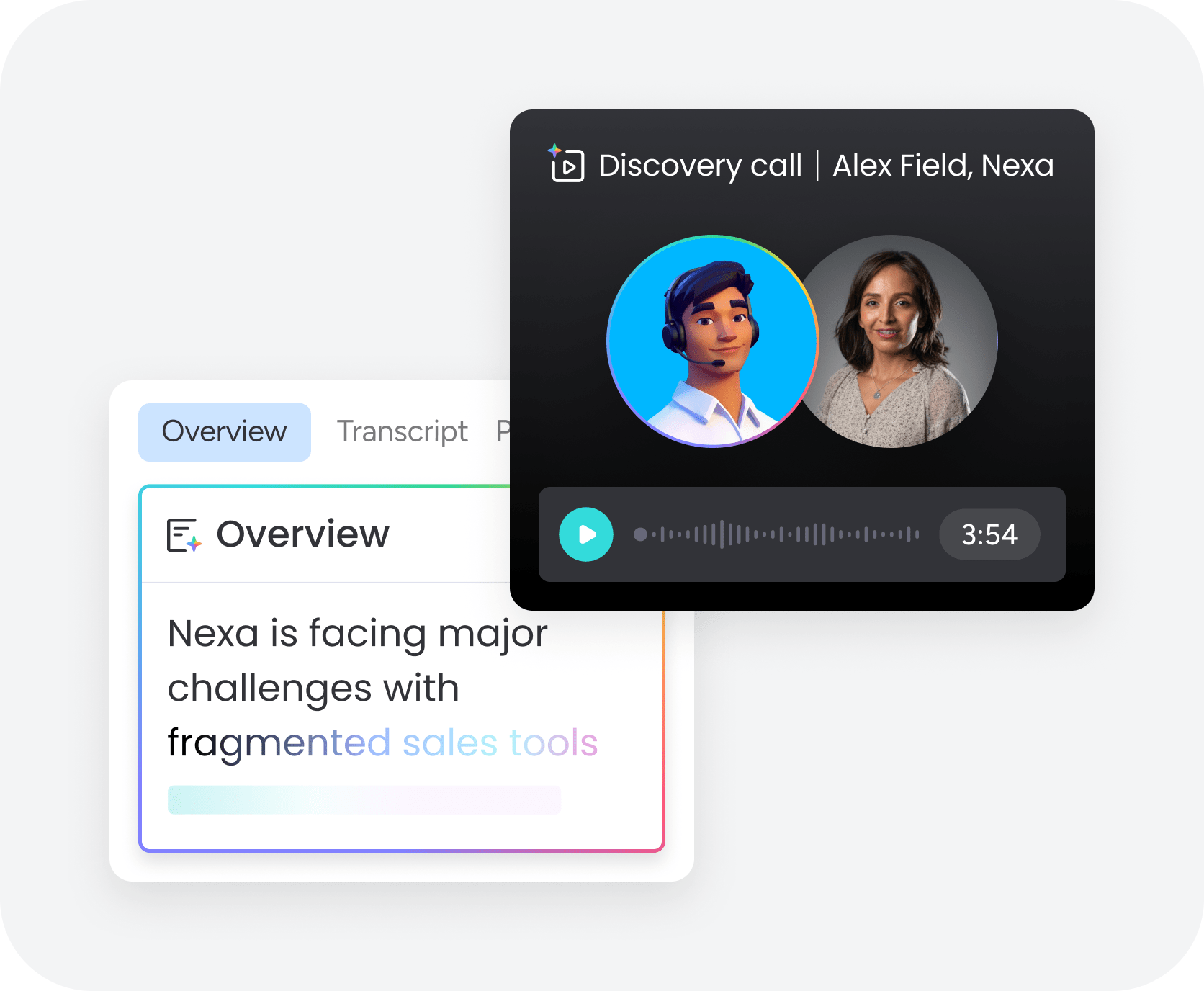
Sales calls and meeting notes capture objections, competitor mentions, feature requests, and buyer concerns in real time. This feedback is unfiltered and immediate, revealing what customers actually say rather than what they choose to write in a survey. Conversation intelligence analysis can reveal themes and sentiment at scale. Without it, valuable insights stay locked in individual rep notes or get forgotten entirely.
3. Track sentiment shifts through emails and CRM activity
Emails and CRM activity logs provide ongoing context about customer sentiment and engagement. Unlike point-in-time surveys, email threads capture how sentiment evolves throughout a relationship. Analyze email patterns to spot:
- Customers who are becoming less responsive
- Frustrated language that indicates growing dissatisfaction
- Requests or questions that signal unmet needs
- Positive feedback that indicates expansion readiness
4. Surface product gaps through support and customer success interactions
Support tickets and customer success interactions provide ongoing feedback about product issues, adoption challenges, and customer satisfaction. This feedback is often more candid than survey responses because customers are seeking help, not answering questions. Support ticket themes reveal:
- Product issues before they cause churn
- Adoption barriers that slow time-to-value
- Feature gaps that affect multiple customers
- Accounts that need proactive outreach
Learn more: AI feedback digest agent
How monday CRM supports voice of the customer programs
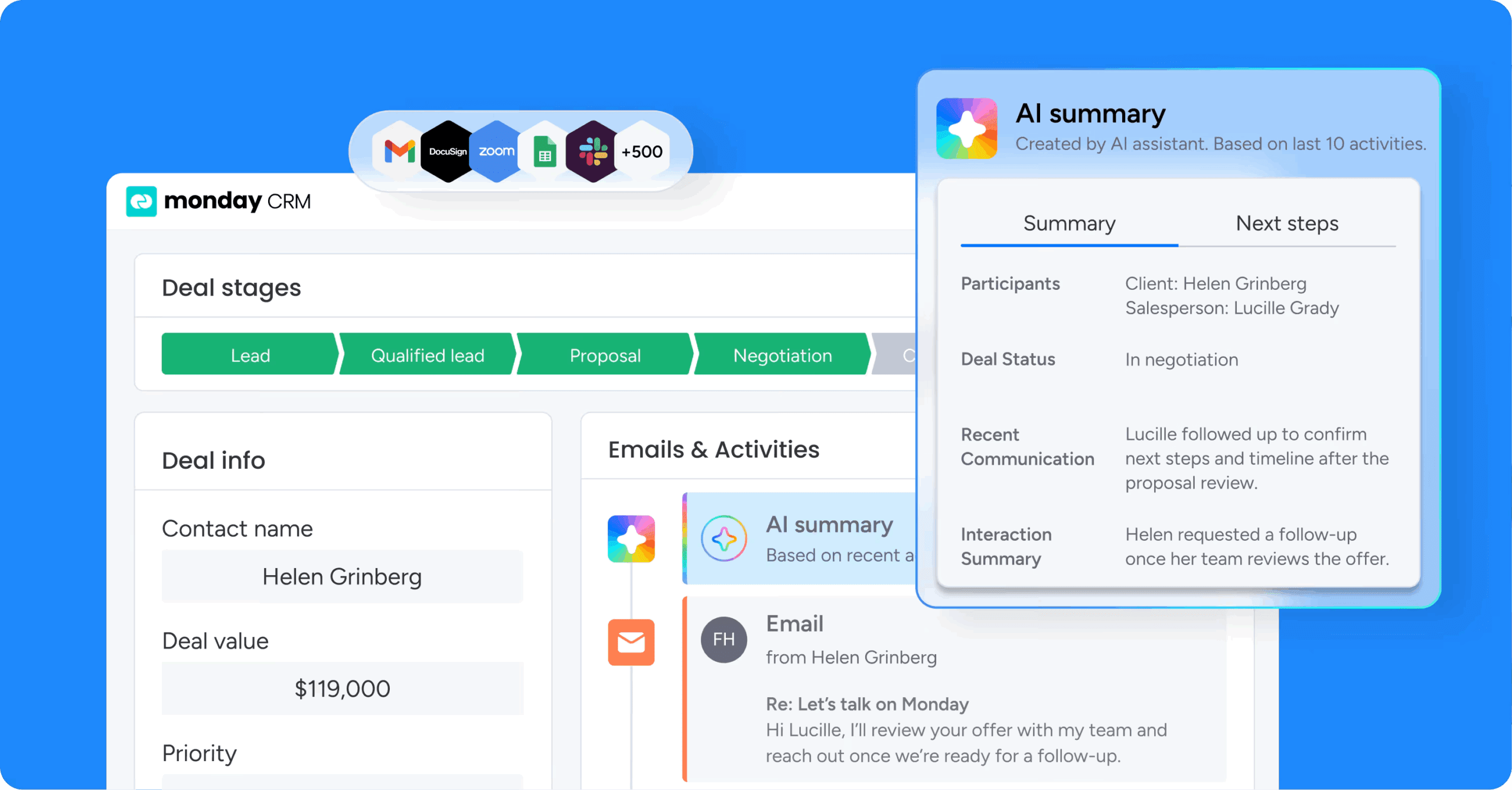
monday CRM gives revenue teams what they need to capture, analyze, and act on customer feedback across the entire revenue journey. Instead of managing VoC data across disconnected systems, teams can centralize feedback, automate analysis, and trigger follow-up actions in 1 place.
Here’s how monday CRM can support your VoC program:
- Centralized feedback capture: monday CRM connects feedback from multiple sources to account and deal records. Email integration captures customer communications automatically. Activity logging tracks calls, meetings, and notes in context. Connected deals, accounts, and contacts keep context organized.
- AI-powered sentiment detection: monday CRM’s AI capabilities analyze customer feedback to surface patterns and risks. The Detect sentiment action automatically classifies feedback as positive, negative, or neutral. The Summarize action generates concise summaries of long conversations. The Extract information action pulls key details from text.
- Automated routing and workflows: monday CRM automates the flow of feedback to the right team members. The Assign person action routes feedback to owners based on role, skill, or account. Automations trigger follow-up tasks with due dates. Status-based workflows move feedback through triage, action, and resolution stages.
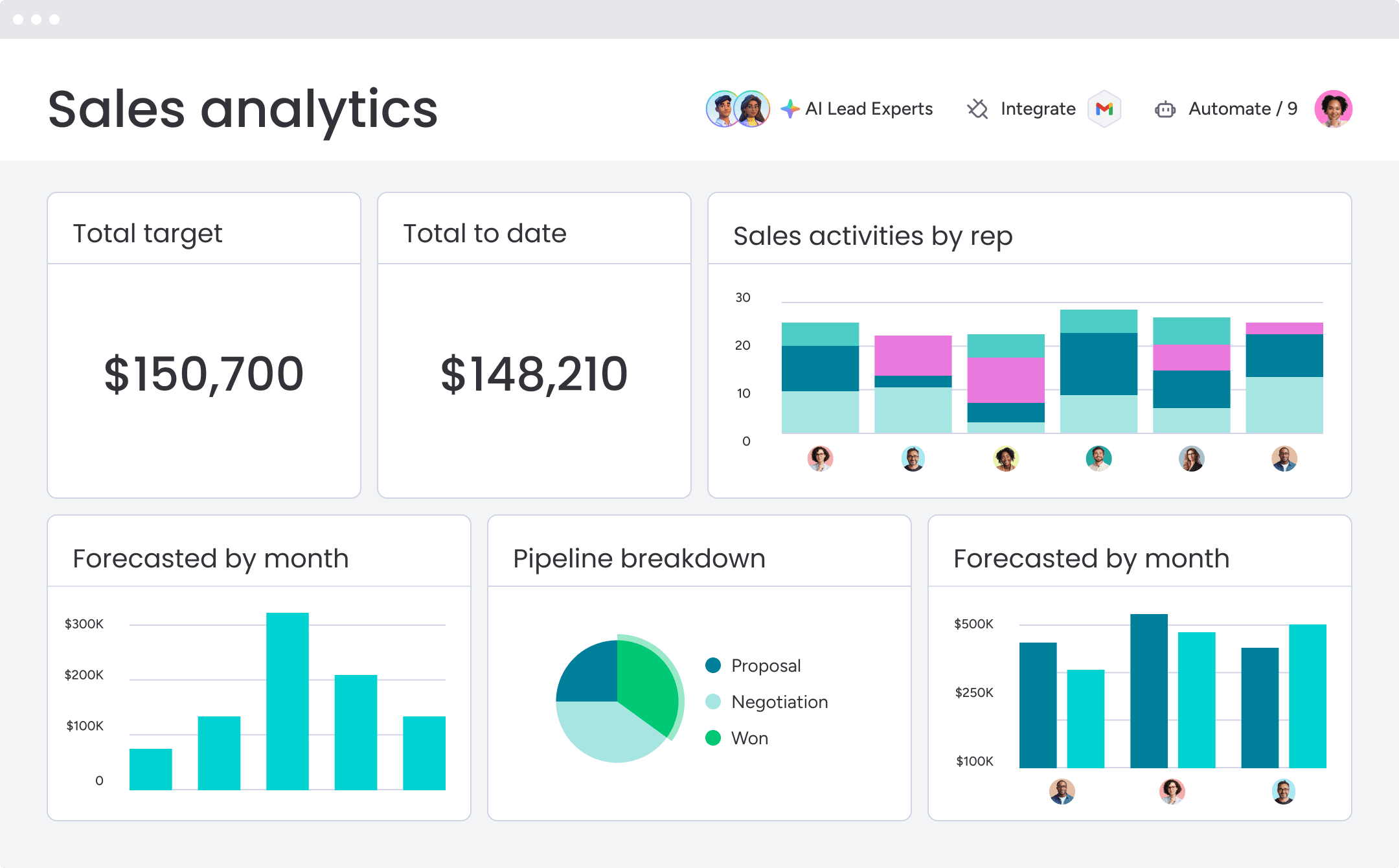
- Customizable dashboards: monday CRM dashboards visualize VoC metrics in real time. Sales-specific widgets like the leaderboard and funnel show the strong and weak points in your pipeline. Dashboards update automatically as new feedback arrives, giving revenue leaders visibility into customer sentiment without manual reporting.

“With monday CRM, we’re finally able to adapt the platform to our needs — not the other way around. It gives us the flexibility to work smarter, cut costs, save time, and scale with confidence.”
Samuel Lobao | Contract Administrator & Special Projects, Strategix
“Now we have a lot less data, but it’s quality data. That change allows us to use AI confidently, without second-guessing the outputs.”
Elizabeth Gerbel | CEO
“Without monday CRM, we’d be chasing updates and fixing errors. Now we’re focused on growing the program — not just keeping up with it."
Quentin Williams | Head of Dropship, Freedom Furniture
“There’s probably about a 70% increase in efficiency in regards to the admin tasks that were removed and automated, which is a huge win for us.“
Kyle Dorman | Department Manager - Operations, Ray White
"monday CRM helps us make sure the right people have immediate visibility into the information they need so we're not wasting time."
Luca Pope | Global Client Solutions Manager at Black Mountain
“In a couple of weeks, all of the team members were using monday CRM fully. The automations and the many integrations, make monday CRM the best CRM in the market right now.”
Nuno Godinho | CIO at Velv
“monday.com provides developmental flexibility, operational efficiency, and data transparency — all in one place. We became a company that moved from chasing data to leading with it.”
Hyunghan Lee | Team Lead, Sandbox Network
"monday.com brought every part of our business into one connected space. The harmony between work management and CRM has become our operating system — giving us the clarity and confidence to scale.”
Jennifer Chinburg | Executive Vice President of Corporate Development & Brand, Chinburg Properties
“We just weren’t getting value from our old CRM. With monday.com, it's a thousand times better. Our sales teams are more informed, more consistent, and far more connected."
James Arnold | Chief Operating Officer, CenversaTurn customer feedback into your next revenue move
The 8 practices in this article give you a way to move from scattered feedback to structured action, capturing feedback consistently, routing it to the right owners, and connecting it to specific pipeline and retention goals. Start with 1 or 2 revenue-focused goals, build the feedback capture habits across your touchpoints, and let AI do the heavy lifting on analysis.
If you’re ready to operationalize VoC, monday CRM helps your team centralize feedback, automate follow-up, and turn customer insights into predictable revenue actions.
Try monday CRMFAQs
What is voice of the customer in sales?
Voice of the customer in sales refers to the systematic capture and analysis of customer feedback throughout the sales process. This includes objections raised during discovery calls, competitor mentions during demos, feature requests in proposals, and sentiment signals in email communications.
How do you measure voice of the customer success?
VoC success is measured through revenue-focused KPIs that connect feedback to business outcomes. Key metrics include churn rate reduction, win rate improvement, expansion revenue identified through VoC signals, and forecast accuracy improvement.
What is the difference between voice of the customer and customer feedback?
Customer feedback is any input from customers, such as a survey response, support ticket, or comment during a call. Voice of the customer is the systematic program that captures, analyzes, segments, routes, and acts on that feedback to drive business outcomes.
How often should revenue teams review voice of the customer data?
The review cadence depends on the metric and the team. Churn risk signals should be reviewed daily or in real time. Objection themes and competitive intelligence should be reviewed weekly or bi-weekly.
What capabilities do revenue teams need for voice of the customer programs?
Revenue teams need capabilities that capture feedback (CRM, survey platforms, conversation intelligence), analyze feedback (AI-powered sentiment detection, theme extraction), and enable action (workflow automation, task management, dashboards).
How do you get buy-in for a voice of the customer program?
Buy-in for VoC programs comes from connecting feedback to revenue outcomes that stakeholders already care about. For sales leaders, show how VoC can improve win rates and forecast accuracy.
