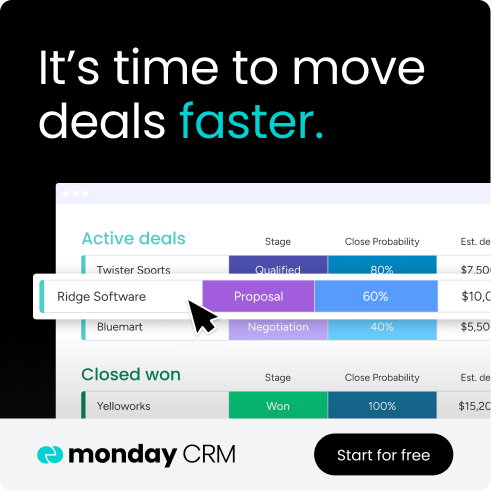
Your team pulls in 200 leads a month. Some are ready to buy. Most aren’t. Which ones should your reps call first? AI lead scoring tools answer that question by ranking every lead on how likely it is to convert, so nobody wastes a morning chasing a tire-kicker.
In this guide, we’ll break down what AI lead scoring is, how the scores get calculated, and what to weigh before you buy. Then we’ll rank 7 platforms revenue teams actually use, with honest notes on pricing and fit. We’ll also show how a flexible, AI-first CRM can score, route, and act on leads without heavy IT work. If that sounds like your kind of setup, start here.
Key takeaways
- AI lead scoring ranks leads by conversion likelihood, so reps work the highest-value prospects first.
- Scores combine explicit fit data with implicit behavioral signals, then learn from your past conversions.
- Prioritize data quality, model transparency, intent signals, and automated routing when comparing platforms.
- CRM-native scoring cuts setup time and keeps lead data in one place.
- Watch for enterprise-only gating and credit-based costs that push the real price well past the sticker.
What is AI lead scoring and how does it work
AI lead scoring is the practice of using machine learning to rank leads by how likely they are to convert. Instead of assigning points by hand, the model studies your data and predicts which leads deserve a rep’s attention first.
Every score blends two kinds of input. Explicit signals describe who a lead is: job title, company size, industry, and budget. Implicit signals describe what a lead does: pages visited, emails opened, demos booked, and replies sent. Together they turn a raw list into a ranked one.
Here’s the part that makes it “AI.” A predictive model learns from your historical conversions, spotting the patterns that separated leads who bought from leads who didn’t. If VPs at 200-person software companies who opened three emails tend to close, the model weights those traits and scores similar leads higher. As more deals close, the model retrains and its predictions sharpen.
This matters for lead qualification, because a good score tells your team when a lead is ready for a sales conversation versus more nurturing. It replaces gut feel with evidence.
The shift is already mainstream. According to McKinsey’s 2025 State of AI report, 42% of organizations now use generative AI in marketing and sales. Scoring is one of the most practical places to put that adoption to work, since it plugs directly into a workflow reps already run every day. The payoff is simple: less time triaging, more time selling.
How to choose an AI lead scoring tool
The right platform depends on your data, your team’s technical depth, and your budget. Before you compare feature lists, it helps to know what’s happening under the hood. So how is a lead score calculated?
Most AI lead scoring platforms blend two inputs: fit (how closely a lead matches your ideal customer) and engagement (how actively they interact with you). The model weights each signal based on your past conversions, then outputs a number or tier. Once you understand that, these seven criteria tell you which option earns its keep.
- Data quality and enrichment: Scores are only as good as the data behind them. Look for built-in enrichment that fills gaps automatically.
- Model transparency: You want to see why a lead scored high or low. Black-box models make coaching and compliance harder.
- CRM-native vs standalone: Native scoring keeps data in one place and cuts sync headaches. Standalone options add power but also integration work.
- Intent and behavioral signals: The strongest models read real actions across the buyer journey, not just form fills.
- Automated routing and actions: A score is only useful if something happens next. Prioritize platforms that route leads and trigger email sequences automatically.
- Pricing and total cost of ownership: Factor in seats, credits, add-ons, and onboarding fees. The sticker price rarely tells the whole story.
- Time-to-value: Some platforms need weeks of setup and thousands of historical records. Others score leads in days.
One more thing worth weighing is setup effort. Legacy systems often need a developer to configure scoring, which stalls momentum. A no-code approach, like the one on monday.com, lets revenue teams build and adjust scoring criteria themselves in minutes, so you can test what predicts conversion without filing an IT ticket.
7 best AI lead scoring tools
We ranked these seven platforms on scoring intelligence, transparency, automation, integrations, and accessibility for revenue teams. The list spans full CRMs with native AI, all-in-one prospecting platforms, and enterprise ABM systems, so there’s a fit whether you’re a lean sales team or a large RevOps org. Use the table below for a fast side-by-side, then dig into each entry for pricing and honest trade-offs. Every price reflects monthly amounts as listed by each vendor.
| Tool | Best for | AI scoring approach | Starting price |
|---|---|---|---|
| monday CRM | revenue teams wanting native AI scoring | AI agent scores fit, intent, and engagement | $12/seat/month |
| HubSpot | inbound teams already on HubSpot | predictive likelihood to close | $20/seat/month |
| Salesforce (Einstein) | enterprise Sales Cloud teams | per-org predictive model | $175/user/month |
| Zoho CRM (Zia) | value-focused SMB teams | Zia Scores from record history | $14/user/month |
| Apollo.io | outbound and SMB teams | AI Scores on CRM and prospecting data | $49/seat/month |
| Clay | technical GTM teams | custom AI scoring columns | $167/month |
| 6sense | enterprise ABM teams | account-level predictive scoring | quote-only |
1. monday CRM
Best for: Revenue teams that want native AI scoring and no-code automation without heavy technical work.
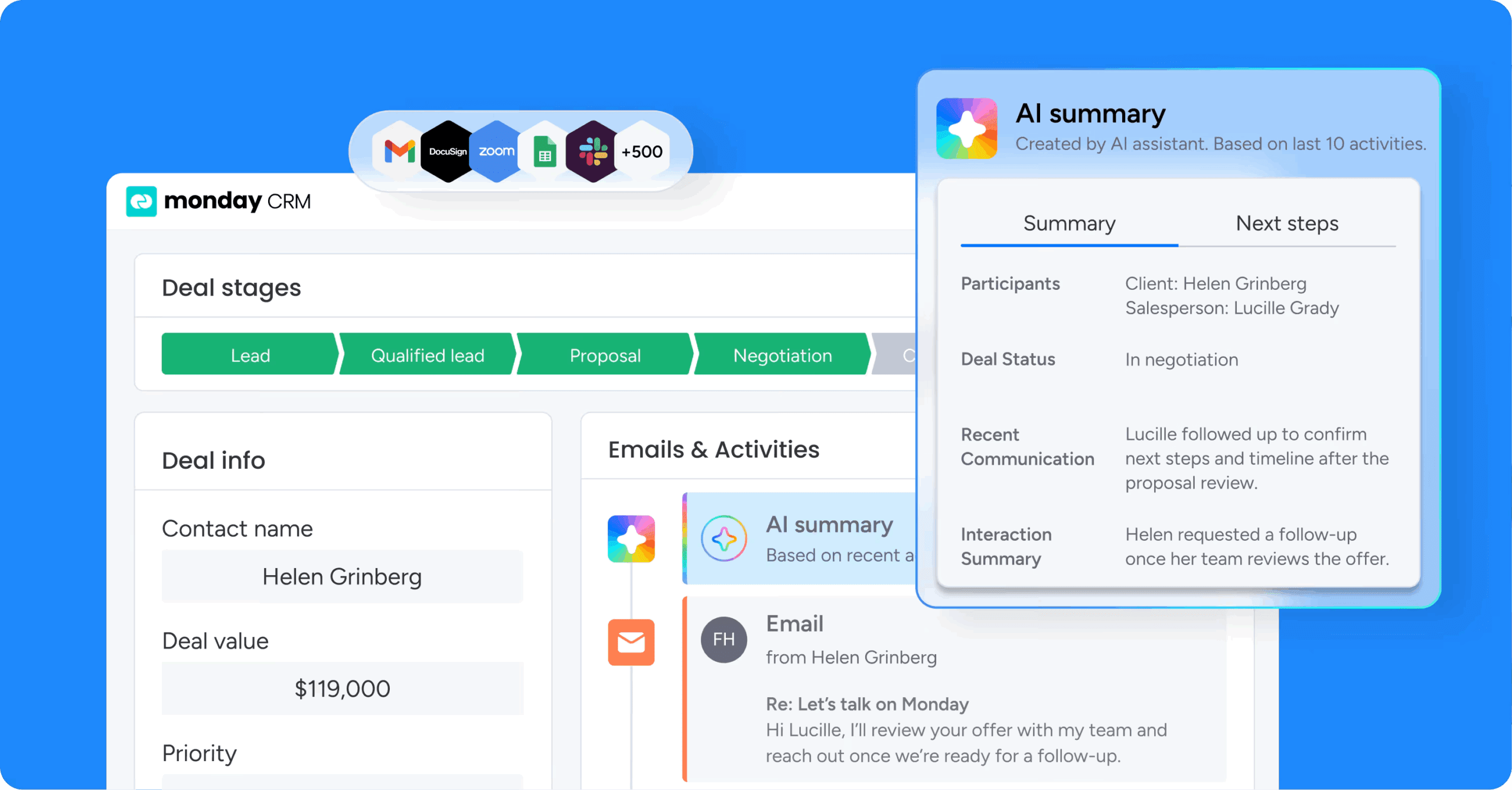
monday CRM is the AI-first, no-code CRM built on the monday.com Work OS for revenue teams. It centralizes leads, deals, and communication, then layers AI agents that score, route, and act on leads directly inside the platform.
Use case
It’s a fit for teams that want serious scoring power without the enterprise price tag or the IT project. The Lead Scorer agent ranks leads by fit, intent, and engagement, then routes them automatically when intent spikes, so your reps work the highest-value prospects first.
Key features
- Lead Scorer agent: Scores each lead on fit, intent, and engagement, then routes it to the right rep and triggers follow-ups when intent spikes.
- AI-based Deal Insights widget: Flags positive and negative signals to grade deal health automatically, so you see which deals need attention before they slip.
- monday sidekick: Context-aware assistant that drafts emails, summarizes deals, and suggests next steps.
- AI-powered data fields: Auto-fill and categorize records, while monday vibe turns any need into a custom app.
- No-code automation: Set up recipes to route leads, trigger follow-ups, and update records automatically, with up to 25,000 automations per month on Pro.
Pricing
Plans start at $18/seat/month (Basic), with Standard at $25, Pro at $41, and Ultimate quote-only. All prices reflect monthly billing, and there’s a 14-day free trial.
Why it stands out
- AI is built into flexible, no-code workflows across the full revenue cycle, not bolted on as a separate module.
- Advanced scoring and automation stay accessible without enterprise-only pricing.
- One adaptable platform covers sales, account management, and post-sale work.
2. HubSpot
Best for: Inbound-heavy teams that already run marketing and sales on HubSpot.
 HubSpot is a customer platform with a shared CRM spanning marketing, sales, and service. Its predictive lead scoring assigns each contact a likelihood-to-close percentage using machine learning trained on your own conversion history.
Use case
It’s a common pick for teams already invested in the HubSpot ecosystem who want to layer AI scoring on top of their existing inbound workflows without switching platforms.
Key features
- Likelihood to close property: Assigns each contact a 0 to 100% probability of converting within 90 days using machine learning.
- Contact priority tiers: Ranks contacts from very high to low based on the predictive model.
- Rule-based manual scoring: Available on Professional plans for teams that want to set custom point values.
Pricing
Plans start at $20/seat/month for Starter (no lead scoring), Professional at $890/month (manual rule-based scoring), and Enterprise at $3,600/month (AI predictive scoring). All prices reflect monthly billing.
Considerations
- AI predictive scoring is limited to the Enterprise tier, which starts at $3,600/month.
- Scoring is contact-centric, so account-based teams get less value from it.
3. Salesforce (Einstein)
Best for: Enterprise teams already running Sales Cloud that want AI scoring inside their existing workflow.
 Salesforce is the largest CRM by market share, and Einstein Lead Scoring is its native predictive feature. It builds a model per org from historical conversions and shows the top factors behind each score.
Use case
It’s aimed at enterprise teams that already live in Sales Cloud and want to layer AI scoring on top of their existing workflow without switching platforms.
Key features
- Einstein machine learning model: Builds a predictive model per org and scores each lead from 1 to 99 based on your historical conversions.
- Score transparency:Each score shows top positive and negative factors, so reps see why a lead ranked where it did.
- Opportunity scoring: Extends AI prioritization across the open pipeline to help reps focus on deals most likely to close.
Pricing
Plans start at $175/user/month for Enterprise (lead scoring available as a paid add-on), $350/user/month for Unlimited (predictive AI included), and $550/user/month for Agentforce 1 Sales (full AI suite). All prices reflect monthly billing.
Considerations
- A custom model needs at least 1,000 leads and 120 conversions in the past 6 months.
- Setup and administration require Salesforce admin expertise, adding cost and complexity.
4. Zoho CRM (Zia)
Best for: Value-focused SMB and mid-market teams that want AI scoring inside a broad app ecosystem.
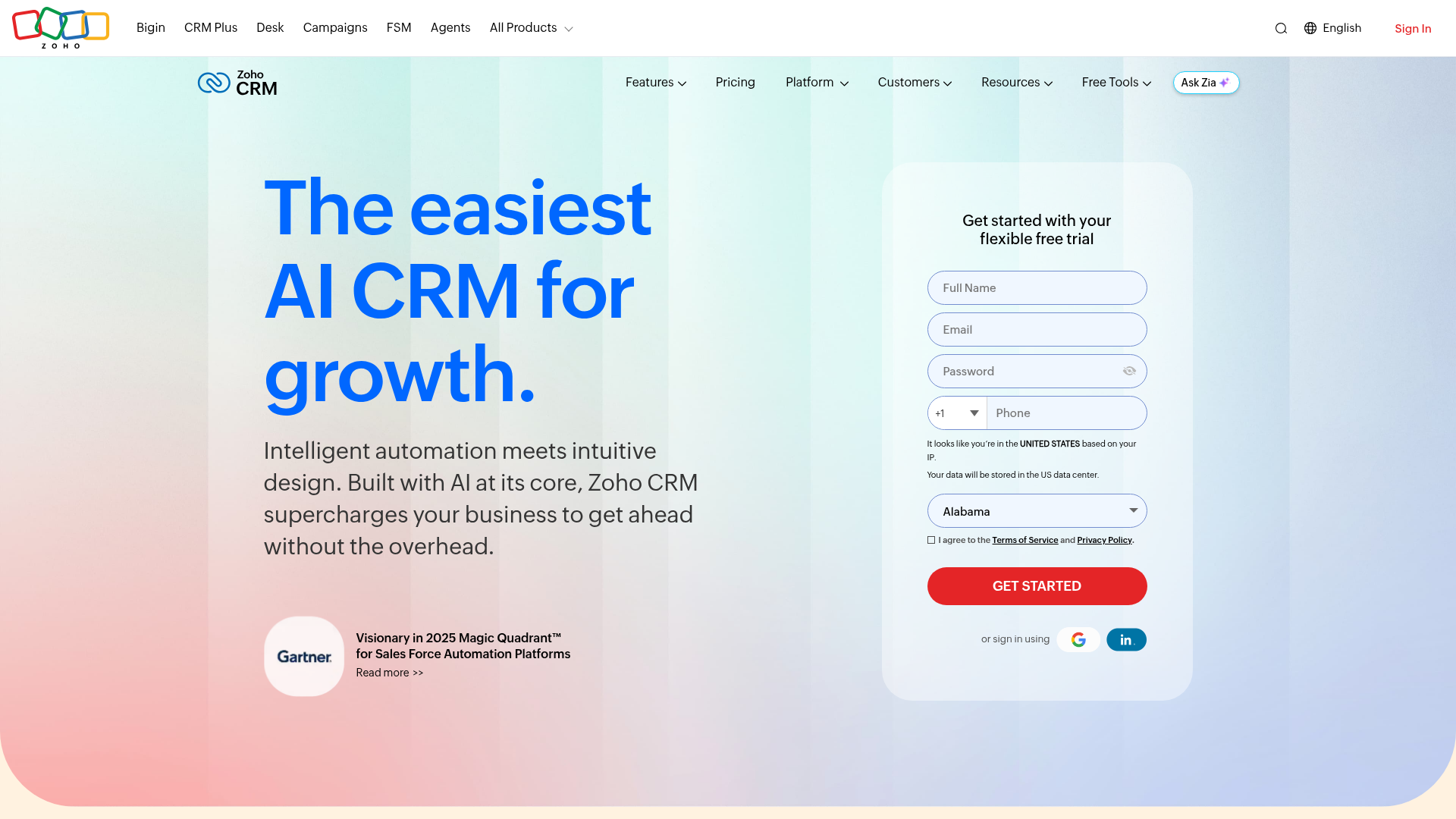 Zoho CRM is a value-priced platform, and Zia is its built-in AI engine. Zia Scores rate leads and deals from 1 to 100 using record history, email engagement, and call data.
Use case
It’s a strong option for SMB and mid-market teams that want AI scoring without a premium bill, especially when running multiple Zoho products together.
Key features
- Zia Scores: Rate leads, deals, and churn risk on a 1 to 100 scale from historical patterns.
- Best-time-to-contact and next-best-action suggestions: Guide rep outreach with AI-driven timing and recommendations.
- Custom ML models: Available on the Ultimate tier via QuickML for teams that want to build their own predictive models.
Pricing
Plans start at $14/user/month for Standard (no AI scoring), Professional at $23/user/month (predictive intelligence), and Enterprise at $40/user/month (full Zia suite). All prices reflect monthly billing.
Considerations
- Zia Scores need at least 75 converted leads before predictions activate.
- Signals are strongest when you run multiple Zoho products together.
5.Apollo.io
Best for: Outbound and SMB teams that want prospecting data and transparent AI scoring together.
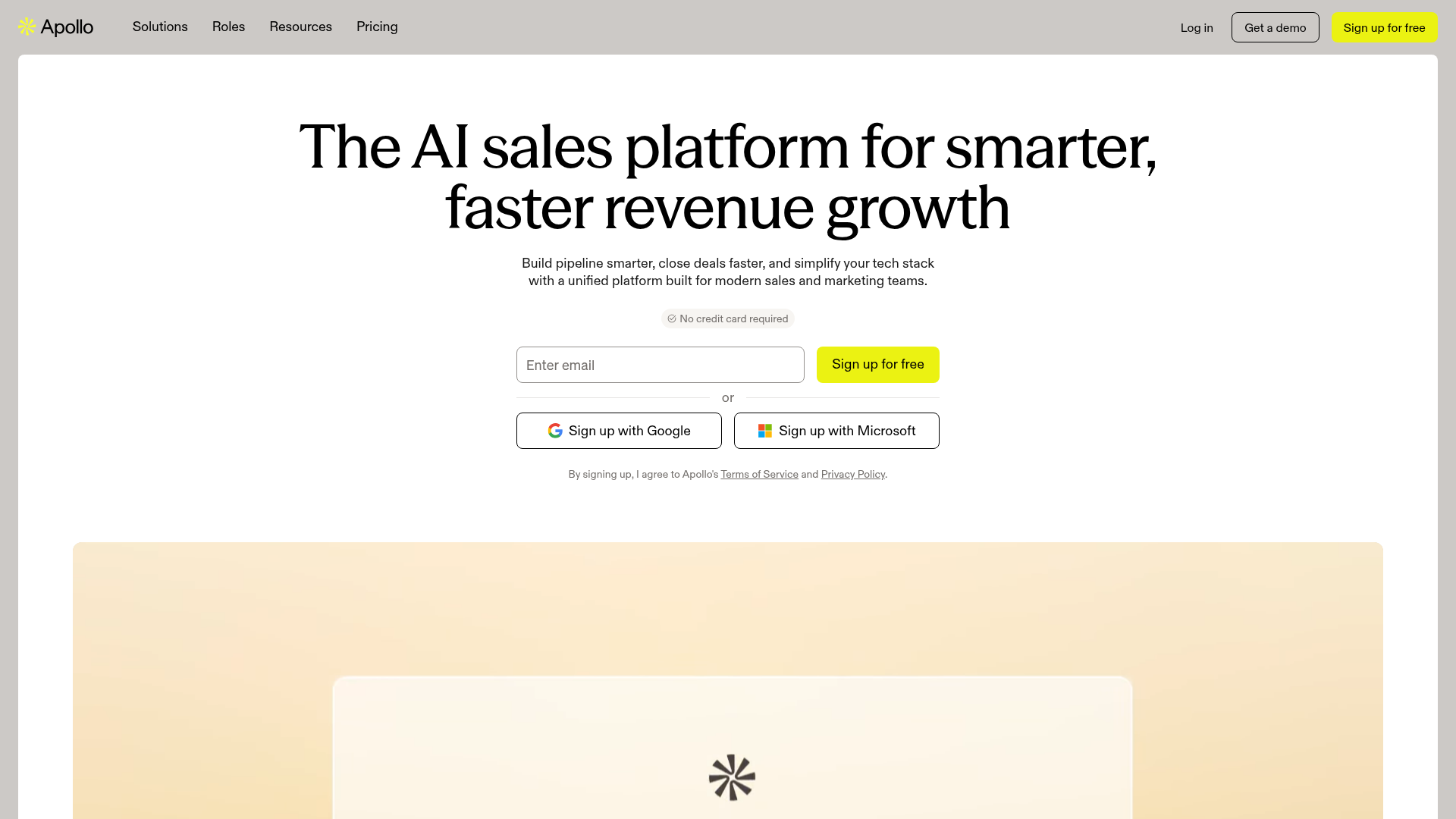 Apollo.io combines a large B2B contact database with prospecting, outreach, and scoring in one platform. Its AI Scores train on your CRM history and Apollo activity, and every score comes with a full breakdown. It’s built for outbound teams that want data and scoring side by side.
Use case
It’s a strong fit for teams running high-volume outbound motions who need to prioritize prospects as they search, with full visibility into why each lead scored where it did.
Key features
- AI Scores: Train on your CRM win and loss history to rank leads automatically.
- Transparency panel: Breaks down every criterion behind each score so reps understand the ranking.
- Live scoring in search:Scores appear in real time as you prospect, so reps prioritize on the fly.
Pricing
Plans start at $49/seat/month for Basic (AI scoring with a 2-score limit), Professional at $79/seat/month (unlimited scores), and Organization at $119/seat/month (12 intent topics). All prices reflect monthly billing.
Considerations
- The Basic plan caps you at 2 scoring models and excludes score filters and detail views.
- Enrichment and research run on credits, which heavy workflows consume quickly.
6. Clay
Best for: Technical GTM teams that want fully custom scoring built on waterfall-enriched data.
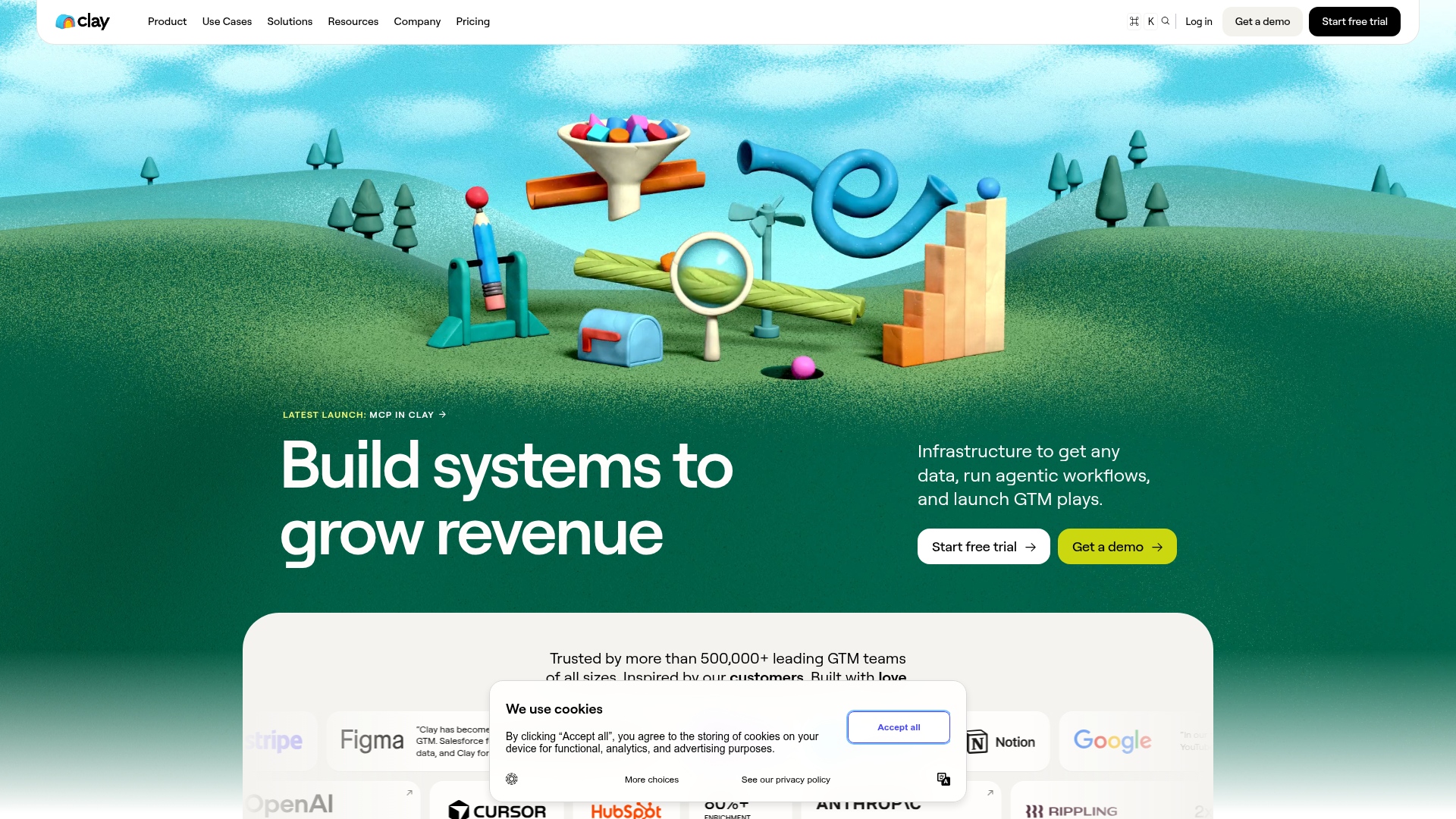 Clay is GTM data infrastructure that layers 150+ data providers under one subscription. Rather than a pre-built model, it lets teams build custom AI scoring columns in a spreadsheet-style interface. It rewards technical teams with total flexibility over how a lead gets scored.
Use case
It’s built for teams that want to design their own scoring logic from scratch, using waterfall-enriched data to reach high coverage across any field they choose to weight.
Key features
- Waterfall enrichment: Chains 150+ providers to reach 80 to 95% data coverage for scoring inputs.
- Custom AI scoring columns: Output a score or tier from any enriched field.
- Claygent: Researches unstructured signals like funding news and job postings.
Pricing
Plans start at $0/month for Free (limited actions and credits), Launch from $167/month (signal tracking and enrichment), and Growth from $446/month (CRM sync and web intent signals).
Considerations
- Clay ships no pre-built scoring model, so teams design their own logic.
- The credit-based model and learning curve suit dedicated GTM engineers.
7. 6sense
Best for: Enterprise ABM teams that need account-level predictive scoring and intent data.
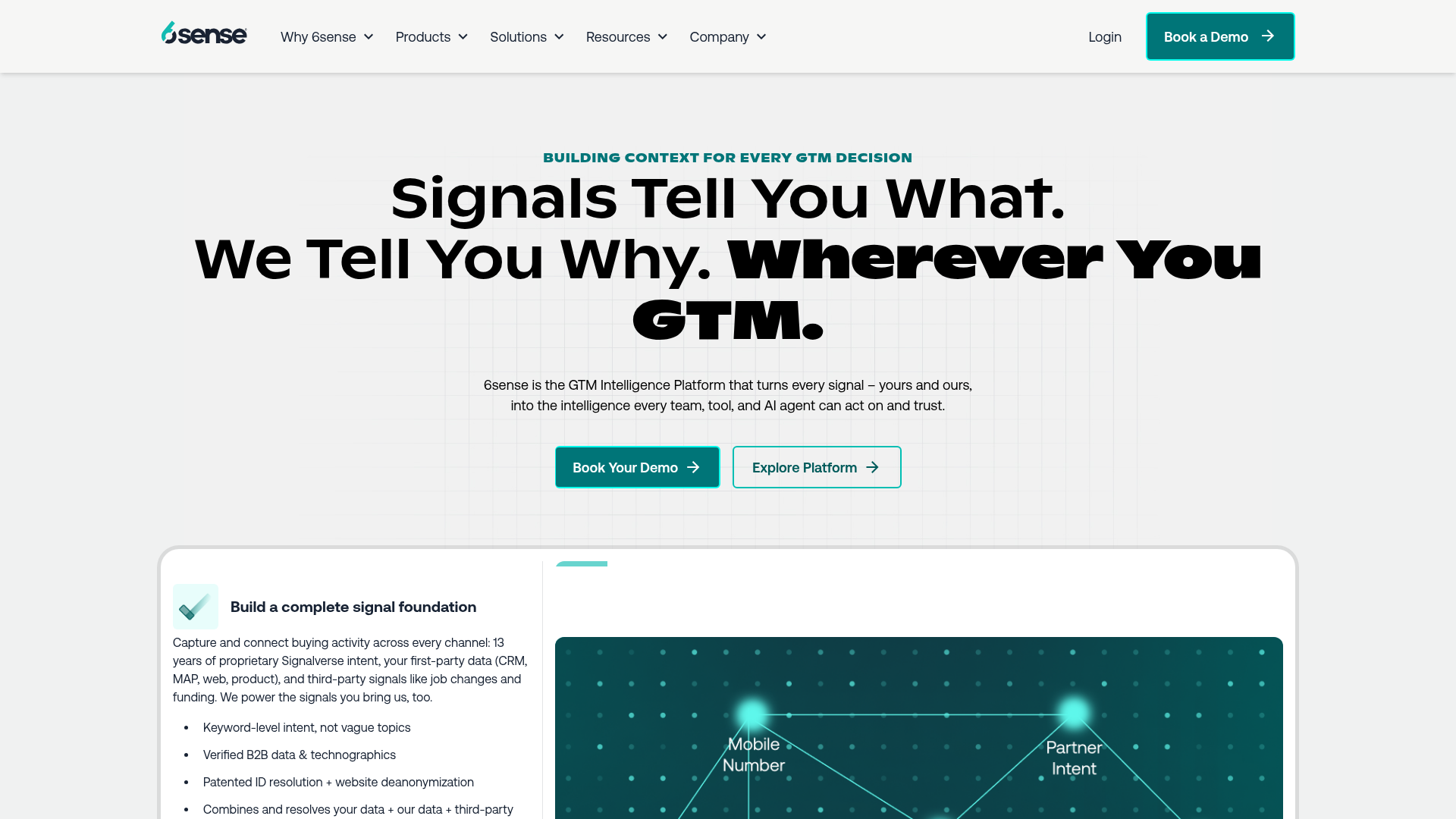 6sense is an enterprise ABM and revenue intelligence platform. Its predictive AI works at the account level, combining first-party and third-party intent data to predict buying stages. It’s built for large teams running account-based motions with sizable budgets.
Use case
It’s a fit for enterprise teams running complex ABM programs who need to identify in-market accounts early and orchestrate multi-channel engagement across buying committees.
Key features
- Account-level predictive scoring: Classifies accounts by buying stage using AI trained on first-party and third-party signals.
- Web deanonymization: Identifies a share of anonymous site visitors to surface early account interest.
- Third-party intent data: Surfaces accounts researching relevant topics across the web before they reach your site.
- Buying stage prediction: Maps accounts to stages like awareness, consideration, and decision to guide outreach timing.
Pricing
All plans are quote-only and sold through a sales demo. There is no free or trial tier.
Considerations
- Pricing is opaque and enterprise-only, which makes budget qualification harder.
- Setup takes one to two months and needs dedicated RevOps support.
How monday CRM turns lead scoring into pipeline
monday CRM is built for revenue teams that want AI lead scoring without the enterprise price tag or the IT project. It’s a flexible, no-code platform that centralizes leads, deals, and communication, then layers AI agents that score, route, and act on leads directly inside your workflow.
The platform adapts to how your team actually works. You get native AI scoring that learns from your conversions, automated routing that moves fast leads to the right rep, and deal intelligence that flags risk before it costs you pipeline. Everything runs on one adaptable system that covers sales, account management, and post-sale work, so your data stays in one place and your team stays focused on closing.
Lead Scorer agent

The Lead Scorer agent ranks every lead on fit, intent, and engagement, then acts when intent spikes. It routes high-scoring leads to the right rep automatically, schedules follow-ups, and sends alerts so nobody misses a hot prospect. Your team works a prioritized list every morning instead of guessing which leads deserve attention first.
AI-based Deal Insights widget

The Deal Insights widget grades deal health by flagging positive and negative signals across your pipeline. It spots multi-threaded contacts and scheduled next steps as strengths, while calling out stalled deals and missing decision-makers as risks. You see which deals need intervention before they slip, so your forecast stays accurate and your reps stay proactive.
monday sidekick
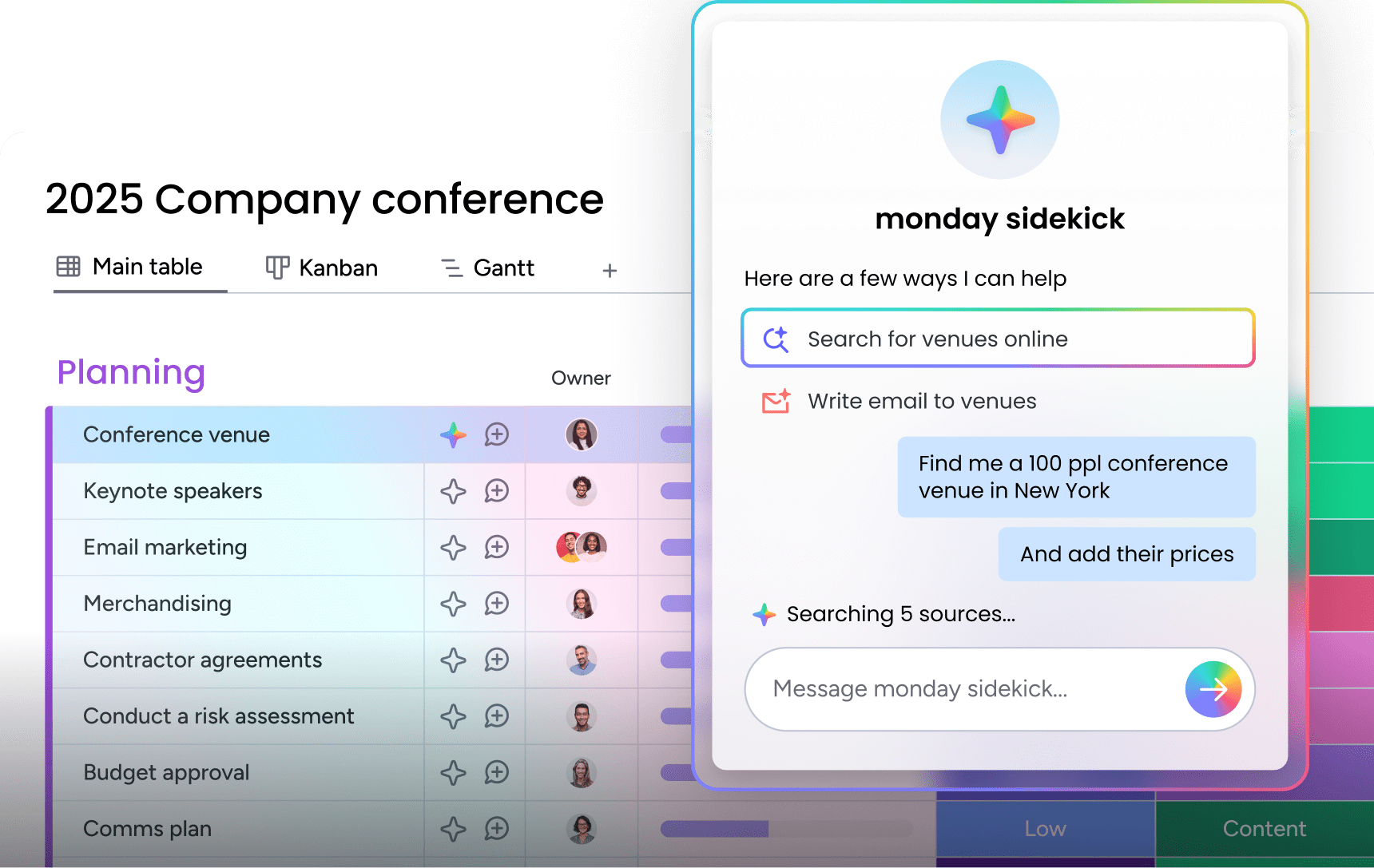
monday sidekick is a context-aware AI assistant that drafts emails, summarizes deals, and suggests next steps based on your CRM data. It cuts the busywork that slows reps down, so they spend more time selling and less time typing. The assistant learns your tone and adapts to your workflow, making it faster to move deals forward without switching tools.
AI-powered data fields and automation

AI-powered data fields auto-fill and categorize records as leads flow in, while no-code automation recipes route leads, trigger email sequences, and update deal stages without manual work. With monday vibe, you can turn any workflow need into a custom app in minutes. The platform connects 200+ integrations, including Gmail, Outlook, Slack, and Zoom, and the open API plus monday MCP let AI assistants like Claude, ChatGPT, and Copilot act securely on your CRM data.
Here’s how monday CRM stacks up against typical alternatives across the capabilities that matter most for AI lead scoring:
| Capability | monday CRM | Typical alternatives |
|---|---|---|
| AI lead scoring approach | native AI agent scores fit, intent, and engagement | often a bolt-on module or paid add-on |
| Model transparency | signals and rules you configure and can see | frequently a black-box model |
| No-code setup | build and adjust in minutes, no IT help | admin or developer setup common |
| Full revenue cycle coverage | sales, account management, and post-sale in one platform | usually pre-sales only |
| Pricing accessibility | AI scoring available from lower tiers | advanced AI often gated to enterprise |
“With monday CRM, we’re finally able to adapt the platform to our needs — not the other way around. It gives us the flexibility to work smarter, cut costs, save time, and scale with confidence.”
Samuel Lobao | Contract Administrator & Special Projects, Strategix
“Now we have a lot less data, but it’s quality data. That change allows us to use AI confidently, without second-guessing the outputs.”
Elizabeth Gerbel | CEO
“Without monday CRM, we’d be chasing updates and fixing errors. Now we’re focused on growing the program — not just keeping up with it."
Quentin Williams | Head of Dropship, Freedom Furniture
“There’s probably about a 70% increase in efficiency in regards to the admin tasks that were removed and automated, which is a huge win for us.“
Kyle Dorman | Department Manager - Operations, Ray White
"monday CRM helps us make sure the right people have immediate visibility into the information they need so we're not wasting time."
Luca Pope | Global Client Solutions Manager at Black Mountain
“In a couple of weeks, all of the team members were using monday CRM fully. The automations and the many integrations, make monday CRM the best CRM in the market right now.”
Nuno Godinho | CIO at Velv
“monday.com provides developmental flexibility, operational efficiency, and data transparency — all in one place. We became a company that moved from chasing data to leading with it.”
Hyunghan Lee | Team Lead, Sandbox Network
"monday.com brought every part of our business into one connected space. The harmony between work management and CRM has become our operating system — giving us the clarity and confidence to scale.”
Jennifer Chinburg | Executive Vice President of Corporate Development & Brand, Chinburg Properties
“We just weren’t getting value from our old CRM. With monday.com, it's a thousand times better. Our sales teams are more informed, more consistent, and far more connected."
James Arnold | Chief Operating Officer, CenversaPut AI lead scoring to work for your revenue team
AI lead scoring tools rank every lead by conversion likelihood, so your reps work the highest-value prospects first instead of guessing. The right platform scores, routes, and acts on leads without heavy setup, turning a raw list into a prioritized pipeline.
monday CRM delivers that with native AI agents that score on fit, intent, and engagement, route leads automatically, and trigger follow-ups when intent spikes. It’s AI built into flexible, no-code workflows across the full revenue cycle. Try monday CRM today.
FAQs
How often should you update lead scoring rules?
You should update your lead scoring rules at least once a quarter, and sooner if your ideal customer profile, product, or sales motion shifts. AI-based scoring adjusts as it learns, but your criteria still deserve regular human review.
What is the difference between lead scoring and lead grading?
The difference between lead scoring and lead grading is what each one measures. Lead scoring rates how likely a lead is to convert, usually as a number, while lead grading rates how well a lead fits your ideal customer profile, usually as a letter or tier.
How many criteria should you start with?
You should start with 5 to 10 criteria that reliably separate your best customers from the rest. Add more once you see which signals actually predict conversion for your team.
What is the ideal score threshold for sales handoff?
There's no universal ideal score threshold for sales handoff, but many teams pass along leads in the top 20 to 25% of scores. Set your threshold where conversion rates jump, then adjust as you gather more data.
Can small businesses use lead scoring?
Yes, small businesses can use lead scoring, and affordable AI options make it accessible. Even a simple model helps a small team focus on the leads most likely to buy.
What should you look for in an AI lead scoring tool?
You should look for an AI lead scoring tool with strong data quality, transparent scoring, intent signals, automated routing, and fair pricing. CRM-native options also cut setup time and keep your lead data in one place.
How does monday CRM handle AI lead scoring?
monday CRM handles AI lead scoring through its Lead Scorer agent, which scores leads on fit, intent, and engagement and routes them automatically. The Deal Insights widget then grades deal health using positive and negative signals.