

The transformation reshaping sales isn’t waiting for the calendar to turn. Teams that act now will enter 2026 with trained talent, refined processes, and AI systems already calibrated to their customers and markets. Those who delay won’t just fall slightly behind — they’ll compete against organizations operating with structural advantages that compound over time.
The changes ahead aren’t incremental improvements. AI agents are embedding into daily workflows, buyer expectations are shifting toward strategic insight, digital sales rooms are replacing fragmented communication, and predictive analytics is shaping decisions before risks surface. These shifts are redefining how modern sales organizations operate.
Below, you’ll find the key trends, technologies, and operational priorities shaping sales in 2026 — including AI-human collaboration, the rise of the self-service buyer, and the integration of predictive analytics into everyday decision-making. Use this guide to assess where your team stands today and identify where to focus next.
Key takeaways
- Adopt a proactive adaptation strategy: early adopters establish structural advantages including trained teams, operational AI systems, and refined processes, that late-arriving competitors cannot easily replicate.
- Deploy AI agents for operational orchestration: automate routine tasks like data entry, lead qualification, and pipeline monitoring. This shift allows human teams to focus on relationship-building and strategic advisory roles.
- Transition from product education to strategic consulting: modern buyers arrive already informed about features. They require industry insights and outcome-focused advice that standard research cannot provide.
- Build flexible, future-ready infrastructure: systems like monday CRM allow teams to modify workflows and integrate new AI capabilities without rebuilding databases or creating technical silos.
- Implement digital sales rooms for complex deals: replacing fragmented email chains with centralized digital spaces gives buyers control over their journey and provides sellers with deal-predictive engagement data.
Why must sales teams start adapting today?
The sales landscape is evolving at an unprecedented pace, outstripping the adaptation capacity of many organizations. Delaying preparation until 2026 will leave teams struggling to catch up while competitors operate with established processes, trained personnel, and mature systems.
With AI capabilities advancing rapidly, buyer expectations evolving continuously and market dynamics shifting fundamentally, the window for proactive preparation is narrowing.
Therefore, early adoption creates structural advantages that later entrants cannot easily replicate. Organizations that begin implementation now will enter 2026 with AI systems trained on their specific customer data, teams proficient in AI collaboration, and infrastructure designed for adaptability rather than rigidity.
Recognize the accelerating pace of change in sales
Sales transformation timelines have compressed dramatically. Changes that previously required multi-year implementations now happen in months or weeks. Buyer behavior shifts that once evolved gradually now pivot rapidly in response to new technologies and market conditions.
Three forces are driving this acceleration:
- AI capabilities advance at exponential rates: machine learning models and automation tools evolve faster than implementation cycles, requiring continuous adaptation.
- Buyer expectations rise as consumer experiences set new standards: B2B buyers demand the same seamless, personalized interactions they experience as consumers.
- Competitive pressures force faster adaptation cycles: organizations that move quickly gain advantages that slow-moving competitors struggle to overcome.
Annual planning and slow rollouts don’t work anymore. You need infrastructure that adapts fast to new AI tools, changing buyer behavior, and competitive moves.
Build future-ready sales infrastructure
Future-ready sales infrastructure requires three foundational elements: flexibility to adapt to emerging trends, AI capabilities that scale with technological advancement, and cross-functional teams that collaborate seamlessly rather than operating in isolation.
However, legacy CRM systems constrain organizations with rigid structures that make modifications time-consuming and costly. Therefore, organizations should prioritize platforms that enable workflow customization without requiring database reconstruction or data migration.
AI capabilities should integrate seamlessly into existing workflows rather than requiring separate platforms that create additional silos. Consider whether your current infrastructure supports rapid workflow modifications by sales teams directly, and whether you can integrate new AI capabilities without vendor dependencies or extensive technical projects.
Create competitive advantage through early adoption
Early adopters establish three distinct advantages that compound over time as their systems mature and competitors struggle to catch up:
- Team capability development: building AI collaboration skills and strategic advisory expertise while competitors remain in planning phases, creating a talent gap that widens with each quarter.
- Relationship transformation: establishing customer engagement patterns that leverage AI insights and personalized guidance, making traditional transactional approaches appear outdated by comparison.
- Data accumulation: collecting customer interaction data, deal patterns, and market intelligence that trains AI models to deliver increasingly accurate predictions and recommendations specific to your business context.
Over time, AI models improve through continuous learning. Predictive analytics become more precise as they process additional customer data. Optimization algorithms refine their recommendations as they analyze more completed deals and outcomes.
Organizations that begin implementation now will enter 2026 with AI systems trained on their actual customers, markets, and sales processes. The performance gap between early adopters and late entrants continues expanding as these advantages accumulate and reinforce each other.
AI agents become essential sales team members
AI agents will fundamentally transform sales team composition and capabilities in 2026. Digital Workers will transition from optional tools to essential team members, managing substantial portions of the sales process.
Unlike basic automation that follows predetermined rules, these AI agents make autonomous decisions, learn from outcomes, and collaborate dynamically with human team members.
A five-person sales team supported by Digital Workers can effectively manage the workload and customer touchpoints that would traditionally require a ten-person team, while simultaneously delivering more personalized attention and faster response times to prospects and customers.
Deploy digital workers for routine sales tasks
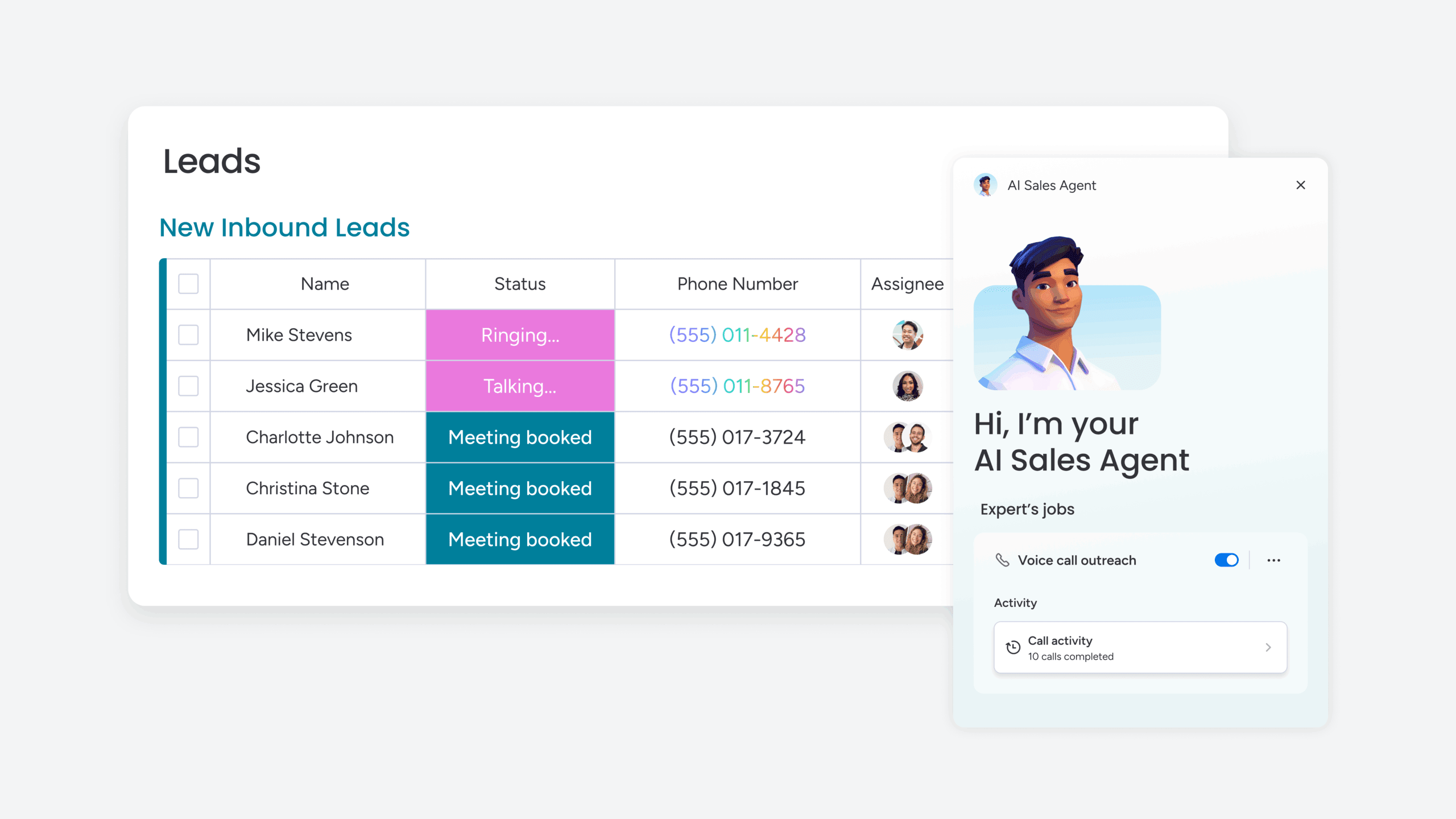
Digital Workers will handle the repetitive processes eating up your sales team’s time. These AI agents handle multiple jobs that free up your team for strategic work:
- Data entry: extracting information from emails, documents, and conversations, then updating CRM records without human intervention.
- Lead qualification: analyzing company data, engagement patterns, and fit criteria, then routing qualified prospects to appropriate sales representatives.
- Pipeline monitoring: real-time tracking of deal progress, identifying changes in customer engagement, and flagging opportunities requiring attention.
This gives leadership accurate, real-time revenue projections, allowing them to anticipate changes and act quickly. Leadership gets accurate, real-time revenue projections.
Leverage generative AI for content creation and personalization
Generative AI solves the problem of creating personalized sales materials for lots of prospects. Therefore, sales teams in 2026 will use AI to generate customized proposals, email sequences, and presentation content tailored to each prospect’s industry, challenges, and business objectives.
This goes way beyond dropping company names into templates. AI looks at customer data, past conversations, and industry context to write messages that hit specific pain points and opportunities.
Email sequences adapt based on recipient engagement, with AI modifying content, timing, and calls-to-action based on what resonates with each prospect.
Master human-AI collaboration for optimal outcomes
The best sales teams in 2026 will nail the split: AI handles data analysis and prep work. Humans build relationships and make strategic calls. This split plays to what each side does best.
- AI excels at: processing large datasets, identifying patterns, and generating options.
- Human sales professionals bring: contextual understanding, strategic thinking, and the ability to navigate organizational politics and build trust.
AI analyzes customer engagement data and suggests optimal outreach timing, while humans craft messages that resonate with specific relationship dynamics. AI identifies cross-sell opportunities based on usage patterns, while humans determine which opportunities align with customer strategic priorities.
Self-service buyers control the vast majority of the journey
By 2026, buyers will complete most of their research, evaluation, and vendor comparison independently before engaging with sales teams. When prospects initiate contact, they arrive with comprehensive knowledge of available solutions, competitive alternatives, pricing structures, and preliminary assessments of organizational fit.
This shift fundamentally changes when and how sales teams add value. Rather than providing information buyers can access through independent research, sales professionals must deliver strategic guidance, implementation expertise, and outcome planning tailored to each buyer’s unique business context.
Engage informed buyers with new strategies
Sales approaches must change when buyers arrive already educated about products, competitors, and pricing. The old discovery process including asking about needs, explaining solutions, feels redundant or annoying to buyers who’ve done their homework.
That is why, consultative selling becomes essential. Buyers want guidance on implementation, change management, and getting the most from their investment. Sales professionals need to demonstrate expertise beyond product features, understanding industry challenges, regulatory considerations, and business model implications that affect solution success.
Your value shifts from explaining products to being a strategic partner. You help buyers make the best decision for their situation and not just process orders.
Create value beyond product information
Sales professionals in 2026 must provide value that buyers cannot access through self-service research. The following capabilities differentiate sales professionals who add genuine value:
- Industry insights: sharing emerging trends, regulatory changes, and competitive dynamics helps buyers understand the broader context for their decisions.
- Strategic guidance: advising on implementation approaches, organizational change management, and success metrics helps buyers plan for outcomes rather than just purchasing products.
- Business outcome planning: connecting solution capabilities to specific financial, operational, or strategic objectives demonstrates how investments translate into measurable business value.
- Implementation expertise: sharing what worked, what didn’t, and how to avoid common pitfalls from similar implementations reduces buyer risk.
These contributions require research, preparation, and genuine expertise. They differentiate sales professionals who add value from those who simply process transactions.
Time sales interactions for maximum impact
Identifying optimal engagement points in the buyer’s journey becomes critical when buyers control most of the evaluation process. Sales teams must recognize signals that indicate buyer readiness for human interaction.
- Early-stage buyers: researching broad solutions don’t need sales engagement.
- Mid-stage buyers: comparing specific options may benefit from clarifying questions and strategic guidance.
- Late-stage buyers: finalizing decisions need help with business case development, stakeholder alignment, and implementation planning.
The key is being available when buyers are ready rather than pushing premature conversations.
Digital sales rooms replace email chains
Digital sales rooms emerge as the standard for managing complex B2B sales processes in 2026. These centralized collaboration spaces consolidate all deal-related information in a single accessible location that both buyers and sellers can access throughout the sales process.
The transformation extends beyond convenience to fundamentally improving how buyers and sellers collaborate. Digital sales rooms create persistent workspaces that survive beyond individual email exchanges, providing continuity as deals progress and stakeholders change.
Centralize all deal information in one place
Digital sales rooms organize every element of a deal in a structured, easily navigable format. The following components exist in a single location rather than scattered across email attachments and shared drives:
- Proposals and pricing: all versions and updates tracked in one place.
- Technical specifications: documentation easily accessible to technical evaluators.
- Case studies and references: relevant examples organized by industry or use case.
- Contract terms: legal documents with version control and commenting capabilities.
- Meeting recordings: past discussions available for stakeholder review.
Buyers gain control over their evaluation process, can easily share information with stakeholders, and have confidence they’re working with the most current versions of all documents. Sellers maintain visibility into what information buyers access, can update materials without resending emails, and ensure all stakeholders see consistent information.
Enable real-time buyer-seller collaboration
Digital sales rooms facilitate immediate feedback and collaborative editing that accelerates the sales process. Buyers can leave comments on specific proposal sections, ask questions about pricing terms, or request modifications to contract language, all within the context of the relevant documents.
Multi-stakeholder involvement becomes manageable when all participants can access the same information and contribute on their own schedules:
- Technical evaluators: review specifications.
- Financial stakeholders: analyze pricing.
- Executive sponsors: review strategic alignment.
This parallel evaluation process can compress weeks of sequential stakeholder reviews into days of concurrent activity.
Track engagement to predict deal outcomes
Digital sales rooms provide unprecedented visibility into buyer engagement patterns that inform deal strategy and improve forecast accuracy. Sales teams can see which stakeholders access which materials, how much time they spend on different sections, and which documents they share with others.
Furthermore, document review patterns predict deal outcomes with surprising accuracy. Buyers who thoroughly review technical documentation and implementation plans typically move forward. Those who focus only on pricing often stall or choose competitors.
Stakeholder engagement levels indicate whether deals have genuine organizational support or represent individual interest without broader buy-in.

“With monday CRM, we’re finally able to adapt the platform to our needs — not the other way around. It gives us the flexibility to work smarter, cut costs, save time, and scale with confidence.”
Samuel Lobao | Contract Administrator & Special Projects, Strategix
“Now we have a lot less data, but it’s quality data. That change allows us to use AI confidently, without second-guessing the outputs.”
Elizabeth Gerbel | CEO
“Without monday CRM, we’d be chasing updates and fixing errors. Now we’re focused on growing the program — not just keeping up with it."
Quentin Williams | Head of Dropship, Freedom Furniture
“There’s probably about a 70% increase in efficiency in regards to the admin tasks that were removed and automated, which is a huge win for us.“
Kyle Dorman | Department Manager - Operations, Ray White
"monday CRM helps us make sure the right people have immediate visibility into the information they need so we're not wasting time."
Luca Pope | Global Client Solutions Manager at Black Mountain
“In a couple of weeks, all of the team members were using monday CRM fully. The automations and the many integrations, make monday CRM the best CRM in the market right now.”
Nuno Godinho | CIO at Velv
“monday.com provides developmental flexibility, operational efficiency, and data transparency — all in one place. We became a company that moved from chasing data to leading with it.”
Hyunghan Lee | Team Lead, Sandbox Network
"monday.com brought every part of our business into one connected space. The harmony between work management and CRM has become our operating system — giving us the clarity and confidence to scale.”
Jennifer Chinburg | Executive Vice President of Corporate Development & Brand, Chinburg Properties
“We just weren’t getting value from our old CRM. With monday.com, it's a thousand times better. Our sales teams are more informed, more consistent, and far more connected."
James Arnold | Chief Operating Officer, CenversaPredictive analytics guide every sales decision
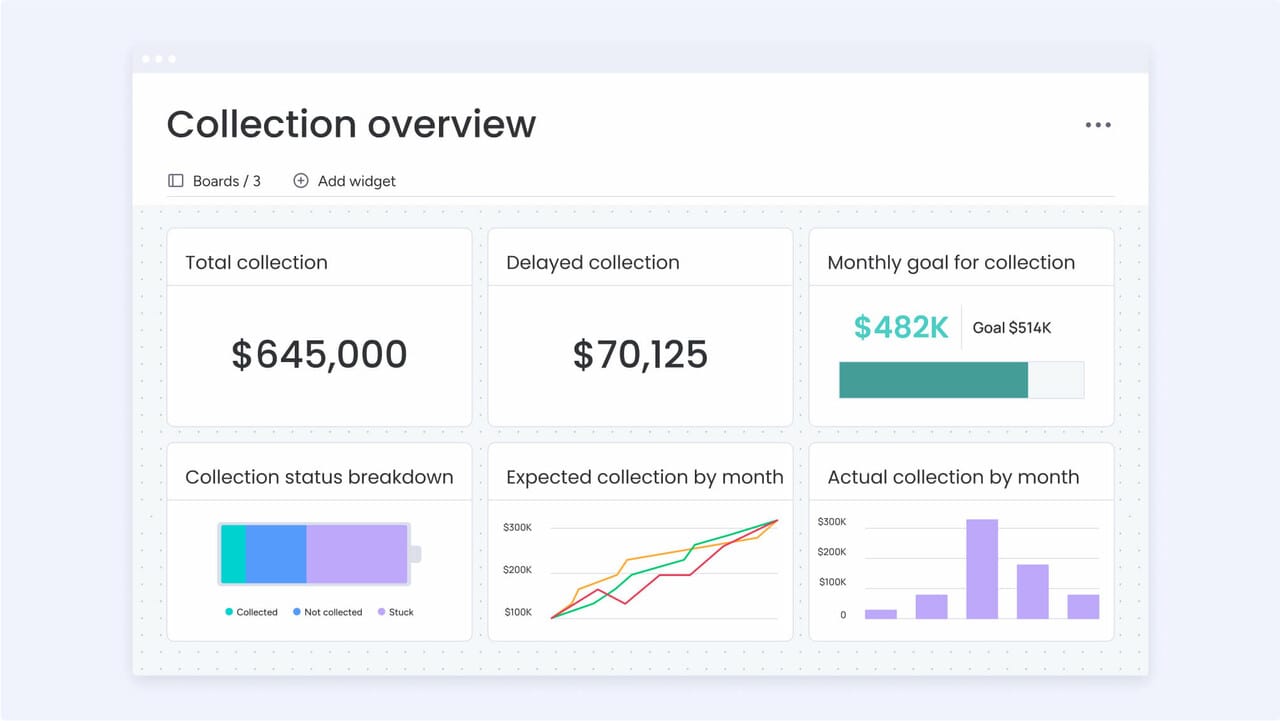
Predictive analytics in 2026 move beyond retrospective reporting to proactive guidance that informs daily sales activities and strategic planning. AI-powered insights analyze patterns across deals, customers, and market conditions to identify opportunities, flag risks, and recommend actions before problems become visible through traditional metrics.
The transformation affects decisions at every level. While individual sales representatives receive guidance on which deals need attention, sales managers get early warning about team performance issues and revenue leaders gain visibility into pipeline health with enough lead time to make strategic adjustments.
Identify at-risk deals before they stall
Predictive models analyze communication patterns, engagement levels, and timeline deviations to flag deals that show early warning signs of stalling or loss. A sudden drop in buyer responsiveness, longer gaps between interactions, or reduced stakeholder engagement all indicate potential issues.
Timeline deviations provide particularly strong signals. Deals that miss expected milestones without explanations typically face internal obstacles. These might include:
- Budget freezes: financial constraints that halt purchasing decisions.
- Competing priorities: internal projects that divert attention and resources.
- Stakeholder disagreements: internal conflicts about solution fit or vendor selection.
Predictive analytics identify these deviations and prompt proactive outreach to understand and address underlying issues. The proactive approach transforms sales management from reactive problem-solving to preventive maintenance.
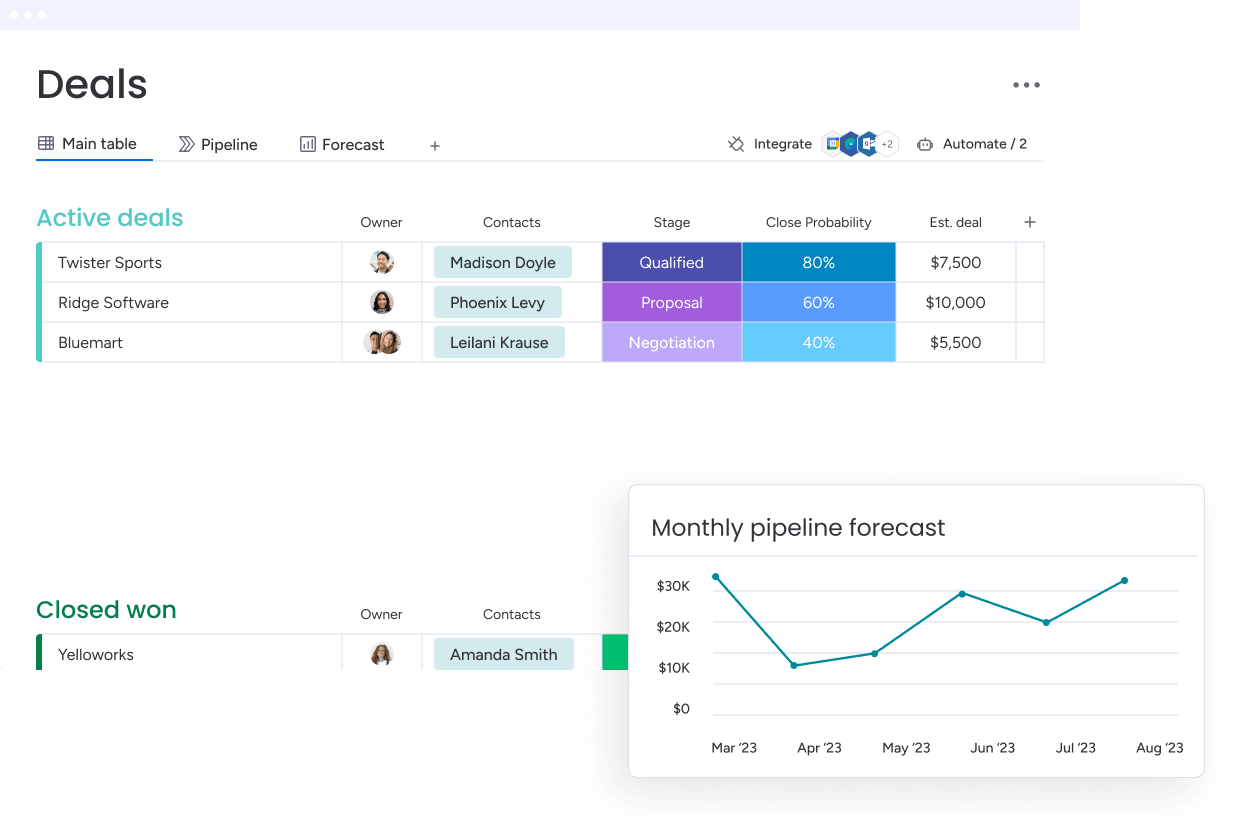
Forecast revenue with AI-powered accuracy
AI improves forecast precision by analyzing multiple data points beyond traditional pipeline metrics. While conventional forecasting relies heavily on deal stage and sales rep estimates, AI-powered models incorporate additional factors:
- Buyer engagement data: email opens, document views, meeting attendance.
- Historical win rates: success rates for similar deals in comparable contexts.
- Seasonal patterns: cyclical trends in buying behavior.
- Competitive situations: win/loss patterns against specific competitors.
- Economic indicators: market conditions affecting purchase decisions.
The business impact of improved forecast accuracy extends throughout the organization. As a result, sales leaders can commit to revenue targets with greater confidence, finance teams can plan resource allocation based on reliable projections, and operations can prepare for growth without over-investing in capacity.
Optimize territory and account planning
Predictive analytics inform territory assignments by analyzing account potential, competitive dynamics, and sales rep strengths to optimize coverage and maximize revenue potential. Traditional territory planning relies on geographic boundaries or account size, often missing opportunities to align rep capabilities with account needs.
Account prioritization shifts from simple revenue size to predicted lifetime value, growth potential, and probability of success. Some large accounts may have limited growth potential or require disproportionate effort relative to revenue. Smaller accounts may offer expansion opportunities and easier sales processes.
Sales professionals become trusted business advisors
The evolution from product-focused selling to strategic business consulting represents one of the most significant shifts in sales professional roles for 2026. Buyers with access to comprehensive product information through self-service research don’t need sales representatives to explain features and capabilities.
They need advisors who understand their industry, recognize their business challenges, and can guide them toward solutions that deliver measurable business outcomes.
Lead with industry insights and expertise
Sales professionals in 2026 must stay current on industry trends, regulatory changes, and market dynamics to provide valuable guidance that buyers cannot access through independent research. This requires continuous learning about the industries they serve.
Industry expertise enables sales professionals to shift conversations from product capabilities to business context. Rather than asking generic discovery questions, they can discuss specific industry challenges, reference relevant trends, and demonstrate understanding of the buyer’s competitive environment.
The expertise must extend beyond surface-level knowledge. Sales professionals need to understand:
- Industry trends: how market shifts affect buyers’ business models and strategic direction.
- Regulatory changes: what new compliance requirements mean for operational processes and resource allocation.
- Competitive dynamics: how market pressures influence buyers’ strategic priorities and investment decisions.
Focus on business outcomes over features
Conversations in 2026 will center on ROI, efficiency gains, and strategic objectives rather than product capabilities. Buyers care about what they can achieve, not what features are available.
Outcome-focused discussions require understanding the buyer’s current state and desired future state. Sales professionals explore what processes exist today, what results they produce, and what constraints limit improvement. Then they explore what outcomes would represent success, what metrics would demonstrate improvement, and what timeline is realistic for achieving results.
This approach translates product capabilities into business outcomes. Instead of discussing features, sales professionals explain how much time the solution saves, what revenue increase it enables, or which strategic objectives it supports.
Build long-term strategic partnerships
Sales relationships in 2026 extend beyond individual transactions to ongoing strategic partnerships. Buyers don’t just need help selecting and implementing solutions. They need ongoing guidance on optimization, expansion, and adaptation as their business evolves.
Strategic partnerships require different skills than transactional sales. Sales professionals must understand their customers’ businesses deeply enough to anticipate needs before customers recognize them. They need to provide value continuously, not just during purchase decisions.
The partnership model changes how success is measured. Rather than focusing solely on deal size and close rates, organizations track customer outcomes, expansion revenue, and long-term relationship health.
Revenue teams operate as one unified force
The breakdown of silos between sales, marketing, and customer success teams represents a fundamental organizational shift for 2026. Traditional departmental boundaries create handoff friction, information gaps, and misaligned incentives that slow revenue growth and frustrate customers.
Unified revenue teams share goals, metrics, and accountability for the entire customer lifecycle. This integration eliminates the finger-pointing and territorial disputes that plague many organizations and creates seamless customer experiences.
Align sales, marketing, and customer success
Unified revenue teams share goals that span the entire customer lifecycle rather than optimizing for departmental metrics. The shift in accountability transforms how teams operate:
| Traditional model | Unified revenue model |
|---|---|
| Marketing measured on lead volume | Marketing accountable for pipeline quality and revenue contribution |
| Sales measured on initial deal size | Sales measured on customer success and expansion potential |
| Customer success manages support tickets | Customer success identifies expansion opportunities and prevents churn |
| Departments protect territorial boundaries | Teams seek collaboration opportunities |
The organizational changes required for this alignment include reporting structures that unite revenue functions under common leadership, compensation plans that reward cross-functional success, and planning processes that integrate marketing, sales, and customer success strategies.
Share data and insights across functions
Unified data platforms enable real-time information sharing between teams through advanced sales reporting, eliminating the delays and information gaps that characterize siloed organizations. Marketing can see which campaigns generate not just leads but actual revenue, while sales access customer success data about product usage and satisfaction and customer success see the original sales conversations and commitments.
The shared data foundation enables insights that no single department could generate alone:
- Marketing: identifies which content assets influence deals at different stages.
- Sales: sees which customer segments have the highest lifetime value.
- Customer success: recognizes patterns that predict expansion opportunities or churn risk.
Create seamless customer experiences
Unified revenue teams eliminate handoff friction and provide consistent customer experiences throughout the entire lifecycle. Customers don’t experience jarring transitions between marketing, sales, and customer success interactions. Information doesn’t get lost in handoffs. The implementation team fulfills the promises made during the sales process.
Seamless experiences require processes and systems that support continuity. Customer information must transfer completely between teams, including not just data but also context about relationships, concerns, and commitments.
The customer experience improvements translate directly to business outcomes:
- Shorter sales cycles: result from buyers not having to repeat information.
- Higher close rates: come from consistent messaging.
- Lower churn: results from implementations that meet expectations set during sales.
Flexible sales processes outperform static playbooks
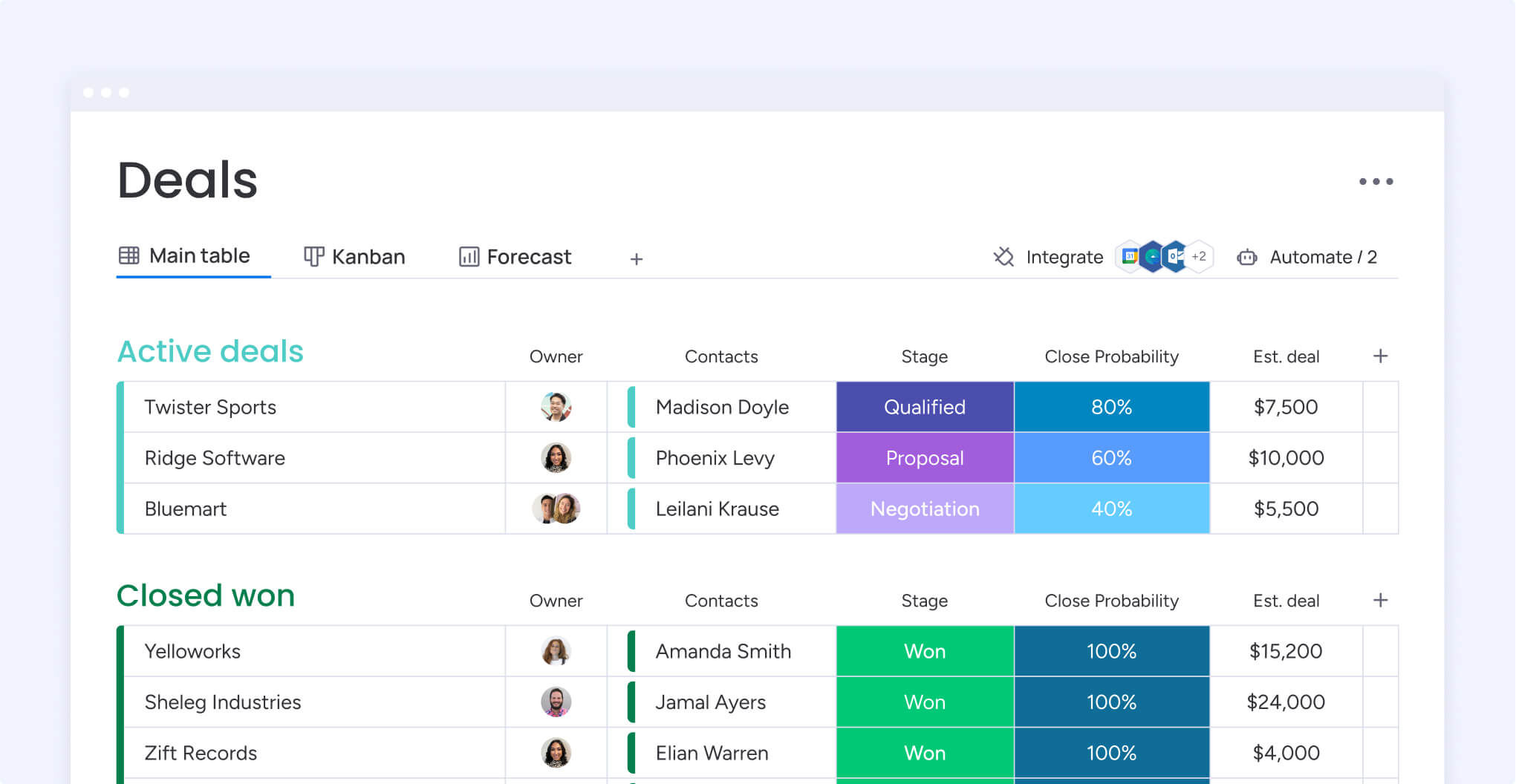
Rigid, one-size-fits-all sales methodologies that worked in stable markets become liabilities in 2026’s environment. Market conditions shift rapidly. Buyer preferences evolve continuously. Competitive situations change without warning.
Sales organizations that lock themselves into static playbooks find their approaches becoming obsolete while they’re still training teams on them. The shift from rigid to flexible doesn’t mean abandoning structure or allowing chaos.
It means providing frameworks rather than scripts, establishing principles rather than rules, and empowering teams to adapt approaches while maintaining consistency in customer experience.
Adapt methodologies to market changes
Successful sales organizations in 2026 will modify their approaches based on economic conditions, industry shifts, and competitive situations. During economic uncertainty, sales approaches emphasize risk mitigation and ROI justification. When competitors introduce new capabilities, sales strategies highlight differentiators.
The ability to adapt quickly depends on having infrastructure that supports rapid change:
- Platforms: allow workflow modifications without technical dependencies.
- Training programs: emphasize principles over procedures.
- Leadership: encourages experimentation.
Empower teams to customize approaches
Sales professionals in 2026 will have frameworks rather than scripts, allowing for personalization while maintaining consistency. Frameworks provide structure and guidance while allowing flexibility in execution:
- Key stages: define the sales process phases without prescribing exact activities.
- Required information: specify what data to gather without dictating how to collect it.
- Advancement criteria: establish standards for moving opportunities forward while allowing judgment in application.
- Quality standards: set expectations for customer experience without micromanaging interactions.
Empowerment requires trust and training. Sales leaders must trust their teams to make good decisions about when and how to deviate from standard approaches. Sales professionals need training that develops judgment and strategic thinking, not just product knowledge and process compliance.
Test and iterate strategies rapidly
Organizations in 2026 will implement rapid testing cycles for sales approaches, using data to quickly identify and scale successful strategies. Rather than annual planning cycles that lock in approaches for twelve months, successful organizations test new strategies with small teams, measure results within weeks, and scale what works while abandoning what doesn’t.
Rapid iteration requires infrastructure that supports quick changes and measurement:
- Workflow modification: ability to modify workflows, test new messaging, and try different approaches without lengthy approval processes.
- Real-time analytics: show results quickly enough to inform decisions while tests are still relevant.
Build trust and competitive advantage through responsible AI in sales
Responsible AI implementation becomes a critical competitive differentiator in 2026. Buyers become more sophisticated about AI capabilities and more concerned about AI risks.
Organizations that implement strong AI governance frameworks, maintain transparency about AI use, and demonstrate commitment to responsible AI practices will build trust that translates to competitive advantage.
The stakes extend beyond avoiding problems to actively building trust. Buyers want to work with vendors who use AI responsibly, protect customer data, and maintain human oversight of important decisions.
Implement responsible AI practices
Responsible AI frameworks for sales include policies about AI decision-making authority, human oversight requirements, and data usage limitations. Remember that AI should augment human judgment, not replace it for important decisions.
The frameworks must address specific sales scenarios:
- Communication authority: when can AI automatically send communications versus when human review is required?
- Data access: what customer data can AI access and analyze?
- Recommendation validation: how are AI recommendations validated before implementation?
- Error handling: what recourse exists when AI makes mistakes?
Implementation requires training, monitoring, and enforcement. Sales teams need education about AI capabilities and limitations, guidance on when to trust AI recommendations and when to apply human judgment, and escalation paths when AI behavior seems problematic.
Build transparency into every interaction
Organizations must communicate when and how they use AI in sales processes. Buyers appreciate knowing when they’re interacting with AI agents versus human sales professionals, when AI has analyzed their data to provide recommendations, and how AI influences decisions about their accounts.
Transparency doesn’t mean overwhelming customers with technical details about AI models. It means simple communication about AI’s role:
- Usage pattern analysis: “our AI analyzed your usage patterns to identify these expansion opportunities”.
- Automated scheduling: “an AI agent scheduled this follow-up based on our previous conversation”.
The transparency extends to explaining AI limitations and potential biases. When AI makes recommendations, sales professionals should understand the basis for those recommendations and be able to explain them to customers.
Avoid costly AI mismanagement risks
Poor AI governance creates multiple risks that can undermine sales effectiveness and organizational reputation. Customer trust issues arise when AI makes visible mistakes, uses data inappropriately, or operates without adequate human oversight. Regulatory problems emerge when AI systems violate data protection laws or create discriminatory outcomes.
The consequences of AI mismanagement extend beyond individual incidents:
- Brand reputation damage: a single high-profile AI mistake can damage brand reputation and create customer skepticism that affects all AI initiatives.
- Deal blockers: customer concerns about AI practices can become deal blockers that prevent sales regardless of product quality or pricing.
Continuous coaching cultures accelerate performance
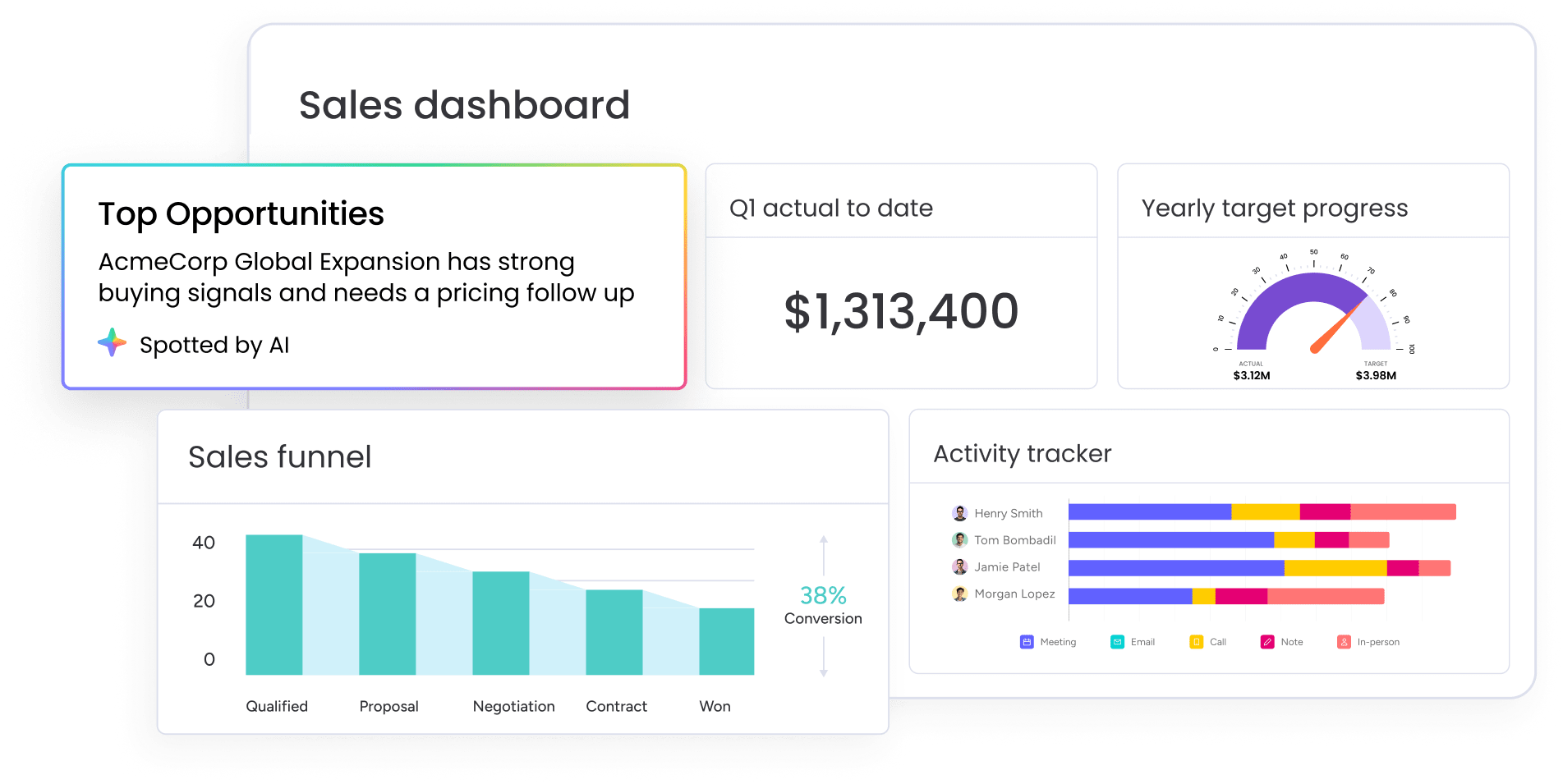
Sales coaching in 2026 evolves from periodic reviews to ongoing, AI-powered development that provides personalized guidance when sales professionals need it most. Traditional quarterly reviews that focus on past performance give way to continuous feedback loops that improve future performance.
This transformation requires both technological capabilities and cultural changes. AI enables personalized coaching at scale by analyzing individual performance patterns and providing customized recommendations.
But, as technology alone doesn’t create coaching cultures, organizations must value development, allocate time for learning, and celebrate improvement as much as results.
Scale personalized development with AI
AI analyzes individual performance patterns to provide customized coaching recommendations that would be impossible for human managers to deliver at scale. The technology identifies specific skills where each sales professional needs development, recognizes successful patterns that should be reinforced, and suggests targeted learning resources based on individual needs.
The personalization extends to learning styles and preferences:
- Video content learners: some sales professionals learn best from visual demonstrations.
- Written guide preferences: others prefer detailed written instructions and frameworks.
- Peer observation: still others learn most effectively by watching successful colleagues.
AI can match learning resources to individual preferences while ensuring all team members develop required capabilities.
Prioritize skills over activity metrics
The shift from measuring calls made and emails sent to evaluating relationship building, strategic thinking, and business advisory capabilities reflects the changing nature of sales success in 2026. Activity metrics made sense when sales was primarily a numbers game.
But when buyers control their journey and sales professionals must act as trusted advisors, activity volume matters less than interaction quality.
Skills-based metrics focus on outcomes that activities should produce:
- Customer engagement levels: measure whether interactions create value.
- Relationship depth: indicates trust and access to decision-makers.
- Strategic value delivered: shows whether sales professionals provide genuine business guidance.
- Business outcomes achieved: demonstrate actual impact on customer success.
Create real-time feedback loops
Continuous feedback mechanisms replace quarterly reviews with ongoing development conversations. Sales professionals receive immediate feedback on specific interactions. What went well in a customer meeting? How could a proposal be strengthened? What approach might work for a stalled deal?
The feedback comes from multiple sources:
- AI analysis: provides objective assessment of communications and outcomes.
- Peer observations: offer different perspectives and suggestions.
- Manager coaching: addresses specific situations with contextual guidance.
The variety of perspectives provides richer development than any single source could offer. Real-time feedback allows course correction while opportunities are still active rather than analyzing failures after deals are lost.
The sales trends shaping 2026 demand infrastructure that adapts as fast as markets change. Advanced solutions like monday CRM provide the flexible foundation revenue teams need to implement AI agents, create digital sales rooms, and unify cross-functional collaboration. Teams can modify workflows, integrate new AI capabilities, and adapt processes in real-time as buyer expectations evolve.
The platform’s intuitive design also means your sales professionals spend time building relationships instead of wrestling with rigid systems that can’t keep pace with change.
How does monday CRM help you capitalize on 2026 sales trends?
Revenue teams get the flexible infrastructure they need to adapt to every trend shaping 2026 with monday CRM. The platform combines AI-powered automation, customizable workflows, and unified collaboration tools in one intuitive system that grows with your business.
The built-in AI features in monday CRM help your team stay ahead:
- AI-powered lead scoring and qualification: automatically prioritize prospects based on engagement patterns, company fit, and conversion likelihood, so your team focuses on deals most likely to close.
- Intelligent email generation: create personalized outreach at scale with AI that adapts messaging based on prospect industry, role, and previous interactions.
- Predictive deal insights: get real-time alerts about at-risk opportunities and recommended next actions based on historical win/loss patterns.
- Automated data capture: eliminate manual entry with AI that extracts information from emails, meetings, and documents directly into your CRM.
- Smart forecasting: generate accurate revenue predictions by analyzing pipeline health, deal velocity, and seasonal trends across your entire sales organization.
- Digital sales rooms: collaborate with buyers in centralized spaces that track engagement and surface which stakeholders are most active in the evaluation process.
The platform’s no-code flexibility means your teams can modify workflows, test new approaches, and adapt processes without waiting for IT support or vendor implementations. And because monday CRM integrates seamlessly with your existing tools, you can start small and scale as your needs evolve.
Organizations using monday CRM report shorter sales cycles, improved forecast accuracy, and better alignment across revenue teams. The platform provides the foundation for implementing the sales trends that will define success in 2026, starting today.
Start building your 2026 sales advantage today
The sales transformation underway isn’t waiting for 2026 to arrive. Organizations that start adapting today will enter the new sales era with trained teams, established processes, and AI systems already tuned to their specific customers and markets.
In contrast, those that delay will find themselves playing catch-up while competitors leverage years of accumulated advantages.
The trends highlighted in this article reflect fundamental shifts in how sales teams operate, engage buyers, and drive revenue. AI agents are becoming essential team members, self-service buyers now expect strategic guidance, digital sales rooms are replacing scattered email chains, and predictive analytics are informing every decision.
Frequently asked questions
What are the most important sales skills for 2026?
The most important sales skills for 2026 include business advisory capabilities, AI collaboration skills, and strategic relationship building. These skills replace traditional product knowledge as the primary value drivers for sales professionals.
How will AI change B2B sales processes?
AI will shift from being a capability that sales professionals use to being a collaborative team member. Digital Workers will handle substantial portions of the sales process autonomously, including data entry, lead qualification, follow-up scheduling, and pipeline updates.
Which sales technologies offer the strongest ROI in 2026?
Platforms that combine AI capabilities, flexibility, and ease of implementation deliver the strongest ROI. These systems enable rapid adaptation to emerging trends without technical dependencies or lengthy implementation projects.
How can small sales teams compete with AI-powered competitors?
Small sales teams can compete by adopting accessible AI platforms that provide enterprise-level capabilities without requiring large technical investments. This enables them to manage workloads previously requiring much larger teams.
What sales metrics matter most in 2026?
Outcome-based metrics like customer lifetime value, relationship quality scores, and business impact measurements will replace activity-based metrics. These indicators provide more accurate insight into actual sales success than traditional activity counts.
When should companies start preparing for these sales changes?
Companies should begin preparation immediately. Early adoption provides competitive advantages that compound over time through accumulated data, trained teams, and established processes that late adopters cannot replicate quickly.