

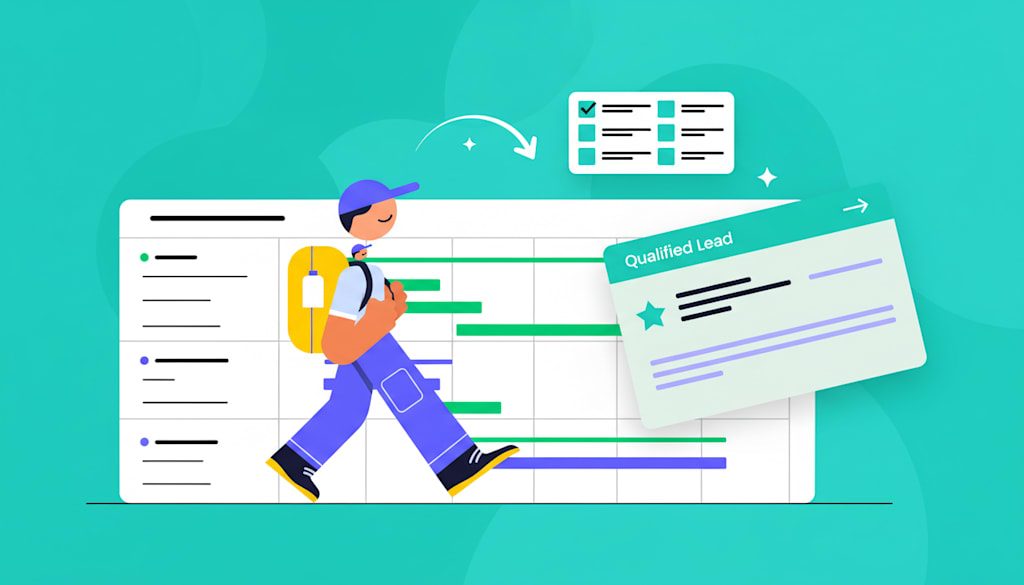
Sales prospecting automation transforms how revenue teams work by handling repetitive tasks like lead research, data entry, and follow-up sequences. This technology frees your team to focus on what drives results: building relationships and closing deals.
This guide shows you how to build a prospecting system that reclaims 15+ hours weekly for actual selling. You’ll discover the technologies powering automation, 7 benefits that boost productivity, 4 essential components every system needs, and how AI agents are revolutionizing prospecting with a step-by-step plan to implement it all on a unified platform.
Key takeaways
- Automation handles lead research, data entry, and follow-up tracking so your team can reclaim 15+ hours weekly for building relationships and closing deals instead of administrative busywork.
- AI-powered lead scoring analyzes conversion patterns to surface your highest-potential prospects automatically, so you stop wasting time on leads that won’t convert.
- Dynamic content and behavioral triggers let you send relevant, customized messages to thousands of prospects while maintaining genuine personalization at scale.
- Monitor prospect behavior 24/7 and get instant alerts when someone visits your pricing page or downloads content, so you never miss a high-intent moment.
- Eliminate integration headaches by combining CRM, automation, and AI capabilities in monday CRM — one unified system that auto-enriches leads and tracks every interaction seamlessly.
What is sales prospecting automation?
Sales prospecting automation handles the repetitive work of finding and engaging potential customers. Think lead research, data collection, outreach, and follow-up — all automated. Instead of researching prospects one by one or tracking outreach in scattered notes, automation handles the logistics.
Automation changes everything about how revenue teams work. Manual prospecting? Hours researching leads, copying contact info between systems, updating spreadsheets that go stale by next week.
Automation fixes 3 big problems:
- Systematic lead discovery: Find prospects across multiple data sources simultaneously.
- Automatic data updates: Keep records current without manual intervention.
- Coordinated multi-channel campaigns: Run campaigns that operate without constant oversight.
Why now? Lead volume has exploded. Buyers research across email, social, your website, review sites — everywhere. If you’re still doing this manually, you can’t keep up with teams using automation.

Transform manual prospecting with automation
Automation doesn’t replace reps. It kills the admin work so they can focus on relationships, complex needs, and closing deals.
Here’s what changes:
| Prospecting activity | Manual approach | Automated approach | Time saved weekly |
|---|---|---|---|
| Lead research | Searching LinkedIn and company websites individually | AI scans databases simultaneously, pulling company info and contact details | 13 hours |
| Data entry | Logging every email, call, and meeting manually | Interactions sync to CRM automatically | 7 hours |
| Outreach sequencing | Creating individual emails for each prospect | Pre-built sequences deliver personalized messages at optimal times | 8 hours |
| Follow-up tracking | Maintaining spreadsheets with calendar reminders | Automated reminders and task creation | 4.5 hours |
| Lead scoring | Prioritization based on gut feel | AI analyzes data points to predict conversion likelihood | 3.5 hours |
New to automation? You might worry outreach will feel robotic. It’s the opposite. When automation handles logistics, reps have more time to craft thoughtful, relevant messages rather than rushing through generic outreach to hit activity targets.
Understand the key technologies driving automation
Know the tech behind automation and you’ll pick the right capabilities for your team. Five technologies power automation:
- Artificial intelligence and machine learning analyze patterns in successful deals to predict which leads will most likely convert. They look at company fit, how prospects engage, and when they’re ready to buy. The more data they get, the smarter they become.
- Natural language processing enables automation to understand and generate human-like communication. They read sentiment in responses, gauge interest, and pull key info from conversations — no manual notes needed.
- API integrations connect different systems in your sales stack, enabling data to flow automatically. Prospect fills out a form? The info hits your CRM, enriches automatically, and kicks off outreach.
- Workflow automation engines create conditional logic to trigger actions based on prospect behavior, time delays, or data changes. Prospect opens an email 3 times? Your rep gets an alert.
- Data enrichment services automatically append missing information to lead records by pulling from public databases, social profiles, and company websites. Lead comes in with just an email? Within seconds, you’ve got their title, company size, and phone number.
7 core benefits of sales prospecting automation
Sales prospecting automation delivers 7 benefits that boost productivity and make revenue predictable. Sales leaders get better resource allocation. Reps get less admin work.
1. Reclaim hours of selling time weekly
Automation reclaims that time by handling the admin work. Automation reduces hours of manual research weekly by automatically gathering company information, contact details, and buying signals.
Automation also reduces time spent on data entry and CRM updates when prospect interactions, email opens, and activity logs automatically sync. Follow-up scheduling and tracking? Automation can also cut this time because automated sequences handle follow-up timing and reminders.
That recovered time? Reps use it for discovery calls, custom proposals, and building real relationships.
2. Accelerate pipeline velocity

Pipeline velocity measures how fast prospects move from first contact to a closed deal. Accelerating this velocity means you close more deals in less time, creating predictable revenue.
Automation accelerates each stage through:
- Faster lead response times: Automated alerts and instant follow-up sequences engage prospects within minutes
- Reduced time between touchpoints: Scheduled sequences maintain momentum
- Quicker qualification: Automated scoring identifies ready-to-buy prospects immediately
RevOps and sales leaders get more predictable forecasts. Consistent velocity means you know how many deals will close each period.
3. Enhance lead quality with AI-powered scoring
Sales teams waste time on raw leads that will never convert while missing high-potential prospects buried in their database. AI scoring fixes this — it analyzes dozens of data points to predict who’ll convert.
AI looks at won and lost deals, spots patterns humans miss. It scores leads on demographic fit and behavior — website visits, downloads, email opens.
Teams using monday CRM leverage AI capabilities to enable this type of scoring within existing workflows. The platform’s AI actions can analyze text sources and assign appropriate labels based on defined criteria, automatically surfacing high-priority leads without manual analysis.
4. Scale personalized outreach to thousands
Scale and personalization at the same time? Automation uses data to customize messages for each prospect while handling delivery at scale.
Automation enables personalization through:
- Dynamic content insertion: References the prospect’s company name, industry challenges, or recent news automatically
- Behavioral triggers: Different messages deploy based on which content the prospect downloaded or pages they visited
- Timing optimization: Messages deliver when individual prospects are most likely to engage based on their historical behavior
You reach thousands of prospects without losing relevance.
5. Reduce manual data entry
Data entry slows teams down and introduces errors that trash your data quality. Automation kills this burden, pulling key details from files like invoices, resumes, or contracts and populating board columns automatically. Email activity tracking captures every sent email, open, click, and reply in the prospect’s timeline without manual input.
No manual work means fewer errors, cleaner data, and reps who actually sell instead of doing admin.
6. Enable round-the-clock lead engagement
Prospects research at 11 PM, on weekends, whenever. Automation enables continuous engagement regardless of time zones or work schedules, helping teams scale outbound sales efficiently.
Automated sequences respond to prospect actions immediately:
- Instant acknowledgment: When a prospect fills out a form at 11 PM, an automated response acknowledges the inquiry and sets expectations for follow-up
- High-intent notifications: Actions like requesting a demo trigger immediate alerts to sales reps
- Continuous monitoring: Systems track prospect behavior 24/7 without human oversight
Leads stay warm. You never miss a high-intent moment.
Try monday CRM7. Build predictable revenue growth
Sales leaders struggle with predictability. When you don’t know if teams will hit targets, planning becomes a guessing game. Automation builds predictability with consistent processes and real insights from your data.
Organizations achieve this predictability through real-time dashboards and sales-specific widgets that track forecast versus actual sales. Teams can drill down by month, sales rep, or any other criteria. Consistent conversion rates make planning simple.
4 essential components of prospecting automation
Four building blocks power any prospecting automation system. Know these components and you’ll build automation that actually delivers.
1. Intelligent lead discovery
Intelligent lead discovery finds potential customers who match your ideal profile — automatically. It’s more than database searches — it finds prospects based on fit and buying signals.
Automation scans data sources to find prospects who fit. They watch for buying signals — funding news, leadership changes, that kind of thing.
Key capabilities include:
- Ideal customer profile matching: Automatically identifies companies that fit your target criteria
- Lookalike audience identification: Finds prospects similar to your best customers
- Trigger event monitoring: Alerts you when prospects show buying signals
- Intent signal detection: Identifies when prospects are actively researching solutions
2. Automated data enrichment
Data enrichment fills in missing info on lead records. You start with an email address. You need title, company size, phone number — the works. New lead hits your system? Enrichment fills in title, company size, phone number, recent news. Takes seconds. Zero manual work.
3. Multi-channel engagement workflows

Effective prospecting means hitting prospects across email, phone, social — coordinated. Multi-channel workflows are automated sequences that orchestrate touchpoints across different channels based on prospect behavior and preferences, enabling sophisticated multi-channel engagement at scale.
The platform supports:
- Email automation: Sending individual and mass emails using dynamic fields and templates
- Activity tracking: Monitoring email open rates and link clicks automatically
- Follow-up sequences: Automating email follow-ups based on prospect behavior
- AI-powered messaging: Composing messages directly within the system with text improvement features for tone, length, and refinement
4. Real-time intent signal tracking
Intent signals show a prospect is researching and might be ready to buy. Track these signals in real-time and you’ll reach prospects exactly when they’re ready.
Key signals to track include:
- Website behavior: Visits to pricing pages or product demos
- Content engagement: Downloading buying guides or comparison sheets
- Email interaction patterns: Multiple opens or link clicks
- Social media activity: Following your company or engaging with posts
Real-time tracking helps you prioritize hot prospects and reach them when interest peaks.
Must-have capabilities for automated prospecting
Five capabilities you can’t skip: These aren’t nice-to-haves. They’re what separate real automation from basic tools.
- AI-driven lead prioritization: You’ve got more leads than you can handle, so prioritization matters. Choose software with AI prioritization that ranks leads by who’s most likely to convert.
- Automated sequence management across channels: Automated sequences create and run multi-step campaigns based on prospect behavior and timing. Look for platforms that make sequence creation intuitive for non-technical team members, enabling effective automated sequence management across your team.
- Buying intent detection with real-time alerts: Timing is everything. Intent detection watches prospect behavior and alerts reps the moment interest spikes. Make sure alerts match your intent criteria and show up where your team actually works.
- Seamless CRM integration: Prospecting automation needs to work with your CRM. Real integration means data flows both ways without manual exports or imports. One system for automation and CRM? No integration headaches. All interactions, including emails, calls, meetings, and notes, get logged in one timeline through a centralized activity system.
- Advanced analytics and reporting: Automation generates a high volume of data. It only matters if you can act on it. Advanced analytics shows sequence performance, conversion rates by stage, and how reps are doing. Code-free, customizable dashboards provide immediate insights into sales pipeline status, forecasting, team performance, and activity status. Sales-specific widgets show the strong and weak points in your pipeline.
15 top sales prospecting automation platforms
Know the platform landscape and you’ll pick what fits your needs. Here’s the breakdown by category:
All-in-one prospecting CRM platforms
All-in-one platforms combine CRM and prospecting automation in one system — no disconnected tools.
- monday CRM: A unified platform combining CRM, automation, and AI capabilities with no-code customization that enables teams to build workflows matching their specific processes
- HubSpot Sales Hub: An all-in-one platform with strong marketing integration, particularly suited for teams wanting tight alignment between marketing and sales
- Salesforce Sales Cloud: An enterprise-grade platform with extensive customization capabilities and a vast ecosystem of integrations
AI sales engagement solutions
AI sales engagement platforms focus specifically on multi-channel sales engagement with AI-powered optimization.
- Outreach: Positioned for enterprise sales engagement with sophisticated sequence capabilities
- Salesloft: Focused on revenue orchestration with strong coaching and conversation intelligence features
- Apollo.io: Combines engagement capabilities with database access in one platform
Data intelligence and enrichment platforms
Data intelligence platforms provide comprehensive prospect data and enrichment capabilities.
- ZoomInfo: A comprehensive B2B database with extensive company and contact information
- Clearbit (now part of HubSpot Breeze Intelligence): Focused on real-time enrichment that integrates with existing workflows
- Cognism: Strong international data coverage, particularly useful for European markets
Social selling automation platforms
Social selling platforms focus on LinkedIn and social media prospecting automation.
- LinkedIn Sales Navigator: LinkedIn’s native sales platform providing advanced search and InMail capabilities
- Dux-Soup: LinkedIn automation focused on profile visits, connection requests, and messaging sequences
- Expandi: Cloud-based LinkedIn outreach with smart sequences and safety features
Specialized email automation platforms
Email automation platforms focus specifically on email prospecting and follow-up automation.
- Lemlist: Known for personalized email campaigns with unique features like personalized images
- Reply.io: Multi-channel sequences starting with email as the primary channel
- Mailshake: Simple, effective email outreach focused on ease of use
How AI agents and digital workers are transforming prospecting
AI agents and digital workers are changing prospecting automation. They go beyond simple rules — they reason, adapt, and act on their own.

Traditional automation follows rules. If a prospect opens an email, send the next message in 3 days. AI agents read context, make decisions, and adapt based on what they learn.
The impact is real. AI outreach agents monitor thousands of prospects simultaneously, identifying the precise moment when each is most likely to engage. They look at LinkedIn activity, company news, engagement history — then write messages that feel personal.
AI agents change prospecting with:
- Autonomous research and preparation: AI agents research prospects before outreach, gathering relevant information in seconds
- Intelligent message crafting: Rather than simple mail merge, AI agents write genuinely personalized messages referencing specific, relevant details
- Continuous learning and optimization: Unlike static automation rules, AI agents learn from outcomes and continuously improve
Know where AI helps and where humans are essential. AI excels at data processing, pattern recognition, and routine tasks at scale. Humans own relationships, complex negotiations, and strategic calls.
Build a prospecting automation system that actually works
Sales prospecting automation works when it removes friction, not when it adds volume. The goal is predictable pipeline with consistent processes, clean data, and real-time visibility so your team spends time in conversations, not CRM housekeeping.
Foundation principles for successful automation
Keep these principles in mind:
- Automation is only as good as your data model: Standardize ICP fields, engagement tracking, and status taxonomy before you automate
- AI assists; humans close: Use AI to reduce research time, draft messages, and surface intent signals while keeping relationship-building human-led
- Centralize activity logging: If outreach lives in one platform and outcomes live in another, your forecast will always be a guess
- Measure what matters: Track meetings booked, pipeline created, and forecast accuracy rather than emails sent
How monday CRM unifies prospecting automation in one platform
With monday CRM, you eliminate the integration headaches that plague most sales teams. Instead of stitching together separate tools for lead capture, enrichment, outreach, and tracking, you get a unified platform where prospecting automation lives alongside your CRM data.

Here’s what makes monday CRM different for prospecting automation:
- No-code automation that adapts to your process. Build custom workflows without IT support. Create conditional triggers based on lead behavior, automatically assign leads to reps based on territory or expertise, and update deal stages as prospects move through your pipeline. The visual automation builder makes complex sequences simple to create and modify.
- AI-powered lead enrichment and scoring built in. New leads automatically enrich with company data, job titles, and contact information through integrated databases. AI actions analyze text sources to assign priority labels, route high-value prospects to senior reps, and surface buying signals without manual analysis. The Extract information action pulls key details from documents and populates your CRM fields instantly.
- Centralized activity tracking across all channels. Every email, call, meeting, and note logs automatically in a unified timeline. Email tracking captures opens, clicks, and replies without switching platforms. Your team sees complete prospect history in one place, eliminating the context-switching that kills productivity.
- Real-time dashboards that show what matters. Code-free dashboards track pipeline velocity, forecast accuracy, and rep performance with sales-specific widgets. Drill down by month, territory, or lead source to spot bottlenecks before they impact revenue. Customizable views mean every team member sees the metrics relevant to their role.
- Seamless collaboration between sales and marketing. When prospecting automation and CRM live on the same platform your marketing team already uses for campaign management, lead handoffs become frictionless. Marketing sees which campaigns generate qualified pipeline. Sales sees complete lead journey from first touch to closed deal. No data gets lost in translation between systems.

Teams using monday CRM report faster implementation compared to traditional CRM platforms. The familiar interface reduces training time. The flexible data model adapts to your sales process rather than forcing you into rigid workflows. And because it’s built on the monday.com Work OS, you can extend prospecting automation to connect with other business processes as your needs evolve.
Choosing the right automation approach
Evaluating solutions? Decide if you want point solutions with integrations or native CRM automation that keeps data in one place. Look for no-code flexibility that adapts to your sales process. Can you audit why an AI action behaved a certain way? Trust comes from explainability.
AI will handle more end-to-end workflows. Human oversight stays critical for quality and compliance. As regulations evolve and inbox providers crack down on spam, automation that prioritizes quality over volume will win. Teams will consolidate platforms for less complexity and better data.
You now have the blueprint. Automate the busywork, standardize the process, and give your team the context they need to close more deals. The rest is execution.
Try monday CRMFAQs
What parts of sales prospecting should be automated versus human-led?
To determine what parts of sales prospecting should be automated versus human-led, you should automate repetitive tasks like data entry, lead research, and initial outreach. Keep relationship-building, complex negotiations, and strategic discussions human-led.
How do you set up an automated prospecting workflow from lead capture to first meeting?
Start by defining your ideal customer profile and required data fields. Configure lead capture forms, enrichment rules, routing logic, and outreach sequences in your CRM. Test with a small segment before scaling.
How can AI reduce prospect research time without losing account context?
AI timeline summaries consolidate emails, calls, meetings, and notes into brief overviews. This gives reps instant context before outreach or handoffs without spending time digging through records.
What data should you collect to make prospecting automation reliable?
Standardize ICP fields like industry, size, and region. Track engagement data including last touch, channel, and sequence step. Define clear status taxonomy such as cold, warm, working, or meeting set. Include compliance fields for opt-out status and lawful basis.
How do you measure whether prospecting automation is working?
Track meetings booked, pipeline created, reply rates by segment, time saved per rep, and forecast accuracy. These metrics show real impact rather than vanity metrics like emails sent.
Can AI replace human sales reps?
AI handles repetitive tasks so reps can focus on relationship-building and complex problem-solving. It augments human capabilities rather than replacing them. The human element remains essential for understanding nuanced needs and building trust.

 Get started