


Your field reps spend hours planning routes, chasing leads across town, and figuring out who should follow up with which prospect. Meanwhile, deals slip through the cracks and travel costs keep climbing. The problem isn’t effort; it’s that manual territory management can’t keep up. Routing software helps sales teams assign leads automatically, plan smarter routes, and balance workloads across territories. When it connects to your CRM, reps stop zigzagging between meetings and start spending more time with the right customers. Travel costs drop, response times shrink, and your team closes more deals without working longer hours.
Here’s what routing software actually does for sales operations, how three platforms stack up for revenue teams, including monday CRM, and how to turn territory management into a competitive advantage.
Try monday CRMWhat is routing software for sales operations?
Sales routing software is like a GPS for getting your reps to the right deals. It plans the smartest routes so they spend less time on the road and more time in front of the right customers, turning drive time into deal time.
Sales routing software plans the smartest routes for your reps so they spend less time on the road and more time in front of the right customers.
New leads get automatically assigned to the closest available rep, making follow-up instant. The software also maps out the most efficient visit schedule, grouping nearby appointments to slash travel costs. No more zigzagging across town for a single meeting.
Connect routing software to your CRM and you’ll know exactly who should take which lead, when, and why. Your deal data drives prioritization of high-value visits while workloads get balanced automatically across territories.
3 effective route planning software platforms for revenue teams
Route planning isn’t just for getting packages to the right doorstep. For sales teams, it’s about getting reps to the right deals at the right time. The most effective platforms connect directly to your CRM, allowing you to manage territories strategically and tie routing decisions directly to revenue outcomes.
We looked at platforms built for sales teams, not logistics fleets: monday CRM, Descartes Systems Group, and Solera. These platforms made the cut based on their deep CRM connections, smart territory management, and sales-focused reporting. Each offers a different approach, from flexible, in-platform workflows to heavy-duty optimization.
| Platform | Pricing | Primary use case | Standout features | Integration capabilities |
|---|---|---|---|---|
| monday CRM | Starts at $12/user/month | Mid-market sales teams needing flexible, customizable routing within CRM workflow | AI-powered territory assignment, no-code customization, unified platform | Native CRM integration with visual territory planning |
| Descartes Systems Group | Custom enterprise pricing | Large enterprises with complex multi-territory field operations | Advanced route optimization algorithms, multi-depot planning | API-based CRM integration, requires technical setup |
| Solera | Custom pricing based on scale | Organizations prioritizing data analytics in routing decisions | Predictive analytics, optimization modeling | Third-party integration via APIs |
Teams that want to manage territories and plan routes within their sales workflow, without jumping to another app, will find monday CRM a natural fit. Your final choice depends on your team’s size, tech stack, and whether you want routing to be part of your sales process or a separate function.
1. monday CRM
monday CRM helps revenue teams turn lead routing into a repeatable process you can actually stick with. You can capture leads, qualify them, assign ownership, and track every touchpoint in one place, so you can manage routing rules directly within your sales operations.
Where it really clicks for routing software workflows is the combo of no-code customization, automations, and AI that can populate key fields for you. That means less manual triage, fewer missed follow-ups, and more consistency across reps.

Use case:
Sales teams who want routing flexibility without constant manual handoffs. With monday CRM, teams can centralize leads from website forms and social ad campaigns, qualify them, and use AI and automations to keep assignments and next steps consistent.
Key features:
- AI-assisted lead assignment: Use the Assign person AI action on a People Column to assign ownership based on a source like Emails & Activities, plus the roles and key skills you define for each teammate.
- AI-powered lead labeling: Use Assign label with a Status column or Dropdown column to categorize leads based on text your team already captured (for example, emails, notes, or other text fields).
- Lead, deal, and account management in one place: Centralize, qualify, and assign leads, manage deals in a visual pipeline, and keep connected accounts and contacts organized with an expanded item view.
Pricing:
- Basic CRM: $12/month per seat (billed annually)
- Standard CRM: $17/month per seat (billed annually)
- Pro CRM: $28/month per seat (billed annually)
- Ultimate (Enterprise): Contact sales for custom pricing
- Annual billing provides an 18% discount compared to monthly plans.
- Plans start at a 3-seat minimum; volume pricing is available for 40+ users.
Advanced AI features:
- AI timeline summary in Emails & Activities: AI creates a short summary of emails, calls, meetings, and notes, so reps and managers get up to speed fast.
- AI email assistant in Emails & Activities: Draft and refine emails where your team already logs communication.
- Autofill columns with AI: Apply AI actions to supported columns (including Text, Date, Number, Dropdown, People, and Status) to summarize, extract info, translate, improve text, detect sentiment, assign labels, or assign people.
Automations:
- Automate follow-ups: Teams use monday CRM to automate email follow-ups so leads keep moving, even when reps are juggling a full pipeline.
- Condition-based workflows: Automate actions based on custom conditions (for example, when a deal stage changes in your pipeline).
- Govern and troubleshoot AI runs: If an AI column returns “No result,” admins can check Run history from the Automation Center to see what happened and adjust instructions.
Integrations:
- Flexible connectivity: monday CRM supports powerful integrations so teams can connect the CRM to the rest of their revenue workflows.
- Centralized communication tracking: Teams log and track interactions, including emails, meetings, and notes, in a single Emails & Activities timeline.
Routing software features:
- Structured ownership and routing fields: Build routing around People, Status, and Dropdown columns, so assignment and qualification rules stay visible to the whole team.
- Communication-aware routing: Use Emails & Activities as an AI input, so assignment and labeling can reflect what the lead actually said, not just what someone typed into a form.
- Sales-ready reporting: Use code-free dashboards to track pipeline status, forecasting, team performance, and activity status, so routing decisions stay tied to revenue outcomes.
Why it stands out:
- Designed for real sales workflows: Lead management, deal stages, communication tracking, and follow-ups live together, so routing doesn’t become a separate side process.
- AI you can control: You choose the source text (including Emails & Activities), define who AI can assign, and describe each teammate’s role and skills to guide assignments.
- Adaptable without the build cycle: Revenue teams discover that monday CRM lets them adjust their process as the sales motion evolves, without heavy technical work.
2. Descartes Systems Group
Descartes Systems Group delivers comprehensive logistics and routing optimization adapted for field sales operations. The platform’s enterprise-grade routing algorithms handle complex multi-territory scenarios where hundreds of reps coordinate across overlapping regions, multiple product lines, and varying customer service requirements. If you’ve got 200+ field reps, Descartes can optimize routes across appointment windows, rep skill sets, territory boundaries, and customer priority tiers.

Use case:
Large enterprise teams managing complex deal structures with extensive field sales forces where routing complexity justifies significant upfront investment.
Key features:
- Genetic algorithms and constraint-based modeling that find near-optimal solutions for routing problems with dozens of variables
- Multi-day route planning that balances workload across territories while ensuring high-value accounts receive appropriate visit frequency
- CRM integration through APIs that enables data flow between routing decisions and sales records
Pricing:
- Custom enterprise pricing: Quote-based models determined by user count, routing complexity, and support requirements
- Implementation timeline: Typically spans 3-6 months for configuration, data integration, and user training
- Additional costs: Technical implementation and ongoing support requirements may apply
Considerations:
- Customization requires technical expertise and often involves working with Descartes implementation teams rather than allowing sales managers to make direct changes
- Implementation complexity creates friction for teams wanting rapid iteration on routing strategies
3. Solera
Solera takes a fundamentally different approach: it’s a territory management and route optimization platform built on predictive modeling to design and manage complex sales territories. If you need to match sales potential with rep capacity using predictive planning and route optimization, Solera’s analytical depth stands out. It requires serious data integration to calibrate its models, so this is less plug-and-play and more strategic planning system.

Use case:
Sales organizations that need to design, balance, and optimize complex sales territories and field routes based on predictive analytics.
Key features:
- Territory design using predictive modeling and what-if scenario planning
- Multi-objective route optimization for field sales and service teams
- Data-driven territory balancing to align sales potential with rep workload
- Deep data integration and model calibration for custom territory alignment
Pricing:
- Custom pricing: All plans are quote-based.
- Contact required: Pricing is determined through a sales consultation.
- Implementation fees: Expect costs associated with the initial data integration and model calibration phase.
Considerations:
- Requires a significant data integration and model calibration period (typically 2–4 months) before the platform is fully operational.
- Sales and support resources appear primarily focused on North American markets.
- The quote-only model makes it tough to budget without a formal sales engagement.
Key features of route optimization software for sales teams
Route optimization does more than just map the fastest path. It connects your map to your sales process, turning chaotic territories into a competitive edge. Here are the features you need to stop guessing and start seeing exactly what’s working.
- CRM integration: Good routing reflects sales context, not just zip codes. Smart software pulls live deal stages and customer history from your CRM, so you prioritize the high-value meeting over the cold prospect next door.
- Visual territory planning: Spreadsheets hide problems, maps show them instantly. Visual sales territory management and planning tools expose overloaded territories and missed opportunities, so you fix coverage gaps before they cost you deals.
- Real-time route optimization: Static routes fail the moment conditions change. AI-powered routing recalculates on the fly, weighing travel time, deal urgency, and rep availability to create the smartest path forward.
- Automated lead assignment: New leads route to the right rep instantly based on territory, expertise, or workload. No manual handoffs, no delays.
- Sales analytics and reporting: Strong reporting connects routing efficiency to revenue, showing how faster response times drive higher close rates and giving you data to justify your next hire.
- Mobile accessibility: Reps need routing on the go. Mobile-friendly platforms let your team view schedules, update appointments, and adjust routes from anywhere.
Why routing software is essential for field sales success
Your field sales team fights three problems at once: rising travel costs, demanding customers, and territory disputes that kill morale. Smart routing isn’t optional anymore, but what’s going to keep you competitive.
Slash travel costs, not your budget
Reps sitting in traffic burn money you could spend on growth. Smart routing eliminates backtracking and zigzagging that burns fuel and time, cutting travel costs immediately. Less time on the road means more budget for the activities that actually drive revenue.
The bigger win: more meetings. Reps freed from windshield time fit more meetings into their day without working longer hours. A rep doing four daily visits can hit five or six, creating more opportunities to connect with customers and close deals.
Put an end to territory turf wars
Territory disputes wreck morale and confuse customers. Two reps chasing the same lead makes your team look disorganized, confuses prospects, and wastes selling time.
Routing software settles debates instantly with automated assignments based on your rules. Imbalances become visible and fixable: no more one rep drowning in 200 accounts while another struggles with 80. Fair territories create happier reps and forecasts you can actually trust.
Get to leads before your competitors do
In sales, speed wins. Routing software connects a hot lead to the nearest available rep in minutes, not days. Reach out within five minutes and you can boost conversion by 10x.
That’s your edge. While competitors figure out who should follow up, your rep’s already scheduling the visit. Warm interest becomes a real meeting before anyone else gets a chance.
Routing software solves these problems so your team can focus on closing deals.
How AI transforms sales territory management
Drawing lines on a map and calling it a territory plan is just guessing. AI learns from every win and loss to show exactly which rep should handle which account, turning static rules into real advantage.
Predictive lead assignment
Zip code-based lead assignment ignores deal size, industry fit, and rep expertise. AI looks at your win/loss history to match the right rep to the right lead. It analyzes deal size, industry, and complexity against each rep’s track record, so your best enterprise closer gets enterprise leads.
With monday CRM, teams get automatic workload balancing, giving reps the bandwidth to actually close deals. Leads route based on expertise: the rep with deep product knowledge gets the relevant calls. You’re matching expertise to opportunity, not just filling a queue.
Adaptive territory optimization
Your January territory plan is outdated by February. Instead of a static map, AI adjusts boundaries based on real performance data and market shifts, flagging imbalances before they kill your quota.
Hot areas trigger suggestions to redistribute accounts and grab the opportunity. Underperforming territories trigger alerts. monday CRM turns reactive scrambles into smart adjustments that keep pace with the market.
Automated route planning
Reps spending more time driving than meeting customers is a waste. AI builds the best routes, packing each day with meetings instead of traffic. It weighs appointment priorities, travel time, and customer availability all at once.
Reps get schedules that put them in front of high-value prospects when it matters. More face time with customers, less time behind the wheel.
Try monday CRMThe real ROI of sales routing software
Sales routing software pays for itself through lower costs and higher productivity, usually within months. The benefits grow as your team scales.
See real savings, right away
Optimized routes mean less road time and lower costs. A 50-person field team can cut travel costs by 20-25%, saving up to $300,000 annually. Most teams break even on travel savings alone within a few months.
Automation shrinks route planning from 15 hours weekly down to 3, giving each rep 12 hours back for selling. Automated assignments free managers from territory disputes and give operations teams less logistics work. Everyone focuses on work that drives revenue.
Get more done without hiring more
A 15% productivity boost means your team closes more deals with the same headcount. Smart routing gives a 10-person team the output of 11 or 12 reps. Scale that to 100 people and you’ve gained the equivalent of 15 new hires without the extra payroll.
Teams using routing optimization typically handle 20-30% more customer touchpoints with existing staff. You get more pipeline and faster deals without adding headcount.
The impact on your bottom line
Cutting response time from hours to minutes can lift conversion rates by 15-25%. For a team receiving 500 leads monthly, that’s an extra $1.25 million in quarterly revenue.
Better routing increases customer face time, strengthening relationships and uncovering new opportunities. Reps visit key accounts more frequently, turning neglected territories into active pipelines. Revenue per rep typically jumps 15-20% within the first year.
How monday CRM makes sales routing a growth strategy
Most sales teams treat routing as a chore: a logistics puzzle that eats time and creates friction. What if routing could drive revenue instead? monday CRM turns routing from an admin headache into a revenue driver. Forget rigid rules and lengthy IT projects. You can build and adjust smart routing workflows in minutes.
Your sales strategy evolves constantly. Your routing should too. The platform combines smart automation with no-code setup, so routing evolves with your sales strategy instead of fighting it. You can adjust to market shifts in real time and close more deals.
| Capability | The monday CRM approach | The old way |
|---|---|---|
| Customization | No-code visual builder, change rules in minutes | Needs IT or developer help, weeks to change |
| CRM integration | Native part of your CRM, real-time data | Separate system, risk of data delays |
| AI capabilities | Built-in AI for smart assignments | Limited or costly add-on AI |
| Ease of use | Visual and intuitive, team-friendly | Complex interface, needs heavy training |
Use AI to assign leads, not just guess
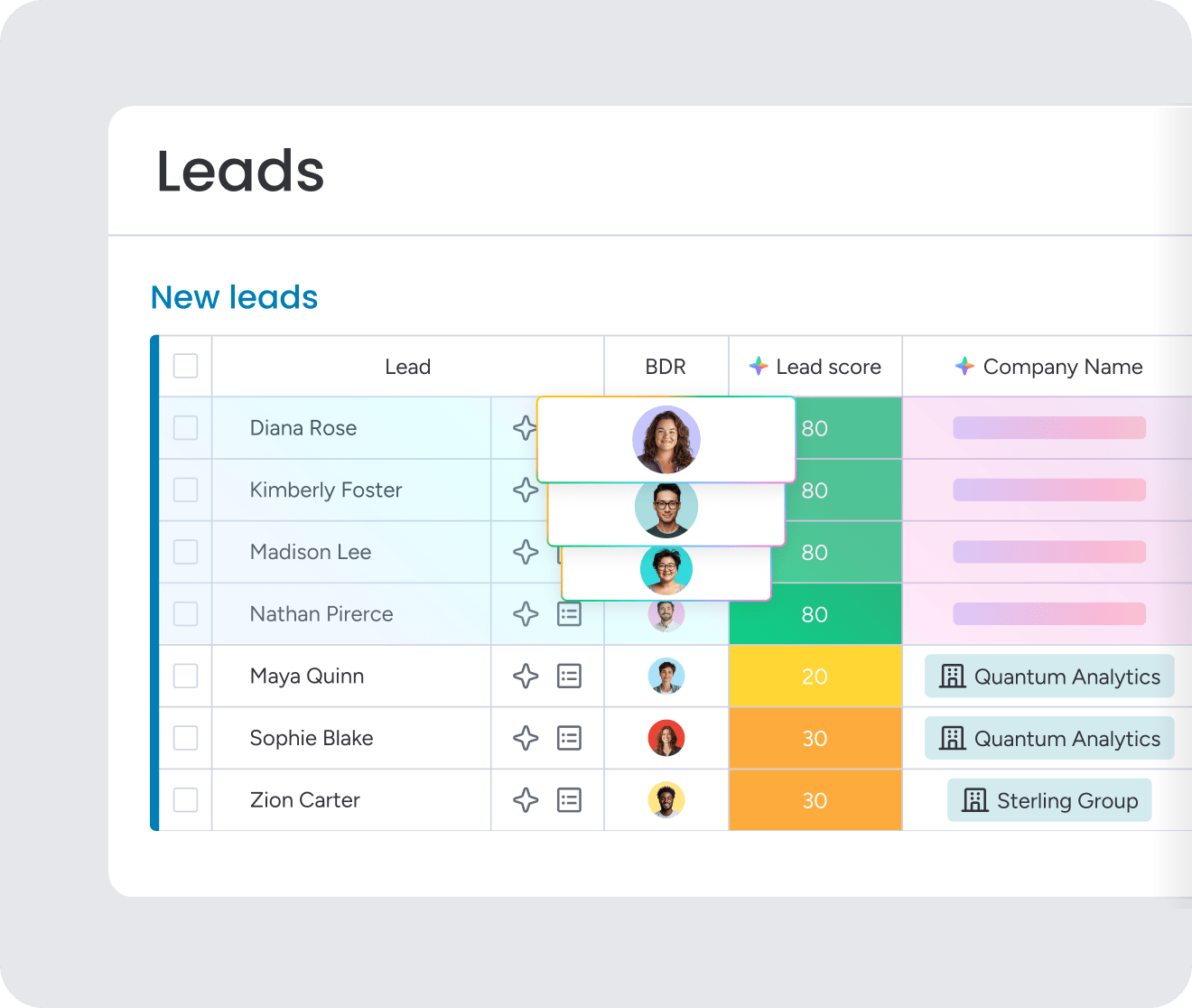
Stop guessing which rep should take which lead. monday CRM’s AI-powered lead assignment routes leads to the best rep based on win rates, workload, and deal characteristics. The Assign person AI action analyzes past deals to predict who’s most likely to close similar opportunities, matching leads to reps based on the roles and key skills you define for each teammate.
monday CRM’s Assign label AI action tags and sorts leads by territory, industry, or value automatically, using text your team already captured in emails, notes, or other fields. Build the logic you need without code. The AI gets smarter with every closed deal, learning from your team’s actual performance data.
Build and change routes without the wait
monday CRM’s no-code visual builder lets you build and change routing rules with drag-and-drop. Leads over $100k go to the enterprise team. Rep on vacation? Leads automatically redirect. Changes go live the moment you make them.
Pivoting from geographic to industry-based territories takes an afternoon, not a quarter. Your routing finally matches your business pace. AI-assisted workflows adapt instantly to your evolving sales strategy without requiring technical resources.
One platform means no more data chaos
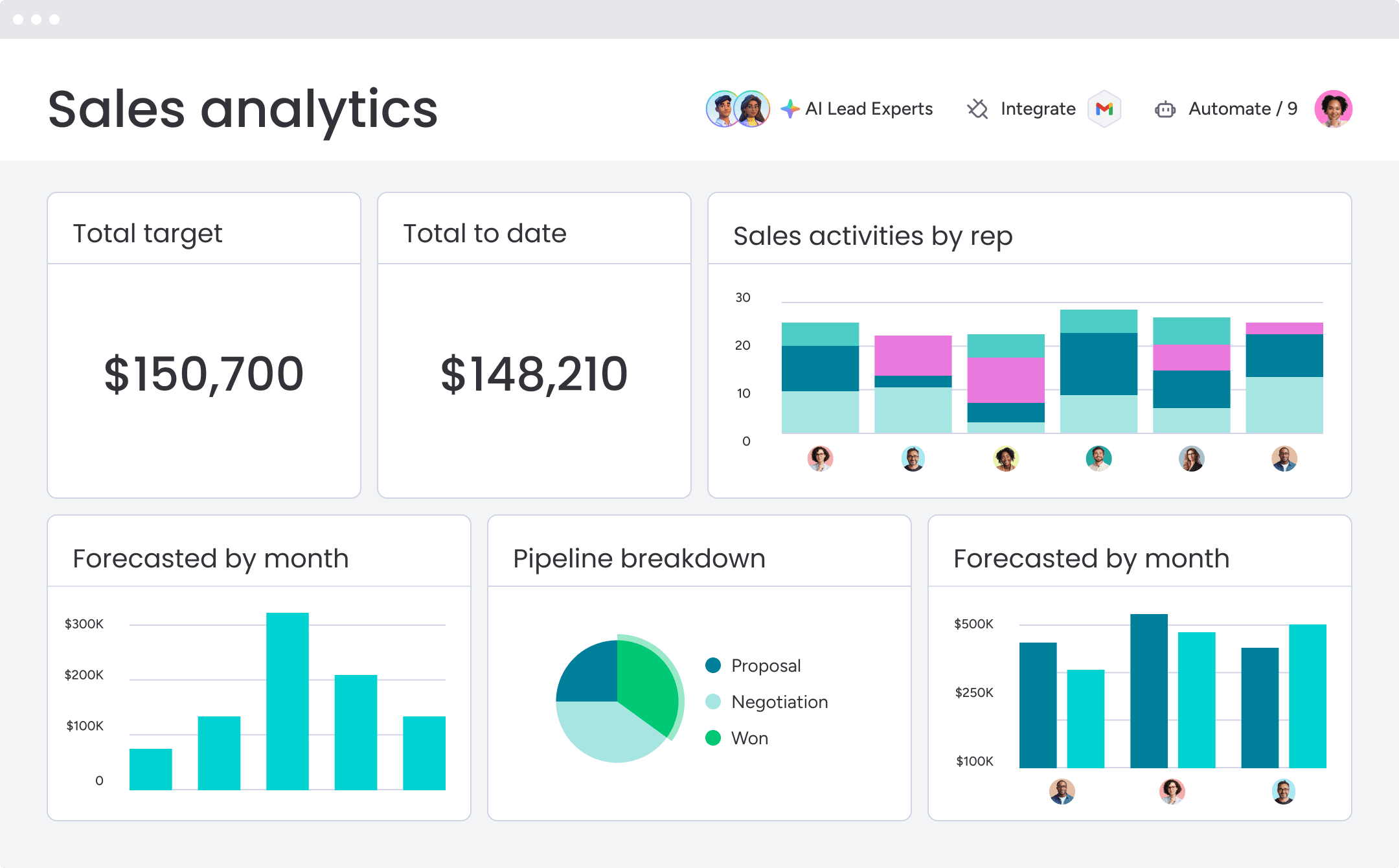
Routing built directly on monday CRM works with your sales data rather than against it. A rep’s route plan reflects deal priorities, marketing sees where campaign leads flow, and everyone operates from identical real-time information pulled from your unified CRM.
AI-powered lead assignment triggers automatic task creation and forecast updates. Data sync errors and version control nightmares disappear. By unifying routing and sales execution with AI that learns from your Emails & Activities timeline and deal history, you eliminate the friction that slows down high-performing teams.

“With monday CRM, we’re finally able to adapt the platform to our needs — not the other way around. It gives us the flexibility to work smarter, cut costs, save time, and scale with confidence.”
Samuel Lobao | Contract Administrator & Special Projects, Strategix
“Now we have a lot less data, but it’s quality data. That change allows us to use AI confidently, without second-guessing the outputs.”
Elizabeth Gerbel | CEO
“Without monday CRM, we’d be chasing updates and fixing errors. Now we’re focused on growing the program — not just keeping up with it."
Quentin Williams | Head of Dropship, Freedom Furniture
“There’s probably about a 70% increase in efficiency in regards to the admin tasks that were removed and automated, which is a huge win for us.“
Kyle Dorman | Department Manager - Operations, Ray White
"monday CRM helps us make sure the right people have immediate visibility into the information they need so we're not wasting time."
Luca Pope | Global Client Solutions Manager at Black Mountain
“In a couple of weeks, all of the team members were using monday CRM fully. The automations and the many integrations, make monday CRM the best CRM in the market right now.”
Nuno Godinho | CIO at Velv
“monday.com provides developmental flexibility, operational efficiency, and data transparency — all in one place. We became a company that moved from chasing data to leading with it.”
Hyunghan Lee | Team Lead, Sandbox Network
"monday.com brought every part of our business into one connected space. The harmony between work management and CRM has become our operating system — giving us the clarity and confidence to scale.”
Jennifer Chinburg | Executive Vice President of Corporate Development & Brand, Chinburg Properties
“We just weren’t getting value from our old CRM. With monday.com, it's a thousand times better. Our sales teams are more informed, more consistent, and far more connected."
James Arnold | Chief Operating Officer, CenversaChoosing the right routing software for your team
Selecting routing software means finding a tool your team will actually use. Wrong choice? You’ve purchased a new set of problems. Right choice? Deals move faster. Look past the polished demo and ask hard questions about integration, scale, and adoption.
Factor 1: Integration capabilities
Your routing tool’s value depends entirely on its CRM connection quality. Clunky integration creates data delays, broken syncs, and sales grinding to a halt. API-based tools promise flexibility but often demand constant technical attention. Great if you have dedicated IT resources, but a nightmare for sales ops leaders with targets to hit. monday CRM succeeds because routing is built in, so reps stay in one place, eliminating tab-switching chaos.
Factor 2: Scalability requirements
Simple routing that works for 10 reps will collapse at 50. Growth brings complex lead assignments, overlapping territories, and performance analytics spanning multiple regions. Can your tool handle 10,000 leads monthly without choking? Buy for the team you’ll have in two years, not just today. Start with basic routing and add AI capabilities or advanced analytics when ready.
Factor 3: Team adoption success factors
The most sophisticated routing platform becomes expensive shelfware if your team refuses to use it. Tools requiring a week of training face resistance. Reps want to sell, not learn another piece of software. Success stems from intuitive design that doesn’t demand behavioral overhaul. For example, monday CRM’s visual, no-code design feels familiar immediately.
Turn territory management into a competitive advantage
Smart routing software delivers far more than fuel savings. It fundamentally reshapes how your sales team operates by removing friction that slows deals and frustrates top performers. Automated assignments and optimized travel give you visibility for data-driven decisions and agility to adapt strategy the moment markets shift. Travel costs drop while prospect face-time increases, creating a fairer, more productive environment where reps concentrate on their core strengths: building relationships and closing revenue.
Ready to move from guessing to optimizing? Examine your current workflow closely, identify where manual handoffs and inefficient routes drain money, then consider a unified platform like monday CRM that brings routing, data, and execution together, empowering your team to win more deals with less effort.
Try monday CRMFAQs
Can routing software integrate with any CRM platform?
Whether routing software can integrate with any CRM platform depends on the solution. Integration capabilities vary significantly, but native solutions like monday CRM avoid complex API connections prone to breaking. A platform with built-in routing, like monday CRM, works from day one without additional configuration.
How quickly can sales teams implement routing software?
Implementation can take days rather than months. No-code platforms allow teams to configure rules and start routing leads within a week.
What's the typical ROI for routing software?
Most sales teams achieve positive returns within 3-6 months through faster lead response and reduced operational costs. Revenue impact compounds as teams close more deals with their reclaimed time.
Does routing software support both field and inside sales?
Absolutely. Field sales teams leverage geographic optimization while inside sales teams use workload balancing and expertise-based lead assignment.
How does AI improve route planning accuracy?
AI processes dozens of variables simultaneously, such as traffic patterns, deal urgency, rep availability, to generate maximally efficient routes. Continuous learning from past results improves recommendations over time.
Can routing software handle complex multi-territory operations?
Yes, though complexity varies by platform. The right software manages everything from simple territories to overlapping regions without requiring a specialist team to operate it.
