

The difference between a target account list and actual closed deals? Timing and intelligence. AI in B2B marketing helps teams identify which accounts are actively researching solutions, connect with the right buying committee members, and personalize outreach based on real signals—so conversations start faster and deals close sooner.
This guide breaks down 10 AI tools for account-based marketing, covering what each platform does well and how to match capabilities to your team’s actual needs. You’ll learn which AI features separate useful platforms from overhyped ones, plus a practical framework for choosing the right fit without overcomplicating your tech stack.
Try monday CRMWhat are AI tools for account-based marketing?
AI platforms for account-based marketing show you exactly which accounts are ready to buy. They analyze buying signals and surface the accounts worth your time right now, giving you data-driven direction on where to focus. They look for a few key things:
- Intent data: Shows what problems an account is actively researching online, signaling their interests in real time
- Predictive scoring: Ranks accounts based on their behavior and similarity to past customers, telling you who’s most likely to convert
- Account intelligence: Builds a detailed profile of a company, including its structure, key players, and the technology it uses
- Buying signals: Identifies specific actions that show an account is moving from just looking to ready-to-buy
Revenue teams find success when they can bring these AI capabilities directly into their daily workflow. With AI-powered features built right in, teams can act on insights immediately. This turns data into deals without the hassle of switching between different platforms.
Why AI transforms ABM from guesswork to precision
Traditional ABM often feels like guesswork. Teams build a target list and spend their budget, hoping someone on it is ready to buy while other hot prospects slip away unnoticed. AI changes that. Static lists give way to live buying signals that reveal exactly who is searching for a solution right now. Your team engages accounts when they’re actually ready to talk.
Here’s how:
- Intent signals replace static account lists: AI monitors content consumption, tech evaluations, and competitor comparisons to surface accounts the moment real interest shows up, so your team focuses on prospects who are actively in-market.
- Contact-level intelligence beats account-level targeting: AI in B2B sales identifies actual buying committee members and maps their individual priorities, ensuring every touchpoint addresses what each stakeholder actually cares about.
- Predictive scoring that actually works: Modern AI examines genuine buying patterns from closed deals, spots the behaviors that lead to conversions, and applies that to current prospects — so your team pursues accounts with real purchase intent, not just high engagement metrics.
Want to learn more about this? Here’s a guide on the best AI for marketing.
10 best AI-powered ABM platforms
ABM platforms fall into 2 camps: Some fill specific gaps in your existing tech stack while others serve as comprehensive systems managing your entire program. Your choice depends on whether you need one specific feature or a full system overhaul.
| Platform | Best for | AI strength | Free Plan | Starting Price |
|---|---|---|---|---|
| monday CRM | B2B teams wanting CRM-native ABM with built-in AI | Workflow automation + AI timeline summaries | 14-day trial | $12/seat/month |
| Demandbase One | Enterprise ABM at scale | Website de-anonymization + predictive scoring | No | Custom |
| 6sense | Predictive buying stage identification | AI buying stage categorization | Limited | Custom |
| AdRoll ABM | Account-based advertising | AI-powered programmatic ad targeting | Limited | Custom |
| Terminus | Multi-channel ABM orchestration | Unified campaign orchestration across channels | No | Custom |
| ZoomInfo | Data-driven account targeting | Intent signals + contact intelligence | No | Custom |
| HubSpot Marketing Hub | ABM inside marketing automation | Native CRM-linked account scoring | No | $890/month |
| Marketo Engage | Enterprise marketing automation + ABM | AI-driven personalization | No | Custom |
| Salesforce (Account Engagement) | CRM-first ABM with Einstein AI | AI account prioritization + analytics | No | $1,250/month |
| Apollo.io | Sales-led ABM prospecting | AI prospecting + visitor ID + sequences | Yes | $49/user/month |
1. monday CRM
monday CRM brings account-based work onto the monday.com Work OS. Revenue teams can run ABM without juggling disconnected systems. Instead of spreading account context across tabs, notes, and “someone’s spreadsheet,” teams organize accounts, contacts, and deals in one place, then tailor the workflow to match their sales cycle.
For account-based marketing teams, that matters because ABM lives and dies on context as part of an effective marketing strategy. And monday CRM keeps that history in one place, so reps and leaders can act fast and report accurately.

Use case: B2B revenue teams wanting to run AI-powered account-based marketing without adding another disconnected tool
Key features
- Account-based pipeline visibility: Manage target accounts and related deals in visual boards with shared ownership and live dashboards.
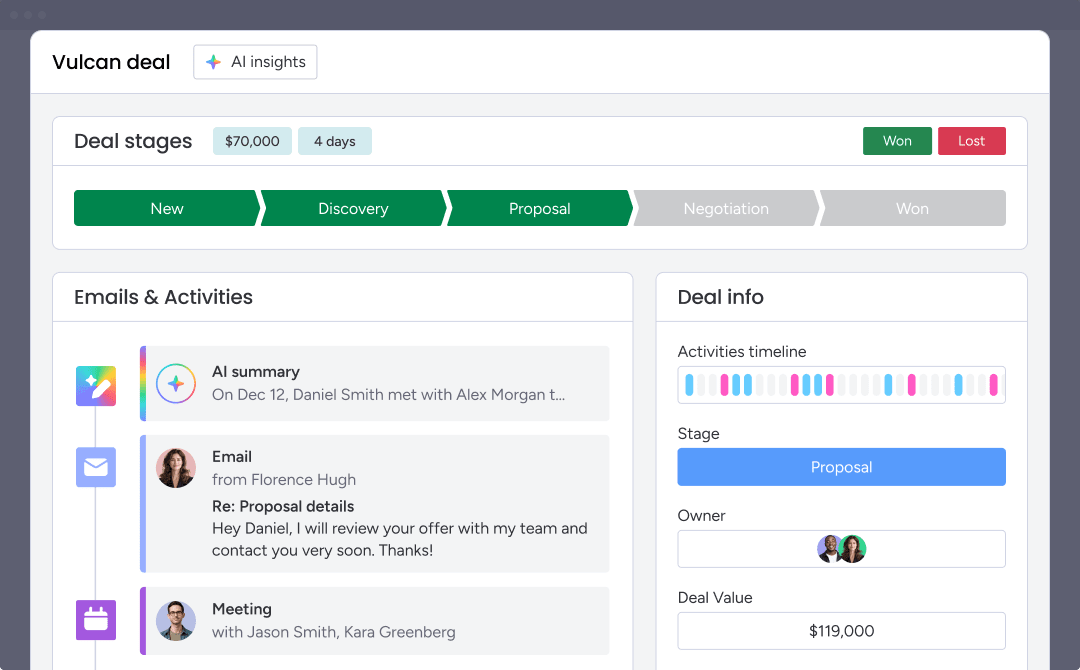
- AI-powered workflow automation: Use AI to summarize timelines, draft emails, extract data from files, and auto-fill CRM fields.
- Connected sales execution: Log emails, meetings, and activities in one timeline while triggering automations based on deal or account changes.
Pricing
- Free trial: 14 days
- Basic: $12 per seat/month (billed annually)
- Standard: $14 per seat/month (billed annually)
- Pro: $28 per seat/month (billed annually)
- Enterprise: Custom pricing (contact sales)
- Annual billing provides an 18% discount
- Minimum 3 seats required for paid plans
- Volume pricing available for teams over 40 users
Why it stands out
- The intuitive setup makes it easier to keep records current, so forecasting and reporting stay reliable.
- Teams can customize boards, views, and workflows to match how they qualify, sell, and hand off accounts.
2. Demandbase One
Demandbase One delivers comprehensive account intelligence for enterprise ABM programs that need serious firepower. The platform combines intent data from multiple sources with machine learning to identify in-market accounts and orchestrate multi-channel campaigns across advertising, web personalization, and sales outreach. Built for revenue teams managing complex B2B sales cycles, it’s designed to turn anonymous website visitors into qualified pipeline opportunities.

Use case: Enterprise organizations requiring de-anonymization of website traffic, multi-dimensional account scoring, and coordinated ABM campaigns at scale
Key features
- Account identification technology: Reveals which companies are researching your solutions, even when visitors don’t fill out forms
- Intent data aggregation: Combines first-party behavioral signals with third-party research data to build comprehensive account buying stage profiles
- Predictive analytics models: Forecast conversion likelihood based on historical patterns, engagement levels, and account fit scores
Pricing
- Custom pricing: Quote-based with platform fee plus per-user costs
- Enterprise contracts: Typically start in 6-figure range annually
- Additional fees: Premium intent data sources and advanced features cost extra
- Implementation: Professional services support often required
Considerations
- Implementation complexity requires dedicated resources and can slow time-to-value for teams without prior ABM platform experience.
- Integration with existing CRM and marketing automation systems needs ongoing maintenance to ensure proper data flow.
3. 6sense
6sense delivers revenue AI that predicts which accounts are ready to buy and orchestrates engagement across your entire customer journey. The platform analyzes billions of behavioral signals to identify in-market accounts, determine their buying stage, and coordinate the right touchpoints to move deals forward. Built for enterprise B2B teams with complex sales cycles, 6sense combines predictive intelligence with omni-channel execution.

Use case: B2B revenue teams who need to identify anonymous buyer research early and orchestrate coordinated ABM campaigns that align marketing and sales around qualified accounts
Key features
- Predictive buying stages: AI categorizes accounts into awareness, consideration, decision, and purchase stages based on web activity, content engagement, and third-party intent data.
- Account orchestration: Coordinates touchpoints across email, advertising, web personalization, and sales outreach to ensure consistent engagement regardless of channel.
- Buying committee identification: Maps stakeholders within target accounts to reveal who’s engaged, who influences decisions, and who remains unreached.
Pricing
- Sales Intelligence: Free tier with 50 data credits per month
- ABM/Revenue Marketing: Custom pricing based on company size and feature requirements
- Additional costs include data credits, media spend for advertising campaigns, and optional Data Packs for bulk data extracts
Considerations
- Complex implementation requiring technical resources and months of configuration before teams see value.
- Substantial data requirements needed to train accurate predictive models, making it less suitable for teams without extensive historical data.
4. AdRoll ABM (formerly RollWorks)
RollWorks, now part of the AdRoll platform as AdRoll ABM, uses AI to turn your target account list into real conversations. It’s built for B2B marketing teams who want to run account-based advertising campaigns that actually work, moving beyond basic channels to reach buyers across the web.

Use case: B2B marketing teams wanting to identify high-value target accounts and engage decision-makers through AI-optimized programmatic advertising
Key features
- AI-powered account targeting: Machine learning prioritizes accounts and delivers ads where they’ll generate impact, reducing wasted spend on low-value impressions.
- Cross-channel ad delivery: Coordinates campaigns across display, native, video, and social networks, syncing audiences to platforms like LinkedIn for message consistency.
- Real-time performance analytics: Tracks account-level metrics connecting ad investment to pipeline progression, revealing which accounts engage and how that correlates with deal movement.
Pricing
- Free tier: Self-serve retargeting and contact targeting with pay-as-you-go media costs. Note: core ABM features like account targeting and intent data playbooks aren’t included.
- Paid ABM packages: Custom quotes for full-funnel Account-Based Marketing and Advertising packages.
- Media costs: Billed separately through auction-based CPMs, with NextRoll (AdRoll’s parent company) retaining a percentage for ad serving.
- Add-ons & extras: Additional user seats and ICP models available for purchase. Access to certain add-ons and creative services depends on annual media spend or package level.
Considerations
- The platform concentrates on advertising, requiring separate tools for email outreach, sales engagement, and comprehensive CRM management.
- Gaps can emerge between ad performance data and sales activity, necessitating additional effort to achieve unified revenue operations visibility.
5. Terminus
Terminus delivers multi-channel ABM orchestration that reaches target accounts across advertising, email, chat, and sales touchpoints. The platform serves mid-market and enterprise B2B teams who need coordinated account engagement, combining native channels with a purpose-built CDP for unified buying-group insights. With sub-3% ad fraud rates and analyst recognition from both Forrester and Gartner, Terminus positions itself as the command center for revenue teams running sophisticated ABM programs.
Use case: Enterprise marketing teams wanting to orchestrate coordinated, multi-channel ABM campaigns across advertising, chat, email signatures, and website personalization from a single platform
Key features
- Account scoring and prioritization: Combines firmographic data, intent signals, and engagement history to identify which accounts deserve immediate attention versus long-term nurturing.
- Multi-channel campaign orchestration: Manages display ads, LinkedIn campaigns, email signatures, chat experiences, and website personalization from one unified interface.
- Revenue attribution and measurement: Tracks account progression through buying stages with account-level metrics rather than individual lead tracking, aligning reporting with ABM strategy.
Pricing
- Custom pricing: Quote-based pricing varies by company size, number of target accounts, and activated channels
- Enterprise focus: Requires substantial annual commitments for full platform access
- Additional costs: Media budgets, third-party intent data (like Bombora), and professional services add to total cost of ownership
Considerations
- Managing multiple ABM channels requires dedicated resources for content creation, performance monitoring, and continuous campaign optimization across touchpoints.
- Platform needs connection with existing CRM and marketing automation systems, adding technical overhead for implementation teams.
6. ZoomInfo
ZoomInfo delivers comprehensive B2B contact and company intelligence that powers targeted account-based marketing campaigns. The platform combines proprietary data with intent signals and multi-channel activation capabilities, making it a go-to choice for revenue teams who need deep account insights and coordinated sales-marketing alignment.

Use case: Revenue teams wanting to identify high-intent accounts and drive personalized, multi-channel engagement using unified B2B data and AI-driven insights
Key features
- Contact discovery and technographic insights: Access millions of verified business contacts with direct dial numbers and email addresses, plus detailed technology stack data to identify competitive displacement opportunities.
- Intent data and predictive scoring: Surface buying signals from web behavior and content consumption patterns, with AI-powered lead scoring to prioritize accounts based on fit and engagement.
- Multi-channel activation platform: Execute campaigns through proprietary DSP for display and social advertising, plus integrated email, SMS, chat, and website visitor identification capabilities.
Pricing
- Custom pricing: Quote-based annual contracts with minimum seat commitments
- AWS Marketplace reference: ZoomInfo Marketing ABM Pro+ listed at $69,995/12 months
- Negotiated discounts: Procurement data indicates 30-65% discounts from list pricing are common
- Add-on costs: Additional fees for bulk credits, enrichment services, website visitor identification, and specialized integrations
Considerations
- Reporting and dashboard capabilities can be limited outside of Salesforce-centric environments, with some users noting gaps in HubSpot integration and granular filtering options.
- Pricing opacity and higher total cost of ownership compared to alternatives, though significant negotiated discounts are typically available for annual commitments.
7. HubSpot Marketing Hub
HubSpot Marketing Hub combines inbound marketing with native ABM capabilities built directly into their CRM. The platform targets mid-market organizations looking for an integrated approach to account-based marketing without the complexity of managing separate point solutions. Teams get unified account intelligence that connects marketing campaigns to sales execution seamlessly.

Use case: Revenue teams seeking ABM features embedded within their existing marketing automation platform rather than bolting on another standalone system
Key features
- Target account workspace: Centralized dashboard to discover, prioritize, and monitor high-value accounts with AI-powered recommendations and collaborative tools for marketing and sales alignment.
- Native CRM integration: Built-in ABM properties (Target account, ICP tier, Buying role) that power automated workflows, scoring, and reporting without requiring data integration between systems.
- LinkedIn audience sync: Direct connection to create company segment audiences from target account lists, enabling immediate ABM advertising activation on LinkedIn’s platform.
Pricing
- Professional: $890/month (includes 3 core seats and 2,000 marketing contacts) plus $3,000 onboarding fee
- Enterprise: $3,600/month (includes 5 core seats and 10,000 marketing contacts) plus $7,000 onboarding fee
- Contact-based Pricing Additional contacts priced in tiers, with costs scaling as database grows
- Nonprofit discount: Up to 40% off for eligible organizations
- Startup discount: Up to 90% off first year for qualifying early-stage companies
Considerations
- ABM features require Professional or Enterprise tiers, making it expensive for smaller teams who need basic account-based capabilities.
- Contact-based pricing model can become costly as your database expands, particularly compared to seat-based alternatives that offer more predictable scaling costs.
8. Marketo Engage
Marketo Engage delivers enterprise marketing automation with AI-powered personalization and advanced segmentation capabilities. The platform targets large organizations with complex marketing operations and substantial content libraries. Adobe’s acquisition brings deep CRM integrations and cross-platform synergy that enterprise teams need for coordinated ABM execution.

Use case: Enterprise teams wanting unified ABM and marketing automation in one platform
Key features
- AI-powered personalization: Adapts email content, web experiences, and advertising creative based on account attributes and behavioral signals.
- Advanced segmentation: Enables sophisticated account targeting based on firmographic data, behavioral patterns, and engagement history.
- Multi-touch attribution: Tracks how different marketing touchpoints contribute to pipeline and revenue, providing visibility into campaign effectiveness.
Pricing
- Growth: Custom pricing via sales consultation
- Select: Custom pricing via sales consultation
- Prime: Custom pricing via sales consultation (includes Target Account Management)
- Ultimate: Custom pricing via sales consultation (includes Target Account Management)
- Enterprise implementations typically require 6-figure annual commitments
- Target Account Management available as add-on for Growth and Select tiers
Considerations
- Implementation requires technical expertise and often involves professional services engagements that extend time-to-value.
- Platform assumes sophisticated marketing operations capabilities — teams without dedicated marketing ops resources struggle to leverage advanced features effectively.
9. Salesforce
Salesforce delivers comprehensive CRM functionality with Einstein AI features and marketing cloud capabilities for enterprise-scale account-based marketing. The platform combines CRM-native ABM execution with Data Cloud segmentation and packaged analytics, making it ideal for revenue teams managing complex, multi-stakeholder sales cycles. Organizations gain unified account tracking, AI-powered insights, and seamless sales-marketing alignment on a single platform.

Use case: Revenue teams executing CRM-first ABM strategies with Einstein AI account prioritization, native campaign tracking, and Data Cloud activation
Key features
- Einstein Key Account Identification: Tiers accounts A-D based on opportunity likelihood, helping sales leaders focus resources on high-propensity targets.
- “Accounts as Campaign Members” functionality: Allows account-level targeting and tracking directly in CRM without requiring specific contacts first.
- B2B Marketing Analytics: Provides templated ABM dashboards for account-focused pipeline analysis and engagement measurement across marketing and sales touchpoints.
Pricing
- Marketing Cloud Account Engagement Growth: $1,250/month (up to included contacts)
- Marketing Cloud Account Engagement Plus: $2,750/month (includes ABM dashboards)
- Marketing Cloud Account Engagement Advanced: $4,400/month
- Marketing Cloud Account Engagement Premium: $15,000/month
- B2B Marketing Analytics Plus: $3,000/user/month (add-on)
- Additional contacts: $100 per 10,000/month
- Dedicated IP: $500/month
- Premier Success Plan: 30% of net license fees
Considerations
- Feature gating requires higher-tier editions for ABM dashboards and advanced analytics, with consumption-based AI features adding operational complexity through Data Cloud dependencies.
- Total cost often exceeds alternatives once add-ons, credits, and success plans are included, particularly challenging for smaller teams managing budget constraints.
10. Apollo.io
Apollo.io combines a massive B2B database with AI-powered prospecting to help sales teams identify and engage high-value accounts. The platform specializes in intent-driven account selection and automated outreach sequences, making it ideal for sales development teams focused on scaling their ABM efforts. With over 210 million verified contacts and integrated engagement workflows, Apollo turns account-based prospecting from guesswork into a data-driven process.
Use case: Sales teams wanting to operationalize account-based prospecting with intent data and automated multi-channel outreach inside their CRM
Key features
- AI-powered account targeting: Analyzes ideal customer profiles and suggests similar accounts using intent signals from 1,600+ topics, refreshed weekly to catch buying signals early.
- Website visitor identification: Tracks companies visiting your site, scores engagement levels, and triggers automated follow-up sequences based on visitor behavior.
- Multi-channel sequence automation: Manages email, calls, and LinkedIn outreach with A/B testing capabilities and automatic follow-ups based on prospect responses.
Pricing
- Free plan: Basic features with limited credits
- Basic: $49/month per user with core prospecting features
- Professional: Higher-tier plan with advanced automation and larger contact databases
- Organization: Custom pricing for enterprise teams
- Additional credits and add-ons (advanced dialer, inbound features) available for purchase
Considerations
- Focuses primarily on sales-led ABM execution rather than comprehensive marketing orchestration, lacking native advertising capabilities and web personalization features found in dedicated ABM platforms.
- Credit-based usage model means higher activity levels often require additional purchases, and some advanced features like the dialer come as separate add-ons.
Key AI capabilities every ABM platform needs
Distinguishing genuine AI capabilities from marketing hype requires understanding what actually moves the needle. Strong ABM platforms leverage AI to synthesize insights across your entire strategy, equipping your team with intelligence that drives decisive action rather than analysis paralysis.
- Intent data and buying signal detection: Sophisticated AI reveals who’s actively seeking solutions before they ever reach your website, distinguishing casual browsers from serious buyers. Signal analysis tracks early-stage signals (educational content consumption, webinar attendance), active evaluation signals (case study engagement, pricing page visits), and decision-stage signals (proposal requests, security questionnaire submissions).
- Predictive account and contact scoring: Predictive scoring eliminates subjective judgment calls by analyzing behavioral patterns, fit criteria, and intent signals to surface accounts with genuine conversion potential. This extends beyond company-level analysis to individual stakeholders, revealing which contacts wield actual influence and directing outreach toward decision-makers capable of advancing deals.
- Automated multi-channel personalization: AI enables personalization at scale, generating contextually relevant messages drawing from each account’s unique history and current situation. Website experiences adapt dynamically—educational content for early-stage visitors, ROI calculators for those evaluating options—ensuring every touchpoint reinforces a coherent, personalized narrative.
- Real-time campaign orchestration: Real-time orchestration ensures immediate, coordinated response when priority accounts take action. Alerts fire instantly, accounts enter appropriate nurture sequences, and follow-up tasks queue automatically, transforming coordinated engagement from aspiration to automatic execution.
These capabilities convert static databases into dynamic revenue engines.
4 steps to choosing the right AI ABM platform for your team
Success isn’t determined by feature lists, but by team adoption. Select a platform matching your team’s current reality rather than a vendor’s vision of your future state.
Step 1: Evaluate your current data foundation
AI quality mirrors data quality. Before evaluating any platform, assess your existing records:
- Accurate contacts: Job titles, emails, and phone numbers are complete and verified.
- Current company info: Firmographics like revenue, employee count, and industry reflect present reality.
- Engagement history: Email, website, and content interactions are systematically tracked.
- A clean CRM: Regular deduplication and updates maintain data integrity.
Step 2: Define must-have integrations
Map essential connections before scheduling demos. Your ABM platform must integrate smoothly with:
- Marketing automation: HubSpot, Marketo
- Ad platforms: LinkedIn, Google Ads
- Sales engagement: Outreach, SalesLoft
- Data providers: ZoomInfo, Clearbit
- Communication: Slack, Teams
Step 3: Calculate total cost of ownership
Total cost of ownership encompasses implementation fees, training investments, and integration expenses that routinely double initial budget projections:
- Implementation services: Professional services, consulting, configuration support
- Training and onboarding: Initial training, ongoing education, certification programs
- Data costs: Intent data subscriptions, contact database access, enrichment services
Step 4: Match platform complexity to team maturity
Capability must align with actual ABM experience levels:
- Pilot stage: Initial ABM experiments require simple platforms with minimal learning curves.
- Developing stage: Coordinated campaigns demand automation and foundational AI features.
- Mature stage: Dedicated ABM teams with proven ROI justify advanced AI and extensive customization.
Launch your AI-powered ABM program with monday CRM
Account-based marketing shouldn’t require a computer science degree. Yet most programs drown in tool complexity that generates more administrative burden than closed deals. Revenue teams find success using monday CRM to consolidate CRM functionality, account intelligence, and automation into a single environment their teams actually embrace.
Step 1: Build and launch your ABM plays fast
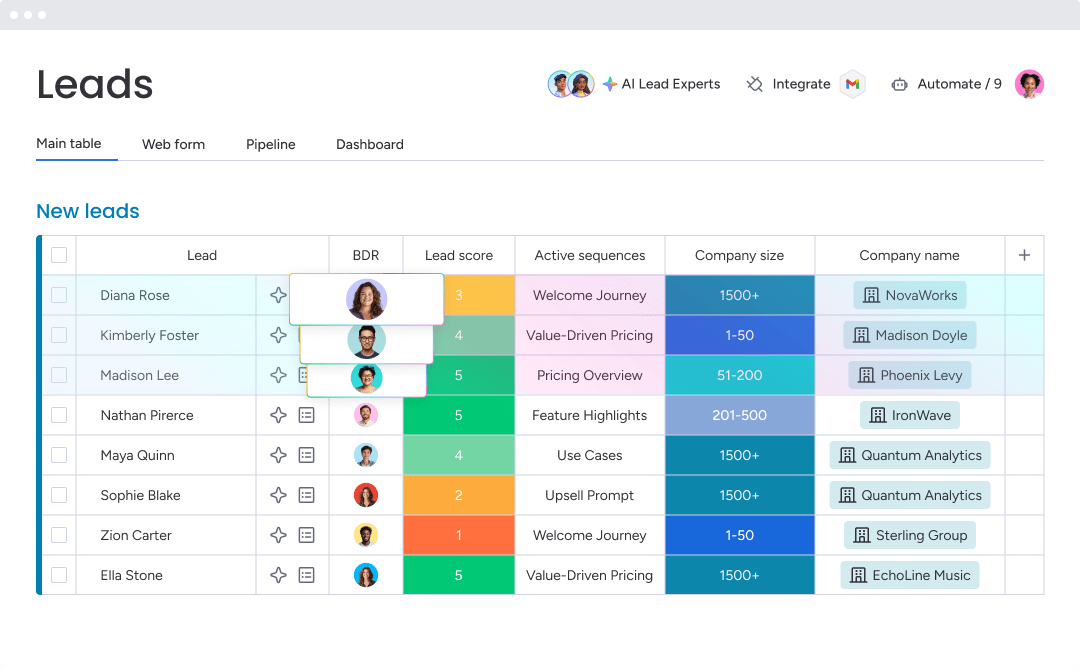
Skip the IT queue and month-long implementation projects. Import target accounts and leverage flexible, no-code configuration to track what matters: account tiers, engagement scores, custom data fields. Every team member gets views optimized for their role — reps monitoring deals, leaders tracking pipeline progression.
Ready to activate your strategy? Construct automations handling repetitive tasks. Account milestone triggers can assign reps, initiate email sequences, and update priorities without manual intervention. Launch functional ABM workflows within days rather than quarters.
Step 2: Let AI do the heavy lifting
Blank page paralysis ends here. AI assists your team in crafting personalized outreach based on account history and deal stage, accelerating connections with more targets. Months of accumulated notes and emails compress into quick briefs, providing instant context for anyone engaging the account.
Data quality issues? AI addresses those too. The platform automatically enriches account records with current contact details and company information, maintaining targeting accuracy. Sentiment detection flags relationship risks before they escalate into lost opportunities.
Step 3: See what’s working (and what’s not)
Invisible problems remain unsolved. Build custom dashboards tracking ABM metrics that actually drive your business: account engagement, pipeline velocity, win rates by tier. Drag-and-drop widgets deliver real-time answers without coding or consulting fees.
Account-level reports reveal which tactics generate movement and which fall flat. Organizations achieve better results when they leverage monday CRM to connect marketing investment directly to pipeline outcomes, demonstrating which campaigns justify continued spending. Visibility enables smarter decisions and confident scaling.
Start small, iterate quickly, and let the platform absorb complexity.

Turn account insights into revenue with the right AI ABM platform
The best AI tools for account-based marketing don’t just surface data—they turn signals into action. From intent detection and predictive scoring to real-time orchestration and CRM-native intelligence, the right platform helps your team focus on accounts that are ready to buy, personalize outreach at scale, and measure what actually drives pipeline. Success comes down to choosing tools that match your team’s maturity, integrate with your existing stack, and deliver insights where your reps already work.
With monday CRM, you get AI-powered ABM capabilities directly into your daily workflow. Build target account lists, automate personalized outreach, and track what’s working from one unified platform your team will actually use. Try monday CRM today.
Try monday CRMFAQs
How long does it take to implement AI-powered ABM tools?
Implementation timelines vary dramatically by platform. Complex enterprise systems often require months of configuration, while intuitive platforms can have teams operational within a week.
What data quality is required for AI ABM success?
AI ABM demands accurate, complete data — verified contact information and comprehensive engagement history. Poor data quality produces unreliable predictions and misdirected effort.
Can AI ABM tools integrate with existing CRM systems?
Most AI ABM tools offer CRM integration, though quality and maintenance requirements differ significantly. CRMs with native AI capabilities, like monday CRM, reduce integration complexity.
What ROI timeline should I expect from AI-powered ABM?
ROI timelines correlate directly with implementation speed. Complex platforms may require 6 months or longer to demonstrate value, while streamlined solutions can deliver returns within 90 days.
How do AI ABM tools handle data privacy and compliance?
Reputable platforms incorporate encryption and comply with regulations including GDPR and SOC 2. Teams remain responsible for ethical and legal data usage regardless of platform capabilities.
Should I choose an all-in-one platform or build a composable stack?
The decision hinges on available resources. All-in-one systems offer faster deployment, while composable stacks demand substantial technical investment and ongoing maintenance.

 Get started