


Imagine a sales pipeline that fills itself, where every prospect receives a perfectly timed, relevant message without any manual intervention from your team. For most organizations, this remains a distant dream, often overshadowed by the daily grind of manual research and the frustration of forgotten follow-ups.
The alternative is a strategic shift in focus, moving your team away from chasing cold leads toward closing warm, highly qualified deals. Outreach sales agents make this possible by using AI to handle prospecting, lead qualification, and initial contact autonomously across multiple channels.
Discover how these AI systems turn pipeline management from a reactive scramble into a proactive, scalable engine for growth. By combining AI speed with human instinct, businesses can finally solve the scaling problems that traditionally stall business expansion and dominate their market.
Key takeaways
- Replace manual prospecting with 24/7 AI automation: outreach agents monitor thousands of prospects continuously, identifying buying signals and sending personalized messages while your team focuses on closing deals.
- Scale personalized outreach without hiring more SDRs: AI agents analyze dozens of data points per prospect to craft relevant messages for hundreds of leads daily at a fraction of traditional hiring costs.
- Transform pipeline predictability through consistent data: automated outreach eliminates the ups and downs of manual prospecting, creating reliable patterns that enable accurate revenue forecasting.
- Leverage AI blocks for instant automation: configure intelligent lead scoring, sentiment analysis, and personalized content generation through visual interfaces in monday CRM without technical expertise or complex setup.
- Implement the hybrid model strategically: let AI handle high-volume prospecting and qualification while human reps focus on relationship building and complex negotiations where empathy matters most.
What are outreach sales agents?
Outreach sales agents are AI-powered software solutions that handle prospecting, lead qualification, and initial outreach across multiple channels automatically. These systems determine which prospects to prioritize, how to personalize messaging, and when to initiate contact based on real-time data analysis.
Traditional outreach sales automation distributes identical messages to all recipients at predetermined intervals. Outreach agents operate through a more sophisticated approach. They analyze each prospect’s industry, company size, recent developments, website behavior, and historical interactions to determine the optimal message content, timing, and communication channel.
An outreach agent identifies potential customers from databases and online sources, researches company information and buying signals, crafts personalized messages tailored to each prospect’s context, schedules follow-ups based on engagement patterns, and qualifies leads through conversational interactions before routing them to human sales representatives.
For mid-market revenue leaders, outreach agents deliver pipeline predictability through consistent, data-driven prospecting. Sales managers and representatives benefit from dramatically reduced manual prospecting work. No more hours researching prospects, writing emails one by one, or tracking follow-ups.
How do outreach sales agents transform your pipeline?
Outreach sales agents turn pipeline management from reactive scrambling into proactive control. They spot and engage prospects nonstop while your reps focus only on qualified opportunities and building relationships.
This addresses three critical pipeline challenges that constrain revenue growth. Here’s how outreach agents resolve each challenge and the implications for your team:
| Pipeline challenge | How outreach agents solve it | Business impact |
|---|---|---|
| Limited volume | Process thousands of prospects simultaneously, monitoring buying signals 24/7 | Every opportunity is captured and engaged, regardless of your team's availability. |
| Inconsistent quality | Analyze behavior patterns, growth indicators, and engagement signals to calculate conversion probability | Reps spend time with prospects ready to buy, not chasing cold leads |
| Unpredictable forecasting | Generate reliable data patterns through consistent, systematic outreach | Revenue leaders can project pipeline growth with confidence |
- Pipeline volume shoots up: one outreach agent handles thousands of prospects at once, tracking buying signals and engagement across multiple sources 24/7. Human reps can’t review hundreds of websites daily, track social activity for thousands of contacts, or catch the moment a prospect downloads a whitepaper at 2 AM.
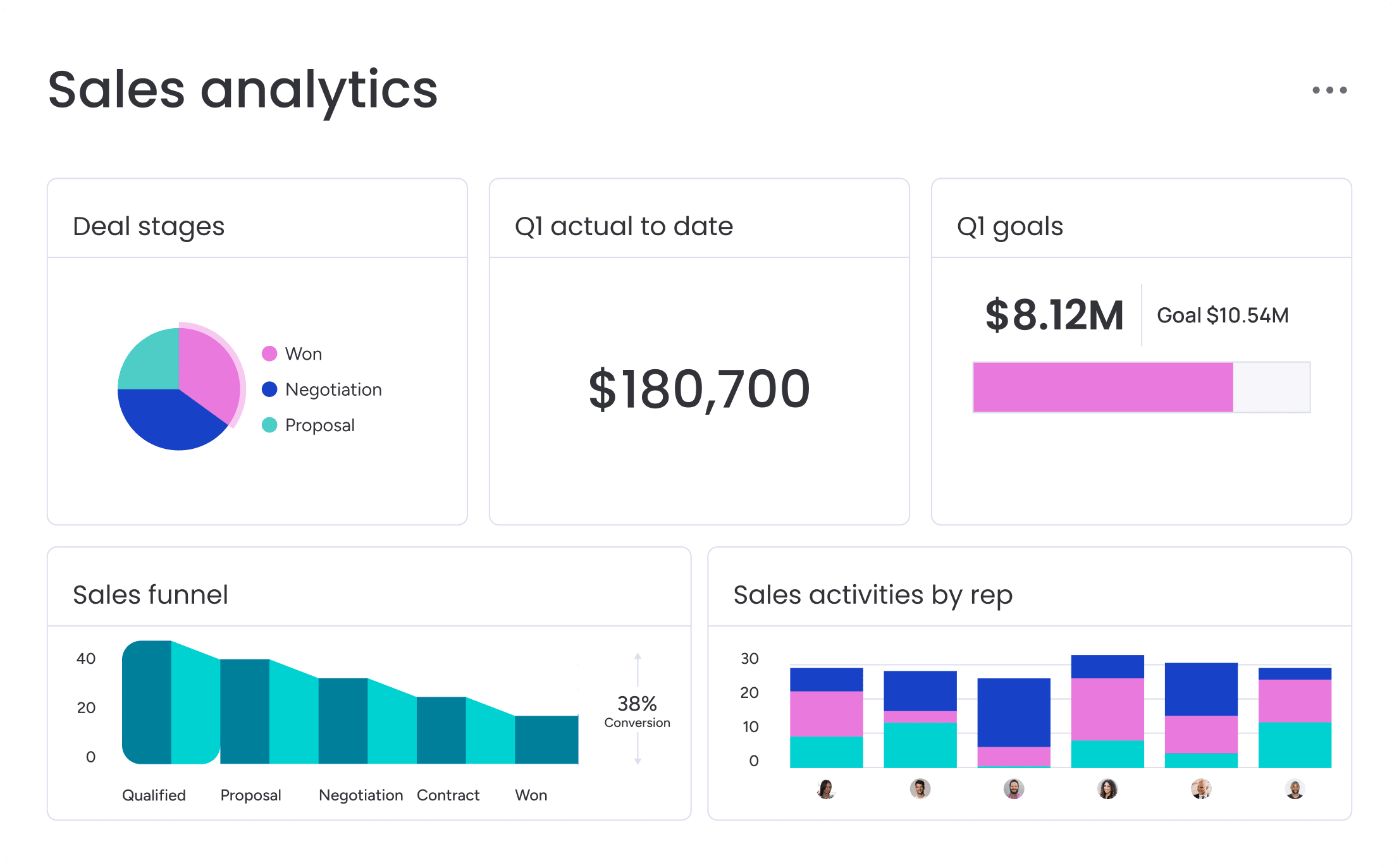
- Pipeline quality improves with smart filtering: agents analyze prospect behavior patterns, company growth indicators, technology stack data, and engagement signals to calculate conversion probability for each lead. A prospect who hits the pricing page three times, downloads two case studies, and works at a company that just raised Series B funding? Higher priority than someone who opened one email six weeks ago.
- You can finally predict your pipeline: consistent, systematic outreach creates reliable data patterns you can actually forecast from. Manual prospecting is all over the place. Reps have good weeks and bad weeks, get pulled into fires, or chase different segments on a hunch. Agents cut out the noise.
7 key benefits of AI sales outreach
These benefits solve the real problems that keep sales teams from scaling. They cut manual prospecting work, fix inconsistent follow-up that kills warm leads, and let you personalize outreach to hundreds of prospects at once.
1. 24/7 autonomous prospecting
Outreach agents watch prospect databases, company news, social media, and industry publications nonstop. A company announces funding at 7 PM. The agent digs into their needs and sends personalized outreach by 8 PM, before competitors even know there’s an opportunity.
The edge grows over time. While competitors wait for reps to manually find opportunities, agents have already started conversations, built credibility, and kicked off qualification.
2. Personalization at scale
Agents study dozens of data points per prospect: company size, industry, tech stack, recent news, website behavior, downloads, social activity. An email to a retail CFO mentions their recent store expansion and talks about inventory headaches that come with running multiple locations.
You couldn’t personalize this deeply at scale before. A human rep might personalize 20-30 emails a day with this much research. Agents personalize 500 emails a day and keep the same level of relevance.
3. Lead prioritization through intent signals
Agents constantly score prospects based on how engaged they are, what they do, and company data. A prospect who hits the pricing page three times in a week, downloads a case study, and works at a company that fits your ICP? They get routed to reps immediately.
This smart prioritization keeps reps from wasting time on prospects who aren’t ready to buy. Close rates improve because every conversation happens with a qualified, engaged prospect rather than a cold contact.
4. Automated multi-channel follow-ups
Agents coordinate outreach across email, LinkedIn, phone, and other channels based on prospect response patterns and preferences. If a prospect opens emails but never responds, the agent shifts to LinkedIn connection requests. The system learns which communication methods work for each prospect and adjusts accordingly.
Timing optimization happens automatically. Agents analyze historical data to determine when specific prospect segments are most likely to engage.
5. Real-time performance analytics
Agents provide immediate visibility into campaign performance, showing which messages generate responses, which prospect segments convert best, and which outreach channels deliver optimal results. If a particular subject line generates 40% open rates while others achieve 15%, the system automatically prioritizes the high-performing variant.
This real-time feedback loop accelerates learning and improvement. Traditional prospecting requires weeks to gather enough data for meaningful analysis. Agents generate statistically significant insights within days.
6. Cost-effective pipeline scaling
A single outreach agent handles prospecting volume equivalent to three to five full-time SDRs at a fraction of the cost. With sales engineer salaries averaging $130,410 annually, the cost savings from automation become substantial. The savings extend beyond direct compensation:
- No recruiting costs: eliminate hiring expenses and time investment.
- No training time: agents operate at full capacity immediately.
- No ramp periods: instant productivity without learning curves.
- No turnover disruption: consistent performance without staff changes.
Adding another SDR means another $60,000-80,000 in annual costs plus months of training. Adding capacity to an outreach agent system costs incrementally less while delivering immediate productivity.
7. Seamless CRM integration
Outreach agents sync automatically with CRM systems, updating prospect records in real-time as interactions occur. When an agent sends an email, the activity logs to the CRM. When a prospect responds, the conversation history updates automatically. When engagement reaches qualification thresholds, the system creates opportunities and notifies representatives.
Essential capabilities for outreach AI agents
Not all outreach agents deliver the same value. The difference between basic automation and real impact comes down to a few core capabilities. These determine how well outreach is personalized, how channels work together, and how easily teams can use the system.
-
Natural language personalization: understands prospect context beyond templates by using company news, product launches, and strategic signals to generate relevant outreach.
-
Multi-channel coordination: aligns email, LinkedIn, phone, and other channels, adjusting timing and channel choice based on prospect behavior.
-
Behavior-based triggers: reacts to real actions like site visits or content downloads with timely, relevant follow-ups.
-
No-code setup: lets revenue teams manage workflows and messaging themselves without relying on technical resources.
5 steps to implement outreach sales agents successfully
Successful implementation requires both strategic planning and tactical execution. Technology deployment alone does not deliver results. Preparation, objectives, and change management determine whether agents transform pipeline performance or become unused software.
Follow these steps to ensure your outreach agents deliver measurable results from day one.
Step 1: audit your current outreach process
Document exactly how prospecting currently happens. Track time spent on manual research, email writing, follow-up scheduling, and lead qualification. Measure conversion rates by channel. Identify technology gaps where data lives in disconnected systems or manual processes create bottlenecks.
This audit reveals specific areas where AI agents deliver immediate impact. If representatives spend ten hours weekly researching prospects, that’s the first automation target. If follow-up consistency is poor because representatives forget or get busy, automated sequences solve that problem.
Calculate baseline metrics that will measure improvement:
- Current prospecting hours per week: establishes time savings potential.
- Qualified leads generated monthly: sets performance benchmarks.
- Cost per qualified lead: measures efficiency gains.
- Time from first contact to qualified opportunity: tracks velocity improvements.
Step 2: define AI agent objectives
Set specific, measurable goals that align with business priorities. Specific goals like “increase qualified leads by 40% within 90 days” create targets that inform agent configuration and performance measurement.
Different objectives require different agent capabilities:
- Increasing pipeline volume: agent needs broad prospecting across large databases.
- Improving lead quality: agent needs sophisticated scoring and qualification logic.
- Accelerating response times: agent needs real-time trigger recognition and instant follow-up.
Step 3: prepare your data foundation
Agent effectiveness depends entirely on data quality. Clean, complete prospect records enable accurate personalization and targeting. Incomplete or outdated data produces generic messages that prospects ignore.
Audit prospect database completeness:
- Company names: are they standardized across records?
- Industry and size data: do records include complete firmographic information?
- Contact details: are email addresses valid and job titles accurate?
- Technology information: is tech stack data current and comprehensive?
Establish data maintenance processes before launching agents. Assign responsibility for data quality. Implement validation rules that prevent incomplete records from entering the system.
Step 4: configure workflows and automations
Design outreach sequences that balance automation with human oversight. Determine which activities agents handle autonomously and where human representatives take over.
Configure trigger conditions that determine when agents take action:
- Behavioral signals: website visits, content downloads, email engagement.
- Firmographic criteria: company size, industry, technology stack matches.
- Intent indicators: pricing page visits, demo requests, competitor research.
Set up escalation rules that route qualified prospects to appropriate representatives. Specify the qualification criteria that trigger handoff.
Step 5: train your team on human-AI collaboration
Address the change management aspect explicitly. Representatives may fear that AI agents will replace them or resist changing familiar workflows.
Explain that agents handle high-volume, repetitive prospecting tasks so representatives can focus on activities that require human expertise:
- Relationship building: developing trust and rapport with prospects.
- Complex needs analysis: understanding nuanced business challenges.
- Organizational navigation: managing multiple stakeholders and politics.
- Creative problem-solving: adapting approaches to unique situations.
Establish feedback loops where representatives report agent performance issues. This feedback enables continuous improvement and gives representatives ownership over agent optimization.

The hybrid sales model: humans and AI working together
The most successful sales organizations strategically combine human representatives and AI agents to leverage the unique strengths of each. This hybrid approach maximizes both efficiency and effectiveness by placing each resource where they deliver the greatest value. Understanding how to structure this collaboration determines whether AI agents enhance or disrupt your sales process.
Defining roles between reps and AI agents
AI agents excel at activities requiring scale, speed, and data processing. Human representatives excel at activities requiring empathy, creativity, and complex judgment.
- Monitor thousands of prospects for buying signals: agents track engagement across databases, social media, and company news continuously, identifying opportunities the moment they emerge.
- Research company information across multiple sources: agents pull data from websites, news articles, funding announcements, and technology databases to build comprehensive prospect profiles.
- Generate personalized messages based on complex data analysis: agents craft relevant outreach by analyzing industry trends, company challenges, and individual prospect behavior patterns.
- Schedule and execute follow-ups with perfect consistency: agents send timely messages based on engagement patterns without forgetting or getting distracted by other priorities.
- Build trust through authentic relationship development: reps create genuine connections that establish credibility and long-term partnerships.
- Understand nuanced business challenges: reps dig into complex organizational problems that require contextual understanding and strategic thinking.
- Navigate organizational politics: reps manage multiple stakeholders, competing priorities, and internal dynamics that influence buying decisions.
- Adapt sales approaches to unique situations: reps modify strategies based on specific customer needs, competitive dynamics, and unexpected obstacles.
- Negotiate complex terms: reps handle pricing discussions, contract structures, and deal terms that require judgment and flexibility.
The optimal division places agents in the prospecting and qualification stages where volume and consistency matter most. Human representatives enter when prospects demonstrate genuine interest and need relationship-building capabilities.
Managing 15,000+ leads with one SDR
Consider a technology company selling to mid-market organizations. Their ideal customer profile includes 15,000 companies across multiple industries and geographic regions. A traditional SDR team of 10 representatives might each manage 1,500 accounts, conducting limited research and sending generic outreach.
With AI agents, a single SDR manages the entire 15,000-company universe effectively. The agent monitors all companies continuously for buying signals including funding announcements, leadership changes, technology implementations, and expansion plans. When signals appear, the agent researches the specific situation, generates contextually relevant outreach, and initiates engagement.
The SDR focuses exclusively on the subset of prospects who respond positively or demonstrate high engagement. Instead of spending 80% of time on prospecting activities that generate 20% of results, the SDR spends 100% of time with qualified, interested prospects.
When to hand off from AI to human
Engagement thresholds trigger handoffs. A prospect who opens three emails, visits the pricing page twice, and downloads a case study demonstrates sufficient interest to warrant human follow-up.
Qualification indicators signal readiness:
- Timeline questions signal readiness: prospects asking about implementation schedules demonstrate active buying consideration and planning.
- Pricing inquiries signal readiness: prospects requesting cost information or budget discussions indicate they’re evaluating financial feasibility.
- Feature exploration signals readiness: prospects asking detailed questions about specific capabilities show they’re assessing solution fit.
- Stakeholder involvement signals readiness: prospects mentioning team members or decision-makers reveal they’re building internal consensus.
Complex situations require human expertise. When prospects raise objections, compare multiple solutions, involve multiple stakeholders, or have unique requirements, agents route to representatives who can navigate complexity.
Representatives receive full interaction history, engagement metrics, content consumed, questions asked, and behavioral patterns observed.
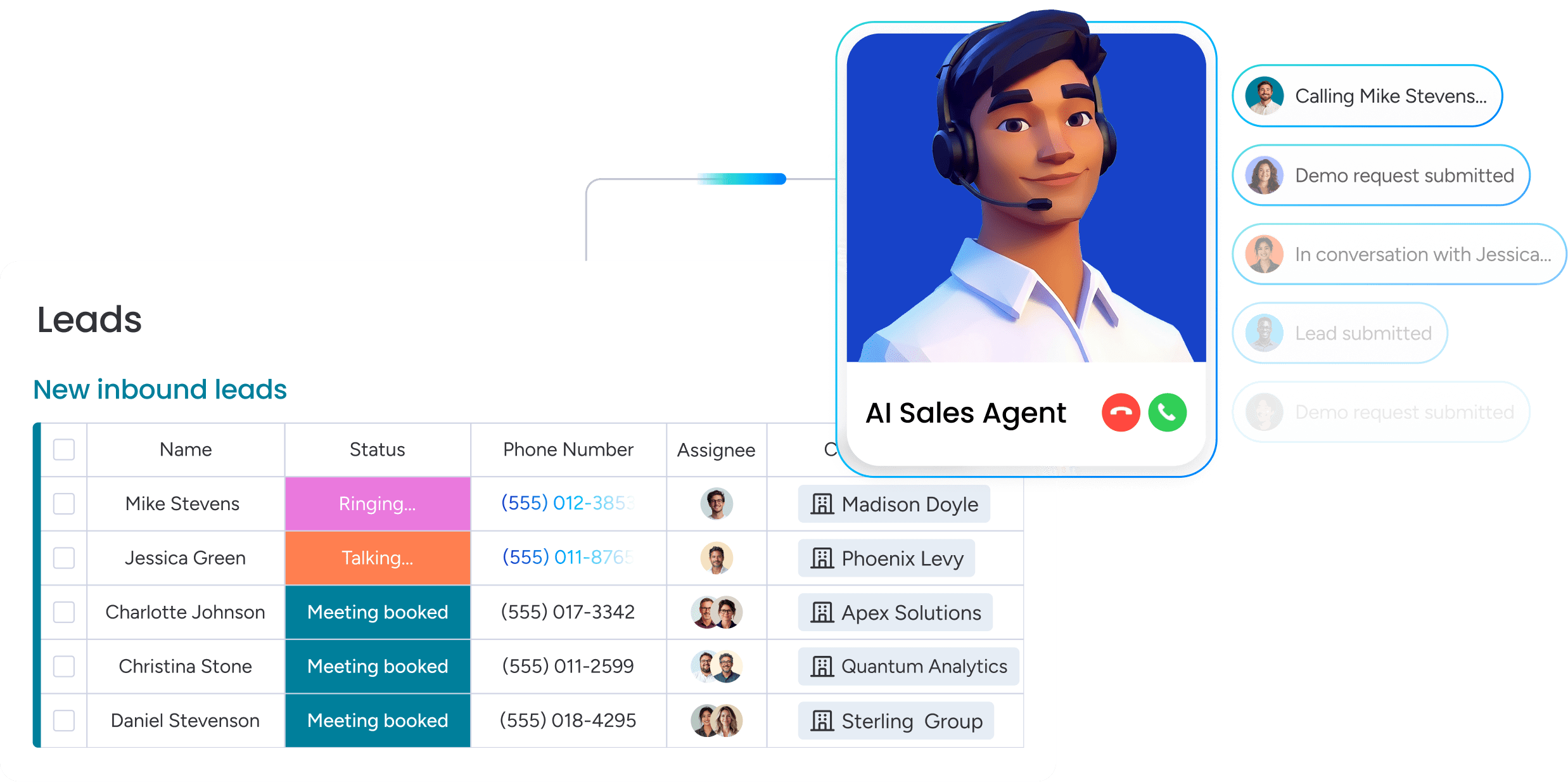
AI-powered outreach without the complexity with monday CRM
For example, agents can sync directly with a platform like monday CRM to update prospect records in real-time as interactions occur. The platform’s AI Blocks enable teams to add intelligent automation to outreach workflows through a no-code interface. This approach eliminates the traditional barriers that prevent sales teams from adopting AI automation.
AI blocks for instant automation
These pre-built AI capabilities handle common automation needs without requiring technical setup:
- Categorize Block: automatically assigns leads to appropriate segments, territories, or priority levels based on company size, industry, technology stack, and engagement patterns.
- Extract Info Block: extracts data from unstructured sources like emails, meeting notes, or company websites to populate CRM fields automatically.
- Summarize Block: transforms email threads, meeting transcripts, or research documents into concise summaries that representatives can quickly review.
- Detect Sentiment Block: identifies positive, negative, or neutral sentiment in prospect messages, enabling appropriate response prioritization.
- Writing Assistant Block: creates tailored outreach messages based on prompts, with customizable tone and length options.
- Assign Person Block: directs prospects to the right representative based on defined criteria and team member skills.
Visual pipeline management with AI insights
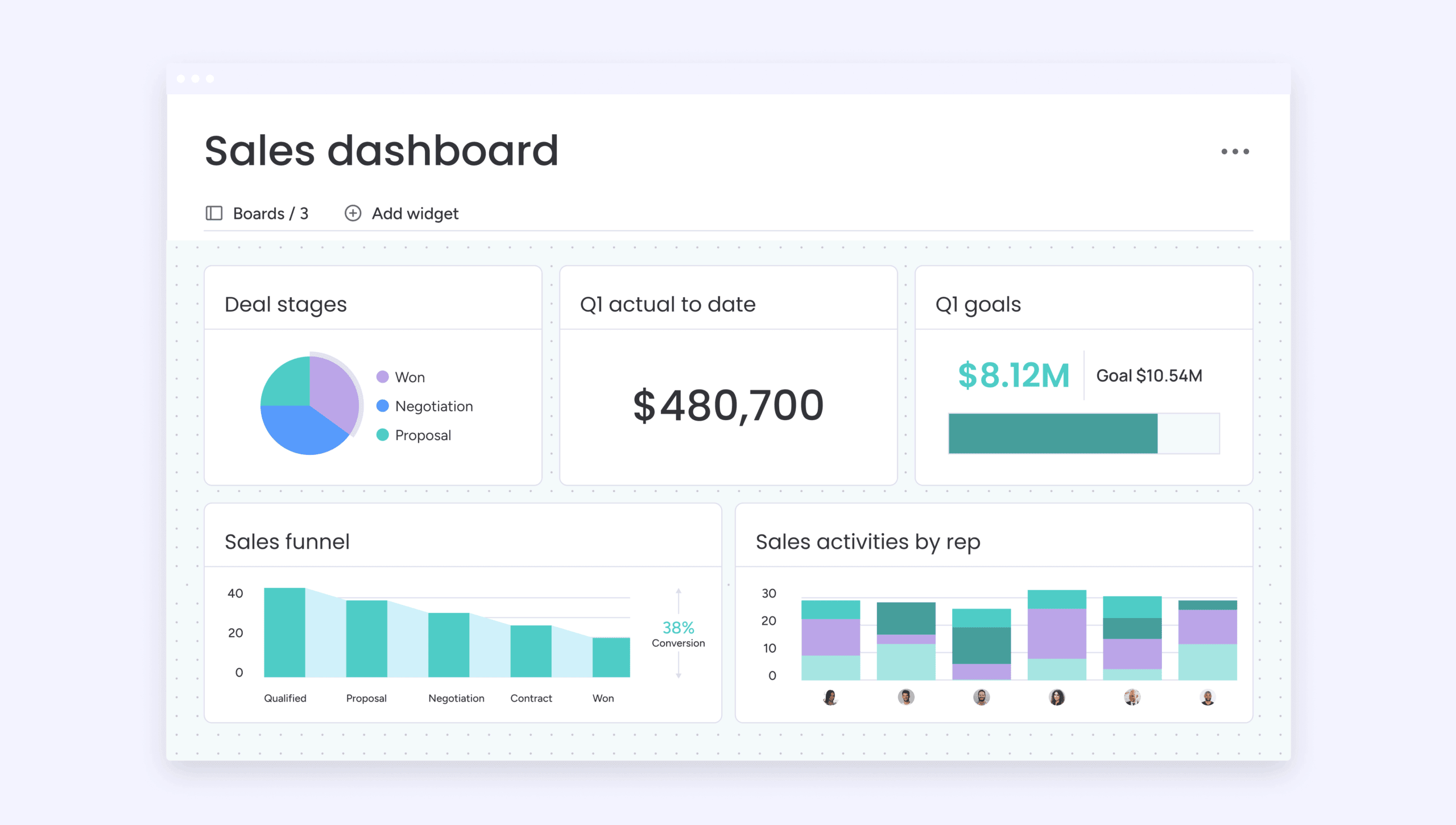
The platform combines traditional pipeline visibility with AI-powered insights. The visual interface displays pipeline stages, deal values, and prospect engagement in customizable dashboards.
AI analysis runs continuously in the background, identifying patterns and generating recommendations:
- Deal risk assessment: the system flags at-risk opportunities before they stall, enabling proactive intervention.
- Next best actions: AI recommends specific follow-up steps that align with how prospects engage.
- Pipeline health scoring: the platform calculates conversion probability across your entire pipeline.
- Forecast accuracy: AI-powered projections help revenue leaders plan with confidence.
No-code setup for revenue teams
Revenue teams configure outreach workflows, automation rules, and integrations through visual interfaces that prioritize usability:
- Workflow configuration: create complex automation sequences without technical expertise.
- Lead scoring rules: define qualification criteria through intuitive interfaces.
- Multi-channel outreach: coordinate email, social, and phone outreach from one place.
- Integration setup: connect platforms through simple selection and instant authentication.

“With monday CRM, we’re finally able to adapt the platform to our needs — not the other way around. It gives us the flexibility to work smarter, cut costs, save time, and scale with confidence.”
Samuel Lobao | Contract Administrator & Special Projects, Strategix
“Now we have a lot less data, but it’s quality data. That change allows us to use AI confidently, without second-guessing the outputs.”
Elizabeth Gerbel | CEO
“Without monday CRM, we’d be chasing updates and fixing errors. Now we’re focused on growing the program — not just keeping up with it."
Quentin Williams | Head of Dropship, Freedom Furniture
“There’s probably about a 70% increase in efficiency in regards to the admin tasks that were removed and automated, which is a huge win for us.“
Kyle Dorman | Department Manager - Operations, Ray White
"monday CRM helps us make sure the right people have immediate visibility into the information they need so we're not wasting time."
Luca Pope | Global Client Solutions Manager at Black Mountain
“In a couple of weeks, all of the team members were using monday CRM fully. The automations and the many integrations, make monday CRM the best CRM in the market right now.”
Nuno Godinho | CIO at Velv
“monday.com provides developmental flexibility, operational efficiency, and data transparency — all in one place. We became a company that moved from chasing data to leading with it.”
Hyunghan Lee | Team Lead, Sandbox Network
"monday.com brought every part of our business into one connected space. The harmony between work management and CRM has become our operating system — giving us the clarity and confidence to scale.”
Jennifer Chinburg | Executive Vice President of Corporate Development & Brand, Chinburg Properties
“We just weren’t getting value from our old CRM. With monday.com, it's a thousand times better. Our sales teams are more informed, more consistent, and far more connected."
James Arnold | Chief Operating Officer, CenversaChange your sales approach with AI automation
AI outreach agents are changing how revenue teams build pipeline. Teams that adopt them early can cover more of the market, respond faster, and use their time more effectively — without adding headcount.
What makes this shift important is that it removes an old trade-off. Teams no longer have to choose between scale and personalization. AI SDR agents can reach large audiences while still tailoring messages to individual prospects, something manual outreach simply can’t do consistently.
That said, results don’t come from switching the technology on and walking away. Strong outcomes depend on having clean data, clear goals, and well-thought-out workflows. When results fall short, it’s usually due to poor setup or unclear ownership, not the tools themselves.
The most effective teams use a hybrid approach. AI handles the high-volume, repeatable work that benefits from speed and consistency. Humans focus on conversations, relationships, and complex deals. When each does what it’s best at, teams move faster and create better experiences for prospects.
Frequently asked questions
How much do outreach sales agents cost?
Outreach sales agents typically cost between $50-500 per user per month depending on features, scale, and pricing structure. The investment often pays for itself through reduced manual work and increased pipeline generation.
Can AI agents replace human sales reps?
The question is, can AI agents replace human sales reps? While AI agents handle prospecting, initial outreach, and lead qualification, they cannot replace human representatives for relationship building, complex negotiations, and situations requiring empathy and creative problem-solving.
What CRM systems work with AI sales agents?
Most outreach agents integrate with popular CRMs through APIs, though integration complexity varies significantly across solutions. Native AI capabilities within CRM platforms eliminate integration challenges entirely.
How long does it take to implement an outreach AI agent?
Implementation typically takes two to eight weeks depending on data preparation requirements, integration complexity, workflow configuration needs, and team training schedules.
What's the typical ROI timeline for AI sales automation?
Most organizations see initial productivity improvements within 30-60 days, with significant ROI typically achieved within 3-6 months as processes optimize and agent-generated opportunities progress through the pipeline.
Do outreach agents work for B2B and B2C sales?
Outreach agents are effective for both B2B and B2C sales, though the approach differs in personalization depth, channel selection, message complexity, and compliance requirements.

 Get started