
Sales reps waste precious hours on data entry and research instead of closing deals. Meanwhile, the hottest leads go cold waiting for follow-up. Website visitors bounce without converting, and the best opportunities get buried under administrative work that adds zero value to the customer relationship.
Lead generation automation flips the script by taking over the tedious busywork that eats up a team’s day. Instead of manually tracking every interaction and hoping nothing falls through the cracks, automation systems capture leads instantly, qualify them based on objective criteria, and initiate appropriate follow-up sequences without human intervention.
This guide walks you through the essential workflows that drive predictable lead generation, from website visitor identification through multi-channel outreach sequences. Discover how to implement automation systems that capture more qualified prospects, nurture them effectively, and deliver sales-ready leads to teams with complete visibility into every interaction and outcome.
Key takeaways
- Automate repetitive tasks to free up selling time: let systems handle data entry, follow-ups, and lead routing so your team focuses on building relationships and closing deals.
- Speed wins — respond to leads in seconds, not hours: automated systems capture and respond to prospects instantly, dramatically improving conversion rates compared to manual follow-up.
- Use lead scoring to prioritize your best opportunities: assign point values based on job titles, company size, and engagement behaviors to focus sales efforts on prospects most likely to buy.
- Integration eliminates data silos across your tech stack: connect your CRM, marketing automation, and communication tools so lead data flows automatically between platforms like monday CRM and your existing systems without manual data entry or missed handoffs.
- Multi-channel outreach gets more responses: coordinate touchpoints across email, LinkedIn, phone calls, and direct mail to reach prospects through their preferred channels.
What is lead generation automation?
Lead generation automation uses software and technology to identify, capture, nurture, and qualify potential customers without manual intervention. Instead of sales reps manually researching prospects, entering data into spreadsheets, and sending individual follow-up emails, automation systems handle these repetitive tasks based on predefined rules and triggers.
Consider it a digital assembly line for your sales pipeline. When a prospect visits your website, downloads content, or engages with your materials, the system immediately captures their information, evaluates their potential, and initiates appropriate follow-up sequences automatically.
This process operates continuously without requiring manual intervention for routine tasks.
Modern lead generation automation integrates multiple platforms and data sources into cohesive workflows. A CRM for lead generation system serves as the central repository, storing lead information and tracking interactions.
Marketing automation platforms manage email sequences and content delivery, while lead tracking software monitors visitor behavior. These components work together to create a seamless system that moves leads through your sales funnel automatically.
How automated lead generation works
Automated lead generation operates through a trigger-action-condition framework that responds to prospect behaviors in real-time:
- Trigger events: the process begins when a trigger event occurs: a website form submission, email click, or social media interaction. The automation system immediately captures this signal and initiates a predetermined sequence of actions.
- Instant qualification: your automation makes snap decisions based on what matters to your business. When someone downloads a pricing guide, it immediately checks if they’re a good fit based on company size and industry. Top prospects go straight to sales, while others receive tailored nurturing, all without anyone lifting a finger.
- Continuous data flow: data flows continuously through the system as leads interact with your content and communications. Each action updates the lead’s profile, adjusting their score and potentially triggering new workflows. A lead who opens three emails and visits your pricing page five times automatically receives higher priority than someone who hasn’t engaged in weeks.
Learn more: Lead generation automation tools
Key differences from manual lead generation
Manual and automated lead generation differ fundamentally in how they handle every aspect of your sales process. These differences impact response times, consistency, scalability, and overall team productivity.
According to a 2025 U.S. Department of Commerce report, businesses that automate lead generation workflows see an average reduction of 40% in customer acquisition costs and a 25% improvement in sales cycle time.
| Aspect | Manual lead generation | Automated lead generation |
|---|---|---|
| Response time | Hours to days depending on rep availability | Seconds — immediate acknowledgment and routing |
| Consistency | Varies by rep skill, mood, and workload | Identical process execution for every lead |
| Scalability | Limited by team size and working hours | Handles unlimited volume 24/7 without additional resources |
| Data accuracy | Prone to human error in data entry and tracking | Systematic capture and validation of all lead information |
| Follow-up reliability | Leads fall through cracks when reps are busy | Automated sequences ensure no lead goes uncontacted |
Manual lead generation requires sales reps to remember follow-up tasks, manually log activities, and rely on personal judgment for lead qualification, creating significant inconsistencies in the lead management process. A rep might forget to follow up with a promising lead after a busy day, or inconsistently apply qualification criteria based on their current pipeline pressure.
Automation eliminates these variability factors while freeing sales teams to focus on activities that genuinely require human judgment: building relationships, handling objections, and closing complex deals. The system handles the repetitive processes of data entry, follow-up scheduling, and initial qualification, ensuring consistent execution regardless of team capacity or time of day.

“With monday CRM, we’re finally able to adapt the platform to our needs — not the other way around. It gives us the flexibility to work smarter, cut costs, save time, and scale with confidence.”
Samuel Lobao | Contract Administrator & Special Projects, Strategix
“Now we have a lot less data, but it’s quality data. That change allows us to use AI confidently, without second-guessing the outputs.”
Elizabeth Gerbel | CEO
“Without monday CRM, we’d be chasing updates and fixing errors. Now we’re focused on growing the program — not just keeping up with it."
Quentin Williams | Head of Dropship, Freedom Furniture
“There’s probably about a 70% increase in efficiency in regards to the admin tasks that were removed and automated, which is a huge win for us.“
Kyle Dorman | Department Manager - Operations, Ray White
"monday CRM helps us make sure the right people have immediate visibility into the information they need so we're not wasting time."
Luca Pope | Global Client Solutions Manager at Black Mountain
“In a couple of weeks, all of the team members were using monday CRM fully. The automations and the many integrations, make monday CRM the best CRM in the market right now.”
Nuno Godinho | CIO at Velv
“monday.com provides developmental flexibility, operational efficiency, and data transparency — all in one place. We became a company that moved from chasing data to leading with it.”
Hyunghan Lee | Team Lead, Sandbox Network
"monday.com brought every part of our business into one connected space. The harmony between work management and CRM has become our operating system — giving us the clarity and confidence to scale.”
Jennifer Chinburg | Executive Vice President of Corporate Development & Brand, Chinburg Properties
“We just weren’t getting value from our old CRM. With monday.com, it's a thousand times better. Our sales teams are more informed, more consistent, and far more connected."
James Arnold | Chief Operating Officer, Cenversa8 lead generation workflows that drive real results
Top sales teams consistently use these eight workflows to create a reliable pipeline of qualified leads. Each one tackles a crucial stage in your lead process, from the moment someone discovers you through to that sales handoff. The workflows work independently but deliver maximum impact when integrated into a cohesive automation strategy.
Implementation doesn’t require starting from scratch. Most businesses already have some manual version of these processes; the automation simply systematizes and accelerates what’s already happening.
1. Website visitor identification and capture
Website visitor identification transforms anonymous traffic into known leads by automatically tracking behavior and capturing contact information at optimal moments. The magic starts the second a visitor hits your site. Tracking pixels follow their journey: noting which pages grab their attention, how much time they invest, and exactly which content gets them to engage.
The system identifies high-intent behaviors that signal purchase readiness: visiting pricing pages multiple times, viewing case studies, or spending extended time on product documentation. When a visitor demonstrates these behaviors, the automation triggers lead capturing mechanisms: strategically timed pop-ups, exit-intent forms, or chatbot interactions that offer value in exchange for contact information.
Once captured, the system immediately enriches the lead data by appending company information, social profiles, and firmographic details from third-party databases. A visitor who downloads a whitepaper receives instant email confirmation while the automation simultaneously creates a CRM record, assigns a preliminary lead score, and adds them to appropriate nurture sequences.
2. Lead scoring and qualification automation
Lead scoring automation assigns numerical values to leads based on demographic attributes and behavioral signals, creating an objective qualification system that prioritizes sales efforts. The scoring model combines explicit data with implicit signals to calculate a composite score representing purchase likelihood.
The most effective teams structure their scoring systems as follows:
- Job title relevance: ten points for director-level, 15 for VP-level.
- Company characteristics: 15 points for companies with 100+ employees.
- Engagement signals: five points for each email opened, 25 for demo requests.
- Content interaction: different point values based on content type and frequency.
The automation continuously recalculates scores as new information arrives. When a lead crosses the sales-ready threshold, the system automatically notifies the assigned sales rep, creates a task for immediate follow-up, and provides a summary of the lead’s engagement history. Leads whose scores decay due to inactivity automatically move into re-engagement workflows.
3. Multi-channel outreach sequences
Multi-channel outreach sales automation coordinates touchpoints across email, social media, phone, and direct mail to maximize response rates while maintaining consistent messaging. A 2025 Bloomberg analysis of SaaS companies revealed that those with multi-channel automated outreach sequences achieved a 60% higher response rate than those relying on single-channel manual outreach.
The workflow orchestrates a carefully timed sequence that reaches prospects through their preferred channels rather than relying solely on email.
A typical seven-touch sequence unfolds over several weeks:
- Day 1: brings an initial email introduction.
- Day 3: includes a LinkedIn connection request with a personalized note.
- Day 5: delivers a follow-up email with a relevant case study.
- Day 8: involves a phone call attempt with voicemail.
- Day 10: shares industry research via email.
- Day 14: sends a LinkedIn message referencing previous touchpoints.
- Day 17: concludes with a final email outlining next steps.
The automation tracks responses across all channels and immediately pauses the sequence when a prospect engages. The system personalizes each touchpoint using merge fields that pull from the lead’s CRM record: company name, industry, pain points identified during capture, and previous content interactions.
Learn more: Automate outreach with AI
4. Email nurture campaign workflows
Nurture campaigns move leads through the buyer’s journey by delivering progressively detailed content that addresses specific objections. Specifically, the automation segments leads by industry and interest to deliver tailored sequences.
A typical five-email path progresses strategically: starting with educational trends, moving to problem-focused pain points, and ultimately concluding with product-specific success stories. Because the workflow uses behavioral branching, high-engagement leads are accelerated to conversion-focused content, while inactive prospects are automatically routed to alternative re-engagement paths.
5. Social media lead generation automation
Social media automation identifies prospects based on their social activity, initiates engagement through automated interactions, and captures leads through platform-native features. On LinkedIn, the workflow automatically sends connection requests to prospects matching specific criteria, then follows up with personalized messages once connections are accepted.
The system monitors social signals that indicate buying intent: prospects who engage with industry content, join relevant groups, or comment on competitor posts. When these signals are detected, the automation adds prospects to targeted outreach sequences or flags them for personalized sales attention.
Facebook and LinkedIn lead ads integrate directly with CRM systems like monday CRM, automatically creating lead records when prospects submit forms within the social platforms. The automation immediately sends confirmation emails, adds leads to nurture sequences, and notifies sales reps of high-value submissions.
6. Chatbot and conversational marketing
AI-powered chatbots qualify leads through automated conversations that feel natural while systematically gathering information and assessing fit. A 2025 academic study from the University of Pennsylvania’s Wharton Schoolfound that companies using AI-powered chatbots for lead qualification saw a 45% increase in qualified leads and a 20% reduction in time-to-first-contact.
The chatbot automation process operates as follows:
- Initial engagement: the chatbot greets website visitors and asks qualifying questions about their needs and timeline.
- Progressive qualification: based on responses, the bot asks follow-up questions about company size, current platforms, and decision-making timeline.
- Smart routing: if the prospect indicates immediate need and meets qualification criteria, the bot offers to schedule a demo directly within the conversation, syncing with sales reps’ calendars.
- Data capture: the system captures all conversation data in the CRM, creating detailed lead records that include stated pain points, budget constraints, and decision-making timeline.
- Nurture path assignment: for leads not ready for sales engagement, the chatbot collects email addresses and adds them to appropriate nurture sequences.
7. Lead routing and assignment workflows
Lead routing automation distributes qualified leads to sales reps based on sophisticated rules that optimize for conversion probability and team capacity. The system evaluates multiple factors including lead score, geographic location, industry expertise, product interest, and rep availability to determine the optimal assignment in real-time.
Different routing strategies serve different needs:
- Territory-based routing: assigns leads to reps covering specific geographic regions.
- Industry-based routing: matches leads with reps who specialize in their sector.
- Round-robin distribution: balances lead volume across team members.
- Performance-based routing: prioritizes top-performing reps for high-value leads.
The automation includes escalation protocols that reassign leads if the initial rep doesn’t respond within defined timeframes. If the assigned rep is on vacation or at capacity, the system automatically routes to backup team members. Automation capabilities provided by solutions like monday CRM enable these complex routing rules without requiring technical expertise.
8. Re-engagement and win-back campaigns
Re-engagement automation identifies dormant leads and initiates targeted campaigns to revive interest before prospects go completely cold. The workflow monitors lead activity and automatically triggers re-engagement sequences when specific conditions are met: no email opens in 30 days, no website visits in 45 days, or no response to previous outreach attempts.
Re-engagement messaging takes a different approach than initial nurture campaigns, acknowledging the previous relationship while offering fresh value. A typical sequence might start by asking if the prospect’s situation has changed, followed by new case studies, updated product information, or exclusive offers designed to recapture attention.
The system prioritizes re-engagement efforts based on the lead’s original score and engagement history. High-scoring leads who went dormant receive more aggressive re-engagement through multiple channels and personalized outreach from sales reps. Lower-scoring leads enter automated email sequences.
Benefits of automating your lead generation process
Lead generation automation delivers measurable improvements across every stage of the lead generation sales funnel, from initial capture through closed deals. As a result, you’ll see more than just time savings; you’ll transform how your sales and marketing teams actually work together.
Take a quick inventory: how many hours does your team waste typing data, setting reminders, and updating lead statuses? Many teams are surprised to see how many hot prospects fall through the cracks when reps get buried in admin work. Automation addresses these pain points systematically through several key advantages that compound over time.
Increased lead volume and quality
Automation captures significantly more leads by operating continuously without breaks, vacations, or capacity constraints. For instance, a website chatbot engages visitors at two AM just as effectively as two PM, capturing leads that would otherwise bounce. Furthermore, form lead with automated follow-ups convert at higher rates because prospects receive immediate confirmation and next steps.
Quality improvements also come from the systematic application of qualification criteria that do not vary based on rep judgment or pipeline pressure. Every lead receives the same evaluation against objective scoring rules, thereby ensuring consistent standards.
Additionally, automated data enrichment appends firmographic information to identify high-value prospects, while behavioral tracking reveals genuine interest levels.
The combination of increased volume and improved quality compounds over time. Specifically, more leads entering the funnel provides more opportunities for the scoring system to identify high-potential prospects. Ultimately, higher qualification standards mean sales reps spend time on leads with genuine purchase intent rather than chasing unqualified contacts.
Time and cost efficiency
Because sales teams use automation, they spend significantly more time selling and less time on administrative tasks. The time savings come from automating repetitive activities; this allows for automatic data entry after calls and real-time updates instead of manual tracking.
Cost efficiency manifests in multiple ways:
- Reduced administrative overhead: less need for support staff to manage data and coordinate follow-ups.
- Lower customer acquisition costs: same team handles larger lead volumes.
- Faster ramp time: new reps rely on automated processes rather than learning complex manual procedures.
- Higher win rates: reps focus their limited time on high-value activities.
The efficiency gains enable smaller teams to achieve results previously requiring much larger organizations. A five-person sales team with comprehensive automation can manage lead volumes and conversion rates that would require eight to ten people in a manual environment.
Improved sales and marketing alignment
Automation creates shared visibility into lead status and progression, eliminating the finger-pointing that typically occurs when marketing-generated leads don’t convert. Both teams see the same data in real-time: which campaigns generate the highest-quality leads, how quickly sales follows up, and where leads stall in the funnel.
Automated lead scoring provides an objective definition of “sales-ready” that both teams agree on upfront. Marketing knows exactly what criteria leads must meet before handoff, while sales receives leads that consistently meet quality thresholds. This eliminates debates about lead quality and creates accountability on both sides.
The shared automation platform enables closed-loop reporting that tracks leads from initial marketing touch through closed deals. Marketing can see which campaigns and content types generate revenue, not just leads, allowing budget optimization based on actual business impact.
Faster lead response times
When automation handles your responses, leads get attention in seconds, not hours or days. This speed is a game-changer, as leads contacted within five minutes have been shown to convert at three times the rate of those who wait half an hour for a response. Automation ensures every lead receives immediate acknowledgment regardless of when they express interest.
Response consistency matters as much as speed. Automated systems deliver the same quality response to the 100th lead of the day as the first, while human reps inevitably experience fatigue and distraction. The automation never forgets to send a follow-up, never loses track of a lead in a busy inbox, and never delays response because of meetings or other priorities.
Fast response times also improve brand perception. Prospects judge companies based on their first interaction: immediate, helpful responses signal professionalism and customer focus, while delayed or inconsistent responses suggest disorganization.
Modern platforms like monday CRM enable this responsiveness through features like automated email follow-ups and customizable automation rules that trigger instant actions based on lead behavior.
Essential components of lead generation automation systems
A complete sales lead generation automation system requires four foundational components that work together to capture, qualify, nurture, and convert leads. Each component serves a specific function, but the real power comes from their integration into a unified system where data flows seamlessly between platforms.
CRM integration and data management
Your CRM serves as the central hub for your entire lead generation operation, functioning as a centralized repository where every contact detail, conversation, qualification status, and sales activity is stored and managed in a single, unified system.
CRM integration delivers the following capabilities:
- Automatic data capture: forms, chatbots, and social media platforms connect directly to your CRM, creating or updating lead records without manual entry.
- Built-in data quality: automated validation, deduplication, and enrichment maintain clean, accurate information.
- Seamless platform connectivity: bi-directional data flow between your CRM and marketing automation tools keeps everything in sync.
When a new lead enters your system, the CRM immediately checks for duplicates by matching email addresses or company domains. Validation rules ensure required fields are complete and formatted consistently. Email engagement from your marketing platform automatically updates lead scores, while sales activities logged in the CRM trigger the next steps in your automation sequences.
Lead capture automation platforms
Lead capture platforms collect prospect information across multiple channels including website forms, landing pages, chatbots, social media platforms, and live events. Modern capture platforms go beyond simple form submission, using progressive profiling to gather information gradually across multiple interactions.
Smart forms adapt based on what information the system already has about a returning visitor. If someone previously downloaded a whitepaper and provided their company name and role, the next form they encounter asks different questions: budget, timeline, or specific pain points. This approach improves conversion rates while building comprehensive lead profiles over time.
Capture platforms include built-in validation and enrichment capabilities that improve data quality at the point of collection. Email verification confirms addresses are valid and deliverable. Company domain lookup automatically populates firmographic data, reducing form fields while gathering essential qualification information.
Workflow automation engine
The automation engine executes workflows based on triggers, conditions, and actions that define how the system responds to lead behaviors. Visual workflow builders allow non-technical users to create sophisticated automation using drag-and-drop interfaces. Pre-built templates provide starting points for common workflows that can be customized to specific business needs.
Trigger management capabilities monitor multiple data sources for events that initiate workflows: form submissions, email clicks, website visits, CRM field updates, or time-based conditions. When triggers fire, the engine evaluates conditional logic to determine appropriate actions.
The engine orchestrates complex, multi-step sequences that span days or weeks, managing timing, branching logic, and cross-channel coordination. Testing capabilities allow workflow validation before deployment, showing exactly how leads will progress through each step and identifying logic errors or missing conditions.
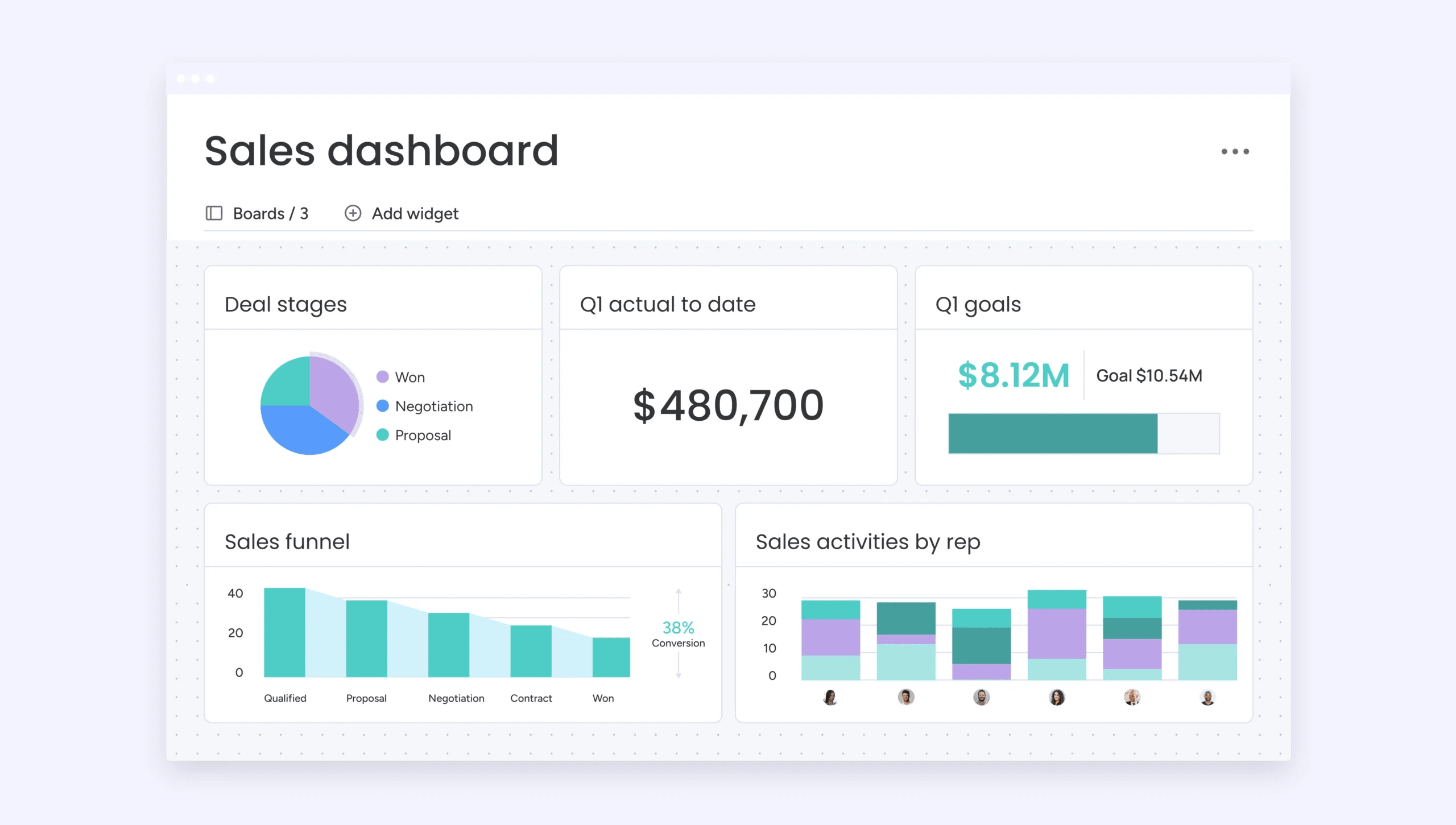
Analytics and reporting dashboard
Analytics dashboards provide real-time visibility into automation performance across all workflows and channels. Customizable reports track key metrics that matter to your business:
- Lead volume metrics: sources, conversion rates, qualification percentages.
- Performance indicators: response times, follow-up rates, engagement scores.
- Revenue attribution: which campaigns and channels drive closed deals.
- Team productivity: activities per rep, conversion rates by owner.
Funnel analysis shows where leads progress smoothly and where they stall, enabling targeted improvements to problematic stages. Cohort analysis compares performance across different lead segments, revealing which industries, company sizes, or lead sources generate the highest conversion rates and lifetime value.
Attribution reporting connects marketing activities to revenue outcomes, showing which campaigns, content pieces, and channels contribute to closed deals. Multi-touch attribution models credit all touchpoints in the buyer’s journey rather than only the first or last interaction.
Frequently asked questions
How long does it take to see results from lead generation automation?
When it comes to seeing results from lead generation automation, most businesses see initial improvements within 30–45 days of implementation. Early improvements typically include faster lead response times, reduced manual data entry, and more consistent follow-up processes. Measurable increases in conversion rates usually appear within 60-90 days as optimized workflows and improved lead scoring take effect.
Can small businesses benefit from automated lead generation?
Small businesses often benefit more dramatically from lead generation automation than larger enterprises because they have fewer resources to dedicate to manual processes. Automation enables small teams to compete effectively against larger competitors by ensuring consistent, professional lead management regardless of team size.
What's the difference between marketing automation and lead generation automation?
Marketing automation encompasses all automated marketing activities including email campaigns, social media posting, content management, and analytics. Lead generation automation specifically focuses on identifying, capturing, qualifying, and nurturing potential customers; it's a subset of marketing automation that concentrates on top-of-funnel activities.
How do you maintain personalization with automated lead generation?
Effective automation enhances personalization by using data to deliver more relevant communications at scale. Modern systems personalize content using merge fields, behavioral triggers, and segmentation to ensure leads receive messages relevant to their specific characteristics and needs.
What skills does my team need for lead generation automation?
Successful lead generation automation requires strategic thinking, process design, and basic technical skills. Teams need members who understand the buyer's journey and can design workflows that guide prospects effectively. Modern no-code platforms minimize technical requirements, enabling business users to create and manage automation without programming knowledge.
How much does lead generation automation cost?
Lead generation automation costs vary widely based on platform choice, lead volume, and required features. Basic automation platforms start around $50–$100 per user monthly, while comprehensive enterprise solutions can exceed $1,000 per user monthly. Calculate total cost of ownership including implementation time, training requirements, and ongoing management effort when comparing options.